Direct and Indirect inguinal
Hernia
Dr. Ahmad Uzair Qureshi
FCPS ( SURGERY) / MCPS ( SURGERY)
MRCS ( ENGLAND) / Dip Med Edu (Cardiff)
Colorectal Fellow Yonsei University, South Korea
Assistant Professor of Surgery, King Edward Medical University, Lahore
Objectives
• The students will be able to
• Define hernia
• Different sites and types of hernia
• Enlist clinical features of groin hernia
• Enumerate differences in direct and indirect hernia
• Describe contents of hernia sac and their origin
• Enlist complications which may arise from hernia
• Describe the steps of open Hernia repair
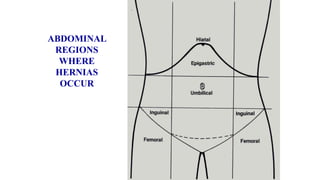
ABDOMINAL
REGIONS
WHERE
HERNIAS
OCCUR
What is a Hernia?
It is an abnormal protrusion of a
viscus or part of a viscus through
a potential weak space of its
containing cavity.
CLINICAL FEATURES
Lump at an appropriate anatomical site
Increases in size on coughing or straining.
It reduces in size or disappears when relaxed or supine
position.
Examination may show it to have a cough impulse and
to be reducible
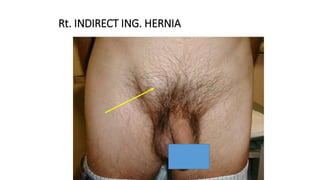
Rt. INDIRECT ING. HERNIA
FACTORS PREVENTING HERNIATION
1- Oblique coarse of the inguinal canal .
2- Contraction of conjoint tendon during
coughing or straining (shutter mechanism) .
3- Contraction of cremasteric muscle :
Plugging of inguinal canal
Groin hernia
• Inguinal
• Femoral
• Obturator
•Two (2) types
•Acquired
•Congenital
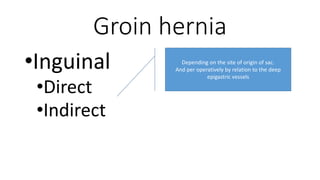
Groin hernia
•Inguinal
•Direct
•Indirect
Depending on the site of origin of sac.
And per operatively by relation to the deep
epigastric vessels
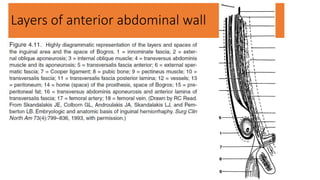
Layers of anterior abdominal wall
What is an Direct/ Indirect
Hernia?
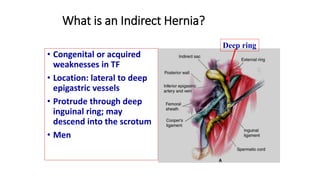
What is an Indirect Hernia?
• Congenital or acquired
weaknesses in TF
• Location: lateral to deep
epigastric vessels
• Protrude through deep
inguinal ring; may
descend into the scrotum
• Men
Deep ring
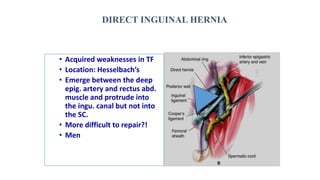
DIRECT INGUINAL HERNIA
• Acquired weaknesses in TF
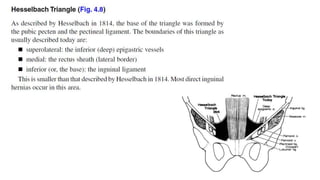
• Location: Hesselbach’s
• Emerge between the deep
epig. artery and rectus abd.
muscle and protrude into
the ingu. canal but not into
the SC.
• More difficult to repair?!
• Men
HERNIAS…COMPLICATIONS
•Reducible
•Irreducible
•Obstructed or incarcerated
•Strangulated
COMPLICATIONS
Obstruction
• Irreducible
• abdominal pain,
• distension and vomiting may occur
• The hernia will be tense tender and irreducible
Strangulation
• become red and tender,
• Irreducible
• No impulse on cough.
• If contains bowel signs of obstruction.
INGUINAL HERNIA REPAIR
RATIONALE
TENTION FREE REPAIR
MESH REPAIR
HERNIA…PRINCIPLES OF REPAIR
Irrespective of approach used the following will
be achieved
• Dissection of the sac
• Reduction / inspection of the contents
• Ligation of the sac
• Approximation of the inguinal and pectineal ligaments
INGUINAL HERNIA.TYPES OF REPAIR
• Bassini repair : Suturing conjoined tendon to inguinal ligament
behind the cord .
• Lytle repair: Plication of the fascia transversals .
• Shouldice repair : incision of the fascia & double breasting of it .
• Halsted ‘s repair Bassini repair plus reinforced by suturing the 2
leaflets of external oblique together behind the cord
INGUINAL HERNIA.TYPES OF REPAIR
•Shouldice or Liechtenstein
•Laparoscopic hernia repair:
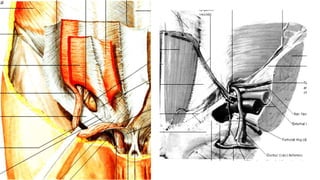
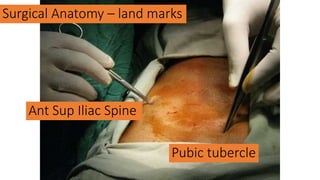
Surgical Anatomy – land marks
Ant Sup Iliac Spine
Pubic tubercle
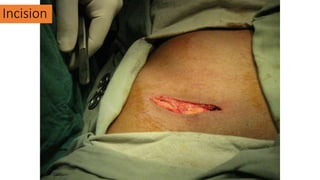
Incision
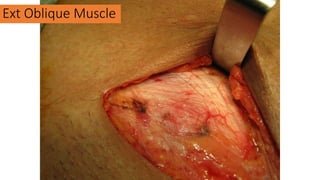
Ext Oblique Muscle
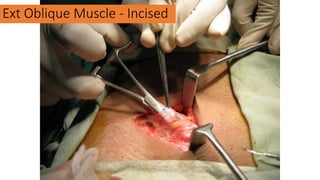
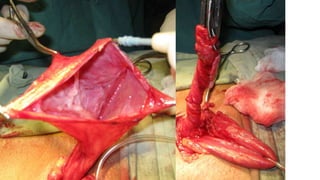
Ext Oblique Muscle - Incised
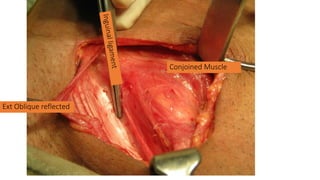
Ext Oblique reflected
Conjoined Muscle
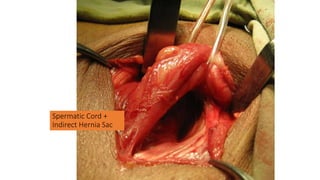
Spermatic Cord +
Indirect Hernia Sac
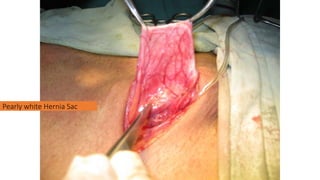
Pearly white Hernia Sac
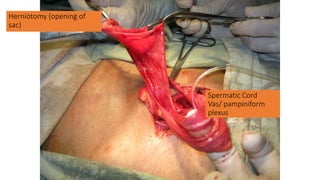
Herniotomy (opening of
sac)
Spermatic Cord
Vas/ pampiniform
plexus
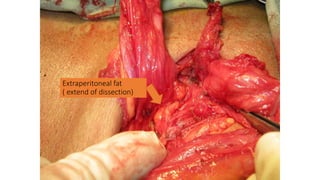
Extraperitoneal fat
( extend of dissection)
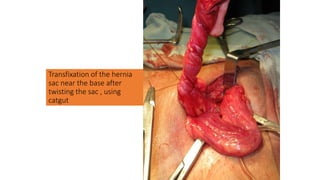
Transfixation of the hernia
sac near the base after
twisting the sac , using
catgut
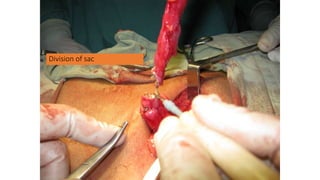
Division of sac
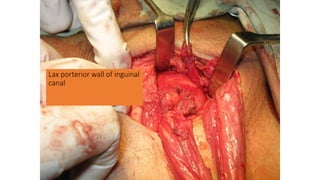
Lax porterior wall of inguinal
canal
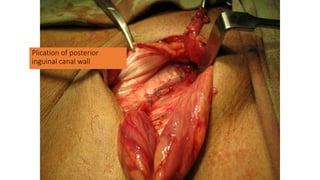
Plication of posterior
inguinal canal wall
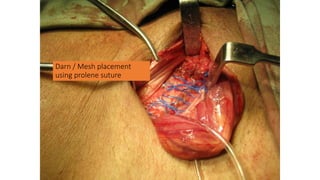
Darn / Mesh placement
using prolene suture
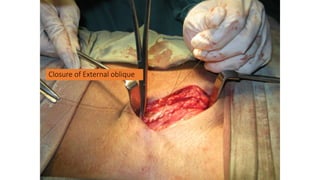
Closure of External oblique
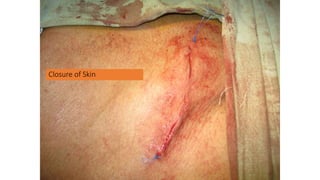
Closure of Skin
In case you have a question or a
query
ahmeduzairq@gmail.com
+923144001410

Direct and indirect inguinal hernia final for website