<Infrastructure resilience, 2013 Slide 1
Infrastructure resilience
Ian Sommerville
<Infrastructure resilience, 2013 Slide 2
Resilience
• Resilience is the ability of assets, networks
and systems to anticipate, absorb, adapt to,
and recover from a disruptive event or series
of events.
• Resilience is about maintaining the continuity
of a service in the presence of disruptive
events
<Infrastructure resilience, 2013 Slide 3
<Infrastructure resilience, 2013 Slide 4
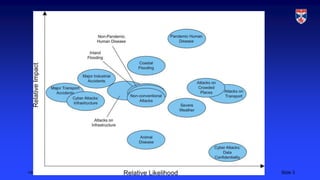
Pandemic disease
• Pandemic disease is the highest impact
risk because it potentially affects the
whole of a national infrastructure as
people become ill
<Infrastructure resilience, 2013 Slide 5
Cyber attacks
• Cyber attacks that compromise
confidentiality are not likely to have a
major impact on the availability of a
national infrastructure
• But cyber attacks that affect the control
systems are more serious
<Infrastructure resilience, 2013 Slide 6
Risk impact
• Risk impact is related to the extent of
the damage to infrastructure assets
<Infrastructure resilience, 2013 Slide 7
Impact depends on locality
• Local incidents, such as a terrorist
attack on physical infrastructure, have
limited impact because they only affect
a small part of that infrastructure
<Infrastructure resilience, 2013 Slide 8
Organisational infrastructure
• Organisations may be more vulnerable
than physical infrastructure
• Incidents that affect the organisational
infrastructure can have more significant
impact
– Organisations are less likely to be distributed
<Infrastructure resilience, 2013 Slide 9
Risk impact
• Because physical infrastructure is
distributed, failures in one part of a
physical network are localised
– A crack is discovered in one bridge but this does
not affect other bridges in the network
<Infrastructure resilience, 2013 Slide 10
Software vulnerability
• However, software control changes this
– If common elements of an infrastructure are
networked and controlled by the same software, a
failure in one element (especially a malicious
attack) can propagate throughout the network
– Large-scale failures and unavailability therefore
become possible
<Infrastructure resilience, 2013 Slide 11
Infrastructure dependencies
• All infrastructure
elements now
depend on power and
communications
• Failure and
unavailable of these
infrastructures has
the most impact
Photo: creative commons/flickr/anemoneprojectors
<Infrastructure resilience, 2013 Slide 12
Infrastructure vulnerabilities
• Limited
physical
protectio
n
<Infrastructure resilience, 2013 Slide 13
Infrastructure vulnerabilities
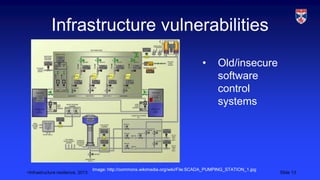
• Old/insecure
software
control
systems
Image: http://commons.wikimedia.org/wiki/File:SCADA_PUMPING_STATION_1.jpg
<Infrastructure resilience, 2013 Slide 14
Infrastructure vulnerabilities
• Lack of monitoring systems
• Lack of coordination across
infrastructure elements
<Infrastructure resilience, 2013 Slide 15
Infrastructure vulnerabilities
• Lack of knowledge of infrastructure
state or dependencies
• Lack of knowledge of infrastructure
demand
<Infrastructure resilience, 2013 Slide 16
Achieving resilience
<Infrastructure resilience, 2013 Slide 17
Resistance
Provide protection
against
anticipated events
or attacks
– Flood defences
– Cybersecurity
awareness© Adrian Pingstone 2005
<Infrastructure resilience, 2013 Slide 18
Resistance
• Based on previous experience and
assumptions
• Changing world or external
circumstances may mean that
assumptions are invalid
<Infrastructure resilience, 2013 Slide 19
Reliability
• Infrastructure components should be
designed to operate under a range of
(anticipated) conditions not just
‘normal’ operating conditions
<Infrastructure resilience, 2013 Slide 20
Reliability
• Components, as far as possible, should
be designed for ‘soft’, incremental rather
than catastrophic failure
<Infrastructure resilience, 2013 Slide 21
Digital and analog systems
• Digital systems are more brittle than
analog systems
• Analog systems often fail gradually;
computer-based systems often simply
crash
<Infrastructure resilience, 2013 Slide 22
Redundancy
• The network or system as a whole
should be designed so that there
are backup installations and spare
capacity available.
<Infrastructure resilience, 2013 Slide 23
Redundancy
• Examples
– Computing support should be provided by different
providers in different locations
– Diverse generation capacity for electricity
– Multiple locations for command and control
<Infrastructure resilience, 2013 Slide 24
Response and recovery
• Respond to distruptive events quickly,
limiting the damage as far as possible
and ensuring public safety
<Infrastructure resilience, 2013 Slide 25
Response and recovery
• Plan how to restore services as quickly
as possible in the event of a loss of
capability
• Business continuity planning
• Disaster recovery
<Infrastructure resilience, 2013 Slide 26
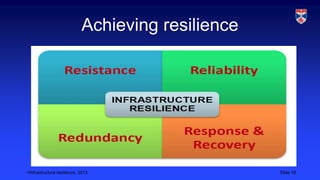
Achieving resilience
• Advance planning to draw up contingency plans to
cover anticipated problems
• (a) good design of the network and systems to
ensure it has the necessary resistance, reliability and
redundancy (spare capacity), and
• (b) by establishing good organisational resilience to
provide the ability, capacity and capability to respond
and recover from disruptive events.
<Infrastructure resilience, 2013 Slide 27
Key points
• Critical infrastructure resilience is the ability of
the infrastructure to continue to deliver
essential services during and after a
hazardous event
• Infrastructure resilience depends on planning
for contingencies and effective infrastructure
design
<Infrastructure resilience, 2013 Slide 28
Key points
• Software control of infrastructure systems
potentially increases vulnerability because the
effects of an event may not be localised
• Resilient infrastructure design is based on 4
R’s – resistance, reliability, redundancy, and
recovery

Infrastructure resilience

  • 1.
    <Infrastructure resilience, 2013Slide 1 Infrastructure resilience Ian Sommerville
  • 2.
    <Infrastructure resilience, 2013Slide 2 Resilience • Resilience is the ability of assets, networks and systems to anticipate, absorb, adapt to, and recover from a disruptive event or series of events. • Resilience is about maintaining the continuity of a service in the presence of disruptive events
  • 3.
  • 4.
    <Infrastructure resilience, 2013Slide 4 Pandemic disease • Pandemic disease is the highest impact risk because it potentially affects the whole of a national infrastructure as people become ill
  • 5.
    <Infrastructure resilience, 2013Slide 5 Cyber attacks • Cyber attacks that compromise confidentiality are not likely to have a major impact on the availability of a national infrastructure • But cyber attacks that affect the control systems are more serious
  • 6.
    <Infrastructure resilience, 2013Slide 6 Risk impact • Risk impact is related to the extent of the damage to infrastructure assets
  • 7.
    <Infrastructure resilience, 2013Slide 7 Impact depends on locality • Local incidents, such as a terrorist attack on physical infrastructure, have limited impact because they only affect a small part of that infrastructure
  • 8.
    <Infrastructure resilience, 2013Slide 8 Organisational infrastructure • Organisations may be more vulnerable than physical infrastructure • Incidents that affect the organisational infrastructure can have more significant impact – Organisations are less likely to be distributed
  • 9.
    <Infrastructure resilience, 2013Slide 9 Risk impact • Because physical infrastructure is distributed, failures in one part of a physical network are localised – A crack is discovered in one bridge but this does not affect other bridges in the network
  • 10.
    <Infrastructure resilience, 2013Slide 10 Software vulnerability • However, software control changes this – If common elements of an infrastructure are networked and controlled by the same software, a failure in one element (especially a malicious attack) can propagate throughout the network – Large-scale failures and unavailability therefore become possible
  • 11.
    <Infrastructure resilience, 2013Slide 11 Infrastructure dependencies • All infrastructure elements now depend on power and communications • Failure and unavailable of these infrastructures has the most impact Photo: creative commons/flickr/anemoneprojectors
  • 12.
    <Infrastructure resilience, 2013Slide 12 Infrastructure vulnerabilities • Limited physical protectio n
  • 13.
    <Infrastructure resilience, 2013Slide 13 Infrastructure vulnerabilities • Old/insecure software control systems Image: http://commons.wikimedia.org/wiki/File:SCADA_PUMPING_STATION_1.jpg
  • 14.
    <Infrastructure resilience, 2013Slide 14 Infrastructure vulnerabilities • Lack of monitoring systems • Lack of coordination across infrastructure elements
  • 15.
    <Infrastructure resilience, 2013Slide 15 Infrastructure vulnerabilities • Lack of knowledge of infrastructure state or dependencies • Lack of knowledge of infrastructure demand
  • 16.
    <Infrastructure resilience, 2013Slide 16 Achieving resilience
  • 17.
    <Infrastructure resilience, 2013Slide 17 Resistance Provide protection against anticipated events or attacks – Flood defences – Cybersecurity awareness© Adrian Pingstone 2005
  • 18.
    <Infrastructure resilience, 2013Slide 18 Resistance • Based on previous experience and assumptions • Changing world or external circumstances may mean that assumptions are invalid
  • 19.
    <Infrastructure resilience, 2013Slide 19 Reliability • Infrastructure components should be designed to operate under a range of (anticipated) conditions not just ‘normal’ operating conditions
  • 20.
    <Infrastructure resilience, 2013Slide 20 Reliability • Components, as far as possible, should be designed for ‘soft’, incremental rather than catastrophic failure
  • 21.
    <Infrastructure resilience, 2013Slide 21 Digital and analog systems • Digital systems are more brittle than analog systems • Analog systems often fail gradually; computer-based systems often simply crash
  • 22.
    <Infrastructure resilience, 2013Slide 22 Redundancy • The network or system as a whole should be designed so that there are backup installations and spare capacity available.
  • 23.
    <Infrastructure resilience, 2013Slide 23 Redundancy • Examples – Computing support should be provided by different providers in different locations – Diverse generation capacity for electricity – Multiple locations for command and control
  • 24.
    <Infrastructure resilience, 2013Slide 24 Response and recovery • Respond to distruptive events quickly, limiting the damage as far as possible and ensuring public safety
  • 25.
    <Infrastructure resilience, 2013Slide 25 Response and recovery • Plan how to restore services as quickly as possible in the event of a loss of capability • Business continuity planning • Disaster recovery
  • 26.
    <Infrastructure resilience, 2013Slide 26 Achieving resilience • Advance planning to draw up contingency plans to cover anticipated problems • (a) good design of the network and systems to ensure it has the necessary resistance, reliability and redundancy (spare capacity), and • (b) by establishing good organisational resilience to provide the ability, capacity and capability to respond and recover from disruptive events.
  • 27.
    <Infrastructure resilience, 2013Slide 27 Key points • Critical infrastructure resilience is the ability of the infrastructure to continue to deliver essential services during and after a hazardous event • Infrastructure resilience depends on planning for contingencies and effective infrastructure design
  • 28.
    <Infrastructure resilience, 2013Slide 28 Key points • Software control of infrastructure systems potentially increases vulnerability because the effects of an event may not be localised • Resilient infrastructure design is based on 4 R’s – resistance, reliability, redundancy, and recovery

Editor's Notes

  • #17 Maybe I need a slide on each of these.