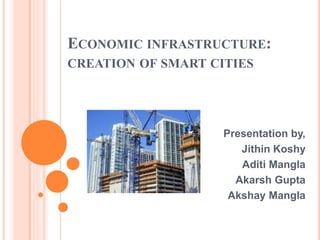
ECONOMIC INFRASTRUCTURE:
CREATION OF SMART CITIES
Presentation by,
Jithin Koshy
Aditi Mangla
Akarsh Gupta
Akshay Mangla
Expanding investment in infrastructure can play
an important counter cyclical role. Projects and
programmes [are] to be reviewed in the area of
infrastructure development, including pure public
private partnerships, to ensure that their
implementation is expedited and does not suffer
from [the] fund crunch.”
Dr. Manmohan Singh FORMAL
PRIME MINISTER OF INDIA
DEFINITION
Internal facility of a country that make
business activity possible,
Such as:
Communication
Transportation
Distribution networks
Financial institutes and market
Energy supply system
Communication: Internet, Mass media,
Mobile.
Transportation: Shipping, Railway,
Airports and Roads.
Distribution Networks.
Financial institutions and Markets: FDI,
FII and Banking
Energy Supply Systems:
Petroleum, Biogas, Water gas,
Thermal, Hydro, Nuclear,
Solar, Tidal, Wind.
WHAT DOES INFRASTRUCTURE
INCLUDE:
• FACTORS FOR BETTER
INFRASTRUCTURE :
 General Education (including related
forms of classical culture).
Science and Technology
(Households, Agriculture, and
Industry)
 Health-Care delivery systems
TYPES OF
INFRASTRUCTURE
ECONOMIC INFRASTRUCTURE
SOCIAL INFRASTRUCTURE
ECONOMIC
INFRASTRUCTURE
Economic infrastructure means those
basic facilities and services which
directly benefits the process of
production and distribution of an
economy. Irrigation, power, transport
and communication are the examples
of economic infrastructures
SOCIAL INFRASTRUCTURE
Social infrastructure means those basic
activities and services which, in addition
to achieving certain social objectives,
indirectly help various economic
activities.
Education, heath service, sanitation
and water supply etc are the example
of social infrastructure.
WHY IS INFRASTRUCTURE IMPORTANT
FOR ECONOMIC GROWTH?
Infrastructure means connectivity like
road, rail, ports and
telecommunications. These are basic
to economic development and growth.
With connectivity the economy will
open to outside world, trade and
commerce will flourish.
With connectivity industries will be
established as labour and capital will
flow from surplus regions to connected
and developing areas.
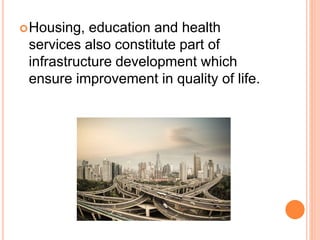
Housing, education and health
services also constitute part of
infrastructure development which
ensure improvement in quality of life.
INVESTMENTS BY FDI’S ON INDIAN
INFRASTRUCTURE
 The Asian Development Bank (ADB) has approved
US$ 631 million loan to develop the first coastal
corridor, namely the Vishakhapatnam-Chennai
industrial corridor, which is expected to bring
manufacturing and export industries to the east
coast.
 The Government of India has unveiled plans to
invest US$ 137 billion in its rail network over the
next five years, heralding Prime Minister Narendra
Modi's aggressive approach to building
infrastructure needed to unlock faster economic
growth.
 The Construction Industry Development Board
(CIDB) of Malaysia has proposed to invest in urban
development and housing projects in India, such as
a mini-smart city adjacent to New Delhi Railway
Station, a green city project at Garhmukhteshwar in
Uttar Pradesh and the Ganga cleaning projects.
GOVERNMENT INITIATIVES
TOWARDS GROWTH OF ECONOMIC
INFRASTRUCTURE
 The Government of India is planning to
boost regional connectivity by setting up 50
new airports over the next three years, out
of which at least 10 would be operational in
next year.
 The government plans to invest over Rs
7,000 crore in FY2016-17 to develop its
network in the north-eastern region for
better connectivity
 The Securities and Exchange Board of India (SEBI)
has announced norms for public issue of units of
infrastructure investment trusts (InvITs) in order to
facilitate infrastructure developers raise capital from
public investors.
 The Government of India plans to award 100
highway projects under the public-private partnership
(PPP) mode in 2016, with expectations that recent
amendments in regulations would revive investor
sentiments in PPP projects in the infrastructure
sector.
 The Reserve Bank of India (RBI) has notified 100 per
cent foreign direct investment (FDI) under automatic
route in the construction development sector. The
new limit came into effect in December 2014.
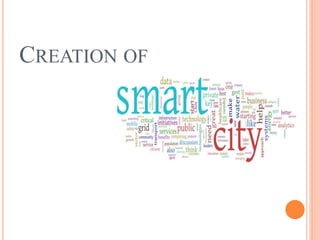
CREATION OF
WHAT IS A SMART CITY?
A Smart City has-
basic infrastructure,
uses ‘smart’ solutions to make
infrastructure and services better, and
relies on Area based development.
OBJECTIVES
Provide basic infrastructure.
Quality of life.
Clean and sustainable environment.
Apply Smart Solutions.
Set examples to be replicated both
within and outside the Smart City and
catalyze the creation of similar Smart
Cities.
WHAT IS BASIC INFRASTRUCTURE?
 Basic public infrastructure is built by dovetailing and
synergizing with other Missions and Schemes –
AMRUT
 Basic infrastructure includes,
 Assured water & electricity supply,
 Sanitation & Solid Waste Management,
 Efficient urban mobility & public transport,
 Affordable Housing,
 Robust IT connectivity,
 e-governance & citizen participation,
 Safety & security of citizens,
 Health & Education and
 Economic Activities & Livelihood Opportunities.
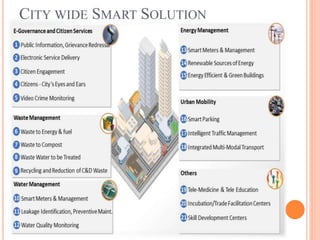
CITY WIDE SMART SOLUTION
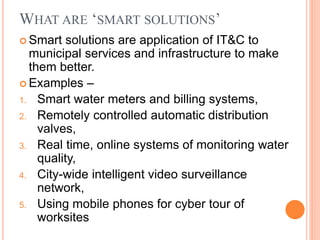
WHAT ARE ‘SMART SOLUTIONS’
 Smart solutions are application of IT&C to
municipal services and infrastructure to make
them better.
 Examples –
1. Smart water meters and billing systems,
2. Remotely controlled automatic distribution
valves,
3. Real time, online systems of monitoring water
quality,
4. City-wide intelligent video surveillance
network,
5. Using mobile phones for cyber tour of
worksites
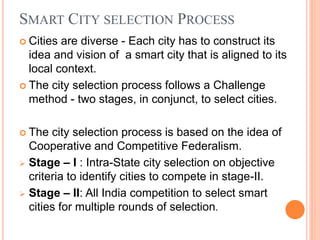
SMART CITY SELECTION PROCESS
 Cities are diverse - Each city has to construct its
idea and vision of a smart city that is aligned to its
local context.
 The city selection process follows a Challenge
method - two stages, in conjunct, to select cities.
 The city selection process is based on the idea of
Cooperative and Competitive Federalism.
 Stage – I : Intra-State city selection on objective
criteria to identify cities to compete in stage-II.
 Stage – II: All India competition to select smart
cities for multiple rounds of selection.
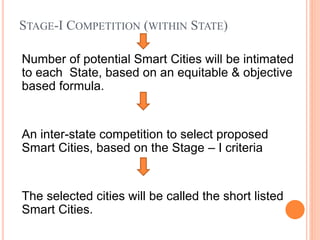
STAGE-I COMPETITION (WITHIN STATE)
Number of potential Smart Cities will be intimated
to each State, based on an equitable & objective
based formula.
An inter-state competition to select proposed
Smart Cities, based on the Stage – I criteria
The selected cities will be called the short listed
Smart Cities.
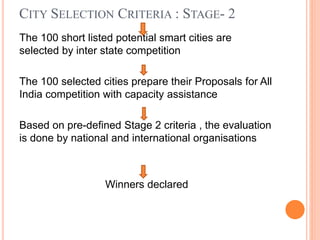
CITY SELECTION CRITERIA : STAGE- 2
The 100 short listed potential smart cities are
selected by inter state competition
The 100 selected cities prepare their Proposals for All
India competition with capacity assistance
Based on pre-defined Stage 2 criteria , the evaluation
is done by national and international organisations
Winners declared
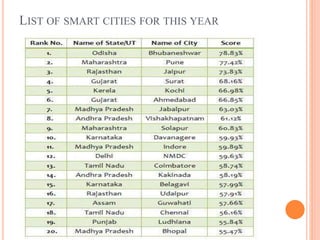
LIST OF SMART CITIES FOR THIS YEAR
Economic infrastructure

Economic infrastructure

  • 1.
    ECONOMIC INFRASTRUCTURE: CREATION OFSMART CITIES Presentation by, Jithin Koshy Aditi Mangla Akarsh Gupta Akshay Mangla
  • 2.
    Expanding investment ininfrastructure can play an important counter cyclical role. Projects and programmes [are] to be reviewed in the area of infrastructure development, including pure public private partnerships, to ensure that their implementation is expedited and does not suffer from [the] fund crunch.” Dr. Manmohan Singh FORMAL PRIME MINISTER OF INDIA
  • 3.
    DEFINITION Internal facility ofa country that make business activity possible, Such as: Communication Transportation Distribution networks Financial institutes and market Energy supply system
  • 4.
    Communication: Internet, Massmedia, Mobile. Transportation: Shipping, Railway, Airports and Roads. Distribution Networks. Financial institutions and Markets: FDI, FII and Banking Energy Supply Systems: Petroleum, Biogas, Water gas, Thermal, Hydro, Nuclear, Solar, Tidal, Wind. WHAT DOES INFRASTRUCTURE INCLUDE:
  • 7.
    • FACTORS FORBETTER INFRASTRUCTURE :  General Education (including related forms of classical culture). Science and Technology (Households, Agriculture, and Industry)  Health-Care delivery systems
  • 8.
  • 9.
    ECONOMIC INFRASTRUCTURE Economic infrastructure meansthose basic facilities and services which directly benefits the process of production and distribution of an economy. Irrigation, power, transport and communication are the examples of economic infrastructures
  • 10.
    SOCIAL INFRASTRUCTURE Social infrastructuremeans those basic activities and services which, in addition to achieving certain social objectives, indirectly help various economic activities. Education, heath service, sanitation and water supply etc are the example of social infrastructure.
  • 11.
    WHY IS INFRASTRUCTUREIMPORTANT FOR ECONOMIC GROWTH? Infrastructure means connectivity like road, rail, ports and telecommunications. These are basic to economic development and growth. With connectivity the economy will open to outside world, trade and commerce will flourish. With connectivity industries will be established as labour and capital will flow from surplus regions to connected and developing areas.
  • 12.
    Housing, education andhealth services also constitute part of infrastructure development which ensure improvement in quality of life.
  • 13.
    INVESTMENTS BY FDI’SON INDIAN INFRASTRUCTURE  The Asian Development Bank (ADB) has approved US$ 631 million loan to develop the first coastal corridor, namely the Vishakhapatnam-Chennai industrial corridor, which is expected to bring manufacturing and export industries to the east coast.  The Government of India has unveiled plans to invest US$ 137 billion in its rail network over the next five years, heralding Prime Minister Narendra Modi's aggressive approach to building infrastructure needed to unlock faster economic growth.
  • 14.
     The ConstructionIndustry Development Board (CIDB) of Malaysia has proposed to invest in urban development and housing projects in India, such as a mini-smart city adjacent to New Delhi Railway Station, a green city project at Garhmukhteshwar in Uttar Pradesh and the Ganga cleaning projects.
  • 15.
    GOVERNMENT INITIATIVES TOWARDS GROWTHOF ECONOMIC INFRASTRUCTURE  The Government of India is planning to boost regional connectivity by setting up 50 new airports over the next three years, out of which at least 10 would be operational in next year.  The government plans to invest over Rs 7,000 crore in FY2016-17 to develop its network in the north-eastern region for better connectivity
  • 16.
     The Securitiesand Exchange Board of India (SEBI) has announced norms for public issue of units of infrastructure investment trusts (InvITs) in order to facilitate infrastructure developers raise capital from public investors.  The Government of India plans to award 100 highway projects under the public-private partnership (PPP) mode in 2016, with expectations that recent amendments in regulations would revive investor sentiments in PPP projects in the infrastructure sector.  The Reserve Bank of India (RBI) has notified 100 per cent foreign direct investment (FDI) under automatic route in the construction development sector. The new limit came into effect in December 2014.
  • 17.
  • 19.
    WHAT IS ASMART CITY? A Smart City has- basic infrastructure, uses ‘smart’ solutions to make infrastructure and services better, and relies on Area based development.
  • 20.
    OBJECTIVES Provide basic infrastructure. Qualityof life. Clean and sustainable environment. Apply Smart Solutions. Set examples to be replicated both within and outside the Smart City and catalyze the creation of similar Smart Cities.
  • 21.
    WHAT IS BASICINFRASTRUCTURE?  Basic public infrastructure is built by dovetailing and synergizing with other Missions and Schemes – AMRUT  Basic infrastructure includes,  Assured water & electricity supply,  Sanitation & Solid Waste Management,  Efficient urban mobility & public transport,  Affordable Housing,  Robust IT connectivity,  e-governance & citizen participation,  Safety & security of citizens,  Health & Education and  Economic Activities & Livelihood Opportunities.
  • 22.
  • 23.
    WHAT ARE ‘SMARTSOLUTIONS’  Smart solutions are application of IT&C to municipal services and infrastructure to make them better.  Examples – 1. Smart water meters and billing systems, 2. Remotely controlled automatic distribution valves, 3. Real time, online systems of monitoring water quality, 4. City-wide intelligent video surveillance network, 5. Using mobile phones for cyber tour of worksites
  • 24.
    SMART CITY SELECTIONPROCESS  Cities are diverse - Each city has to construct its idea and vision of a smart city that is aligned to its local context.  The city selection process follows a Challenge method - two stages, in conjunct, to select cities.  The city selection process is based on the idea of Cooperative and Competitive Federalism.  Stage – I : Intra-State city selection on objective criteria to identify cities to compete in stage-II.  Stage – II: All India competition to select smart cities for multiple rounds of selection.
  • 25.
    STAGE-I COMPETITION (WITHINSTATE) Number of potential Smart Cities will be intimated to each State, based on an equitable & objective based formula. An inter-state competition to select proposed Smart Cities, based on the Stage – I criteria The selected cities will be called the short listed Smart Cities.
  • 26.
    CITY SELECTION CRITERIA: STAGE- 2 The 100 short listed potential smart cities are selected by inter state competition The 100 selected cities prepare their Proposals for All India competition with capacity assistance Based on pre-defined Stage 2 criteria , the evaluation is done by national and international organisations Winners declared
  • 27.
    LIST OF SMARTCITIES FOR THIS YEAR