Construction & Project Management
KKKA 6644
“Construction Risk Management”
Lecturer : Ir. ISHAK BIN ARSHAD
(GROUP 7)
Present by: ARY SHEHAB JAMIL P81496
HUSSEIN ALI ABDULLAH P81516
MOHAMMED ISMAEL P81580
ZAID ABDULLAH P81461
AHMED HASAN ALI P81517
 Introduction
 What is Project Risk ?
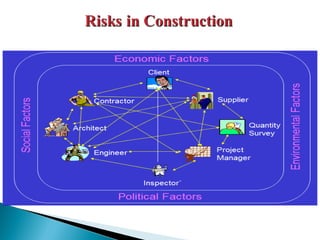
 Risks in Construction
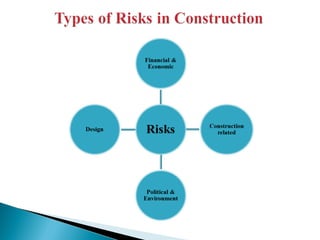
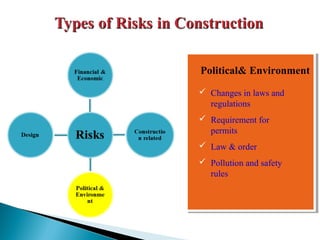
 Types of Risks in Construction
 Construction Risk Management
 What does it include?
 How is it done in project?
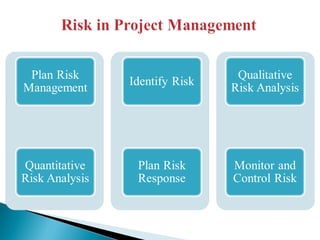
 Risk in Project Management
 What are the benefits?
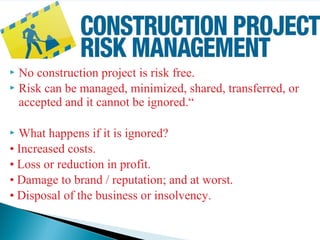
 No construction project is risk free.
 Risk can be managed, minimized, shared, transferred, or
accepted and it cannot be ignored.“
 What happens if it is ignored?
• Increased costs.
• Loss or reduction in profit.
• Damage to brand / reputation; and at worst.
• Disposal of the business or insolvency.
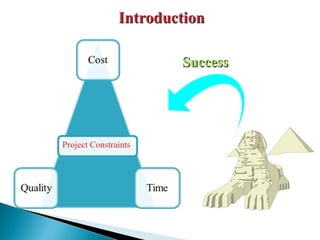
SuccessSuccess
Project Constraints
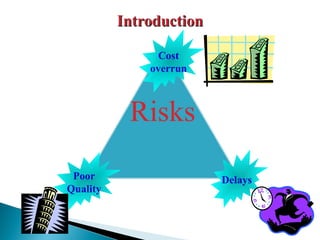
Poor
Quality
Delays
Cost
overrun
 A situation involving exposure to danger.
 Expose (someone or something valued) to danger, harm,
or loss.
 Risk is an uncertain event that may have a positive or
negative impact on the project.
 May effect: scope, schedule, cost, performance, and
quality.
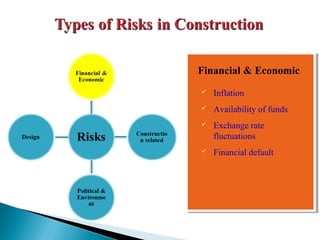
Financial & EconomicFinancial & Economic
 Inflation
 Availability of funds
 Exchange rate
fluctuations
 Financial default
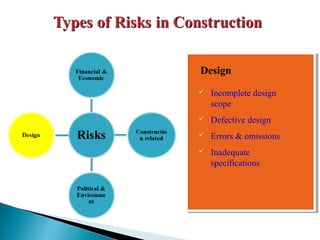
DesignDesign
 Incomplete design
scope
 Defective design
 Errors & omissions
 Inadequate
specifications
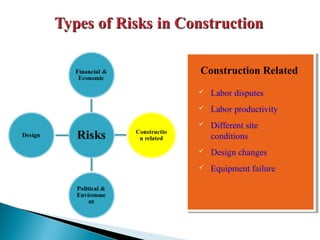
Construction RelatedConstruction Related
 Labor disputes
 Labor productivity
 Different site
conditions
 Design changes
 Equipment failure
Political& EnvironmentPolitical& Environment
 Changes in laws and
regulations
 Requirement for
permits
 Law & order
 Pollution and safety
rules
 Construction Risk Management is the process of identifying and
migrating risk.
 Proper Construction Risk Management implies control of possible
future events and is proactive rather than reactive.
 Proper Construction Risk Management will reduce not only the
likelihood of an event occurring, but also the magnitude of its
impact.
 Construction Risk Management Systems are designed to do more
than just identify the risk.
 The system must also quantify the risk and predict the impact on
the project.
 The outcome is therefore a risk that is either acceptable or
unacceptable.
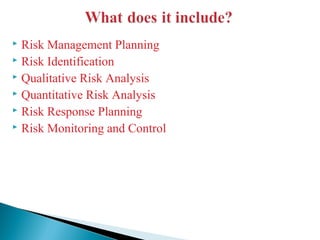
 Risk Management Planning
 Risk Identification
 Qualitative Risk Analysis
 Quantitative Risk Analysis
 Risk Response Planning
 Risk Monitoring and Control
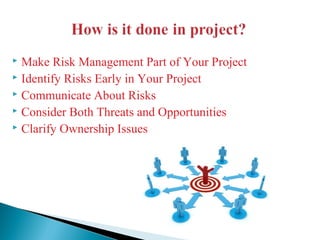
 Make Risk Management Part of Your Project
 Identify Risks Early in Your Project
 Communicate About Risks
 Consider Both Threats and Opportunities
 Clarify Ownership Issues
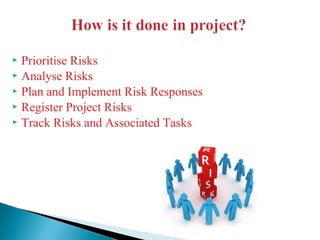
 Prioritise Risks
 Analyse Risks
 Plan and Implement Risk Responses
 Register Project Risks
 Track Risks and Associated Tasks
 Analysis and decision making to implement risk management.
 Defining how to conduct risk management activities for a project.
 Appropriate to size and complexity of the project.
 Stakeholders will be involved in planning risk management.
 The process of how to conduct risk management Activities.
 Success of the other five risk management processes will be
enhanced by careful and explicit planning.
Generate a list of possible risks through brainstorming,
problem identification and risk profiling.
Determining which risk may affect the projects.
Documenting their characteristics.
SWOT Analysis.
Information gathering.
Check-list Analysis.
Assumption Analysis.
To filter the risks to determine which are the significant
risks and which are insignificant.
Assess impact and likelihood of the identified risk.
Probability and Impact Matrix.
Risk categorization.
Risk urgency assessment.
 Data gathering
◦ Direct
◦ Diagrammatic
◦ Delphi
 Probability distribution
 Modeling Techniques
◦ Decision tree Analysis
◦ Sensitivity Analysis
◦ Expert Judgment
 Eliminate threats before they happen.
 Decrease impact of threat.
 Contingency plan ( Do something if risk happens).
 Fallback plan ( Do something if contingency plans are not
effective).
 Negative risk or threat
◦ Avoid
◦ Transfer
◦ Mitigate
◦ Accept
 Positive risk or opportunity
◦ Exploit
◦ Share
◦ Enhance
-Mitigating Risk
oReducing the likelihood an adverse event will occur.
oReducing impact of adverse event.
-Avoiding Risk
oChanging the project plan to eliminate the risk or condition.
-Transferring Risk
oPaying a premium to pass the risk to another party.
oRequiring Build-Own-Operate-Transfer (BOOT) provisions.
-Retaining Risk
oMaking a conscious decision to accept the risk.
 Risk Reassessment (Scheduled regularly to identify new
risk).
 Risk Audit (Examine the effectiveness of planned risk
response).
 Trend analysis (Monitor overall project performance).
 Effective use of resources.
 Promoting continuous improvement.
 Fewer shocks and failures.
 Strategic business planning.
 Raised awareness of significant risks.
 Quick grasp of new opportunities.
 Enhancing communication.
 Reassuring stakeholders.
 Focus on internal audit programme.
“Construction Risk Management”

“Construction Risk Management”

  • 1.
    Construction & ProjectManagement KKKA 6644 “Construction Risk Management” Lecturer : Ir. ISHAK BIN ARSHAD (GROUP 7) Present by: ARY SHEHAB JAMIL P81496 HUSSEIN ALI ABDULLAH P81516 MOHAMMED ISMAEL P81580 ZAID ABDULLAH P81461 AHMED HASAN ALI P81517
  • 2.
     Introduction  Whatis Project Risk ?  Risks in Construction  Types of Risks in Construction  Construction Risk Management  What does it include?  How is it done in project?  Risk in Project Management  What are the benefits?
  • 3.
     No constructionproject is risk free.  Risk can be managed, minimized, shared, transferred, or accepted and it cannot be ignored.“  What happens if it is ignored? • Increased costs. • Loss or reduction in profit. • Damage to brand / reputation; and at worst. • Disposal of the business or insolvency.
  • 4.
  • 5.
  • 6.
     A situationinvolving exposure to danger.  Expose (someone or something valued) to danger, harm, or loss.  Risk is an uncertain event that may have a positive or negative impact on the project.  May effect: scope, schedule, cost, performance, and quality.
  • 10.
    Financial & EconomicFinancial& Economic  Inflation  Availability of funds  Exchange rate fluctuations  Financial default
  • 11.
    DesignDesign  Incomplete design scope Defective design  Errors & omissions  Inadequate specifications
  • 12.
    Construction RelatedConstruction Related Labor disputes  Labor productivity  Different site conditions  Design changes  Equipment failure
  • 13.
    Political& EnvironmentPolitical& Environment Changes in laws and regulations  Requirement for permits  Law & order  Pollution and safety rules
  • 14.
     Construction RiskManagement is the process of identifying and migrating risk.  Proper Construction Risk Management implies control of possible future events and is proactive rather than reactive.  Proper Construction Risk Management will reduce not only the likelihood of an event occurring, but also the magnitude of its impact.  Construction Risk Management Systems are designed to do more than just identify the risk.  The system must also quantify the risk and predict the impact on the project.  The outcome is therefore a risk that is either acceptable or unacceptable.
  • 15.
     Risk ManagementPlanning  Risk Identification  Qualitative Risk Analysis  Quantitative Risk Analysis  Risk Response Planning  Risk Monitoring and Control
  • 16.
     Make RiskManagement Part of Your Project  Identify Risks Early in Your Project  Communicate About Risks  Consider Both Threats and Opportunities  Clarify Ownership Issues
  • 17.
     Prioritise Risks Analyse Risks  Plan and Implement Risk Responses  Register Project Risks  Track Risks and Associated Tasks
  • 19.
     Analysis anddecision making to implement risk management.  Defining how to conduct risk management activities for a project.  Appropriate to size and complexity of the project.  Stakeholders will be involved in planning risk management.  The process of how to conduct risk management Activities.  Success of the other five risk management processes will be enhanced by careful and explicit planning.
  • 20.
    Generate a listof possible risks through brainstorming, problem identification and risk profiling. Determining which risk may affect the projects. Documenting their characteristics. SWOT Analysis. Information gathering. Check-list Analysis. Assumption Analysis.
  • 21.
    To filter therisks to determine which are the significant risks and which are insignificant. Assess impact and likelihood of the identified risk. Probability and Impact Matrix. Risk categorization. Risk urgency assessment.
  • 22.
     Data gathering ◦Direct ◦ Diagrammatic ◦ Delphi  Probability distribution  Modeling Techniques ◦ Decision tree Analysis ◦ Sensitivity Analysis ◦ Expert Judgment
  • 23.
     Eliminate threatsbefore they happen.  Decrease impact of threat.  Contingency plan ( Do something if risk happens).  Fallback plan ( Do something if contingency plans are not effective).
  • 24.
     Negative riskor threat ◦ Avoid ◦ Transfer ◦ Mitigate ◦ Accept  Positive risk or opportunity ◦ Exploit ◦ Share ◦ Enhance
  • 25.
    -Mitigating Risk oReducing thelikelihood an adverse event will occur. oReducing impact of adverse event. -Avoiding Risk oChanging the project plan to eliminate the risk or condition. -Transferring Risk oPaying a premium to pass the risk to another party. oRequiring Build-Own-Operate-Transfer (BOOT) provisions. -Retaining Risk oMaking a conscious decision to accept the risk.
  • 26.
     Risk Reassessment(Scheduled regularly to identify new risk).  Risk Audit (Examine the effectiveness of planned risk response).  Trend analysis (Monitor overall project performance).
  • 27.
     Effective useof resources.  Promoting continuous improvement.  Fewer shocks and failures.  Strategic business planning.  Raised awareness of significant risks.  Quick grasp of new opportunities.  Enhancing communication.  Reassuring stakeholders.  Focus on internal audit programme.