

Roland Friedli
Senior Risk Engineer, Swiss Re
Critical Infrastructure
An overview of exposures and risks
Roland Friedli | Critical Infrastructure | 4th Conference on Community Resiliency
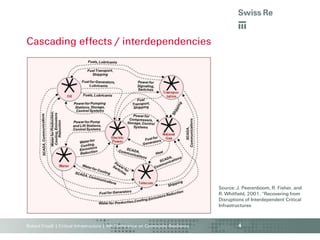
 Cascading effects / interdependencies
 Ageing infrastructure
 Long lead times
 Running at limit of capacity
 Controversial issue: privatisation
2
What are the challenges?
Roland Friedli | Critical Infrastructure | 4th Conference on Community Resiliency
 Shortage of cervalat casings in Switzerland
– http://en.wikipedia.org/wiki/Cervelat#2008_casings_shortage
 Panama Canal Third Set of Locks Project
– http://en.wikipedia.org/wiki/Panama_Canal_expansion_project
 E-Coli outbreak in Germany
– https://en.wikipedia.org/wiki/2011_Germany_E._coli_O104:H4_outbreak
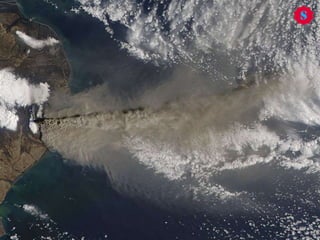
 Eruptions of Eyjafjallajökull
– http://en.wikipedia.org/wiki/2010_eruptions_of_Eyjafjallaj%C3%B6kull
 Taum Sauk upper reservoir breach
– http://en.wikipedia.org/wiki/Taum_Sauk_Hydroelectric_Power_Station#Upper_r
eservoir_breached
3
Illustrative cases for
critical infrastructure (I)
Roland Friedli | Critical Infrastructure | 4th Conference on Community Resiliency
 Camelford water poisoning
– http://www.guardian.co.uk/uk/camelford-water-poisoning
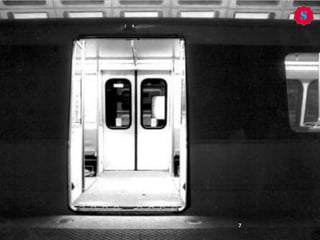
 Malfunction of a metro door causes disruption of train system
– http://edition.cnn.com/2010/WORLD/americas/09/22/brazil.trains/index.html
 Sayano–Shushenskaya power station accident
– http://en.wikipedia.org/wiki/2009_Sayano%E2%80%93Shushenskaya_power_
station_accident
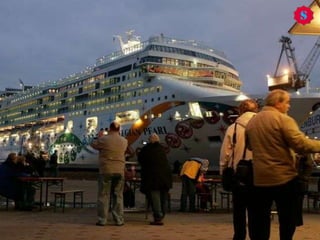
 Ship passing beneath power line causes power blackout
– http://news.nationalgeographic.com/news/energy/2012/08/pictures/120821-
world-s-worst-power-outages/#/energy-worst-power-outages-germany-cruise-
ship_58532_600x450.jpg
4
Illustrative cases for
critical infrastructure (II)
Roland Friedli | Critical Infrastructure | 4th Conference on Community Resiliency
 Facilitate risk management discussions with stakeholders
 Include risk assessment
– and require elements such as "Risk based maintenance", "Resilient design"
 Provide incentives for risk mitigation and risk reduction
– by offering a premium discount or by restructuring coverage
 Beware of elements of critical infrastructures which fail to meet the
criteria of insurability
– lack of track record e.g. for new technology
– risk of change e.g. due to climate change/extreme weather
– interconnectedness resulting in unforeseeable consequences
5
What can the insurance industry do?
Thank you
Roland Friedli | Critical Infrastructure | 4th Conference on Community Resiliency
Legal notice
©2013 Swiss Re. All rights reserved. You are not permitted to create any
modifications or derivatives of this presentation or to use it for commercial
or other public purposes without the prior written permission of Swiss Re.
Although all the information used was taken from reliable sources, Swiss Re
does not accept any responsibility for the accuracy or comprehensiveness of
the details given. All liability for the accuracy and completeness thereof or
for any damage resulting from the use of the information contained in this
presentation is expressly excluded. Under no circumstances shall Swiss Re
or its Group companies be liable for any financial and/or consequential loss
relating to this presentation.
7

Roland Friedli - Critical Infrastructure Davos

  • 1.
    Roland Friedli Senior RiskEngineer, Swiss Re Critical Infrastructure An overview of exposures and risks
  • 2.
    Roland Friedli |Critical Infrastructure | 4th Conference on Community Resiliency  Cascading effects / interdependencies  Ageing infrastructure  Long lead times  Running at limit of capacity  Controversial issue: privatisation 2 What are the challenges?
  • 3.
    Roland Friedli |Critical Infrastructure | 4th Conference on Community Resiliency  Shortage of cervalat casings in Switzerland – http://en.wikipedia.org/wiki/Cervelat#2008_casings_shortage  Panama Canal Third Set of Locks Project – http://en.wikipedia.org/wiki/Panama_Canal_expansion_project  E-Coli outbreak in Germany – https://en.wikipedia.org/wiki/2011_Germany_E._coli_O104:H4_outbreak  Eruptions of Eyjafjallajökull – http://en.wikipedia.org/wiki/2010_eruptions_of_Eyjafjallaj%C3%B6kull  Taum Sauk upper reservoir breach – http://en.wikipedia.org/wiki/Taum_Sauk_Hydroelectric_Power_Station#Upper_r eservoir_breached 3 Illustrative cases for critical infrastructure (I)
  • 4.
    Roland Friedli |Critical Infrastructure | 4th Conference on Community Resiliency  Camelford water poisoning – http://www.guardian.co.uk/uk/camelford-water-poisoning  Malfunction of a metro door causes disruption of train system – http://edition.cnn.com/2010/WORLD/americas/09/22/brazil.trains/index.html  Sayano–Shushenskaya power station accident – http://en.wikipedia.org/wiki/2009_Sayano%E2%80%93Shushenskaya_power_ station_accident  Ship passing beneath power line causes power blackout – http://news.nationalgeographic.com/news/energy/2012/08/pictures/120821- world-s-worst-power-outages/#/energy-worst-power-outages-germany-cruise- ship_58532_600x450.jpg 4 Illustrative cases for critical infrastructure (II)
  • 5.
    Roland Friedli |Critical Infrastructure | 4th Conference on Community Resiliency  Facilitate risk management discussions with stakeholders  Include risk assessment – and require elements such as "Risk based maintenance", "Resilient design"  Provide incentives for risk mitigation and risk reduction – by offering a premium discount or by restructuring coverage  Beware of elements of critical infrastructures which fail to meet the criteria of insurability – lack of track record e.g. for new technology – risk of change e.g. due to climate change/extreme weather – interconnectedness resulting in unforeseeable consequences 5 What can the insurance industry do?
  • 6.
  • 7.
    Roland Friedli |Critical Infrastructure | 4th Conference on Community Resiliency Legal notice ©2013 Swiss Re. All rights reserved. You are not permitted to create any modifications or derivatives of this presentation or to use it for commercial or other public purposes without the prior written permission of Swiss Re. Although all the information used was taken from reliable sources, Swiss Re does not accept any responsibility for the accuracy or comprehensiveness of the details given. All liability for the accuracy and completeness thereof or for any damage resulting from the use of the information contained in this presentation is expressly excluded. Under no circumstances shall Swiss Re or its Group companies be liable for any financial and/or consequential loss relating to this presentation. 7

Editor's Notes

  • #3 http://www.nzz.ch/aktuell/startseite/cervelat-huellen-nicht-mehr-verfuegbar-1.641706Traditionally, Swiss beef intestines were used for the casings, but towards the end of the 20th century, local cattle producers lost interest in cleaning and preparing them, so meat processors switched to Brazilianzebu intestines, which are not fatty and do not easily split open when roasted.[2] However, beginning on 1 April 2006, the European Union banned the import of many animal parts from Brazil as a measure aimed at preventing the spread of mad cow disease. Among these were beef intestines.[1] Although Switzerland is not an EU member state, it is bound to observe European food protection laws through other treaty agreements.[2] Hence, Swiss and German stockpiles of zebu intestines became very low by 2008, threatening production altogether, and causing some controversy in Switzerland.[6] In January of that year, the Swiss meat industry announced that a national "cervelat task force" had failed in an exhaustive search for an acceptable alternative to zebu intestines.[6]The New York Times noted that "the possible demise of cervelas visibly upset the Swiss, a normally even-tempered people."[2] The cervelat production crisis was covered closely by the Swiss media and in a newspaper poll, 72% of those surveyed said the "cervelas, as they knew it, had to be saved."[2] The cervelat crisis was brought up in a parliamentary debate wherein state councillor and president of the Swiss Meat Association, Rolf Büttiker, spoke of the national sausage's social significance, calling it a "cult sausage" and "the worker's steak".[7] The Swiss government entered into negotiations with the EU to seek an exception for zebu intestines, and Swiss scientists were sent to Brazil hoping to show that the intestines posed no risk of transmitting mad cow disease.[2]By August 2008, most of the Swiss demand for bovine intestines had been met with imports from Uruguay, Argentina and Paraguay.[8]
  • #6 2010 eruptions of EyjafjallajökullThe MODIS instrument on NASA's Aqua satellite captured an ash plume from Eyjafjallajökull Volcano over the North Atlantic at 13:20 UTC on 17 April 2010
  • #7 Europe, 2006Photograph by JoergSarbach, APOnlookers wait for the newly built cruise ship Norwegian Pearl to leave the Papenburg, Germany, shipyard in November 2006. Soon after, on its trip down the River Ems, the ship indirectly caused a two-hour power outage for some 10 million people on the evening of November 4.The German power company E. turned off a 380,000-volt line over the river so that the ship could pass safely beneath on its way to the North Sea. But the dead line quickly increased pressures elsewhere in the German power grid and then sparked a chain reaction across parts of Germany, France, Belgium, Italy, Spain, Austria, the Netherlands, and Croatia. Critics said the incident showcased the need for more universal electricity distribution policies across Europe.
  • #8 Passengers, angry about slow service, took out their frustration on trains in Sao Paulo, Brazil, bashing windows and damaging at least 17 train cars Tuesday, an official told the national broadcaster.The passengers were furious that some trains had stopped moving Tuesday morning, Conrado Grava de Souza, operations director of the Sao Paulo Metro, told AgenciaBrasil.The triggering device to open one of the train's doors malfunctioned causing one of the trains to stop. Passengers used emergency buttons to get off the train and began walking on the tracks.This caused other trains to stop, further slowing service, Souza said.An estimated 150,000 people were disrupted by the interruption in train service, Souza said.Later in the day, the 17 damaged trains were back in service.
  • #9 Gedanken Experiment: AlterndeWasserleitung.
  • #11 Ende der achtziger Jahre verwandelte sich der Stadelhofen vom putzigen Vorstadtbahnhof zum eleganten Vorzeigestück der Zürcher S-Bahn. Heute stösst er an die Grenzen seiner Kapazität. Daran ändert sich so rasch nichts. Merken MerkenE-Mail Drucken DruckenStefan Hotz«Der Bahnhof Stadelhofen mit seiner Umgebung ist ein Sorgenkind der Verkehrspolitiker und Städteplaner geworden.» Das schrieb die NZZ am 3. April 1973; damals in der Erwartung, dass sieben Wochen später, nach der Volksabstimmung über die S- und U-Bahn-Vorlage, die Arbeiten für seinen Ausbau ausgeschrieben werden können. Es kam bekanntlich anders.Keine Lücke im FahrplanHeute bereitet Stadelhofen den Verkehrsplanern erneut Kopfzerbrechen. Der nach Passagieraufkommen grösste Bahnhof der Schweiz ohne Fernverkehr ist mit neun Linien auch einer der grössten Engpässe im Netz der S-Bahn. Im Rahmen ihrer 4. Teilergänzung bis 2018 sind keine Ausbauten geplant. Der dichte Fahrplan lässt jedoch fast keine weiteren Züge zu. Für die neue S 20, die ab 2014 zu den Hauptverkehrszeiten die S 7 am rechten Seeufer entlasten soll, fand sich nur mit Mühe eine Lücke.(NZZ-Infografik / cke.)Die Probleme haben auch mit dem Nein zur S- und U-Bahn am 20. Mai 1973 zu tun. Damals war an der Stelle der heutigen Ladenstrasse ein unterirdischer Bahnhof mit drei Gleisen geplant. Das Bahnhofgebäude sollte einer neuen Überbauung weichen. Letzteres habe viel Opposition erzeugt, erinnert sich Walter Diener, der damals in der kantonalen Verwaltung für den öffentlichen Verkehr zuständig war. In der Folge war Stadelhofen wiederholt Gegenstand von Sparrunden.Ungeahnte VerkehrszunahmeEin vor 40 Jahren erwogener viergleisiger Bahnhof – ebenerdig zwei Gleise stadtwärts, unterirdisch zwei Gleise Richtung Riesbach- und Zürichbergtunnel – stand für die S-Bahn nicht mehr zur Debatte. Im Rückblick als Fehleinschätzung erwies sich, dass man 1981 «auf längere Sicht» keinen zweiten Riesbachtunnel für nötig hielt. Das bedeutete, dass sich das Gleis von Tiefenbrunnen und jenes von Stettbach kreuzen, was die Kapazität begrenzt.Schon bei der Planung der S-Bahn war klar, dass irgendwann ein Ausbau auf vier Gleise unumgänglich wird. Vermutlich rechnete man damals eher damit, es sei Mitte des 21. Jahrhunderts so weit. Vor 30 Jahren konnte niemand ahnen, welche Dynamik die S-Bahn entwickeln sollte. Sinnvoll wären Vorinvestitionen gewesen, die in einem Bericht zur «Zürichberglinie» 1977 angedeutet wurden, aber ausblieben. Die Probleme in den achtziger Jahren beim Bau der um rund 15 Meter versetzten Stützmauer waren gross genug. Sie musste von permanenten Erdankern gesichert werden. Deshalb ist nun ein viertes Gleis auf Höhe des Ladengeschosses nur noch 30 bis 40 Meter tief im Innern des Abhangs machbar (siehe Grafik).Stadelhofer Tunnel eine Stunde lang blockiertDer Eisenbahntunnel zwischen Zürich Stadelhofen und Zürich Stettbach war am Dienstag Vormittag für eine Stunde blockiert. Die SBB teilten auf ihrer Website um 10 Uhr mit: «Zwischen Dübendorf und Zürich Stadelhofen ist die Strecke für den Bahnverkehr unterbrochen. Dauer der Störung unbestimmt.» Als Ursache der Störung wurde ein Personenunfall genannt. Eine Stunde später wurde Entwarnung gegeben; die Störung war behoben, der Eisenbahnverkehr begann sich wieder zu normalisieren. Betroffen waren die S-Bahn-Linien S3, S5, S9, S12, S15; ein Reihe von Zügen fielen aus oder wurden umgeleitet.Ausbau nicht vom TischIn der kurzen Debatte vom Montag im Kantonsrat herrschte Einigkeit, der Bahnhof Stadelhofen zeige fast sinnbildlich, wie die S-Bahn ein Opfer ihres eigenen Erfolges wird. Unbestritten war ebenso, dass der Ausbau nach den 4. Teilergänzungen an die Hand zu nehmen ist. Er ist auch, allerdings nur in 3. Priorität, im Entwurf des Bundes für Bahn 2030 enthalten und steht auf der Wunschliste der Metropolitankonferenz Zürich. Volkswirtschaftsdirektor Ernst Stocker versicherte, dass das Postulat, das den Bericht ausgelöst habe, nun abgeschrieben werde, heisse nicht, das Thema sei damit vom Tisch.
  • #13 http://www.guardian.co.uk/uk/camelford-water-poisoninghttp://www.guardian.co.uk/society/2012/mar/14/camelford-water-poisoning-timeline-cornwall