Earthquake Resistant
Buildings
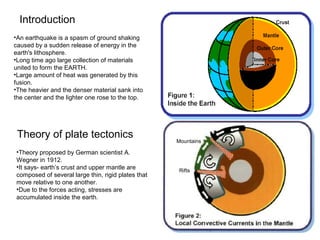
•An earthquake is a spasm of ground shaking
caused by a sudden release of energy in the
earth's lithosphere.
•Long time ago large collection of materials
united to form the EARTH.
•Large amount of heat was generated by this
fusion.
•The heavier and the denser material sank into
the center and the lighter one rose to the top.
Introduction
Theory of plate tectonics
•Theory proposed by German scientist A.
Wegner in 1912.
•It says- earth’s crust and upper mantle are
composed of several large thin, rigid plates that
move relative to one another.
•Due to the forces acting, stresses are
accumulated inside the earth.
Mountains
Rifts
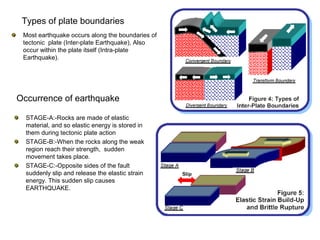
Types of plate boundaries
Most earthquake occurs along the boundaries of
tectonic plate (Inter-plate Earthquake), Also
occur within the plate itself (Intra-plate
Earthquake).
Occurrence of earthquake
STAGE-A:-Rocks are made of elastic
material, and so elastic energy is stored in
them during tectonic plate action
STAGE-B:-When the rocks along the weak
region reach their strength, sudden
movement takes place.
STAGE-C:-Opposite sides of the fault
suddenly slip and release the elastic strain
energy. This sudden slip causes
EARTHQUAKE.
Faults
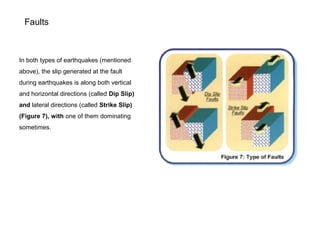
In both types of earthquakes (mentioned
above), the slip generated at the fault
during earthquakes is along both vertical
and horizontal directions (called Dip Slip)
and lateral directions (called Strike Slip)
(Figure 7), with one of them dominating
sometimes.
How the ground shakes?
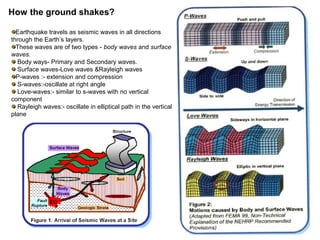
Earthquake travels as seismic waves in all directions
through the Earth’s layers.
These waves are of two types - body waves and surface
waves.
Body ways- Primary and Secondary waves.
Surface waves-Love waves &Rayleigh waves
P-waves :- extension and compression
S-waves:-oscillate at right angle
Love-waves:- similar to s-waves with no vertical
component
Rayleigh waves:- oscillate in elliptical path in the vertical
plane
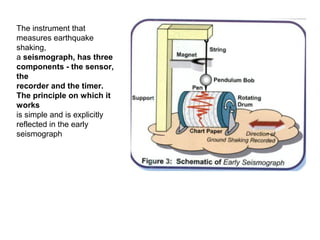
The instrument that
measures earthquake
shaking,
a seismograph, has three
components - the sensor,
the
recorder and the timer.
The principle on which it
works
is simple and is explicitly
reflected in the early
seismograph
terminologies
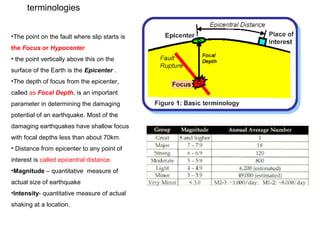
•The point on the fault where slip starts is
the Focus or Hypocenter
• the point vertically above this on the
surface of the Earth is the Epicenter .
•The depth of focus from the epicenter,
called as Focal Depth, is an important
parameter in determining the damaging
potential of an earthquake. Most of the
damaging earthquakes have shallow focus
with focal depths less than about 70km.
• Distance from epicenter to any point of
interest is called epicentral distance.
•Magnitude – quantitative measure of
actual size of earthquake
•Intensity- quantitative measure of actual
shaking at a location.
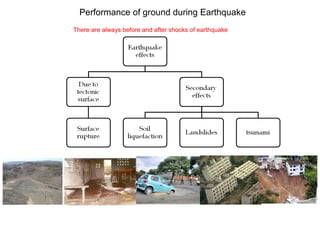
Performance of ground during Earthquake
There are always before and after shocks of earthquake
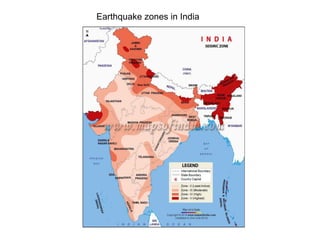
Earthquake zones in India
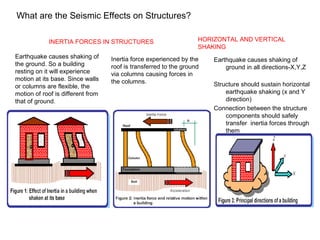
What are the Seismic Effects on Structures?
INERTIA FORCES IN STRUCTURES
Earthquake causes shaking of
the ground. So a building
resting on it will experience
motion at its base. Since walls
or columns are flexible, the
motion of roof is different from
that of ground.
Inertia force experienced by the
roof is transferred to the ground
via columns causing forces in
the columns.
HORIZONTAL AND VERTICAL
SHAKING
Earthquake causes shaking of
ground in all directions-X,Y,Z
Structure should sustain horizontal
earthquake shaking (x and Y
direction)
Connection between the structure
components should safely
transfer inertia forces through
them
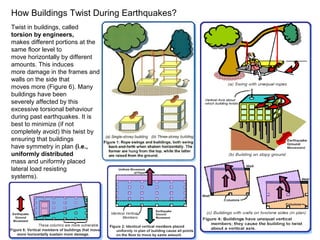
How Buildings Twist During Earthquakes?
Twist in buildings, called
torsion by engineers,
makes different portions at the
same floor level to
move horizontally by different
amounts. This induces
more damage in the frames and
walls on the side that
moves more (Figure 6). Many
buildings have been
severely affected by this
excessive torsional behaviour
during past earthquakes. It is
best to minimize (if not
completely avoid) this twist by
ensuring that buildings
have symmetry in plan (i.e.,
uniformly distributed
mass and uniformly placed
lateral load resisting
systems).
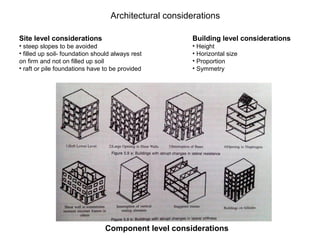
Architectural considerations
Site level considerations
• steep slopes to be avoided
• filled up soil- foundation should always rest
on firm and not on filled up soil
• raft or pile foundations have to be provided
Building level considerations
• Height
• Horizontal size
• Proportion
• Symmetry
Component level considerations
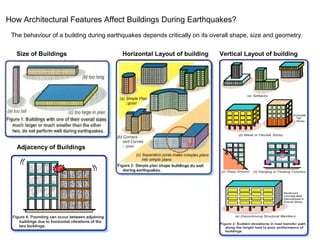
How Architectural Features Affect Buildings During Earthquakes?
The behaviour of a building during earthquakes depends critically on its overall shape, size and geometry.
Size of Buildings Horizontal Layout of building Vertical Layout of building
Adjacency of Buildings
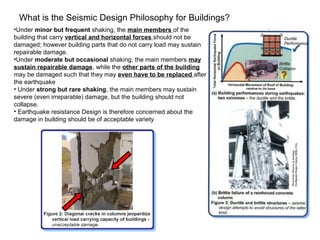
What is the Seismic Design Philosophy for Buildings?
•Under minor but frequent shaking, the main members of the
building that carry vertical and horizontal forces should not be
damaged; however building parts that do not carry load may sustain
repairable damage.
•Under moderate but occasional shaking, the main members may
sustain repairable damage, while the other parts of the building
may be damaged such that they may even have to be replaced after
the earthquake
• Under strong but rare shaking, the main members may sustain
severe (even irreparable) damage, but the building should not
collapse.
• Earthquake resistance Design is therefore concerned about the
damage in building should be of acceptable variety
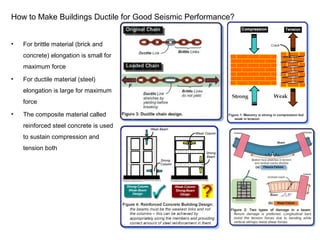
How to Make Buildings Ductile for Good Seismic Performance?
• For brittle material (brick and
concrete) elongation is small for
maximum force
• For ductile material (steel)
elongation is large for maximum
force
• The composite material called
reinforced steel concrete is used
to sustain compression and
tension both
Importance of Seismic design Codes
Good Structural Configuration: Its size, shape and
structural system carrying loads are such that they
ensure a direct and smooth flow of inertia forces to
the ground.
Lateral Strength: The maximum lateral (horizontal)
force that it can resist is such that the damage
induced in it does not result in collapse.
Adequate Stiffness: Its lateral load resisting system
is such that the earthquake-induced deformations in
it do not damage its contents under low-to
Moderate shaking.
Good Ductility: Its capacity to undergo large
deformations under severe earthquake shaking
even after yielding, is improved by favorable
design and detailing strategies.
Helps to improve behavior of structures so that they may withstand the earthquake effects without
significant loss of life
Seismic codes are unique to a particular region or country
Earthquake resistant building has four virtues in it namely:-
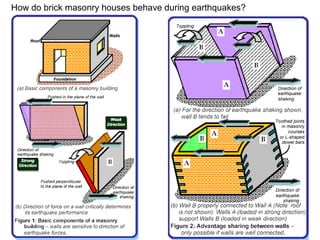
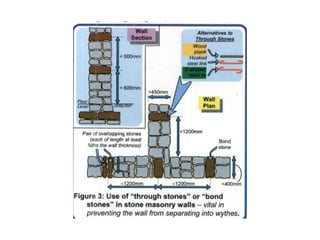
How do brick masonry houses behave during earthquakes?
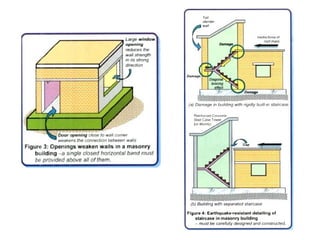
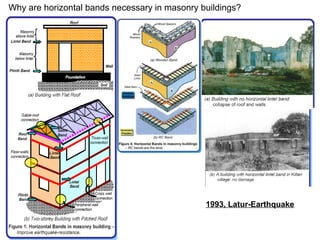
Why are horizontal bands necessary in masonry buildings?
1993, Latur-Earthquake
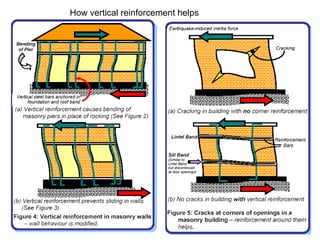
How vertical reinforcement helps
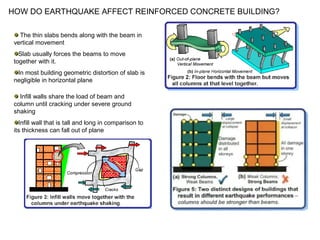
HOW DO EARTHQUAKE AFFECT REINFORCED CONCRETE BUILDING?
Infill walls share the load of beam and
column until cracking under severe ground
shaking
Infill wall that is tall and long in comparison to
its thickness can fall out of plane
The thin slabs bends along with the beam in
vertical movement
Slab usually forces the beams to move
together with it.
In most building geometric distortion of slab is
negligible in horizontal plane
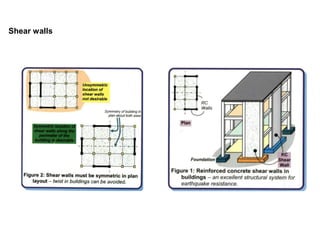
Shear walls
How to Reduce Earthquake Effects on Buildings?
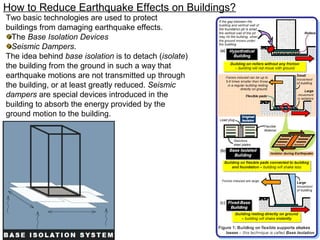
Two basic technologies are used to protect
buildings from damaging earthquake effects.
The Base Isolation Devices
Seismic Dampers.
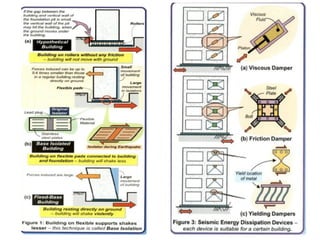
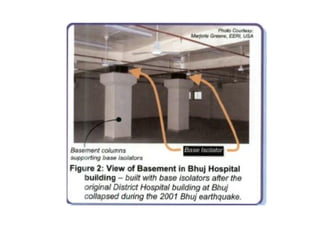
The idea behind base isolation is to detach (isolate)
the building from the ground in such a way that
earthquake motions are not transmitted up through
the building, or at least greatly reduced. Seismic
dampers are special devices introduced in the
building to absorb the energy provided by the
ground motion to the building.
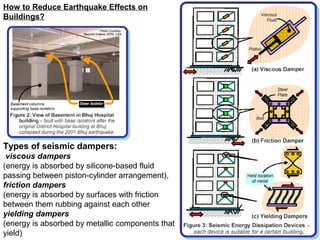
Types of seismic dampers:
viscous dampers
(energy is absorbed by silicone-based fluid
passing between piston-cylinder arrangement),
friction dampers
(energy is absorbed by surfaces with friction
between them rubbing against each other
yielding dampers
(energy is absorbed by metallic components that
yield)
How to Reduce Earthquake Effects on
Buildings?
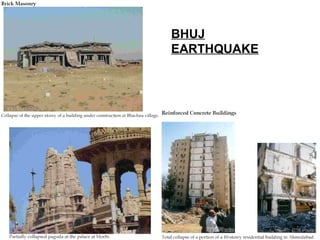
BHUJ
EARTHQUAKE
Diaphragms
(fig. 1)
Diaphragms are horizontal resistance elements,
generally floors and roofs, that transfer the lateral forces between the vertical resistance
elements (shear walls or frames). Basically, a diaphragm acts as a horizontal I-beam.
That is, the diaphragm itself acts as the web of the beam and its edges act as flanges.
(See figure 1)
Shear Walls
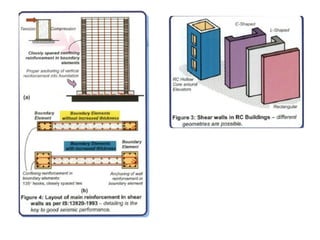
Shear walls are vertical walls that are designed to receive lateral forces from diaphragms and transmit them to the ground.
The forces in these walls are predominantly shear forces in which the fibers within the wall try to slide past one another.
(fig. 2)
When you build a house of cards, you design a shear wall structure, and you soon learn
that sufficient card "walls" must be placed at right angles to one another or the house
will collapse. If you were to connect your walls together with tape, it is easy to see that
the strength of this house of cards would significantly increase. This illustrates a very
important point, in which the earthquake resistance of any building is highly dependent
upon the connections joining the building's larger structural members, such as walls,
beams, columns and floor-slabs.
Shear walls, in particular, must be strong in themselves and also strongly connected to
each other and to the horizontal diaphragms. In a simple building with shear walls at
each end, ground motion enters the building and creates inertial forces that move the
floor diaphragms. This movement is resisted by the shear walls and the forces are
transmitted back down to the foundation.
References
1.Earthquake Tips- learning earthquake design and construction, IITK
1.National programme for capacity building of architects in earthquake
risk management, lecture notes, SPA

Earthquake and effect in building types precaution

  • 1.
  • 2.
    •An earthquake isa spasm of ground shaking caused by a sudden release of energy in the earth's lithosphere. •Long time ago large collection of materials united to form the EARTH. •Large amount of heat was generated by this fusion. •The heavier and the denser material sank into the center and the lighter one rose to the top. Introduction Theory of plate tectonics •Theory proposed by German scientist A. Wegner in 1912. •It says- earth’s crust and upper mantle are composed of several large thin, rigid plates that move relative to one another. •Due to the forces acting, stresses are accumulated inside the earth. Mountains Rifts
  • 3.
    Types of plateboundaries Most earthquake occurs along the boundaries of tectonic plate (Inter-plate Earthquake), Also occur within the plate itself (Intra-plate Earthquake). Occurrence of earthquake STAGE-A:-Rocks are made of elastic material, and so elastic energy is stored in them during tectonic plate action STAGE-B:-When the rocks along the weak region reach their strength, sudden movement takes place. STAGE-C:-Opposite sides of the fault suddenly slip and release the elastic strain energy. This sudden slip causes EARTHQUAKE.
  • 4.
    Faults In both typesof earthquakes (mentioned above), the slip generated at the fault during earthquakes is along both vertical and horizontal directions (called Dip Slip) and lateral directions (called Strike Slip) (Figure 7), with one of them dominating sometimes.
  • 5.
    How the groundshakes? Earthquake travels as seismic waves in all directions through the Earth’s layers. These waves are of two types - body waves and surface waves. Body ways- Primary and Secondary waves. Surface waves-Love waves &Rayleigh waves P-waves :- extension and compression S-waves:-oscillate at right angle Love-waves:- similar to s-waves with no vertical component Rayleigh waves:- oscillate in elliptical path in the vertical plane
  • 6.
    The instrument that measuresearthquake shaking, a seismograph, has three components - the sensor, the recorder and the timer. The principle on which it works is simple and is explicitly reflected in the early seismograph
  • 7.
    terminologies •The point onthe fault where slip starts is the Focus or Hypocenter • the point vertically above this on the surface of the Earth is the Epicenter . •The depth of focus from the epicenter, called as Focal Depth, is an important parameter in determining the damaging potential of an earthquake. Most of the damaging earthquakes have shallow focus with focal depths less than about 70km. • Distance from epicenter to any point of interest is called epicentral distance. •Magnitude – quantitative measure of actual size of earthquake •Intensity- quantitative measure of actual shaking at a location.
  • 8.
    Performance of groundduring Earthquake There are always before and after shocks of earthquake
  • 9.
  • 10.
    What are theSeismic Effects on Structures? INERTIA FORCES IN STRUCTURES Earthquake causes shaking of the ground. So a building resting on it will experience motion at its base. Since walls or columns are flexible, the motion of roof is different from that of ground. Inertia force experienced by the roof is transferred to the ground via columns causing forces in the columns. HORIZONTAL AND VERTICAL SHAKING Earthquake causes shaking of ground in all directions-X,Y,Z Structure should sustain horizontal earthquake shaking (x and Y direction) Connection between the structure components should safely transfer inertia forces through them
  • 11.
    How Buildings TwistDuring Earthquakes? Twist in buildings, called torsion by engineers, makes different portions at the same floor level to move horizontally by different amounts. This induces more damage in the frames and walls on the side that moves more (Figure 6). Many buildings have been severely affected by this excessive torsional behaviour during past earthquakes. It is best to minimize (if not completely avoid) this twist by ensuring that buildings have symmetry in plan (i.e., uniformly distributed mass and uniformly placed lateral load resisting systems).
  • 12.
    Architectural considerations Site levelconsiderations • steep slopes to be avoided • filled up soil- foundation should always rest on firm and not on filled up soil • raft or pile foundations have to be provided Building level considerations • Height • Horizontal size • Proportion • Symmetry Component level considerations
  • 13.
    How Architectural FeaturesAffect Buildings During Earthquakes? The behaviour of a building during earthquakes depends critically on its overall shape, size and geometry. Size of Buildings Horizontal Layout of building Vertical Layout of building Adjacency of Buildings
  • 14.
    What is theSeismic Design Philosophy for Buildings? •Under minor but frequent shaking, the main members of the building that carry vertical and horizontal forces should not be damaged; however building parts that do not carry load may sustain repairable damage. •Under moderate but occasional shaking, the main members may sustain repairable damage, while the other parts of the building may be damaged such that they may even have to be replaced after the earthquake • Under strong but rare shaking, the main members may sustain severe (even irreparable) damage, but the building should not collapse. • Earthquake resistance Design is therefore concerned about the damage in building should be of acceptable variety
  • 15.
    How to MakeBuildings Ductile for Good Seismic Performance? • For brittle material (brick and concrete) elongation is small for maximum force • For ductile material (steel) elongation is large for maximum force • The composite material called reinforced steel concrete is used to sustain compression and tension both
  • 16.
    Importance of Seismicdesign Codes Good Structural Configuration: Its size, shape and structural system carrying loads are such that they ensure a direct and smooth flow of inertia forces to the ground. Lateral Strength: The maximum lateral (horizontal) force that it can resist is such that the damage induced in it does not result in collapse. Adequate Stiffness: Its lateral load resisting system is such that the earthquake-induced deformations in it do not damage its contents under low-to Moderate shaking. Good Ductility: Its capacity to undergo large deformations under severe earthquake shaking even after yielding, is improved by favorable design and detailing strategies. Helps to improve behavior of structures so that they may withstand the earthquake effects without significant loss of life Seismic codes are unique to a particular region or country Earthquake resistant building has four virtues in it namely:-
  • 17.
    How do brickmasonry houses behave during earthquakes?
  • 20.
    Why are horizontalbands necessary in masonry buildings? 1993, Latur-Earthquake
  • 21.
  • 22.
    HOW DO EARTHQUAKEAFFECT REINFORCED CONCRETE BUILDING? Infill walls share the load of beam and column until cracking under severe ground shaking Infill wall that is tall and long in comparison to its thickness can fall out of plane The thin slabs bends along with the beam in vertical movement Slab usually forces the beams to move together with it. In most building geometric distortion of slab is negligible in horizontal plane
  • 23.
  • 27.
    How to ReduceEarthquake Effects on Buildings? Two basic technologies are used to protect buildings from damaging earthquake effects. The Base Isolation Devices Seismic Dampers. The idea behind base isolation is to detach (isolate) the building from the ground in such a way that earthquake motions are not transmitted up through the building, or at least greatly reduced. Seismic dampers are special devices introduced in the building to absorb the energy provided by the ground motion to the building.
  • 28.
    Types of seismicdampers: viscous dampers (energy is absorbed by silicone-based fluid passing between piston-cylinder arrangement), friction dampers (energy is absorbed by surfaces with friction between them rubbing against each other yielding dampers (energy is absorbed by metallic components that yield) How to Reduce Earthquake Effects on Buildings?
  • 29.
  • 30.
    Diaphragms (fig. 1) Diaphragms arehorizontal resistance elements, generally floors and roofs, that transfer the lateral forces between the vertical resistance elements (shear walls or frames). Basically, a diaphragm acts as a horizontal I-beam. That is, the diaphragm itself acts as the web of the beam and its edges act as flanges. (See figure 1) Shear Walls Shear walls are vertical walls that are designed to receive lateral forces from diaphragms and transmit them to the ground. The forces in these walls are predominantly shear forces in which the fibers within the wall try to slide past one another. (fig. 2) When you build a house of cards, you design a shear wall structure, and you soon learn that sufficient card "walls" must be placed at right angles to one another or the house will collapse. If you were to connect your walls together with tape, it is easy to see that the strength of this house of cards would significantly increase. This illustrates a very important point, in which the earthquake resistance of any building is highly dependent upon the connections joining the building's larger structural members, such as walls, beams, columns and floor-slabs. Shear walls, in particular, must be strong in themselves and also strongly connected to each other and to the horizontal diaphragms. In a simple building with shear walls at each end, ground motion enters the building and creates inertial forces that move the floor diaphragms. This movement is resisted by the shear walls and the forces are transmitted back down to the foundation.
  • 31.
    References 1.Earthquake Tips- learningearthquake design and construction, IITK 1.National programme for capacity building of architects in earthquake risk management, lecture notes, SPA

Editor's Notes

  • #3 These plates move in different directions and at different speeds from those of the neighbouring ones. Sometimes, the plate in the front is slower; then, the plate behind it comes and collides (and mountains are formed). On the other hand, sometimes two plates move away from one another (and rifts are created). In another case, two plates move side-by-side, along the same direction or in opposite directions. These three types of inter-plate interactions are the convergent, divergent and transform boundaries (Figure 4), respectively.
  • #4 Plate- A rigid layer of the Earth's crust that is believed to drift slowly
  • #6 Oscillate=Move or swing from side to side regularly
  • #15 Jeopardize= Put at risk