Damage Assessment Methodology An Overview Prof. Ravi Sinha Indian Institute of Technology Bombay Seminar on Loss and Damage Assessment Methodologies, Ahmedabad, April 21, 2005  Damage and Loss Assessment Methodology Developed by Asian Disasters Preparedness Centre Centre for Environmental Planning and Technology Indian Institute of Technology Bombay
Context of Damage Assessment Primary focus is on condition of physical assets: Buildings (Residential, Office, Commercial, Lifeline etc.) Roads and Bridges Water supply and sanitation structures Dams and other irrigation structures Industrial facilities (including power plants) Ports and other coastal structures Electrical and Communications system structures
Objectives of Damage Assessment Will depend on the type and intensity of the disaster Minor/moderate disasters: Estimate total losses (for reporting and policy purposes) Help develop repair/rehabilitation procedures  Major disasters: Same objectives as for minor/moderate disasters Also assess extent of damage to buildings and other structures (and its geographical distribution)
Objectives of Damage Assessment Short-Term (within a few days): To quickly identify the safe and unsafe buildings To quickly estimate total damage losses (for reporting and policy purposes) To quickly identify status of lifeline buildings and other structures Medium-Term (within a few weeks): To assess safety status of doubtful category structures To reassess and quantify damage losses Long-Term (few months to years): To help develop rehabilitation/retrofitting procedures  To help identify deficiencies in prevalent technical knowledge and its implementation mechanisms
Primary Focus for DA Structures which are owned by multiple agencies of the government Structures that may require government funds for repairs or rehabilitation (including private buildings) Structures that affect a large number of people Buildings Bridges Tanks and storage reservoirs (UGSR, GSR & ESR)
Secondary Focus for DA Structures owned or operated by specialised agencies Very complex structures that require high-level technical skills for assessment Complex industrial facilities Port and harbour structures Petrochemical infrastructure Dams Roads Electrical generation & transmission networks, etc.
Basic Philosophy of DA Should be based on international sound-practices Should consider the types of structures prevalent in Gujarat Should consider the technical skills likely to be available after a disaster Should incorporate experiences from recent disasters, particularly the 2001 earthquake and 1998 cyclone disasters
Damage Assessment for Buildings  Method should dependent on building type Very large number of buildings are likely to be damaged in a major disaster – Method should be relatively rapid Structural repairs are based on technically detailed evaluation – Method should be technically rigorous Method should consider the variations in international “best practices”
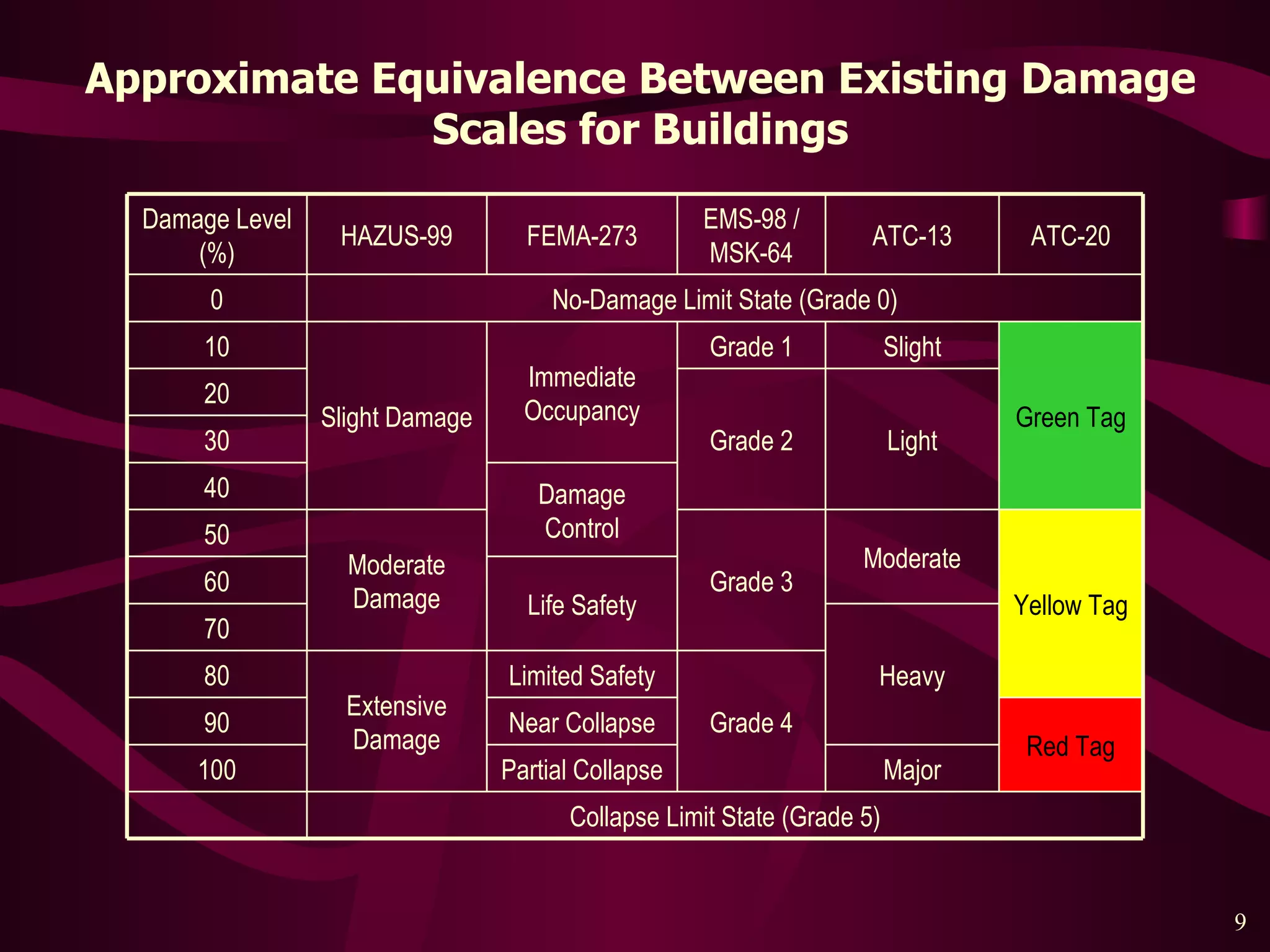
Approximate Equivalence Between Existing Damage Scales for Buildings Damage Control Collapse Limit State (Grade 5) Major Partial Collapse 100 Red Tag Near Collapse 90 Grade 4 Limited Safety Extensive Damage 80 Heavy 70 Life Safety 60 Yellow Tag Moderate Grade 3 Moderate Damage 50 40 30 Light Grade 2 20 Green Tag Slight Grade 1 Immediate Occupancy Slight Damage 10 No-Damage Limit State (Grade 0) 0 ATC-20 ATC-13 EMS-98 / MSK-64 FEMA-273 HAZUS-99 Damage Level (%)
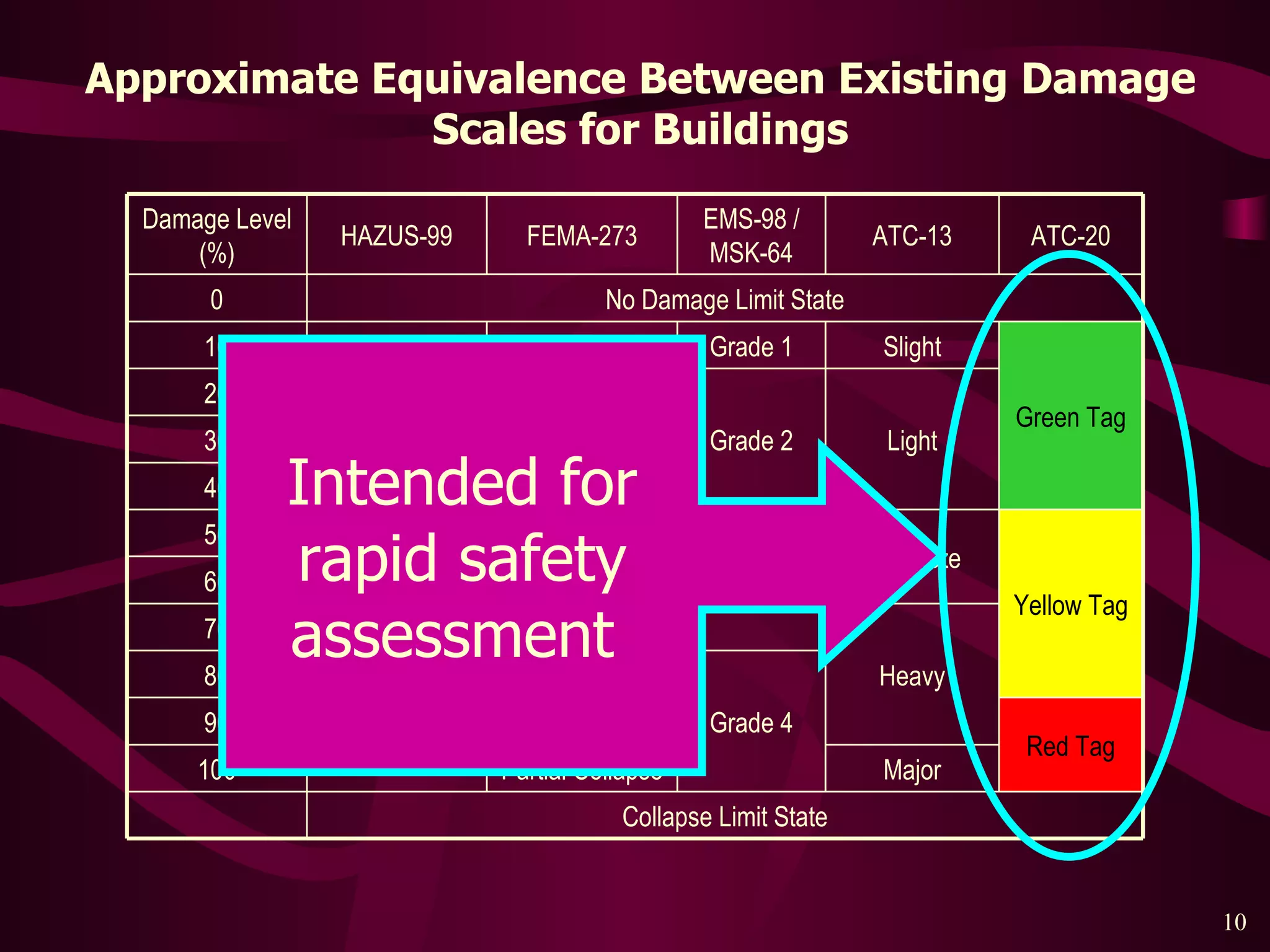
Approximate Equivalence Between Existing Damage Scales for Buildings Damage Control Collapse Limit State Major Partial Collapse 100 Red Tag Near Collapse 90 Grade 4 Limited Safety Extensive Damage 80 Heavy 70 Life Safety 60 Yellow Tag Moderate Grade 3 Moderate Damage 50 40 30 Light Grade 2 20 Green Tag Slight Grade 1 Immediate Occupancy Slight Damage 10 No Damage Limit State 0 ATC-20 ATC-13 EMS-98 / MSK-64 FEMA-273 HAZUS-99 Damage Level (%) Intended for rapid safety assessment
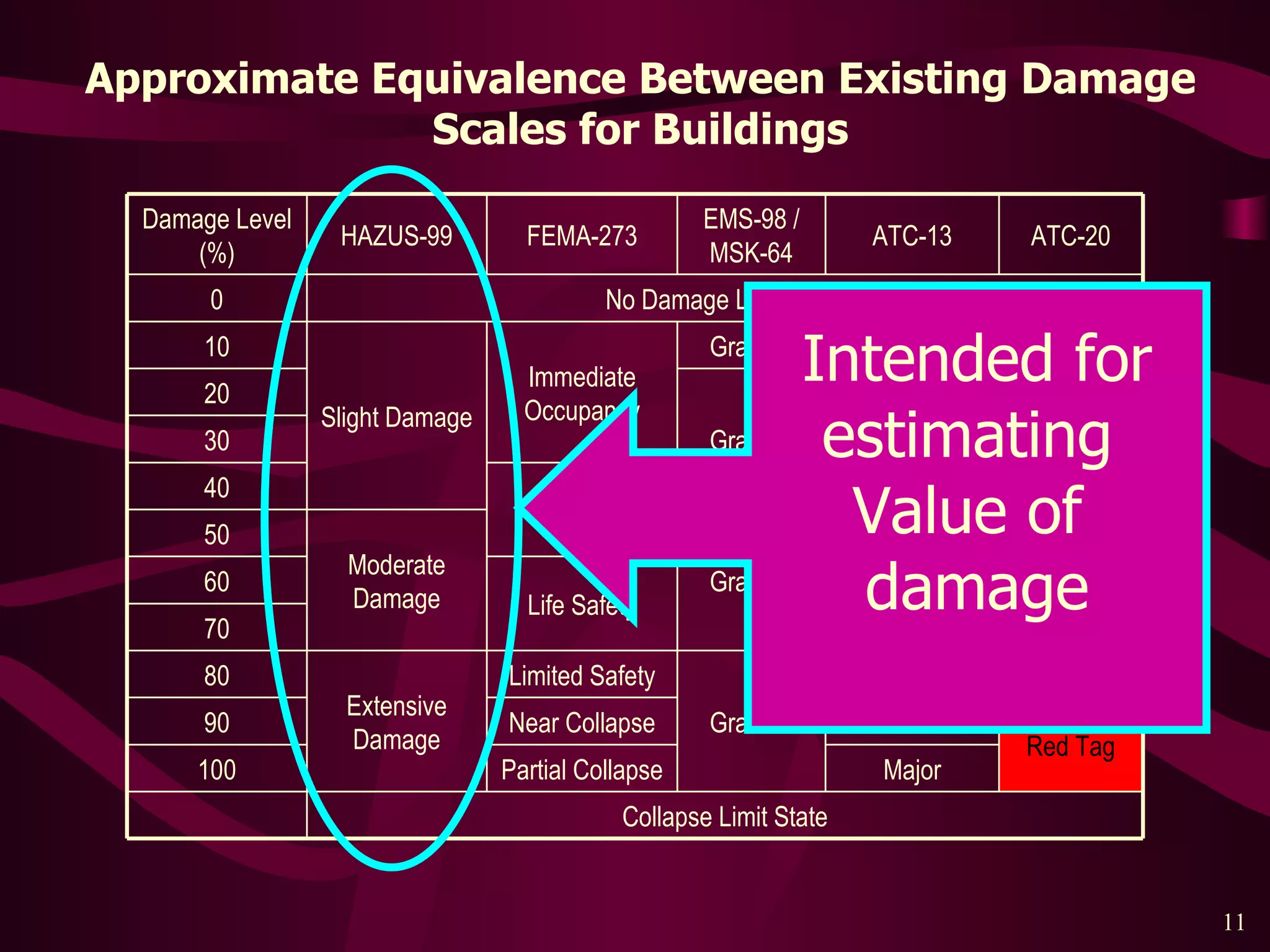
Approximate Equivalence Between Existing Damage Scales for Buildings Damage Control Collapse Limit State Major Partial Collapse 100 Red Tag Near Collapse 90 Grade 4 Limited Safety Extensive Damage 80 Heavy 70 Life Safety 60 Yellow Tag Moderate Grade 3 Moderate Damage 50 40 30 Light Grade 2 20 Green Tag Slight Grade 1 Immediate Occupancy Slight Damage 10 No Damage Limit State 0 ATC-20 ATC-13 EMS-98 / MSK-64 FEMA-273 HAZUS-99 Damage Level (%) Intended for estimating  Value of  damage
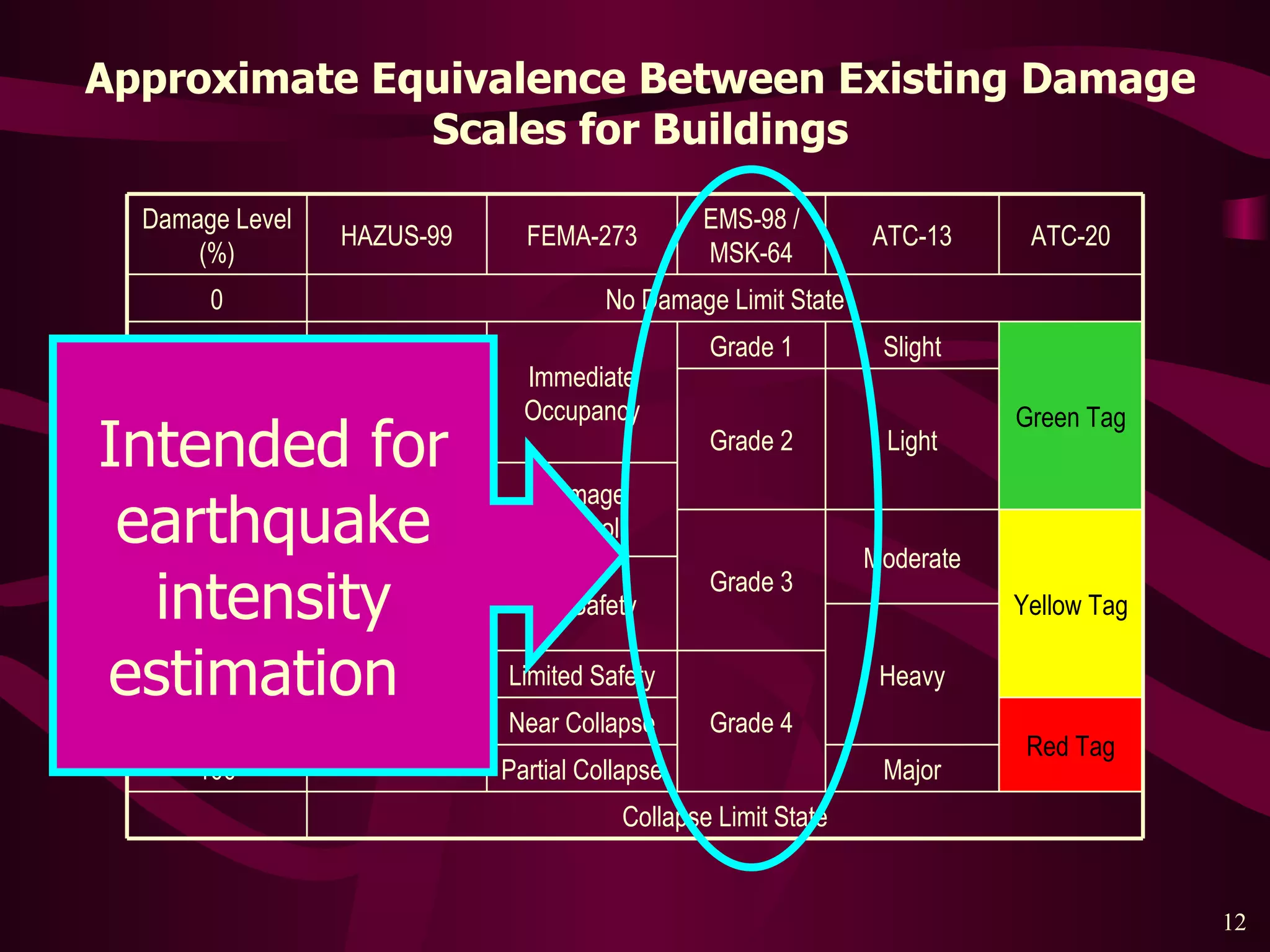
Approximate Equivalence Between Existing Damage Scales for Buildings Damage Control Collapse Limit State Major Partial Collapse 100 Red Tag Near Collapse 90 Grade 4 Limited Safety Extensive Damage 80 Heavy 70 Life Safety 60 Yellow Tag Moderate Grade 3 Moderate Damage 50 40 30 Light Grade 2 20 Green Tag Slight Grade 1 Immediate Occupancy Slight Damage 10 No Damage Limit State 0 ATC-20 ATC-13 EMS-98 / MSK-64 FEMA-273 HAZUS-99 Damage Level (%) Intended for earthquake intensity estimation
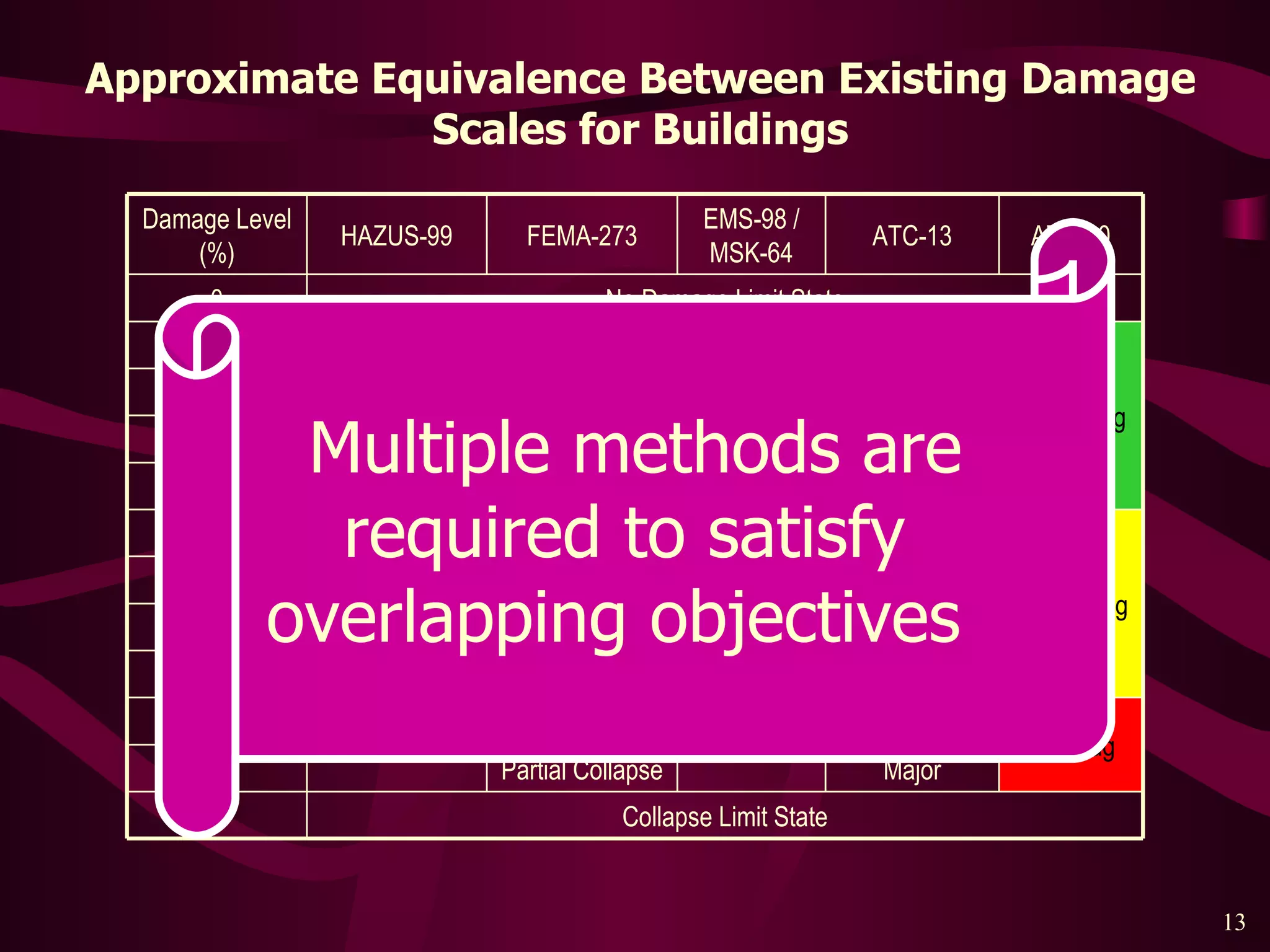
Approximate Equivalence Between Existing Damage Scales for Buildings Multiple methods are required to satisfy  overlapping objectives  Damage Control Collapse Limit State Major Partial Collapse 100 Red Tag Near Collapse 90 Grade 4 Limited Safety Extensive Damage 80 Heavy 70 Life Safety 60 Yellow Tag Moderate Grade 3 Moderate Damage 50 40 30 Light Grade 2 20 Green Tag Slight Grade 1 Immediate Occupancy Slight Damage 10 No Damage Limit State 0 ATC-20 ATC-13 EMS-98 / MSK-64 FEMA-273 HAZUS-99 Damage Level (%)
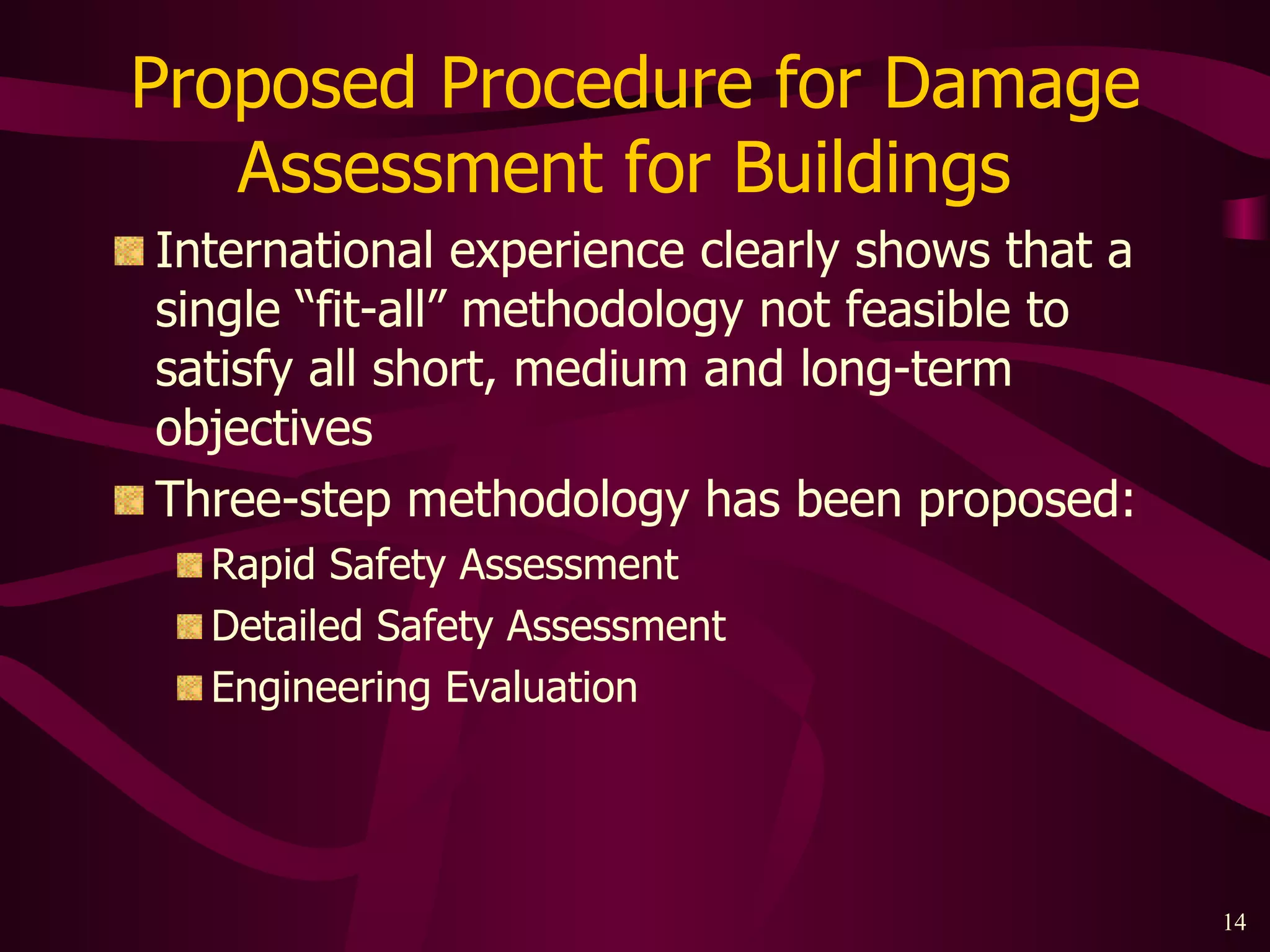
Proposed Procedure for Damage Assessment for Buildings  International experience clearly shows that a single “fit-all” methodology not feasible to satisfy all short, medium and long-term objectives Three-step methodology has been proposed: Rapid Safety Assessment Detailed Safety Assessment Engineering Evaluation
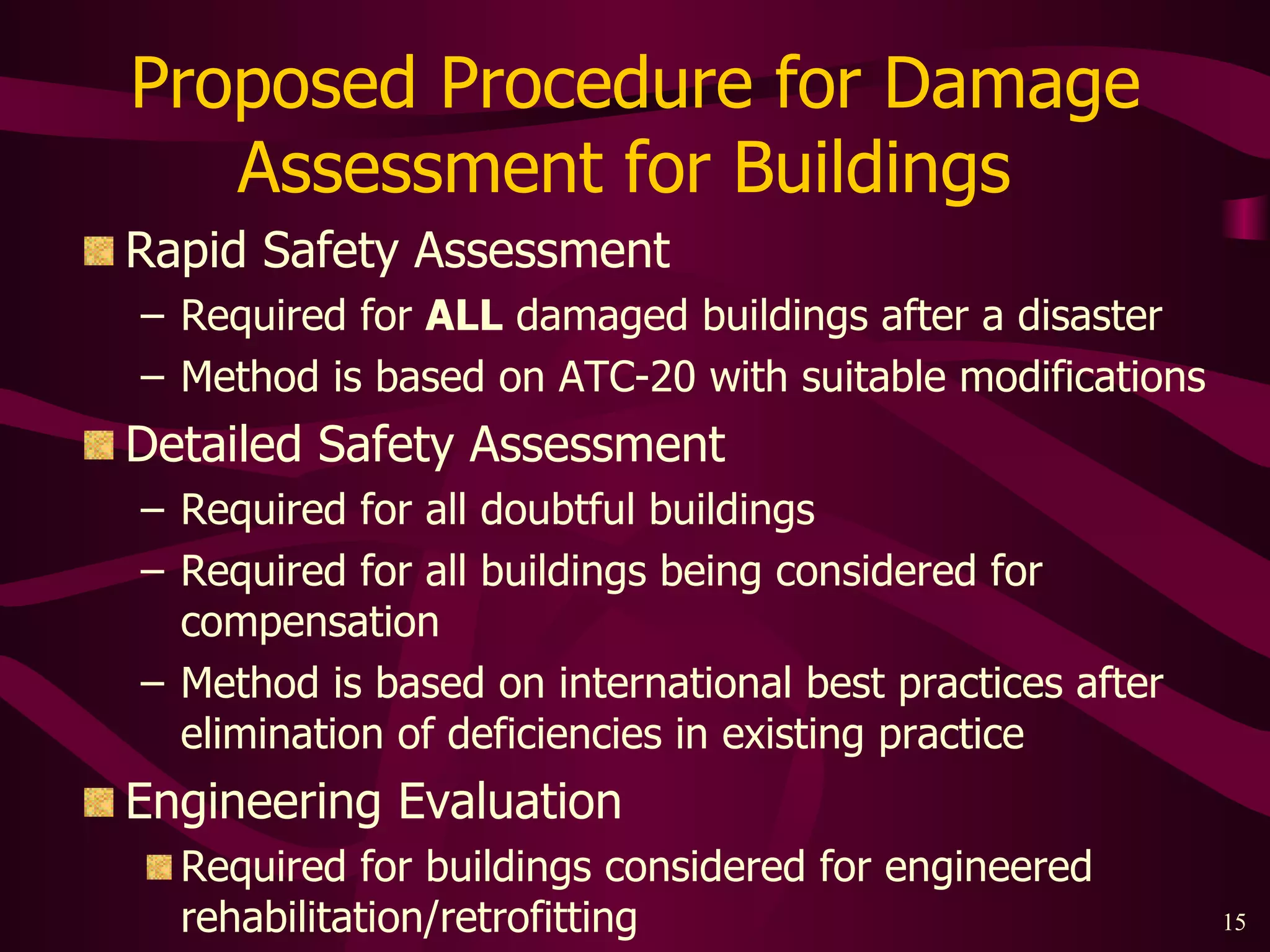
Proposed Procedure for Damage Assessment for Buildings  Rapid Safety Assessment Required for  ALL  damaged buildings after a disaster Method is based on ATC-20 with suitable modifications Detailed Safety Assessment Required for all doubtful buildings Required for all buildings being considered for compensation Method is based on international best practices after elimination of deficiencies in existing practice Engineering Evaluation Required for buildings considered for engineered rehabilitation/retrofitting
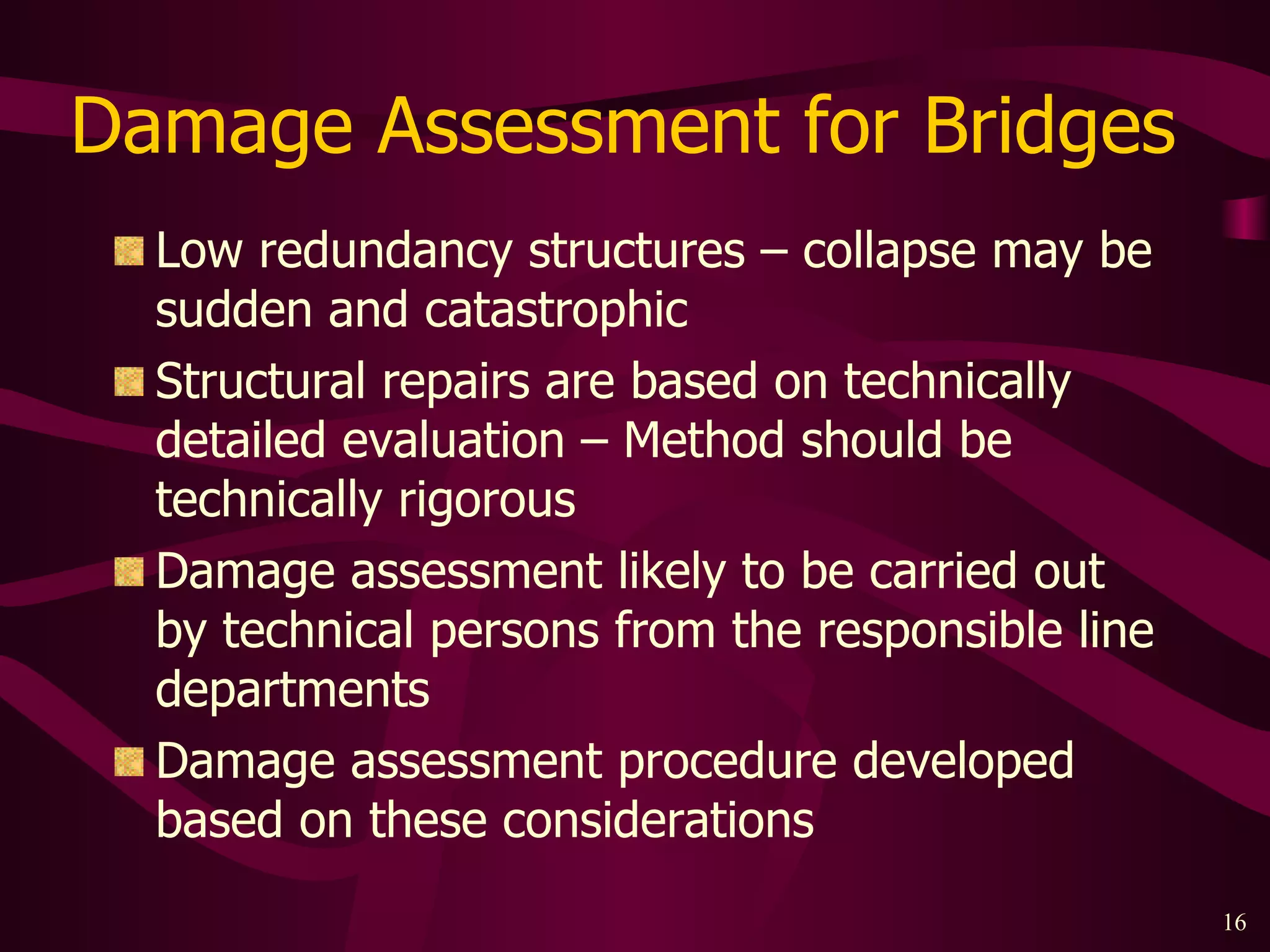
Damage Assessment for Bridges  Low redundancy structures – collapse may be sudden and catastrophic Structural repairs are based on technically detailed evaluation – Method should be technically rigorous Damage assessment likely to be carried out by technical persons from the responsible line departments Damage assessment procedure developed based on these considerations
Damage Assessment for Roads  Damage assessment based on visual evaluations Damage assessment likely to be carried out by technical persons from the responsible line departments Damage assessment procedure developed based on these considerations
Damage Assessment for  Storage Reservoirs  Low redundancy structures – collapse may be sudden and catastrophic Repairs are based on technically detailed evaluation – Method should be technically rigorous Initial damage assessment likely to be carried out by owners or users with limited technical skills Damage assessment procedure developed based on these considerations
Damage Assessment for  Irrigation Structures  Damage assessment mainly based on visual observations Initial damage assessment likely to be carried out by owners or users with limited technical skills Damage assessment procedure developed based on these considerations
Damage Assessment for  Surface Pipelines  Damage assessment mainly based on visual observations Initial damage assessment likely to be carried out by owners or users with limited technical skills Damage assessment procedure developed based on these considerations
Damage Assessment for  Water Supply and Sewerage  Damage assessment mainly based on visual observations Initial damage assessment likely to be carried out by owners or users with limited technical skills Damage assessment procedure developed based on these considerations
Damage Assessment for  Ports and Harbours  Damage assessment initially based on visual observations Repairs are based on technically detailed evaluation – Method should be technically rigorous Initial damage assessment likely to be carried out by owners or users with limited technical skills Damage assessment procedure developed based on these considerations
Damage Assessment for  Electricity Generation Structures  Damage assessment initially based on visual observations Repairs are based on technically detailed evaluation – Method should be technically rigorous Initial damage assessment likely to be carried out by owners or users with limited technical skills Damage assessment procedure developed based on these considerations
Damage Assessment for  Electricity Transmission and Distr.  Damage assessment mainly based on visual observations Initial damage assessment likely to be carried out by owners or users with limited technical skills Damage assessment procedure developed based on these considerations
Damage Assessment for  Industrial Structures  Damage assessment initially based on visual observations Repairs are based on technically detailed evaluation – Method should be technically rigorous Initial damage assessment likely to be carried out by owners or users with limited technical skills Damage assessment procedure developed based on these considerations
Damage Assessment for  Environmental Impact  Environmental Impact assessment needs to consider the environmental and social impact of the disaster Assessment needs to be carried out over long-term to quantitatively evaluate the impact Damage assessment procedure developed based on these considerations
Thank You

04 damage assessment methodology

  • 1.
    Damage Assessment MethodologyAn Overview Prof. Ravi Sinha Indian Institute of Technology Bombay Seminar on Loss and Damage Assessment Methodologies, Ahmedabad, April 21, 2005 Damage and Loss Assessment Methodology Developed by Asian Disasters Preparedness Centre Centre for Environmental Planning and Technology Indian Institute of Technology Bombay
  • 2.
    Context of DamageAssessment Primary focus is on condition of physical assets: Buildings (Residential, Office, Commercial, Lifeline etc.) Roads and Bridges Water supply and sanitation structures Dams and other irrigation structures Industrial facilities (including power plants) Ports and other coastal structures Electrical and Communications system structures
  • 3.
    Objectives of DamageAssessment Will depend on the type and intensity of the disaster Minor/moderate disasters: Estimate total losses (for reporting and policy purposes) Help develop repair/rehabilitation procedures Major disasters: Same objectives as for minor/moderate disasters Also assess extent of damage to buildings and other structures (and its geographical distribution)
  • 4.
    Objectives of DamageAssessment Short-Term (within a few days): To quickly identify the safe and unsafe buildings To quickly estimate total damage losses (for reporting and policy purposes) To quickly identify status of lifeline buildings and other structures Medium-Term (within a few weeks): To assess safety status of doubtful category structures To reassess and quantify damage losses Long-Term (few months to years): To help develop rehabilitation/retrofitting procedures To help identify deficiencies in prevalent technical knowledge and its implementation mechanisms
  • 5.
    Primary Focus forDA Structures which are owned by multiple agencies of the government Structures that may require government funds for repairs or rehabilitation (including private buildings) Structures that affect a large number of people Buildings Bridges Tanks and storage reservoirs (UGSR, GSR & ESR)
  • 6.
    Secondary Focus forDA Structures owned or operated by specialised agencies Very complex structures that require high-level technical skills for assessment Complex industrial facilities Port and harbour structures Petrochemical infrastructure Dams Roads Electrical generation & transmission networks, etc.
  • 7.
    Basic Philosophy ofDA Should be based on international sound-practices Should consider the types of structures prevalent in Gujarat Should consider the technical skills likely to be available after a disaster Should incorporate experiences from recent disasters, particularly the 2001 earthquake and 1998 cyclone disasters
  • 8.
    Damage Assessment forBuildings Method should dependent on building type Very large number of buildings are likely to be damaged in a major disaster – Method should be relatively rapid Structural repairs are based on technically detailed evaluation – Method should be technically rigorous Method should consider the variations in international “best practices”
  • 9.
    Approximate Equivalence BetweenExisting Damage Scales for Buildings Damage Control Collapse Limit State (Grade 5) Major Partial Collapse 100 Red Tag Near Collapse 90 Grade 4 Limited Safety Extensive Damage 80 Heavy 70 Life Safety 60 Yellow Tag Moderate Grade 3 Moderate Damage 50 40 30 Light Grade 2 20 Green Tag Slight Grade 1 Immediate Occupancy Slight Damage 10 No-Damage Limit State (Grade 0) 0 ATC-20 ATC-13 EMS-98 / MSK-64 FEMA-273 HAZUS-99 Damage Level (%)
  • 10.
    Approximate Equivalence BetweenExisting Damage Scales for Buildings Damage Control Collapse Limit State Major Partial Collapse 100 Red Tag Near Collapse 90 Grade 4 Limited Safety Extensive Damage 80 Heavy 70 Life Safety 60 Yellow Tag Moderate Grade 3 Moderate Damage 50 40 30 Light Grade 2 20 Green Tag Slight Grade 1 Immediate Occupancy Slight Damage 10 No Damage Limit State 0 ATC-20 ATC-13 EMS-98 / MSK-64 FEMA-273 HAZUS-99 Damage Level (%) Intended for rapid safety assessment
  • 11.
    Approximate Equivalence BetweenExisting Damage Scales for Buildings Damage Control Collapse Limit State Major Partial Collapse 100 Red Tag Near Collapse 90 Grade 4 Limited Safety Extensive Damage 80 Heavy 70 Life Safety 60 Yellow Tag Moderate Grade 3 Moderate Damage 50 40 30 Light Grade 2 20 Green Tag Slight Grade 1 Immediate Occupancy Slight Damage 10 No Damage Limit State 0 ATC-20 ATC-13 EMS-98 / MSK-64 FEMA-273 HAZUS-99 Damage Level (%) Intended for estimating Value of damage
  • 12.
    Approximate Equivalence BetweenExisting Damage Scales for Buildings Damage Control Collapse Limit State Major Partial Collapse 100 Red Tag Near Collapse 90 Grade 4 Limited Safety Extensive Damage 80 Heavy 70 Life Safety 60 Yellow Tag Moderate Grade 3 Moderate Damage 50 40 30 Light Grade 2 20 Green Tag Slight Grade 1 Immediate Occupancy Slight Damage 10 No Damage Limit State 0 ATC-20 ATC-13 EMS-98 / MSK-64 FEMA-273 HAZUS-99 Damage Level (%) Intended for earthquake intensity estimation
  • 13.
    Approximate Equivalence BetweenExisting Damage Scales for Buildings Multiple methods are required to satisfy overlapping objectives Damage Control Collapse Limit State Major Partial Collapse 100 Red Tag Near Collapse 90 Grade 4 Limited Safety Extensive Damage 80 Heavy 70 Life Safety 60 Yellow Tag Moderate Grade 3 Moderate Damage 50 40 30 Light Grade 2 20 Green Tag Slight Grade 1 Immediate Occupancy Slight Damage 10 No Damage Limit State 0 ATC-20 ATC-13 EMS-98 / MSK-64 FEMA-273 HAZUS-99 Damage Level (%)
  • 14.
    Proposed Procedure forDamage Assessment for Buildings International experience clearly shows that a single “fit-all” methodology not feasible to satisfy all short, medium and long-term objectives Three-step methodology has been proposed: Rapid Safety Assessment Detailed Safety Assessment Engineering Evaluation
  • 15.
    Proposed Procedure forDamage Assessment for Buildings Rapid Safety Assessment Required for ALL damaged buildings after a disaster Method is based on ATC-20 with suitable modifications Detailed Safety Assessment Required for all doubtful buildings Required for all buildings being considered for compensation Method is based on international best practices after elimination of deficiencies in existing practice Engineering Evaluation Required for buildings considered for engineered rehabilitation/retrofitting
  • 16.
    Damage Assessment forBridges Low redundancy structures – collapse may be sudden and catastrophic Structural repairs are based on technically detailed evaluation – Method should be technically rigorous Damage assessment likely to be carried out by technical persons from the responsible line departments Damage assessment procedure developed based on these considerations
  • 17.
    Damage Assessment forRoads Damage assessment based on visual evaluations Damage assessment likely to be carried out by technical persons from the responsible line departments Damage assessment procedure developed based on these considerations
  • 18.
    Damage Assessment for Storage Reservoirs Low redundancy structures – collapse may be sudden and catastrophic Repairs are based on technically detailed evaluation – Method should be technically rigorous Initial damage assessment likely to be carried out by owners or users with limited technical skills Damage assessment procedure developed based on these considerations
  • 19.
    Damage Assessment for Irrigation Structures Damage assessment mainly based on visual observations Initial damage assessment likely to be carried out by owners or users with limited technical skills Damage assessment procedure developed based on these considerations
  • 20.
    Damage Assessment for Surface Pipelines Damage assessment mainly based on visual observations Initial damage assessment likely to be carried out by owners or users with limited technical skills Damage assessment procedure developed based on these considerations
  • 21.
    Damage Assessment for Water Supply and Sewerage Damage assessment mainly based on visual observations Initial damage assessment likely to be carried out by owners or users with limited technical skills Damage assessment procedure developed based on these considerations
  • 22.
    Damage Assessment for Ports and Harbours Damage assessment initially based on visual observations Repairs are based on technically detailed evaluation – Method should be technically rigorous Initial damage assessment likely to be carried out by owners or users with limited technical skills Damage assessment procedure developed based on these considerations
  • 23.
    Damage Assessment for Electricity Generation Structures Damage assessment initially based on visual observations Repairs are based on technically detailed evaluation – Method should be technically rigorous Initial damage assessment likely to be carried out by owners or users with limited technical skills Damage assessment procedure developed based on these considerations
  • 24.
    Damage Assessment for Electricity Transmission and Distr. Damage assessment mainly based on visual observations Initial damage assessment likely to be carried out by owners or users with limited technical skills Damage assessment procedure developed based on these considerations
  • 25.
    Damage Assessment for Industrial Structures Damage assessment initially based on visual observations Repairs are based on technically detailed evaluation – Method should be technically rigorous Initial damage assessment likely to be carried out by owners or users with limited technical skills Damage assessment procedure developed based on these considerations
  • 26.
    Damage Assessment for Environmental Impact Environmental Impact assessment needs to consider the environmental and social impact of the disaster Assessment needs to be carried out over long-term to quantitatively evaluate the impact Damage assessment procedure developed based on these considerations
  • 27.