Sanjivani Rural Education Society's
Sanjivani College of Engineering, Kopargaon 423603.
Department of Civil Engineering
Sub –Infrastructure Policies
T. Y. B Tech Civil, Semester –I
Topic- 1.1 Introduction to Infrastructure
Unit-I –Introduction to Infrastructure
By,
Prof. Nitin.B.Aher
(Assistant Professor)
Mail Id- ahernitincivil@sanjivani.org.in
Introduction
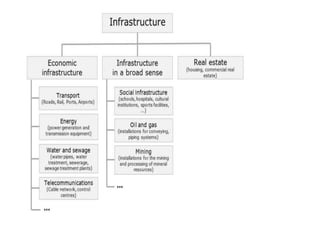
• What Is Infrastructure?
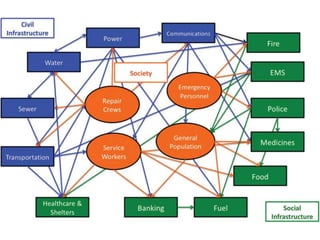
• Infrastructure is the general term for the basic physical
systems of a business, region, or nation. Examples of
infrastructure include transportation systems,
communication networks, sewage, water, and electric
systems. These systems tend to be capital intensive and
high-cost investments, and are vital to a country's
economic development and prosperity
• Projects related to infrastructure improvements may be
funded publicly, privately, or through public-private
partnerships. In economic terms, infrastructure often
involves the production of public goods or production
processes that support natural monopolies
Definition: Infrastructure
The basic physical and organizational structures and
facilities (e.g. buildings, roads, power supplies)
needed for the operation of a society or enterprise
Infrastructure refers to the core elements of economic and
social change that serve as support systems to the
production activities in the economy. These elements
include the following:
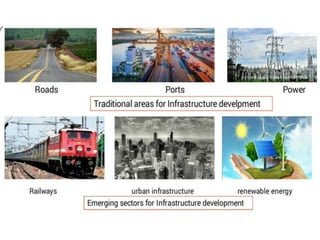
1. Roads
2. Railways
3. Telecommunication facilities
4. Educational system including schools and colleges
5. Health system including hospitals
6. Sanitary system including clean drinking water facilities
7. Monetary system including banks, insurance, and other
financial institutions
Important Terms
 Infrastructure are the basic systems that undergoes the
structure of the economy.
 Examples of infrastructure include transportation
facilities, telecommunications networks, and water
supplies.
 Large scale infrastructure is usually produced by the
public sector or publicly regulated monopolies, but at
smaller scales infrastructure can often be produced by
private firms or through local collective action.
 As an investment, infrastructure tends to be less volatile
than some other asset classes and is sometimes sought
as an investment.
Historical Overview of the infrastructure
development in India
 At present infrastructure sector is the key driver for the
Indian economy.
 The sector is highly responsible for the propelling India's
overall development and enjoys intense focus from
government for initiating policies that would ensure
time bound creation of world class infrastructure in the
country
 Infrastructure sector includes power , bridges, dams ,
roads and the infrastructure development
 In 2016 India jumped 19 places in world bank logistics
Performnce Index (LPI) 2016, to rank 35th amongst 160
countries.
 An analysis of the previous and present government
plans reveals that energy security & improving
connectivity both (physical & virtual) are emerging as
the 2 major areas of infrastructure development in India
 Development in India after independence
1. Service sector growth
2. Growth in agriculture
3. infrastructure development
4. Progress in educational sector
5. Achievement in healthcare sector
6. Scientific achievement
Governing Features
 Infrastructure facilities are generally available to large
group of people
 It helps deliver essential services for the functioning of
an organization or society
 It helps achieves economics and social objectives
 It is the base upon which society and its activities rests
 E.g. Waterways , railways, Industrial areas & hospitals
etc.
Rather than describing infrastructure through a single definition,
it might more helpful to describe infrastructure through a set of
governing features
Economic Importance of Infrastructure
 Raises Productivity
 Provides Employment
 Induces Foreign Investment
 Raises ability to work
 Facilitates outsourcing
 Raises economic development
 Raises size of market
 Generates linkages in production
Purpose of Infrastructure
 Infrastructure to all such services and facilities, which are
needed to provide different kinds of services in an economy
and which are essential in raising the place of economic growth
of country.
 It contributes to economic development of a country both by
raising the productivity of factors of production and improving
the quality of life of its people
 It provide supporting services in the main areas of industrial
and agriculture production, domestic and foreign trade and
commerce
State of Infrastructure in India
 With rapid population growth, urban designers face
tremendous challenges to accommodate the increasing
size of the population in urban areas while simultaneously
considering future environmental, social, and economic
impacts. A “smart city” is an urban development vision
that integrates multiple information and communication
technologies to manage the assets of a city, including its
information systems, transportation systems, power
plants, water supply networks, waste management
systems, and other community services provided by a local
department
Infrastructure Development: Current Scenario
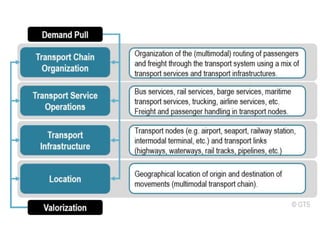
 Urban development and transport infrastructure are
the two segments of the Indian infrastructure sector
that present the best opportunities for Australia. Given
the differences in the nature of the opportunities this
chapter examines them separately
The urbanisation of the world's largest rural population
brings enormous opportunities and challenges. India's
urban population is expected to reach 640 million by 2035.
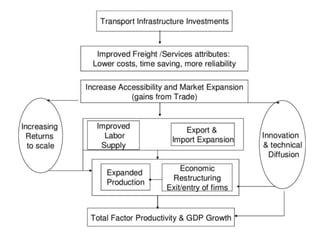
 Improving transport infrastructure is critical to the
liveability of India's cities. It is also central to India's
productivity and the competitiveness of sectors such as
agriculture and manufacturing.
 Transport is expected to attract the majority of
infrastructure investment in India out to 2035. The need
for capital is immense. Issues around land acquisition and
dispute resolution could keep the sector from reaching its
potential.
 The Indian Government is actively seeking foreign
investment to finance its large-scale rail and road
connectivity projects, with the creation of new
investment vehicles and financing models. It is also
beginning to improve regulatory clarity and reduce
execution risk through policy reform.
 Urban development and associated infrastructure
investment is a major source of growth for India.
Urbanisation drives demand for inputs across sectors
(such as metallurgical coal and iron ore for steel
production) and shapes India's use of energy. The Indian
Government is focusing on improving basic services
such as sanitation and housing. Water management is a
serious challenge, with most of India's large cities
already facing water shortages on a daily basis
India's population growth and economic
development requires improved transport
infrastructure, including through investments in
roads, railways, and aviation, shipping and inland
waterways.
Capital is the key to advancing India's transport
infrastructure
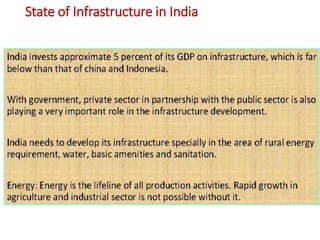
 India will require investments of over USD4.5
trillion by 2040 for the development of its
infrastructure, according to the Economic Survey
2017–18
 of this, India will be able to meet about
USD3.9 trillion, leaving a $526 billion deficit
Infrastructure Project
 Infrastructure projects focus on the development and
maintenance of services, facilities, and systems. These
can be funded by private companies, publicly, or
combined as a public-private partnership (a collaboration
of government entities and private sector companies).
The private investments can help manage the economic
development of a city, state or an entire country.
 Construction trends emphasize technology and
other innovative advancements, to contribute to our
economic growth and wellbeing
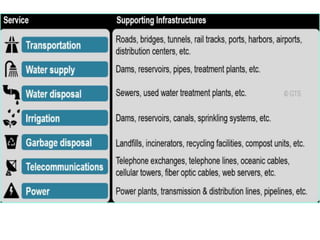
Types of Infrastructure Projects
1. Aviation Infrastructure
2. Bridge Infrastructure
3. Communications Infrastructure
4. Power and Energy Infrastructure
5. Railroad Infrastructure
6. Road Infrastructure
7. Water Infrastructure
8. Waste Management
9. Hazardous Waste Management
1. Aviation Infrastructure
 Aviation infrastructure projects develop and maintain
airplanes and airports. This form of construction is a crucial
part of the United States Transportation System.
 The Federal Aviation Administration (FAA) funded $840
million in infrastructure grants to 381 airports across the
United States.
 Its Next Generation of Air Transportation System
(NextGen) project will be one of the most technical aviation
infrastructure construction efforts to date. The project’s goal
is to renovate aging airports and deteriorating runways.
Air traffic is expected to experience double digit growth well
beyond 2020, at which point India will become the world's
third largest aviation market (behind China and the United
States)
 passenger traffic is forecast to multiply by four times and
cargo traffic by six times in the next twenty years; India's
existing airport infrastructure is underutilised
 of the 449 airports or airstrips in India, commercial
airlines are operating at just 61, with the remaining
unused or only occasionally used65
 but of those 61, several are under strain and at
capacity
 many Indian airports have widely recognised deficiencies
in areas such as ground handling, night landing systems
and cargo handling
2. Bridge Infrastructure
 Bridge infrastructure construction oversees the costs of
building and maintaining bridges throughout the country. This
includes heavily-trafficked highway bridges that are accessed
daily.
3. Communications Infrastructure
 The communications infrastructure sector focuses on the
connection between government agencies, businesses, and
the nation through wireless, cable, satellite and other
technologies. Private and government sectors work together,
ensuring that outages are fixed and updates keep wireless
networks streamlined.
4. Power and Energy Infrastructure
 The electrical infrastructure oversees projects that deal with
power including; electrical lines, power grids, and innovations
in alternative energy. The United State’s electricity system is
one of the largest in the world, using nearly 160,00 miles of
power lines, and connecting 145 million people.
5. Road Infrastructure
 Railroad infrastructure is on the pulse of the United States
transportation system. The sector is responsible for
innovating and safeguarding trains, subways, and light rail
systems. This includes track layout, steel supplies, bridges
and tunnels
India's road quality is generally low, despite India's roads
carrying 90 per cent of passenger traffic and 65 per cent of
freight
 road density is high but the length of surfaced roads is low
at 61 per cent (compared to Russia at 70 per cent or China
at 67 per cent)
 most highways are narrow, congested, and poorly surfaced
 there is poor access to rural areas; 40 per cent of India's
villages do not have access to all weather roads.
The Government of India has a range of projects to improve
road infrastructure
 the National Highways Development Projects, which
require investments of up to USD170 billion
 the Bharatmala project, stretching from India's western to
eastern land borders.
 the Northeast Express Highway (1,300 km express highway
in northeast India).
6. Rail Infrastructure
India's railways play a major role in affordable transport of
passengers and cargo across the country
 it is one of the largest networks in the world with 7,216
stations; 92,000 km of track and 1.3 million employees
 Indian railways carried eight billion passengers and
transported over one billion tonnes of freight in 2017–18
 however, most major corridors are facing severe capacity
constraints and there are safety issues
The Ministry of Railways plans to improve and expand the rail
network, renew the train fleet, and improve passenger safety. It
plans to invest up to $170 billion over the next five years, with the
largest proportion aimed at network expansion and decongestion,
and safety.64 Investments are also planned for station
redevelopment and the dedicated freight corridor between Delhi
and Mumbai.
 The Government of India is seeking greater private investment
through:
 allowing 100 per cent FDI in railways for construction,
operation and maintenance of suburban corridor projects, high-
speed train projects, railway electrification and signalling,
among others
 encouraging the development of new investment vehicles such
as the Railways of India Development Fund to attract long term
investment from global institutional investors.
7. Shipping Infrastructure
 India has unrealised potential in shipping, with 7,500
km of coastline and 14,500 km of navigable or
potentially navigable waterways.
 More than one billion tonnes of cargo was handled
across over 200 ports in India in 2015 with maritime
logistics accounting for 90 per cent of international
trade by volume and 72 per cent by value.
Despite the cost-efficiency of coastal and inland water
transportation, India's ports tend to be small, lack draft for
larger vessels, and are inefficient
 with an average 4.5 day turn-around time, versus one day in
China and 1.2 in the United States.
Port links to road and rail connections are poor
 between 2015 and 2025 the Indian Government's
SagarMala project is set to provide over $80 billion to
infrastructure for ports and coastal shipping in India
 the focus will be on enhanced connectivity through road,
rail and inland waterways, and port development and
modernisation.
8. Water Infrastructure
 Water infrastructure works to create sustainable
water projects to purify water supplies from waste, and make
it safe for drinking. The Environmental Protection
Agency (EPA) works with other water sector partners to
improve water efficiency in each state.
9. Waste Management Infrastructure
 Construction waste management works to improve the
environment by storing, treating and eliminating hazardous
materials. Sustainable construction practices are used to
safely reprocess water for drinking, enhance human health,
and dispose of sewage and solid waste.
Hazardous Waste Management Infrastructure
 Hazardous waste construction finds and disposes of
hazardous materials to protect the environment. Solid and
hazardous waste bi-products, such as sewage remnants and
other industrial leftovers, are transported to designated
landfills hazardous waste facilities. Tanks, drip pads and
incinerators are used to treat, recycle or dispose of..
Thank You

Introduction to Infrastructure.pptx

  • 1.
    Sanjivani Rural EducationSociety's Sanjivani College of Engineering, Kopargaon 423603. Department of Civil Engineering Sub –Infrastructure Policies T. Y. B Tech Civil, Semester –I Topic- 1.1 Introduction to Infrastructure Unit-I –Introduction to Infrastructure By, Prof. Nitin.B.Aher (Assistant Professor) Mail Id- ahernitincivil@sanjivani.org.in
  • 2.
    Introduction • What IsInfrastructure? • Infrastructure is the general term for the basic physical systems of a business, region, or nation. Examples of infrastructure include transportation systems, communication networks, sewage, water, and electric systems. These systems tend to be capital intensive and high-cost investments, and are vital to a country's economic development and prosperity • Projects related to infrastructure improvements may be funded publicly, privately, or through public-private partnerships. In economic terms, infrastructure often involves the production of public goods or production processes that support natural monopolies
  • 3.
    Definition: Infrastructure The basicphysical and organizational structures and facilities (e.g. buildings, roads, power supplies) needed for the operation of a society or enterprise Infrastructure refers to the core elements of economic and social change that serve as support systems to the production activities in the economy. These elements include the following: 1. Roads 2. Railways 3. Telecommunication facilities 4. Educational system including schools and colleges 5. Health system including hospitals 6. Sanitary system including clean drinking water facilities 7. Monetary system including banks, insurance, and other financial institutions
  • 4.
    Important Terms  Infrastructureare the basic systems that undergoes the structure of the economy.  Examples of infrastructure include transportation facilities, telecommunications networks, and water supplies.  Large scale infrastructure is usually produced by the public sector or publicly regulated monopolies, but at smaller scales infrastructure can often be produced by private firms or through local collective action.  As an investment, infrastructure tends to be less volatile than some other asset classes and is sometimes sought as an investment.
  • 5.
    Historical Overview ofthe infrastructure development in India  At present infrastructure sector is the key driver for the Indian economy.  The sector is highly responsible for the propelling India's overall development and enjoys intense focus from government for initiating policies that would ensure time bound creation of world class infrastructure in the country  Infrastructure sector includes power , bridges, dams , roads and the infrastructure development  In 2016 India jumped 19 places in world bank logistics Performnce Index (LPI) 2016, to rank 35th amongst 160 countries.
  • 6.
     An analysisof the previous and present government plans reveals that energy security & improving connectivity both (physical & virtual) are emerging as the 2 major areas of infrastructure development in India  Development in India after independence 1. Service sector growth 2. Growth in agriculture 3. infrastructure development 4. Progress in educational sector 5. Achievement in healthcare sector 6. Scientific achievement
  • 8.
    Governing Features  Infrastructurefacilities are generally available to large group of people  It helps deliver essential services for the functioning of an organization or society  It helps achieves economics and social objectives  It is the base upon which society and its activities rests  E.g. Waterways , railways, Industrial areas & hospitals etc. Rather than describing infrastructure through a single definition, it might more helpful to describe infrastructure through a set of governing features
  • 9.
    Economic Importance ofInfrastructure
  • 10.
     Raises Productivity Provides Employment  Induces Foreign Investment  Raises ability to work  Facilitates outsourcing  Raises economic development  Raises size of market  Generates linkages in production
  • 11.
    Purpose of Infrastructure Infrastructure to all such services and facilities, which are needed to provide different kinds of services in an economy and which are essential in raising the place of economic growth of country.  It contributes to economic development of a country both by raising the productivity of factors of production and improving the quality of life of its people  It provide supporting services in the main areas of industrial and agriculture production, domestic and foreign trade and commerce
  • 14.
  • 18.
     With rapidpopulation growth, urban designers face tremendous challenges to accommodate the increasing size of the population in urban areas while simultaneously considering future environmental, social, and economic impacts. A “smart city” is an urban development vision that integrates multiple information and communication technologies to manage the assets of a city, including its information systems, transportation systems, power plants, water supply networks, waste management systems, and other community services provided by a local department
  • 22.
  • 23.
     Urban developmentand transport infrastructure are the two segments of the Indian infrastructure sector that present the best opportunities for Australia. Given the differences in the nature of the opportunities this chapter examines them separately The urbanisation of the world's largest rural population brings enormous opportunities and challenges. India's urban population is expected to reach 640 million by 2035.  Improving transport infrastructure is critical to the liveability of India's cities. It is also central to India's productivity and the competitiveness of sectors such as agriculture and manufacturing.
  • 24.
     Transport isexpected to attract the majority of infrastructure investment in India out to 2035. The need for capital is immense. Issues around land acquisition and dispute resolution could keep the sector from reaching its potential.  The Indian Government is actively seeking foreign investment to finance its large-scale rail and road connectivity projects, with the creation of new investment vehicles and financing models. It is also beginning to improve regulatory clarity and reduce execution risk through policy reform.
  • 25.
     Urban developmentand associated infrastructure investment is a major source of growth for India. Urbanisation drives demand for inputs across sectors (such as metallurgical coal and iron ore for steel production) and shapes India's use of energy. The Indian Government is focusing on improving basic services such as sanitation and housing. Water management is a serious challenge, with most of India's large cities already facing water shortages on a daily basis
  • 26.
    India's population growthand economic development requires improved transport infrastructure, including through investments in roads, railways, and aviation, shipping and inland waterways. Capital is the key to advancing India's transport infrastructure  India will require investments of over USD4.5 trillion by 2040 for the development of its infrastructure, according to the Economic Survey 2017–18  of this, India will be able to meet about USD3.9 trillion, leaving a $526 billion deficit
  • 27.
    Infrastructure Project  Infrastructureprojects focus on the development and maintenance of services, facilities, and systems. These can be funded by private companies, publicly, or combined as a public-private partnership (a collaboration of government entities and private sector companies). The private investments can help manage the economic development of a city, state or an entire country.  Construction trends emphasize technology and other innovative advancements, to contribute to our economic growth and wellbeing
  • 28.
    Types of InfrastructureProjects 1. Aviation Infrastructure 2. Bridge Infrastructure 3. Communications Infrastructure 4. Power and Energy Infrastructure 5. Railroad Infrastructure 6. Road Infrastructure 7. Water Infrastructure 8. Waste Management 9. Hazardous Waste Management
  • 29.
    1. Aviation Infrastructure Aviation infrastructure projects develop and maintain airplanes and airports. This form of construction is a crucial part of the United States Transportation System.  The Federal Aviation Administration (FAA) funded $840 million in infrastructure grants to 381 airports across the United States.  Its Next Generation of Air Transportation System (NextGen) project will be one of the most technical aviation infrastructure construction efforts to date. The project’s goal is to renovate aging airports and deteriorating runways.
  • 30.
    Air traffic isexpected to experience double digit growth well beyond 2020, at which point India will become the world's third largest aviation market (behind China and the United States)  passenger traffic is forecast to multiply by four times and cargo traffic by six times in the next twenty years; India's existing airport infrastructure is underutilised  of the 449 airports or airstrips in India, commercial airlines are operating at just 61, with the remaining unused or only occasionally used65  but of those 61, several are under strain and at capacity  many Indian airports have widely recognised deficiencies in areas such as ground handling, night landing systems and cargo handling
  • 31.
    2. Bridge Infrastructure Bridge infrastructure construction oversees the costs of building and maintaining bridges throughout the country. This includes heavily-trafficked highway bridges that are accessed daily.
  • 32.
    3. Communications Infrastructure The communications infrastructure sector focuses on the connection between government agencies, businesses, and the nation through wireless, cable, satellite and other technologies. Private and government sectors work together, ensuring that outages are fixed and updates keep wireless networks streamlined.
  • 33.
    4. Power andEnergy Infrastructure  The electrical infrastructure oversees projects that deal with power including; electrical lines, power grids, and innovations in alternative energy. The United State’s electricity system is one of the largest in the world, using nearly 160,00 miles of power lines, and connecting 145 million people.
  • 34.
    5. Road Infrastructure Railroad infrastructure is on the pulse of the United States transportation system. The sector is responsible for innovating and safeguarding trains, subways, and light rail systems. This includes track layout, steel supplies, bridges and tunnels
  • 35.
    India's road qualityis generally low, despite India's roads carrying 90 per cent of passenger traffic and 65 per cent of freight  road density is high but the length of surfaced roads is low at 61 per cent (compared to Russia at 70 per cent or China at 67 per cent)  most highways are narrow, congested, and poorly surfaced  there is poor access to rural areas; 40 per cent of India's villages do not have access to all weather roads. The Government of India has a range of projects to improve road infrastructure  the National Highways Development Projects, which require investments of up to USD170 billion  the Bharatmala project, stretching from India's western to eastern land borders.  the Northeast Express Highway (1,300 km express highway in northeast India).
  • 36.
    6. Rail Infrastructure India'srailways play a major role in affordable transport of passengers and cargo across the country  it is one of the largest networks in the world with 7,216 stations; 92,000 km of track and 1.3 million employees  Indian railways carried eight billion passengers and transported over one billion tonnes of freight in 2017–18  however, most major corridors are facing severe capacity constraints and there are safety issues
  • 37.
    The Ministry ofRailways plans to improve and expand the rail network, renew the train fleet, and improve passenger safety. It plans to invest up to $170 billion over the next five years, with the largest proportion aimed at network expansion and decongestion, and safety.64 Investments are also planned for station redevelopment and the dedicated freight corridor between Delhi and Mumbai.  The Government of India is seeking greater private investment through:  allowing 100 per cent FDI in railways for construction, operation and maintenance of suburban corridor projects, high- speed train projects, railway electrification and signalling, among others  encouraging the development of new investment vehicles such as the Railways of India Development Fund to attract long term investment from global institutional investors.
  • 38.
    7. Shipping Infrastructure India has unrealised potential in shipping, with 7,500 km of coastline and 14,500 km of navigable or potentially navigable waterways.  More than one billion tonnes of cargo was handled across over 200 ports in India in 2015 with maritime logistics accounting for 90 per cent of international trade by volume and 72 per cent by value.
  • 39.
    Despite the cost-efficiencyof coastal and inland water transportation, India's ports tend to be small, lack draft for larger vessels, and are inefficient  with an average 4.5 day turn-around time, versus one day in China and 1.2 in the United States. Port links to road and rail connections are poor  between 2015 and 2025 the Indian Government's SagarMala project is set to provide over $80 billion to infrastructure for ports and coastal shipping in India  the focus will be on enhanced connectivity through road, rail and inland waterways, and port development and modernisation.
  • 40.
    8. Water Infrastructure Water infrastructure works to create sustainable water projects to purify water supplies from waste, and make it safe for drinking. The Environmental Protection Agency (EPA) works with other water sector partners to improve water efficiency in each state.
  • 41.
    9. Waste ManagementInfrastructure  Construction waste management works to improve the environment by storing, treating and eliminating hazardous materials. Sustainable construction practices are used to safely reprocess water for drinking, enhance human health, and dispose of sewage and solid waste.
  • 42.
    Hazardous Waste ManagementInfrastructure  Hazardous waste construction finds and disposes of hazardous materials to protect the environment. Solid and hazardous waste bi-products, such as sewage remnants and other industrial leftovers, are transported to designated landfills hazardous waste facilities. Tanks, drip pads and incinerators are used to treat, recycle or dispose of..
  • 43.