UNIT I
1.1 NEED FOR INFORMATION SYSTEM FOR BUSINESS Information System Definition :  Information System is a group of connected components Input data Process data Output data Feed back Which are dependent on each other. Example : ATM’s Reservation Systems.
NEED  FOR  IS Fast  and  Accurate Transaction Processing Storage  with  Large-capacity and  Fast access. Fast communications. Competitive Weapons Support for Decision –making Reduction in Information Overload Cross Divisional Abilities
1.2 BUSINESS IN THE INFORMATION AGE These various trends put a lot of pressure on the companies. Different Pressures the company has to deal with are, Global competition for trade and Labor. Necessity of real time operations. Rapidly changing workforce. Customer orientation Technology Innovation Overload of Information Social responsibility Ethical issues.
CUSTOMER ORIENTATION Customer  satisfaction  involves  giving complete information to the customers such as.. Cost of a Product  Lifetime of a Product Various feature of the Product etc. Different companies must keep updating their website regularly with new information about their products.
ORGANIZATIONAL RESPONSES Strategic Systems Business Process Re-engineering(BPR) E-Commerce Business Alliances Continuous improvement efforts.
STRATEGIC  SYSTEMS - CHARACTERISTS ADHOCNESS UNEXPECTEDNESS PREDICTIVENESS SUMMARYNESS EXTERNAL SOURCE UNSTRUCTURED SUBJECTIVENESS
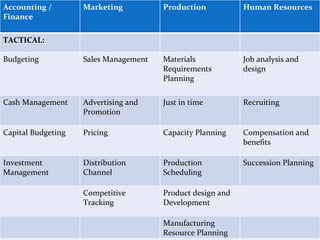
Accounting / Finance Marketing Production Human Resources TACTICAL: Budgeting Sales Management Materials Requirements Planning Job analysis and design Cash Management Advertising and Promotion Just in time Recruiting Capital Budgeting Pricing Capacity Planning Compensation and benefits Investment Management Distribution Channel Production Scheduling Succession Planning Competitive Tracking Product design and Development Manufacturing Resource Planning Computer Integrated manufacturing STRATEGIC: Financial Condition Analysis Sales forecasting Site Planning Selection Workforce planning Long – term forecasting Market research Technology Planning and Assessment Labor Negotiations Product planning and development Process Postioning
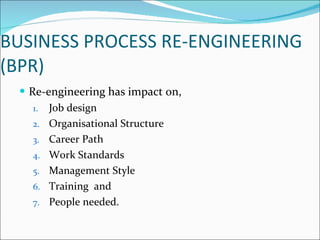
BUSINESS PROCESS RE-ENGINEERING (BPR) Re-engineering has impact on, Job design Organisational Structure Career Path Work Standards Management Style Training  and People needed.
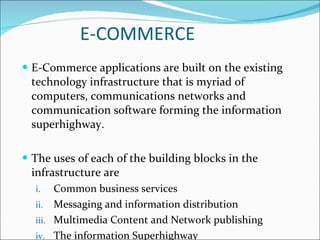
E-COMMERCE E-Commerce applications are built on the existing technology infrastructure that is myriad of computers, communications networks and communication software forming the information superhighway. The uses of each of the building blocks in the infrastructure are Common business services Messaging and information distribution Multimedia Content and Network publishing The information Superhighway
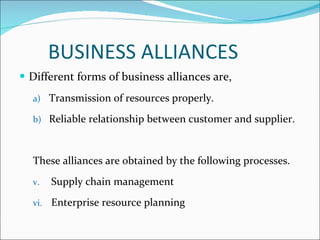
BUSINESS ALLIANCES Different forms of business alliances are, Transmission of resources properly. Reliable relationship between customer and supplier. These alliances are obtained by the following processes. Supply chain management Enterprise resource planning
CONTINOUS IMPROVEMENT EFFORTS Various Efforts of Improvement are, Just – In – Time (JIT) Total Quality Management (TQM)
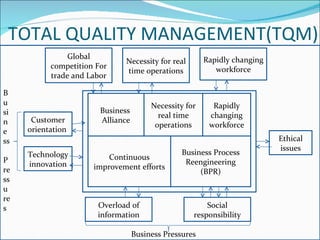
TOTAL QUALITY MANAGEMENT(TQM) Global competition For trade and Labor Necessity for real time operations Customer orientation  Technology innovation Overload of information Social responsibility Rapidly changing workforce Ethical issues Business Pressures Business Pressures Business  Alliance Necessity for real time operations Rapidly changing workforce Continuous improvement efforts Business Process Reengineering (BPR)
INFORMATION SYSTEMS CONCEPTS Information System Information is the processed form of a data. Types of Information Systems Operational Tactical  Strategic Planning Systems Components of Information Systems Hardware Software People Data Storage Procedures
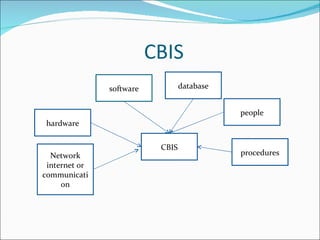
COMPUTER BASED IS (CBIS) CBIS:  An Information System that utilizes the computer  and telecommunication technology to accomplish its tasks is called  CBIS. Components: Hardware Software Database Network Procedure People
CBIS hardware Network internet or communication CBIS software database people procedures
Importance of CBIS Facilitates support organization by fulfilling information needs of organizations workforce. The purpose of CBIS :  Long term benefit Strategic planning to stand against its competitors It allows alteration of the structure of the organization  and improve existing ones CBIS capture , transform and distribute information. It also improves  decision making Performance Increase profitability
CS Vs  CBIS A Computer System  is an electronic system that takes input, processes the input and generates output-self in the specified form. It can do calculation a a much greater speed than  human beings. Moreover, It can store data temporarily as well as permanently. CBIS  is a special type of IS that is partially or completely computerized.  Some IS take data while others may take information from other IS’s. However, CBIS takes only data as input. Generally CBIS is interchangeably used with IS.
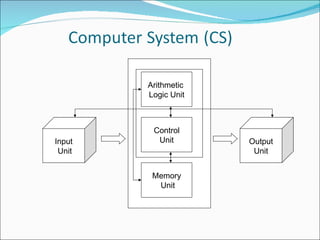
Arithmetic  Logic Unit Control Unit Memory Unit Output Unit Input Unit
Computer System (CS) Components: Input Unit Output Unit Memory Unit Central Processing Unit (CPU)
Categories of IS Depending upon the level of support provided while executing the operations of different levels of an organization the following categories evolved. Operation Support System Management Support System
Operation Support System OSS closely monitors the on-going transactions with the organizations. OSS mainly required for performing low level operations. It provides support to the organization by keeping track of information regarding activities, which are performed on daily basis. Transaction Processing System Office Automation System
Management Support System MSS is used by tactical level managers as well as strategic level managers. Its main objective is to Provide information and support, which is required by managers in performing decision –making process. Management Information System Decision Support System Executive Information System
QUERIES

INFORMATION TECHNOLOGY FOR BUSINESS

  • 1.
  • 2.
    1.1 NEED FORINFORMATION SYSTEM FOR BUSINESS Information System Definition : Information System is a group of connected components Input data Process data Output data Feed back Which are dependent on each other. Example : ATM’s Reservation Systems.
  • 3.
    NEED FOR IS Fast and Accurate Transaction Processing Storage with Large-capacity and Fast access. Fast communications. Competitive Weapons Support for Decision –making Reduction in Information Overload Cross Divisional Abilities
  • 4.
    1.2 BUSINESS INTHE INFORMATION AGE These various trends put a lot of pressure on the companies. Different Pressures the company has to deal with are, Global competition for trade and Labor. Necessity of real time operations. Rapidly changing workforce. Customer orientation Technology Innovation Overload of Information Social responsibility Ethical issues.
  • 5.
    CUSTOMER ORIENTATION Customer satisfaction involves giving complete information to the customers such as.. Cost of a Product Lifetime of a Product Various feature of the Product etc. Different companies must keep updating their website regularly with new information about their products.
  • 6.
    ORGANIZATIONAL RESPONSES StrategicSystems Business Process Re-engineering(BPR) E-Commerce Business Alliances Continuous improvement efforts.
  • 7.
    STRATEGIC SYSTEMS- CHARACTERISTS ADHOCNESS UNEXPECTEDNESS PREDICTIVENESS SUMMARYNESS EXTERNAL SOURCE UNSTRUCTURED SUBJECTIVENESS
  • 8.
    Accounting / FinanceMarketing Production Human Resources TACTICAL: Budgeting Sales Management Materials Requirements Planning Job analysis and design Cash Management Advertising and Promotion Just in time Recruiting Capital Budgeting Pricing Capacity Planning Compensation and benefits Investment Management Distribution Channel Production Scheduling Succession Planning Competitive Tracking Product design and Development Manufacturing Resource Planning Computer Integrated manufacturing STRATEGIC: Financial Condition Analysis Sales forecasting Site Planning Selection Workforce planning Long – term forecasting Market research Technology Planning and Assessment Labor Negotiations Product planning and development Process Postioning
  • 9.
    BUSINESS PROCESS RE-ENGINEERING(BPR) Re-engineering has impact on, Job design Organisational Structure Career Path Work Standards Management Style Training and People needed.
  • 10.
    E-COMMERCE E-Commerce applicationsare built on the existing technology infrastructure that is myriad of computers, communications networks and communication software forming the information superhighway. The uses of each of the building blocks in the infrastructure are Common business services Messaging and information distribution Multimedia Content and Network publishing The information Superhighway
  • 11.
    BUSINESS ALLIANCES Differentforms of business alliances are, Transmission of resources properly. Reliable relationship between customer and supplier. These alliances are obtained by the following processes. Supply chain management Enterprise resource planning
  • 12.
    CONTINOUS IMPROVEMENT EFFORTSVarious Efforts of Improvement are, Just – In – Time (JIT) Total Quality Management (TQM)
  • 13.
    TOTAL QUALITY MANAGEMENT(TQM)Global competition For trade and Labor Necessity for real time operations Customer orientation Technology innovation Overload of information Social responsibility Rapidly changing workforce Ethical issues Business Pressures Business Pressures Business Alliance Necessity for real time operations Rapidly changing workforce Continuous improvement efforts Business Process Reengineering (BPR)
  • 14.
    INFORMATION SYSTEMS CONCEPTSInformation System Information is the processed form of a data. Types of Information Systems Operational Tactical Strategic Planning Systems Components of Information Systems Hardware Software People Data Storage Procedures
  • 15.
    COMPUTER BASED IS(CBIS) CBIS: An Information System that utilizes the computer and telecommunication technology to accomplish its tasks is called CBIS. Components: Hardware Software Database Network Procedure People
  • 16.
    CBIS hardware Networkinternet or communication CBIS software database people procedures
  • 17.
    Importance of CBISFacilitates support organization by fulfilling information needs of organizations workforce. The purpose of CBIS : Long term benefit Strategic planning to stand against its competitors It allows alteration of the structure of the organization and improve existing ones CBIS capture , transform and distribute information. It also improves decision making Performance Increase profitability
  • 18.
    CS Vs CBIS A Computer System is an electronic system that takes input, processes the input and generates output-self in the specified form. It can do calculation a a much greater speed than human beings. Moreover, It can store data temporarily as well as permanently. CBIS is a special type of IS that is partially or completely computerized. Some IS take data while others may take information from other IS’s. However, CBIS takes only data as input. Generally CBIS is interchangeably used with IS.
  • 19.
    Arithmetic LogicUnit Control Unit Memory Unit Output Unit Input Unit
  • 20.
    Computer System (CS)Components: Input Unit Output Unit Memory Unit Central Processing Unit (CPU)
  • 21.
    Categories of ISDepending upon the level of support provided while executing the operations of different levels of an organization the following categories evolved. Operation Support System Management Support System
  • 22.
    Operation Support SystemOSS closely monitors the on-going transactions with the organizations. OSS mainly required for performing low level operations. It provides support to the organization by keeping track of information regarding activities, which are performed on daily basis. Transaction Processing System Office Automation System
  • 23.
    Management Support SystemMSS is used by tactical level managers as well as strategic level managers. Its main objective is to Provide information and support, which is required by managers in performing decision –making process. Management Information System Decision Support System Executive Information System
  • 24.