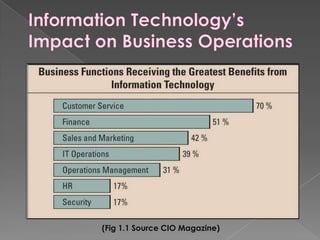
(Fig 1.1 Source CIO Magazine)
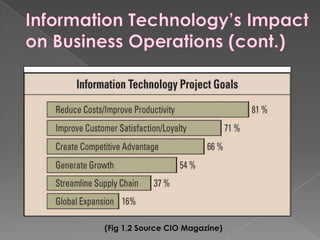
(Fig 1.2 Source CIO Magazine)
Role of information
technology in business
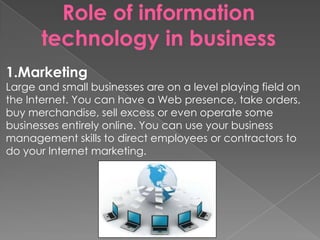
1.Marketing
Large and small businesses are on a level playing field on
the Internet. You can have a Web presence, take orders,
buy merchandise, sell excess or even operate some
businesses entirely online. You can use your business
management skills to direct employees or contractors to
do your Internet marketing.
Role of information technology
in business
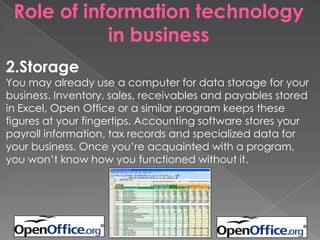
2.Storage
You may already use a computer for data storage for your
business. Inventory, sales, receivables and payables stored
in Excel, Open Office or a similar program keeps these
figures at your fingertips. Accounting software stores your
payroll information, tax records and specialized data for
your business. Once you’re acquainted with a program,
you won’t know how you functioned without it.
Role of information
technology in business
3.Communication
Communication by email is faster and costs less than
sending a paper letter in the mail. You can transform your
business to the 21st century with the use of email for
communication with clients or customers. Your
communication are placed in storage on CD or on a hard
drive with a duplicate copy or backup automated by a
program or service.
Role of information technology in
business
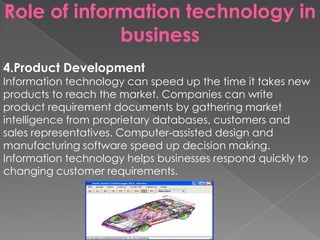
4.Product Development
Information technology can speed up the time it takes new
products to reach the market. Companies can write
product requirement documents by gathering market
intelligence from proprietary databases, customers and
sales representatives. Computer-assisted design and
manufacturing software speed up decision making.
Information technology helps businesses respond quickly to
changing customer requirements.
Role of information technology
in business
5.Globalization
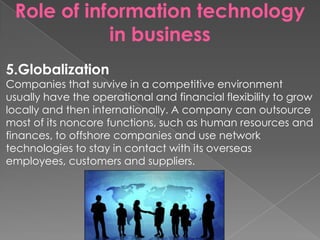
Companies that survive in a competitive environment
usually have the operational and financial flexibility to grow
locally and then internationally. A company can outsource
most of its noncore functions, such as human resources and
finances, to offshore companies and use network
technologies to stay in contact with its overseas
employees, customers and suppliers.
E-commerce is the ability of businesses to
trade with the world via websites. This
means that there is a larger market and
the business is now open 24 hours a day.
This has provided opportunities for
businesses that could only trade locally to
now expand the size of the market (e.g.
Amazon as world wide book and CD
sellers). Customers can also shop around
for the best deals for new products.
E-commerce
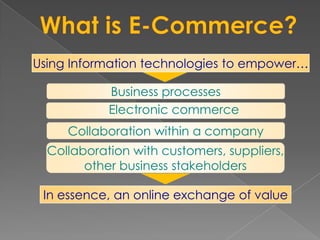
Using Information technologies to empower…
Business processes
Electronic commerce
Collaboration within a company
Collaboration with customers, suppliers,
other business stakeholders
In essence, an online exchange of value
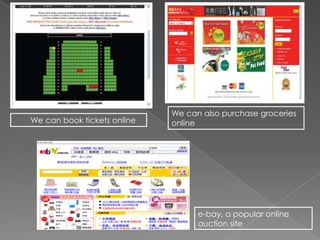
We can book tickets online
We can also purchase groceries
online
e-bay, a popular online
auction site

Information Technology In Business

  • 2.
    (Fig 1.1 SourceCIO Magazine)
  • 3.
    (Fig 1.2 SourceCIO Magazine)
  • 4.
    Role of information technologyin business 1.Marketing Large and small businesses are on a level playing field on the Internet. You can have a Web presence, take orders, buy merchandise, sell excess or even operate some businesses entirely online. You can use your business management skills to direct employees or contractors to do your Internet marketing.
  • 5.
    Role of informationtechnology in business 2.Storage You may already use a computer for data storage for your business. Inventory, sales, receivables and payables stored in Excel, Open Office or a similar program keeps these figures at your fingertips. Accounting software stores your payroll information, tax records and specialized data for your business. Once you’re acquainted with a program, you won’t know how you functioned without it.
  • 6.
    Role of information technologyin business 3.Communication Communication by email is faster and costs less than sending a paper letter in the mail. You can transform your business to the 21st century with the use of email for communication with clients or customers. Your communication are placed in storage on CD or on a hard drive with a duplicate copy or backup automated by a program or service.
  • 7.
    Role of informationtechnology in business 4.Product Development Information technology can speed up the time it takes new products to reach the market. Companies can write product requirement documents by gathering market intelligence from proprietary databases, customers and sales representatives. Computer-assisted design and manufacturing software speed up decision making. Information technology helps businesses respond quickly to changing customer requirements.
  • 8.
    Role of informationtechnology in business 5.Globalization Companies that survive in a competitive environment usually have the operational and financial flexibility to grow locally and then internationally. A company can outsource most of its noncore functions, such as human resources and finances, to offshore companies and use network technologies to stay in contact with its overseas employees, customers and suppliers.
  • 9.
    E-commerce is theability of businesses to trade with the world via websites. This means that there is a larger market and the business is now open 24 hours a day. This has provided opportunities for businesses that could only trade locally to now expand the size of the market (e.g. Amazon as world wide book and CD sellers). Customers can also shop around for the best deals for new products. E-commerce
  • 10.
    Using Information technologiesto empower… Business processes Electronic commerce Collaboration within a company Collaboration with customers, suppliers, other business stakeholders In essence, an online exchange of value
  • 11.
    We can booktickets online We can also purchase groceries online e-bay, a popular online auction site