Copyright©2013DorlingKindersley(India)Pvt.Ltd.
Management Information Systems: Managing the Digital Firm, 12e Authors: Kenneth C. Laudon and Jane P. Laudon
Information Systems in
Business Today
Chapter 1
Copyright©2013DorlingKindersley(India)Pvt.Ltd.
Management Information Systems: Managing the Digital Firm, 12e Authors: Kenneth C. Laudon and Jane P. Laudon
• How information systems are transforming business
Increase in wireless technology use, Web sites
Increased business use of Web 2.0 technologies
Cloud computing, mobile digital platform allow more distributed
work, decision-making, and collaboration
• Globalization opportunities
Internet has drastically reduced costs of operating on global
scale
Presents both challenges and opportunities
The Role of Information Systems in
Business Today
Copyright©2013DorlingKindersley(India)Pvt.Ltd.
Management Information Systems: Managing the Digital Firm, 12e Authors: Kenneth C. Laudon and Jane P. Laudon
The Role of Information Systems in
Business Today
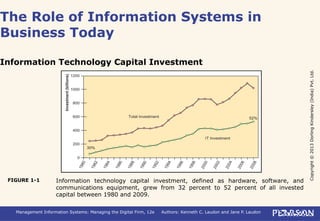
Information Technology Capital Investment
Information technology capital investment, defined as hardware, software, and
communications equipment, grew from 32 percent to 52 percent of all invested
capital between 1980 and 2009.
FIGURE 1-1
Copyright©2013DorlingKindersley(India)Pvt.Ltd.
Management Information Systems: Managing the Digital Firm, 12e Authors: Kenneth C. Laudon and Jane P. Laudon
• In the emerging, fully digital firm
Significant business relationships are digitally enabled and
mediated
Core business processes are accomplished through digital
networks
Key corporate assets are managed digitally
• Digital firms offer greater flexibility in organization and
management
Time shifting, space shifting
The Role of Information Systems in
Business Today
Copyright©2013DorlingKindersley(India)Pvt.Ltd.
Management Information Systems: Managing the Digital Firm, 12e Authors: Kenneth C. Laudon and Jane P. Laudon
• Growing interdependence between ability to use information
technology and ability to implement corporate strategies and
achieve corporate goals
• Business firms invest heavily in information systems to achieve
six strategic business objectives:
Operational excellence
New products, services, and business models
Customer and supplier intimacy
Improved decision making
Competitive advantage
Survival
The Role of Information Systems in
Business Today
Copyright©2013DorlingKindersley(India)Pvt.Ltd.
Management Information Systems: Managing the Digital Firm, 12e Authors: Kenneth C. Laudon and Jane P. Laudon
• Operational excellence:
Improvement of efficiency to attain higher profitability
Information systems, technology an important tool in achieving
greater efficiency and productivity
Walmart’s RetailLink system links suppliers to stores for
superior replenishment system
The Role of Information Systems in
Business Today
Copyright©2013DorlingKindersley(India)Pvt.Ltd.
Management Information Systems: Managing the Digital Firm, 12e Authors: Kenneth C. Laudon and Jane P. Laudon
• New products, services, and business models:
Business model: describes how company produces, delivers, and
sells product or service to create wealth
Information systems and technology a major enabling tool for
new products, services, business models
 Examples: Apple’s iPod, iTunes, iPhone, iPad, Google’s Android
OS, and Netflix
The Role of Information Systems in
Business Today
Copyright©2013DorlingKindersley(India)Pvt.Ltd.
Management Information Systems: Managing the Digital Firm, 12e Authors: Kenneth C. Laudon and Jane P. Laudon
• Customer and supplier intimacy:
Serving customers well leads to customers returning, which
raises revenues and profits
 Example: High-end hotels that use computers to track customer
preferences and use to monitor and customize environment
Intimacy with suppliers allows them to provide vital inputs,
which lowers costs
 Example: J.C.Penney’s information system which links sales
records to contract manufacturer
The Role of Information Systems in
Business Today
Copyright©2013DorlingKindersley(India)Pvt.Ltd.
Management Information Systems: Managing the Digital Firm, 12e Authors: Kenneth C. Laudon and Jane P. Laudon
• Improved decision making
Without accurate information:
 Managers must use forecasts, best guesses, luck
 Leads to:
 Overproduction, underproduction of goods and services
 Misallocation of resources
 Poor response times
 Poor outcomes raise costs, lose customers
 Example: Verizon’s Web-based digital dashboard to provide managers
with real-time data on customer complaints, network performance,
line outages, etc.
The Role of Information Systems in
Business Today
Copyright©2013DorlingKindersley(India)Pvt.Ltd.
Management Information Systems: Managing the Digital Firm, 12e Authors: Kenneth C. Laudon and Jane P. Laudon
• Operational excellence:
Improvement of efficiency to attain higher profitability
• New products, services, and business models:
Enabled by technology
• Customer and supplier intimacy:
Serving customers raises revenues and profits
Better communication with suppliers lowers costs
• Improved decision making
More accurate data leads to better decisions
The Role of Information Systems in
Business Today
Copyright©2013DorlingKindersley(India)Pvt.Ltd.
Management Information Systems: Managing the Digital Firm, 12e Authors: Kenneth C. Laudon and Jane P. Laudon
• Competitive advantage
Delivering better performance
Charging less for superior products
Responding to customers and suppliers in real time
Examples: Apple, Walmart, UPS
The Role of Information Systems in
Business Today
Copyright©2013DorlingKindersley(India)Pvt.Ltd.
Management Information Systems: Managing the Digital Firm, 12e Authors: Kenneth C. Laudon and Jane P. Laudon
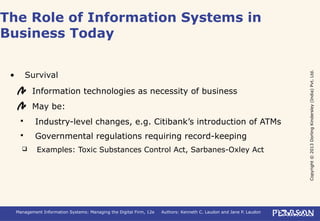
• Survival
Information technologies as necessity of business
May be:
 Industry-level changes, e.g. Citibank’s introduction of ATMs
 Governmental regulations requiring record-keeping
 Examples: Toxic Substances Control Act, Sarbanes-Oxley Act
The Role of Information Systems in
Business Today
Copyright©2013DorlingKindersley(India)Pvt.Ltd.
Management Information Systems: Managing the Digital Firm, 12e Authors: Kenneth C. Laudon and Jane P. Laudon
The Role of Information Systems in
Business Today
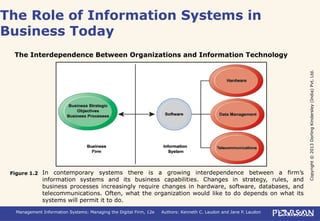
The Interdependence Between Organizations and Information Technology
In contemporary systems there is a growing interdependence between a firm’s
information systems and its business capabilities. Changes in strategy, rules, and
business processes increasingly require changes in hardware, software, databases, and
telecommunications. Often, what the organization would like to do depends on what its
systems will permit it to do.
Figure 1.2
Copyright©2013DorlingKindersley(India)Pvt.Ltd.
Management Information Systems: Managing the Digital Firm, 12e Authors: Kenneth C. Laudon and Jane P. Laudon
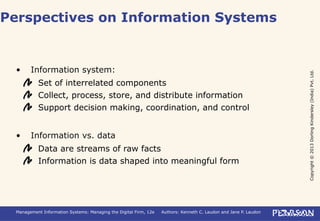
• Information system:
Set of interrelated components
Collect, process, store, and distribute information
Support decision making, coordination, and control
• Information vs. data
Data are streams of raw facts
Information is data shaped into meaningful form
Perspectives on Information Systems
Copyright©2013DorlingKindersley(India)Pvt.Ltd.
Management Information Systems: Managing the Digital Firm, 12e Authors: Kenneth C. Laudon and Jane P. Laudon
Perspectives on Information Systems
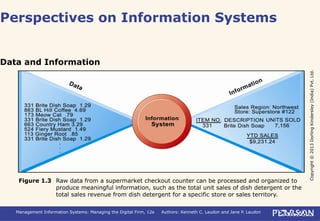
Data and Information
Raw data from a supermarket checkout counter can be processed and organized to
produce meaningful information, such as the total unit sales of dish detergent or the
total sales revenue from dish detergent for a specific store or sales territory.
Figure 1.3
Copyright©2013DorlingKindersley(India)Pvt.Ltd.
Management Information Systems: Managing the Digital Firm, 12e Authors: Kenneth C. Laudon and Jane P. Laudon
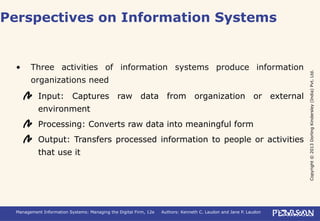
• Three activities of information systems produce information
organizations need
Input: Captures raw data from organization or external
environment
Processing: Converts raw data into meaningful form
Output: Transfers processed information to people or activities
that use it
Perspectives on Information Systems
Copyright©2013DorlingKindersley(India)Pvt.Ltd.
Management Information Systems: Managing the Digital Firm, 12e Authors: Kenneth C. Laudon and Jane P. Laudon
• Feedback:
Output returned to appropriate members of organization to
help evaluate or correct input stage
• Computer/Computer program vs. information system
Computers and software are technical foundation and tools,
similar to the material and tools used to build a house
Perspectives on Information Systems
Copyright©2013DorlingKindersley(India)Pvt.Ltd.
Management Information Systems: Managing the Digital Firm, 12e Authors: Kenneth C. Laudon and Jane P. Laudon
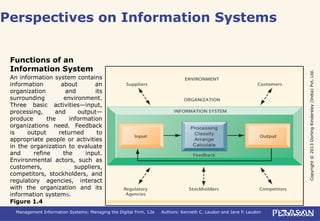
Perspectives on Information Systems
Functions of an
Information System
An information system contains
information about an
organization and its
surrounding environment.
Three basic activities—input,
processing, and output—
produce the information
organizations need. Feedback
is output returned to
appropriate people or activities
in the organization to evaluate
and refine the input.
Environmental actors, such as
customers, suppliers,
competitors, stockholders, and
regulatory agencies, interact
with the organization and its
information systems.
Figure 1.4
Copyright©2013DorlingKindersley(India)Pvt.Ltd.
Management Information Systems: Managing the Digital Firm, 12e Authors: Kenneth C. Laudon and Jane P. Laudon
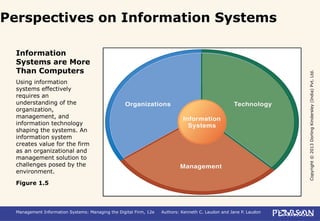
Perspectives on Information Systems
Information
Systems are More
Than Computers
Using information
systems effectively
requires an
understanding of the
organization,
management, and
information technology
shaping the systems. An
information system
creates value for the firm
as an organizational and
management solution to
challenges posed by the
environment.
Figure 1.5
Copyright©2013DorlingKindersley(India)Pvt.Ltd.
Management Information Systems: Managing the Digital Firm, 12e Authors: Kenneth C. Laudon and Jane P. Laudon
• Organizational dimension of information systems
Hierarchy of authority, responsibility
 Senior management
 Middle management
 Operational management
 Knowledge workers
 Data workers
 Production or service workers
Contd…
Perspectives on Information Systems
Copyright©2013DorlingKindersley(India)Pvt.Ltd.
Management Information Systems: Managing the Digital Firm, 12e Authors: Kenneth C. Laudon and Jane P. Laudon
Perspectives on Information Systems
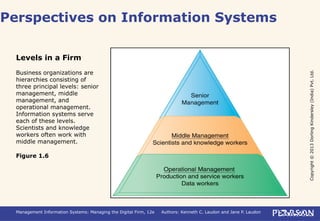
Levels in a Firm
Business organizations are
hierarchies consisting of
three principal levels: senior
management, middle
management, and
operational management.
Information systems serve
each of these levels.
Scientists and knowledge
workers often work with
middle management.
Figure 1.6
Copyright©2013DorlingKindersley(India)Pvt.Ltd.
Management Information Systems: Managing the Digital Firm, 12e Authors: Kenneth C. Laudon and Jane P. Laudon
• Organizational dimension of information systems
Separation of business functions
 Sales and marketing
 Human resources
 Finance and accounting
 Manufacturing and production
Unique business processes
Unique business culture
Organizational politics
Perspectives on Information Systems
Copyright©2013DorlingKindersley(India)Pvt.Ltd.
Management Information Systems: Managing the Digital Firm, 12e Authors: Kenneth C. Laudon and Jane P. Laudon
• Management dimension of information systems
Managers set organizational strategy for responding to business
challenges
In addition, managers must act creatively:
 Creation of new products and services
 Occasionally recreating the organization
Perspectives on Information Systems
Copyright©2013DorlingKindersley(India)Pvt.Ltd.
Management Information Systems: Managing the Digital Firm, 12e Authors: Kenneth C. Laudon and Jane P. Laudon
• Technology dimension of information systems
Computer hardware and software
Data management technology
Networking and telecommunications technology
 Networks, the Internet, intranets and extranets, World Wide
Web
IT infrastructure: provides platform that system is built on
Perspectives on Information Systems
Copyright©2013DorlingKindersley(India)Pvt.Ltd.
Management Information Systems: Managing the Digital Firm, 12e Authors: Kenneth C. Laudon and Jane P. Laudon
• Business perspective on information systems:
Information system is instrument for creating value
Investments in information technology will result in superior
returns:
 Productivity increases
 Revenue increases
 Superior long-term strategic positioning
Perspectives on Information Systems
Copyright©2013DorlingKindersley(India)Pvt.Ltd.
Management Information Systems: Managing the Digital Firm, 12e Authors: Kenneth C. Laudon and Jane P. Laudon
• Business information value chain
Raw data acquired and transformed through stages that add
value to that information
Value of information system determined in part by extent to
which it leads to better decisions, greater efficiency, and higher
profits
• Business perspective:
Calls attention to organizational and managerial nature of
information systems
Perspectives on Information Systems
Copyright©2013DorlingKindersley(India)Pvt.Ltd.
Management Information Systems: Managing the Digital Firm, 12e Authors: Kenneth C. Laudon and Jane P. Laudon
Perspectives on Information Systems
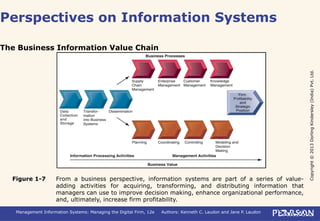
The Business Information Value Chain
From a business perspective, information systems are part of a series of value-
adding activities for acquiring, transforming, and distributing information that
managers can use to improve decision making, enhance organizational performance,
and, ultimately, increase firm profitability.
Figure 1-7
Copyright©2013DorlingKindersley(India)Pvt.Ltd.
Management Information Systems: Managing the Digital Firm, 12e Authors: Kenneth C. Laudon and Jane P. Laudon
Perspectives on Information Systems
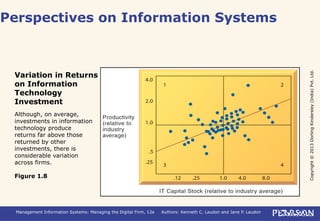
Variation in Returns
on Information
Technology
Investment
Although, on average,
investments in information
technology produce
returns far above those
returned by other
investments, there is
considerable variation
across firms.
Figure 1.8
Copyright©2013DorlingKindersley(India)Pvt.Ltd.
Management Information Systems: Managing the Digital Firm, 12e Authors: Kenneth C. Laudon and Jane P. Laudon
• Investing in information technology does not guarantee good
returns
• Considerable variation in the returns firms receive from systems
investments
• Factors:
Adopting the right business model
Investing in complementary assets (organizational and
management capital)
Perspectives on Information Systems
Copyright©2013DorlingKindersley(India)Pvt.Ltd.
Management Information Systems: Managing the Digital Firm, 12e Authors: Kenneth C. Laudon and Jane P. Laudon
• Complementary assets:
Assets required to derive value from a primary investment
Firms supporting technology investments with investment in
complementary assets receive superior returns
Example: invest in technology and the people to make it work
properly
Perspectives on Information Systems
Copyright©2013DorlingKindersley(India)Pvt.Ltd.
Management Information Systems: Managing the Digital Firm, 12e Authors: Kenneth C. Laudon and Jane P. Laudon
• Complementary assets include:
Organizational assets, e.g.
 Appropriate business model
 Efficient business processes
Managerial assets, e.g.
 Incentives for management innovation
 Teamwork and collaborative work environments
Social assets, e.g.
 The Internet and telecommunications infrastructure
 Technology standards
Perspectives on Information Systems
Copyright©2013DorlingKindersley(India)Pvt.Ltd.
Management Information Systems: Managing the Digital Firm, 12e Authors: Kenneth C. Laudon and Jane P. Laudon
Contemporary Approaches to Information
Systems
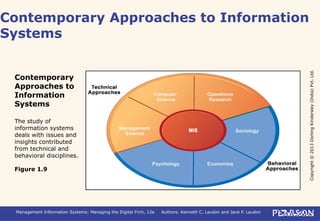
Contemporary
Approaches to
Information
Systems
The study of
information systems
deals with issues and
insights contributed
from technical and
behavioral disciplines.
Figure 1.9
Copyright©2013DorlingKindersley(India)Pvt.Ltd.
Management Information Systems: Managing the Digital Firm, 12e Authors: Kenneth C. Laudon and Jane P. Laudon
• Technical approach
Emphasizes mathematically based models
Computer science, management science, operations research
• Behavioral approach
Behavioral issues (strategic business integration,
implementation, etc.)
Psychology, economics, sociology
Contemporary Approaches to Information
Systems
Copyright©2013DorlingKindersley(India)Pvt.Ltd.
Management Information Systems: Managing the Digital Firm, 12e Authors: Kenneth C. Laudon and Jane P. Laudon
• Management Information Systems
Combines computer science, management science, operations
research and practical orientation with behavioral issues
• Four main actors
Suppliers of hardware and software
Business firms
Managers and employees
Firm’s environment (legal, social, cultural context)
Contemporary Approaches to Information
Systems
Copyright©2013DorlingKindersley(India)Pvt.Ltd.
Management Information Systems: Managing the Digital Firm, 12e Authors: Kenneth C. Laudon and Jane P. Laudon
• Approach of this book: Sociotechnical view
Optimal organizational performance achieved by jointly
optimizing both social and technical systems used in production
Helps avoid purely technological approach
Contemporary Approaches to Information
Systems
Copyright©2013DorlingKindersley(India)Pvt.Ltd.
Management Information Systems: Managing the Digital Firm, 12e Authors: Kenneth C. Laudon and Jane P. Laudon
Contemporary Approaches to Information
Systems
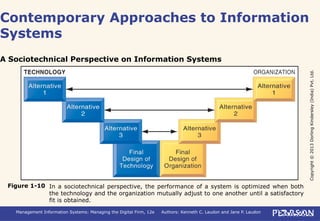
A Sociotechnical Perspective on Information Systems
In a sociotechnical perspective, the performance of a system is optimized when both
the technology and the organization mutually adjust to one another until a satisfactory
fit is obtained.
Figure 1-10

information system in business today

  • 1.
    Copyright©2013DorlingKindersley(India)Pvt.Ltd. Management Information Systems:Managing the Digital Firm, 12e Authors: Kenneth C. Laudon and Jane P. Laudon Information Systems in Business Today Chapter 1
  • 2.
    Copyright©2013DorlingKindersley(India)Pvt.Ltd. Management Information Systems:Managing the Digital Firm, 12e Authors: Kenneth C. Laudon and Jane P. Laudon • How information systems are transforming business Increase in wireless technology use, Web sites Increased business use of Web 2.0 technologies Cloud computing, mobile digital platform allow more distributed work, decision-making, and collaboration • Globalization opportunities Internet has drastically reduced costs of operating on global scale Presents both challenges and opportunities The Role of Information Systems in Business Today
  • 3.
    Copyright©2013DorlingKindersley(India)Pvt.Ltd. Management Information Systems:Managing the Digital Firm, 12e Authors: Kenneth C. Laudon and Jane P. Laudon The Role of Information Systems in Business Today Information Technology Capital Investment Information technology capital investment, defined as hardware, software, and communications equipment, grew from 32 percent to 52 percent of all invested capital between 1980 and 2009. FIGURE 1-1
  • 4.
    Copyright©2013DorlingKindersley(India)Pvt.Ltd. Management Information Systems:Managing the Digital Firm, 12e Authors: Kenneth C. Laudon and Jane P. Laudon • In the emerging, fully digital firm Significant business relationships are digitally enabled and mediated Core business processes are accomplished through digital networks Key corporate assets are managed digitally • Digital firms offer greater flexibility in organization and management Time shifting, space shifting The Role of Information Systems in Business Today
  • 5.
    Copyright©2013DorlingKindersley(India)Pvt.Ltd. Management Information Systems:Managing the Digital Firm, 12e Authors: Kenneth C. Laudon and Jane P. Laudon • Growing interdependence between ability to use information technology and ability to implement corporate strategies and achieve corporate goals • Business firms invest heavily in information systems to achieve six strategic business objectives: Operational excellence New products, services, and business models Customer and supplier intimacy Improved decision making Competitive advantage Survival The Role of Information Systems in Business Today
  • 6.
    Copyright©2013DorlingKindersley(India)Pvt.Ltd. Management Information Systems:Managing the Digital Firm, 12e Authors: Kenneth C. Laudon and Jane P. Laudon • Operational excellence: Improvement of efficiency to attain higher profitability Information systems, technology an important tool in achieving greater efficiency and productivity Walmart’s RetailLink system links suppliers to stores for superior replenishment system The Role of Information Systems in Business Today
  • 7.
    Copyright©2013DorlingKindersley(India)Pvt.Ltd. Management Information Systems:Managing the Digital Firm, 12e Authors: Kenneth C. Laudon and Jane P. Laudon • New products, services, and business models: Business model: describes how company produces, delivers, and sells product or service to create wealth Information systems and technology a major enabling tool for new products, services, business models  Examples: Apple’s iPod, iTunes, iPhone, iPad, Google’s Android OS, and Netflix The Role of Information Systems in Business Today
  • 8.
    Copyright©2013DorlingKindersley(India)Pvt.Ltd. Management Information Systems:Managing the Digital Firm, 12e Authors: Kenneth C. Laudon and Jane P. Laudon • Customer and supplier intimacy: Serving customers well leads to customers returning, which raises revenues and profits  Example: High-end hotels that use computers to track customer preferences and use to monitor and customize environment Intimacy with suppliers allows them to provide vital inputs, which lowers costs  Example: J.C.Penney’s information system which links sales records to contract manufacturer The Role of Information Systems in Business Today
  • 9.
    Copyright©2013DorlingKindersley(India)Pvt.Ltd. Management Information Systems:Managing the Digital Firm, 12e Authors: Kenneth C. Laudon and Jane P. Laudon • Improved decision making Without accurate information:  Managers must use forecasts, best guesses, luck  Leads to:  Overproduction, underproduction of goods and services  Misallocation of resources  Poor response times  Poor outcomes raise costs, lose customers  Example: Verizon’s Web-based digital dashboard to provide managers with real-time data on customer complaints, network performance, line outages, etc. The Role of Information Systems in Business Today
  • 10.
    Copyright©2013DorlingKindersley(India)Pvt.Ltd. Management Information Systems:Managing the Digital Firm, 12e Authors: Kenneth C. Laudon and Jane P. Laudon • Operational excellence: Improvement of efficiency to attain higher profitability • New products, services, and business models: Enabled by technology • Customer and supplier intimacy: Serving customers raises revenues and profits Better communication with suppliers lowers costs • Improved decision making More accurate data leads to better decisions The Role of Information Systems in Business Today
  • 11.
    Copyright©2013DorlingKindersley(India)Pvt.Ltd. Management Information Systems:Managing the Digital Firm, 12e Authors: Kenneth C. Laudon and Jane P. Laudon • Competitive advantage Delivering better performance Charging less for superior products Responding to customers and suppliers in real time Examples: Apple, Walmart, UPS The Role of Information Systems in Business Today
  • 12.
    Copyright©2013DorlingKindersley(India)Pvt.Ltd. Management Information Systems:Managing the Digital Firm, 12e Authors: Kenneth C. Laudon and Jane P. Laudon • Survival Information technologies as necessity of business May be:  Industry-level changes, e.g. Citibank’s introduction of ATMs  Governmental regulations requiring record-keeping  Examples: Toxic Substances Control Act, Sarbanes-Oxley Act The Role of Information Systems in Business Today
  • 13.
    Copyright©2013DorlingKindersley(India)Pvt.Ltd. Management Information Systems:Managing the Digital Firm, 12e Authors: Kenneth C. Laudon and Jane P. Laudon The Role of Information Systems in Business Today The Interdependence Between Organizations and Information Technology In contemporary systems there is a growing interdependence between a firm’s information systems and its business capabilities. Changes in strategy, rules, and business processes increasingly require changes in hardware, software, databases, and telecommunications. Often, what the organization would like to do depends on what its systems will permit it to do. Figure 1.2
  • 14.
    Copyright©2013DorlingKindersley(India)Pvt.Ltd. Management Information Systems:Managing the Digital Firm, 12e Authors: Kenneth C. Laudon and Jane P. Laudon • Information system: Set of interrelated components Collect, process, store, and distribute information Support decision making, coordination, and control • Information vs. data Data are streams of raw facts Information is data shaped into meaningful form Perspectives on Information Systems
  • 15.
    Copyright©2013DorlingKindersley(India)Pvt.Ltd. Management Information Systems:Managing the Digital Firm, 12e Authors: Kenneth C. Laudon and Jane P. Laudon Perspectives on Information Systems Data and Information Raw data from a supermarket checkout counter can be processed and organized to produce meaningful information, such as the total unit sales of dish detergent or the total sales revenue from dish detergent for a specific store or sales territory. Figure 1.3
  • 16.
    Copyright©2013DorlingKindersley(India)Pvt.Ltd. Management Information Systems:Managing the Digital Firm, 12e Authors: Kenneth C. Laudon and Jane P. Laudon • Three activities of information systems produce information organizations need Input: Captures raw data from organization or external environment Processing: Converts raw data into meaningful form Output: Transfers processed information to people or activities that use it Perspectives on Information Systems
  • 17.
    Copyright©2013DorlingKindersley(India)Pvt.Ltd. Management Information Systems:Managing the Digital Firm, 12e Authors: Kenneth C. Laudon and Jane P. Laudon • Feedback: Output returned to appropriate members of organization to help evaluate or correct input stage • Computer/Computer program vs. information system Computers and software are technical foundation and tools, similar to the material and tools used to build a house Perspectives on Information Systems
  • 18.
    Copyright©2013DorlingKindersley(India)Pvt.Ltd. Management Information Systems:Managing the Digital Firm, 12e Authors: Kenneth C. Laudon and Jane P. Laudon Perspectives on Information Systems Functions of an Information System An information system contains information about an organization and its surrounding environment. Three basic activities—input, processing, and output— produce the information organizations need. Feedback is output returned to appropriate people or activities in the organization to evaluate and refine the input. Environmental actors, such as customers, suppliers, competitors, stockholders, and regulatory agencies, interact with the organization and its information systems. Figure 1.4
  • 19.
    Copyright©2013DorlingKindersley(India)Pvt.Ltd. Management Information Systems:Managing the Digital Firm, 12e Authors: Kenneth C. Laudon and Jane P. Laudon Perspectives on Information Systems Information Systems are More Than Computers Using information systems effectively requires an understanding of the organization, management, and information technology shaping the systems. An information system creates value for the firm as an organizational and management solution to challenges posed by the environment. Figure 1.5
  • 20.
    Copyright©2013DorlingKindersley(India)Pvt.Ltd. Management Information Systems:Managing the Digital Firm, 12e Authors: Kenneth C. Laudon and Jane P. Laudon • Organizational dimension of information systems Hierarchy of authority, responsibility  Senior management  Middle management  Operational management  Knowledge workers  Data workers  Production or service workers Contd… Perspectives on Information Systems
  • 21.
    Copyright©2013DorlingKindersley(India)Pvt.Ltd. Management Information Systems:Managing the Digital Firm, 12e Authors: Kenneth C. Laudon and Jane P. Laudon Perspectives on Information Systems Levels in a Firm Business organizations are hierarchies consisting of three principal levels: senior management, middle management, and operational management. Information systems serve each of these levels. Scientists and knowledge workers often work with middle management. Figure 1.6
  • 22.
    Copyright©2013DorlingKindersley(India)Pvt.Ltd. Management Information Systems:Managing the Digital Firm, 12e Authors: Kenneth C. Laudon and Jane P. Laudon • Organizational dimension of information systems Separation of business functions  Sales and marketing  Human resources  Finance and accounting  Manufacturing and production Unique business processes Unique business culture Organizational politics Perspectives on Information Systems
  • 23.
    Copyright©2013DorlingKindersley(India)Pvt.Ltd. Management Information Systems:Managing the Digital Firm, 12e Authors: Kenneth C. Laudon and Jane P. Laudon • Management dimension of information systems Managers set organizational strategy for responding to business challenges In addition, managers must act creatively:  Creation of new products and services  Occasionally recreating the organization Perspectives on Information Systems
  • 24.
    Copyright©2013DorlingKindersley(India)Pvt.Ltd. Management Information Systems:Managing the Digital Firm, 12e Authors: Kenneth C. Laudon and Jane P. Laudon • Technology dimension of information systems Computer hardware and software Data management technology Networking and telecommunications technology  Networks, the Internet, intranets and extranets, World Wide Web IT infrastructure: provides platform that system is built on Perspectives on Information Systems
  • 25.
    Copyright©2013DorlingKindersley(India)Pvt.Ltd. Management Information Systems:Managing the Digital Firm, 12e Authors: Kenneth C. Laudon and Jane P. Laudon • Business perspective on information systems: Information system is instrument for creating value Investments in information technology will result in superior returns:  Productivity increases  Revenue increases  Superior long-term strategic positioning Perspectives on Information Systems
  • 26.
    Copyright©2013DorlingKindersley(India)Pvt.Ltd. Management Information Systems:Managing the Digital Firm, 12e Authors: Kenneth C. Laudon and Jane P. Laudon • Business information value chain Raw data acquired and transformed through stages that add value to that information Value of information system determined in part by extent to which it leads to better decisions, greater efficiency, and higher profits • Business perspective: Calls attention to organizational and managerial nature of information systems Perspectives on Information Systems
  • 27.
    Copyright©2013DorlingKindersley(India)Pvt.Ltd. Management Information Systems:Managing the Digital Firm, 12e Authors: Kenneth C. Laudon and Jane P. Laudon Perspectives on Information Systems The Business Information Value Chain From a business perspective, information systems are part of a series of value- adding activities for acquiring, transforming, and distributing information that managers can use to improve decision making, enhance organizational performance, and, ultimately, increase firm profitability. Figure 1-7
  • 28.
    Copyright©2013DorlingKindersley(India)Pvt.Ltd. Management Information Systems:Managing the Digital Firm, 12e Authors: Kenneth C. Laudon and Jane P. Laudon Perspectives on Information Systems Variation in Returns on Information Technology Investment Although, on average, investments in information technology produce returns far above those returned by other investments, there is considerable variation across firms. Figure 1.8
  • 29.
    Copyright©2013DorlingKindersley(India)Pvt.Ltd. Management Information Systems:Managing the Digital Firm, 12e Authors: Kenneth C. Laudon and Jane P. Laudon • Investing in information technology does not guarantee good returns • Considerable variation in the returns firms receive from systems investments • Factors: Adopting the right business model Investing in complementary assets (organizational and management capital) Perspectives on Information Systems
  • 30.
    Copyright©2013DorlingKindersley(India)Pvt.Ltd. Management Information Systems:Managing the Digital Firm, 12e Authors: Kenneth C. Laudon and Jane P. Laudon • Complementary assets: Assets required to derive value from a primary investment Firms supporting technology investments with investment in complementary assets receive superior returns Example: invest in technology and the people to make it work properly Perspectives on Information Systems
  • 31.
    Copyright©2013DorlingKindersley(India)Pvt.Ltd. Management Information Systems:Managing the Digital Firm, 12e Authors: Kenneth C. Laudon and Jane P. Laudon • Complementary assets include: Organizational assets, e.g.  Appropriate business model  Efficient business processes Managerial assets, e.g.  Incentives for management innovation  Teamwork and collaborative work environments Social assets, e.g.  The Internet and telecommunications infrastructure  Technology standards Perspectives on Information Systems
  • 32.
    Copyright©2013DorlingKindersley(India)Pvt.Ltd. Management Information Systems:Managing the Digital Firm, 12e Authors: Kenneth C. Laudon and Jane P. Laudon Contemporary Approaches to Information Systems Contemporary Approaches to Information Systems The study of information systems deals with issues and insights contributed from technical and behavioral disciplines. Figure 1.9
  • 33.
    Copyright©2013DorlingKindersley(India)Pvt.Ltd. Management Information Systems:Managing the Digital Firm, 12e Authors: Kenneth C. Laudon and Jane P. Laudon • Technical approach Emphasizes mathematically based models Computer science, management science, operations research • Behavioral approach Behavioral issues (strategic business integration, implementation, etc.) Psychology, economics, sociology Contemporary Approaches to Information Systems
  • 34.
    Copyright©2013DorlingKindersley(India)Pvt.Ltd. Management Information Systems:Managing the Digital Firm, 12e Authors: Kenneth C. Laudon and Jane P. Laudon • Management Information Systems Combines computer science, management science, operations research and practical orientation with behavioral issues • Four main actors Suppliers of hardware and software Business firms Managers and employees Firm’s environment (legal, social, cultural context) Contemporary Approaches to Information Systems
  • 35.
    Copyright©2013DorlingKindersley(India)Pvt.Ltd. Management Information Systems:Managing the Digital Firm, 12e Authors: Kenneth C. Laudon and Jane P. Laudon • Approach of this book: Sociotechnical view Optimal organizational performance achieved by jointly optimizing both social and technical systems used in production Helps avoid purely technological approach Contemporary Approaches to Information Systems
  • 36.
    Copyright©2013DorlingKindersley(India)Pvt.Ltd. Management Information Systems:Managing the Digital Firm, 12e Authors: Kenneth C. Laudon and Jane P. Laudon Contemporary Approaches to Information Systems A Sociotechnical Perspective on Information Systems In a sociotechnical perspective, the performance of a system is optimized when both the technology and the organization mutually adjust to one another until a satisfactory fit is obtained. Figure 1-10

Editor's Notes

  • #3 New federal security and accounting laws that require companies to store e-mail for 5 years have spurred the growth of digital information, which is increasing at a rate of 5 exabytes annually. Students may be surprised to learn that 5 exabytes of data is equivalent to 37,000 Libraries of Congress. Ask the students to think about what difference it makes to the world economy, or the U.S. economy, if global operations become much less expensive? What are the challenges to American suppliers of goods and services, and to labor? <number>
  • #4 Emphasize to students that total investment is over one trillion dollars in 2010, and that over 550 billion dollars of that was invested in information technology. You could ask them why it is that the percentage of total investment devoted to IT has increased so much since 1980? Other kinds of capital investment are machinery and buildings. Why would firms increase IT investment faster than machinery and buildings. The answer is capital substitution: the price of IT capital has been falling exponentially, while the price of machine and buildings has been growing at slightly more than the rate of inflation. Wherever possible, firms would much rather invest in more IT than machinery or buildings because the returns on the investment are greater. <number>
  • #5 Time shifting and space shifting are connected to globalization. You could ask students to explain why a digital firm is more likely to benefit from globalization than a traditional firm. One answer is that by allowing business to be conducted at any time (time shifting) and any place (space shifting), digital firms are ideally suited for global operations which take place in remote locations and very different time zones. <number>
  • #6 In the Yankee Stadium opening case, the UPS Interactive Session later in the chapter, and with many of the Interactive Sessions and opening cases in the book, it will be useful to ask students to explain how various information systems succeeded or failed in achieving the six strategic business objectives. For example, in the Yankee Stadium case, information systems helped the Yankees achieve greater customer intimacy and offer new services. You might ask the students to think about some other business objectives and think about how IT might help firms achieve them. For instance, speed to market is very important to firms introducing new products. How can IT help achieve that objective? <number>
  • #7 Walmart is the most efficient retailer in the industry and exemplifies operational excellence. You could ask students to name other businesses that they believe to exhibit a high level of operational excellence. Do customers perceive operational excellence? Does it make a difference for customer purchasing? What Web sites strike students as really excellent in terms of customer service? If you have a podium computer, you might want to visit the Walmart site and the Amazon site to compare them in terms of ease of use. <number>
  • #8 You could ask students to name other new products or business models that they’ve encountered and how they might relate to new information systems or new technology. One way to encourage participation is ask students to help you list on the blackboard some really interesting recent digital product innovations. Discussing “green technologies” like wind, solar, and hybrid vehicles is always fun. In this context, what role will IT be playing in the development of these technologies? <number>
  • #9 You could ask students what types of companies might rely more on customer and supplier intimacy than others and which companies they feel have served them exceptionally well. Ask the students to identify online sites that achieve a high degree of customer intimacy. Sites to visit would include Netflix, Amazon, and other sites which have recommender systems to suggest purchase ideas to consumers. <number>
  • #10 You could ask students if they have ever been recipients of exceptional service from a company made possible by improved decision-making and whether or not information systems contributed to that level of service. For example, perhaps they had a power outage and it took a very short (or very long) time for the utility company to correct the error. <number>
  • #11 This slide is a recap of the previous four slides. You might ask students which business objective they believe to be most critical to the success of a business, or whether they all carry equal weight. <number>
  • #12 Emphasize that achieving any of the previous four business objectives represents the achievement of a competitive advantage as well. <number>
  • #13 Ask students if they can name any examples of companies that failed to survive due to unwillingness or inability to update their information systems. The Sarbanes-Oxley Act requires that public firms keep all data, including e-mail, on record for 5 years. You could ask students if they appreciate why information systems would be useful towards meeting the standards imposed by this legislation. <number>
  • #14 The basic point of this graphic is that in order to achieve its business objectives, a firm will need a significant investment in IT. Going the other direction (from right to left), having a significant IT platform can lead to changes in business objectives and strategies. Emphasize the two-way nature of this relationship. Businesses rely on information systems to help them achieve their goals; a business without adequate information systems will inevitably fall short. But information systems are also products of the businesses that use them. Businesses shape their information systems and information systems shape businesses. <number>
  • #15 These are some basic background understandings needed for the course. A system refers to a set of components that work together (hopefully). Can students think of systems other than information systems? The point of an information system is to make sense out all the confusing data in the environment, and put the data into some kind of order. Information is an ordered set of data that you can understand and act on. If the students want to get a sense of raw data, show them a stock ticker on a Web financial site (or Yahoo/finance). Ask them to tell you what it means? Then show them the current value of the Dow Jones Industrial Index and the S&P 500, and its daily trend (or for that matter switch to a 1 year view of either of these indexes). Looking at the indexes students can quickly get a grasp of whether the market is up or down, and they could act on that information. <number>
  • #16 Emphasize the distinction between information and data. You could, for example, ask several students to list their ages and write the numbers on one side of the board – then you could calculate the average age of those students on the other side, oldest student, youngest student, and so forth, to illustrate the difference between raw data and meaningful information. <number>
  • #17 Use an example similar to the one given in the previous slide to illustrate the three activities involved in the function of an information system. Continuing with that example, the process of asking students their age would represent input, calculating the average age and determining the oldest and youngest age would represent processing, and writing that information on the board would represent output. <number>
  • #18 Explain to students how the ‘house’ analogy works: assuming that a successful information system is like a completed ‘house’, computers and software only represent the tools and materials used to build the house. Tools and materials don’t just suddenly become a completed house – outside (human) input is required. Systems need to be designed to fit the firms and the humans who work with the systems. <number>
  • #19 The point of this diagram is first of all to highlight the three basic activities of information systems, so that students can understand what an information system is doing at its most fundamental level. But the diagram also puts information systems into the context of organizations (firms), and then puts the firm into its respective environment composed of shareholders, higher level authorities (government), competitors, suppliers and customers. Suddenly students should see that information systems play a central role mediating and interacting with all these players. Hence, systems play a key role in the operations and survival of the firm. You could also explain this diagram by relating it back to the opening case, as the book does. The two types of input into the Synergy system are manually entered data as well as video. The system processes that data and creates the output, video and statistics about specific types of players and plays. <number>
  • #20 These three themes (management, organizations, and technology) will reappear throughout the book. Understanding the interaction between these factors and information systems is known as information system literacy. Knowing how to optimize the relationship between technology, organizations, and management is the purpose of this book and course. <number>
  • #21 Pages 18 and 19 in the text provides more specific details on each level of this hierarchy. You can ask students to talk about an organization where they currently work, or have worked in the past. What was their contact with senior management, middle management, and operational (supervisory) management? Many younger students will have had little or no contact with senior and middle management. Older students most likely will have experience. You might need to provide more description about exactly what senior managers do for the firm (and middle managers). <number>
  • #22 Ask students to think about how information systems would factor into the day-to-day jobs of each of the three types of workers in the pyramid. <number>
  • #23 The point of this slide is to let students know there are many organizational factors that will shape information systems. A common observation is that “Every business is different.” Does this mean every business will have different information systems? Every business has its unique culture, and politics. Systems reflect these business cultures. For an example of how information systems shed light on a firm’s unique business processes and culture, you might describe the UPS Interactive Session later in the chapter. The company’s package tracking systems exemplify their commitment to customer service and putting the customer first. <number>
  • #24 How might information systems assist managers in the development of new products and services? What is meant by re-creating the organization? Why do organizations need to be continually re-created? The answer is that they quickly become obsolete unless they continue to change. Ask students to help you list some organizations that have recently failed, or are about to fail. <number>
  • #25 Information technology is at the heart of information systems. While organization and management are important too, it’s the technology that enables the systems and the organizations and managers who use the technology. The distinction between the Internet and intranets & extranets has to do with their scope. Intranets are private networks used by corporations and extranets are similar except that they are directed at external users (like customers and suppliers). In contrast, the Internet connects millions of different networks across the globe. Students may not immediately understand this distinction. <number>
  • #26 You could ask students to consider how this view of information systems might contrast with the sociotechnical view or other views. You could also ask them to consider the circumstances under which information systems might not result in increased productivity and revenue. <number>
  • #27 During this and the next slide, emphasize that the end result of the business information value chain will always be profitability. Questions for students: What aspects of the business perspective might be lacking? Are there other perspectives that might provide a different picture? (sociotechnical) <number>
  • #28 The information value chain is one way to visualize the relationship between information activities, business processes, and management activities. You could also ask students if they could imagine any reason to create an information system besides profitability or strategic positioning (it’s not likely that they will think of one, which will prove the point). One reason to create a system that is not primarily profit oriented is to meet the information reporting requirements of government and other authorities. <number>
  • #29 Emphasize that each quadrant of the graph represents a different type of firm. Quadrant 1 represents firms that invest much less in IT but still receive strong returns. Quadrant 2 represents firms that invest a great deal in IT and receive a great deal in returns. Quadrant 3 represents firms that invest much less in IT and receive poor returns. Quadrant 4 represents firms that invest a great deal in IT but receive poor returns. Ask students where they want their firms to show up? The purpose of the course and book is to show students how to end up in top quadrant (2). <number>
  • #30 Connect this slide to the previous slide. Many firms make significant investments in IT for very little benefit to the bottom line. Discuss why companies experience a wide variety of outcomes in their efforts to invest in IT. Consider the factors we use in this book: organizational and management factors. <number>
  • #31 The example used in the book for complementary assets is for automobile companies: these companies rely on investments in highways, other roads, gas stations, repair facilities, and so on to maximize the value of their primary investment. Ask students to provide a different example of another company’s or industries complementary assets. <number>
  • #32 Emphasize that firms that make significant investment in complementary assets tend to derive greater benefit from information technology investment than those that do not. Consideration of complementary assets should be a part of any firm’s broader view of how to create and implement their information systems. Stress to students that managers must consider dimensions like complementary assets in order to derive benefit from information systems and be successful. <number>
  • #33 Ask students which of the two major types of approaches, behavioral and technical, they find to be most appropriate or accurate. Why do they feel this way? Emphasize that the technical approach does not ignore behavior and the behavioral approach does not ignore technology, but that they are indeed two distinct approaches. <number>
  • #34 You might ask the students whether they think it’s possible to adopt only one of the two approaches to information systems and be successful. Then emphasize that the most accurate position is that there is no single approach that can truly capture the full scope and importance of information systems by itself. <number>
  • #35 Ask students to describe some of the relationships between the four main actors. For example, business firms look to acquire the components of their information systems from suppliers of hardware and software. The firm’s environment may dictate the type of software a company uses as well as the kind of employees that work there. <number>
  • #36 The sociotechnical systems perspective was also discussed briefly in slide 3, which you could revisit to give students a refresher. The critical aspect of this view is the balance between technological and social/behavioral concerns. Sometimes a lesser form of technology may be the best option because it is more suited to the personal needs of the individual, for example. <number>
  • #37 This graphic illustrates the interplay between technology and the organization. The two continue to grow closer together until an approach satisfying both perspectives is reached. Ensure that students understand that the two sides do not always need to form an equal compromise. Sometimes highly advanced technology may be more acceptable than at other times. As they will see with packaged software solutions, and enterprise systems, firms are often required to change greatly in order to make the software applications work. <number>