WELCOME EVERYONE
It’s a “ Creative Thinkers”
Presentation
Group Members of “Creative Thinkers”
Serial No Name
01.
Rafiqul Alam Khan
02. Rakibul Haque
03. Helal Chowdhury
04. Md. Al Amin
Submitted To :
Shaikh Masrick Hasan
Lecturer
Department of Finance
Jagannath University
Submitted By
Rafiqul Alam Khan
Group representative of
“Creative Thinkers”
Date of Submission:
15/06/2013
An empirical study on “ Information
System Increases the Efficiency of
Business Organization”
Definition of Information System
• Information system is defined as the use of
computers and telecommunications
equipment to store, retrieve, transmit and
manipulate information.
• Information system is the driving force
behind globalization and is the key element
of a small-time business transiting to a large
scale business.
Background of Information System
• We can identify five eras of IS evolution
corresponding to the five phases in the
development of computing technology:
• Mainframe and minicomputer computing,
• personal computers,
• client/server networks,
• enterprise computing,
• Cloud computing.
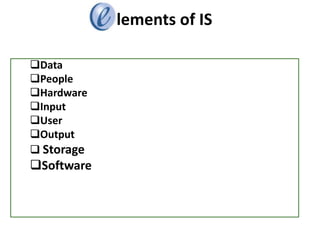
Elements of IS
Data
People
Hardware
Input
User
Output
 Storage
Software
Information systems should have
these characteristics
• They are flexible and provide many options for
handling data and evaluating information.
• They are capable of supporting a variety of
styles, skills, and knowledge.
• They have the ability to keep track of many
alternatives and consequences.
• They are sensitive to the bureaucratic and
political requirements of systems.
Business Information System
• Order Entry System
• Billing System
• Accounts Receivable System
• Inventory Control System
• Purchasing System
• Accounts Payable System
• Payroll System
• General Ledger System
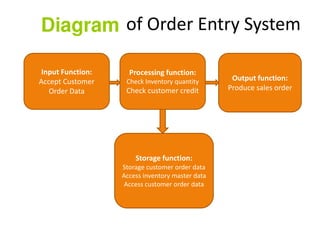
of Order Entry System
Input Function:
Accept Customer
Order Data
Processing function:
Check Inventory quantity
Check customer credit
Output function:
Produce sales order
Storage function:
Storage customer order data
Access inventory master data
Access customer order data
of IS
Information system has impacts on
• Organization & Business Impacts
• Economic Impacts
• Organizational & Behavioral Impacts
• Impact on Workplace
• Impact over Personnel
How Information Systems
Impact Organizations and
Business Firms
• Change is the only constant in the relationship
between information systems and organizations.
• The changes that have taken place in computing have
affected the business environment in a big way. Over
40 percent of the equipment investment in the last
decade has been on computing equipment.
• Organizations are finding more efficient ways to
accomplish tasks via networking, either internal
networks or by connecting to external networks.
Technology has caused many changes in the way
businesses connect to their customers and suppliers.
Relationship between Business Organizations and
Information Systems
• The business organization needs to design
information systems that serve the better services. At
the same time the organization must be ready and
willing to restructure the organization to take
advantage of the improvements an information
system can offer.
• Information systems use data as their main
ingredient and organizations rely on people. However,
the similarities are remarkable. Both are a structured
method of turning raw products (data/people) into
useful entities (information/producers).
Organizing the IS Function
Organizations and information systems
influence each other. Each organization shares
common characteristics that the information
system can enhance.
Each organization has unique characteristics
that should be taken into account when
incorporating technology.
Organization should determine how the
technology is incorporated and not let the
information system totally dictate the
organizational structure.
The Internet and Organizations
 Business-to-business commerce is growing at a tremendous
pace because of the cost savings the Internet allows.
 The innovative ways organizations are using the Internet,
intranets, and extranets to improve their business processes
and lower costs are simply fascinating.
 The integration of an information system into an
organization naturally causes change for the organization.
What isn't so simple to manage is the very fact that many
people do not readily accept change.
 It doesn’t matter how much technology we employ, it is still
the organization's people who will make or break it.
Information Systems and Business Strategy
“If a business doesn’t have a plan, then it is
planning to fail”
 Using information systems should be a
positive exercise. That is, the system should
help managers at all levels make better
decisions, more efficiently, to the benefit of a
greater number of people, and to improve the
organization.
Information Systems and Business
The levels of long-term strategic planning feasibility
by the use of IS :
• Business level: a single firm
• Firm level: multidivisional businesses operating as
one cohesive unit
• Industry level: an entire industrial environment or
ecosystem
By effectively using an information system in a
strategic role at any, or preferably all, levels of the
organization, a digital firm can provide more value in
their products than the competition.
Information System in
• A very effective use of strategic information
systems is to create products or services that
are so different from the competition's as to
create barriers for the competition.
• Product differentiation is at the heart of the
most companies success. IS provides the
benefits of product differentiation.
Supply Chain Management and
Efficient Customer Response Systems
• Because of the integration of information systems
throughout an organization, a digital firm can
reduce costs and prices well below the
competitions.
• Supply chain management offers new
opportunities for companies to integrate with
suppliers and customers and lower costs for
everyone.
• Another way firms can hold onto their customers
is to raise the switching costs the customer would
experience by using a different company.
Company rofile
Lusaka Group is a pioneer, dynamic,
professionally managed business organization
has Strong experience in the field of Garment
Sector.
100% export oriented garments manufacturer.
They are manufacturing shirts, trousers,
shorts, sweaters and all kind of knit garments
all round the year.
Objectives behind using Information
Technology in LG
• LG want to ensure,
• Highest product quality
• Recruiting highest deserving employees
• Best quality service to their customers
• And many more minor plans by using
Information Technology
Strategies to Implement the Objective
As a company of RMG sector, LG fully related
to the Information Technology.
LG use various Software and Hardware, which
make the work easy and comfortable. Besides
this it also have various strategy to reach in
dominant position in RMG sector and helps to
play a monopoly role in RMG sector.
Firm-level Strategy and Information Technology
• Legato services are an Internet Service Provider and Lusaka
group produces garment items. So why did Legato services
and Lusaka group linked their companies?
• Because these two companies see a lot of synergy between
their products and services. As they continue to demand
more content and entertainment through the Internet,
Legato is well positioned to deliver the content.
• Lusaka has the content but not an efficient, low-cost
method of delivering it through the Internet. By merging a
delivery-based company with a content-based company,
they can beat their competition through synergy.
• Esquire Knit Composite Limited is a composite
circular knit garment manufacturer in
Bangladesh.
• A privately owned company.
• Esquire Knit Composite Limited is a sister
concern of Esquire Group which deals with
woven, knit products and produces the goods
from standard factories in Dhaka.
ESC following departments
• 1.Human resource,
• 2.Textile (knit dying, yarn dying, spinning,
washing, laboratory)
• 3.Maintenance (warehouse, ETP, WTP)
• 4.Garments (swing, merchandise)
Visible seen of IS we observed in management site
• Accounting (Financial, Sales, Inventory,
Management, Inter branch)
• Payroll management (Employee database,
Employee ID cards, shift’s and overtime, import
data, analysis and reports)
• Fixed asset management (Asset life cycle, Asset
database, Fixed asset register, Depreciation for
income tax)
Visible seen of IS we observed in technical site
• In all division we see that, textile division have
No of Machines 250.
• All machine used high priced software. And
this machines also run manually. But it takes a
lot of time and most of time it gives wrong
result.
• So it is clear that by using information system
it much better profitable
Supply Chain Management and
Efficient Customer Response Systems
• For example Esquire Knit Composite provide branded
garment products to its customers in hopes of creating
switching costs so great the customer will continue to
making deal with them.
• It also offers discounts on their retailing price if the
retailers make the purchase through its Web site.
• By selling various products its web page become a
selling point, It can also gather more data about its
customers when they use its Web site.
• Customers are very much induced to this kind
of innovative advantages.
Tools for Data Collection
• We’ve developed a questionnaire for
collecting data from this two firms.
• Questionnaire_IS increases Business
Efficiency1.pdf
• The survey was mailed to the executives of the Lusaka
Group & Esquire Knit Composite Ltd., which
enthusiastically supported the study.
• The survey was initially tested on individual executives
who reviewed the survey and made several
recommendations. The input of this test group was
incorporated into the survey and the revised surveys
were mailed to the executives of those organizations.
• We received 23 usable responses to our survey,
giving us a response rate of 57 per cent.
Online surveying
Multi-part questions were broadly divided into the
following categories:
– Profile and characteristics of the business organization;
– Technologies used by the business organization;
– Investments in technology;
– Alignment between IS and business goals;
– Top management’s commitment to technology;
– Role of IS in supporting organizational tasks;
– Efficiency measures used to identify the contribution of IS;
– Critical success factors.
Findings & Recommendations
We`ve try to find out the key features that is
needed to be successful using of IS. They are;
 Evaluating analysis the effect of IS (How IS
effect the Organization’s)
 How IS supports the activities of managers
 How IS support various business strategies for
competitive advantage.
Enhancing Core Competencies
Managers develop routines called Standard
Operating Procedures which are précised
rules, procedures and practices.
Employee learn these to tackle all expected
and unexpected situations so that they
become highly creative and capable to reduce
costs and increases efficiency.
Findings
IS for achieving organizational goal
There are different types of Organization’s
with different goals.
For instance, we can say a contrast
manufacturing with an insurance company.
Findings
 Basically the manufacturing company is targeting
new buyers to sell their new products.
 To achieve its goals they take the advantages of
IS.
 On the other hand, the goal of insurance
company is to stable customers. So obviously
they also use IS.
 Though both of these businesses are small and
entrepreneurial. But they must respond to IS.
Of Information System
Advantages are
• Support business decision making
• Reduce human labor
• Support short and long term business goal
• Distribute complex information
• Globalize the business
• More cheaper ,quicker and efficient communication
• Has made the possibility for business to be open 24*7
• Creation of new jobs.
• Minimize the cost
Disadvantages are
• Unemployment
• Outsourcing the jobs
• Cost of maintains
Making Invest Decision
Information system changes the way of individual
investment
IS change the way we invest in today’s market. we can
gain the knowledge how other investment become
succeed.
There are different types of software that can analysis
the data where the firms should invest or not.
We can get the business forecast by experts through
Websites ,blogs and social media. Business firms can
get up to dated knowledge about the market.
• IS has expand the business operations which
enables business too effectively and successfully
plan, manage, execute strategies which leads to
profit.
• Our surveyed groups have already successfully
implement the IS functions.
• At the end, the most ethical thing that we should
remember is that at the core of every
organization are people because they run the
Information System.
Thank you for not being asleep

Business with Information Technology

  • 1.
    WELCOME EVERYONE It’s a“ Creative Thinkers” Presentation
  • 2.
    Group Members of“Creative Thinkers” Serial No Name 01. Rafiqul Alam Khan 02. Rakibul Haque 03. Helal Chowdhury 04. Md. Al Amin
  • 3.
    Submitted To : ShaikhMasrick Hasan Lecturer Department of Finance Jagannath University Submitted By Rafiqul Alam Khan Group representative of “Creative Thinkers” Date of Submission: 15/06/2013
  • 4.
    An empirical studyon “ Information System Increases the Efficiency of Business Organization”
  • 5.
    Definition of InformationSystem • Information system is defined as the use of computers and telecommunications equipment to store, retrieve, transmit and manipulate information. • Information system is the driving force behind globalization and is the key element of a small-time business transiting to a large scale business.
  • 6.
    Background of InformationSystem • We can identify five eras of IS evolution corresponding to the five phases in the development of computing technology: • Mainframe and minicomputer computing, • personal computers, • client/server networks, • enterprise computing, • Cloud computing.
  • 7.
  • 8.
    Information systems shouldhave these characteristics • They are flexible and provide many options for handling data and evaluating information. • They are capable of supporting a variety of styles, skills, and knowledge. • They have the ability to keep track of many alternatives and consequences. • They are sensitive to the bureaucratic and political requirements of systems.
  • 9.
    Business Information System •Order Entry System • Billing System • Accounts Receivable System • Inventory Control System • Purchasing System • Accounts Payable System • Payroll System • General Ledger System
  • 10.
    of Order EntrySystem Input Function: Accept Customer Order Data Processing function: Check Inventory quantity Check customer credit Output function: Produce sales order Storage function: Storage customer order data Access inventory master data Access customer order data
  • 11.
    of IS Information systemhas impacts on • Organization & Business Impacts • Economic Impacts • Organizational & Behavioral Impacts • Impact on Workplace • Impact over Personnel
  • 12.
    How Information Systems ImpactOrganizations and Business Firms • Change is the only constant in the relationship between information systems and organizations. • The changes that have taken place in computing have affected the business environment in a big way. Over 40 percent of the equipment investment in the last decade has been on computing equipment. • Organizations are finding more efficient ways to accomplish tasks via networking, either internal networks or by connecting to external networks. Technology has caused many changes in the way businesses connect to their customers and suppliers.
  • 13.
    Relationship between BusinessOrganizations and Information Systems • The business organization needs to design information systems that serve the better services. At the same time the organization must be ready and willing to restructure the organization to take advantage of the improvements an information system can offer. • Information systems use data as their main ingredient and organizations rely on people. However, the similarities are remarkable. Both are a structured method of turning raw products (data/people) into useful entities (information/producers).
  • 14.
    Organizing the ISFunction Organizations and information systems influence each other. Each organization shares common characteristics that the information system can enhance. Each organization has unique characteristics that should be taken into account when incorporating technology. Organization should determine how the technology is incorporated and not let the information system totally dictate the organizational structure.
  • 15.
    The Internet andOrganizations  Business-to-business commerce is growing at a tremendous pace because of the cost savings the Internet allows.  The innovative ways organizations are using the Internet, intranets, and extranets to improve their business processes and lower costs are simply fascinating.  The integration of an information system into an organization naturally causes change for the organization. What isn't so simple to manage is the very fact that many people do not readily accept change.  It doesn’t matter how much technology we employ, it is still the organization's people who will make or break it.
  • 16.
    Information Systems andBusiness Strategy “If a business doesn’t have a plan, then it is planning to fail”  Using information systems should be a positive exercise. That is, the system should help managers at all levels make better decisions, more efficiently, to the benefit of a greater number of people, and to improve the organization.
  • 17.
    Information Systems andBusiness The levels of long-term strategic planning feasibility by the use of IS : • Business level: a single firm • Firm level: multidivisional businesses operating as one cohesive unit • Industry level: an entire industrial environment or ecosystem By effectively using an information system in a strategic role at any, or preferably all, levels of the organization, a digital firm can provide more value in their products than the competition.
  • 18.
    Information System in •A very effective use of strategic information systems is to create products or services that are so different from the competition's as to create barriers for the competition. • Product differentiation is at the heart of the most companies success. IS provides the benefits of product differentiation.
  • 19.
    Supply Chain Managementand Efficient Customer Response Systems • Because of the integration of information systems throughout an organization, a digital firm can reduce costs and prices well below the competitions. • Supply chain management offers new opportunities for companies to integrate with suppliers and customers and lower costs for everyone. • Another way firms can hold onto their customers is to raise the switching costs the customer would experience by using a different company.
  • 20.
    Company rofile Lusaka Groupis a pioneer, dynamic, professionally managed business organization has Strong experience in the field of Garment Sector. 100% export oriented garments manufacturer. They are manufacturing shirts, trousers, shorts, sweaters and all kind of knit garments all round the year.
  • 21.
    Objectives behind usingInformation Technology in LG • LG want to ensure, • Highest product quality • Recruiting highest deserving employees • Best quality service to their customers • And many more minor plans by using Information Technology
  • 22.
    Strategies to Implementthe Objective As a company of RMG sector, LG fully related to the Information Technology. LG use various Software and Hardware, which make the work easy and comfortable. Besides this it also have various strategy to reach in dominant position in RMG sector and helps to play a monopoly role in RMG sector.
  • 23.
    Firm-level Strategy andInformation Technology • Legato services are an Internet Service Provider and Lusaka group produces garment items. So why did Legato services and Lusaka group linked their companies? • Because these two companies see a lot of synergy between their products and services. As they continue to demand more content and entertainment through the Internet, Legato is well positioned to deliver the content. • Lusaka has the content but not an efficient, low-cost method of delivering it through the Internet. By merging a delivery-based company with a content-based company, they can beat their competition through synergy.
  • 24.
    • Esquire KnitComposite Limited is a composite circular knit garment manufacturer in Bangladesh. • A privately owned company. • Esquire Knit Composite Limited is a sister concern of Esquire Group which deals with woven, knit products and produces the goods from standard factories in Dhaka.
  • 25.
    ESC following departments •1.Human resource, • 2.Textile (knit dying, yarn dying, spinning, washing, laboratory) • 3.Maintenance (warehouse, ETP, WTP) • 4.Garments (swing, merchandise)
  • 26.
    Visible seen ofIS we observed in management site • Accounting (Financial, Sales, Inventory, Management, Inter branch) • Payroll management (Employee database, Employee ID cards, shift’s and overtime, import data, analysis and reports) • Fixed asset management (Asset life cycle, Asset database, Fixed asset register, Depreciation for income tax)
  • 27.
    Visible seen ofIS we observed in technical site • In all division we see that, textile division have No of Machines 250. • All machine used high priced software. And this machines also run manually. But it takes a lot of time and most of time it gives wrong result. • So it is clear that by using information system it much better profitable
  • 28.
    Supply Chain Managementand Efficient Customer Response Systems • For example Esquire Knit Composite provide branded garment products to its customers in hopes of creating switching costs so great the customer will continue to making deal with them. • It also offers discounts on their retailing price if the retailers make the purchase through its Web site. • By selling various products its web page become a selling point, It can also gather more data about its customers when they use its Web site. • Customers are very much induced to this kind of innovative advantages.
  • 29.
    Tools for DataCollection • We’ve developed a questionnaire for collecting data from this two firms. • Questionnaire_IS increases Business Efficiency1.pdf
  • 30.
    • The surveywas mailed to the executives of the Lusaka Group & Esquire Knit Composite Ltd., which enthusiastically supported the study. • The survey was initially tested on individual executives who reviewed the survey and made several recommendations. The input of this test group was incorporated into the survey and the revised surveys were mailed to the executives of those organizations. • We received 23 usable responses to our survey, giving us a response rate of 57 per cent.
  • 31.
    Online surveying Multi-part questionswere broadly divided into the following categories: – Profile and characteristics of the business organization; – Technologies used by the business organization; – Investments in technology; – Alignment between IS and business goals; – Top management’s commitment to technology; – Role of IS in supporting organizational tasks; – Efficiency measures used to identify the contribution of IS; – Critical success factors.
  • 32.
    Findings & Recommendations We`vetry to find out the key features that is needed to be successful using of IS. They are;  Evaluating analysis the effect of IS (How IS effect the Organization’s)  How IS supports the activities of managers  How IS support various business strategies for competitive advantage.
  • 33.
    Enhancing Core Competencies Managersdevelop routines called Standard Operating Procedures which are précised rules, procedures and practices. Employee learn these to tackle all expected and unexpected situations so that they become highly creative and capable to reduce costs and increases efficiency.
  • 34.
    Findings IS for achievingorganizational goal There are different types of Organization’s with different goals. For instance, we can say a contrast manufacturing with an insurance company.
  • 35.
    Findings  Basically themanufacturing company is targeting new buyers to sell their new products.  To achieve its goals they take the advantages of IS.  On the other hand, the goal of insurance company is to stable customers. So obviously they also use IS.  Though both of these businesses are small and entrepreneurial. But they must respond to IS.
  • 36.
    Of Information System Advantagesare • Support business decision making • Reduce human labor • Support short and long term business goal • Distribute complex information • Globalize the business • More cheaper ,quicker and efficient communication • Has made the possibility for business to be open 24*7 • Creation of new jobs. • Minimize the cost
  • 37.
    Disadvantages are • Unemployment •Outsourcing the jobs • Cost of maintains
  • 38.
    Making Invest Decision Informationsystem changes the way of individual investment IS change the way we invest in today’s market. we can gain the knowledge how other investment become succeed. There are different types of software that can analysis the data where the firms should invest or not. We can get the business forecast by experts through Websites ,blogs and social media. Business firms can get up to dated knowledge about the market.
  • 39.
    • IS hasexpand the business operations which enables business too effectively and successfully plan, manage, execute strategies which leads to profit. • Our surveyed groups have already successfully implement the IS functions. • At the end, the most ethical thing that we should remember is that at the core of every organization are people because they run the Information System.
  • 40.
    Thank you fornot being asleep