Chapter 3 Information Systems in Organizations
Contents In this chapter, we discuss the significance of ISs in an organization, and their different types. What is an Organization? Some Basic Issues around Organizations What is  Organizational Change?  Trends that Force Organizational Change Management Information Systems – The Different Types of Information Systems in Organizations
What is an Organization?
Information Systems and Organizations What is an Organization? An  Organization  is a formal collection of people and various other resources established to accomplish a set of goals. For-profit organizations  have a goal to maximize profit by increasing revenues while reducing costs.  Nonprofit organizations  do not have (monetary) profit as the primary goal  e.g.   include social groups, religious groups, universities and organizations that.
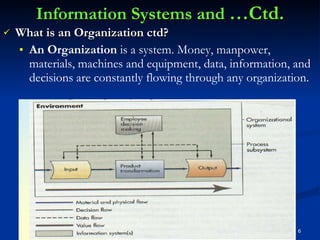
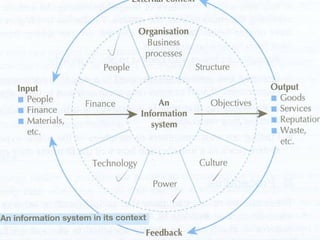
Information Systems and  …Ctd. What is an Organization ctd? An Organization  is a system. Money, manpower, materials, machines and equipment, data, information, and decisions are constantly flowing through any organization.
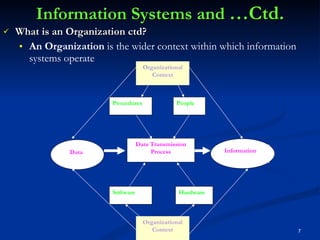
Information Systems and  …Ctd. What is an Organization ctd? An Organization  is the wider context within which information systems operate Data Information Organizational Context Organizational Context Procedures   People   Software Hardware Data Transmission Process
 
Some Basic Issues around Organizations
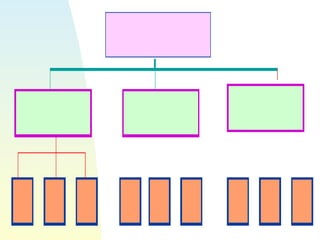
Information Systems and  …Ctd. Some Basic Issues Around Organizations Organizational Structure-  refers to organizational submits and the way they are related to the overall organization. Typical organizational structures include: Traditional Organizational Structure An organizational structure in which major department heads report to a president or top level manager.  The major departments are usually divided according to function and can include marketing, production , information system, finance, accounting, research and development … Is often referred to as hierarchical
 
Information Systems and  …Ctd. Some Basic Issues Around Organizations ctd Organizational Structure ctd. Flat Organizational Structure An organizational structure in which there is a trend of reducing the number of management levels or layers from the traditional organizational structure.  is usually accomplished by empowering employees at lower levels to make decisions and solve problems without needing permission from midlevel managers.
Information Systems and  …Ctd. Some Basic Issues Around Organizations ctd Organizational Culture is a set of major understandings and assumptions shared by a group. The understandings, which can include common beliefs, values and approaches to decision making are often not stated or documented in goal statement or formal policies. Influences any activities in the organization including IS implementation
Information Systems and  …Ctd. Some Basic Issues Around Organizations ctd Major Departments in an Organization Information – whether computer-based or not – has to flow within an organization in a way that will that will help managers, and the organization, achieve their goals. To that end, depending on the services or products they provide, most organizations are structured with departments that perform five functions:
Information Systems and  …Ctd. Some Basic Issues Around Organizations ctd Major Departments in an Organization ctd Production Makes the product or provides the service Inputs are turned to finished outputs by people or machinery Sales and Marketing Oversees advertising, promotion and sales Distributes the services or goods to customers or clients  Computers, phones, e-mail, and fax may be used
Information Systems and  …Ctd. Some Basic Issues Around Organizations ctd Major Departments in an Organization ctd Accounting and Finance Handles all financial matters – cash management, pays bills and taxes, record payments, makes investments, and compiles financial statements and reports Produces financial budgets and forecasts financial performance after receiving information from other departments Human Resources (Personnel) Finds and hires people and administers sick leave and retirement matters Also concerned with compensation levels, professional development, employee relations, government regulations
Information Systems and  …Ctd. Some Basic Issues Around Organizations ctd Major Departments in an Organization ctd Research and Development (R&D) (1) Conducts basic researches, relating discoveries to the organization's current or new products  (2) It does product development and tests and modifies new products or services created by researchers Whatever the kind of organization, it is likely to have departments corresponding to these.
Questions to ponder over:  To which department of an organization do information systems belong?
Information Systems and  …Ctd. Some Basic Issues Around Organizations ctd Major Management Tasks: Five Functions Planning Is setting objectives, both long term and short term, and developing strategies for achieving them  is what you, as a manager, do to try to get yourself or your organization from the present position to an even better position. Lays the groundwork for the other four tasks Organizing Making orderly arrangements of resources, such as people and materials Structuring the parts of your of your goal in a coordinated and integrated effort.
Information Systems and  …Ctd. Some Basic Issues Around Organizations ctd Major Management Tasks …ctd. Staffing Selecting, training and developing people Supervising Directing, guiding, and motivating employees to work toward achieving the organization’s goals. Controlling Monitoring the organization’s progress and adapting methods toward achieving its goals. All managers perform all these tasks as par to their work, though their level of responsibility regarding these tasks varies with the level of the manger.
Questions to ponder over:  To which management task of  an organization do information systems belong?
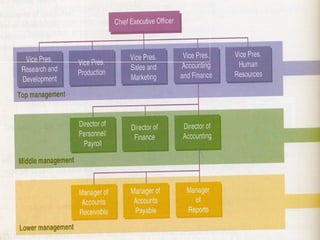
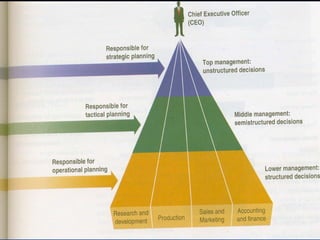
Information Systems and  …Ctd. Some Basic Issues Around Organizations ctd Major Management Levels: Three Levels, Three Kinds of Decisions Managers carry out their tasks by  making decisions based on the basis of the information available to them. A managers daily job is to decide on the best course of action based on the facts known at the time. For each of the five departments  there are three traditional levels of management – top, middle, and lower Managers on each of the three levels have different levels of responsibility and are therefore required to make different kinds of decisions.
Information Systems and  …Ctd. Some Basic Issues Around Organizations ctd Major Management Levels: Three Levels, Three Kinds of Decisions ctd. Top mangers –  Strategic decisions: The Chief executive officer (CEO) or president is the very top manager Vice presidents, one of whom heads each department, are also in the top management Top mangers are concerned with long-range planning, to make strategic decisions Strategic decisions are complex decisions rarely based on predetermined routine procedures, involving the subjective judgment of the decision maker.  E.g. what new markets should be tackled first, deciding the companies 5-year goals, deciding how to react to competitors’ actions Strategic  means that ,  of the five management tasks, top mangers are principally concerned with  planning.
Information Systems and  …Ctd. Some Basic Issues Around Organizations ctd Major Management Levels: Three Levels, Three Kinds of Decisions ctd. Middle mangers –  Tactical decisions: Middle mangers (eg. Branch manger) implement the goals of the organization and deal with short-term goals  Their job is to oversee the supervisors, and to make tactical decisions A tactical decision  is a decision that must be made  without a base of clearly defined informational procedures,  perhaps  requiring detailed analysis and computations  Tactical  means that, of the five management tasks, middle mangers deal principally with  organizing  and  staffing. An example of a tactical decision:  deciding how many units of a specific product should be kept in inventory, whether or not to purchase a larger compute system.
Information Systems and  …Ctd. Some Basic Issues Around Organizations ctd Major Management Levels: Three Levels, Three Kinds of Decisions ctd. Lower or supervisory mangers –  Operational decisions: Manage or monitor nonmanagement employees, and make operational decisions An operational decision is a predictable decision that can be made by following a well-defined set of routine procedures Eg.  Whether or not t restock inventory; when sales begin to drop off, the supervisor would need to take immediate action. Operational  means these managers focus principally on supervising and controlling. They monitor day-to-day events and, if necessary, take corrective action.
 
 
Questions to ponder over:  To which level of management do information systems belong?
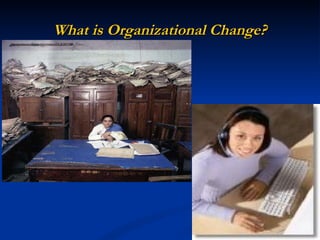
What is Organizational Change?
Information Systems and  …Ctd. What is Organizational Change?  Deals with how  for-profit  and  nonprofit  organizations plan for and implement, and handle their activities to achieve their goals better. Can be caused by: internal factors eg. activities initiated by employees at all levels external factors eg. Triggered by compotators, other stakeholders, government laws, general economic conditions, natural occurrences (flood?) “ All change is a struggle. Dramatic across-the-company change is war.” While some change efforts are socio-technical others may take a political form
Trends that Force Organizational Change
 
Information Systems and  …Ctd. Trends that Force Organizational Change Automation computers are changing  how  organizations do their work and  the kind of work  they do.   Downsizing  reducing the size of an organization by eliminating workers as a result of automation, economic considerations, and the drive for increased profitability  This “flattened the hierarchy” reducing the levels and number of middle managers Much of the company’s work remains while forcing the rest of the staff to take up the slack eg. The secretary may be gone while the secretarial work remains
Information Systems and  …Ctd. Trends that Force Organizational Change Outsourcing the contracting with outside businesses or services to perform the work once done by in-house departments The outside specialized contractors can often do the work more cheaply and efficiently  Total Quality Management (TQM) Is managing with an organization-wide commitment to continuous work improvement and really meeting customer needs.
Information Systems and  …Ctd. Trends that Force Organizational Change Employee Empowerment Means giving others the authority to act and make decisions The old style of management was to give lower-level mangers and employees only the information they “needed” to know, which minimized their power to make decisions Today’s philosophy is that information should be spread widely, not closely held by top managers, to enable employees lower down in the organization do their jobs better there are various change models which are representations of change theories that identify the phases of change the best way to implement them.
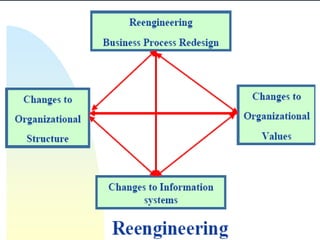
Information Systems and  …Ctd. What is Organizational Change ctd. Reengineering/Process redesign/ Business Process  Reengineering (BPR) Is the search for and implementation of radical change in business processes to achieve breakthrough results  IS one of the best models of organizational change The redesign includes the following:  Business processes, Organizational structures Organizational values Information Systems
Information Systems and  …Ctd. What is Organizational Change ctd. Reengineering/Process redesign/ Business Process  Reengineering (BPR) ctd. BPR has a number of advantages including the following  reduces delivery time,  increases product and service quality Enhances customer satisfaction Increase revenues and profitability
 
Questions to ponder over:  What is the major role of ISs in Organizational change?
Management Information Systems – The Different Types of Information Systems in Organizations
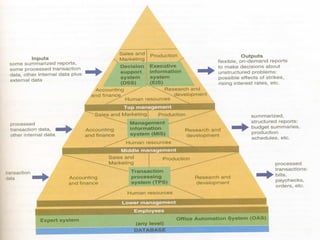
Information Systems and  …Ctd. Management Information Systems– The Different Types of Information Systems in Organizations The purpose of computer-based information systems is to provide managers (and the various categories of employees) with the appropriate kind of information to help them make decisions Corresponding to the three management layers and their requirements, six basic types of computer-based information systems provide information for decision making
Information Systems and  …Ctd. Management Information Systems– The Different Types of Information Systems in Organizations ctd Transaction Processing Systems (TPS):  For Lower Managers   A transaction is a recorded event having to do with routine business activities which includes everything concerning the product or service in which the organization is engaged: production, distribution, sales, orders, materials purchased, employees hired, … In most organizations, most of what goes on takes the form of transactions Today in most organizations, the bulk of such transactions are recorded in a computer-based information system called TPS
Information Systems and  …Ctd. Management Information Systems– The Different Types of Information Systems in Organizations ctd Transaction Processing Systems (TPS):  For Lower Managers   A Transaction Processing System (TPS) is a compute-based information system that keeps track of the transactions needed to conduct businesses A TPS records data but do little in the way of converting it to information.
Information Systems and  …Ctd. Management Information Systems– … ctd TPS ctd Some features of a TPS include One TPS for each department –  each department usually has its own TPS Input and output  – the inputs to the system are transaction data: bills, orders, … The outputs consist of processed transactions: bills, paycheck, … For lower managers –  because the TPS deals with day-to-day matters, it is principally of use to supervisory mangers; it helps in making  operational  decisions; not usually helpful to middle or top managers
Information Systems and  …Ctd. Management Information Systems– … ctd TPS ctd Some features of a TPS ctd Produces detail reports –  a manger at this level typically will receive information in the form of detail reports containing specific information about routine activities; the info may be useful to decide whether to restock inventory … Basis for MIS and DSS –  the database of transactions stored in a TPS is used to support MIS and DSS
Information Systems and  …Ctd. Management Information Systems– … ctd Management Information Systems (MIS): For Middle Managers Is a computer-based IS that uses data recorded by a TPS as input into programs that produce routine reports as outputs Some features of an MIS include: Input and output –  inputs consist of processed transaction data, such as orders, paychecks, …  Outputs consist of summarized, structured reports: eg. Budget summaries, production schedules For middle managers –  intended principally to assist middle managers, for  tactical  decisions, it enables them to get an overview of current business activities  Draws from all departments:  not just from one Produces several kinds of reports:  summary, exception, periodic on-demand
Information Systems and  …Ctd. Management Information Systems– … ctd MIS ctd. Summary reports:  show totals and trends. E.g. total orders by section (chemistry, hematology, immunology, microbiology), lab technician, or as total overall orders Exception reports:  show out-of-the-ordinary data. E.g. A report showing orders made fewer than 10 in a year Periodic reports:  are produced on a regular schedule eg. Order figures daily, weekly, monthly, quarterly, annually On-demand reports:  produce information in response to an unscheduled demand
Information Systems and  …Ctd. Management Information Systems– … ctd Decision Support Systems (DSS): For Top Managers Is a computer-based IS that provides a flexible tool for analysis and helps managers focus on the future To reach the DSS level of sophistication in IT, an organization must have established a TPS and MIS. Some features of a DSS include: Input and output –  Inputs consist of some summarized reports, some processed transaction data, …, and also data that is external to that produced by the organization eg. Government agencies, … the outputs are flexible, on-demand reports on which a top manger can make decisions about unstructured problems
Information Systems and  …Ctd. Management Information Systems– … ctd Decision Support Systems (DSS): For Top Managers ctd Mainly for   top mangers  –assists them make  strategic  decisions Produces analytical model-  The key attribute of a DSS is that it uses models (mathematical representations of a real system); the models use a DSS database, which draws on the TPS and MIS files, as well as external data  the model allow the mangers to do a simulation – play a “what if” game to reach decisions the manger can simulate an aspect of the organization’s environment in order to decide how to react to a change in conditions affecting it. By changing the hypothetical inputs to the model (eg. Number of workers available) the manger can see how the model’s outputs are affected.
Information Systems and  …Ctd. Management Information Systems– … ctd Executive Information Systems (EIS): For Top Managers Is an easy to use DSS made especially for top managers; specifically supporting strategic decision making Also called Executive Support System (ESS)  Draws on data not only from systems internal to the organization but also from those outside, such as news services or market-research databases An EIS allow manager to call up predefined reports from their personal computers (eg. Call up sales figures in many forms – by region, by week, by anticipated year, by projected increases) Include capabilities for analyzing data and doing “what if” scenarios
Information Systems and  …Ctd. Management Information Systems– … ctd Office Automation System (OAS): Information For Everyone Are those that combine various technologies to reduce the manual labor required to operate an efficient office environment Used throughout all levels of an organization OAS technologies include tax, e-mail, word processing,  The backbone of an OAS is a network eg. LAN
Information Systems and  …Ctd. Management Information Systems– … ctd Expert System (ES): Information For Everyone Is a set of interactive computer programs that help users solve problems that would otherwise require the assistance of a human expert Are created on the basis of knowledge collected on specific topics from human experts, and they imitate the reasoning process of a human being Emerged from the filed of artificial intelligence Are used by both management and nonmanagement people to solve specific problems
 
Questions to ponder over:  How does the group? of IS (TPSs, MISs, DSSs, EISs) differ from the group OASs and ESs
 

Information systems in Organizations

  • 1.
    Chapter 3 InformationSystems in Organizations
  • 2.
    Contents In thischapter, we discuss the significance of ISs in an organization, and their different types. What is an Organization? Some Basic Issues around Organizations What is Organizational Change? Trends that Force Organizational Change Management Information Systems – The Different Types of Information Systems in Organizations
  • 3.
    What is anOrganization?
  • 4.
    What is anOrganization?
  • 5.
    Information Systems andOrganizations What is an Organization? An Organization is a formal collection of people and various other resources established to accomplish a set of goals. For-profit organizations have a goal to maximize profit by increasing revenues while reducing costs. Nonprofit organizations do not have (monetary) profit as the primary goal e.g. include social groups, religious groups, universities and organizations that.
  • 6.
    Information Systems and …Ctd. What is an Organization ctd? An Organization is a system. Money, manpower, materials, machines and equipment, data, information, and decisions are constantly flowing through any organization.
  • 7.
    Information Systems and …Ctd. What is an Organization ctd? An Organization is the wider context within which information systems operate Data Information Organizational Context Organizational Context Procedures People Software Hardware Data Transmission Process
  • 8.
  • 9.
    Some Basic Issuesaround Organizations
  • 10.
    Information Systems and …Ctd. Some Basic Issues Around Organizations Organizational Structure- refers to organizational submits and the way they are related to the overall organization. Typical organizational structures include: Traditional Organizational Structure An organizational structure in which major department heads report to a president or top level manager. The major departments are usually divided according to function and can include marketing, production , information system, finance, accounting, research and development … Is often referred to as hierarchical
  • 11.
  • 12.
    Information Systems and …Ctd. Some Basic Issues Around Organizations ctd Organizational Structure ctd. Flat Organizational Structure An organizational structure in which there is a trend of reducing the number of management levels or layers from the traditional organizational structure. is usually accomplished by empowering employees at lower levels to make decisions and solve problems without needing permission from midlevel managers.
  • 13.
    Information Systems and …Ctd. Some Basic Issues Around Organizations ctd Organizational Culture is a set of major understandings and assumptions shared by a group. The understandings, which can include common beliefs, values and approaches to decision making are often not stated or documented in goal statement or formal policies. Influences any activities in the organization including IS implementation
  • 14.
    Information Systems and …Ctd. Some Basic Issues Around Organizations ctd Major Departments in an Organization Information – whether computer-based or not – has to flow within an organization in a way that will that will help managers, and the organization, achieve their goals. To that end, depending on the services or products they provide, most organizations are structured with departments that perform five functions:
  • 15.
    Information Systems and …Ctd. Some Basic Issues Around Organizations ctd Major Departments in an Organization ctd Production Makes the product or provides the service Inputs are turned to finished outputs by people or machinery Sales and Marketing Oversees advertising, promotion and sales Distributes the services or goods to customers or clients Computers, phones, e-mail, and fax may be used
  • 16.
    Information Systems and …Ctd. Some Basic Issues Around Organizations ctd Major Departments in an Organization ctd Accounting and Finance Handles all financial matters – cash management, pays bills and taxes, record payments, makes investments, and compiles financial statements and reports Produces financial budgets and forecasts financial performance after receiving information from other departments Human Resources (Personnel) Finds and hires people and administers sick leave and retirement matters Also concerned with compensation levels, professional development, employee relations, government regulations
  • 17.
    Information Systems and …Ctd. Some Basic Issues Around Organizations ctd Major Departments in an Organization ctd Research and Development (R&D) (1) Conducts basic researches, relating discoveries to the organization's current or new products (2) It does product development and tests and modifies new products or services created by researchers Whatever the kind of organization, it is likely to have departments corresponding to these.
  • 18.
    Questions to ponderover: To which department of an organization do information systems belong?
  • 19.
    Information Systems and …Ctd. Some Basic Issues Around Organizations ctd Major Management Tasks: Five Functions Planning Is setting objectives, both long term and short term, and developing strategies for achieving them is what you, as a manager, do to try to get yourself or your organization from the present position to an even better position. Lays the groundwork for the other four tasks Organizing Making orderly arrangements of resources, such as people and materials Structuring the parts of your of your goal in a coordinated and integrated effort.
  • 20.
    Information Systems and …Ctd. Some Basic Issues Around Organizations ctd Major Management Tasks …ctd. Staffing Selecting, training and developing people Supervising Directing, guiding, and motivating employees to work toward achieving the organization’s goals. Controlling Monitoring the organization’s progress and adapting methods toward achieving its goals. All managers perform all these tasks as par to their work, though their level of responsibility regarding these tasks varies with the level of the manger.
  • 21.
    Questions to ponderover: To which management task of an organization do information systems belong?
  • 22.
    Information Systems and …Ctd. Some Basic Issues Around Organizations ctd Major Management Levels: Three Levels, Three Kinds of Decisions Managers carry out their tasks by making decisions based on the basis of the information available to them. A managers daily job is to decide on the best course of action based on the facts known at the time. For each of the five departments there are three traditional levels of management – top, middle, and lower Managers on each of the three levels have different levels of responsibility and are therefore required to make different kinds of decisions.
  • 23.
    Information Systems and …Ctd. Some Basic Issues Around Organizations ctd Major Management Levels: Three Levels, Three Kinds of Decisions ctd. Top mangers – Strategic decisions: The Chief executive officer (CEO) or president is the very top manager Vice presidents, one of whom heads each department, are also in the top management Top mangers are concerned with long-range planning, to make strategic decisions Strategic decisions are complex decisions rarely based on predetermined routine procedures, involving the subjective judgment of the decision maker. E.g. what new markets should be tackled first, deciding the companies 5-year goals, deciding how to react to competitors’ actions Strategic means that , of the five management tasks, top mangers are principally concerned with planning.
  • 24.
    Information Systems and …Ctd. Some Basic Issues Around Organizations ctd Major Management Levels: Three Levels, Three Kinds of Decisions ctd. Middle mangers – Tactical decisions: Middle mangers (eg. Branch manger) implement the goals of the organization and deal with short-term goals Their job is to oversee the supervisors, and to make tactical decisions A tactical decision is a decision that must be made without a base of clearly defined informational procedures, perhaps requiring detailed analysis and computations Tactical means that, of the five management tasks, middle mangers deal principally with organizing and staffing. An example of a tactical decision: deciding how many units of a specific product should be kept in inventory, whether or not to purchase a larger compute system.
  • 25.
    Information Systems and …Ctd. Some Basic Issues Around Organizations ctd Major Management Levels: Three Levels, Three Kinds of Decisions ctd. Lower or supervisory mangers – Operational decisions: Manage or monitor nonmanagement employees, and make operational decisions An operational decision is a predictable decision that can be made by following a well-defined set of routine procedures Eg. Whether or not t restock inventory; when sales begin to drop off, the supervisor would need to take immediate action. Operational means these managers focus principally on supervising and controlling. They monitor day-to-day events and, if necessary, take corrective action.
  • 26.
  • 27.
  • 28.
    Questions to ponderover: To which level of management do information systems belong?
  • 29.
  • 30.
  • 31.
    Information Systems and …Ctd. What is Organizational Change? Deals with how for-profit and nonprofit organizations plan for and implement, and handle their activities to achieve their goals better. Can be caused by: internal factors eg. activities initiated by employees at all levels external factors eg. Triggered by compotators, other stakeholders, government laws, general economic conditions, natural occurrences (flood?) “ All change is a struggle. Dramatic across-the-company change is war.” While some change efforts are socio-technical others may take a political form
  • 32.
    Trends that ForceOrganizational Change
  • 33.
  • 34.
    Information Systems and …Ctd. Trends that Force Organizational Change Automation computers are changing how organizations do their work and the kind of work they do. Downsizing reducing the size of an organization by eliminating workers as a result of automation, economic considerations, and the drive for increased profitability This “flattened the hierarchy” reducing the levels and number of middle managers Much of the company’s work remains while forcing the rest of the staff to take up the slack eg. The secretary may be gone while the secretarial work remains
  • 35.
    Information Systems and …Ctd. Trends that Force Organizational Change Outsourcing the contracting with outside businesses or services to perform the work once done by in-house departments The outside specialized contractors can often do the work more cheaply and efficiently Total Quality Management (TQM) Is managing with an organization-wide commitment to continuous work improvement and really meeting customer needs.
  • 36.
    Information Systems and …Ctd. Trends that Force Organizational Change Employee Empowerment Means giving others the authority to act and make decisions The old style of management was to give lower-level mangers and employees only the information they “needed” to know, which minimized their power to make decisions Today’s philosophy is that information should be spread widely, not closely held by top managers, to enable employees lower down in the organization do their jobs better there are various change models which are representations of change theories that identify the phases of change the best way to implement them.
  • 37.
    Information Systems and …Ctd. What is Organizational Change ctd. Reengineering/Process redesign/ Business Process Reengineering (BPR) Is the search for and implementation of radical change in business processes to achieve breakthrough results IS one of the best models of organizational change The redesign includes the following: Business processes, Organizational structures Organizational values Information Systems
  • 38.
    Information Systems and …Ctd. What is Organizational Change ctd. Reengineering/Process redesign/ Business Process Reengineering (BPR) ctd. BPR has a number of advantages including the following reduces delivery time, increases product and service quality Enhances customer satisfaction Increase revenues and profitability
  • 39.
  • 40.
    Questions to ponderover: What is the major role of ISs in Organizational change?
  • 41.
    Management Information Systems– The Different Types of Information Systems in Organizations
  • 42.
    Information Systems and …Ctd. Management Information Systems– The Different Types of Information Systems in Organizations The purpose of computer-based information systems is to provide managers (and the various categories of employees) with the appropriate kind of information to help them make decisions Corresponding to the three management layers and their requirements, six basic types of computer-based information systems provide information for decision making
  • 43.
    Information Systems and …Ctd. Management Information Systems– The Different Types of Information Systems in Organizations ctd Transaction Processing Systems (TPS): For Lower Managers A transaction is a recorded event having to do with routine business activities which includes everything concerning the product or service in which the organization is engaged: production, distribution, sales, orders, materials purchased, employees hired, … In most organizations, most of what goes on takes the form of transactions Today in most organizations, the bulk of such transactions are recorded in a computer-based information system called TPS
  • 44.
    Information Systems and …Ctd. Management Information Systems– The Different Types of Information Systems in Organizations ctd Transaction Processing Systems (TPS): For Lower Managers A Transaction Processing System (TPS) is a compute-based information system that keeps track of the transactions needed to conduct businesses A TPS records data but do little in the way of converting it to information.
  • 45.
    Information Systems and …Ctd. Management Information Systems– … ctd TPS ctd Some features of a TPS include One TPS for each department – each department usually has its own TPS Input and output – the inputs to the system are transaction data: bills, orders, … The outputs consist of processed transactions: bills, paycheck, … For lower managers – because the TPS deals with day-to-day matters, it is principally of use to supervisory mangers; it helps in making operational decisions; not usually helpful to middle or top managers
  • 46.
    Information Systems and …Ctd. Management Information Systems– … ctd TPS ctd Some features of a TPS ctd Produces detail reports – a manger at this level typically will receive information in the form of detail reports containing specific information about routine activities; the info may be useful to decide whether to restock inventory … Basis for MIS and DSS – the database of transactions stored in a TPS is used to support MIS and DSS
  • 47.
    Information Systems and …Ctd. Management Information Systems– … ctd Management Information Systems (MIS): For Middle Managers Is a computer-based IS that uses data recorded by a TPS as input into programs that produce routine reports as outputs Some features of an MIS include: Input and output – inputs consist of processed transaction data, such as orders, paychecks, … Outputs consist of summarized, structured reports: eg. Budget summaries, production schedules For middle managers – intended principally to assist middle managers, for tactical decisions, it enables them to get an overview of current business activities Draws from all departments: not just from one Produces several kinds of reports: summary, exception, periodic on-demand
  • 48.
    Information Systems and …Ctd. Management Information Systems– … ctd MIS ctd. Summary reports: show totals and trends. E.g. total orders by section (chemistry, hematology, immunology, microbiology), lab technician, or as total overall orders Exception reports: show out-of-the-ordinary data. E.g. A report showing orders made fewer than 10 in a year Periodic reports: are produced on a regular schedule eg. Order figures daily, weekly, monthly, quarterly, annually On-demand reports: produce information in response to an unscheduled demand
  • 49.
    Information Systems and …Ctd. Management Information Systems– … ctd Decision Support Systems (DSS): For Top Managers Is a computer-based IS that provides a flexible tool for analysis and helps managers focus on the future To reach the DSS level of sophistication in IT, an organization must have established a TPS and MIS. Some features of a DSS include: Input and output – Inputs consist of some summarized reports, some processed transaction data, …, and also data that is external to that produced by the organization eg. Government agencies, … the outputs are flexible, on-demand reports on which a top manger can make decisions about unstructured problems
  • 50.
    Information Systems and …Ctd. Management Information Systems– … ctd Decision Support Systems (DSS): For Top Managers ctd Mainly for top mangers –assists them make strategic decisions Produces analytical model- The key attribute of a DSS is that it uses models (mathematical representations of a real system); the models use a DSS database, which draws on the TPS and MIS files, as well as external data the model allow the mangers to do a simulation – play a “what if” game to reach decisions the manger can simulate an aspect of the organization’s environment in order to decide how to react to a change in conditions affecting it. By changing the hypothetical inputs to the model (eg. Number of workers available) the manger can see how the model’s outputs are affected.
  • 51.
    Information Systems and …Ctd. Management Information Systems– … ctd Executive Information Systems (EIS): For Top Managers Is an easy to use DSS made especially for top managers; specifically supporting strategic decision making Also called Executive Support System (ESS) Draws on data not only from systems internal to the organization but also from those outside, such as news services or market-research databases An EIS allow manager to call up predefined reports from their personal computers (eg. Call up sales figures in many forms – by region, by week, by anticipated year, by projected increases) Include capabilities for analyzing data and doing “what if” scenarios
  • 52.
    Information Systems and …Ctd. Management Information Systems– … ctd Office Automation System (OAS): Information For Everyone Are those that combine various technologies to reduce the manual labor required to operate an efficient office environment Used throughout all levels of an organization OAS technologies include tax, e-mail, word processing, The backbone of an OAS is a network eg. LAN
  • 53.
    Information Systems and …Ctd. Management Information Systems– … ctd Expert System (ES): Information For Everyone Is a set of interactive computer programs that help users solve problems that would otherwise require the assistance of a human expert Are created on the basis of knowledge collected on specific topics from human experts, and they imitate the reasoning process of a human being Emerged from the filed of artificial intelligence Are used by both management and nonmanagement people to solve specific problems
  • 54.
  • 55.
    Questions to ponderover: How does the group? of IS (TPSs, MISs, DSSs, EISs) differ from the group OASs and ESs
  • 56.