SPREAD SPECTRUM UNIT 3 PART 2 Copyright © The McGraw-Hill Companies, Inc. Permission required for reproduction or display.
6. 3-2  SPREAD SPECTRUM In spread spectrum (SS), we combine signals from different sources to fit into a larger bandwidth, but our goals are to prevent eavesdropping and jamming. To achieve these goals, spread spectrum techniques add redundancy. Frequency Hopping Spread Spectrum (FHSS) Direct Sequence Spread Spectrum (DSSS) Topics discussed in this section:
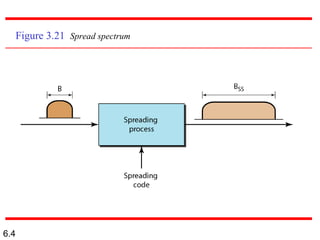
Spread Spectrum A signal that occupies a bandwidth of B,   is  spread  out to occupy a bandwidth of B ss All signals are spread to occupy the same bandwidth B ss Signals are spread with different codes so that they can be separated at the receivers. Signals can be spread in the frequency domain or in the time domain . 6.
6. Figure 3.21  Spread spectrum
6. Figure 3.22  Frequency hopping spread spectrum (FHSS)
6. Figure 3.23  Frequency selection in FHSS
6. Figure 3.24  FHSS cycles
6. Figure 3.25  Bandwidth sharing
6. Figure 3.26  DSSS
DSSS MODULATION 6.
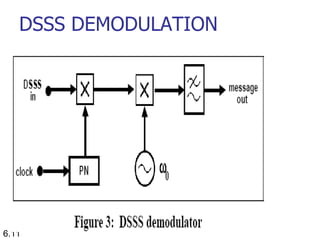
DSSS DEMODULATION 6.
6. Figure 3.27  DSSS example
DS-SS  Vs  FH-SS PERFORMANCE ISSUES 6.
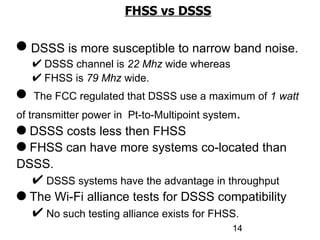
FHSS vs DSSS DSSS is more susceptible to narrow band noise. DSSS channel is  22 Mhz  wide whereas FHSS is  79 Mhz  wide. The FCC regulated that DSSS use a maximum of  1 watt  of transmitter power in  Pt-to-Multipoint system .  DSSS costs less then FHSS FHSS can have more systems co-located than DSSS. DSSS systems have the advantage in throughput The Wi-Fi alliance tests for DSSS compatibility No such testing alliance exists for FHSS.
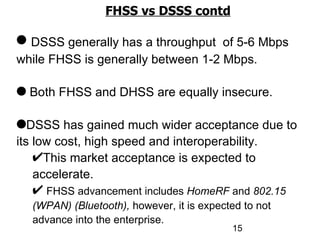
FHSS vs DSSS contd DSSS generally has a throughput  of 5-6 Mbps while FHSS is generally between 1-2 Mbps. Both FHSS and DHSS are equally insecure. DSSS has gained much wider acceptance due to its low cost, high speed and interoperability.  This market acceptance is expected to accelerate. FHSS advancement includes  HomeRF  and  802.15 (WPAN) (Bluetooth),  however, it is expected to not advance into the enterprise.
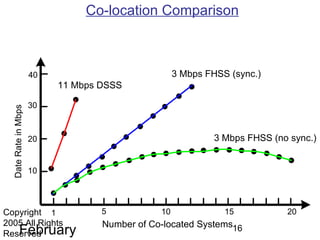
Copyright 2005 All Rights Reserved February 2005 Co-location Comparison Date Rate in Mbps
UNIT - 3 THE END 6.

SPREAD SPECTRUM

  • 1.
    SPREAD SPECTRUM UNIT3 PART 2 Copyright © The McGraw-Hill Companies, Inc. Permission required for reproduction or display.
  • 2.
    6. 3-2 SPREAD SPECTRUM In spread spectrum (SS), we combine signals from different sources to fit into a larger bandwidth, but our goals are to prevent eavesdropping and jamming. To achieve these goals, spread spectrum techniques add redundancy. Frequency Hopping Spread Spectrum (FHSS) Direct Sequence Spread Spectrum (DSSS) Topics discussed in this section:
  • 3.
    Spread Spectrum Asignal that occupies a bandwidth of B, is spread out to occupy a bandwidth of B ss All signals are spread to occupy the same bandwidth B ss Signals are spread with different codes so that they can be separated at the receivers. Signals can be spread in the frequency domain or in the time domain . 6.
  • 4.
    6. Figure 3.21 Spread spectrum
  • 5.
    6. Figure 3.22 Frequency hopping spread spectrum (FHSS)
  • 6.
    6. Figure 3.23 Frequency selection in FHSS
  • 7.
    6. Figure 3.24 FHSS cycles
  • 8.
    6. Figure 3.25 Bandwidth sharing
  • 9.
  • 10.
  • 11.
  • 12.
    6. Figure 3.27 DSSS example
  • 13.
    DS-SS Vs FH-SS PERFORMANCE ISSUES 6.
  • 14.
    FHSS vs DSSSDSSS is more susceptible to narrow band noise. DSSS channel is 22 Mhz wide whereas FHSS is 79 Mhz wide. The FCC regulated that DSSS use a maximum of 1 watt of transmitter power in Pt-to-Multipoint system . DSSS costs less then FHSS FHSS can have more systems co-located than DSSS. DSSS systems have the advantage in throughput The Wi-Fi alliance tests for DSSS compatibility No such testing alliance exists for FHSS.
  • 15.
    FHSS vs DSSScontd DSSS generally has a throughput of 5-6 Mbps while FHSS is generally between 1-2 Mbps. Both FHSS and DHSS are equally insecure. DSSS has gained much wider acceptance due to its low cost, high speed and interoperability. This market acceptance is expected to accelerate. FHSS advancement includes HomeRF and 802.15 (WPAN) (Bluetooth), however, it is expected to not advance into the enterprise.
  • 16.
    Copyright 2005 AllRights Reserved February 2005 Co-location Comparison Date Rate in Mbps
  • 17.
    UNIT - 3THE END 6.