





MBA – SEM I
OVERVIEW
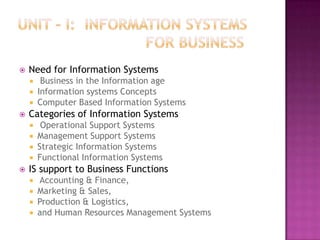
   Need for Information Systems
        Business in the Information age
       Information systems Concepts
       Computer Based Information Systems
   Categories of Information Systems
        Operational Support Systems
       Management Support Systems
       Strategic Information Systems
       Functional Information Systems
   IS support to Business Functions
       Accounting & Finance,
       Marketing & Sales,
       Production & Logistics,
       and Human Resources Management Systems
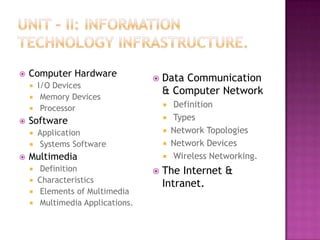
   Computer Hardware               Data Communication
     I/O Devices
                                     & Computer Network
     Memory Devices
     Processor
                                        Definition
   Software                            Types
     Application                       Network Topologies
     Systems Software                  Network Devices
   Multimedia                          Wireless Networking.
     Definition                    The Internet &
     Characteristics
                                     Intranet.
     Elements of Multimedia
     Multimedia Applications.
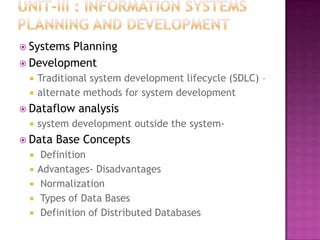
 SystemsPlanning
 Development
    Traditional system development lifecycle (SDLC) –
    alternate methods for system development
 Dataflow   analysis
    system development outside the system-
 Data   Base Concepts
    Definition
    Advantages- Disadvantages
    Normalization
    Types of Data Bases
    Definition of Distributed Databases
 Inter   organizational
     Global information systems
     Electronic Data Interchange (EDI)
     Electronic Funds Transfer (EFT)
 Extranets
     E-Commerce Overview
     E-commerce Applications
     M-Commerce Services & Applications
     E-Governance
 Emerging     Trends in Computing
     Cloud Computing
     Grid Computing (Definitions only).
   Need For Security
       Security Threat
       Attack
       Malicious Software
       Hacking
       Security Services
   Security Mechanisms
        Cryptography
        Digital Signature
        Firewall
        Types of Firewall
       Identification
   Authentication
     Biometric Techniques
     Other Security Measures
   Security Policy.
   1. Turban, Rainer and Potter, “Introduction to Information
                                Technology”, John & Wiley Sons.
   2. Anita Goel, “Computer Fundamentals”, Pearson.
   3. Ralph M. Stair& George W. Reynolds, “Principles of
          Information Systems, Thomson Course Technology”.
   4. Ramesh Behl,“Information Technology for
    Management”,                       McGraw-Hill Companies.
   5. Ken Laudon, Jane Laudon & Rajnish Dass, “Management
                 Information System”, 11nd Ed. Pearson.
   6. B. Muthukumaran, “Information Technology for
                        Management”, 2010, Oxford.
   7. Alex Leon & Mathew Leon, “Fundamentals of Information
                        Technologies”, 2009, Leon Vikas, 2nd Ed.
   8. S. Sudalaimuthu & S. Anthony Raj, “Computer
                 Applications of Business”, 2010, HPH.
   9. Arpita Gopal & Chandrani Singh, “E - World- Emerging
                 Trends in Information Technology”, Excel Books.
Information Technology for Business

Information Technology for Business

  • 1.
  • 2.
  • 14.
    Need for Information Systems  Business in the Information age  Information systems Concepts  Computer Based Information Systems  Categories of Information Systems  Operational Support Systems  Management Support Systems  Strategic Information Systems  Functional Information Systems  IS support to Business Functions  Accounting & Finance,  Marketing & Sales,  Production & Logistics,  and Human Resources Management Systems
  • 15.
    Computer Hardware  Data Communication  I/O Devices & Computer Network  Memory Devices  Processor  Definition  Software  Types  Application  Network Topologies  Systems Software  Network Devices  Multimedia  Wireless Networking.  Definition  The Internet &  Characteristics Intranet.  Elements of Multimedia  Multimedia Applications.
  • 16.
     SystemsPlanning  Development  Traditional system development lifecycle (SDLC) –  alternate methods for system development  Dataflow analysis  system development outside the system-  Data Base Concepts  Definition  Advantages- Disadvantages  Normalization  Types of Data Bases  Definition of Distributed Databases
  • 17.
     Inter organizational  Global information systems  Electronic Data Interchange (EDI)  Electronic Funds Transfer (EFT)  Extranets  E-Commerce Overview  E-commerce Applications  M-Commerce Services & Applications  E-Governance  Emerging Trends in Computing  Cloud Computing  Grid Computing (Definitions only).
  • 18.
    Need For Security  Security Threat  Attack  Malicious Software  Hacking  Security Services  Security Mechanisms  Cryptography  Digital Signature  Firewall  Types of Firewall  Identification  Authentication  Biometric Techniques  Other Security Measures  Security Policy.
  • 20.
    1. Turban, Rainer and Potter, “Introduction to Information Technology”, John & Wiley Sons.  2. Anita Goel, “Computer Fundamentals”, Pearson.  3. Ralph M. Stair& George W. Reynolds, “Principles of Information Systems, Thomson Course Technology”.  4. Ramesh Behl,“Information Technology for Management”, McGraw-Hill Companies.  5. Ken Laudon, Jane Laudon & Rajnish Dass, “Management Information System”, 11nd Ed. Pearson.  6. B. Muthukumaran, “Information Technology for Management”, 2010, Oxford.  7. Alex Leon & Mathew Leon, “Fundamentals of Information Technologies”, 2009, Leon Vikas, 2nd Ed.  8. S. Sudalaimuthu & S. Anthony Raj, “Computer Applications of Business”, 2010, HPH.  9. Arpita Gopal & Chandrani Singh, “E - World- Emerging Trends in Information Technology”, Excel Books.