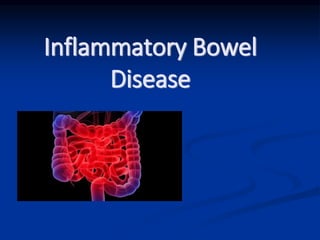
Inflammatory Bowel
Disease
Objectives
 Introduction
 Classifications
 Clinical features
 Diagnosis
 Management
 Conclusion
Surgical anatomy of small and large
intestine
1. Tinea coli:
Aggregation of longitudinal muscles
Absent in appendix and rectum
Sacculations are present
2. Appendices epiploicae
Fat filled peritoneal pouches
Absent in caecum, appendix, rectum
Numerously seen in transverse colon and
sigmoidcolon
Features of large intestine
Ascending colon : 5 inch
Transverse colon : 20 inch
Descending colon: 10 inch
Sigmoid colon : 15 inch
Measurements
Introduction of IBD
 IBD characterized by a tendency for chronic or
relapsing immune activation and inflammation
within the gastrointestinal tract (GIT)
 Crohn’s disease (CD) and ulcerative colitis (UC)
are the 2 major forms of idiopathic IBD.
Less common entities
 Microscopic colitis (collagenous and
lymphocytic)
 Others
 Diversion colitis
 Radiation colitis
 Drug induced colitis
 Infectious colitis
 Ischemic colitis
CD and UC
 CD is a condition of
 Chronic inflammation potentially involving any
location of the GIT from mouth to anus.
 It is a lifelong disease arising from an interaction
between genetic and environmental factors
 UC is an inflammatory disorder that affects the
rectum and extends proximally to affect variable
extent of the colon.
Genetics
 Studies suggested that 1st degree relatives of an
affected patient have a risk of IBD that is 4-20
times higher than that of general population.
 The best replicated linkage region, IBD1, on
chromosome 16q contains the CD susceptibility
gene, NOD2/CARD15.
 Having one copy of the risk alleles confers a 2–
4-fold risk for developing CD, whereas double-
dose carriage increases the risk 20–40-fold.
Etiology
 Mutations within the NOD2/ CARD15 gene contribute
to CD susceptibility.
 Functional studies suggest that inappropriate responses
to bacterial components may alter signaling pathways of
the innate immune system, leading to
 the development and persistence of intestinal inflammation.
Pathogenesis
 The mucosa of CD patients is dominated by
Th1 (T helper), which produce interferon-γ and
IL-2.
 In contrast, UC dominated by Th2 phenotype,
which produce transforming growth factor
(TGF-) and IL-5.
 Activation of Th1 cells produce the down-
regulatory cytokines IL-10 and TGF-.
Environmental Precipitants
 Factors:
 NSAIDs use (?altered intestinal barrier), and
 Early appendectomy (increase UC incidence)
 Smoking (protects against UC but increases the risk
of CD).
CD: PATHOLOGY
 Early Findings:
 Aphthous ulcer.
 The presence of granulomas
 Late findings:
 Linear ulcers.
 The classic cobble stoned appearance may arise.
 Transmural inflammation
 Sinus tracts, and strictures.
 Fibrosis.
transmural inflammation with predominance of the
inflammation in the mucosa and submucosa.
UC: PATHOLOGY
 The inflammation is predominantly confined to
the mucosa.
 Non-specific (can be seen with any acute
inflammation)
 The lamina propria becomes edematous.
 Inflammatory infiltrate of neutrophils
 Neutrophils invade crypts, causing cryptitis &
ultimately crypt abscesses.
 Specific (suggest chronicity):
 Distorted crypt architecture, crypt atrophy and a
chronic inflammatory infiltrate.
Diagnosis
 Exclude other possibilities (need good history,
physical exam, labs, imaging and endoscopy with
biopsy)
 There are many distinguishing features of CD
and UC.
 In about 5% it is classified as indeterminate
because of overlapping features.
Distinguishing characteristics of CD and UC
Feature CD UC
Location SB or colon Only colon (rarely
“backwash ileitis”
Anatomic
distribution
Skip lesions Continuous,
begins distally
Rectal
involvement
Rectal spare Involved in >90%
Gross bleeding Only 25% Universal
Peri-anal disease 75% Rare
Fistulization Yes No
Granulomas 50-75% No
Endoscopic features of CD and UC
Feature CD UC
Mucosal
involvement
Discontinuous Continuous
Aphthous ulcers Common Rare
Surrounding
mucosa
Relatively
normal
Abnormal
Longitudinal ulcer Common Rare
Cobble stoning In severe cases No
Mucosal friability Uncommon Common
Vascular pattern Normal distorted
Pathologic features of CD and UC
Feature CD UC
Transmural inflammation Yes Uncommon
Granulomas 50-75% No
Fissures Common Rare
Fibrosis Common No
Submucosal
inflammation
Common Uncommon
Radiologic features of CD and UC
Feature CD UC
Nodularity
granularity
cobble stoning
string sign of SB
Collar button
ulcers
UC: Presentation
 Must exclude infectious cause before making Dx.
 Rectal Bleeding
 Diarrhea:
 frequent passage of loose or liquid stool, often associated
with passing large quantities of mucus.
 Abdominal Pain:
 it is not a prominent symptom.
 Anorexia, nausea, fever…
DDX of UC
 Infectious
 Drug induced
 Microscopic colitis
UC: Presentation
 Mild attack:
 Most common form, mainly left sided colitis, <4
BM/day with no blood
 Moderate attack:
 25% of all patients, 4-6 BM/day with blood.
 Severe or fulminant colitis:
 ~ 15% of cases, >6BM/day, bloody, fever, weight
loss, diffuse abd tenderness, elevated WBC, most
refractory to medical therapy
CD: clinical presentations
 Disease of the ileum:
 May present initially with a small bowel obstruction.
 Patients with an active disease often present with anorexia,
loose stools, and weight loss.
 Perianal disease
 In 24% of patients with CD.
 Skin lesions include superficial ulcers, and abscesses.
 Anal canal lesions include fissures, ulcers, and stenosis.
CD ilitis: DDx
 Lymphoma
 Yersinea Enterocolitis and
 TB
CD: clinical presentations
 colonic disease
 The typical presenting symptom is diarrhea, occasionally with
passage of obvious blood.
 proctitis
 May be the initial presentation in some cases of CD
Extra-intestinal manifestations of IBD
 Arthritis:
 Peripheral arthritis, usu paralels the disease activity
 Ankylosing Spondylitis, 1-6%, sacroiliitis
 Ocular lesions:
 Iritis (uvietis) (0.5-3%), episcleritis, keratitis,
 Skin and oral cavity:
 Erythema nodosum 1-3%
 Pyoderma Gangrenosum 0.6%
 Aphthus stomatitis, metastatic CD.
Extra-intestinal manifestations of IBD
 Liver and Biliary tract disease:
 Pericholangitis, fatty infiltration, PSC (1-4%, more
with UC), cholangiocarcinoma, gallstones
 Thromboembolic disease, vasculitis, Renal
disease (urolithiasis, GN), clubbing, amyloidosis.
Complications of IBD
 Bleeding
 Stricture
 Fistula
 Toxic megacolon
 Cancer
How to diagnose IBD
 History
 Physical examinations
 Labs
 Radiology
 Endoscopy
 Histopathology
Treatment
 Goals of therapy
 Induce and maintain remission.
 Ameliorate symptoms
 Improve pts quality of life
 Adequate nutrition
 Prevent complication of both the disease and
medications
5-Aminosalicylic Acids
 The mainstay treatment of mild to moderately
active UC and CD (induction).
 5-ASA may act by
 blocking the production of prostaglandins and
leukotrienes,
 inhibiting bacterial peptide–induced neutrophil
chemotaxis and adenosine-induced secretion,
 scavenging reactive oxygen metabolites
5-Aminosalicylic Acids
 For patients with distal colonic disease, a
suppository or enema form will be most
appropriate.
 Maintenance treatment with a 5-aminosalicylic
acid can be effective for sustaining remission in
ulcerative colitis but is of questionable value in
Crohn's disease.
Corticosteroids
 Topical corticosteroids can be used as an
alternative to 5-ASA in ulcerative proctitis or
distal UC.
 Oral prednisone or prednisolone is used for
moderately severe UC or CD, in doses ranging
up to 60 mg per day.
 IV is warranted for patients who are sufficiently
ill to require hospitalization; the majority will
have a response within 7 to 10 days.
Corticosteroids
 No proven maintenance benefit in the treatment
of either UC or CD.
 Many and serious side effects.
 Budesonide:
 less side effects,
 its use is limited to patients with distal ileal and right-
sided colonic disease
Immunosuppressive Agents
 These agents are generally appropriate for patients in
whom the dose of corticosteroids cannot be tapered or
discontinued.
 Azathioprine & 6-MP
 The most extensively used immunosuppressive agents.
 The mechanisms of action unknown but may include
 suppressing the generation of a specific subgroup of T cells.
 The onset of benefit takes several weeks up to six months.
 Dose-related BM suppression is uniformly observed
Immunosuppressive Agents
 Methotrexate
 Effective in steroid-dependent active CD and in
maintaining remission.
 Cyclosporine
 Severe UC not responding to IV steroid &need
urgent proctocolectomy.
 50% of the responders will need surgery within a
year.
Anti-TNF Therapy
 It is a chimeric monoclonal antibody, binds soluble
TNF.
 Infleximab, Adalimumab (Humira) and Certolizumab
 Prompt onset, effects takes 6weeks to max of 6m.
 Indicated in fistulising crohns, moderate to severe CD
 Infleximab also indicated in severe ulcerative colitis
INDICATIONS FOR SURGERY
 In patients with UC:
 Severe attacks that fail to respond to medical therapy.
 Complications of a severe attack (e.g., perforation, acute
dilatation).
 Chronic continuous disease with an impaired quality of life.
 Dysplasia or carcinoma.
 In patients with CD
 Obstruction, severe perianal disease unresponsive to medical
therapy, difficult fistulas, major bleeding, severe disability
 30 % relapse rate
28 - IBD-1.ppt

28 - IBD-1.ppt

  • 1.
  • 2.
    Objectives  Introduction  Classifications Clinical features  Diagnosis  Management  Conclusion
  • 3.
    Surgical anatomy ofsmall and large intestine
  • 4.
    1. Tinea coli: Aggregationof longitudinal muscles Absent in appendix and rectum Sacculations are present 2. Appendices epiploicae Fat filled peritoneal pouches Absent in caecum, appendix, rectum Numerously seen in transverse colon and sigmoidcolon Features of large intestine
  • 6.
    Ascending colon :5 inch Transverse colon : 20 inch Descending colon: 10 inch Sigmoid colon : 15 inch Measurements
  • 9.
    Introduction of IBD IBD characterized by a tendency for chronic or relapsing immune activation and inflammation within the gastrointestinal tract (GIT)  Crohn’s disease (CD) and ulcerative colitis (UC) are the 2 major forms of idiopathic IBD.
  • 10.
    Less common entities Microscopic colitis (collagenous and lymphocytic)  Others  Diversion colitis  Radiation colitis  Drug induced colitis  Infectious colitis  Ischemic colitis
  • 11.
    CD and UC CD is a condition of  Chronic inflammation potentially involving any location of the GIT from mouth to anus.  It is a lifelong disease arising from an interaction between genetic and environmental factors  UC is an inflammatory disorder that affects the rectum and extends proximally to affect variable extent of the colon.
  • 12.
    Genetics  Studies suggestedthat 1st degree relatives of an affected patient have a risk of IBD that is 4-20 times higher than that of general population.  The best replicated linkage region, IBD1, on chromosome 16q contains the CD susceptibility gene, NOD2/CARD15.  Having one copy of the risk alleles confers a 2– 4-fold risk for developing CD, whereas double- dose carriage increases the risk 20–40-fold.
  • 13.
    Etiology  Mutations withinthe NOD2/ CARD15 gene contribute to CD susceptibility.  Functional studies suggest that inappropriate responses to bacterial components may alter signaling pathways of the innate immune system, leading to  the development and persistence of intestinal inflammation.
  • 14.
    Pathogenesis  The mucosaof CD patients is dominated by Th1 (T helper), which produce interferon-γ and IL-2.  In contrast, UC dominated by Th2 phenotype, which produce transforming growth factor (TGF-) and IL-5.  Activation of Th1 cells produce the down- regulatory cytokines IL-10 and TGF-.
  • 16.
    Environmental Precipitants  Factors: NSAIDs use (?altered intestinal barrier), and  Early appendectomy (increase UC incidence)  Smoking (protects against UC but increases the risk of CD).
  • 17.
    CD: PATHOLOGY  EarlyFindings:  Aphthous ulcer.  The presence of granulomas  Late findings:  Linear ulcers.  The classic cobble stoned appearance may arise.  Transmural inflammation  Sinus tracts, and strictures.  Fibrosis.
  • 19.
    transmural inflammation withpredominance of the inflammation in the mucosa and submucosa.
  • 20.
    UC: PATHOLOGY  Theinflammation is predominantly confined to the mucosa.  Non-specific (can be seen with any acute inflammation)  The lamina propria becomes edematous.  Inflammatory infiltrate of neutrophils  Neutrophils invade crypts, causing cryptitis & ultimately crypt abscesses.  Specific (suggest chronicity):  Distorted crypt architecture, crypt atrophy and a chronic inflammatory infiltrate.
  • 22.
    Diagnosis  Exclude otherpossibilities (need good history, physical exam, labs, imaging and endoscopy with biopsy)  There are many distinguishing features of CD and UC.  In about 5% it is classified as indeterminate because of overlapping features.
  • 23.
    Distinguishing characteristics ofCD and UC Feature CD UC Location SB or colon Only colon (rarely “backwash ileitis” Anatomic distribution Skip lesions Continuous, begins distally Rectal involvement Rectal spare Involved in >90% Gross bleeding Only 25% Universal Peri-anal disease 75% Rare Fistulization Yes No Granulomas 50-75% No
  • 25.
    Endoscopic features ofCD and UC Feature CD UC Mucosal involvement Discontinuous Continuous Aphthous ulcers Common Rare Surrounding mucosa Relatively normal Abnormal Longitudinal ulcer Common Rare Cobble stoning In severe cases No Mucosal friability Uncommon Common Vascular pattern Normal distorted
  • 27.
    Pathologic features ofCD and UC Feature CD UC Transmural inflammation Yes Uncommon Granulomas 50-75% No Fissures Common Rare Fibrosis Common No Submucosal inflammation Common Uncommon
  • 28.
    Radiologic features ofCD and UC Feature CD UC Nodularity granularity cobble stoning string sign of SB Collar button ulcers
  • 33.
    UC: Presentation  Mustexclude infectious cause before making Dx.  Rectal Bleeding  Diarrhea:  frequent passage of loose or liquid stool, often associated with passing large quantities of mucus.  Abdominal Pain:  it is not a prominent symptom.  Anorexia, nausea, fever…
  • 34.
    DDX of UC Infectious  Drug induced  Microscopic colitis
  • 35.
    UC: Presentation  Mildattack:  Most common form, mainly left sided colitis, <4 BM/day with no blood  Moderate attack:  25% of all patients, 4-6 BM/day with blood.  Severe or fulminant colitis:  ~ 15% of cases, >6BM/day, bloody, fever, weight loss, diffuse abd tenderness, elevated WBC, most refractory to medical therapy
  • 36.
    CD: clinical presentations Disease of the ileum:  May present initially with a small bowel obstruction.  Patients with an active disease often present with anorexia, loose stools, and weight loss.  Perianal disease  In 24% of patients with CD.  Skin lesions include superficial ulcers, and abscesses.  Anal canal lesions include fissures, ulcers, and stenosis.
  • 37.
    CD ilitis: DDx Lymphoma  Yersinea Enterocolitis and  TB
  • 38.
    CD: clinical presentations colonic disease  The typical presenting symptom is diarrhea, occasionally with passage of obvious blood.  proctitis  May be the initial presentation in some cases of CD
  • 39.
    Extra-intestinal manifestations ofIBD  Arthritis:  Peripheral arthritis, usu paralels the disease activity  Ankylosing Spondylitis, 1-6%, sacroiliitis  Ocular lesions:  Iritis (uvietis) (0.5-3%), episcleritis, keratitis,  Skin and oral cavity:  Erythema nodosum 1-3%  Pyoderma Gangrenosum 0.6%  Aphthus stomatitis, metastatic CD.
  • 42.
    Extra-intestinal manifestations ofIBD  Liver and Biliary tract disease:  Pericholangitis, fatty infiltration, PSC (1-4%, more with UC), cholangiocarcinoma, gallstones  Thromboembolic disease, vasculitis, Renal disease (urolithiasis, GN), clubbing, amyloidosis.
  • 44.
    Complications of IBD Bleeding  Stricture  Fistula  Toxic megacolon  Cancer
  • 47.
    How to diagnoseIBD  History  Physical examinations  Labs  Radiology  Endoscopy  Histopathology
  • 48.
    Treatment  Goals oftherapy  Induce and maintain remission.  Ameliorate symptoms  Improve pts quality of life  Adequate nutrition  Prevent complication of both the disease and medications
  • 49.
    5-Aminosalicylic Acids  Themainstay treatment of mild to moderately active UC and CD (induction).  5-ASA may act by  blocking the production of prostaglandins and leukotrienes,  inhibiting bacterial peptide–induced neutrophil chemotaxis and adenosine-induced secretion,  scavenging reactive oxygen metabolites
  • 50.
    5-Aminosalicylic Acids  Forpatients with distal colonic disease, a suppository or enema form will be most appropriate.  Maintenance treatment with a 5-aminosalicylic acid can be effective for sustaining remission in ulcerative colitis but is of questionable value in Crohn's disease.
  • 51.
    Corticosteroids  Topical corticosteroidscan be used as an alternative to 5-ASA in ulcerative proctitis or distal UC.  Oral prednisone or prednisolone is used for moderately severe UC or CD, in doses ranging up to 60 mg per day.  IV is warranted for patients who are sufficiently ill to require hospitalization; the majority will have a response within 7 to 10 days.
  • 52.
    Corticosteroids  No provenmaintenance benefit in the treatment of either UC or CD.  Many and serious side effects.  Budesonide:  less side effects,  its use is limited to patients with distal ileal and right- sided colonic disease
  • 53.
    Immunosuppressive Agents  Theseagents are generally appropriate for patients in whom the dose of corticosteroids cannot be tapered or discontinued.  Azathioprine & 6-MP  The most extensively used immunosuppressive agents.  The mechanisms of action unknown but may include  suppressing the generation of a specific subgroup of T cells.  The onset of benefit takes several weeks up to six months.  Dose-related BM suppression is uniformly observed
  • 54.
    Immunosuppressive Agents  Methotrexate Effective in steroid-dependent active CD and in maintaining remission.  Cyclosporine  Severe UC not responding to IV steroid &need urgent proctocolectomy.  50% of the responders will need surgery within a year.
  • 55.
    Anti-TNF Therapy  Itis a chimeric monoclonal antibody, binds soluble TNF.  Infleximab, Adalimumab (Humira) and Certolizumab  Prompt onset, effects takes 6weeks to max of 6m.  Indicated in fistulising crohns, moderate to severe CD  Infleximab also indicated in severe ulcerative colitis
  • 56.
    INDICATIONS FOR SURGERY In patients with UC:  Severe attacks that fail to respond to medical therapy.  Complications of a severe attack (e.g., perforation, acute dilatation).  Chronic continuous disease with an impaired quality of life.  Dysplasia or carcinoma.  In patients with CD  Obstruction, severe perianal disease unresponsive to medical therapy, difficult fistulas, major bleeding, severe disability  30 % relapse rate