BY Dr.Veer Vikram Singh
MEDICINE DEPARTMENT
• It refers to the microbial infection of endothelium of
heart usually the valves .
• Incidence; 5 to 15 cases per 100000 per Year.
• More than 50% are of >60 years of age.
Risk Factors
.History of previous endocarditis
.Ventricular septal defect
.Mitral and Aortic Regurgitation
.Calcified Aortic Valve
.Rheumatic Heart disease
.IV drug users
Causative Organisms Of Endocarditis
ORGANISM
Strep Viridan Most common overall Cause
Staph Aureus Most common in IV Drug users ,and acute I.E
Staph epidermis Most common in Prosthatic valves I.E
HACEK(Gram -ve)
Hemophilus
Actino bacillus
Cardiobacterum
Eikenella
Kingella
Yeast and Fungi Mostly in immunocompromised.
• Mitral valve= Most common valve involved
• Aortic Valve= 2nd most common valve involved
• Tricuspid valve= Most commonly in IV drug abusers
• Sub-acute Endocarditis
• Acute Endocarditis
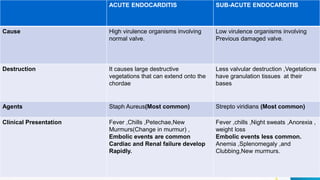
ACUTE ENDOCARDITIS SUB-ACUTE ENDOCARDITIS
Cause High virulence organisms involving
normal valve.
Low virulence organisms involving
Previous damaged valve.
Destruction It causes large destructive
vegetations that can extend onto the
chordae
Less valvular destruction ,Vegetations
have granulation tissues at their
bases
Agents Staph Aureus(Most common) Strepto viridians (Most common)
Clinical Presentation Fever ,Chills ,Petechae,New
Murmurs(Change in murmur) ,
Embolic events are common
Cardiac and Renal failure develop
Rapidly.
Fever ,chills ,Night sweats ,Anorexia ,
weight loss
Embolic events less common.
Anemia ,Splenomegaly ,and
Clubbing,New murmurs.
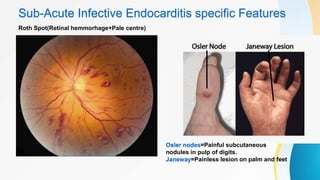
Sub-Acute Infective Endocarditis specific Features
Roth Spot(Retinal hemmorhage+Pale centre)
Osler nodes=Painful subcutaneous
nodules in pulp of digits.
Janeway=Painless lesion on palm and feet
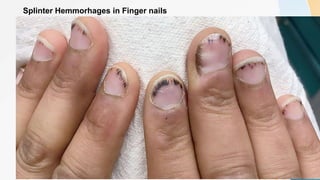
Splinter Hemmorhages in Finger nails
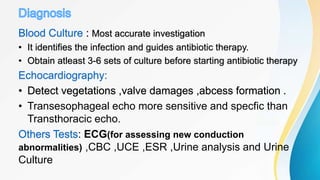
Blood Culture : Most accurate investigation
• It identifies the infection and guides antibiotic therapy.
• Obtain atleast 3-6 sets of culture before starting antibiotic therapy
Echocardiography:
• Detect vegetations ,valve damages ,abcess formation .
• Transesophageal echo more sensitive and specfic than
Transthoracic echo.
Others Tests: ECG(for assessing new conduction
abnormalities) ,CBC ,UCE ,ESR ,Urine analysis and Urine
Culture
Major”s Criteria Minor Criteria
Positive blood culture
Typical organism from 2 Culture
Persistent Positive blood culture taken >12 hr a part.
Endocardial involvement
Positive echocardial findings of Vegtations
New valvular Regurgitation
.Predisposing Valvular or cardiac abnormality
.IV drug misuse
.Pyrexia> 38C
.Embolic phenomenon
.Vasculitic phenomenon
.Suggestive Blood culture
.Suggestive Echocardiac findings (but not matching
Major Criteria)
Definitive Diagnosis= 2 Major; or 1 Major+3 Minor or 5 Minor
Possible Diagnosis=1 Major + 1 Minor or 3 Minor
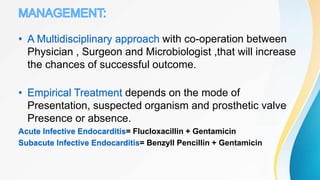
• A Multidisciplinary approach with co-operation between
Physician , Surgeon and Microbiologist ,that will increase
the chances of successful outcome.
• Empirical Treatment depends on the mode of
Presentation, suspected organism and prosthetic valve
Presence or absence.
Acute Infective Endocarditis= Flucloxacillin + Gentamicin
Subacute Infective Endocarditis= Benzyll Pencillin + Gentamicin
• Triple Therapy with Vancomycin ,Gentamicin and Oral
Rifampcin .
• Heart Failure due to valve damage
• Failure of Antibiotic Therapy
• Large vegetation on left side heart valves
• Recurrent Emboli
• Abcess Formation
ENDOCARDITIS
Defination;It is the microbial infection of endothelium of Heart usually the valves.
Risk Factors:History of previous endocarditis,,Ventricular septal defect ,,Mitral and Aortic Regurgitation,,Calcified
Aortic Valve,,Rheumatic Heart disease,,IV drug users.
Strep viridians is the most common ,staph aureus in IV drug abusers,Strep Epidermis in with Prosthetic valves.
Mitral Valve is the most common valve involved,Aortic valve is the 2nd most common valve involved.
2 Types of Infective Endocarditis :Acute Endocarditis and Sub acute Endocarditis.
Acute Endocarditis caused by high virulence organisms in normal valves , caused by Staph aureus, cause the large
destructive vegetation and Embolic events are common ,while subacute Endocarditis caused by Low virulence
organisms in damaged valve ,caused mostly by strep viridians, cause less valvular damage ,vegetations has
granulation on base.
Osler nodes ,splinter hemmorhage ,Janeway lesions found mostly in subacute Endocarditis.
Blood Culture is most accurate , Tracheo esophageal Echo is most senitive and specfic than trans thoracic.Duke
Criteria for definitive and Prospective Diagnosis is used.
Management involves the multidisciplinary team of Physician , Surgeon and Microbiologist.
Emprical therapy is used to Treat .Acute=Flucloxacillin + Gentamicin Subacute= Benzyll Pencillin + Gentamicin.
Triple therapy is used to treat Pencillin allergen and Prosthetic valves Endocarditis.
Heart failure due to valve damage ,Failure of Antibiotic therapy ,Recurrent Emboli +Abcess formation are
indications of Surgical Indications.
Infective Endocarditis

Infective Endocarditis

  • 1.
    BY Dr.Veer VikramSingh MEDICINE DEPARTMENT
  • 3.
    • It refersto the microbial infection of endothelium of heart usually the valves . • Incidence; 5 to 15 cases per 100000 per Year. • More than 50% are of >60 years of age.
  • 4.
    Risk Factors .History ofprevious endocarditis .Ventricular septal defect .Mitral and Aortic Regurgitation .Calcified Aortic Valve .Rheumatic Heart disease .IV drug users
  • 5.
    Causative Organisms OfEndocarditis ORGANISM Strep Viridan Most common overall Cause Staph Aureus Most common in IV Drug users ,and acute I.E Staph epidermis Most common in Prosthatic valves I.E HACEK(Gram -ve) Hemophilus Actino bacillus Cardiobacterum Eikenella Kingella Yeast and Fungi Mostly in immunocompromised.
  • 6.
    • Mitral valve=Most common valve involved • Aortic Valve= 2nd most common valve involved • Tricuspid valve= Most commonly in IV drug abusers
  • 7.
  • 8.
    ACUTE ENDOCARDITIS SUB-ACUTEENDOCARDITIS Cause High virulence organisms involving normal valve. Low virulence organisms involving Previous damaged valve. Destruction It causes large destructive vegetations that can extend onto the chordae Less valvular destruction ,Vegetations have granulation tissues at their bases Agents Staph Aureus(Most common) Strepto viridians (Most common) Clinical Presentation Fever ,Chills ,Petechae,New Murmurs(Change in murmur) , Embolic events are common Cardiac and Renal failure develop Rapidly. Fever ,chills ,Night sweats ,Anorexia , weight loss Embolic events less common. Anemia ,Splenomegaly ,and Clubbing,New murmurs.
  • 9.
    Sub-Acute Infective Endocarditisspecific Features Roth Spot(Retinal hemmorhage+Pale centre) Osler nodes=Painful subcutaneous nodules in pulp of digits. Janeway=Painless lesion on palm and feet
  • 10.
  • 11.
    Blood Culture :Most accurate investigation • It identifies the infection and guides antibiotic therapy. • Obtain atleast 3-6 sets of culture before starting antibiotic therapy Echocardiography: • Detect vegetations ,valve damages ,abcess formation . • Transesophageal echo more sensitive and specfic than Transthoracic echo. Others Tests: ECG(for assessing new conduction abnormalities) ,CBC ,UCE ,ESR ,Urine analysis and Urine Culture
  • 12.
    Major”s Criteria MinorCriteria Positive blood culture Typical organism from 2 Culture Persistent Positive blood culture taken >12 hr a part. Endocardial involvement Positive echocardial findings of Vegtations New valvular Regurgitation .Predisposing Valvular or cardiac abnormality .IV drug misuse .Pyrexia> 38C .Embolic phenomenon .Vasculitic phenomenon .Suggestive Blood culture .Suggestive Echocardiac findings (but not matching Major Criteria) Definitive Diagnosis= 2 Major; or 1 Major+3 Minor or 5 Minor Possible Diagnosis=1 Major + 1 Minor or 3 Minor
  • 13.
    • A Multidisciplinaryapproach with co-operation between Physician , Surgeon and Microbiologist ,that will increase the chances of successful outcome. • Empirical Treatment depends on the mode of Presentation, suspected organism and prosthetic valve Presence or absence. Acute Infective Endocarditis= Flucloxacillin + Gentamicin Subacute Infective Endocarditis= Benzyll Pencillin + Gentamicin
  • 14.
    • Triple Therapywith Vancomycin ,Gentamicin and Oral Rifampcin . • Heart Failure due to valve damage • Failure of Antibiotic Therapy • Large vegetation on left side heart valves • Recurrent Emboli • Abcess Formation
  • 15.
    ENDOCARDITIS Defination;It is themicrobial infection of endothelium of Heart usually the valves. Risk Factors:History of previous endocarditis,,Ventricular septal defect ,,Mitral and Aortic Regurgitation,,Calcified Aortic Valve,,Rheumatic Heart disease,,IV drug users. Strep viridians is the most common ,staph aureus in IV drug abusers,Strep Epidermis in with Prosthetic valves. Mitral Valve is the most common valve involved,Aortic valve is the 2nd most common valve involved. 2 Types of Infective Endocarditis :Acute Endocarditis and Sub acute Endocarditis. Acute Endocarditis caused by high virulence organisms in normal valves , caused by Staph aureus, cause the large destructive vegetation and Embolic events are common ,while subacute Endocarditis caused by Low virulence organisms in damaged valve ,caused mostly by strep viridians, cause less valvular damage ,vegetations has granulation on base. Osler nodes ,splinter hemmorhage ,Janeway lesions found mostly in subacute Endocarditis. Blood Culture is most accurate , Tracheo esophageal Echo is most senitive and specfic than trans thoracic.Duke Criteria for definitive and Prospective Diagnosis is used. Management involves the multidisciplinary team of Physician , Surgeon and Microbiologist. Emprical therapy is used to Treat .Acute=Flucloxacillin + Gentamicin Subacute= Benzyll Pencillin + Gentamicin. Triple therapy is used to treat Pencillin allergen and Prosthetic valves Endocarditis. Heart failure due to valve damage ,Failure of Antibiotic therapy ,Recurrent Emboli +Abcess formation are indications of Surgical Indications.