Endocarditis
Contents of Lecture
 Endocarditis
 Definitions
 Epidemiology
 Pathogenesis
 Clinical Presentations
 Diagnosis
 Complications/Mortality
 Septic thrombophlebitis
 Mycotic aneurysm
Endocarditis: Definition
 Infective Endocarditis: a microbial infection
of the endocardial surface of the heart
 Common site: heart valve, but may occur at
septal defect, on chordae tendinae or in the
mural endocardium
 Classification:
 acute or subacute-chronic on temporal basis,
severity of presentation and progression
 By organism
 Native valve or prosthetic valve
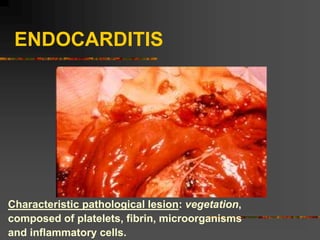
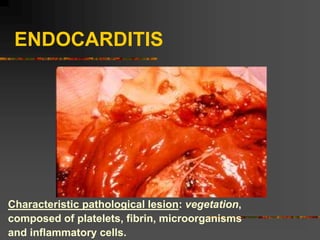
ENDOCARDITIS
Characteristic pathological lesion: vegetation,
composed of platelets, fibrin, microorganisms
and inflammatory cells.
Pathogenesis
 Altered valve surface
 Animal experiments suggest that IE is almost
impossible to establish unless the valve surface is
damaged
 Deposition of platelets and fibrin – nonbacterial
thrombotic vegetation (NBTE)
 Bacteraemia – attaches to platelet-fibrin deposits
 Covered by more fibrin
 Protected from neutrophils
 Division of bacteria
 Mature vegetation
Pathogenesis
 Haemodynamic Factors
 Bacterial colonisation more likely to occur
around lesions with high degrees of tubulence
 eg. small VSD, valvular stenosis
 Large surface areas, low flow and low
turbulence are less likely to cause IE
 eg large VSD,
Pathogenesis
 Bacteraemia
 Transient bacteraemia occurs when a heavily
colonised mucosal surface is traumatised
 Dental extraction
 Periodontal surgery
 Tooth brushing
 Tonsillectomy
 Operations involving the respiratory, GI or GU tract mucosa
 Oesophageal dilatation
 Biliary tract surgery
Site of Infection
 Aortic valve more common than mitral
 Aortic:
 Vegetation usually on ventricular aspect, all 3
cusps usually affected
 Perforation or dysfunction of valve
 Root abscess
 Mitral:
 Dysfunction by rupture of chordae tendinae
EPIDEMIOLOGY
 Changing over the
past decade due to:
 Increased longevity
 New predisposing
factors
 Nosocomial
infections
 In U.S and Western
Europe incidence of
community –acquired
endocarditis is 1.7-6.2
cases per 100,000
person-years.
 M:F ratio 1.7:1
 Mean age now 47-69
(30-40 previously)
EPIDEMIOLOGY
 Incidence in IVDA group is estimated at 2000
per 100,000 person-years, even higher if
there is known valvular heart disease
 Increased longevitiy leads to more
degenerative valvular disease, placement of
prosthetic valves and increased exposure to
nosocomial bacteremia
PROSTHETIC VALVES
 7-25% of cases of infective endocarditis
 The rates of infection are the same at 5 years for
both mechanical and bioprostheses, but higher
for mechanical in first 3 months
 Culmulative risk: 3.1% at 12 months and 5.7% at
60 months post surgery
 Onset:
 within 2 months of surgery early and usually
hospital acquired
 12 months post surgery late onset and usually
community acquired
Nosocomial Infective
Endocarditis
 7-29% of alll cases seen in tertiary referral
hospitals
 At least half linked to intravascular devices
 Other sources GU and GIT procedures or
surgical-wound infection
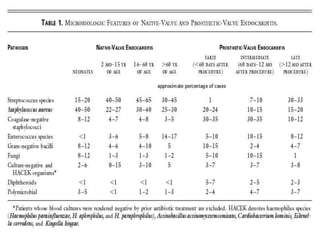
Aetiological Agents
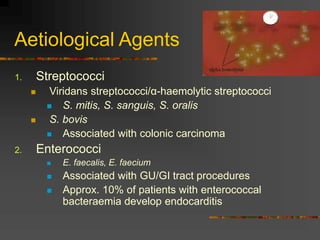
1. Streptococci
 Viridans streptococci/ι-haemolytic streptococci
 S. mitis, S. sanguis, S. oralis
 S. bovis
 Associated with colonic carcinoma
2. Enterococci
 E. faecalis, E. faecium
 Associated with GU/GI tract procedures
 Approx. 10% of patients with enterococcal
bacteraemia develop endocarditis
Aetiological Agents
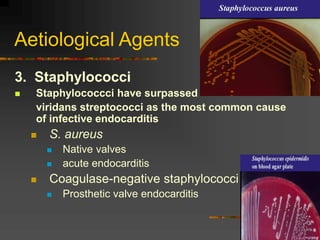
3. Staphylococci
 Staphylococcci have surpassed
viridans streptococci as the most common cause
of infective endocarditis
 S. aureus
 Native valves
 acute endocarditis
 Coagulase-negative staphylococci
 Prosthetic valve endocarditis
Aetiological Agents
4. Gram-negative rods
 HACEK group
 Haemophilus aphrophilus, Actinobacillus
actinomycetemcomitans, Cardiobacterium hominis,
Eikenella corrodens, Kingella kingae.
 Fastidious oropharyngeal GNBs
 E. coli, Klebsiella etc
 Uncommon
 Pseudomonas aeruginosa
 IVDA
 Neisseria gonorrhoae
 Rare since introduction of penicillin
Aetiological Agents
5. Others
 Fungi
 Candida species, Aspergillus species
 Q fever
 Chlamydia
 Bartonella
 Legionella
MICROBIOLOGY OF NATIVE
VALVE ENDOCARDITIS
Clinical Manifestations
 Fever, most common symptom, sign (but
may be absent)
 Anorexia, weight-loss, malaise, night sweats
 Heart murmur
 Petechiae on the skin, conjunctivae, oral
mucosa
 Splenomegaly
 Right-sided endocarditis is not associated
with peripheral emboli/phenomena but
pulmonary findings predominate
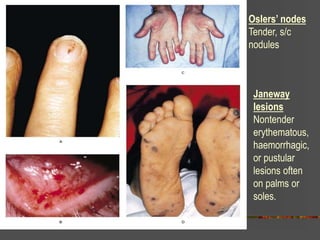
Oslers’ nodes
Tender, s/c
nodules
Janeway
lesions
Nontender
erythematous,
haemorrhagic,
or pustular
lesions often
on palms or
soles.
ENDOCARDITIS
Characteristic pathological lesion: vegetation,
composed of platelets, fibrin, microorganisms
and inflammatory cells.
Prosthetic valve-Presentation
 Often indolent illness with low grade fever
or acute toxic illness
 Locally invasive : new murmurs and
congestive cardiac failure
 If prosthetic valve in situ and unexplained
fever suspect endocarditis
Nosocomial Endocarditis
 May present acutely without signs of
endocarditis
 Suggested by: Bacteremia persisting for
days before treatment or for 72 hours or
more after the removal of an infected
catheter and initiation of treatment (esp in
those with abnormal or prosthetic valves)
 Risk if prosthetic valve and bacteremia: 11%
 Risk if prosthetic valve and candidaemia:
16%
Investigations
1. Blood culture
2. Echo
 TTE
 TOE
3. FBC/ESR/CRP
4. Rheumatoid Factor
5. MSU
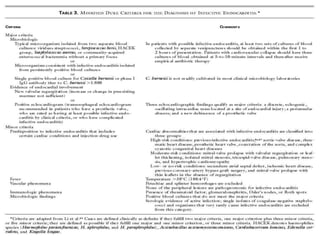
Diagnosis: Duke Criteria
 In 1994 a group at Duke University
standardised criteria for assessing
patients with suspected endocarditis
 Include
-Predisposing Factors
-Blood culture isolates or persistence of
bacteremia
-Echocardiogram findings with other
clinical, laboratory findings
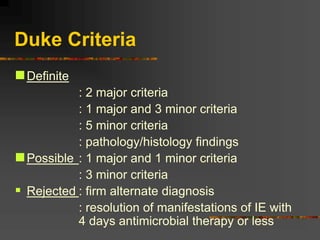
Duke Criteria
Definite
: 2 major criteria
: 1 major and 3 minor criteria
: 5 minor criteria
: pathology/histology findings
Possible : 1 major and 1 minor criteria
: 3 minor criteria
 Rejected : firm alternate diagnosis
: resolution of manifestations of IE with
4 days antimicrobial therapy or less
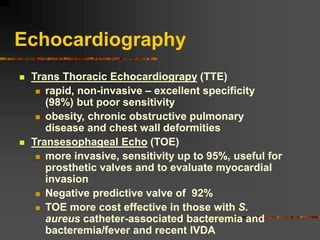
Echocardiography
 Trans Thoracic Echocardiograpy (TTE)
 rapid, non-invasive – excellent specificity
(98%) but poor sensitivity
 obesity, chronic obstructive pulmonary
disease and chest wall deformities
 Transesophageal Echo (TOE)
 more invasive, sensitivity up to 95%, useful for
prosthetic valves and to evaluate myocardial
invasion
 Negative predictive valve of 92%
 TOE more cost effective in those with S.
aureus catheter-associated bacteremia and
bacteremia/fever and recent IVDA
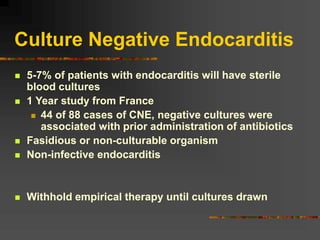
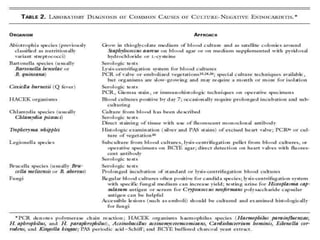
Culture Negative Endocarditis
 5-7% of patients with endocarditis will have sterile
blood cultures
 1 Year study from France
 44 of 88 cases of CNE, negative cultures were
associated with prior administration of antibiotics
 Fasidious or non-culturable organism
 Non-infective endocarditis
 Withhold empirical therapy until cultures drawn
COMPLICATIONS OF
ENDOCARDITIS
 Cardiac :
 congestive cardiac failure-valvular damage,
more common with aortic valve endocarditis,
infection beyond valve→ CCF, higher mortality,
need for surgery, A-V, fascicular or bundle
branch block, pericarditis, tamponade or
fistulae
 Systemic emboli
 Risk depends on valve (mitral>aortic), size of
vegetation, (high risk if >10 mm)
 20-40% of patients with endocarditis,
 risk decreases once appropriate antimicrobial
therapy started.
 Prolonged Fever: usually fever associated
with endocarditis resolves in 2-3 days after
commencing appropriate antimicrobial
therapy with less virulent organisms and 90%
by the end ot the second week
 Recurrent fever:
 infection beyond the valve
 focal metastatic disease
 drug hypersentivity
 nosocomial infection or others e.g. Pulmonary
embolus
Therapy
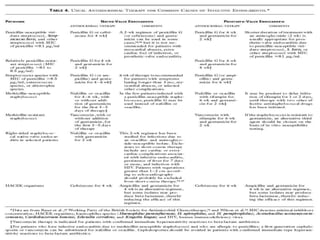
 Antimicrobial therapy
 Use a bactericidal regimen
 Use a recommended regimen for the organism
isolated
 E.g. American Heart Association JAMA 1995; 274: 1706-13.,
British Society for Antimicrobial Chemotherapy
 Repeat blood cultures until blood is demonstrated to
be sterile
 Surgery
 Get cardiothoracic teams involved early
Therapy
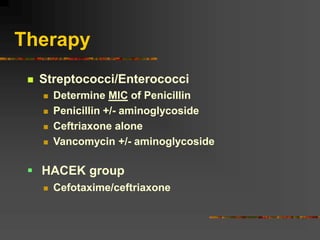
 Streptococci/Enterococci
 Determine MIC of Penicillin
 Penicillin +/- aminoglycoside
 Ceftriaxone alone
 Vancomycin +/- aminoglycoside
 Cefotaxime/ceftriaxone
 HACEK group
Therapy
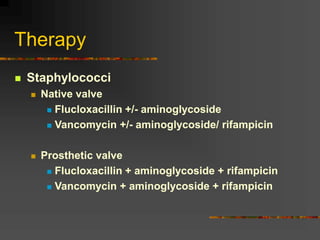
 Staphylococci
 Native valve
 Flucloxacillin +/- aminoglycoside
 Vancomycin +/- aminoglycoside/ rifampicin
 Prosthetic valve
 Flucloxacillin + aminoglycoside + rifampicin
 Vancomycin + aminoglycoside + rifampicin
Surgical Therapy
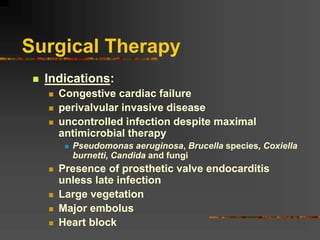
 Indications:
 Congestive cardiac failure
 perivalvular invasive disease
 uncontrolled infection despite maximal
antimicrobial therapy
 Pseudomonas aeruginosa, Brucella species, Coxiella
burnetti, Candida and fungi
 Presence of prosthetic valve endocarditis
unless late infection
 Large vegetation
 Major embolus
 Heart block
Surgical Therapy
 The hemodynamic status at the time
determines principally operative
mortality
MORTALITY
 Depends on ORGANISM
 Presence of complications
 Preexisting conditions
 Development of perivalvular or myocardial
abscess
 Use of combined antimicrobial and
surgical therapy
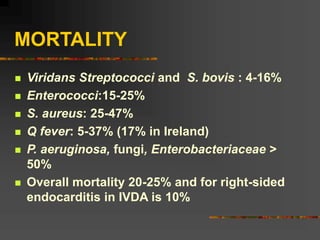
MORTALITY
 Viridans Streptococci and S. bovis : 4-16%
 Enterococci:15-25%
 S. aureus: 25-47%
 Q fever: 5-37% (17% in Ireland)
 P. aeruginosa, fungi, Enterobacteriaceae >
50%
 Overall mortality 20-25% and for right-sided
endocarditis in IVDA is 10%
Prevention
 Antimicrobial prophylaxis is given to at risk
patients when bacteraemia-inducing procedures
are performed
 Look up and follow guidelines
 American Heart Association. Circulation 1997; 96:
358-366
 British Society for Antimicrobial Chemotherapy.
Journal of Antimicrobial Chemotherapy 1993; 31:
347-438
 BNF
Septic/Suppurative Thrombophlebitis
 Inflammation of the vein wall often accompanied
by thrombosis and bacteraemia
 Superficial – complication of catheterisation or dermal
infection
 Central (inc. pelvic)
 Assoc. with catheterisation
 Abortion, parturition, pelvic surgery
 Suppurative Intracranial thrombophlebitis
 Portal vein
 Clinical manifestations
 Fever
 Septic pulmonary emboli
 Pelvic: typically 1-2 weeks post-partum
 High fever, abdominal pain + tenderness
 Treatment
 Appropriate antimicrobial therapy +/- surgery
Suppurative Intracranial
thrombophlebitis
 Cavernous sinus
 From facial infection
 Opthalmoplegia
 Lateral sinus thrombosis
 Otitis or mastoiditis
 Superior sagittal sinus
 Petrosal sinus
Lemierre’s Syndrome
 Acute oropharyngeal infection complicated
by septic thrombophlebitis of the internal
jugular vein and metastatic infection.
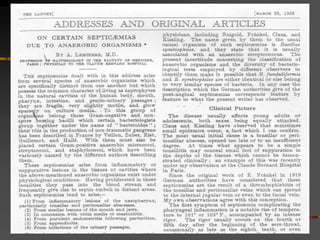
Lemierre’s syndrome
“the appearance and repetition, several
days after the onset of a sore-throat (and
particularly of a tonsillar abscess) of
severe pyrexial attacks and an initial rigor,
or still more certainly the occurrence of
pulmonary infarcts and arthritic
manifestations, constitute a syndrome so
characteristic that a mistake is almost
impossible”
Clinical Presentation
 Usually healthy young adults
 Oropharyngeal infection
 Tonsillopharyngitis, mastoiditis, dental infection,
surgery, trauma
 All signs and symptoms may have resolved by
presentation
 Internal jugular vein thrombosis occurs usually
4-8 days after oropharyngeal infection
 Thrombosis not documented in about 50% of
patients
 Fever, toxic
 Swelling at angle of mandible
 Septic emboli from thrombosed IJ vein
 Lungs, septic arthritis, visceral abscesses,
meningitis etc
Mortality
 80% in series described by Lemierre
 4-12% in more recent series
Causative agents
 F. necrophorum is most commonly
recovered
 F. nucleatum
 Peptostreptococcus species
 Bacteroides species
 Haemophilus aphrophilus
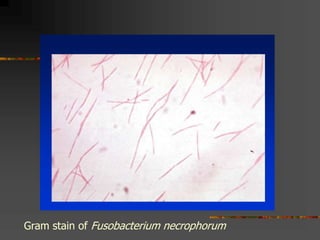
Gram stain of Fusobacterium necrophorum
Treatment
1. Appropriate antimicrobial therapy
 Penicillin previously considered drug of choice
 ß-lactamase producing isolates now reported
 Metronidazole, ß-lactam- ß-lactamase inhibitor
combinations, carbapenems, clindamycin
 Duration of antimicrobial treatment is unknown
2. Drainage of purulent fluid collections
3. ?Anticoagulation
4. ?Internal jugular vein ligation
Mycotic aneurysms
 Term used to describe all extra-cardiac
aneurysms of infective aetiology except for
syphilitic aortitis
 Haematogenous seeding of a damaged
atherosclerotic vessel
 Associated with endocarditis
 Elderly, male>female
 intracranial
 Proximal thoracic aorta
 Other arteries
 Pre-existing aortic aneurysm
 Pseudoaneurysm – infection complicating arterial injury
Aetiology:
 Wide variation
Treatment:
 Surgery + prolonged antimicrobial therapy

Endocarditis.ppt

  • 1.
  • 2.
    Contents of Lecture Endocarditis  Definitions  Epidemiology  Pathogenesis  Clinical Presentations  Diagnosis  Complications/Mortality  Septic thrombophlebitis  Mycotic aneurysm
  • 3.
    Endocarditis: Definition  InfectiveEndocarditis: a microbial infection of the endocardial surface of the heart  Common site: heart valve, but may occur at septal defect, on chordae tendinae or in the mural endocardium  Classification:  acute or subacute-chronic on temporal basis, severity of presentation and progression  By organism  Native valve or prosthetic valve
  • 4.
    ENDOCARDITIS Characteristic pathological lesion:vegetation, composed of platelets, fibrin, microorganisms and inflammatory cells.
  • 5.
    Pathogenesis  Altered valvesurface  Animal experiments suggest that IE is almost impossible to establish unless the valve surface is damaged  Deposition of platelets and fibrin – nonbacterial thrombotic vegetation (NBTE)  Bacteraemia – attaches to platelet-fibrin deposits  Covered by more fibrin  Protected from neutrophils  Division of bacteria  Mature vegetation
  • 6.
    Pathogenesis  Haemodynamic Factors Bacterial colonisation more likely to occur around lesions with high degrees of tubulence  eg. small VSD, valvular stenosis  Large surface areas, low flow and low turbulence are less likely to cause IE  eg large VSD,
  • 7.
    Pathogenesis  Bacteraemia  Transientbacteraemia occurs when a heavily colonised mucosal surface is traumatised  Dental extraction  Periodontal surgery  Tooth brushing  Tonsillectomy  Operations involving the respiratory, GI or GU tract mucosa  Oesophageal dilatation  Biliary tract surgery
  • 8.
    Site of Infection Aortic valve more common than mitral  Aortic:  Vegetation usually on ventricular aspect, all 3 cusps usually affected  Perforation or dysfunction of valve  Root abscess  Mitral:  Dysfunction by rupture of chordae tendinae
  • 9.
    EPIDEMIOLOGY  Changing overthe past decade due to:  Increased longevity  New predisposing factors  Nosocomial infections  In U.S and Western Europe incidence of community –acquired endocarditis is 1.7-6.2 cases per 100,000 person-years.  M:F ratio 1.7:1  Mean age now 47-69 (30-40 previously)
  • 10.
    EPIDEMIOLOGY  Incidence inIVDA group is estimated at 2000 per 100,000 person-years, even higher if there is known valvular heart disease  Increased longevitiy leads to more degenerative valvular disease, placement of prosthetic valves and increased exposure to nosocomial bacteremia
  • 11.
    PROSTHETIC VALVES  7-25%of cases of infective endocarditis  The rates of infection are the same at 5 years for both mechanical and bioprostheses, but higher for mechanical in first 3 months  Culmulative risk: 3.1% at 12 months and 5.7% at 60 months post surgery  Onset:  within 2 months of surgery early and usually hospital acquired  12 months post surgery late onset and usually community acquired
  • 12.
    Nosocomial Infective Endocarditis  7-29%of alll cases seen in tertiary referral hospitals  At least half linked to intravascular devices  Other sources GU and GIT procedures or surgical-wound infection
  • 13.
    Aetiological Agents 1. Streptococci Viridans streptococci/ι-haemolytic streptococci  S. mitis, S. sanguis, S. oralis  S. bovis  Associated with colonic carcinoma 2. Enterococci  E. faecalis, E. faecium  Associated with GU/GI tract procedures  Approx. 10% of patients with enterococcal bacteraemia develop endocarditis
  • 14.
    Aetiological Agents 3. Staphylococci Staphylococcci have surpassed viridans streptococci as the most common cause of infective endocarditis  S. aureus  Native valves  acute endocarditis  Coagulase-negative staphylococci  Prosthetic valve endocarditis
  • 15.
    Aetiological Agents 4. Gram-negativerods  HACEK group  Haemophilus aphrophilus, Actinobacillus actinomycetemcomitans, Cardiobacterium hominis, Eikenella corrodens, Kingella kingae.  Fastidious oropharyngeal GNBs  E. coli, Klebsiella etc  Uncommon  Pseudomonas aeruginosa  IVDA  Neisseria gonorrhoae  Rare since introduction of penicillin
  • 16.
    Aetiological Agents 5. Others Fungi  Candida species, Aspergillus species  Q fever  Chlamydia  Bartonella  Legionella
  • 17.
  • 18.
    Clinical Manifestations  Fever,most common symptom, sign (but may be absent)  Anorexia, weight-loss, malaise, night sweats  Heart murmur  Petechiae on the skin, conjunctivae, oral mucosa  Splenomegaly  Right-sided endocarditis is not associated with peripheral emboli/phenomena but pulmonary findings predominate
  • 19.
  • 20.
    ENDOCARDITIS Characteristic pathological lesion:vegetation, composed of platelets, fibrin, microorganisms and inflammatory cells.
  • 21.
    Prosthetic valve-Presentation  Oftenindolent illness with low grade fever or acute toxic illness  Locally invasive : new murmurs and congestive cardiac failure  If prosthetic valve in situ and unexplained fever suspect endocarditis
  • 22.
    Nosocomial Endocarditis  Maypresent acutely without signs of endocarditis  Suggested by: Bacteremia persisting for days before treatment or for 72 hours or more after the removal of an infected catheter and initiation of treatment (esp in those with abnormal or prosthetic valves)  Risk if prosthetic valve and bacteremia: 11%  Risk if prosthetic valve and candidaemia: 16%
  • 23.
    Investigations 1. Blood culture 2.Echo  TTE  TOE 3. FBC/ESR/CRP 4. Rheumatoid Factor 5. MSU
  • 24.
    Diagnosis: Duke Criteria In 1994 a group at Duke University standardised criteria for assessing patients with suspected endocarditis  Include -Predisposing Factors -Blood culture isolates or persistence of bacteremia -Echocardiogram findings with other clinical, laboratory findings
  • 25.
    Duke Criteria Definite : 2major criteria : 1 major and 3 minor criteria : 5 minor criteria : pathology/histology findings Possible : 1 major and 1 minor criteria : 3 minor criteria  Rejected : firm alternate diagnosis : resolution of manifestations of IE with 4 days antimicrobial therapy or less
  • 27.
    Echocardiography  Trans ThoracicEchocardiograpy (TTE)  rapid, non-invasive – excellent specificity (98%) but poor sensitivity  obesity, chronic obstructive pulmonary disease and chest wall deformities  Transesophageal Echo (TOE)  more invasive, sensitivity up to 95%, useful for prosthetic valves and to evaluate myocardial invasion  Negative predictive valve of 92%  TOE more cost effective in those with S. aureus catheter-associated bacteremia and bacteremia/fever and recent IVDA
  • 28.
    Culture Negative Endocarditis 5-7% of patients with endocarditis will have sterile blood cultures  1 Year study from France  44 of 88 cases of CNE, negative cultures were associated with prior administration of antibiotics  Fasidious or non-culturable organism  Non-infective endocarditis  Withhold empirical therapy until cultures drawn
  • 30.
    COMPLICATIONS OF ENDOCARDITIS  Cardiac:  congestive cardiac failure-valvular damage, more common with aortic valve endocarditis, infection beyond valve→ CCF, higher mortality, need for surgery, A-V, fascicular or bundle branch block, pericarditis, tamponade or fistulae  Systemic emboli  Risk depends on valve (mitral>aortic), size of vegetation, (high risk if >10 mm)  20-40% of patients with endocarditis,  risk decreases once appropriate antimicrobial therapy started.
  • 31.
     Prolonged Fever:usually fever associated with endocarditis resolves in 2-3 days after commencing appropriate antimicrobial therapy with less virulent organisms and 90% by the end ot the second week  Recurrent fever:  infection beyond the valve  focal metastatic disease  drug hypersentivity  nosocomial infection or others e.g. Pulmonary embolus
  • 32.
    Therapy  Antimicrobial therapy Use a bactericidal regimen  Use a recommended regimen for the organism isolated  E.g. American Heart Association JAMA 1995; 274: 1706-13., British Society for Antimicrobial Chemotherapy  Repeat blood cultures until blood is demonstrated to be sterile  Surgery  Get cardiothoracic teams involved early
  • 33.
    Therapy  Streptococci/Enterococci  DetermineMIC of Penicillin  Penicillin +/- aminoglycoside  Ceftriaxone alone  Vancomycin +/- aminoglycoside  Cefotaxime/ceftriaxone  HACEK group
  • 34.
    Therapy  Staphylococci  Nativevalve  Flucloxacillin +/- aminoglycoside  Vancomycin +/- aminoglycoside/ rifampicin  Prosthetic valve  Flucloxacillin + aminoglycoside + rifampicin  Vancomycin + aminoglycoside + rifampicin
  • 36.
    Surgical Therapy  Indications: Congestive cardiac failure  perivalvular invasive disease  uncontrolled infection despite maximal antimicrobial therapy  Pseudomonas aeruginosa, Brucella species, Coxiella burnetti, Candida and fungi  Presence of prosthetic valve endocarditis unless late infection  Large vegetation  Major embolus  Heart block
  • 37.
    Surgical Therapy  Thehemodynamic status at the time determines principally operative mortality
  • 38.
    MORTALITY  Depends onORGANISM  Presence of complications  Preexisting conditions  Development of perivalvular or myocardial abscess  Use of combined antimicrobial and surgical therapy
  • 39.
    MORTALITY  Viridans Streptococciand S. bovis : 4-16%  Enterococci:15-25%  S. aureus: 25-47%  Q fever: 5-37% (17% in Ireland)  P. aeruginosa, fungi, Enterobacteriaceae > 50%  Overall mortality 20-25% and for right-sided endocarditis in IVDA is 10%
  • 40.
    Prevention  Antimicrobial prophylaxisis given to at risk patients when bacteraemia-inducing procedures are performed  Look up and follow guidelines  American Heart Association. Circulation 1997; 96: 358-366  British Society for Antimicrobial Chemotherapy. Journal of Antimicrobial Chemotherapy 1993; 31: 347-438  BNF
  • 41.
    Septic/Suppurative Thrombophlebitis  Inflammationof the vein wall often accompanied by thrombosis and bacteraemia  Superficial – complication of catheterisation or dermal infection  Central (inc. pelvic)  Assoc. with catheterisation  Abortion, parturition, pelvic surgery  Suppurative Intracranial thrombophlebitis  Portal vein
  • 42.
     Clinical manifestations Fever  Septic pulmonary emboli  Pelvic: typically 1-2 weeks post-partum  High fever, abdominal pain + tenderness  Treatment  Appropriate antimicrobial therapy +/- surgery
  • 43.
    Suppurative Intracranial thrombophlebitis  Cavernoussinus  From facial infection  Opthalmoplegia  Lateral sinus thrombosis  Otitis or mastoiditis  Superior sagittal sinus  Petrosal sinus
  • 44.
    Lemierre’s Syndrome  Acuteoropharyngeal infection complicated by septic thrombophlebitis of the internal jugular vein and metastatic infection.
  • 46.
    Lemierre’s syndrome “the appearanceand repetition, several days after the onset of a sore-throat (and particularly of a tonsillar abscess) of severe pyrexial attacks and an initial rigor, or still more certainly the occurrence of pulmonary infarcts and arthritic manifestations, constitute a syndrome so characteristic that a mistake is almost impossible”
  • 47.
    Clinical Presentation  Usuallyhealthy young adults  Oropharyngeal infection  Tonsillopharyngitis, mastoiditis, dental infection, surgery, trauma  All signs and symptoms may have resolved by presentation  Internal jugular vein thrombosis occurs usually 4-8 days after oropharyngeal infection  Thrombosis not documented in about 50% of patients
  • 48.
     Fever, toxic Swelling at angle of mandible  Septic emboli from thrombosed IJ vein  Lungs, septic arthritis, visceral abscesses, meningitis etc Mortality  80% in series described by Lemierre  4-12% in more recent series
  • 49.
    Causative agents  F.necrophorum is most commonly recovered  F. nucleatum  Peptostreptococcus species  Bacteroides species  Haemophilus aphrophilus
  • 50.
    Gram stain ofFusobacterium necrophorum
  • 51.
    Treatment 1. Appropriate antimicrobialtherapy  Penicillin previously considered drug of choice  ß-lactamase producing isolates now reported  Metronidazole, ß-lactam- ß-lactamase inhibitor combinations, carbapenems, clindamycin  Duration of antimicrobial treatment is unknown 2. Drainage of purulent fluid collections 3. ?Anticoagulation 4. ?Internal jugular vein ligation
  • 52.
    Mycotic aneurysms  Termused to describe all extra-cardiac aneurysms of infective aetiology except for syphilitic aortitis  Haematogenous seeding of a damaged atherosclerotic vessel  Associated with endocarditis  Elderly, male>female
  • 53.
     intracranial  Proximalthoracic aorta  Other arteries  Pre-existing aortic aneurysm  Pseudoaneurysm – infection complicating arterial injury Aetiology:  Wide variation Treatment:  Surgery + prolonged antimicrobial therapy