INFECTIVE ENDOCARDITIS
Dr. J . Umbon
Assistant Professor, JMCH
Contents
 Endocarditis
– Definitions
– Epidemiology
– classification
– Pathogenesis
– Clinical Presentations
– Diagnosis
– Complications
– treatment
– prophylaxis
DEFINITION
 Infective Endocarditis (IE) is a microbial
infection of the endocardial (endothelial)
surface of the heart.
 The vegetation is a variably sized amorphous
mass of platelets and fibrin in which abundant
micro-organisms and scant inflammatory cells
are enmeshed.
ENDOCARDITIS
Characteristic pathological lesion: vegetation,
composed of platelets, fibrin, microorganisms
and inflammatory cells.
Epidemiology
 Incidence difficult to ascertain and varies
according to location
 Much more common in males than in
females
 May occur in persons of any age and
increasingly common in elderly
 Mortality ranges from 20-30%
Classification
 Acute
– Affects normal heart
valves
– Rapidly destructive
– Metastatic foci
– Commonly Staph.
– If not treated, usually
fatal within 6 weeks
 Subacute
– Often affects damaged
heart valves
– Indolent nature
– If not treated, usually
fatal by one year
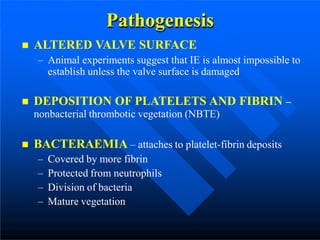
Pathogenesis
 ALTERED VALVE SURFACE
– Animal experiments suggest that IE is almost impossible to
establish unless the valve surface is damaged
 DEPOSITION OF PLATELETS AND FIBRIN –
nonbacterial thrombotic vegetation (NBTE)
 BACTERAEMIA – attaches to platelet-fibrin deposits
– Covered by more fibrin
– Protected from neutrophils
– Division of bacteria
– Mature vegetation
Pathogenesis
 Haemodynamic Factors
– Bacterial colonisation more likely to occur
around lesions with high degrees of tubulence
» eg. small VSD, valvular stenosis
– Large surface areas, low flow and low
turbulence are less likely to cause IE
» eg large VSD,
Pathogenesis
 Bacteraemia
– Transient bacteraemia occurs when a heavily colonised
mucosal surface is traumatised
» Dental extraction
» Periodontal surgery
» Tooth brushing
» Tonsillectomy
» Operations involving the respiratory, GI or GU tract mucosa
» Oesophageal dilatation
» Biliary tract surgery
Site of Infection
 Aortic valve more common than mitral
 Aortic:
– Vegetation usually on ventricular aspect, all 3
cusps usually affected
– Perforation or dysfunction of valve
– Root abscess
 Mitral:
– Dysfunction by rupture of chordae tendinae
Nonbacterial thrombotic
endocarditis
Bacteraemia
Turbulent blood flow
traumatises endothelium
Further deposition of
fibrin and platelets
Clinical Manifestations
SYMPTOMS
 Fever, most common symptom.
 Anorexia, weight-loss, malaise, night sweats
SIGNS
 Petechiae on the skin, conjunctivae, oral mucosa
 Heart murmur
 Splenomegaly
 Right-sided endocarditis is not associated with
peripheral emboli/phenomena but pulmonary
findings predominate
CLINICAL MANIFESTATION
SYMPTOMS PERCENT SIGNS PERCENT
Fever 80-95 Fever 80-90
Chills 42-75 Murmur 80-95
Sweats 25 Changing/new 10-40
Anorexia 25-55 murmur
Weight loss 25-35 Neurological 30-40
Malaise 25-40 abnormalities
Dyspnea 20-40 Embolic event 20-40
Cough 25 Splenomegaly 15-50
Stroke 13-20 Clubbing 10-20
headache 15-40 Peripheral 10-20
Nausea/vomiting 15-20 manifestation
myalgia/arthralgia 15-30 Osler’s nodes 7-10
Chest pain 8-35 Splinter hemorrhage 5-15
Abdominal pain 5-15 Petechiae
Back pain 7-10 Janeway’s lesions 10-40
confusion 10-20 Retinal lesion 6-10
4-10
Petechiae—Nonspecific
Splinter Hemorrhages
Nonspecific
Osler’s Nodes--More specific
Painful and erythematous nodules
Janeway Lesions
More specific,Nonpainful
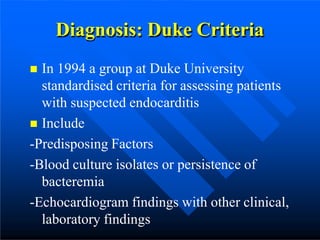
Diagnosis: Duke Criteria
 In 1994 a group at Duke University
standardised criteria for assessing patients
with suspected endocarditis
 Include
-Predisposing Factors
-Blood culture isolates or persistence of
bacteremia
-Echocardiogram findings with other clinical,
laboratory findings
Duke Criteria
Definite
: 2 major criteria
: 1 major and 3 minor criteria
: 5 minor criteria
: pathology/histology findings
Possible : 1 major and 1 minor criteria
: 3 minor criteria
 Rejected : firm alternate diagnosis
: resolution of manifestations of IE with
4 days antimicrobial therapy or less
Echocardiography
 Trans Thoracic Echocardiograpy (TTE)
– rapid, non-invasive – excellent specificity (98%) but
poor sensitivity
– obesity, chronic obstructive pulmonary disease and
chest wall deformities
 Transesophageal Echo (TOE)
– more invasive, sensitivity up to 95%, useful for
prosthetic valves and to evaluate myocardial
invasion
– Negative predictive valve of 92%
Microbiology is very important
since virulence of the infecting
organism is a significant factor in
determining the success rates of
both medical and surgical
treatment
Microbiology
sx’s<60 d post
The Essential Blood Test
 Blood Cultures
– Minimum of three blood cultures
– Three separate venipuncture sites
– Obtain 10-20mL in adults and 0.5-5mL in
children2
 Positive Result
– Typical organisms present in at least 2 separate samples
Complications
 Four etiologies
– Embolic
– Local spread of infection
– Metastatic spread of infection
– Formation of immune complexes –
glomerulonephritis and arthritis
Local Spread of Infection
Acute S. aureus IE with
perforation of the
aortic valve and aortic valve
vegetations.
Acute S. aureus IE with mitral
valve ring
abscess extending into
myocardium.
Therapy
 Streptococci/Enterococci
– Determine MIC of Penicillin
– Penicillin +/- aminoglycoside
– Ceftriaxone alone
– Vancomycin +/- aminoglycoside
 HACEK group
– Cefotaxime/ceftriaxone
Therapy
 Staphylococci
– Native valve
» Flucloxacillin +/- aminoglycoside
» Vancomycin +/- aminoglycoside/ rifampicin
– Prosthetic valve
» Flucloxacillin + aminoglycoside + rifampicin
» Vancomycin + aminoglycoside + rifampicin
Surgical Therapy
 Indications:
– Congestive cardiac failure
– perivalvular invasive disease
– uncontrolled infection despite maximal antimicrobial
therapy
– Presence of prosthetic valve endocarditis unless late
infection
– Large vegetation
– Major embolus
– Heart block
Surgical Therapy
 The hemodynamic status at the time
determines principally operative
mortality
PROPHYLAXIS
 The pathogenesis of infective endocarditis (IE) is presumed to involve the
following sequence of events
●Formation of a small thrombus on an abnormal endothelial surface
●Secondary infection of this nidus with bacteria that are transiently circulating in
the bloodstream
●Proliferation of bacteria resulting in the formation of vegetations on the
endothelial surface
 Since the occurrence of bacteremia is crucial to the initiation of an episode of IE,
in theory it is reasonable to conclude that preventing or promptly treating
transient bacteremia can prevent the above events.
 Evidence to support antimicrobial prophylaxis for
prevention of endocarditis is weak
 Antimicrobial prophylaxis for patients with the highest
risk medical conditions undergoing procedures likely to
result in bacteremia with a microorganism that has the
potential ability to cause bacterial endocarditis
HIGHEST RISK CONDITIONS
 Prosthetic heart valves, including bioprosthetic and homograft valves
 A prior history of IE
 Unrepaired cyanotic congenital heart disease, including palliative shunts and
conduits
 Completely repaired congenital heart defects with prosthetic material or
device, whether placed by surgery or by catheter intervention, during the first
six months after the procedure
 Repaired congenital heart disease with residual defects at the site or adjacent
to the site of the prosthetic patch or prosthetic device
 Valve regurgitation due to a structurally abnormal valve in a transplanted
heart
HIGHEST RISK PROCEDURES
 Dental procedures that involve manipulation of either gingival tissue or
the periapical region of teeth or perforation of the oral mucosa; this
includes routine dental cleaning.
 Procedures of the respiratory tract that involve incision or biopsy of the
respiratory mucosa
 Gastrointestinal (GI) or genitourinary (GU) procedures in patients with
ongoing GI or GU tract infection
 Procedures on infected skin, skin structure, or musculoskeletal tissue
 Surgery to place prosthetic heart valves or prosthetic intravascular or
intracardiac materials
Antibiotic Regimens for Prophylaxis of Endocarditis in Adults with
High-Risk Cardiac Lesions
A. Standard oral regimen
 1. Amoxicillin: 2 g PO 1 h before procedure
B. Inability to take oral medication
 1. Ampicillin: 2 g IV or IM within 1 h before procedure
C. Penicillin allergy
 1. Clarithromycin or azithromycin: 500 mg PO 1 h before procedure
 2. Cephalexinc: 2 g PO 1 h before procedure
 3. Clindamycin: 600 mg PO 1 h before procedure
D. Penicillin allergy, inability to take oral medication
 1. Cefazolinc or ceftriaxonec: 1 g IV or IM 30 min before procedure
 2. Clindamycin: 600 mg IV or IM 1 h before procedure
THANK YOU

infectiveendocarditis ppt.pptx

  • 1.
    INFECTIVE ENDOCARDITIS Dr. J. Umbon Assistant Professor, JMCH
  • 2.
    Contents  Endocarditis – Definitions –Epidemiology – classification – Pathogenesis – Clinical Presentations – Diagnosis – Complications – treatment – prophylaxis
  • 3.
    DEFINITION  Infective Endocarditis(IE) is a microbial infection of the endocardial (endothelial) surface of the heart.  The vegetation is a variably sized amorphous mass of platelets and fibrin in which abundant micro-organisms and scant inflammatory cells are enmeshed.
  • 4.
    ENDOCARDITIS Characteristic pathological lesion:vegetation, composed of platelets, fibrin, microorganisms and inflammatory cells.
  • 5.
    Epidemiology  Incidence difficultto ascertain and varies according to location  Much more common in males than in females  May occur in persons of any age and increasingly common in elderly  Mortality ranges from 20-30%
  • 6.
    Classification  Acute – Affectsnormal heart valves – Rapidly destructive – Metastatic foci – Commonly Staph. – If not treated, usually fatal within 6 weeks  Subacute – Often affects damaged heart valves – Indolent nature – If not treated, usually fatal by one year
  • 7.
    Pathogenesis  ALTERED VALVESURFACE – Animal experiments suggest that IE is almost impossible to establish unless the valve surface is damaged  DEPOSITION OF PLATELETS AND FIBRIN – nonbacterial thrombotic vegetation (NBTE)  BACTERAEMIA – attaches to platelet-fibrin deposits – Covered by more fibrin – Protected from neutrophils – Division of bacteria – Mature vegetation
  • 8.
    Pathogenesis  Haemodynamic Factors –Bacterial colonisation more likely to occur around lesions with high degrees of tubulence » eg. small VSD, valvular stenosis – Large surface areas, low flow and low turbulence are less likely to cause IE » eg large VSD,
  • 9.
    Pathogenesis  Bacteraemia – Transientbacteraemia occurs when a heavily colonised mucosal surface is traumatised » Dental extraction » Periodontal surgery » Tooth brushing » Tonsillectomy » Operations involving the respiratory, GI or GU tract mucosa » Oesophageal dilatation » Biliary tract surgery
  • 11.
    Site of Infection Aortic valve more common than mitral  Aortic: – Vegetation usually on ventricular aspect, all 3 cusps usually affected – Perforation or dysfunction of valve – Root abscess  Mitral: – Dysfunction by rupture of chordae tendinae
  • 12.
    Nonbacterial thrombotic endocarditis Bacteraemia Turbulent bloodflow traumatises endothelium Further deposition of fibrin and platelets
  • 13.
    Clinical Manifestations SYMPTOMS  Fever,most common symptom.  Anorexia, weight-loss, malaise, night sweats SIGNS  Petechiae on the skin, conjunctivae, oral mucosa  Heart murmur  Splenomegaly  Right-sided endocarditis is not associated with peripheral emboli/phenomena but pulmonary findings predominate
  • 14.
    CLINICAL MANIFESTATION SYMPTOMS PERCENTSIGNS PERCENT Fever 80-95 Fever 80-90 Chills 42-75 Murmur 80-95 Sweats 25 Changing/new 10-40 Anorexia 25-55 murmur Weight loss 25-35 Neurological 30-40 Malaise 25-40 abnormalities Dyspnea 20-40 Embolic event 20-40 Cough 25 Splenomegaly 15-50 Stroke 13-20 Clubbing 10-20 headache 15-40 Peripheral 10-20 Nausea/vomiting 15-20 manifestation myalgia/arthralgia 15-30 Osler’s nodes 7-10 Chest pain 8-35 Splinter hemorrhage 5-15 Abdominal pain 5-15 Petechiae Back pain 7-10 Janeway’s lesions 10-40 confusion 10-20 Retinal lesion 6-10 4-10
  • 15.
    Petechiae—Nonspecific Splinter Hemorrhages Nonspecific Osler’s Nodes--Morespecific Painful and erythematous nodules Janeway Lesions More specific,Nonpainful
  • 16.
    Diagnosis: Duke Criteria In 1994 a group at Duke University standardised criteria for assessing patients with suspected endocarditis  Include -Predisposing Factors -Blood culture isolates or persistence of bacteremia -Echocardiogram findings with other clinical, laboratory findings
  • 18.
    Duke Criteria Definite : 2major criteria : 1 major and 3 minor criteria : 5 minor criteria : pathology/histology findings Possible : 1 major and 1 minor criteria : 3 minor criteria  Rejected : firm alternate diagnosis : resolution of manifestations of IE with 4 days antimicrobial therapy or less
  • 19.
    Echocardiography  Trans ThoracicEchocardiograpy (TTE) – rapid, non-invasive – excellent specificity (98%) but poor sensitivity – obesity, chronic obstructive pulmonary disease and chest wall deformities  Transesophageal Echo (TOE) – more invasive, sensitivity up to 95%, useful for prosthetic valves and to evaluate myocardial invasion – Negative predictive valve of 92%
  • 24.
    Microbiology is veryimportant since virulence of the infecting organism is a significant factor in determining the success rates of both medical and surgical treatment
  • 25.
  • 26.
    The Essential BloodTest  Blood Cultures – Minimum of three blood cultures – Three separate venipuncture sites – Obtain 10-20mL in adults and 0.5-5mL in children2  Positive Result – Typical organisms present in at least 2 separate samples
  • 27.
    Complications  Four etiologies –Embolic – Local spread of infection – Metastatic spread of infection – Formation of immune complexes – glomerulonephritis and arthritis
  • 28.
    Local Spread ofInfection Acute S. aureus IE with perforation of the aortic valve and aortic valve vegetations. Acute S. aureus IE with mitral valve ring abscess extending into myocardium.
  • 29.
    Therapy  Streptococci/Enterococci – DetermineMIC of Penicillin – Penicillin +/- aminoglycoside – Ceftriaxone alone – Vancomycin +/- aminoglycoside  HACEK group – Cefotaxime/ceftriaxone
  • 30.
    Therapy  Staphylococci – Nativevalve » Flucloxacillin +/- aminoglycoside » Vancomycin +/- aminoglycoside/ rifampicin – Prosthetic valve » Flucloxacillin + aminoglycoside + rifampicin » Vancomycin + aminoglycoside + rifampicin
  • 32.
    Surgical Therapy  Indications: –Congestive cardiac failure – perivalvular invasive disease – uncontrolled infection despite maximal antimicrobial therapy – Presence of prosthetic valve endocarditis unless late infection – Large vegetation – Major embolus – Heart block
  • 33.
    Surgical Therapy  Thehemodynamic status at the time determines principally operative mortality
  • 35.
    PROPHYLAXIS  The pathogenesisof infective endocarditis (IE) is presumed to involve the following sequence of events ●Formation of a small thrombus on an abnormal endothelial surface ●Secondary infection of this nidus with bacteria that are transiently circulating in the bloodstream ●Proliferation of bacteria resulting in the formation of vegetations on the endothelial surface  Since the occurrence of bacteremia is crucial to the initiation of an episode of IE, in theory it is reasonable to conclude that preventing or promptly treating transient bacteremia can prevent the above events.
  • 36.
     Evidence tosupport antimicrobial prophylaxis for prevention of endocarditis is weak  Antimicrobial prophylaxis for patients with the highest risk medical conditions undergoing procedures likely to result in bacteremia with a microorganism that has the potential ability to cause bacterial endocarditis
  • 37.
    HIGHEST RISK CONDITIONS Prosthetic heart valves, including bioprosthetic and homograft valves  A prior history of IE  Unrepaired cyanotic congenital heart disease, including palliative shunts and conduits  Completely repaired congenital heart defects with prosthetic material or device, whether placed by surgery or by catheter intervention, during the first six months after the procedure  Repaired congenital heart disease with residual defects at the site or adjacent to the site of the prosthetic patch or prosthetic device  Valve regurgitation due to a structurally abnormal valve in a transplanted heart
  • 38.
    HIGHEST RISK PROCEDURES Dental procedures that involve manipulation of either gingival tissue or the periapical region of teeth or perforation of the oral mucosa; this includes routine dental cleaning.  Procedures of the respiratory tract that involve incision or biopsy of the respiratory mucosa  Gastrointestinal (GI) or genitourinary (GU) procedures in patients with ongoing GI or GU tract infection  Procedures on infected skin, skin structure, or musculoskeletal tissue  Surgery to place prosthetic heart valves or prosthetic intravascular or intracardiac materials
  • 39.
    Antibiotic Regimens forProphylaxis of Endocarditis in Adults with High-Risk Cardiac Lesions A. Standard oral regimen  1. Amoxicillin: 2 g PO 1 h before procedure B. Inability to take oral medication  1. Ampicillin: 2 g IV or IM within 1 h before procedure C. Penicillin allergy  1. Clarithromycin or azithromycin: 500 mg PO 1 h before procedure  2. Cephalexinc: 2 g PO 1 h before procedure  3. Clindamycin: 600 mg PO 1 h before procedure D. Penicillin allergy, inability to take oral medication  1. Cefazolinc or ceftriaxonec: 1 g IV or IM 30 min before procedure  2. Clindamycin: 600 mg IV or IM 1 h before procedure
  • 40.