Dr. V. S. Swathi
Assistant Professor
INFECTIVE ENDOCARDITIS
Definition
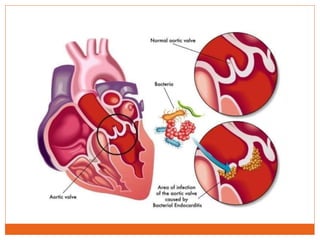
Infective Endocarditis (IE) is an inflammation of
the endocardium, the membrane lining the chamber of
the heart and covering the cups of heart valves.
Most commonly it refers to infection of heart
valves by various microbes
Epidemiology
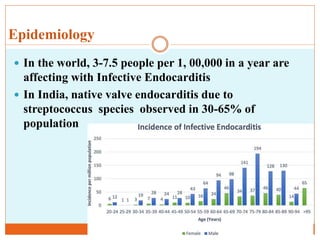
 In the world, 3-7.5 people per 1, 00,000 in a year are
affecting with Infective Endocarditis
 In India, native valve endocarditis due to
streptococcus species observed in 30-65% of
population
Acute
 Fulminating form
 High fever and systemic toxicity is observed
 Mostly occurs due to Staphylococcus aureus
 If not untreated, it leads to death
Sub acute infection
 Indolent form
 Mostly occurs due to Viridians streptococci
 Usually occurs in persons with pre existing valvular disease
Prosthetic Valve Endocarditis (PVE)
 Infection to the endocardium occurs following insertion of prosthetic heart valve
Cardiac Device Infective Endocarditis (CDIE)
 Infection to endocardium occurs following insertion of cardiac implantable electronic
device
Risk factors
 Presence of prosthetic valve
 Previous Endocarditis
 Health care related exposure
 Congenital heart disease
 Chronic IV access
 Diabetes mellitus
 Acquired valvular dysfunction
 Cardiac implantation device
 Chronic heart failure
 Mitral valve prolapse with regurgitation
 Intravenous drug abuse
Etiology
 Staphylococci species
 Streptococci species
 Enterococci species
 Gram negative aerobic bacilli
 Fungi
 Miscellaneous bacteria
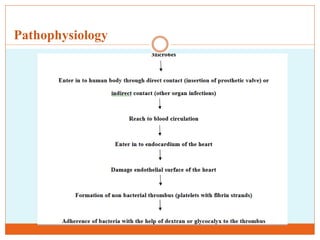
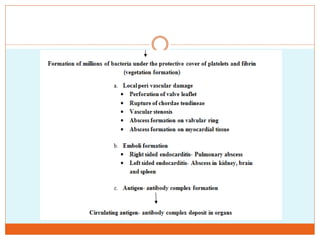
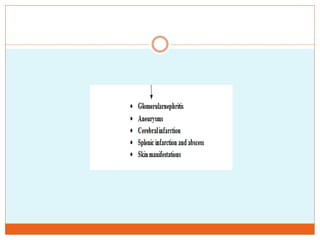
Pathophysiology
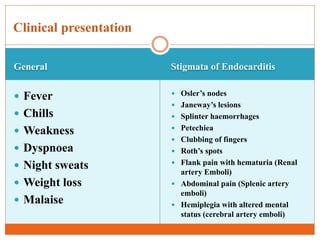
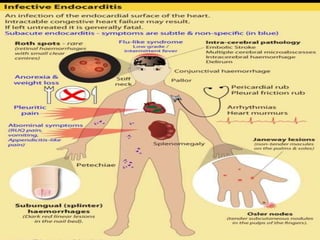
General Stigmata of Endocarditis
 Fever
 Chills
 Weakness
 Dyspnoea
 Night sweats
 Weight loss
 Malaise
 Osler’s nodes
 Janeway’s lesions
 Splinter haemorrhages
 Petechiea
 Clubbing of fingers
 Roth’s spots
 Flank pain with hematuria (Renal
artery Emboli)
 Abdominal pain (Splenic artery
emboli)
 Hemiplegia with altered mental
status (cerebral artery emboli)
Clinical presentation
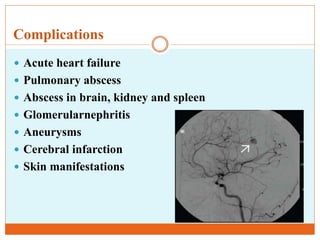
Complications
 Acute heart failure
 Pulmonary abscess
 Abscess in brain, kidney and spleen
 Glomerularnephritis
 Aneurysms
 Cerebral infarction
 Skin manifestations
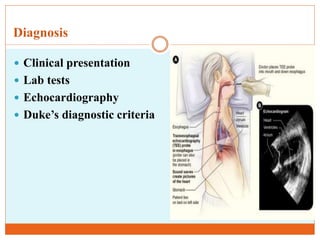
Diagnosis
 Clinical presentation
 Lab tests
 Echocardiography
 Duke’s diagnostic criteria
Duke’s Criteria
Major criteria:
1. Blood culture positive
 At least two positive cultures of blood samples drawn greater than
12hours apart
 Single positive blood culture for coxiella burnetii
 Antiphase 1 immunoglobulin G antibody titre greater than 1: 800
2. Evidence of endocardial involvement
 Transesophageal echocardiography or transthorasic
echocardiography shows evidence of oscillating intracardiac mass on
valve or supporting structures or abscess or new partial dehiscence of
prosthetic valve
Minor criteria:
1. Predisposing heart problem
2. Injection drug use
3. Fever greater than 100.4 ͦF
4. Vascular phenomenon
 Major arterial emboli
 Septic pulmonary infarcts
 Mycotic aneurysms
 Intracranial hemorrhage
 Conjuctival hemorrhage
 Janeway’s lesions
5. Immunological phenomenon
 Glomerularnephritis
 Osler’s nodes
 Roth’s spots
 Rheumatoid factor
6. Microbial evidence of positive blood culture but does not meet above major criteria (HACEK)
 Haemophilus species
 Aggregate species
 Cardiobacterium
 Eikenella species
 Kingella species
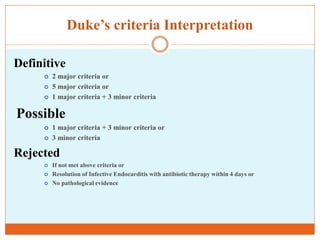
Duke’s criteria Interpretation
Definitive
 2 major criteria or
 5 major criteria or
 1 major criteria + 3 minor criteria
Possible
 1 major criteria + 3 minor criteria or
 3 minor criteria
Rejected
 If not met above criteria or
 Resolution of Infective Endocarditis with antibiotic therapy within 4 days or
 No pathological evidence
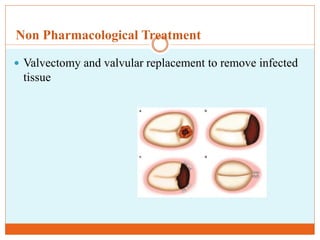
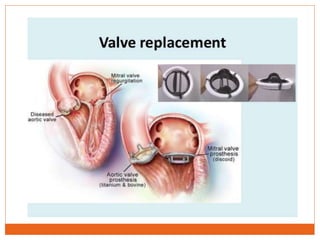
Non Pharmacological Treatment
 Valvectomy and valvular replacement to remove infected
tissue
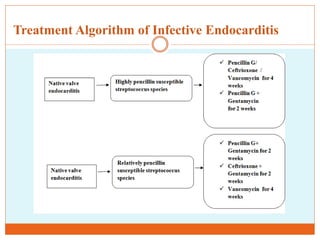
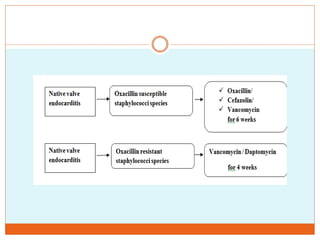
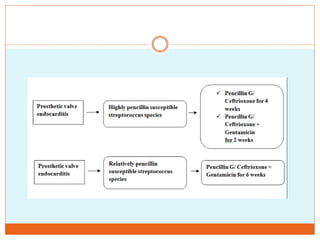
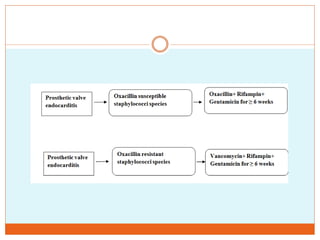
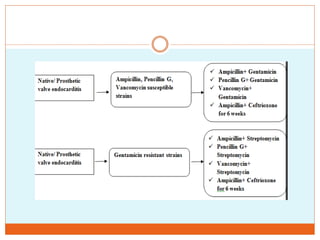
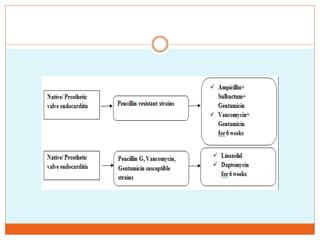
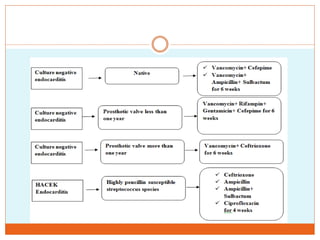
Treatment Algorithm of Infective Endocarditis
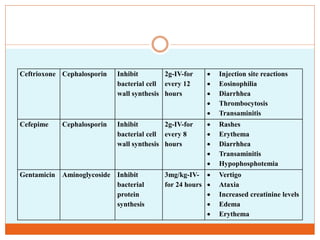
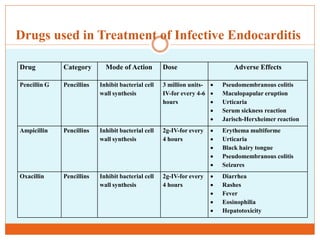
Drugs used in Treatment of Infective Endocarditis
Drug Category Mode of Action Dose Adverse Effects
Pencillin G Pencillins Inhibit bacterial cell
wall synthesis
3 million units-
IV-for every 4-6
hours
 Pseudomembranous colitis
 Maculopapular eruption
 Urticaria
 Serum sickness reaction
 Jarisch-Herxheimer reaction
Ampicillin Pencillins Inhibit bacterial cell
wall synthesis
2g-IV-for every
4 hours
 Erythema multiforme
 Urticaria
 Black hairy tongue
 Pseudomembranous colitis
 Seizures
Oxacillin Pencillins Inhibit bacterial cell
wall synthesis
2g-IV-for every
4 hours
 Diarrhea
 Rashes
 Fever
 Eosinophilia
 Hepatotoxicity
Ceftrioxone Cephalosporin Inhibit
bacterial cell
wall synthesis
2g-IV-for
every 12
hours
 Injection site reactions
 Eosinophilia
 Diarrhhea
 Thrombocytosis
 Transaminitis
Cefepime Cephalosporin Inhibit
bacterial cell
wall synthesis
2g-IV-for
every 8
hours
 Rashes
 Erythema
 Diarrhhea
 Transaminitis
 Hypophosphotemia
Gentamicin Aminoglycoside Inhibit
bacterial
protein
synthesis
3mg/kg-IV-
for 24 hours
 Vertigo
 Ataxia
 Increased creatinine levels
 Edema
 Erythema
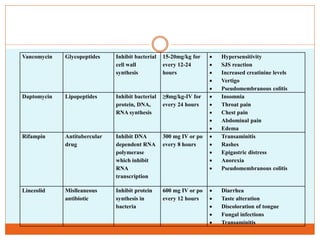
Vancomycin Glycopeptides Inhibit bacterial
cell wall
synthesis
15-20mg/kg for
every 12-24
hours
 Hypersensitivity
 SJS reaction
 Increased creatinine levels
 Vertigo
 Pseudomembranous colitis
Daptomycin Lipopeptides Inhibit bacterial
protein, DNA,
RNA synthesis
≥8mg/kg-IV for
every 24 hours
 Insomnia
 Throat pain
 Chest pain
 Abdominal pain
 Edema
Rifampin Antitubercular
drug
Inhibit DNA
dependent RNA
polymerase
which inhibit
RNA
transcription
300 mg IV or po
every 8 hours
 Transaminitis
 Rashes
 Epigastric distress
 Anorexia
 Pseudomembranous colitis
Linezolid Mislleaneous
antibiotic
Inhibit protein
synthesis in
bacteria
600 mg IV or po
every 12 hours
 Diarrhea
 Taste alteration
 Discoloration of tongue
 Fungal infections
 Transaminitis
Resources
 https://www.ncbi.nlm.nih.gov/pmc/articles/PMC49434
30/
 https://www.ncbi.nlm.nih.gov/pmc/articles/PMC49719
93/pdf/ACA-19-551.pdf
 https://www.ncbi.nlm.nih.gov/pmc/articles/PMC51060
88/
 https://www.ncbi.nlm.nih.gov/pmc/articles/PMC50673
87/pdf/main.pdf
 https://www.ncbi.nlm.nih.gov/pmc/articles/PMC61167
10/pdf/main.pdf

Infective endocarditis

  • 1.
    Dr. V. S.Swathi Assistant Professor INFECTIVE ENDOCARDITIS
  • 2.
    Definition Infective Endocarditis (IE)is an inflammation of the endocardium, the membrane lining the chamber of the heart and covering the cups of heart valves. Most commonly it refers to infection of heart valves by various microbes
  • 4.
    Epidemiology  In theworld, 3-7.5 people per 1, 00,000 in a year are affecting with Infective Endocarditis  In India, native valve endocarditis due to streptococcus species observed in 30-65% of population
  • 5.
    Acute  Fulminating form High fever and systemic toxicity is observed  Mostly occurs due to Staphylococcus aureus  If not untreated, it leads to death Sub acute infection  Indolent form  Mostly occurs due to Viridians streptococci  Usually occurs in persons with pre existing valvular disease Prosthetic Valve Endocarditis (PVE)  Infection to the endocardium occurs following insertion of prosthetic heart valve Cardiac Device Infective Endocarditis (CDIE)  Infection to endocardium occurs following insertion of cardiac implantable electronic device
  • 6.
    Risk factors  Presenceof prosthetic valve  Previous Endocarditis  Health care related exposure  Congenital heart disease  Chronic IV access  Diabetes mellitus  Acquired valvular dysfunction  Cardiac implantation device  Chronic heart failure  Mitral valve prolapse with regurgitation  Intravenous drug abuse
  • 7.
    Etiology  Staphylococci species Streptococci species  Enterococci species  Gram negative aerobic bacilli  Fungi  Miscellaneous bacteria
  • 8.
  • 11.
    General Stigmata ofEndocarditis  Fever  Chills  Weakness  Dyspnoea  Night sweats  Weight loss  Malaise  Osler’s nodes  Janeway’s lesions  Splinter haemorrhages  Petechiea  Clubbing of fingers  Roth’s spots  Flank pain with hematuria (Renal artery Emboli)  Abdominal pain (Splenic artery emboli)  Hemiplegia with altered mental status (cerebral artery emboli) Clinical presentation
  • 13.
    Complications  Acute heartfailure  Pulmonary abscess  Abscess in brain, kidney and spleen  Glomerularnephritis  Aneurysms  Cerebral infarction  Skin manifestations
  • 14.
    Diagnosis  Clinical presentation Lab tests  Echocardiography  Duke’s diagnostic criteria
  • 15.
    Duke’s Criteria Major criteria: 1.Blood culture positive  At least two positive cultures of blood samples drawn greater than 12hours apart  Single positive blood culture for coxiella burnetii  Antiphase 1 immunoglobulin G antibody titre greater than 1: 800 2. Evidence of endocardial involvement  Transesophageal echocardiography or transthorasic echocardiography shows evidence of oscillating intracardiac mass on valve or supporting structures or abscess or new partial dehiscence of prosthetic valve
  • 16.
    Minor criteria: 1. Predisposingheart problem 2. Injection drug use 3. Fever greater than 100.4 ͦF 4. Vascular phenomenon  Major arterial emboli  Septic pulmonary infarcts  Mycotic aneurysms  Intracranial hemorrhage  Conjuctival hemorrhage  Janeway’s lesions 5. Immunological phenomenon  Glomerularnephritis  Osler’s nodes  Roth’s spots  Rheumatoid factor 6. Microbial evidence of positive blood culture but does not meet above major criteria (HACEK)  Haemophilus species  Aggregate species  Cardiobacterium  Eikenella species  Kingella species
  • 17.
    Duke’s criteria Interpretation Definitive 2 major criteria or  5 major criteria or  1 major criteria + 3 minor criteria Possible  1 major criteria + 3 minor criteria or  3 minor criteria Rejected  If not met above criteria or  Resolution of Infective Endocarditis with antibiotic therapy within 4 days or  No pathological evidence
  • 18.
    Non Pharmacological Treatment Valvectomy and valvular replacement to remove infected tissue
  • 20.
    Treatment Algorithm ofInfective Endocarditis
  • 27.
    Drugs used inTreatment of Infective Endocarditis Drug Category Mode of Action Dose Adverse Effects Pencillin G Pencillins Inhibit bacterial cell wall synthesis 3 million units- IV-for every 4-6 hours  Pseudomembranous colitis  Maculopapular eruption  Urticaria  Serum sickness reaction  Jarisch-Herxheimer reaction Ampicillin Pencillins Inhibit bacterial cell wall synthesis 2g-IV-for every 4 hours  Erythema multiforme  Urticaria  Black hairy tongue  Pseudomembranous colitis  Seizures Oxacillin Pencillins Inhibit bacterial cell wall synthesis 2g-IV-for every 4 hours  Diarrhea  Rashes  Fever  Eosinophilia  Hepatotoxicity
  • 28.
    Ceftrioxone Cephalosporin Inhibit bacterialcell wall synthesis 2g-IV-for every 12 hours  Injection site reactions  Eosinophilia  Diarrhhea  Thrombocytosis  Transaminitis Cefepime Cephalosporin Inhibit bacterial cell wall synthesis 2g-IV-for every 8 hours  Rashes  Erythema  Diarrhhea  Transaminitis  Hypophosphotemia Gentamicin Aminoglycoside Inhibit bacterial protein synthesis 3mg/kg-IV- for 24 hours  Vertigo  Ataxia  Increased creatinine levels  Edema  Erythema
  • 29.
    Vancomycin Glycopeptides Inhibitbacterial cell wall synthesis 15-20mg/kg for every 12-24 hours  Hypersensitivity  SJS reaction  Increased creatinine levels  Vertigo  Pseudomembranous colitis Daptomycin Lipopeptides Inhibit bacterial protein, DNA, RNA synthesis ≥8mg/kg-IV for every 24 hours  Insomnia  Throat pain  Chest pain  Abdominal pain  Edema Rifampin Antitubercular drug Inhibit DNA dependent RNA polymerase which inhibit RNA transcription 300 mg IV or po every 8 hours  Transaminitis  Rashes  Epigastric distress  Anorexia  Pseudomembranous colitis Linezolid Mislleaneous antibiotic Inhibit protein synthesis in bacteria 600 mg IV or po every 12 hours  Diarrhea  Taste alteration  Discoloration of tongue  Fungal infections  Transaminitis
  • 30.
    Resources  https://www.ncbi.nlm.nih.gov/pmc/articles/PMC49434 30/  https://www.ncbi.nlm.nih.gov/pmc/articles/PMC49719 93/pdf/ACA-19-551.pdf https://www.ncbi.nlm.nih.gov/pmc/articles/PMC51060 88/  https://www.ncbi.nlm.nih.gov/pmc/articles/PMC50673 87/pdf/main.pdf  https://www.ncbi.nlm.nih.gov/pmc/articles/PMC61167 10/pdf/main.pdf