



RAI SAHEB BHANWAR SINGH
COLLEGE
RALA, NASRULLAGANJ
CLASS- B.Sc (5th Sem)
SUBJECT- PHYSICS
PRESENTATION
 Guided By- Mr Gyanrao
Dhote
 Student Name- Kamini
Malviya
INERTIAL FRAME OF
REFERENCE
•DEFINITION
The frames of reference in which
the Newton’s law holds are called
the Inertial frames.
According to Newton’s law, a body not acted
upon by any external force, has an
unaccelerated motion (i.e., if no external
force acts on a body, its acceleration
remains zero). In other words, if the body is
at rest, it remains at rest, but if it is in
motion, it remains moving with the same
speed in the same direction unless an
external force is applied.
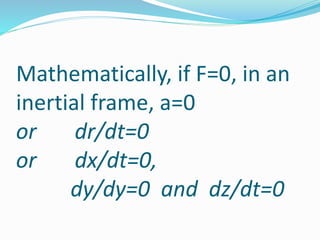
Mathematically, if F=0, in an
inertial frame, a=0
or dr/dt=0
or dx/dt=0,
dy/dy=0 and dz/dt=0
Inertial frames of reference
1.Inertia is a property of matter.
2.It is that property of matter which opposes
changes in velocity.
So, one must centre one’s physics on these
thoughts:
An object’s velocity will not change all on its own.
Pushes, or pulls, are necessary to change an object’s
velocity.
There are several ways to
describe an inertial frame. Here
are a few discriptions:
1.An inertial frame of reference is a frame of
reference with constant velocity.
2. An inertial frame of reference is a non-
accelerating frame of reference.
3.An inertial frame of reference is a
frame of reference in which the law of
inertia holds.
4.An inertial frame of reference is a
frame of reference in which Newton’s
laws of motion hold.
5.In an inertial frame of reference no
fictitious forces arise.
Consider two frames S and S’ either
stationary relative to each other or
moving with a constant velocity relative
to each other. A body which is
stationary to an observer in a frame S,
will either appear to be stationary or
will appear to be moving with a
constant velocity to an observer in the
frame S’ also, i.e., the force acting on
the body for the observers of both the
frames will be zero. Similarly, if a
body is moving with some
acceleration a relative to the
observer in the frame S, the body
will have the same acceleration(= a)
relative to the observer in the
frame S’.
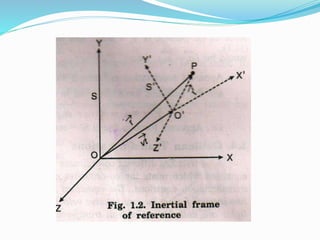
Proof: In Fig., S is an inertial frame and
another frame S’ is moving with a
constant velocity v relative to the frame
S. Initially (at t=0 ), the origin of both
the frames coincide. At any instant t,
the position vectors r and r’ of the
partical P in the frames S and S’
respectively are related as follows:
r’= r – vt
In Fig., in the vector triangle OO’P,
OP= OO’+O’P
or r = vt + r’
or r’= r – vt
The velocity of the partical in frame S’ is
dr/dt= dr/dt-v
and acceleration of the particle in frame S’
is
dr’/dt= dr/dt or a’= a
Thus, a particle experiences a the
same acceleration in frames S and
S’ moving with a constant velocity
relative to each other. If the
acceleration of the particle is zero
in a frame S, its acceleration will
also be zero in the frame S’. Since
the frames S is inertial, the frame S’
will also be inertial.
THANK YOU

INERTIAL FRAM OF REFERENCE Ka2

  • 2.
    RAI SAHEB BHANWARSINGH COLLEGE RALA, NASRULLAGANJ CLASS- B.Sc (5th Sem) SUBJECT- PHYSICS PRESENTATION  Guided By- Mr Gyanrao Dhote  Student Name- Kamini Malviya
  • 3.
  • 4.
    •DEFINITION The frames ofreference in which the Newton’s law holds are called the Inertial frames.
  • 5.
    According to Newton’slaw, a body not acted upon by any external force, has an unaccelerated motion (i.e., if no external force acts on a body, its acceleration remains zero). In other words, if the body is at rest, it remains at rest, but if it is in motion, it remains moving with the same speed in the same direction unless an external force is applied.
  • 6.
    Mathematically, if F=0,in an inertial frame, a=0 or dr/dt=0 or dx/dt=0, dy/dy=0 and dz/dt=0
  • 7.
    Inertial frames ofreference 1.Inertia is a property of matter. 2.It is that property of matter which opposes changes in velocity. So, one must centre one’s physics on these thoughts: An object’s velocity will not change all on its own. Pushes, or pulls, are necessary to change an object’s velocity.
  • 8.
    There are severalways to describe an inertial frame. Here are a few discriptions: 1.An inertial frame of reference is a frame of reference with constant velocity. 2. An inertial frame of reference is a non- accelerating frame of reference.
  • 9.
    3.An inertial frameof reference is a frame of reference in which the law of inertia holds. 4.An inertial frame of reference is a frame of reference in which Newton’s laws of motion hold. 5.In an inertial frame of reference no fictitious forces arise.
  • 11.
    Consider two framesS and S’ either stationary relative to each other or moving with a constant velocity relative to each other. A body which is stationary to an observer in a frame S, will either appear to be stationary or will appear to be moving with a constant velocity to an observer in the frame S’ also, i.e., the force acting on the body for the observers of both the
  • 12.
    frames will bezero. Similarly, if a body is moving with some acceleration a relative to the observer in the frame S, the body will have the same acceleration(= a) relative to the observer in the frame S’.
  • 13.
    Proof: In Fig.,S is an inertial frame and another frame S’ is moving with a constant velocity v relative to the frame S. Initially (at t=0 ), the origin of both the frames coincide. At any instant t, the position vectors r and r’ of the partical P in the frames S and S’ respectively are related as follows:
  • 14.
    r’= r –vt In Fig., in the vector triangle OO’P, OP= OO’+O’P or r = vt + r’ or r’= r – vt The velocity of the partical in frame S’ is dr/dt= dr/dt-v and acceleration of the particle in frame S’ is dr’/dt= dr/dt or a’= a
  • 15.
    Thus, a particleexperiences a the same acceleration in frames S and S’ moving with a constant velocity relative to each other. If the acceleration of the particle is zero in a frame S, its acceleration will also be zero in the frame S’. Since the frames S is inertial, the frame S’ will also be inertial.
  • 16.