CONTENT:
➢ Lorentz Transformation
➢ Superseding of Lorentz Transformation to Galilean
Transformation
➢ Inverse Lorentz Transformation
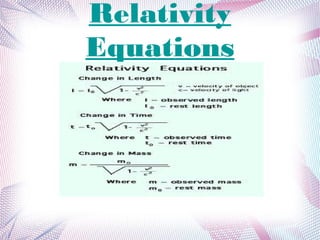
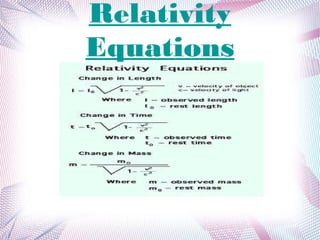
➢ Relativity Equations
LORENTZ
TRANSFORMATION
The set of equations which in Einstein's special
theory of relativity relate the space and time
coordinates of one frame of reference to those of
other.
Or,
The Lorentz transformation are coordinate
transformations between two coordinate frames that
move at constant velocity relative to each other.
Note: The 'Lorentz Transformations' only refers
to transformations between inertial frames,
usually in the context of special relativity.
The transformations are named after the Dutch
Physicist Hendrik Lorentz
Superseding of Lorentz Transformation to Galilean
Transformation
Lorentz transformation supersede(replace) the
Galilean transformation of Newtonian physics, which
assumes an absolute space and time. The Galilean
transformation is a good approximation only at relative
speeds much smaller than the speed of light.
What Einstein's special theory of relativity says is that
to understand why the speed of light is constant, we
have modify the way in which we relate the
observation in one inertial frame to that of another.
The Galilean transformation is,
x'=x-vt, t'=t
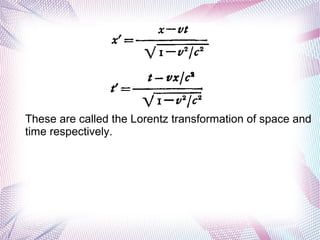
which is wrong. The correct relation is,
These are called the Lorentz transformation of space and
time respectively.
We can see that if the relative velocity v between the two
frames are much smaller than the speed of light c, then
the ratio v/c can be neglected in this relation and we
recover the Galilei transformation. So the reason why we
did not have any problems with the Galilei transformation
up to now is that v was small enough for it to be good
approximation of the Lorentz transformation.
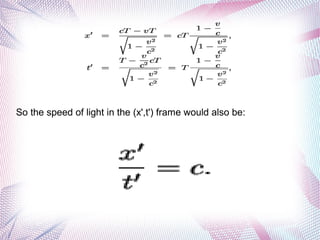
Let's check that this relation does indeed show that the
speed of light is same in both frames (x,t) and (x',t'). Let's
say that a beam of light started out from the origin x'=x=0
at time t'=t=0. Since the speed of light is c,at time t=T,
the beam of light would have travelled to the point x=cT
in the (x,t) frame. In the other frame, this point is
observed as,
So the speed of light in the (x',t') frame would also be:
Inverse Lorentz
Transformation
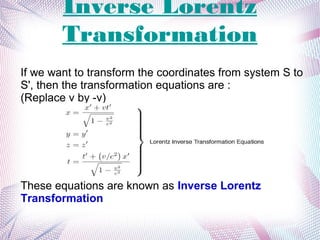
If we want to transform the coordinates from system S to
S', then the transformation equations are :
(Replace v by -v)
These equations are known as Inverse Lorentz
Transformation
Relativity
Equations
Relativity
Equations

LORENTZ TRANSFORMATION

  • 1.
    CONTENT: ➢ Lorentz Transformation ➢Superseding of Lorentz Transformation to Galilean Transformation ➢ Inverse Lorentz Transformation ➢ Relativity Equations
  • 2.
    LORENTZ TRANSFORMATION The set ofequations which in Einstein's special theory of relativity relate the space and time coordinates of one frame of reference to those of other. Or, The Lorentz transformation are coordinate transformations between two coordinate frames that move at constant velocity relative to each other. Note: The 'Lorentz Transformations' only refers to transformations between inertial frames, usually in the context of special relativity. The transformations are named after the Dutch Physicist Hendrik Lorentz
  • 3.
    Superseding of LorentzTransformation to Galilean Transformation Lorentz transformation supersede(replace) the Galilean transformation of Newtonian physics, which assumes an absolute space and time. The Galilean transformation is a good approximation only at relative speeds much smaller than the speed of light. What Einstein's special theory of relativity says is that to understand why the speed of light is constant, we have modify the way in which we relate the observation in one inertial frame to that of another. The Galilean transformation is, x'=x-vt, t'=t which is wrong. The correct relation is,
  • 4.
    These are calledthe Lorentz transformation of space and time respectively.
  • 6.
    We can seethat if the relative velocity v between the two frames are much smaller than the speed of light c, then the ratio v/c can be neglected in this relation and we recover the Galilei transformation. So the reason why we did not have any problems with the Galilei transformation up to now is that v was small enough for it to be good approximation of the Lorentz transformation. Let's check that this relation does indeed show that the speed of light is same in both frames (x,t) and (x',t'). Let's say that a beam of light started out from the origin x'=x=0 at time t'=t=0. Since the speed of light is c,at time t=T, the beam of light would have travelled to the point x=cT in the (x,t) frame. In the other frame, this point is observed as,
  • 7.
    So the speedof light in the (x',t') frame would also be:
  • 8.
    Inverse Lorentz Transformation If wewant to transform the coordinates from system S to S', then the transformation equations are : (Replace v by -v) These equations are known as Inverse Lorentz Transformation
  • 9.
  • 10.