SUPPLIER
PARTNERSHIP
SUPPLIER
PARTNERSHIP
 DEFINITION:
 Supplier Partnership is the discipline the strategically planning for,
and managing, all interactions with third party organization that
supply good and or/ service to your organization, in order to
maximize the values of those interactions.
SUPPLIER
PARTNERSHIP INTRODUCTION:
 An organization (or customer) purchases its
requirements, raw materials, components, and
services, from supplier.
 Better supplier’s quality  Better product’s quality
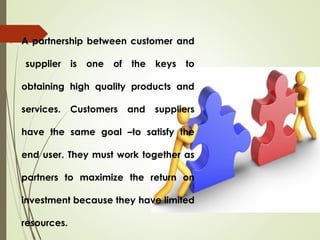
 A partnership between customer and
supplier is one of the keys to
obtaining high quality products and
services. Customers and suppliers
have the same goal –to satisfy the
end user. They must work together as
partners to maximize the return on
investment because they have limited
resources.
REASONS FOR
PARTNERSHIP
 QUALITY AND TIMELY DELIVERY
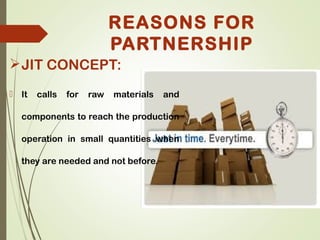
JIT CONCEPT:
 It calls for raw materials and
components to reach the production
operation in small quantities when
they are needed and not before.
REASONS FOR
PARTNERSHIP
 PRACTICE OF CONTINUOUS
PROCESS IMPROVEMENT:
The practice of continuous process
improvement has also caused many
suppliers to develop partnerships with
their customer.
REASONS FOR
PARTNERSHIP
 QUALITY ASSURANCE
SYSTEMS (ISO 9000, ETC.)
 ISO 9000 can help a company
satisfy its customers, meet
regulatory requirements, and
achieve continual improvement.
But it’s a first step, many quality
professionals will tell you, the base
level of a quality system, not a
complete guarantee of quality.
REASONS FOR
PARTNERSHIP
PRINCIPLES OF
CUSTOMER/SUPPLIER RELATIONS
 Both the customer and the supplier are fully
responsible for the control of the quality.
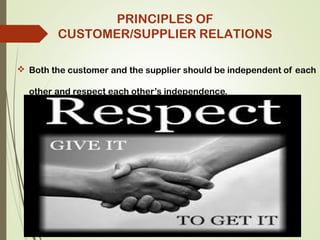
 Both the customer and the supplier should be independent of each
other and respect each other’s independence.
PRINCIPLES OF
CUSTOMER/SUPPLIER RELATIONS
 The customer is responsible for providing the supplier with clear and
sufficient requirements so that the supplier can know exactly what to
produce.
PRINCIPLES OF
CUSTOMER/SUPPLIER RELATIONS
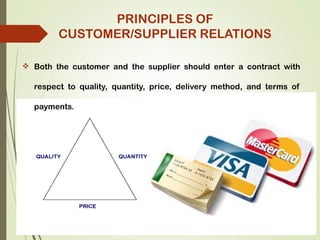
 Both the customer and the supplier should enter a contract with
respect to quality, quantity, price, delivery method, and terms of
payments.
PRINCIPLES OF
CUSTOMER/SUPPLIER RELATIONS
 The supplier is responsible for providing the quality that will satisfy the
customer and submitting necessary related with customer’s needs.
PRINCIPLES OF
CUSTOMER/SUPPLIER RELATIONS
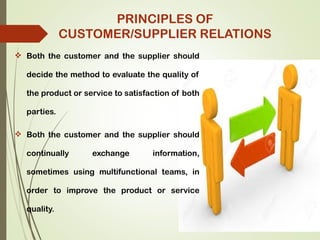
 Both the customer and the supplier should
decide the method to evaluate the quality of
the product or service to satisfaction of both
parties.
 Both the customer and the supplier should
continually exchange information,
sometimes using multifunctional teams, in
order to improve the product or service
quality.
PRINCIPLES OF
CUSTOMER/SUPPLIER RELATIONS
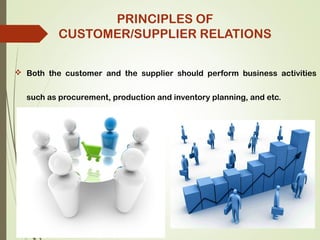
 Both the customer and the supplier should perform business activities
such as procurement, production and inventory planning, and etc.
PRINCIPLES OF
CUSTOMER/SUPPLIER RELATIONS
 When dealing with business transactions, both the customer and
the supplier should always have the best interest of the end user in
mind.
PRINCIPLES OF
CUSTOMER/SUPPLIER RELATIONS
PARTNERING
 Partnering is along-term commitment
between two or more organizations
for the purpose of achieving specific
business goals and objectives by
maximizing the effectiveness of each
participant’s resources.
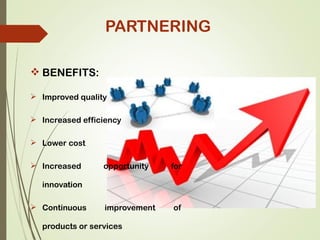
 BENEFITS:
 Improved quality
 Increased efficiency
 Lower cost
 Increased opportunity for
innovation
 Continuous improvement of
products or services
PARTNERING
 Key Elements to a partnering
Relationship:
 LONG-TERM COMMITMENT:
Long-term commitment provides the
needed environment for both parties to
work toward continuous improvement.
PARTNERING
 Key Elements to a partnering
Relationship:
 TRUST:
Trust enables the resources and
knowledge of each partner to be
combined to eliminate an adversarial
relationship. Partners are then able to
share information and accept reduced
control. Mutual trust forms the basis for a
strong working relationship.
PARTNERING
 Key Elements to a partnering
Relationship:
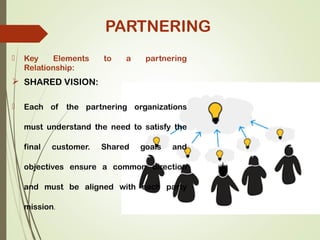
 SHARED VISION:
 Each of the partnering organizations
must understand the need to satisfy the
final customer. Shared goals and
objectives ensure a common direction
and must be aligned with each party
mission.
PARTNERING
SOURCING
SOURCING
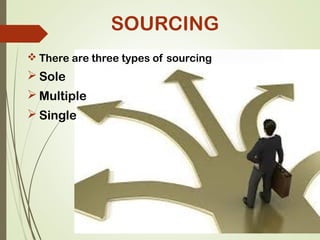
 There are three types of sourcing
 Sole
 Multiple
 Single
TYPES OF SOURCING
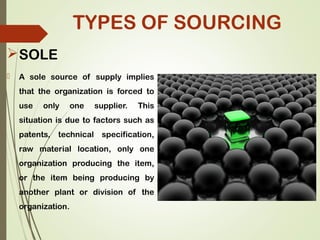
SOLE
 A sole source of supply implies
that the organization is forced to
use only one supplier. This
situation is due to factors such as
patents, technical specification,
raw material location, only one
organization producing the item,
or the item being producing by
another plant or division of the
organization.
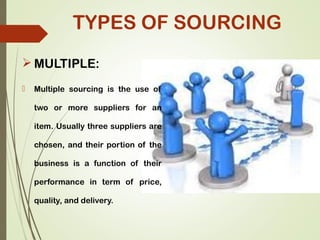
 MULTIPLE:
 Multiple sourcing is the use of
two or more suppliers for an
item. Usually three suppliers are
chosen, and their portion of the
business is a function of their
performance in term of price,
quality, and delivery.
TYPES OF SOURCING
 SINGLE:
 Single sourcing is a planned decision by the organization to select one
supplier for an item when several sources are available. It results in
large, long term contracts and a partnering relationship.
TYPES OF SOURCING
Benefits for organization:
Reduced business and production costs
Complete accountability
Supplier loyalty
Better end product with less variability
Benefits for supplier
New business from the customer
Reduced the cost of business
Production processes
SUPPLIER SELECTION
 Before discussing supplier activities. It must be decided whether to
produce or outsource a particular item.
 The following three questions need to be answered:
 How critical is the item to the design of the product or service?
 Does the organization have the technical knowledge to produce the
items internally? If not, should that knowledge be develop?
 Are there suppliers who specialize in producing the item? If not, is the
organization willing to develop such a specialized supplier?
CONDITION OF SUPPLIER
SELECTION
 There are following condition for selection of supplier
 The supplier understand and appreciate the management philosophy of
the organization.
 The supplier has a stable management system. And ask several question
should be asked:
 Is there a quality policy statement that includes objectives for quality and
its commitment to quality?
 Is the policy implemented and understood at all levels of the
organization?
 Is there documentation that indicates who is in charge and responsible
for quality in the organization?
 The supplier maintains high technical standards and has the capability of
dealing with feature technological innovations.
CONDITION OF SUPPLIER
SELECTION
 The suppliers can provide those raw materials and parts required by
the purchaser and those supplied meet quality specifications.
CONDITION OF SUPPLIER
SELECTION
 The supplier has the capability to produce the amount of
production needed.
CONDITION OF SUPPLIER
SELECTION
 There is no danger of the supplier breaching corporate
secrets.
 The price is right and delivery dates can be meet.
 The supplier implements contract provisions.
CONDITION OF SUPPLIER
SELECTION
 The supplier has an effective quality system and improvement
program such as ISO/QS 9000.
CONDITION OF SUPPLIER
SELECTION
 The supplier has a track record of customer satisfaction and
organization credibility.
CONDITION OF SUPPLIER
SELECTION

Supplier partnership part 2

  • 3.
  • 4.
    SUPPLIER PARTNERSHIP  DEFINITION:  SupplierPartnership is the discipline the strategically planning for, and managing, all interactions with third party organization that supply good and or/ service to your organization, in order to maximize the values of those interactions.
  • 5.
    SUPPLIER PARTNERSHIP INTRODUCTION:  Anorganization (or customer) purchases its requirements, raw materials, components, and services, from supplier.  Better supplier’s quality  Better product’s quality
  • 6.
     A partnershipbetween customer and supplier is one of the keys to obtaining high quality products and services. Customers and suppliers have the same goal –to satisfy the end user. They must work together as partners to maximize the return on investment because they have limited resources.
  • 7.
  • 8.
    JIT CONCEPT:  Itcalls for raw materials and components to reach the production operation in small quantities when they are needed and not before. REASONS FOR PARTNERSHIP
  • 9.
     PRACTICE OFCONTINUOUS PROCESS IMPROVEMENT: The practice of continuous process improvement has also caused many suppliers to develop partnerships with their customer. REASONS FOR PARTNERSHIP
  • 10.
     QUALITY ASSURANCE SYSTEMS(ISO 9000, ETC.)  ISO 9000 can help a company satisfy its customers, meet regulatory requirements, and achieve continual improvement. But it’s a first step, many quality professionals will tell you, the base level of a quality system, not a complete guarantee of quality. REASONS FOR PARTNERSHIP
  • 11.
    PRINCIPLES OF CUSTOMER/SUPPLIER RELATIONS Both the customer and the supplier are fully responsible for the control of the quality.
  • 12.
     Both thecustomer and the supplier should be independent of each other and respect each other’s independence. PRINCIPLES OF CUSTOMER/SUPPLIER RELATIONS
  • 13.
     The customeris responsible for providing the supplier with clear and sufficient requirements so that the supplier can know exactly what to produce. PRINCIPLES OF CUSTOMER/SUPPLIER RELATIONS
  • 14.
     Both thecustomer and the supplier should enter a contract with respect to quality, quantity, price, delivery method, and terms of payments. PRINCIPLES OF CUSTOMER/SUPPLIER RELATIONS
  • 15.
     The supplieris responsible for providing the quality that will satisfy the customer and submitting necessary related with customer’s needs. PRINCIPLES OF CUSTOMER/SUPPLIER RELATIONS
  • 16.
     Both thecustomer and the supplier should decide the method to evaluate the quality of the product or service to satisfaction of both parties.  Both the customer and the supplier should continually exchange information, sometimes using multifunctional teams, in order to improve the product or service quality. PRINCIPLES OF CUSTOMER/SUPPLIER RELATIONS
  • 17.
     Both thecustomer and the supplier should perform business activities such as procurement, production and inventory planning, and etc. PRINCIPLES OF CUSTOMER/SUPPLIER RELATIONS
  • 18.
     When dealingwith business transactions, both the customer and the supplier should always have the best interest of the end user in mind. PRINCIPLES OF CUSTOMER/SUPPLIER RELATIONS
  • 19.
    PARTNERING  Partnering isalong-term commitment between two or more organizations for the purpose of achieving specific business goals and objectives by maximizing the effectiveness of each participant’s resources.
  • 20.
     BENEFITS:  Improvedquality  Increased efficiency  Lower cost  Increased opportunity for innovation  Continuous improvement of products or services PARTNERING
  • 21.
     Key Elementsto a partnering Relationship:  LONG-TERM COMMITMENT: Long-term commitment provides the needed environment for both parties to work toward continuous improvement. PARTNERING
  • 22.
     Key Elementsto a partnering Relationship:  TRUST: Trust enables the resources and knowledge of each partner to be combined to eliminate an adversarial relationship. Partners are then able to share information and accept reduced control. Mutual trust forms the basis for a strong working relationship. PARTNERING
  • 23.
     Key Elementsto a partnering Relationship:  SHARED VISION:  Each of the partnering organizations must understand the need to satisfy the final customer. Shared goals and objectives ensure a common direction and must be aligned with each party mission. PARTNERING
  • 24.
  • 25.
    SOURCING  There arethree types of sourcing  Sole  Multiple  Single
  • 26.
    TYPES OF SOURCING SOLE A sole source of supply implies that the organization is forced to use only one supplier. This situation is due to factors such as patents, technical specification, raw material location, only one organization producing the item, or the item being producing by another plant or division of the organization.
  • 27.
     MULTIPLE:  Multiplesourcing is the use of two or more suppliers for an item. Usually three suppliers are chosen, and their portion of the business is a function of their performance in term of price, quality, and delivery. TYPES OF SOURCING
  • 28.
     SINGLE:  Singlesourcing is a planned decision by the organization to select one supplier for an item when several sources are available. It results in large, long term contracts and a partnering relationship. TYPES OF SOURCING
  • 29.
    Benefits for organization: Reducedbusiness and production costs Complete accountability Supplier loyalty Better end product with less variability Benefits for supplier New business from the customer Reduced the cost of business Production processes
  • 30.
    SUPPLIER SELECTION  Beforediscussing supplier activities. It must be decided whether to produce or outsource a particular item.  The following three questions need to be answered:  How critical is the item to the design of the product or service?  Does the organization have the technical knowledge to produce the items internally? If not, should that knowledge be develop?  Are there suppliers who specialize in producing the item? If not, is the organization willing to develop such a specialized supplier?
  • 31.
    CONDITION OF SUPPLIER SELECTION There are following condition for selection of supplier  The supplier understand and appreciate the management philosophy of the organization.  The supplier has a stable management system. And ask several question should be asked:  Is there a quality policy statement that includes objectives for quality and its commitment to quality?  Is the policy implemented and understood at all levels of the organization?  Is there documentation that indicates who is in charge and responsible for quality in the organization?
  • 32.
     The suppliermaintains high technical standards and has the capability of dealing with feature technological innovations. CONDITION OF SUPPLIER SELECTION
  • 33.
     The supplierscan provide those raw materials and parts required by the purchaser and those supplied meet quality specifications. CONDITION OF SUPPLIER SELECTION
  • 34.
     The supplierhas the capability to produce the amount of production needed. CONDITION OF SUPPLIER SELECTION
  • 35.
     There isno danger of the supplier breaching corporate secrets.  The price is right and delivery dates can be meet.  The supplier implements contract provisions. CONDITION OF SUPPLIER SELECTION
  • 36.
     The supplierhas an effective quality system and improvement program such as ISO/QS 9000. CONDITION OF SUPPLIER SELECTION
  • 37.
     The supplierhas a track record of customer satisfaction and organization credibility. CONDITION OF SUPPLIER SELECTION