Topic Name Bearing
Name Muddassar Awan
THE UNIVERSITY OF LAHORE1
A Bearing is a device that support
load and reduces the friction of
motion between moving machine
parts.
2
3
 Plain or slider bearing
 Rolling or anti-friction
bearing
4
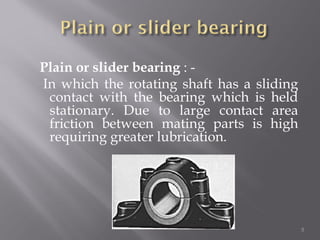
Plain or slider bearing : -
In which the rotating shaft has a sliding
contact with the bearing which is held
stationary. Due to large contact area
friction between mating parts is high
requiring greater lubrication.
5
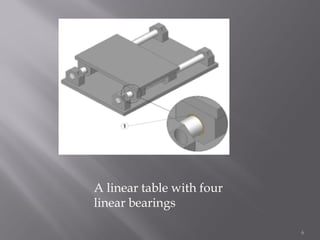
A linear table with four
linear bearings
6
Metals and Alloys
(1) Bronze
(2) Cast iron
(3) Steel
(4) Silver
(5) Copper based alloys
(6)Aluminum Based
materials
Non- Metal
(1)Wood
(2) Rubber
(3) Plastics
7
Collar bearing
Footstep bearing
Journal bearing
8
 Journal bearing – in this the bearing
pressure is exerted at right angles to the
axis of the shaft. This journal bearing is
used for supporting a radial load. Shaft
are generally made of mild steel.
9
 Foot step bearing – in this bearing the bearing
pressure is exerted parallel to the shaft whose
axis is vertical. Note that in this case the end of
the shaft rests within the bearing.
10
 Collar bearing – Collar bearing mainly used on
horizontal which carry a large axial force.
Thrust bearing are used in bevel mountings,
propeller drives, turbines, etc.
 Collar bearing also known as “Thrust bearings ”.
11
 Advantages Plain bearing are cheap to produce and
have noiseless operation. They can be easily
machined, and have vibration damping properties.
 Disadvantages are they require large supply of
lubricating oil, they are suitable only for relative
low temperature and speed.
12
 Used rolling element between moving
parts.
 Due to less contact area rolling friction is
much lesser than the sliding friction ,
hence these bearings are also known as
antifriction bearing.
13
Load on the Bearings
14
Ball bearing
Roller bearing
15
Ball bearing:
A bearing is type of rolling element bearing
which uses balls to maintain the separation
between the moving parts of the bearing. The
purpose of a ball bearing is to reduce rotational
friction and support axial and radial loads.
16
Roller bearing:
Roller bearing use cylinder of greater length
than diameter. It is typically have higher radial
load capacity than ball bearing, but in low axial
capacity and higher friction.
17
Races and balls are high carbon chrome steel (to provide resistance to wear)
machined and highly polished and hardened.
The cages are made of low-carbon steel.
18
19
 Deep Groove Ball
Bearings
 Primarily radial
load carrying
 Deep groove radial
Bearing is one in
which the race
dimensions are close
to the dimensions of
the ball that run in
it.
http://my.ecplaza.net/nbsinobest/12l.asp
20
21
 Double row deep
Groove
 Increases radial load
Single row deep
groove ball bearings
22
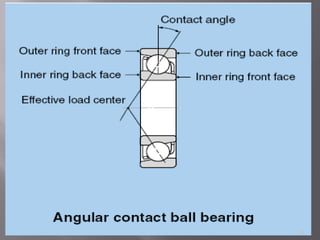
Angular contact ball bearing
 Angular contact bearing better support combined
loads. The angle of contact on inner race is the same
as that on the outer race.
 Contact angle 10 to 45
www.hz-bearing.com
23
24
Dingle row
angular contact
ball bearings
Double row
angular contact
ball bearings
25
 Thrust ball Bearings
 A thrust bearing is a
particular type of
rotary bearing. Like
other rotary bearings
they permit rotation
between parts, but
they are designed to
support a high axial
load while doing this.
http://kianho.com
26
27
 Needle Bearings
 Use long and thin
cylinder
 The greater the contact
area the greater the
load
 Support radial load
www.clworldwide.com
28
 Tapered Roller
Bearing
 Support high combine
loads (wheel bearing)
 Wheel rotates with little
resistance/friction
 Noiseless
www.ahrinternational.com
29
Cylindrical roller bearing :
Use thick and long cylinder.
Roller bearings typically have higher load
capacity than ball bearings. If the inner and
outer races are misaligned, the bearing
capacity often drops quickly compared to
either a ball bearing.
30
31
 Tapered roller bearing (TRB):
 TRB can take both radial and axial loads and used for gear
boxes for heavy trucks, bevel-gear transmission, lathe
spindles, etc.
 Thrust ball bearing:
 Thrust ball bearing are used for heavy axial loads and low
speeds.
 Needle roller bearing:
 It use small diameter of rollers. They are used for radial load
at slow speed.
 They have the advantage of light weight and occupy small space.
 They are used in aircraft industry, bench-drill spindles, etc.
APPLICATIONS OF ROLLER BEARINGS
32
33
Around 16% of all premature bearing failures
are a result of poor fitting or using incorrect
mounting techniques. Individual applications
may require mechanical, heat or hydraulic
mounting methods for correct and efficient
bearing mounting. Selecting the mounting
technique appropriate for your application will
help you extend your bearing’s service life and
reduce costs resulting from premature bearing
failure.
34
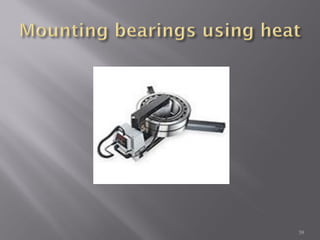
 Mounting bearings in a cold condition
 Mounting bearings using heat
35
Small and medium size bearings are generally
cold mounted. Traditionally the bearing is
mounted using a hammer and a length of old
pipe. This practice can cause forces to be
transmitted through the rolling elements,
causing damage to the raceways. Proper fitting
tools help prevent bearing damage by applying
the forces to the bearing ring with the
interference fit.
36
37
Oil baths are often used for heating bearings
prior to mounting. However, this method can
contaminate the bearing, resulting in
premature bearing failure. Today, induction
heating is the most common technique for
heating bearings since it allows a high degree
of controllability, efficiency and safety.
38
39
40
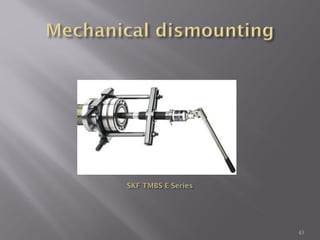
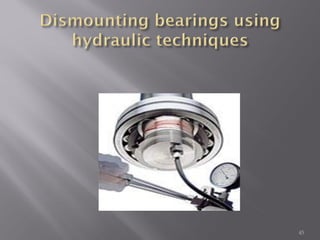
When dismounting bearings, care must be
taken not to damage other machine
components, such as the shaft or housing, as
damage can result in compromising the
machine’s efficiency and lifetime. Bearings are
sometimes dismounted to maintain or replace
other components of the machine. These
bearings are often re–used. Individual
applications may require mechanical, heat or
hydraulic dismounting methods and tools to
allow safe, correct and efficient bearing
dismounting.
41
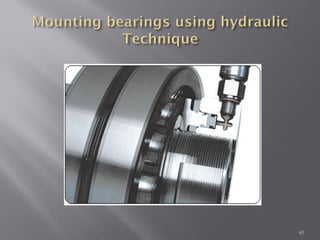
 Mechanical dismounting
 Dismounting using heat
 Hydraulic Techniques
42
43
44
45
 Bearing life
 Bearing speed (rpm)
 Accuracy
46
• Bearing load – radial, thrust (axial) or both
Radial loadRadial load
Thrust load
Bearings are selected from catalogs, before referring
to catalogs you should know the followings:
47
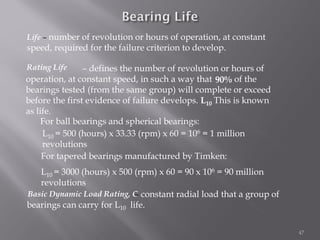
Life – number of revolution or hours of operation, at constant
speed, required for the failure criterion to develop.
L10 = 500 (hours) x 33.33 (rpm) x 60 = 106 = 1 million
revolutions
For ball bearings and spherical bearings:
For tapered bearings manufactured by Timken:
L10 = 3000 (hours) x 500 (rpm) x 60 = 90 x 106 = 90 million
revolutions
– defines the number of revolution or hours of
operation, at constant speed, in such a way that of the
bearings tested (from the same group) will complete or exceed
before the first evidence of failure develops. This is known
as life.
Rating Life
L10
90%
– constant radial load that a group of
bearings can carry for L10 life.
Basic Dynamic Load Rating, C
48
L10 = (C / F)
a
, a = 3 for ball bearings and a = 10/3 for roller bearings
F = applied radial load
49
Select a deep groove ball bearing for a desired life of 5000 hours
at 1725 rpm with 90% reliability. The bearing radial load is 400
lb.
 Improper Lubrication - 43%
 Improper Mounting - 27%
 Other Lubrication Causes - 21%
 Separation in Storage
 Temperature Limit Exceeded
 Moisture Contamination
 Fatigue - 9% Ultimate L10 Life Expectancy
64% of Bearing Failures are Lubrication Related IS Not The Whole
Story
In the Industry We Serve, Most Bearings Fail Due To Some Form of
CORROSION
50
 www.bocabearings.com
 www.evolution.skf.com
 www.bearings.com
 www.bardenbearings.com
 www.ceramicbearings.com
 www.bsahome.org/tools/index.shtml
 www.skf.com/
51
52

Bearing

  • 1.
    Topic Name Bearing NameMuddassar Awan THE UNIVERSITY OF LAHORE1
  • 2.
    A Bearing isa device that support load and reduces the friction of motion between moving machine parts. 2
  • 3.
  • 4.
     Plain orslider bearing  Rolling or anti-friction bearing 4
  • 5.
    Plain or sliderbearing : - In which the rotating shaft has a sliding contact with the bearing which is held stationary. Due to large contact area friction between mating parts is high requiring greater lubrication. 5
  • 6.
    A linear tablewith four linear bearings 6
  • 7.
    Metals and Alloys (1)Bronze (2) Cast iron (3) Steel (4) Silver (5) Copper based alloys (6)Aluminum Based materials Non- Metal (1)Wood (2) Rubber (3) Plastics 7
  • 8.
  • 9.
     Journal bearing– in this the bearing pressure is exerted at right angles to the axis of the shaft. This journal bearing is used for supporting a radial load. Shaft are generally made of mild steel. 9
  • 10.
     Foot stepbearing – in this bearing the bearing pressure is exerted parallel to the shaft whose axis is vertical. Note that in this case the end of the shaft rests within the bearing. 10
  • 11.
     Collar bearing– Collar bearing mainly used on horizontal which carry a large axial force. Thrust bearing are used in bevel mountings, propeller drives, turbines, etc.  Collar bearing also known as “Thrust bearings ”. 11
  • 12.
     Advantages Plainbearing are cheap to produce and have noiseless operation. They can be easily machined, and have vibration damping properties.  Disadvantages are they require large supply of lubricating oil, they are suitable only for relative low temperature and speed. 12
  • 13.
     Used rollingelement between moving parts.  Due to less contact area rolling friction is much lesser than the sliding friction , hence these bearings are also known as antifriction bearing. 13
  • 14.
    Load on theBearings 14
  • 15.
  • 16.
    Ball bearing: A bearingis type of rolling element bearing which uses balls to maintain the separation between the moving parts of the bearing. The purpose of a ball bearing is to reduce rotational friction and support axial and radial loads. 16
  • 17.
    Roller bearing: Roller bearinguse cylinder of greater length than diameter. It is typically have higher radial load capacity than ball bearing, but in low axial capacity and higher friction. 17
  • 18.
    Races and ballsare high carbon chrome steel (to provide resistance to wear) machined and highly polished and hardened. The cages are made of low-carbon steel. 18
  • 19.
  • 20.
     Deep GrooveBall Bearings  Primarily radial load carrying  Deep groove radial Bearing is one in which the race dimensions are close to the dimensions of the ball that run in it. http://my.ecplaza.net/nbsinobest/12l.asp 20
  • 21.
  • 22.
     Double rowdeep Groove  Increases radial load Single row deep groove ball bearings 22
  • 23.
    Angular contact ballbearing  Angular contact bearing better support combined loads. The angle of contact on inner race is the same as that on the outer race.  Contact angle 10 to 45 www.hz-bearing.com 23
  • 24.
  • 25.
    Dingle row angular contact ballbearings Double row angular contact ball bearings 25
  • 26.
     Thrust ballBearings  A thrust bearing is a particular type of rotary bearing. Like other rotary bearings they permit rotation between parts, but they are designed to support a high axial load while doing this. http://kianho.com 26
  • 27.
  • 28.
     Needle Bearings Use long and thin cylinder  The greater the contact area the greater the load  Support radial load www.clworldwide.com 28
  • 29.
     Tapered Roller Bearing Support high combine loads (wheel bearing)  Wheel rotates with little resistance/friction  Noiseless www.ahrinternational.com 29
  • 30.
    Cylindrical roller bearing: Use thick and long cylinder. Roller bearings typically have higher load capacity than ball bearings. If the inner and outer races are misaligned, the bearing capacity often drops quickly compared to either a ball bearing. 30
  • 31.
  • 32.
     Tapered rollerbearing (TRB):  TRB can take both radial and axial loads and used for gear boxes for heavy trucks, bevel-gear transmission, lathe spindles, etc.  Thrust ball bearing:  Thrust ball bearing are used for heavy axial loads and low speeds.  Needle roller bearing:  It use small diameter of rollers. They are used for radial load at slow speed.  They have the advantage of light weight and occupy small space.  They are used in aircraft industry, bench-drill spindles, etc. APPLICATIONS OF ROLLER BEARINGS 32
  • 33.
  • 34.
    Around 16% ofall premature bearing failures are a result of poor fitting or using incorrect mounting techniques. Individual applications may require mechanical, heat or hydraulic mounting methods for correct and efficient bearing mounting. Selecting the mounting technique appropriate for your application will help you extend your bearing’s service life and reduce costs resulting from premature bearing failure. 34
  • 35.
     Mounting bearingsin a cold condition  Mounting bearings using heat 35
  • 36.
    Small and mediumsize bearings are generally cold mounted. Traditionally the bearing is mounted using a hammer and a length of old pipe. This practice can cause forces to be transmitted through the rolling elements, causing damage to the raceways. Proper fitting tools help prevent bearing damage by applying the forces to the bearing ring with the interference fit. 36
  • 37.
  • 38.
    Oil baths areoften used for heating bearings prior to mounting. However, this method can contaminate the bearing, resulting in premature bearing failure. Today, induction heating is the most common technique for heating bearings since it allows a high degree of controllability, efficiency and safety. 38
  • 39.
  • 40.
  • 41.
    When dismounting bearings,care must be taken not to damage other machine components, such as the shaft or housing, as damage can result in compromising the machine’s efficiency and lifetime. Bearings are sometimes dismounted to maintain or replace other components of the machine. These bearings are often re–used. Individual applications may require mechanical, heat or hydraulic dismounting methods and tools to allow safe, correct and efficient bearing dismounting. 41
  • 42.
     Mechanical dismounting Dismounting using heat  Hydraulic Techniques 42
  • 43.
  • 44.
  • 45.
  • 46.
     Bearing life Bearing speed (rpm)  Accuracy 46 • Bearing load – radial, thrust (axial) or both Radial loadRadial load Thrust load Bearings are selected from catalogs, before referring to catalogs you should know the followings:
  • 47.
    47 Life – numberof revolution or hours of operation, at constant speed, required for the failure criterion to develop. L10 = 500 (hours) x 33.33 (rpm) x 60 = 106 = 1 million revolutions For ball bearings and spherical bearings: For tapered bearings manufactured by Timken: L10 = 3000 (hours) x 500 (rpm) x 60 = 90 x 106 = 90 million revolutions – defines the number of revolution or hours of operation, at constant speed, in such a way that of the bearings tested (from the same group) will complete or exceed before the first evidence of failure develops. This is known as life. Rating Life L10 90% – constant radial load that a group of bearings can carry for L10 life. Basic Dynamic Load Rating, C
  • 48.
    48 L10 = (C/ F) a , a = 3 for ball bearings and a = 10/3 for roller bearings F = applied radial load
  • 49.
    49 Select a deepgroove ball bearing for a desired life of 5000 hours at 1725 rpm with 90% reliability. The bearing radial load is 400 lb.
  • 50.
     Improper Lubrication- 43%  Improper Mounting - 27%  Other Lubrication Causes - 21%  Separation in Storage  Temperature Limit Exceeded  Moisture Contamination  Fatigue - 9% Ultimate L10 Life Expectancy 64% of Bearing Failures are Lubrication Related IS Not The Whole Story In the Industry We Serve, Most Bearings Fail Due To Some Form of CORROSION 50
  • 51.
     www.bocabearings.com  www.evolution.skf.com www.bearings.com  www.bardenbearings.com  www.ceramicbearings.com  www.bsahome.org/tools/index.shtml  www.skf.com/ 51
  • 52.