Concept of Indicator organisms
and water quality
Lecture 9
Prepared by
Samira fattah
Assis. Lec.
College of health sciences-HMU
INTRODUCTION
One of the primary concerns of water
authorities is to ensure that the drinking water
they supply does not pose an unacceptable
health risk to consumers
There are two major reasons for monitoring drinking
water quality:
• to determine if the water supply system is being operated
correctly, implying that the water is safe for consumers
(Primary Assessment).
• proof that the water was safe after it was supplied. This
includes monitoring for compliance (Verification).
- To address microbial health risk, primary assessment can only
be achieved by monitoring source water.
- Monitoring treated water in distribution systems for
microorganisms is a means of verification only.
Microbial indicators of water quality
• Pathogens that can be spread through drinking water and
cause waterborne disease include bacteria, viruses, and
protozoa.
• The number of different types of pathogens that can be
present in water as a result of pollution with human or animal
faeces is very large and it is not possible to test water samples
for each specific pathogen.
• For example, more than 100 types of enteric viruses have
been isolated from human faeces and from sewage .
• Isolation and identification of some of these viruses is very
difficult, or not currently possible.
• If these viruses or other pathogens are present in water as a
result of fecal pollution, a measure is required which will alert
water managers to their presence.
• The concept of coliforms as bacterial indicators of
microbial water quality is based on the premise that
because coliforms are present in high numbers in the
faeces of humans and other warm-blooded animals;
if faecal pollution has entered drinking water, it is
likely that these bacteria will be present, even after
significant dilution.
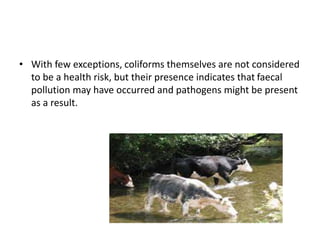
• With few exceptions, coliforms themselves are not considered
to be a health risk, but their presence indicates that faecal
pollution may have occurred and pathogens might be present
as a result.
What are indicator bacteria?
• The use of an organism that can serve as a surrogate for
another is called an indicator organism.
• Trying to detect disease-causing bacteria and other pathogens
in water is expensive and may pose potential health hazards.
• And it is not practical to test for pathogens in every water
sample collected.
• Instead, the presence of pathogens is determined with
indirect evidence by testing for an "indicator" organism such
as coliform bacteria.
• Coliforms come from the same sources as pathogenic
organisms.
What are Coliforms?
• Coliforms are bacteria that are always present
in the digestive tracts of animals, including
humans, and are found in their wastes. They
are also found in plant and soil material.
Are Coliform Bacteria Harmful?
• Most coliform bacteria do not cause disease.
• However, some rare strains of E. coli, particularly the strain
0157:H7, can cause serious illness.
• Cases of E. coli 0157:H7 caused by contaminated drinking
water supplies are rare.
• Coliforms are relatively:
-easy to identify.
-are usually present in larger numbers than more
dangerous pathogens.
- and respond to the environment, wastewater treatment,
and water treatment similarly to many pathogens.
• As a result, testing for coliform bacteria can be a
reasonable indication of whether other pathogenic
bacteria are present.
• E. coli are one of the best indicators for the presence of
potentially pathogenic bacteria.
• Because E. coli monitoring does not measure the actual
pathogens, however, it is a good approach for assessing
the likelihood of risks to human health.
• Monitoring for these indicator organisms is an easy
and economical method for citizens or professionals to
assess health risks due to bacterial contamination of
surface waters.
Common sources of E. coli
• Bacteria in water can originate from the intestinal tracts
of both humans and other warm-blooded animals, such
as pets, livestock and wildlife.
• Human sources include failing septic tanks, leaking
sewer lines, wastewater treatment plants, combined
sewer overflow and boat discharges.
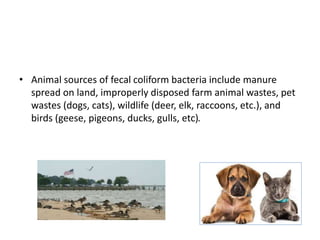
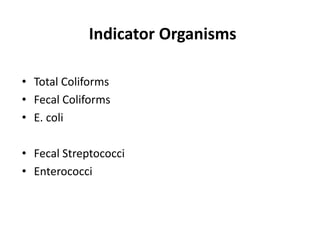
• Animal sources of fecal coliform bacteria include manure
spread on land, improperly disposed farm animal wastes, pet
wastes (dogs, cats), wildlife (deer, elk, raccoons, etc.), and
birds (geese, pigeons, ducks, gulls, etc).
Indicator Organisms
• Total Coliforms
• Fecal Coliforms
• E. coli
• Fecal Streptococci
• Enterococci
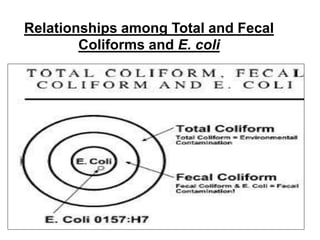
Relationships among Total and Fecal
Coliforms and E. coli
Total Coliform Test
• The coliform group includes a number of genera and
species of bacteria which have common biochemical and
morphological attributes that include gram negative,
non-spore forming rods that ferment lactose in 24 to 48
hours at 35C.
• These attributes are found in Escherichia coli which is the
coliform of most sanitary significance as it is very
common in the feces of warm blooded animals.
• Historically, the coliform test was developed with the aim
to estimate the presence of E. coli in water samples by
detecting bacteria that had the same cultural attributes.
•
• As the test was used it soon became clear that it was not
specific for E. coli. and that a variety of bacteria species can
be included under the coliform umbrella, many of which
are of limited sanitary significance.
•
• The total coliform standard is still used in certain
jurisdictions (drinking water for example) as it is felt to be a
very conservative risk management tool.
Fecal Coliform Test
• A subset of the coliform group of bacteria that are able to
grow at 44.5C (thermotolerant coliforms).
• E. coli is able to grow at this temperature while most of the
coliforms of limited sanitary significance do not.
• Monitoring methods that employ elevated temperature
incubation give a more specific estimate of the presence and
number of E. coli and thus the presence of fecal
contamination.
• There are some thermotolerant coliform species, such as
Klebsiella, that are of questionable sanitary significance, thus
the test is not an absolute.
E. coli Test
• The most recent development in the evolution of the coliform
test is the ability to specifically identify and quantify E. coli in
water samples through the use of elevated temperatures and
the development of a readily identifiable chemical indicator
for the presence of an enzyme system specific to E. coli.
• The presence of E. coli is a much more certain indication of
fecal contamination than is the presence of fecal coliforms.
• There is a need for an indicator bacterium that could be used
to indicate the presence of fecal material as well as indicate
the source as human or non-human.
• unfortunately, E. coli does not fill this bill.
• A great deal of effort continues to be expended to find an
indicator that will fill the bill but to date nothing practical has
been developed.
• Differentiation of pathogenic E. coli is possible, but not
commonly practiced.
Fecal Streptococci Test
• The feces of humans and animals contain large numbers of
streptococcal bacteria that can be classified as belonging to
the fecal streptococci group.
• There are six species or of streptococci included in this
grouping.
• These streptococci include S. faecalis,; S. faecium; and, S.
avium and S. gallinarum; S. bovis; and, S. equinus.
• In some reports the two subspecies S. faecalis subsp.
liquefaciens; S. faecalis subsp. zymogenese are also
described but their validity as subspecies is questionable.
• This group of bacteria are primarily found only in the feces of
warm-blooded animals but it is now understood that some
subtypes of this group might be associated with insects.
• With the advent of the fecal coliform test interest in the use
of the fecal streptococcias an important water quality
indicator was diminished.
• The recognition that the fecal streptococci numbers in animal
feces was considerably higher than that for fecal coliforms,
gave birth to the idea that the ratio of their numbers relative
to each other (FC/FS) in a water sample would be an
indication of the source of fecal contamination (human vs
animal).
Enterococci Test
• The enterococci are a subset of the fecal streptococci group
that include the first four species of fecal streptococci listed
above.
• This group of streptococci are considered to be more specific
as indicators of the sanitary quality of recreational waters
than the fecal streptococci group as a whole.

Indicator organisms and water quality

  • 1.
    Concept of Indicatororganisms and water quality Lecture 9 Prepared by Samira fattah Assis. Lec. College of health sciences-HMU
  • 2.
    INTRODUCTION One of theprimary concerns of water authorities is to ensure that the drinking water they supply does not pose an unacceptable health risk to consumers
  • 3.
    There are twomajor reasons for monitoring drinking water quality: • to determine if the water supply system is being operated correctly, implying that the water is safe for consumers (Primary Assessment). • proof that the water was safe after it was supplied. This includes monitoring for compliance (Verification).
  • 4.
    - To addressmicrobial health risk, primary assessment can only be achieved by monitoring source water. - Monitoring treated water in distribution systems for microorganisms is a means of verification only.
  • 5.
    Microbial indicators ofwater quality • Pathogens that can be spread through drinking water and cause waterborne disease include bacteria, viruses, and protozoa. • The number of different types of pathogens that can be present in water as a result of pollution with human or animal faeces is very large and it is not possible to test water samples for each specific pathogen.
  • 6.
    • For example,more than 100 types of enteric viruses have been isolated from human faeces and from sewage . • Isolation and identification of some of these viruses is very difficult, or not currently possible. • If these viruses or other pathogens are present in water as a result of fecal pollution, a measure is required which will alert water managers to their presence.
  • 7.
    • The conceptof coliforms as bacterial indicators of microbial water quality is based on the premise that because coliforms are present in high numbers in the faeces of humans and other warm-blooded animals; if faecal pollution has entered drinking water, it is likely that these bacteria will be present, even after significant dilution.
  • 8.
    • With fewexceptions, coliforms themselves are not considered to be a health risk, but their presence indicates that faecal pollution may have occurred and pathogens might be present as a result.
  • 9.
    What are indicatorbacteria? • The use of an organism that can serve as a surrogate for another is called an indicator organism. • Trying to detect disease-causing bacteria and other pathogens in water is expensive and may pose potential health hazards. • And it is not practical to test for pathogens in every water sample collected.
  • 10.
    • Instead, thepresence of pathogens is determined with indirect evidence by testing for an "indicator" organism such as coliform bacteria. • Coliforms come from the same sources as pathogenic organisms.
  • 11.
    What are Coliforms? •Coliforms are bacteria that are always present in the digestive tracts of animals, including humans, and are found in their wastes. They are also found in plant and soil material.
  • 12.
    Are Coliform BacteriaHarmful? • Most coliform bacteria do not cause disease. • However, some rare strains of E. coli, particularly the strain 0157:H7, can cause serious illness. • Cases of E. coli 0157:H7 caused by contaminated drinking water supplies are rare.
  • 13.
    • Coliforms arerelatively: -easy to identify. -are usually present in larger numbers than more dangerous pathogens. - and respond to the environment, wastewater treatment, and water treatment similarly to many pathogens. • As a result, testing for coliform bacteria can be a reasonable indication of whether other pathogenic bacteria are present.
  • 14.
    • E. coliare one of the best indicators for the presence of potentially pathogenic bacteria. • Because E. coli monitoring does not measure the actual pathogens, however, it is a good approach for assessing the likelihood of risks to human health. • Monitoring for these indicator organisms is an easy and economical method for citizens or professionals to assess health risks due to bacterial contamination of surface waters.
  • 15.
    Common sources ofE. coli • Bacteria in water can originate from the intestinal tracts of both humans and other warm-blooded animals, such as pets, livestock and wildlife. • Human sources include failing septic tanks, leaking sewer lines, wastewater treatment plants, combined sewer overflow and boat discharges.
  • 16.
    • Animal sourcesof fecal coliform bacteria include manure spread on land, improperly disposed farm animal wastes, pet wastes (dogs, cats), wildlife (deer, elk, raccoons, etc.), and birds (geese, pigeons, ducks, gulls, etc).
  • 17.
    Indicator Organisms • TotalColiforms • Fecal Coliforms • E. coli • Fecal Streptococci • Enterococci
  • 18.
    Relationships among Totaland Fecal Coliforms and E. coli
  • 19.
    Total Coliform Test •The coliform group includes a number of genera and species of bacteria which have common biochemical and morphological attributes that include gram negative, non-spore forming rods that ferment lactose in 24 to 48 hours at 35C. • These attributes are found in Escherichia coli which is the coliform of most sanitary significance as it is very common in the feces of warm blooded animals.
  • 20.
    • Historically, thecoliform test was developed with the aim to estimate the presence of E. coli in water samples by detecting bacteria that had the same cultural attributes. • • As the test was used it soon became clear that it was not specific for E. coli. and that a variety of bacteria species can be included under the coliform umbrella, many of which are of limited sanitary significance. • • The total coliform standard is still used in certain jurisdictions (drinking water for example) as it is felt to be a very conservative risk management tool.
  • 21.
    Fecal Coliform Test •A subset of the coliform group of bacteria that are able to grow at 44.5C (thermotolerant coliforms). • E. coli is able to grow at this temperature while most of the coliforms of limited sanitary significance do not.
  • 22.
    • Monitoring methodsthat employ elevated temperature incubation give a more specific estimate of the presence and number of E. coli and thus the presence of fecal contamination. • There are some thermotolerant coliform species, such as Klebsiella, that are of questionable sanitary significance, thus the test is not an absolute.
  • 23.
    E. coli Test •The most recent development in the evolution of the coliform test is the ability to specifically identify and quantify E. coli in water samples through the use of elevated temperatures and the development of a readily identifiable chemical indicator for the presence of an enzyme system specific to E. coli. • The presence of E. coli is a much more certain indication of fecal contamination than is the presence of fecal coliforms.
  • 24.
    • There isa need for an indicator bacterium that could be used to indicate the presence of fecal material as well as indicate the source as human or non-human. • unfortunately, E. coli does not fill this bill. • A great deal of effort continues to be expended to find an indicator that will fill the bill but to date nothing practical has been developed. • Differentiation of pathogenic E. coli is possible, but not commonly practiced.
  • 25.
    Fecal Streptococci Test •The feces of humans and animals contain large numbers of streptococcal bacteria that can be classified as belonging to the fecal streptococci group. • There are six species or of streptococci included in this grouping. • These streptococci include S. faecalis,; S. faecium; and, S. avium and S. gallinarum; S. bovis; and, S. equinus. • In some reports the two subspecies S. faecalis subsp. liquefaciens; S. faecalis subsp. zymogenese are also described but their validity as subspecies is questionable.
  • 26.
    • This groupof bacteria are primarily found only in the feces of warm-blooded animals but it is now understood that some subtypes of this group might be associated with insects. • With the advent of the fecal coliform test interest in the use of the fecal streptococcias an important water quality indicator was diminished.
  • 27.
    • The recognitionthat the fecal streptococci numbers in animal feces was considerably higher than that for fecal coliforms, gave birth to the idea that the ratio of their numbers relative to each other (FC/FS) in a water sample would be an indication of the source of fecal contamination (human vs animal).
  • 28.
    Enterococci Test • Theenterococci are a subset of the fecal streptococci group that include the first four species of fecal streptococci listed above. • This group of streptococci are considered to be more specific as indicators of the sanitary quality of recreational waters than the fecal streptococci group as a whole.