Water bacteriology
Microbiological Water Analysis
The Rationale of the Use of Fecal Indicator Bacteria
The most important bacterial gastrointestinal diseases transmitted through water are
 Cholera
 salmonellosis
 shigellosis.
 These diseases are mainly transmitted through water (and food) contaminated with
feces of patients.
 Drinking water can be contaminated with these pathogenic bacteria, and this is an
issue of great concern.
 However, the presence of pathogenic bacteria in water is
 sporadic and erratic
 levels are low
 isolation and culture of these bacteria is not straightforward.
• For these reasons, routine water microbiological analysis does not include the
detection of pathogenic bacteria.
• Water contaminated with pathogenic species also has the normal inhabitants
of the human intestine.
Good bacterial indicator of fecal pollution should fulfill the following
criteria:
 Exist in high numbers in the human intestine and feces
 not be pathogenic to humans
 Easily, reliably and cheaply detectable in environmental waters.
 Additionally, the following requisites should be met if possible:
 does not multiply outside the enteric environment
 In environmental waters, the indicator should exist in greater numbers than
eventual pathogenic bacteria
 Indicators should have a similar die-off behavior as the pathogens
 If human fecal pollution is to be separated from animal pollution, the
indicator should not be very common in the intestine of farm and domestic
animals
 Usefulness of indicator bacteria in predicting the presence of pathogens
• Bacteria present in feces are naturally derived from the microbiota of the
human gastrointestinal tract.
• Estimated that at least 500–1,000 different microbial species exist in the
human gastrointestinal microbiota, although on a quantitative basis 10–20
genera usually predominate
Microflora of the human gastrointestinal tract
• Dominated by obligate anaerobes, which are ca. 103 more abundant than facultative
anaerobe.The main anaerobic genera :
• Bacteroides
• Eubacterium
• Bifidobacteria.
 Anaerobic bacteria such as Bacteroides and Eubacterium are not easily
cultured by conventional techniques
• Require incubation chambers with nitrogen atmosphere.
Bifidobacterium and Lactobacillus tolerate some oxygen but are
fastidious bacteria growing very slowly in culture media.
Therefore, these four genera are not adequate to be used as indicators
of fecal pollution
• The most abundant facultative anaerobes are
• Enterococci
• Enterobacteriaceae.
• The main Enterobacteriaceae genera
• Escherichia
• Citrobacter
• Klebsiella
• Proteus
• Enterobacter
Citrobacter and Klebsiella are present in most individuals although in low numbers
and are widespread in environmental waters, and therefore are also not suitable as
indicators of fecal pollution.
Proteus and Enterobacter are only present in a minority of humans
Indicator organism of fecal contamination of water:
1. Total Coliform (TC)
2. Faecal Coliform (FC)
3. Faecal Enterococci / Streptococcci species
4. Pseudomonas auerogenosa
 The tests results are compared to standards or guideline values that have been
designed to protect human health.
 The presence of such organisms in a water sample suggest that the water has been
compromised by faecal contamination and that pathogens may be present.
DEFINITION AND ABBREVIATIONS
Coliforms: Total coliforms include bacteria that are found in the soil, in water that has been
influenced by surface water, and in human or animal waste.
Fecal coliforms are the group of the total coliforms that are considered to be present
specifically in the gut and feces of warm-blooded animals.
Because the origins of fecal coliforms are more specific than the origins of the more general
total coliform group of bacteria, fecal coliforms are considered a more accurate indication of
animal or human waste than the total coliforms.
Escherichia coli (E. coli) is the major species in the fecal coliform group.
 Of the five general groups of bacteria that comprise the total coliforms, only E. coli is
generally not found growing and reproducing in the environment.
 Consequently, E. coli is considered to be the species of coliform bacteria that is the best
indicator of fecal pollution and the possible presence of pathogens.
PROCEDURE:
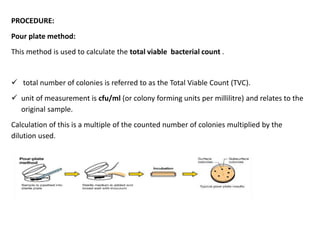
Pour plate method:
This method is used to calculate the total viable bacterial count .
 total number of colonies is referred to as the Total Viable Count (TVC).
 unit of measurement is cfu/ml (or colony forming units per millilitre) and relates to the
original sample.
Calculation of this is a multiple of the counted number of colonies multiplied by the
dilution used.
Membrane filtration method
 Membrane filtration is the method of choice for the analysis of fecal
coliforms in water. Samples to be tested are passed through a membrane
filter of particular pore size (generally 0.45 micron).
 The microorganisms present in the water remain on the filter surface. When
the filter is placed in a sterile petri dish and saturated with an appropriate
medium, growth of the desired organisms is encouraged, while that of other
organisms is suppressed.
 Each cell develops into a separate colony, which can be counted directly,
and the results calculated as microbial density.
 Sample volumes of 100 ml will be used for the water testing, with the goal of
achieving a final desirable colony density range of 20-60 colonies/filter.
 Contaminated sources may require dilution to achieve a "countable" number
Steps in Membrane filtration method.
 The apparatus is autoclave and assembled .
 Water sample is drawn through the membrane filter by applying a vacuum.
 filter is removed aseptically and placed on the surface of an agar medium.
 After incubation the colonies are visible and can be counted.
Culture media used for water bacteriology
• Plate count agar
• Eosin methylene blue agar modified (Levine)
• Pseudomonas citramide agar
Eosin Methylene Blue (EMB) agar is both selective and
differential culture medium.
It is a selective culture medium for Gram-negative
bacteria (selects against Gram-positive bacteria) and is
commonly used for the isolation and differentiation of
coliforms and fecal coliforms37C֯ for( total coliform)
44C֯ for (Fecal E.coli).
• If on 44C exhibit a green metallic sheen by
reflected light and dark purple center colonies.
• isolate these colonies on Mac Conkey medium and
incubate at 37 C for 24 hours and next day follow
the further identification parameters performed
Biochemical testing ( triple sugar iron agar
test,citrate , urease test and SIM test) If fecal E.coli
is present it will grow on MacConkey medium .
EMB (Eosin methylene blue )
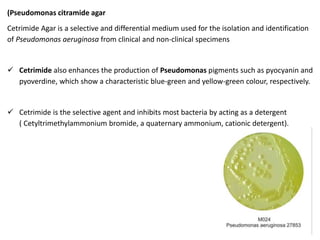
(Pseudomonas citramide agar
Cetrimide Agar is a selective and differential medium used for the isolation and identification
of Pseudomonas aeruginosa from clinical and non-clinical specimens
 Cetrimide also enhances the production of Pseudomonas pigments such as pyocyanin and
pyoverdine, which show a characteristic blue-green and yellow-green colour, respectively.
 Cetrimide is the selective agent and inhibits most bacteria by acting as a detergent
( Cetyltrimethylammonium bromide, a quaternary ammonium, cationic detergent).
Azide broth: 5ml water sample added in Azide broth
Fecal enterococcus
 Azide Dextrose Broth is used for the detection and enumeration of
enterococci/streptococci in water, sewage, foods and other materials.
The medium contains Sodium azide, which inhibits the growth of the accompanying flora
in Gram-negative bacteria and permits the growth of enterococci.
The presence of enterococci is an indicator for faecal contamination, especially when
occurred a long time ago and the less resistant coliform bacteria, including Escherichia
coli, may already be dead when the analysis is carried out.
RESULTS AND REPORTING
 The sample is found to be satisfactory on bacteriological ground on following results
 Total Viable Plat Count at 37C :< 20 CFU/ml
 Total Coliform : < 1 CFU/100ml
 Fecal E.coli: < 1 CFU/100ml
 Pseodomonas spp : < 1 CFU/100ml
 Fecal Enterococci/Streptococci : < 1 CFU/
TROUBLE SHOOTING/CORRECTIVE ACTION:
 Clinical history and correlation is necessary for appropriate interpretation of
cultures.
 Review and countercheck all the procedures involved right from the beginning
till end.
 If any flaw is identified during investigation then document it.
 TVPC is not available then use alternative agar that is nutrient agar/ MHA .
Reference
Cabral JP. Water microbiology. Bacterial pathogens and water.
International journal of environmental research and public health. 2010
Oct;7(10):3657-703.
Water bacteriology

Water bacteriology

  • 1.
  • 2.
    Microbiological Water Analysis TheRationale of the Use of Fecal Indicator Bacteria The most important bacterial gastrointestinal diseases transmitted through water are  Cholera  salmonellosis  shigellosis.  These diseases are mainly transmitted through water (and food) contaminated with feces of patients.  Drinking water can be contaminated with these pathogenic bacteria, and this is an issue of great concern.  However, the presence of pathogenic bacteria in water is  sporadic and erratic  levels are low  isolation and culture of these bacteria is not straightforward. • For these reasons, routine water microbiological analysis does not include the detection of pathogenic bacteria.
  • 3.
    • Water contaminatedwith pathogenic species also has the normal inhabitants of the human intestine. Good bacterial indicator of fecal pollution should fulfill the following criteria:  Exist in high numbers in the human intestine and feces  not be pathogenic to humans  Easily, reliably and cheaply detectable in environmental waters.  Additionally, the following requisites should be met if possible:  does not multiply outside the enteric environment  In environmental waters, the indicator should exist in greater numbers than eventual pathogenic bacteria  Indicators should have a similar die-off behavior as the pathogens  If human fecal pollution is to be separated from animal pollution, the indicator should not be very common in the intestine of farm and domestic animals  Usefulness of indicator bacteria in predicting the presence of pathogens
  • 4.
    • Bacteria presentin feces are naturally derived from the microbiota of the human gastrointestinal tract. • Estimated that at least 500–1,000 different microbial species exist in the human gastrointestinal microbiota, although on a quantitative basis 10–20 genera usually predominate
  • 5.
    Microflora of thehuman gastrointestinal tract • Dominated by obligate anaerobes, which are ca. 103 more abundant than facultative anaerobe.The main anaerobic genera : • Bacteroides • Eubacterium • Bifidobacteria.  Anaerobic bacteria such as Bacteroides and Eubacterium are not easily cultured by conventional techniques • Require incubation chambers with nitrogen atmosphere. Bifidobacterium and Lactobacillus tolerate some oxygen but are fastidious bacteria growing very slowly in culture media. Therefore, these four genera are not adequate to be used as indicators of fecal pollution
  • 6.
    • The mostabundant facultative anaerobes are • Enterococci • Enterobacteriaceae. • The main Enterobacteriaceae genera • Escherichia • Citrobacter • Klebsiella • Proteus • Enterobacter Citrobacter and Klebsiella are present in most individuals although in low numbers and are widespread in environmental waters, and therefore are also not suitable as indicators of fecal pollution. Proteus and Enterobacter are only present in a minority of humans
  • 7.
    Indicator organism offecal contamination of water: 1. Total Coliform (TC) 2. Faecal Coliform (FC) 3. Faecal Enterococci / Streptococcci species 4. Pseudomonas auerogenosa  The tests results are compared to standards or guideline values that have been designed to protect human health.  The presence of such organisms in a water sample suggest that the water has been compromised by faecal contamination and that pathogens may be present.
  • 8.
    DEFINITION AND ABBREVIATIONS Coliforms:Total coliforms include bacteria that are found in the soil, in water that has been influenced by surface water, and in human or animal waste. Fecal coliforms are the group of the total coliforms that are considered to be present specifically in the gut and feces of warm-blooded animals. Because the origins of fecal coliforms are more specific than the origins of the more general total coliform group of bacteria, fecal coliforms are considered a more accurate indication of animal or human waste than the total coliforms. Escherichia coli (E. coli) is the major species in the fecal coliform group.  Of the five general groups of bacteria that comprise the total coliforms, only E. coli is generally not found growing and reproducing in the environment.  Consequently, E. coli is considered to be the species of coliform bacteria that is the best indicator of fecal pollution and the possible presence of pathogens.
  • 9.
    PROCEDURE: Pour plate method: Thismethod is used to calculate the total viable bacterial count .  total number of colonies is referred to as the Total Viable Count (TVC).  unit of measurement is cfu/ml (or colony forming units per millilitre) and relates to the original sample. Calculation of this is a multiple of the counted number of colonies multiplied by the dilution used.
  • 10.
    Membrane filtration method Membrane filtration is the method of choice for the analysis of fecal coliforms in water. Samples to be tested are passed through a membrane filter of particular pore size (generally 0.45 micron).  The microorganisms present in the water remain on the filter surface. When the filter is placed in a sterile petri dish and saturated with an appropriate medium, growth of the desired organisms is encouraged, while that of other organisms is suppressed.  Each cell develops into a separate colony, which can be counted directly, and the results calculated as microbial density.  Sample volumes of 100 ml will be used for the water testing, with the goal of achieving a final desirable colony density range of 20-60 colonies/filter.  Contaminated sources may require dilution to achieve a "countable" number
  • 11.
    Steps in Membranefiltration method.  The apparatus is autoclave and assembled .  Water sample is drawn through the membrane filter by applying a vacuum.  filter is removed aseptically and placed on the surface of an agar medium.  After incubation the colonies are visible and can be counted. Culture media used for water bacteriology • Plate count agar • Eosin methylene blue agar modified (Levine) • Pseudomonas citramide agar
  • 12.
    Eosin Methylene Blue(EMB) agar is both selective and differential culture medium. It is a selective culture medium for Gram-negative bacteria (selects against Gram-positive bacteria) and is commonly used for the isolation and differentiation of coliforms and fecal coliforms37C֯ for( total coliform) 44C֯ for (Fecal E.coli). • If on 44C exhibit a green metallic sheen by reflected light and dark purple center colonies. • isolate these colonies on Mac Conkey medium and incubate at 37 C for 24 hours and next day follow the further identification parameters performed Biochemical testing ( triple sugar iron agar test,citrate , urease test and SIM test) If fecal E.coli is present it will grow on MacConkey medium . EMB (Eosin methylene blue )
  • 16.
    (Pseudomonas citramide agar CetrimideAgar is a selective and differential medium used for the isolation and identification of Pseudomonas aeruginosa from clinical and non-clinical specimens  Cetrimide also enhances the production of Pseudomonas pigments such as pyocyanin and pyoverdine, which show a characteristic blue-green and yellow-green colour, respectively.  Cetrimide is the selective agent and inhibits most bacteria by acting as a detergent ( Cetyltrimethylammonium bromide, a quaternary ammonium, cationic detergent).
  • 17.
    Azide broth: 5mlwater sample added in Azide broth Fecal enterococcus  Azide Dextrose Broth is used for the detection and enumeration of enterococci/streptococci in water, sewage, foods and other materials. The medium contains Sodium azide, which inhibits the growth of the accompanying flora in Gram-negative bacteria and permits the growth of enterococci. The presence of enterococci is an indicator for faecal contamination, especially when occurred a long time ago and the less resistant coliform bacteria, including Escherichia coli, may already be dead when the analysis is carried out.
  • 18.
    RESULTS AND REPORTING The sample is found to be satisfactory on bacteriological ground on following results  Total Viable Plat Count at 37C :< 20 CFU/ml  Total Coliform : < 1 CFU/100ml  Fecal E.coli: < 1 CFU/100ml  Pseodomonas spp : < 1 CFU/100ml  Fecal Enterococci/Streptococci : < 1 CFU/
  • 19.
    TROUBLE SHOOTING/CORRECTIVE ACTION: Clinical history and correlation is necessary for appropriate interpretation of cultures.  Review and countercheck all the procedures involved right from the beginning till end.  If any flaw is identified during investigation then document it.  TVPC is not available then use alternative agar that is nutrient agar/ MHA .
  • 20.
    Reference Cabral JP. Watermicrobiology. Bacterial pathogens and water. International journal of environmental research and public health. 2010 Oct;7(10):3657-703.

Editor's Notes

  • #8 Water is essential to life, but many people do not have access to clean and safe drinking water and many die of waterborne bacterial infections.
  • #18 Azide is a strong inhibitor of the respiratory chain. Since streptococci are one of the very few bacteria that have no respiratory chain, the test is very specific for this group, and false positives are rarely found