Indicator Micro-
organism
Presented by: Dilshida O C
241081
MSc. Nutrition Biology
Submitted to: Prof. Dr. Surender Singh
Dept. Of Microbiology
Course title: Techniques in Microbiology(GEC)
2 12/08/2024
Content
• Introduction
• Characteristics of effective indicator
• Types of Indicator Microorganism
• General applications
• Factors affecting Indicator
• Advantages
• Limitations
• Conclusion
• References
3 12/08/2024
Introduction
• Concepts of Indicator micro-organisms
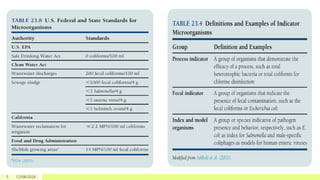
• Microorganisms used as indicators to assess the quality and
safety of water, food & the environment.
• They are not harmful themselves but signal the potential
presence of pathogen or contaminants.
• Indicator microorganisms have also been used to assess the
efficacy of wastewater treatment processes.
• Bacteria that are known to be indicator organisms are usually
members of the Enterobacteriaceae family; and Escherichia
coli, Streptococci, Enterococcus species, Salmonella and coliform
bacteria are the most common indicator organisms of food
contamination.
• Indicator organisms usually emanate from the feces of
humans and animals; they easily contaminate the food and this
can cause several health anomalies in consumers.
4 12/08/2024
The Criteria for an Ideal Indicator Organism
• The organism should be useful for all types of water
• The organism should be present whenever enteric pathogens are present.
• The organism should have a reasonably longer survival time than the hardiest enteric
pathogen.
• The organism should not grow in water.
• The testing method should be easy to perform.
• The density of the indicator organism should have some direct relationship to the
degree of fecal pollution.
• The organism should be a member of the intestinal microflora of warm-blooded
animals.
5 12/08/2024
6 12/08/2024
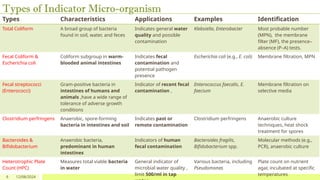
Types Characteristics Applications Examples Identification
Total Coliform A broad group of bacteria
found in soil, water, and feces
Indicates general water
quality and possible
contamination
Klebsiella, Enterobacter Most probable number
(MPN), the membrane
filter (MF), the presence–
absence (P–A) tests.
Fecal Coliform &
Escherichia coli
Coliform subgroup in warm-
blooded animal intestines
Indicates fecal
contamination and
potential pathogen
presence
Escherichia coli (e.g., E. coli) Membrane filtration, MPN
Fecal streptococci
(Enterococci)
Gram-positive bacteria in
intestines of humans and
animals ,have a wide range of
tolerance of adverse growth
conditions
Indicator of recent fecal
contamination ,
Enterococcus faecalis, E.
faecium
Membrane filtration on
selective media
Clostridium perfringens Anaerobic, spore-forming
bacteria in intestines and soil
Indicates past or
remote contamination
Clostridium perfringens Anaerobic culture
techniques, heat shock
treatment for spores
Bacteroides &
Bifidobacterium
Anaerobic bacteria,
predominant in human
intestines
Indicators of human
fecal contamination
Bacteroides fragilis,
Bifidobacterium spp.
Molecular methods (e.g.,
PCR), anaerobic culture
Heterotrophic Plate
Count (HPC)
Measures total viable bacteria
in water
General indicator of
microbial water quality ,
limit 500/ml in tap
Various bacteria, including
Pseudomonas
Plate count on nutrient
agar, incubated at specific
temperatures
Types of Indicator Micro-organism
7 12/08/2024
Continue.....
8 12/08/2024
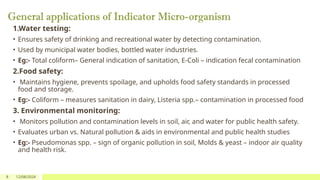
General applications of Indicator Micro-organism
1.Water testing:
• Ensures safety of drinking and recreational water by detecting contamination.
• Used by municipal water bodies, bottled water industries.
• Eg:- Total coliform– General indication of sanitation, E-Coli – indication fecal contamination
2.Food safety:
• Maintains hygiene, prevents spoilage, and upholds food safety standards in processed
food and storage.
• Eg:- Coliform – measures sanitation in dairy, Listeria spp.– contamination in processed food
3. Environmental monitoring:
• Monitors pollution and contamination levels in soil, air, and water for public health safety.
• Evaluates urban vs. Natural pollution & aids in environmental and public health studies
• Eg:- Pseudomonas spp. – sign of organic pollution in soil, Molds & yeast – indoor air quality
and health risk.
9 12/08/2024
Factors affecting Indicator microorganism
• Temperature: Growth varies by microorganisms (E-coli grows best at 30°C-37°C &
slows at <4°C or >60°C
• pH level: Acidity or Alkalinity will affect growth (Coliforms prefer pH 6.5-7.5 & inhibits
in <4
• Nutrient availability: Availability of food source increase growth rates
• Oxygen level: Can be aerobic or anaerobic (E-coli grows with or without oxygen;
Clostridium perfringens needs no oxygen)
• Salinity: Can inhibit or promote growth (vibrio cholerae thrives; Coliforms do not
survive
• Presence of chemicals: disinfectants & chemicals can kill or inhibit growth
• Competition from other microorganism: Salmonella can outcompete E-coli in food
products
• Light, humidity & organic matter can influence growth
10 12/08/2024
Advantages & Limitations
Advantages Limitations
• Simplicity & cost effectiveness:
Easys to culture and identify
• Proven reliability: Fecal
contamination corelated with
pathogen
• Regulatory acceptance: Recognized
by health organization, which help
standardize testing
• Quick testing
• Protects public health
• Reflects cleanliness
• Easy to monitor
• Not specific to harmful germs
• Results can vary: Results can vary
based on environmental condition
• Some germs can't be grown in labs
• False results possible(False positive
or False negative)
• May not always indicate pathogens
• May resist harsh condition: some
indicators can survive better than
harmful germs, leading to confusing
result
• Limited use: Only used in certain
11 12/08/2024
• Indicator microorganisms are essential tools for evaluating the safety of
food and water by serving as markers for fecal contamination and the
potential presence of harmful pathogens.
• Understanding the factors that influence their growth—such as
temperature, pH, nutrient availability, oxygen levels, salinity, competition,
and environmental conditions—is crucial for accurate detection and
monitoring.
• These factors can significantly affect the reliability of test results, which
directly impacts public health assessments.
• Regular monitoring of indicator microorganisms enables timely
interventions to prevent foodborne and waterborne diseases.
• Continuous research and refinement of detection methods are necessary
to enhance the effectiveness of safety measures.
• By utilizing the knowledge of indicator microorganisms and their
influencing factors, we can better safeguard public health and ensure
safer food and water for all communities.
Conclusion
References
• I.L. Pepper, C.P. Gerba, T.J. Gentry: Environmental
Microbiology, Third edition.
• James M. Jay Martin J. Loessner David A. golden 'Modern food
microbiology' 7th edition
• Krishi.icar.gov.in
12 12/08/2024
13 12/08/2024

Indicator microorganisms - Microbiology..pptx

  • 1.
    Indicator Micro- organism Presented by:Dilshida O C 241081 MSc. Nutrition Biology Submitted to: Prof. Dr. Surender Singh Dept. Of Microbiology Course title: Techniques in Microbiology(GEC)
  • 2.
    2 12/08/2024 Content • Introduction •Characteristics of effective indicator • Types of Indicator Microorganism • General applications • Factors affecting Indicator • Advantages • Limitations • Conclusion • References
  • 3.
    3 12/08/2024 Introduction • Conceptsof Indicator micro-organisms • Microorganisms used as indicators to assess the quality and safety of water, food & the environment. • They are not harmful themselves but signal the potential presence of pathogen or contaminants. • Indicator microorganisms have also been used to assess the efficacy of wastewater treatment processes. • Bacteria that are known to be indicator organisms are usually members of the Enterobacteriaceae family; and Escherichia coli, Streptococci, Enterococcus species, Salmonella and coliform bacteria are the most common indicator organisms of food contamination. • Indicator organisms usually emanate from the feces of humans and animals; they easily contaminate the food and this can cause several health anomalies in consumers.
  • 4.
    4 12/08/2024 The Criteriafor an Ideal Indicator Organism • The organism should be useful for all types of water • The organism should be present whenever enteric pathogens are present. • The organism should have a reasonably longer survival time than the hardiest enteric pathogen. • The organism should not grow in water. • The testing method should be easy to perform. • The density of the indicator organism should have some direct relationship to the degree of fecal pollution. • The organism should be a member of the intestinal microflora of warm-blooded animals.
  • 5.
  • 6.
    6 12/08/2024 Types CharacteristicsApplications Examples Identification Total Coliform A broad group of bacteria found in soil, water, and feces Indicates general water quality and possible contamination Klebsiella, Enterobacter Most probable number (MPN), the membrane filter (MF), the presence– absence (P–A) tests. Fecal Coliform & Escherichia coli Coliform subgroup in warm- blooded animal intestines Indicates fecal contamination and potential pathogen presence Escherichia coli (e.g., E. coli) Membrane filtration, MPN Fecal streptococci (Enterococci) Gram-positive bacteria in intestines of humans and animals ,have a wide range of tolerance of adverse growth conditions Indicator of recent fecal contamination , Enterococcus faecalis, E. faecium Membrane filtration on selective media Clostridium perfringens Anaerobic, spore-forming bacteria in intestines and soil Indicates past or remote contamination Clostridium perfringens Anaerobic culture techniques, heat shock treatment for spores Bacteroides & Bifidobacterium Anaerobic bacteria, predominant in human intestines Indicators of human fecal contamination Bacteroides fragilis, Bifidobacterium spp. Molecular methods (e.g., PCR), anaerobic culture Heterotrophic Plate Count (HPC) Measures total viable bacteria in water General indicator of microbial water quality , limit 500/ml in tap Various bacteria, including Pseudomonas Plate count on nutrient agar, incubated at specific temperatures Types of Indicator Micro-organism
  • 7.
  • 8.
    8 12/08/2024 General applicationsof Indicator Micro-organism 1.Water testing: • Ensures safety of drinking and recreational water by detecting contamination. • Used by municipal water bodies, bottled water industries. • Eg:- Total coliform– General indication of sanitation, E-Coli – indication fecal contamination 2.Food safety: • Maintains hygiene, prevents spoilage, and upholds food safety standards in processed food and storage. • Eg:- Coliform – measures sanitation in dairy, Listeria spp.– contamination in processed food 3. Environmental monitoring: • Monitors pollution and contamination levels in soil, air, and water for public health safety. • Evaluates urban vs. Natural pollution & aids in environmental and public health studies • Eg:- Pseudomonas spp. – sign of organic pollution in soil, Molds & yeast – indoor air quality and health risk.
  • 9.
    9 12/08/2024 Factors affectingIndicator microorganism • Temperature: Growth varies by microorganisms (E-coli grows best at 30°C-37°C & slows at <4°C or >60°C • pH level: Acidity or Alkalinity will affect growth (Coliforms prefer pH 6.5-7.5 & inhibits in <4 • Nutrient availability: Availability of food source increase growth rates • Oxygen level: Can be aerobic or anaerobic (E-coli grows with or without oxygen; Clostridium perfringens needs no oxygen) • Salinity: Can inhibit or promote growth (vibrio cholerae thrives; Coliforms do not survive • Presence of chemicals: disinfectants & chemicals can kill or inhibit growth • Competition from other microorganism: Salmonella can outcompete E-coli in food products • Light, humidity & organic matter can influence growth
  • 10.
    10 12/08/2024 Advantages &Limitations Advantages Limitations • Simplicity & cost effectiveness: Easys to culture and identify • Proven reliability: Fecal contamination corelated with pathogen • Regulatory acceptance: Recognized by health organization, which help standardize testing • Quick testing • Protects public health • Reflects cleanliness • Easy to monitor • Not specific to harmful germs • Results can vary: Results can vary based on environmental condition • Some germs can't be grown in labs • False results possible(False positive or False negative) • May not always indicate pathogens • May resist harsh condition: some indicators can survive better than harmful germs, leading to confusing result • Limited use: Only used in certain
  • 11.
    11 12/08/2024 • Indicatormicroorganisms are essential tools for evaluating the safety of food and water by serving as markers for fecal contamination and the potential presence of harmful pathogens. • Understanding the factors that influence their growth—such as temperature, pH, nutrient availability, oxygen levels, salinity, competition, and environmental conditions—is crucial for accurate detection and monitoring. • These factors can significantly affect the reliability of test results, which directly impacts public health assessments. • Regular monitoring of indicator microorganisms enables timely interventions to prevent foodborne and waterborne diseases. • Continuous research and refinement of detection methods are necessary to enhance the effectiveness of safety measures. • By utilizing the knowledge of indicator microorganisms and their influencing factors, we can better safeguard public health and ensure safer food and water for all communities. Conclusion
  • 12.
    References • I.L. Pepper,C.P. Gerba, T.J. Gentry: Environmental Microbiology, Third edition. • James M. Jay Martin J. Loessner David A. golden 'Modern food microbiology' 7th edition • Krishi.icar.gov.in 12 12/08/2024
  • 13.