Mineral
Groups
‐
Silicates
and

         Carbonates


    Earth
Science
–
2nd
Semester

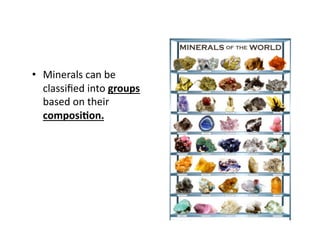
•  Minerals
can
be

   classified
into
groups

   based
on
their

   composi;on.

Silicates

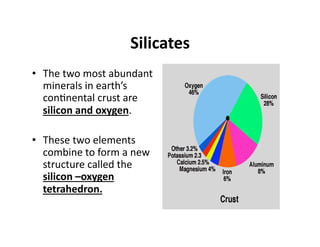
•  The
two
most
abundant

   minerals
in
earth’s

   con6nental
crust
are

   silicon
and
oxygen.


•  These
two
elements

   combine
to
form
a
new

   structure
called
the

   silicon
–oxygen

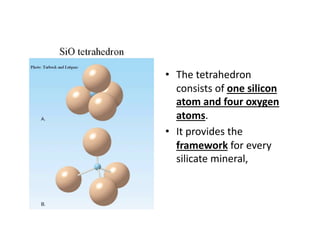
   tetrahedron.

•  The
tetrahedron

   consists
of
one
silicon

   atom
and
four
oxygen

   atoms.


•  It
provides
the

   framework
for
every

   silicate
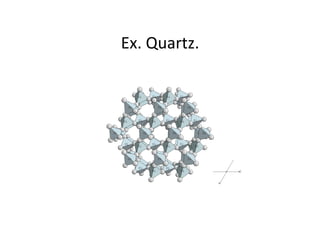
mineral,


Ex.
Quartz.

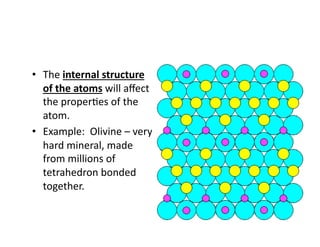
•  The
internal
structure

   of
the
atoms
will
affect

   the
proper6es
of
the

   atom.

•  Example:

Olivine
–
very

   hard
mineral,
made

   from
millions
of

   tetrahedron
bonded

   together.

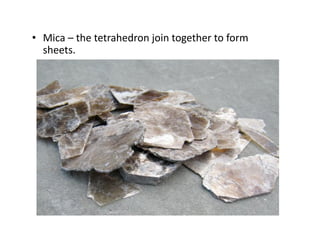
•  Mica
–
the
tetrahedron
join
together
to
form

   sheets.

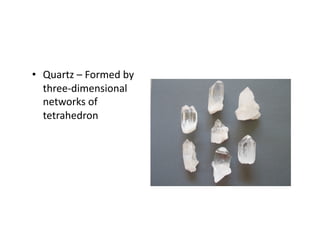
•  Quartz
–
Formed
by

   three‐dimensional

   networks
of

   tetrahedron


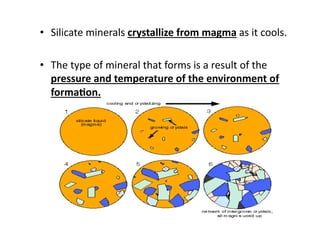
•  Silicate
minerals
crystallize
from
magma
as
it
cools.


•  The
type
of
mineral
that
forms
is
a
result
of
the

   pressure
and
temperature
of
the
environment
of

   forma;on.

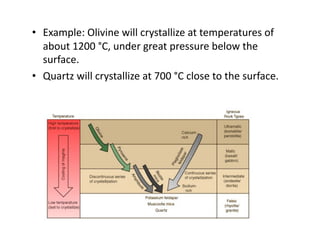
•  Example:
Olivine
will
crystallize
at
temperatures
of

   about
1200
°C,
under
great
pressure
below
the

   surface.


•  Quartz
will
crystallize
at
700
°C
close
to
the
surface.

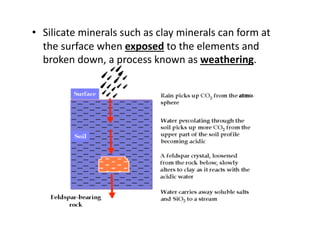
•  Silicate
minerals
such
as
clay
minerals
can
form
at

   the
surface
when
exposed
to
the
elements
and

   broken
down,
a
process
known
as
weathering.

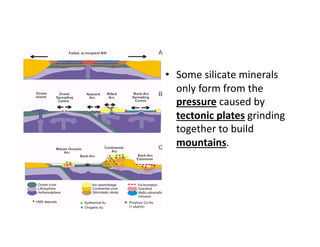
•  Some
silicate
minerals

   only
form
from
the

   pressure
caused
by

   tectonic
plates
grinding

   together
to
build

   mountains.

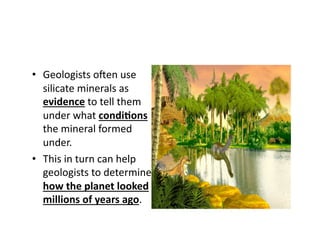
•  Geologists
oSen
use

   silicate
minerals
as

   evidence
to
tell
them

   under
what
condi;ons

   the
mineral
formed

   under.


•  This
in
turn
can
help

   geologists
to
determine

   how
the
planet
looked

   millions
of
years
ago.

Carbonates

•  Second
most
common

   mineral
group.


•  These
are
minerals
that

   contain
the
elements

   carbon,
oxygen,
and

   one
or
more
metallic

   elements.

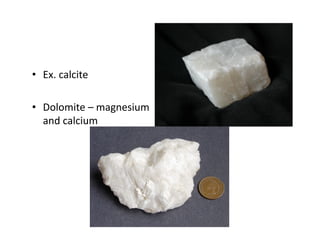
•  Ex.
calcite


•  Dolomite
–
magnesium

   and
calcium

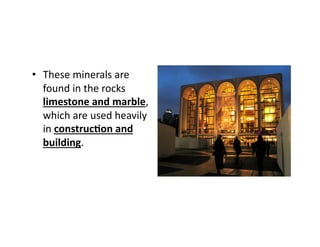
•  These
minerals
are

   found
in
the
rocks

   limestone
and
marble,

   which
are
used
heavily

   in
construc;on
and

   building.


Silicates And Carbonates