Microorganisms
(The Coliform Group Bacteria)
S. D. Spence
Microorganisms
 single-celled
 generally microscopic
 include bacteria, protozoa, algae, fungi,
viruses
 may or may not be disease causing
Implications of Microbial
Contamination of Water
 potential for transmission of disease causing
microorganisms (pathogens) via water
contact - oral fecal route
 contact includes ingestion, primary contact,
and secondary contact
Water Borne Diseases/Pathogens
 Bacteria
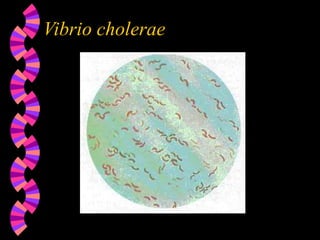
• Vibrio cholera - cholera
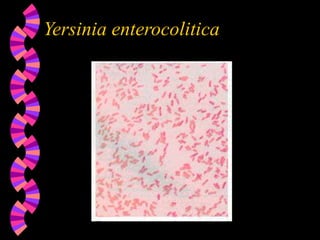
• Yersinia enterocolitica - gastroenteritis
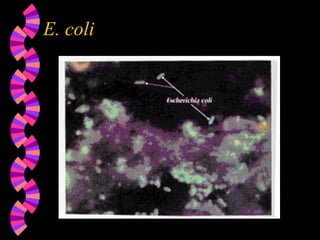
• Escherichia coli - gastroenteritis
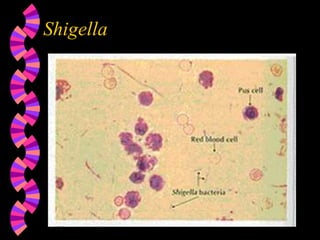
• Shigella sp.- gastroenteritis
• Listeria monocytogenes - flu-like symptoms
• Salmonella sp. - gastroenteritis, typhoid
• Campylobacter jejuni - gastroenteritis (animals
sources)
Vibrio cholerae
Yersinia enterocolitica
E. coli
Shigella
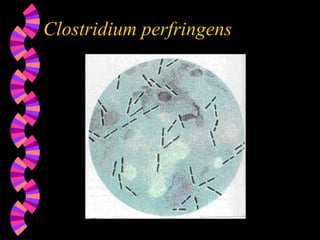
Clostridium perfringens
Water Borne Diseases/Pathogens
 Viruses
• Polio Virus - paralytic poliomyelitis
• Rotaviruses - gastroenteritis
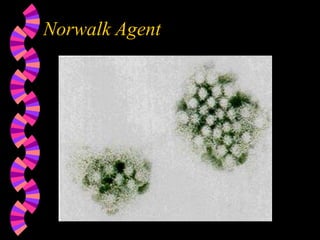
• Norwalk Viruses - gastroenteritis
• Hepatitis Type A and E - liver inflammation
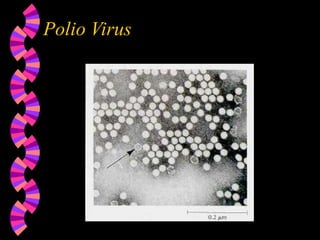
Polio Virus
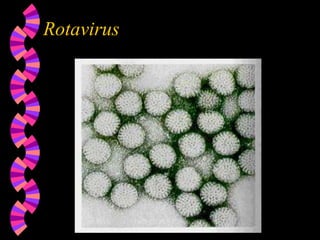
Rotavirus
Norwalk Agent
Water Borne Diseases/Pathogens
 Protozoa
• Entamoeba histolytica - amoebic dysentery
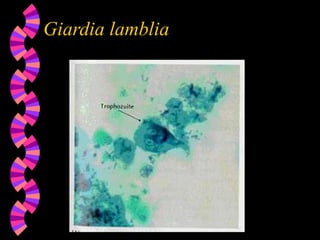
• Giardia lamblia - intestinal disease
• Cryptosporidium - intestinal disease
Giardia lamblia
Difficulties With Routine Testing
Of Pathogens in Water
 present in low numbers
 limited survival time
 numerous pathogens to analyze
 time and cost prohibitive
Testing of Indicator Organisms
 need an indicator of potential pathogen
contamination of water which is easy,
reliable, inexpensive, quick, etc.
Requirements of Indicator
Organisms
 present when pathogens present in water
 absent in uncontaminated water
 present in higher numbers than pathogens in
contaminated water
 better survival in water than pathogens
 easy to analyze
Coliform Bacteria - Indicators of
Fecal Contamination
 bacteria in the family Enterobacteriaceae
 generally include the genera Enterobacter,
Klebsiella, Citrobacter, and Escherichia
 present in the intestinal tract of numerous
organisms
 gram negative, non-spore forming rods
 ferment lactose with acid and gas
production in 48 hours at 35 °C
Total Coliform Bacteria
 inhabit the intestinal tract of animals
 sources: fecal material, soil, water, grain
 some capable of reproduction in the
environment
 non-fecal examples include: Klebsiella sp.,
Citrobacter sp., Enterobacter sp.
Fecal Coliform Bacteria
 subset of the total coliform group
 separated from non-fecal coliforms by
growth at 44.5 °C
 sources: fecal material
 capable of limited survival and growth in
the environment
 primary example is Escherichia coli (E.
coli)
Can Stagnant Water Result in
Positive Coliform Results?
 presence of coliform bacteria indicates
influence from a source - human activity,
fecal material, soil, water, grain
 stagnation of water - environment for
reproduction of bacteria allowing great
enough numbers to be detected
Coliform Sample Preservation
 sodium thiosulfate added to chlorinated
samples
 no additives for nonchlorinated samples
 recommended-drinking water samples iced
 required-source water samples iced
Coliform Sample Holding Times
and Analyses Methods
Source Water vs. Drinking Water
 Drinking water and source water have
different requirements for coliform analysis
methods and holding times
Coliform Sample Holding Times
 drinking water - 30 hours
[40 CFR 141.21(f)]
 surface/source water - 8 hours
[40 CFR 141.74 (a)(1)]
Effects of Holding Time on
Samples
 coliform numbers may decline
 coliform numbers may increase
 hetertrophic (non-coliform) bacteria may
increase and inhibit detection of coliforms
in the sample
Heterotrophic Interference
 Non-coliform bacteria which are better than
coliforms at surviving in the environment
may be present in the sample. If these
organisms are given a chance to grow, they
may out-compete coliforms during analysis
and may limit the analysts ability to detect
coliforms. The effect of HI is an
underestimation of coliform numbers or a
false negative result.
Holding Times Are Critical
 greater chance of heterotrophic interference
in untreated source water - hence, shorter
allowable holding time
Coliform Methods
Choosing a Laboratory for
Testing
 laboratory must be certified by the State or
EPA to conduct analyses of compliance
drinking water and surface/source water
samples [40 CFR 141.28(a), 40 CFR
141.74(a)]
Certified Laboratory
 granted certification by State or EPA
 meets QA/QC requirements
 analyzes blind audit samples
 audited every 3 years
 documentation of certification
 certified for specific methods
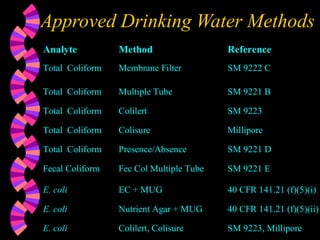
Approved Drinking Water Methods
Analyte Method Reference
Total Coliform Membrane Filter SM 9222 C
Total Coliform Multiple Tube SM 9221 B
Total Coliform Colilert SM 9223
Total Coliform Colisure Millipore
Total Coliform Presence/Absence SM 9221 D
Fecal Coliform Fec Col Multiple Tube SM 9221 E
E. coli EC + MUG 40 CFR 141.21 (f)(5)(i)
E. coli Nutrient Agar + MUG 40 CFR 141.21 (f)(5)(ii)
E. coli Colilert, Colisure SM 9223, Millipore
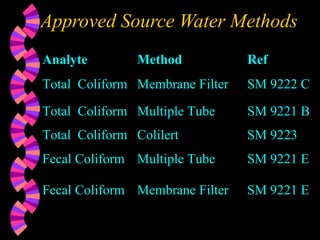
Approved Source Water Methods
Analyte Method Ref
Total Coliform Membrane Filter SM 9222 C
Total Coliform Multiple Tube SM 9221 B
Total Coliform Colilert SM 9223
Fecal Coliform Multiple Tube SM 9221 E
Fecal Coliform Membrane Filter SM 9221 E
Approved Drinking Water
Methods [40 CFR 141.21 (f)]
 Membrane Filter Method - total coliforms, fecal
coliforms, E. coli
 Multiple Tube Fermentation Method- total
coliforms, fecal coliforms, E. coli
Approved Drinking Water
Methods [40 CFR 141.21 (f)]
 Presence/Absence Method -total coliforms,
fecal coliforms, E. coli
 Colilert Method - total coliforms, E. coli
 Colisure Method - total coliforms, E. coli
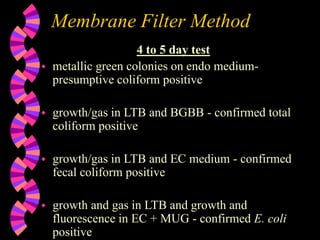
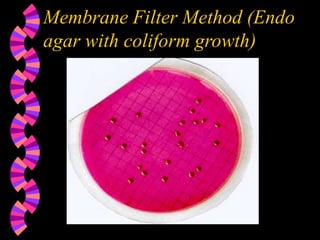
Membrane Filter Method
4 to 5 day test
 metallic green colonies on endo medium-
presumptive coliform positive
 growth/gas in LTB and BGBB - confirmed total
coliform positive
 growth/gas in LTB and EC medium - confirmed
fecal coliform positive
 growth and gas in LTB and growth and
fluorescence in EC + MUG - confirmed E. coli
positive
Membrane Filter Method (Endo
agar with coliform growth)
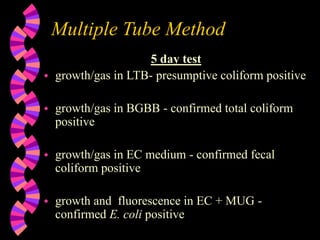
Multiple Tube Method
5 day test
 growth/gas in LTB- presumptive coliform positive
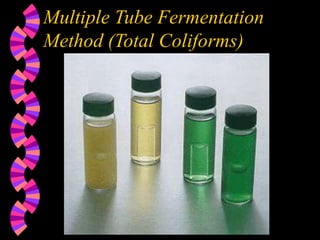
 growth/gas in BGBB - confirmed total coliform
positive
 growth/gas in EC medium - confirmed fecal
coliform positive
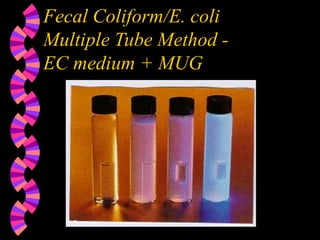
 growth and fluorescence in EC + MUG -
confirmed E. coli positive
Multiple Tube Fermentation
Method (Total Coliforms)
Fecal Coliform/E. coli
Multiple Tube Method -
EC medium + MUG
Presence Absence Method
5 day test
 growth/acid in PA broth - presumptive coliform
positive
 growth/gas in BGBB - confirmed total coliform
positive
 growth/gas in EC medium - confirmed fecal
coliform positive
 growth and fluorescence in EC + MUG -
confirmed E. coli positive
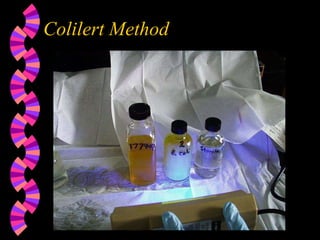
Colilert and Colisure Methods
1 day test
 color change in culture media - confirmed
total coliform positive
 production of fluorescence under 366 nm
UV light - confirmed E. coli positive
Colilert Method
Useful References
 Standard Methods for the Examination of
Water and Wastewater, 18th Edition, 1992,
American Public Health Association, 1015
Fifteenth Street NW, Washington, D.C., 20005
 Total Coliform Rule (40 CFR 141.21)
 Surface Water Treatment Rule (40 CFR
141.74)
Photo References
 Microorganism photos scanned from
Microbiology Concepts and Applications,
Pelczar et al., McGraw-Hill, Inc., 1993
 Media vials and plate photos scanned from
Products and Analysis 1999, Hach
Company, P.O. Box 608, Loveland
Colorado, 80539-0608

microooooooooooooooooooooooorg_3 (2).ppt

  • 1.
    Microorganisms (The Coliform GroupBacteria) S. D. Spence
  • 2.
    Microorganisms  single-celled  generallymicroscopic  include bacteria, protozoa, algae, fungi, viruses  may or may not be disease causing
  • 3.
    Implications of Microbial Contaminationof Water  potential for transmission of disease causing microorganisms (pathogens) via water contact - oral fecal route  contact includes ingestion, primary contact, and secondary contact
  • 4.
    Water Borne Diseases/Pathogens Bacteria • Vibrio cholera - cholera • Yersinia enterocolitica - gastroenteritis • Escherichia coli - gastroenteritis • Shigella sp.- gastroenteritis • Listeria monocytogenes - flu-like symptoms • Salmonella sp. - gastroenteritis, typhoid • Campylobacter jejuni - gastroenteritis (animals sources)
  • 5.
  • 6.
  • 7.
  • 8.
  • 9.
  • 10.
    Water Borne Diseases/Pathogens Viruses • Polio Virus - paralytic poliomyelitis • Rotaviruses - gastroenteritis • Norwalk Viruses - gastroenteritis • Hepatitis Type A and E - liver inflammation
  • 11.
  • 12.
  • 13.
  • 14.
    Water Borne Diseases/Pathogens Protozoa • Entamoeba histolytica - amoebic dysentery • Giardia lamblia - intestinal disease • Cryptosporidium - intestinal disease
  • 15.
  • 16.
    Difficulties With RoutineTesting Of Pathogens in Water  present in low numbers  limited survival time  numerous pathogens to analyze  time and cost prohibitive
  • 17.
    Testing of IndicatorOrganisms  need an indicator of potential pathogen contamination of water which is easy, reliable, inexpensive, quick, etc.
  • 18.
    Requirements of Indicator Organisms present when pathogens present in water  absent in uncontaminated water  present in higher numbers than pathogens in contaminated water  better survival in water than pathogens  easy to analyze
  • 19.
    Coliform Bacteria -Indicators of Fecal Contamination  bacteria in the family Enterobacteriaceae  generally include the genera Enterobacter, Klebsiella, Citrobacter, and Escherichia  present in the intestinal tract of numerous organisms  gram negative, non-spore forming rods  ferment lactose with acid and gas production in 48 hours at 35 °C
  • 20.
    Total Coliform Bacteria inhabit the intestinal tract of animals  sources: fecal material, soil, water, grain  some capable of reproduction in the environment  non-fecal examples include: Klebsiella sp., Citrobacter sp., Enterobacter sp.
  • 21.
    Fecal Coliform Bacteria subset of the total coliform group  separated from non-fecal coliforms by growth at 44.5 °C  sources: fecal material  capable of limited survival and growth in the environment  primary example is Escherichia coli (E. coli)
  • 22.
    Can Stagnant WaterResult in Positive Coliform Results?  presence of coliform bacteria indicates influence from a source - human activity, fecal material, soil, water, grain  stagnation of water - environment for reproduction of bacteria allowing great enough numbers to be detected
  • 23.
  • 24.
    Coliform Sample Preservation sodium thiosulfate added to chlorinated samples  no additives for nonchlorinated samples  recommended-drinking water samples iced  required-source water samples iced
  • 25.
    Coliform Sample HoldingTimes and Analyses Methods
  • 26.
    Source Water vs.Drinking Water  Drinking water and source water have different requirements for coliform analysis methods and holding times
  • 27.
    Coliform Sample HoldingTimes  drinking water - 30 hours [40 CFR 141.21(f)]  surface/source water - 8 hours [40 CFR 141.74 (a)(1)]
  • 28.
    Effects of HoldingTime on Samples  coliform numbers may decline  coliform numbers may increase  hetertrophic (non-coliform) bacteria may increase and inhibit detection of coliforms in the sample
  • 29.
    Heterotrophic Interference  Non-coliformbacteria which are better than coliforms at surviving in the environment may be present in the sample. If these organisms are given a chance to grow, they may out-compete coliforms during analysis and may limit the analysts ability to detect coliforms. The effect of HI is an underestimation of coliform numbers or a false negative result.
  • 30.
    Holding Times AreCritical  greater chance of heterotrophic interference in untreated source water - hence, shorter allowable holding time
  • 31.
  • 32.
    Choosing a Laboratoryfor Testing  laboratory must be certified by the State or EPA to conduct analyses of compliance drinking water and surface/source water samples [40 CFR 141.28(a), 40 CFR 141.74(a)]
  • 33.
    Certified Laboratory  grantedcertification by State or EPA  meets QA/QC requirements  analyzes blind audit samples  audited every 3 years  documentation of certification  certified for specific methods
  • 34.
    Approved Drinking WaterMethods Analyte Method Reference Total Coliform Membrane Filter SM 9222 C Total Coliform Multiple Tube SM 9221 B Total Coliform Colilert SM 9223 Total Coliform Colisure Millipore Total Coliform Presence/Absence SM 9221 D Fecal Coliform Fec Col Multiple Tube SM 9221 E E. coli EC + MUG 40 CFR 141.21 (f)(5)(i) E. coli Nutrient Agar + MUG 40 CFR 141.21 (f)(5)(ii) E. coli Colilert, Colisure SM 9223, Millipore
  • 35.
    Approved Source WaterMethods Analyte Method Ref Total Coliform Membrane Filter SM 9222 C Total Coliform Multiple Tube SM 9221 B Total Coliform Colilert SM 9223 Fecal Coliform Multiple Tube SM 9221 E Fecal Coliform Membrane Filter SM 9221 E
  • 36.
    Approved Drinking Water Methods[40 CFR 141.21 (f)]  Membrane Filter Method - total coliforms, fecal coliforms, E. coli  Multiple Tube Fermentation Method- total coliforms, fecal coliforms, E. coli
  • 37.
    Approved Drinking Water Methods[40 CFR 141.21 (f)]  Presence/Absence Method -total coliforms, fecal coliforms, E. coli  Colilert Method - total coliforms, E. coli  Colisure Method - total coliforms, E. coli
  • 38.
    Membrane Filter Method 4to 5 day test  metallic green colonies on endo medium- presumptive coliform positive  growth/gas in LTB and BGBB - confirmed total coliform positive  growth/gas in LTB and EC medium - confirmed fecal coliform positive  growth and gas in LTB and growth and fluorescence in EC + MUG - confirmed E. coli positive
  • 39.
    Membrane Filter Method(Endo agar with coliform growth)
  • 40.
    Multiple Tube Method 5day test  growth/gas in LTB- presumptive coliform positive  growth/gas in BGBB - confirmed total coliform positive  growth/gas in EC medium - confirmed fecal coliform positive  growth and fluorescence in EC + MUG - confirmed E. coli positive
  • 41.
  • 42.
    Fecal Coliform/E. coli MultipleTube Method - EC medium + MUG
  • 43.
    Presence Absence Method 5day test  growth/acid in PA broth - presumptive coliform positive  growth/gas in BGBB - confirmed total coliform positive  growth/gas in EC medium - confirmed fecal coliform positive  growth and fluorescence in EC + MUG - confirmed E. coli positive
  • 44.
    Colilert and ColisureMethods 1 day test  color change in culture media - confirmed total coliform positive  production of fluorescence under 366 nm UV light - confirmed E. coli positive
  • 45.
  • 46.
    Useful References  StandardMethods for the Examination of Water and Wastewater, 18th Edition, 1992, American Public Health Association, 1015 Fifteenth Street NW, Washington, D.C., 20005  Total Coliform Rule (40 CFR 141.21)  Surface Water Treatment Rule (40 CFR 141.74)
  • 47.
    Photo References  Microorganismphotos scanned from Microbiology Concepts and Applications, Pelczar et al., McGraw-Hill, Inc., 1993  Media vials and plate photos scanned from Products and Analysis 1999, Hach Company, P.O. Box 608, Loveland Colorado, 80539-0608