V. Microbiology of waterV. Microbiology of water
A. Waterborne microbial pathogensA. Waterborne microbial pathogens
B. Indicator bacteria for drinking waterB. Indicator bacteria for drinking water
C. Other indicators for drinking andC. Other indicators for drinking and
recreational waterrecreational water
A.WA.Waterborne microbial pathogensaterborne microbial pathogens
Microbiology review:Microbiology review:
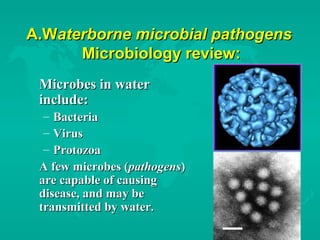
Microbes in waterMicrobes in water
include:include:
– BacteriaBacteria
– VirusVirus
– ProtozoaProtozoa
A few microbes (A few microbes (pathogenspathogens))
are capable of causingare capable of causing
disease, and may bedisease, and may be
transmitted by water.transmitted by water.
Waterborne pathogens:Waterborne pathogens:
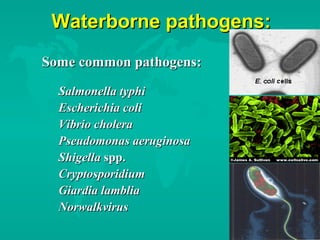
Some common pathogens:Some common pathogens:
Salmonella typhiSalmonella typhi
Escherichia coliEscherichia coli
Vibrio choleraVibrio cholera
Pseudomonas aeruginosaPseudomonas aeruginosa
ShigellaShigella spp.spp.
CryptosporidiumCryptosporidium
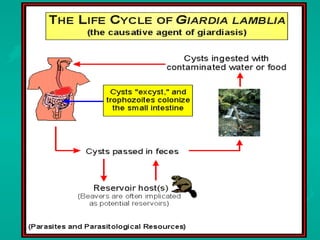
Giardia lambliaGiardia lamblia
NorwalkvirusNorwalkvirus
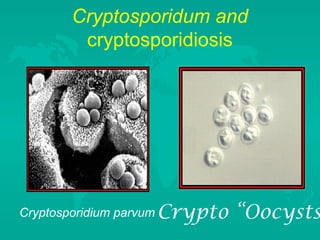
Cryptosporidum and
cryptosporidiosis
Cryptosporidium parvum Crypto “Oocysts
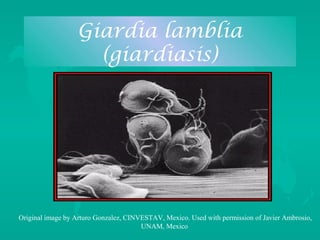
Giardia lamblia
(giardiasis)
Original image by Arturo Gonzalez, CINVESTAV, Mexico. Used with permission of Javier Ambrosio,
UNAM, Mexico
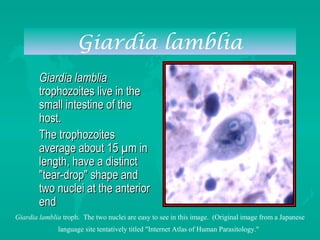
Giardia lamblia
Giardia lambliaGiardia lamblia
trophozoites live in thetrophozoites live in the
small intestine of thesmall intestine of the
host.host.
The trophozoitesThe trophozoites
average about 15 µm inaverage about 15 µm in
length, have a distinctlength, have a distinct
"tear-drop" shape and"tear-drop" shape and
two nuclei at the anteriortwo nuclei at the anterior
endend
Giardia lamblia troph. The two nuclei are easy to see in this image. (Original image from a Japanese
language site tentatively titled "Internet Atlas of Human Parasitology."
B. Indicator bacteria forB. Indicator bacteria for
Drinking Water:Drinking Water:
Indicator microorganismsIndicator microorganisms are used toare used to
indicate an increased risk of pathogenindicate an increased risk of pathogen
contamination due to fecalcontamination due to fecal
contamination.contamination.
Indicator microbes should be:Indicator microbes should be:
– Always present when feces/sewage is presentAlways present when feces/sewage is present
– Always absent when feces/sewage is absentAlways absent when feces/sewage is absent
– Survives longer in water than any of theSurvives longer in water than any of the
pathogenic speciespathogenic species
– Easily isolated and identified.Easily isolated and identified.
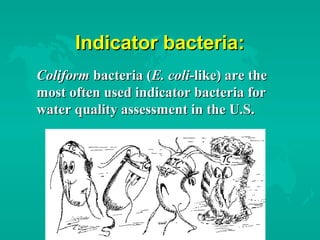
Indicator bacteria:Indicator bacteria:
ColiformColiform bacteria (bacteria (E. coliE. coli-like) are the-like) are the
most often used indicator bacteria formost often used indicator bacteria for
water quality assessment in the U.S.water quality assessment in the U.S.
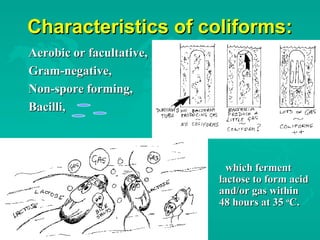
Characteristics of coliforms:Characteristics of coliforms:
Aerobic or facultative,Aerobic or facultative,
Gram-negative,Gram-negative,
Non-spore forming,Non-spore forming,
Bacilli,Bacilli,
which fermentwhich ferment
lactose to form acidlactose to form acid
and/or gas withinand/or gas within
48 hours at 3548 hours at 35 oo
C.C.
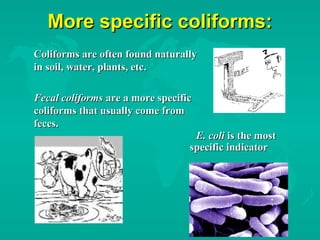
More specific coliforms:More specific coliforms:
Coliforms are often found naturallyColiforms are often found naturally
in soil, water, plants, etc.in soil, water, plants, etc.
Fecal coliformsFecal coliforms are a more specificare a more specific
coliforms that usually come fromcoliforms that usually come from
feces.feces.
E. coliE. coli is the mostis the most
specific indicatorspecific indicator
Guidelines and methods forGuidelines and methods for
enumerating coliforms:enumerating coliforms:
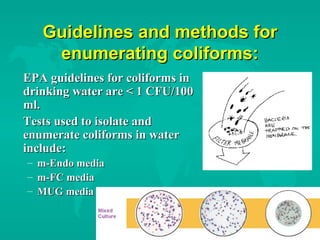
EPA guidelines for coliforms inEPA guidelines for coliforms in
drinking water are < 1 CFU/100drinking water are < 1 CFU/100
ml.ml.
Tests used to isolate andTests used to isolate and
enumerate coliforms in waterenumerate coliforms in water
include:include:
– m-Endo mediam-Endo media
– m-FC mediam-FC media
– MUG mediaMUG media
C. Other indicators for drinking andC. Other indicators for drinking and
recreational waterrecreational water
Limitation ofLimitation of Total coliformTotal coliform asas
drinking water microbialdrinking water microbial
indicatorindicator
– Ubiquitous.Ubiquitous.
– Less resistant to traditionalLess resistant to traditional
disinfection.disinfection.
– Proliferate in the biofilms ofProliferate in the biofilms of
water distribution systemswater distribution systems
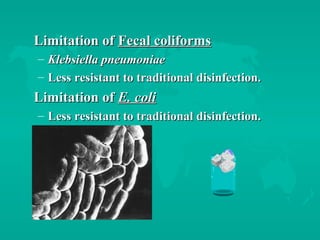
Limitation ofLimitation of Fecal coliformsFecal coliforms
– Klebsiella pneumoniaeKlebsiella pneumoniae
– Less resistant to traditional disinfection.Less resistant to traditional disinfection.
Limitation ofLimitation of E. coliE. coli
– Less resistant to traditional disinfection.Less resistant to traditional disinfection.
Microbial Indicators forMicrobial Indicators for
Recreational WaterRecreational Water
Total coliform?Total coliform?
Fecal coliform?Fecal coliform?
– Average 200 MPN/100 mlAverage 200 MPN/100 ml
E. Coli (fresh water)?E. Coli (fresh water)?
– Average 126 MPN/100 ml.Average 126 MPN/100 ml.
Enterococci (saltEnterococci (salt
water)water)
– Average 35 MPN/100 ml.Average 35 MPN/100 ml.

Water microbiology

  • 1.
    V. Microbiology ofwaterV. Microbiology of water A. Waterborne microbial pathogensA. Waterborne microbial pathogens B. Indicator bacteria for drinking waterB. Indicator bacteria for drinking water C. Other indicators for drinking andC. Other indicators for drinking and recreational waterrecreational water
  • 2.
    A.WA.Waterborne microbial pathogensaterbornemicrobial pathogens Microbiology review:Microbiology review: Microbes in waterMicrobes in water include:include: – BacteriaBacteria – VirusVirus – ProtozoaProtozoa A few microbes (A few microbes (pathogenspathogens)) are capable of causingare capable of causing disease, and may bedisease, and may be transmitted by water.transmitted by water.
  • 3.
    Waterborne pathogens:Waterborne pathogens: Somecommon pathogens:Some common pathogens: Salmonella typhiSalmonella typhi Escherichia coliEscherichia coli Vibrio choleraVibrio cholera Pseudomonas aeruginosaPseudomonas aeruginosa ShigellaShigella spp.spp. CryptosporidiumCryptosporidium Giardia lambliaGiardia lamblia NorwalkvirusNorwalkvirus
  • 4.
  • 5.
    Giardia lamblia (giardiasis) Original imageby Arturo Gonzalez, CINVESTAV, Mexico. Used with permission of Javier Ambrosio, UNAM, Mexico
  • 6.
    Giardia lamblia Giardia lambliaGiardialamblia trophozoites live in thetrophozoites live in the small intestine of thesmall intestine of the host.host. The trophozoitesThe trophozoites average about 15 µm inaverage about 15 µm in length, have a distinctlength, have a distinct "tear-drop" shape and"tear-drop" shape and two nuclei at the anteriortwo nuclei at the anterior endend Giardia lamblia troph. The two nuclei are easy to see in this image. (Original image from a Japanese language site tentatively titled "Internet Atlas of Human Parasitology."
  • 8.
    B. Indicator bacteriaforB. Indicator bacteria for Drinking Water:Drinking Water: Indicator microorganismsIndicator microorganisms are used toare used to indicate an increased risk of pathogenindicate an increased risk of pathogen contamination due to fecalcontamination due to fecal contamination.contamination. Indicator microbes should be:Indicator microbes should be: – Always present when feces/sewage is presentAlways present when feces/sewage is present – Always absent when feces/sewage is absentAlways absent when feces/sewage is absent – Survives longer in water than any of theSurvives longer in water than any of the pathogenic speciespathogenic species – Easily isolated and identified.Easily isolated and identified.
  • 9.
    Indicator bacteria:Indicator bacteria: ColiformColiformbacteria (bacteria (E. coliE. coli-like) are the-like) are the most often used indicator bacteria formost often used indicator bacteria for water quality assessment in the U.S.water quality assessment in the U.S.
  • 10.
    Characteristics of coliforms:Characteristicsof coliforms: Aerobic or facultative,Aerobic or facultative, Gram-negative,Gram-negative, Non-spore forming,Non-spore forming, Bacilli,Bacilli, which fermentwhich ferment lactose to form acidlactose to form acid and/or gas withinand/or gas within 48 hours at 3548 hours at 35 oo C.C.
  • 11.
    More specific coliforms:Morespecific coliforms: Coliforms are often found naturallyColiforms are often found naturally in soil, water, plants, etc.in soil, water, plants, etc. Fecal coliformsFecal coliforms are a more specificare a more specific coliforms that usually come fromcoliforms that usually come from feces.feces. E. coliE. coli is the mostis the most specific indicatorspecific indicator
  • 12.
    Guidelines and methodsforGuidelines and methods for enumerating coliforms:enumerating coliforms: EPA guidelines for coliforms inEPA guidelines for coliforms in drinking water are < 1 CFU/100drinking water are < 1 CFU/100 ml.ml. Tests used to isolate andTests used to isolate and enumerate coliforms in waterenumerate coliforms in water include:include: – m-Endo mediam-Endo media – m-FC mediam-FC media – MUG mediaMUG media
  • 13.
    C. Other indicatorsfor drinking andC. Other indicators for drinking and recreational waterrecreational water Limitation ofLimitation of Total coliformTotal coliform asas drinking water microbialdrinking water microbial indicatorindicator – Ubiquitous.Ubiquitous. – Less resistant to traditionalLess resistant to traditional disinfection.disinfection. – Proliferate in the biofilms ofProliferate in the biofilms of water distribution systemswater distribution systems
  • 14.
    Limitation ofLimitation ofFecal coliformsFecal coliforms – Klebsiella pneumoniaeKlebsiella pneumoniae – Less resistant to traditional disinfection.Less resistant to traditional disinfection. Limitation ofLimitation of E. coliE. coli – Less resistant to traditional disinfection.Less resistant to traditional disinfection.
  • 15.
    Microbial Indicators forMicrobialIndicators for Recreational WaterRecreational Water Total coliform?Total coliform? Fecal coliform?Fecal coliform? – Average 200 MPN/100 mlAverage 200 MPN/100 ml E. Coli (fresh water)?E. Coli (fresh water)? – Average 126 MPN/100 ml.Average 126 MPN/100 ml. Enterococci (saltEnterococci (salt water)water) – Average 35 MPN/100 ml.Average 35 MPN/100 ml.