Margaret McKay Theresa Duffy 
An Introduction to iPads for Learning 
Jisc RSC Scotland
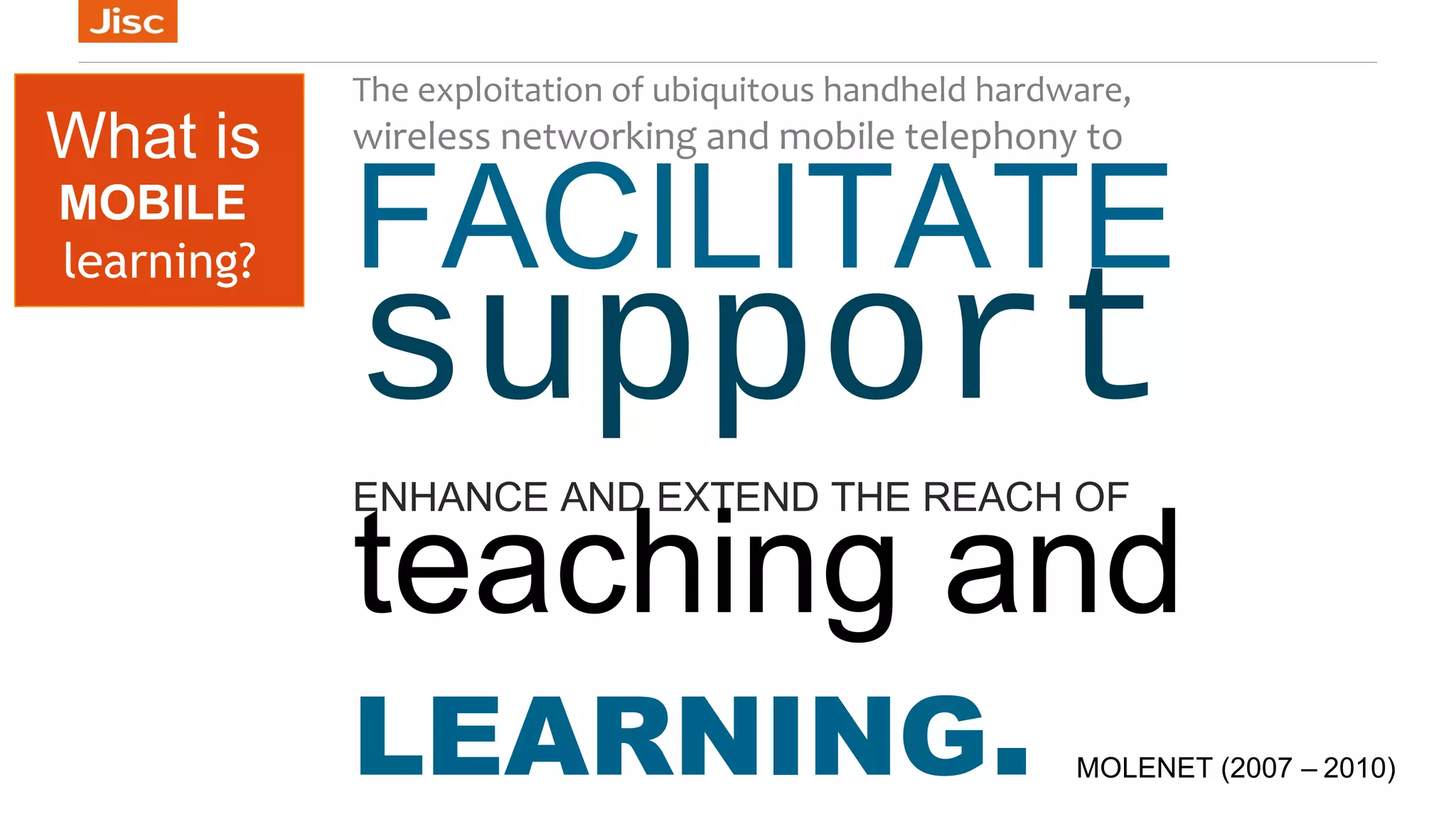
What is 
MOBILE 
learning? 
The exploitation of ubiquitous handheld hardware, 
wireless networking and mobile telephony to FACILITATE 
support 
ENHANCE AND EXTEND THE REACH OF teaching and 
LEARNING. MOLENET (2007 – 2010)
Mobile Learning 3 
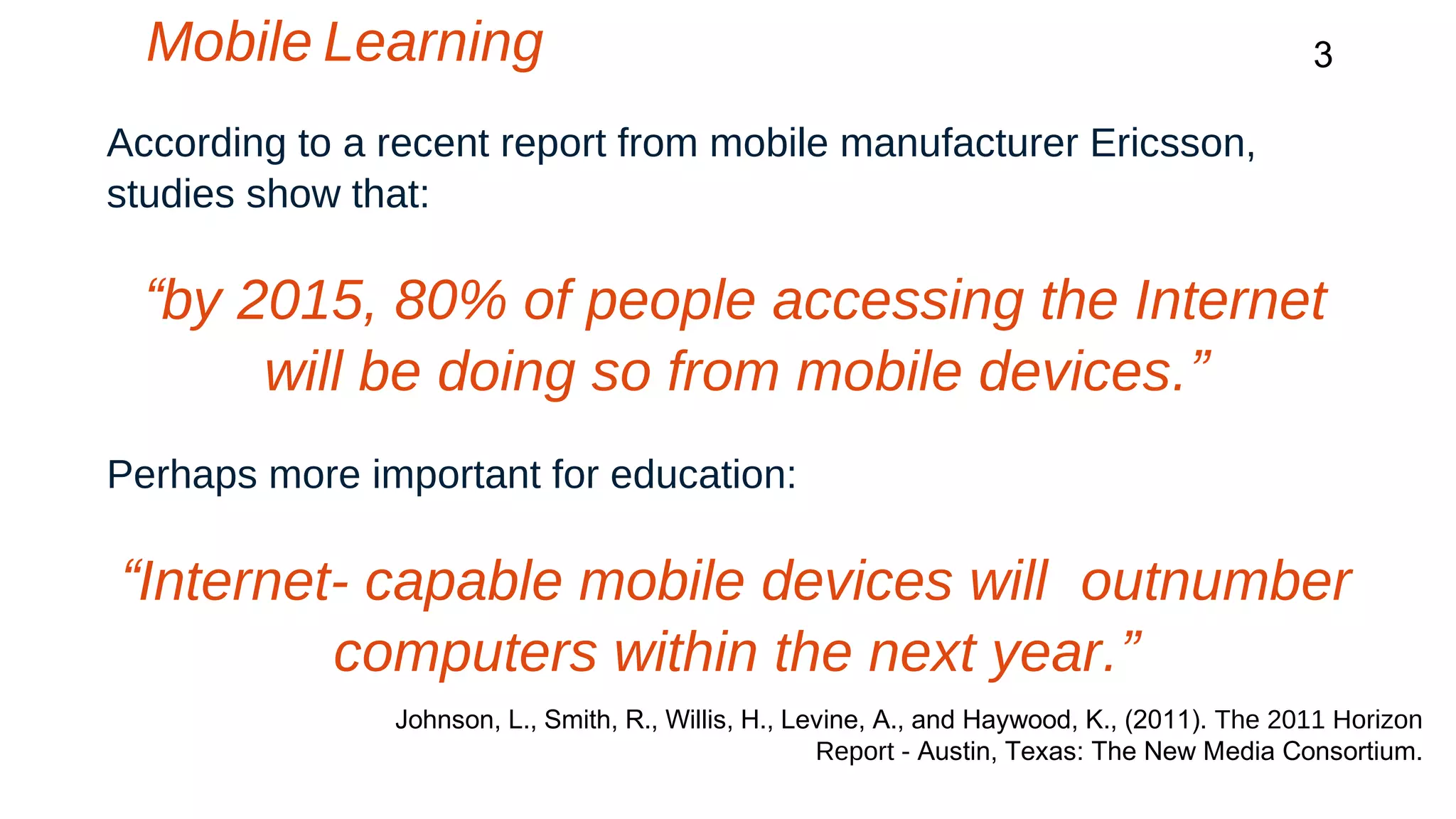
According to a recent report from mobile manufacturer Ericsson, 
studies show that: 
“by 2015, 80% of people accessing the Internet 
will be doing so from mobile devices.” 
Perhaps more important for education: 
“Internet- capable mobile devices will outnumber 
computers within the next year.” 
Johnson, L., Smith, R., Willis, H., Levine, A., and Haywood, K., (2011). The 2011 Horizon 
Report - Austin, Texas: The New Media Consortium.
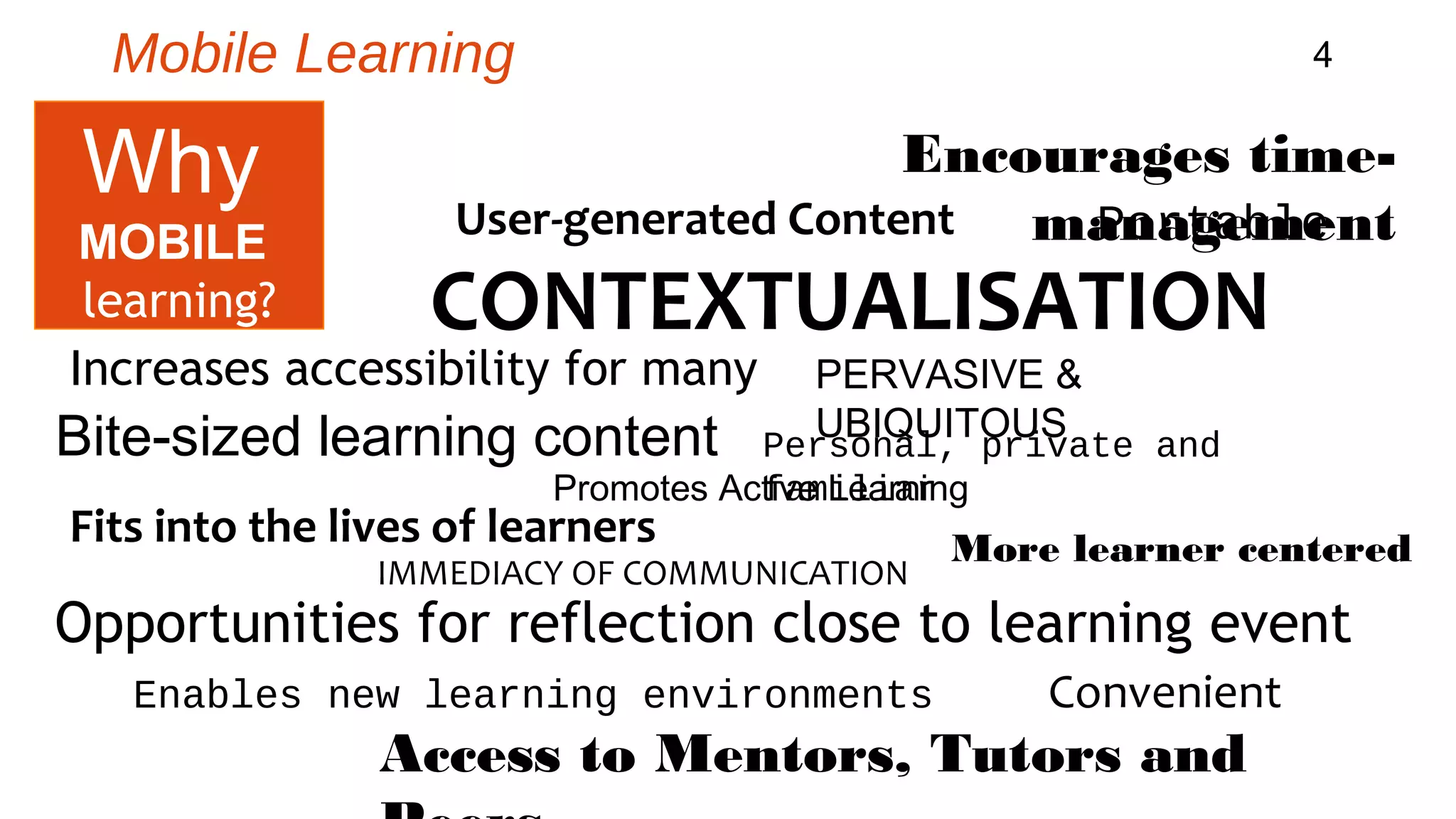
Mobile Learning 4 
Encourages time-management 
User-generated Content 
Portable 
CONTEXTUALISATION 
Increases accessibility for many 
Bite-sized learning content 
Promotes Actfivaem Lielairanring 
Fits into the lives of learners 
PERVASIVE & 
UBIQUITOUS Personal, private and 
IMMEDIACY OF COMMUNICATION 
More learner centered 
Opportunities for reflection close to learning event 
Enables new learning environments 
Access to Mentors, Tutors and 
Peers 
Why 
MOBILE 
learning? 
Convenient
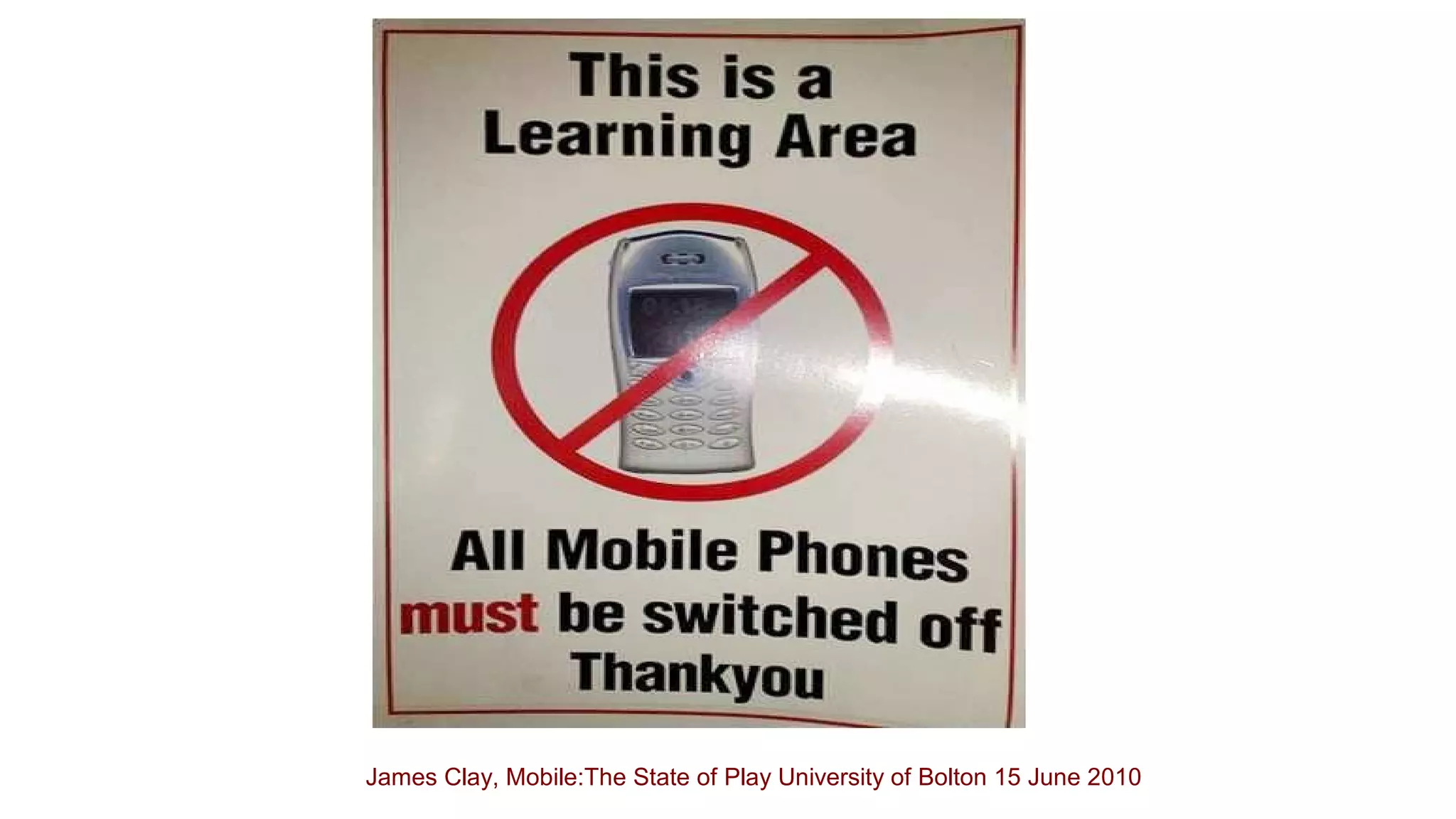
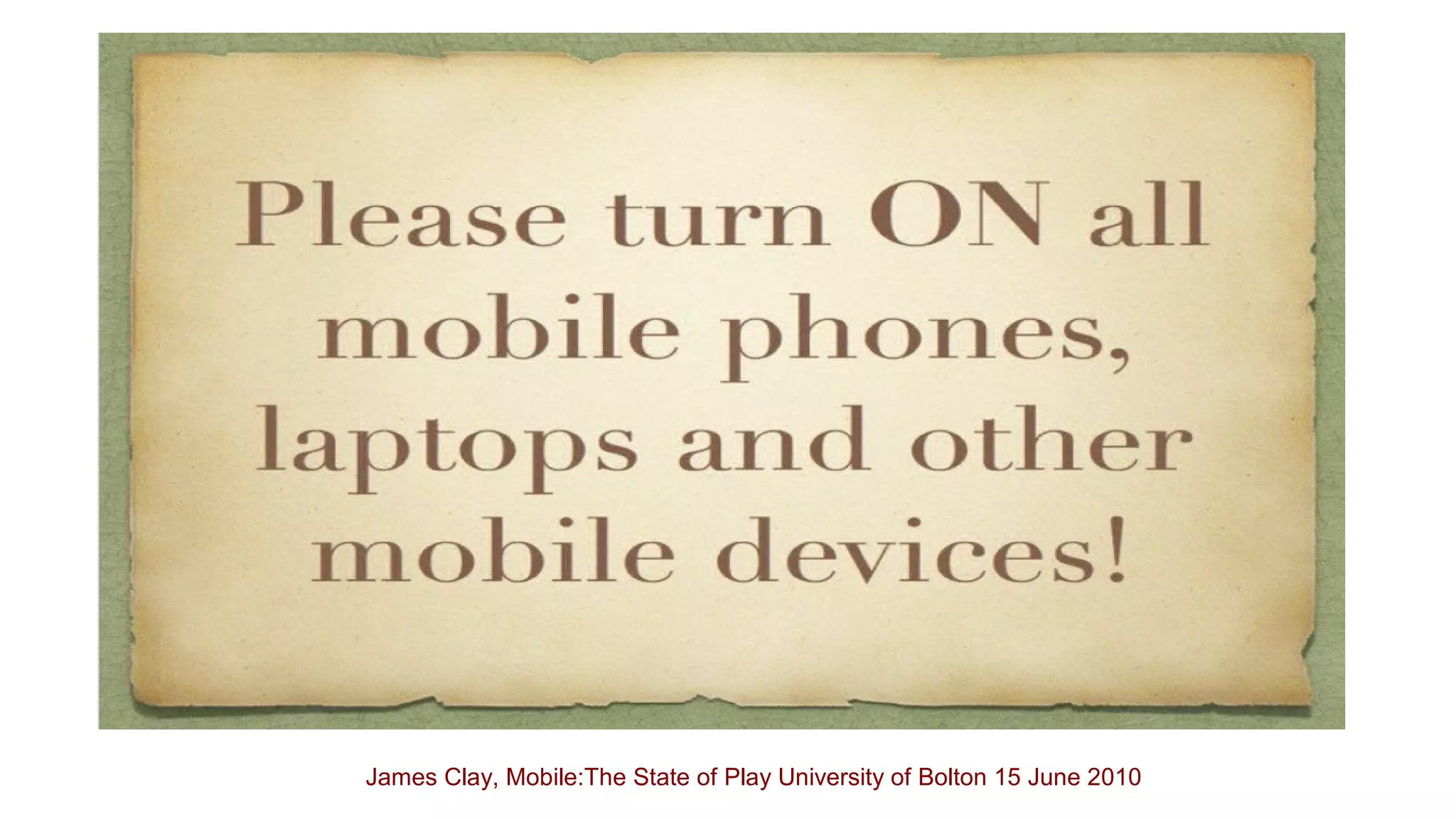
James Clay, Mobile:The State of Play University of Bolton 15 June 2010
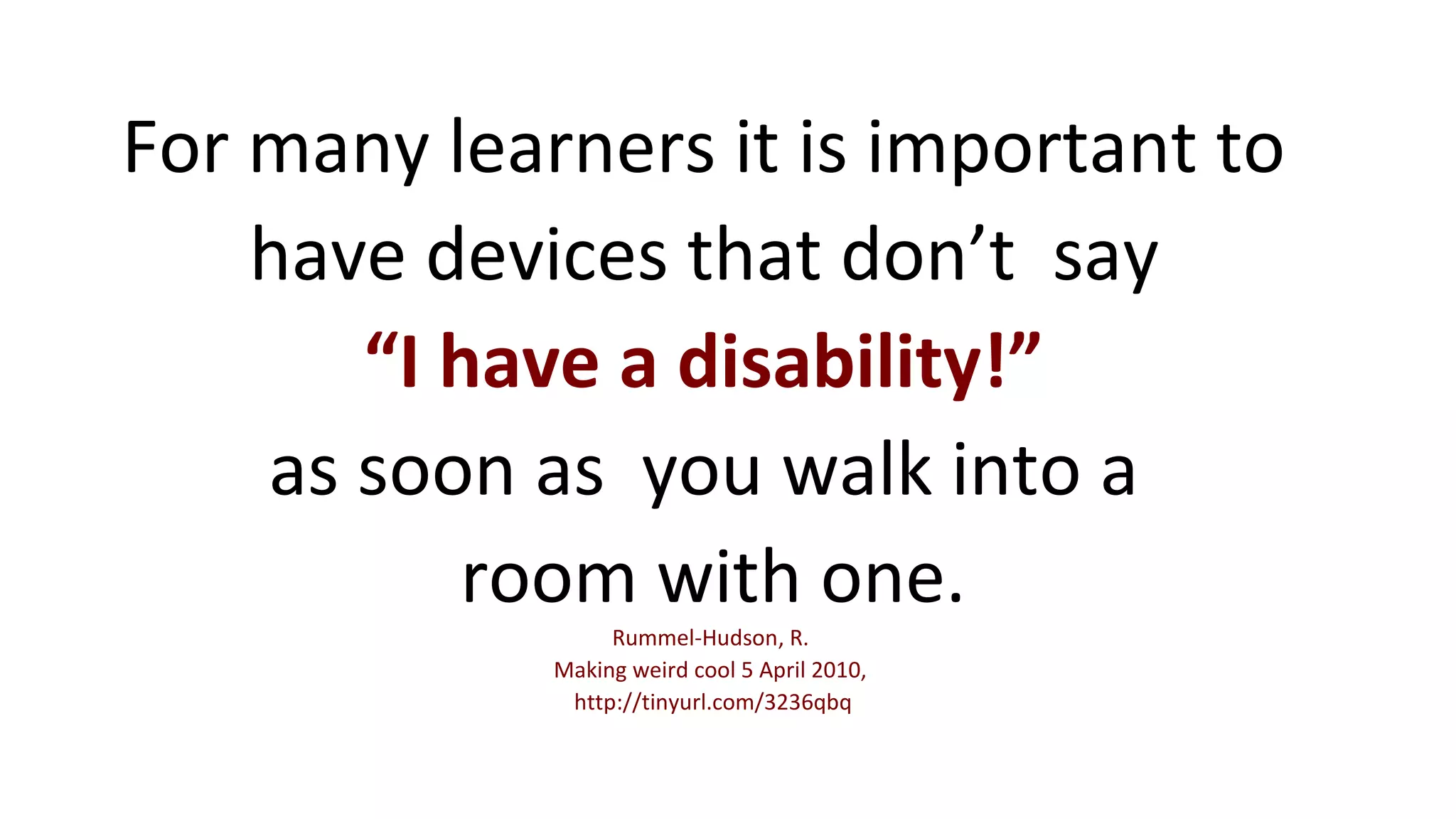
For many learners it is important to 
have devices that don’t say 
“I have a disability!” 
as soon as you walk into a 
room with one. 
Rummel-Hudson, R. 
Making weird cool 5 April 2010, 
http://tinyurl.com/3236qbq
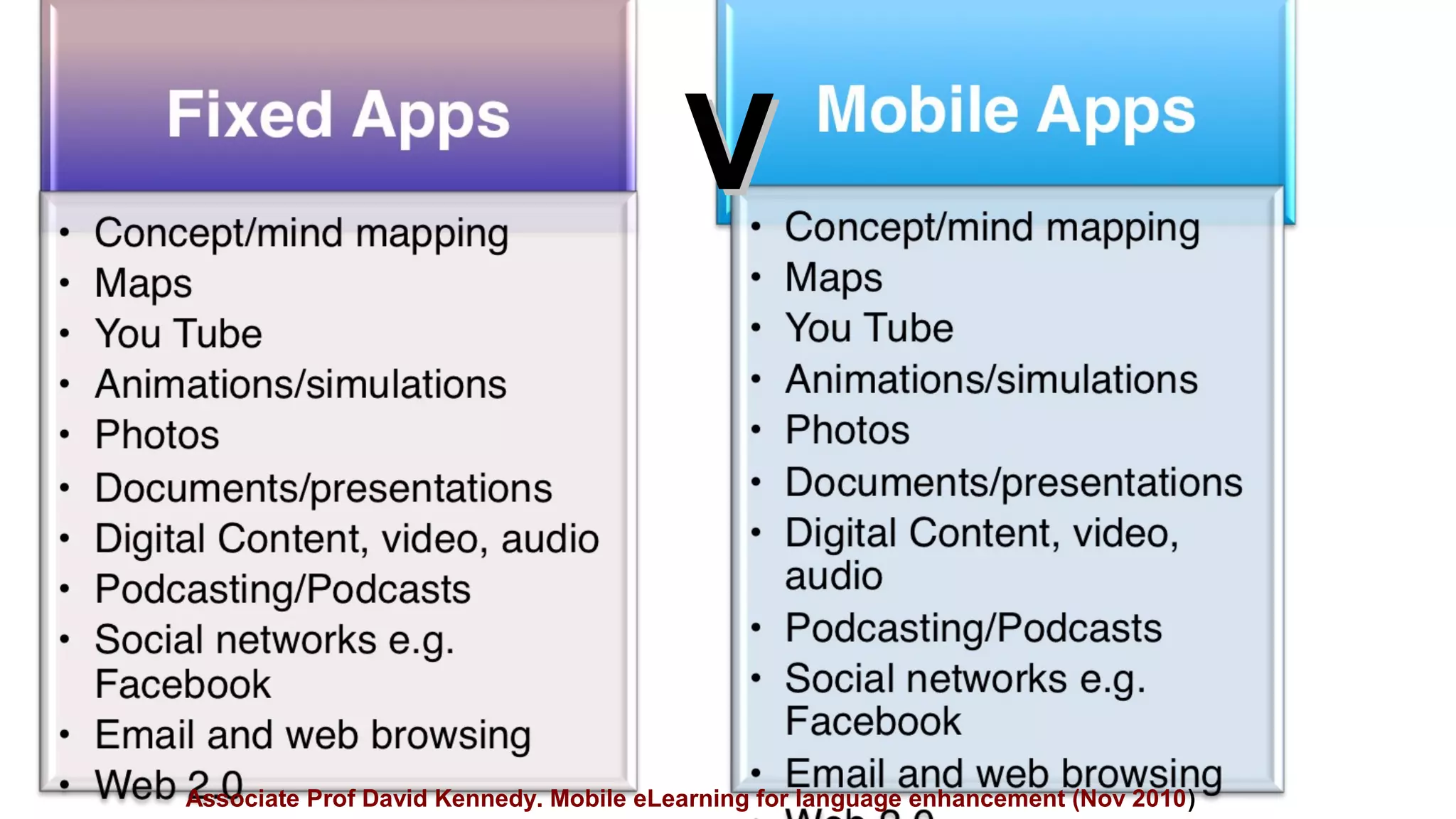
VV 
Associate Prof David Kennedy. Mobile eLearning for language enhancement (Nov 2010)
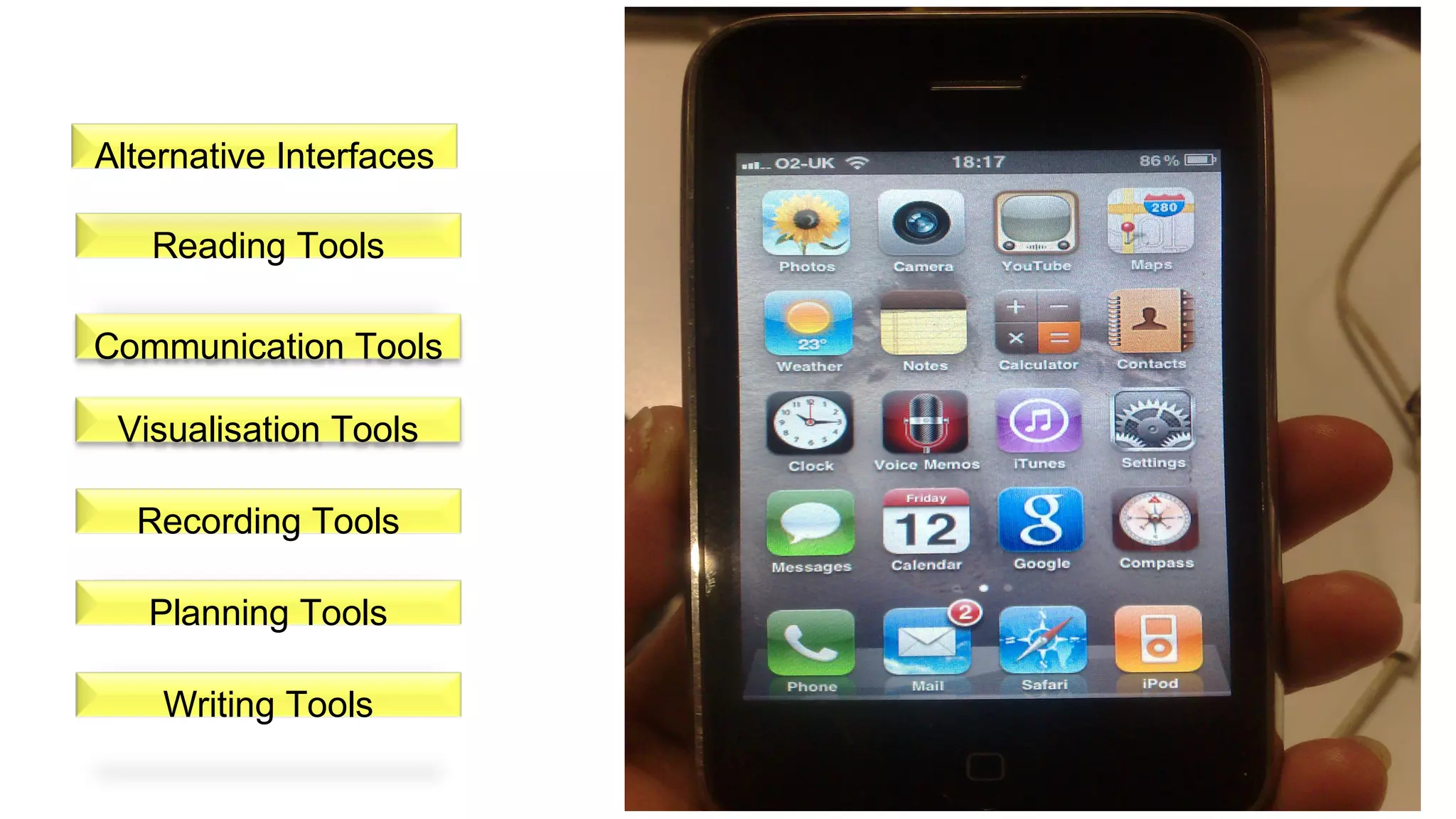
Alternative Interfaces 
Reading Tools 
Communication Tools 
Visualisation Tools 
Recording Tools 
Planning Tools 
Writing Tools
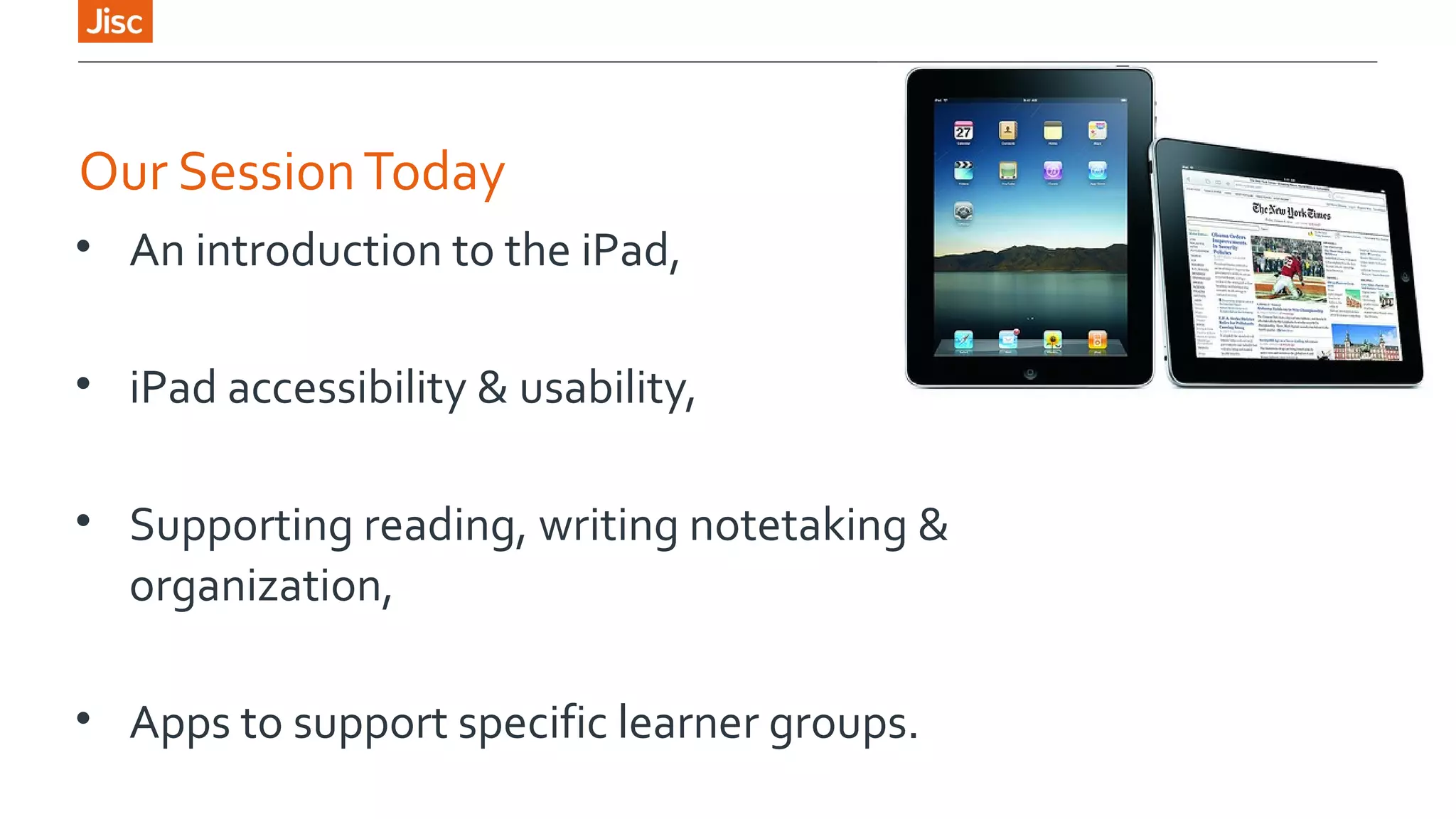
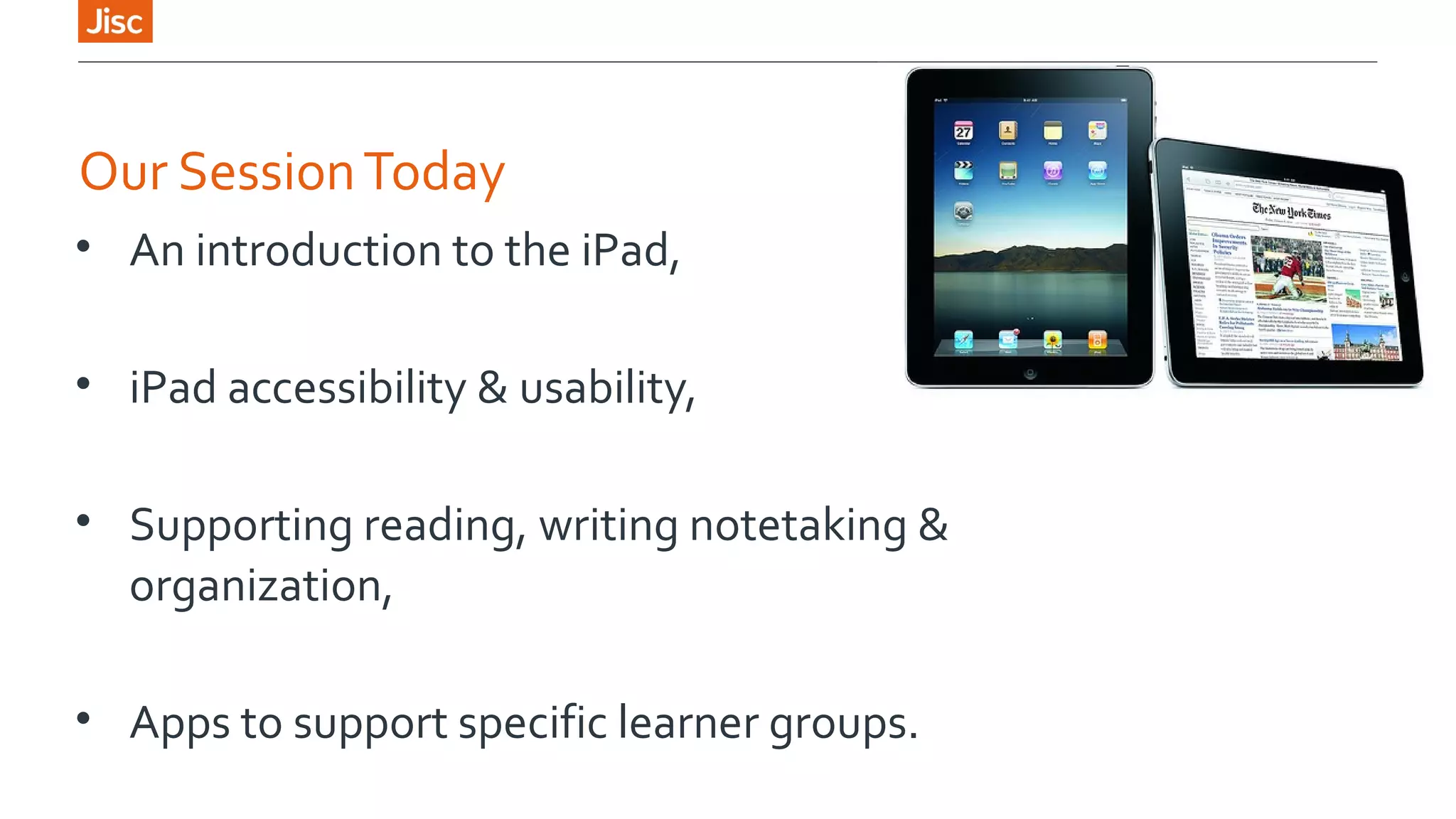
Our Session Today 
• An introduction to the iPad, 
• iPad accessibility & usability, 
• Supporting reading, writing notetaking & 
organization, 
• Apps to support specific learner groups.
iPad Orientation
iPad Orientation 
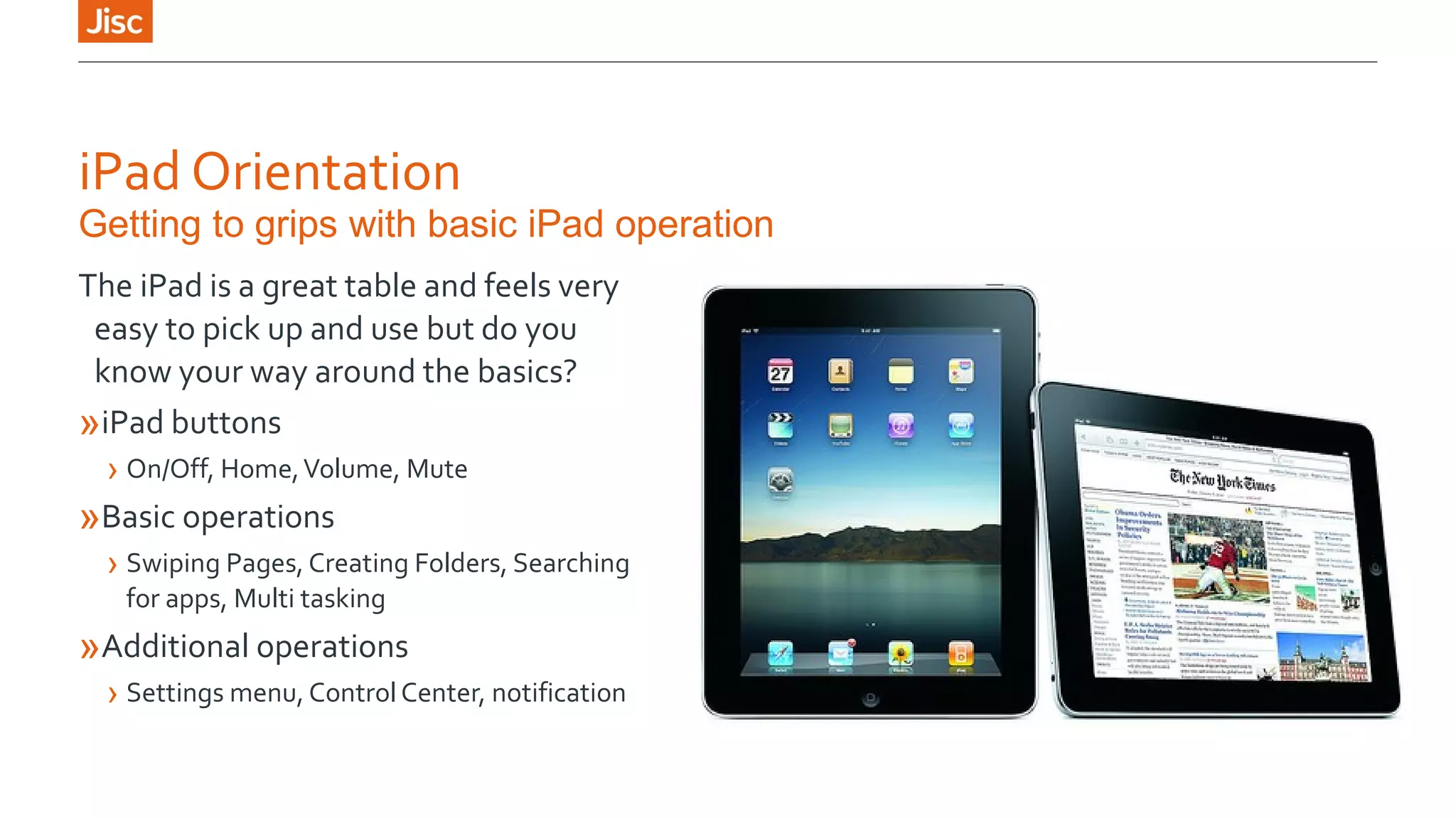
Getting to grips with basic iPad operation 
The iPad is a great table and feels very 
easy to pick up and use but do you 
know your way around the basics? 
»iPad buttons 
› On/Off, Home, Volume, Mute 
»Basic operations 
› Swiping Pages, Creating Folders, Searching 
for apps, Multi tasking 
»Additional operations 
› Settings menu, Control Center, notification
iPad Accessibility & Usability Features
iPad Accessibility & Usability Features 
Getting to grips with basic iPad operation 
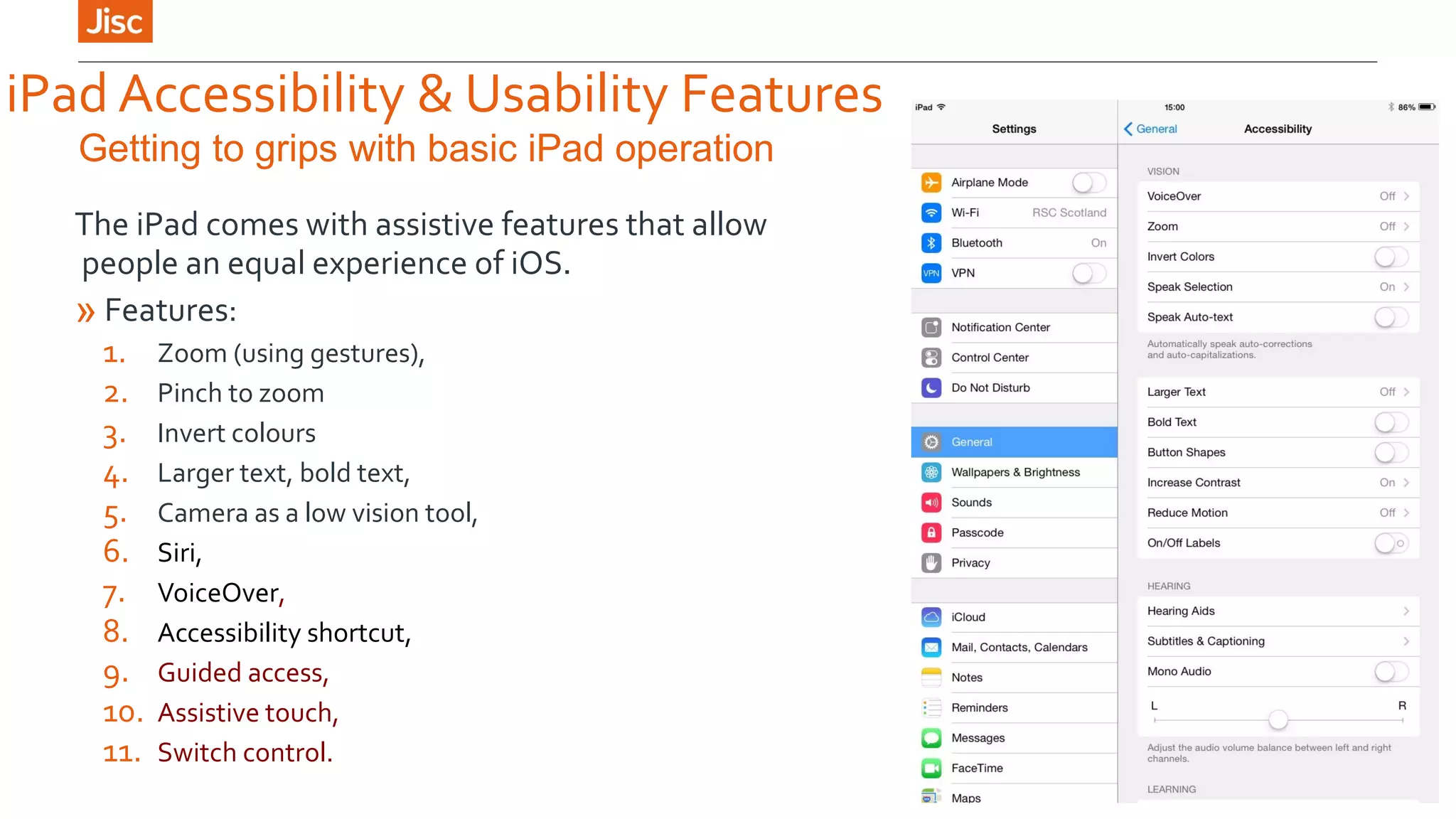
The iPad comes with assistive features that allow 
people an equal experience of iOS. 
» Features: 
1. Zoom (using gestures), 
2. Pinch to zoom 
3. Invert colours 
4. Larger text, bold text, 
5. Camera as a low vision tool, 
6. Siri, 
7. VoiceOver, 
8. Accessibility shortcut, 
9. Guided access, 
10. Assistive touch, 
11. Switch control.
Activity 
Follow the instructions to access features 
» Audio Note 
» Paperport notes - Case study 
» Educreations 
» Skitch
Mobile Learning 16 
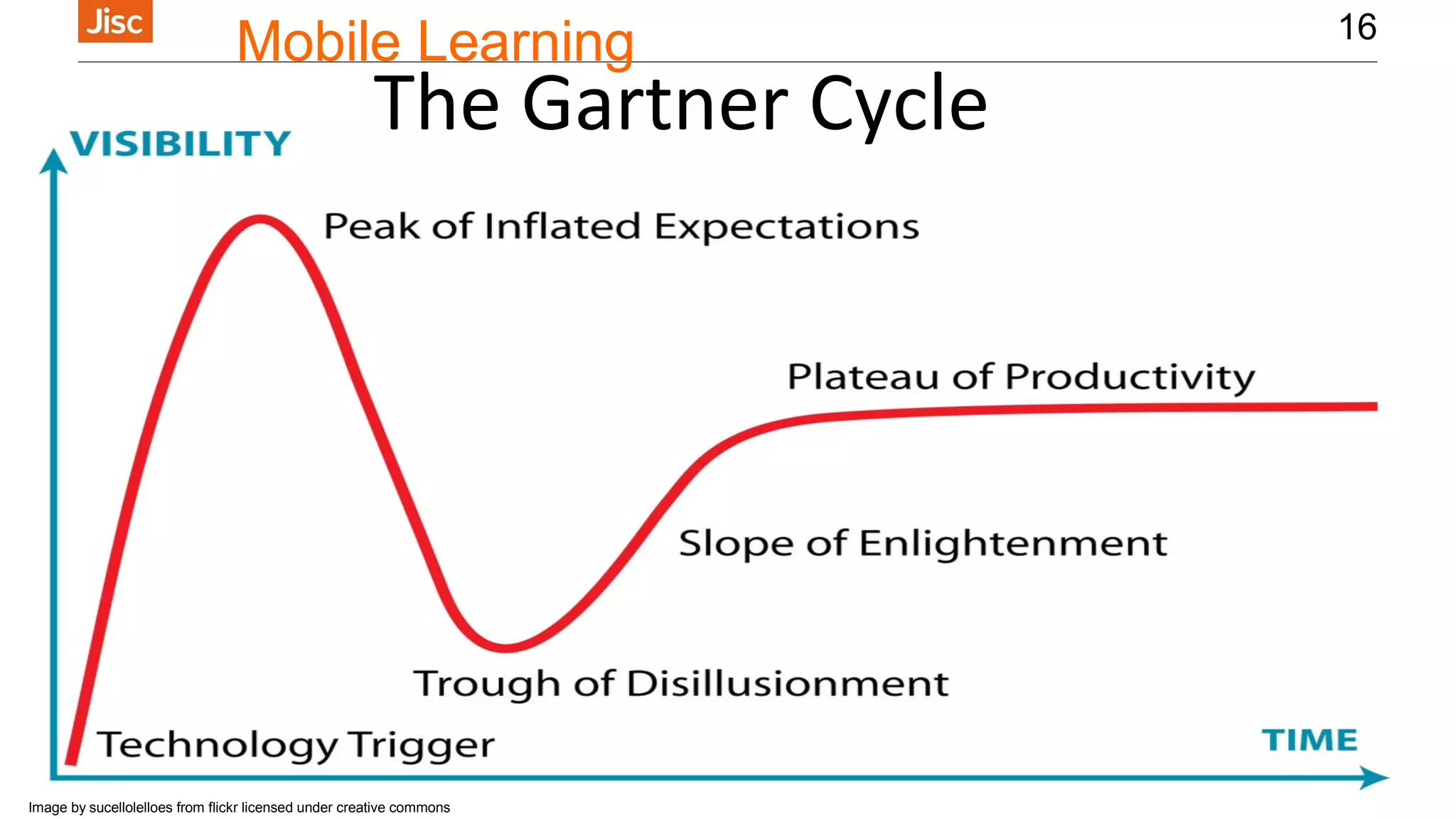
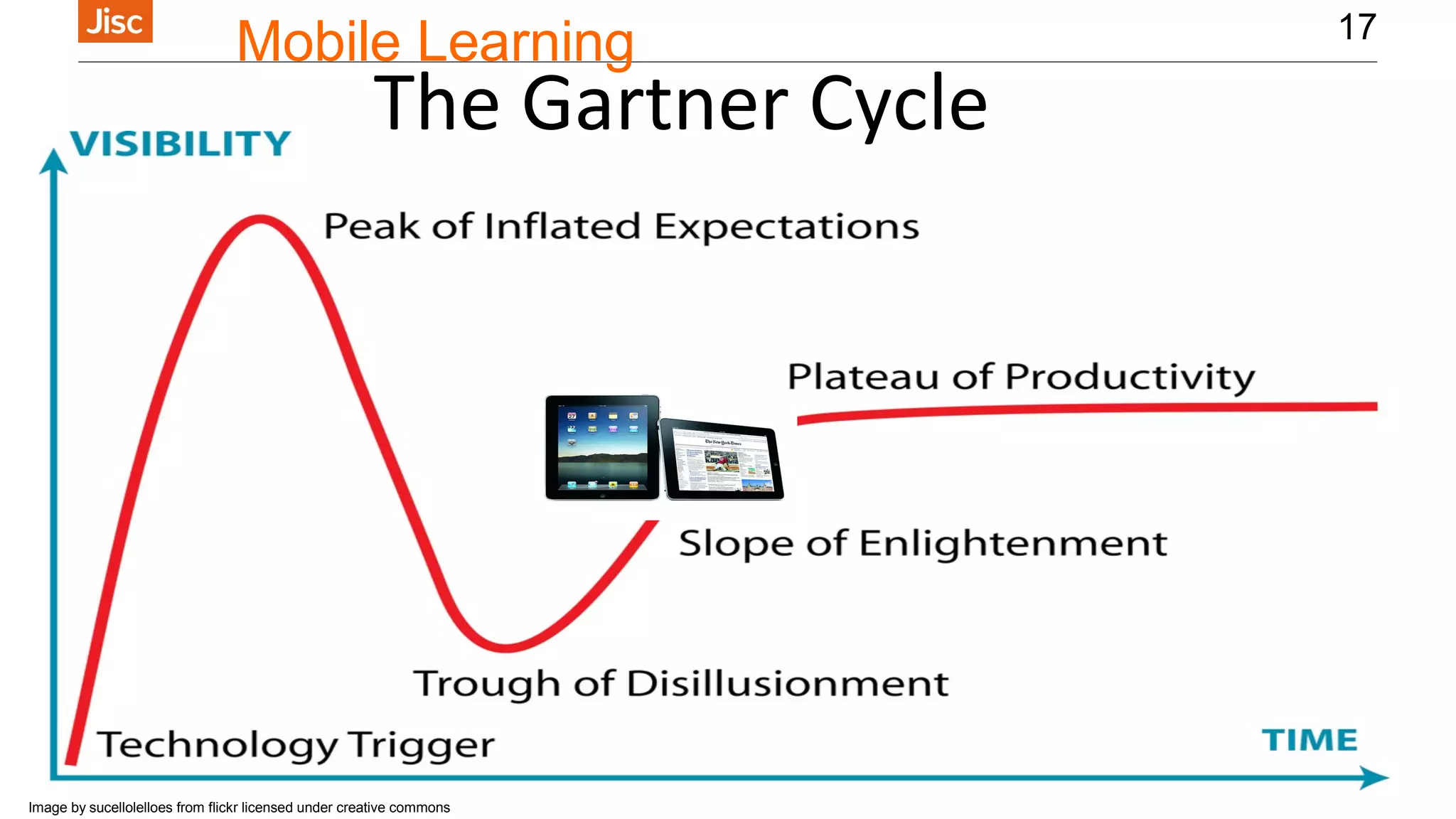
The Gartner Cycle 
Image by sucellolelloes from flickr licensed under creative commons
Mobile Learning 17 
The Gartner Cycle 
Image by sucellolelloes from flickr licensed under creative commons
Resources to support reading, writing, notetaking and 
organisational skills
Apps that support successful learners 
Planning and organisation 
These apps can helps individuals to plan and organise their studies. They can be 
invaluable for students with a wide range of support needs or learning styles. 
»Calendar (built in) 
»Reminders (built in) 
»Notification Centre (built in) 
»SQA My Study Plan 
»Mind mapping 
»Photomind 
»VoCal XL
Resources that support successful learners 
Reading & writing 
»Speak autotext, speak selection, define & language support 
»Dictation 
»iBooks 
»Safari website readability feature 
»IntoWords
Resources that support successful learners 
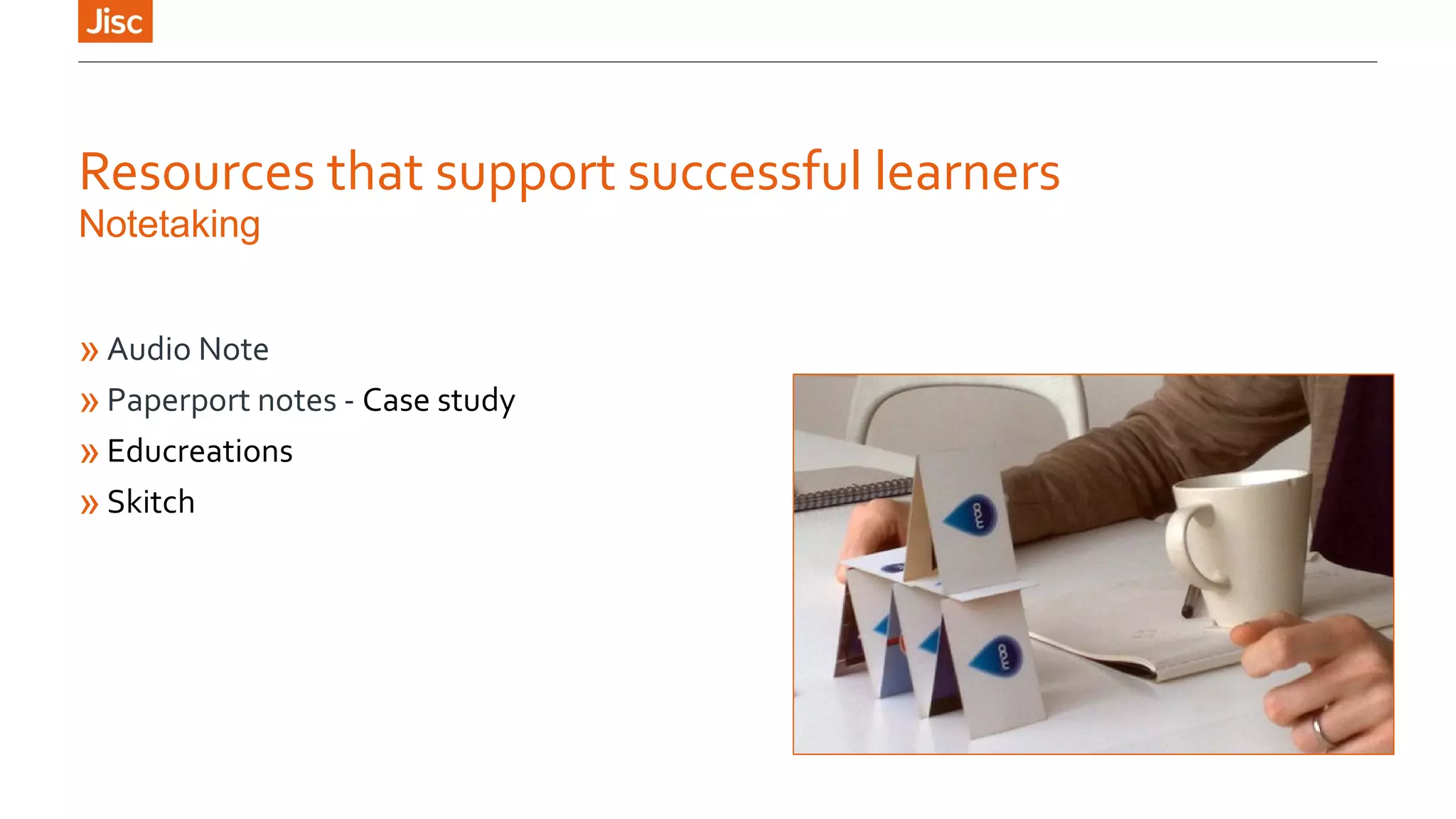
Notetaking 
»Audio Note 
»Paperport notes - Case study 
»Educreations 
»Skitch
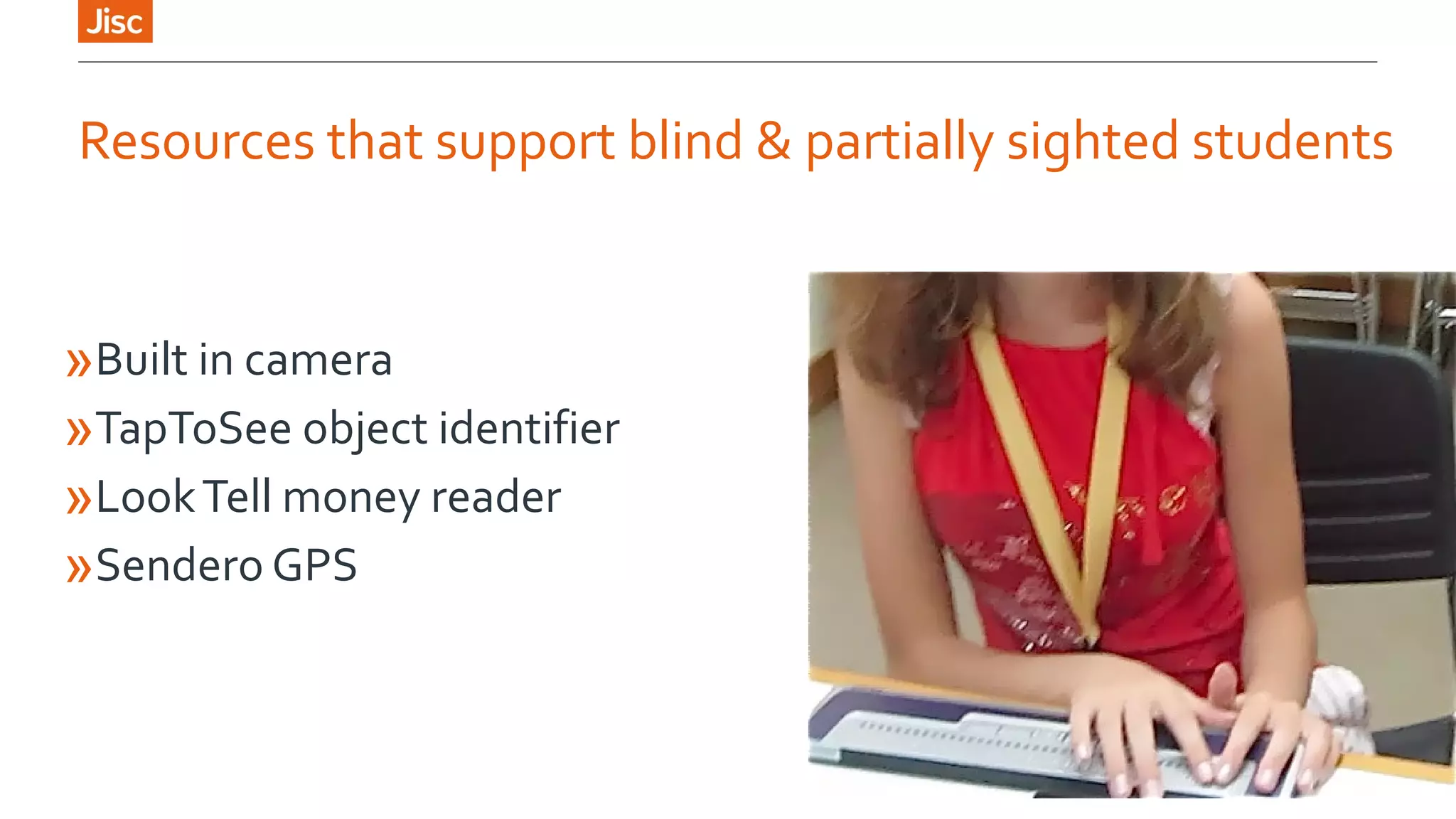
Resources that support blind & partially sighted students 
»Built in camera 
»TapToSee object identifier 
»Look Tell money reader 
»Sendero GPS
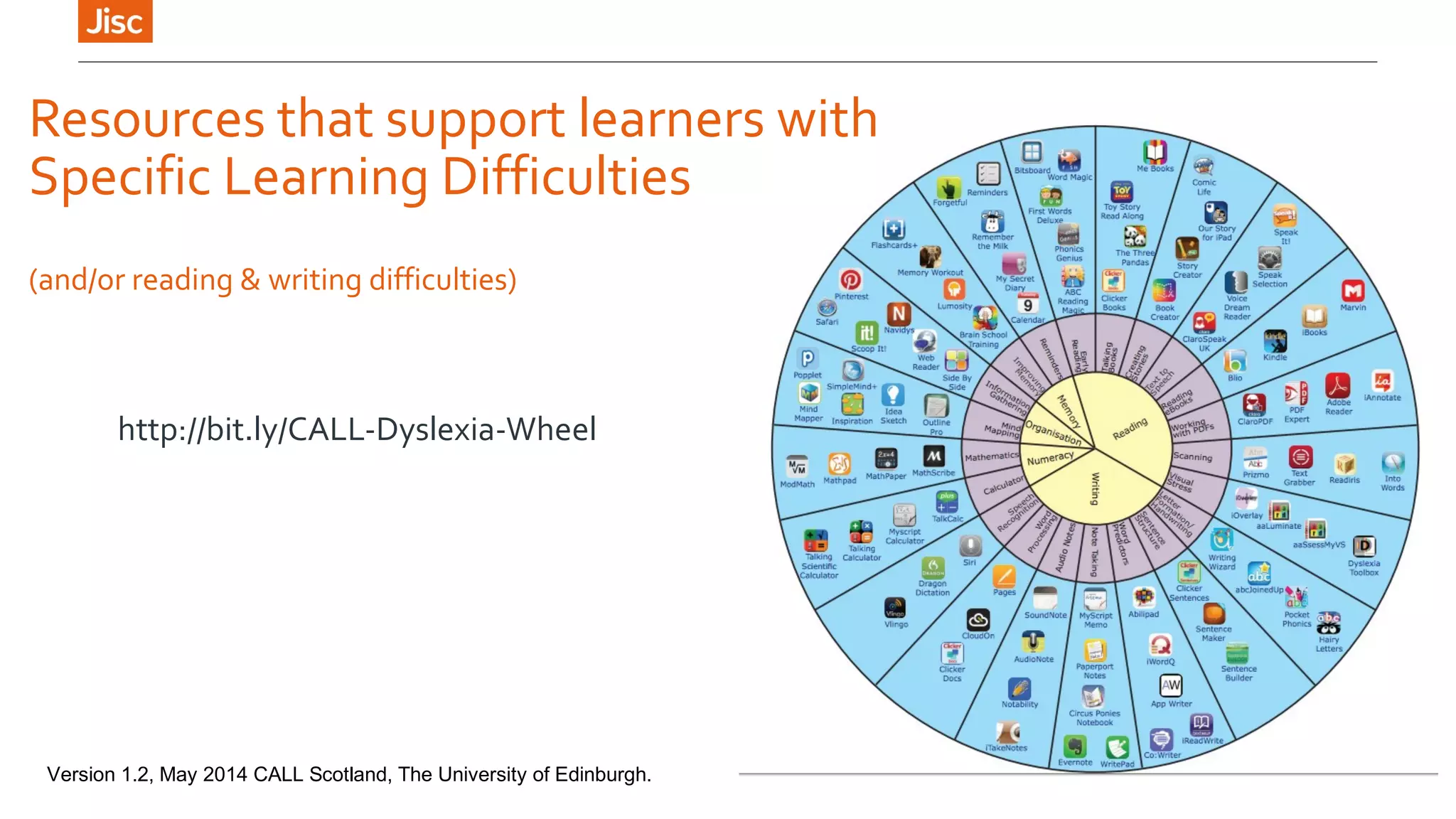
Resources that support learners with 
Specific Learning Difficulties 
(and/or reading & writing difficulties) 
http://bit.ly/CALL-Dyslexia-Wheel 
Version 1.2, May 2014 CALL Scotland, The University of Edinburgh.
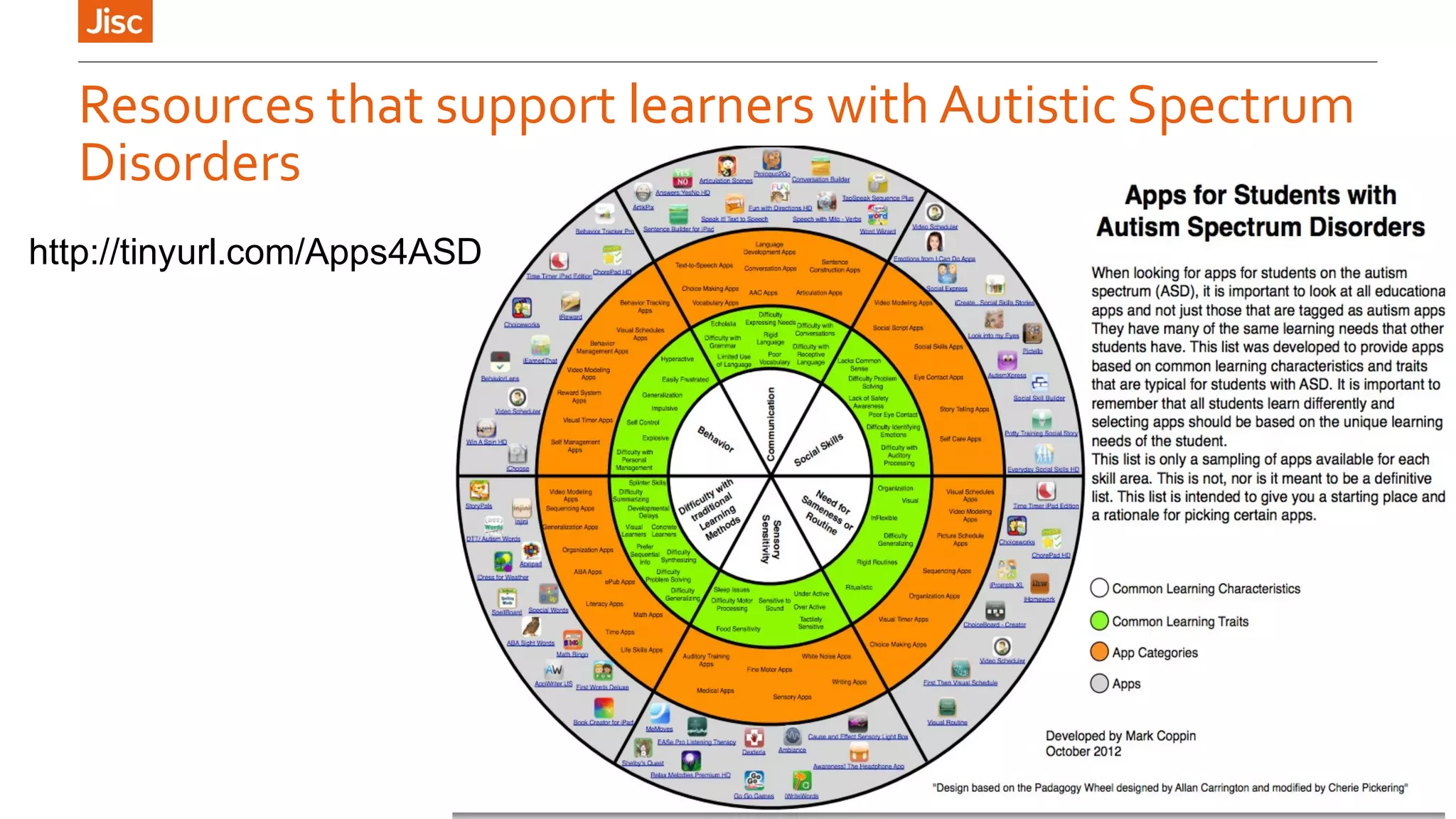
Resources that support learners with Autistic Spectrum 
Disorders 
http://tinyurl.com/Apps4ASD
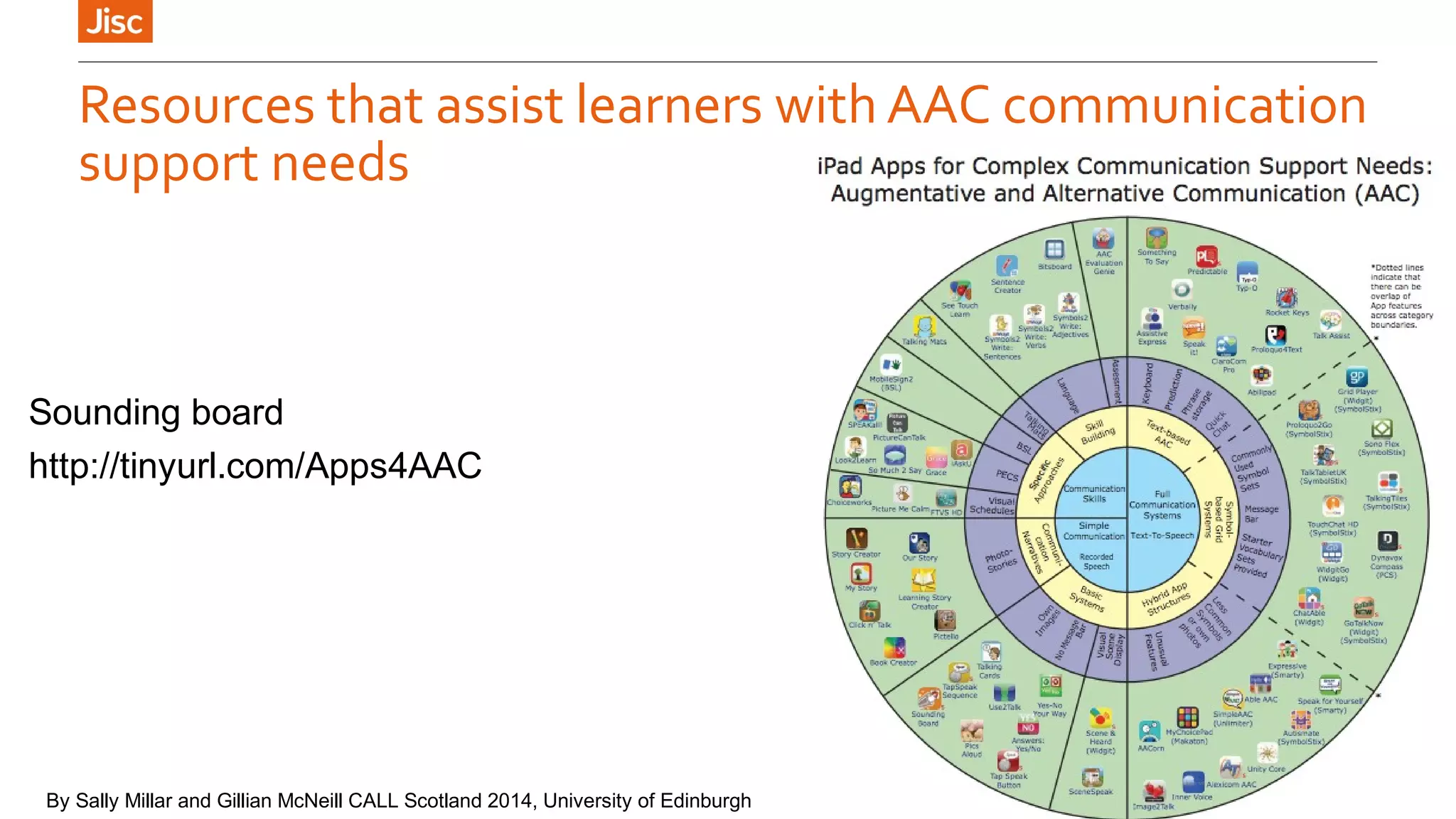
Resources that assist learners with AAC communication 
support needs 
Sounding board 
http://tinyurl.com/Apps4AAC 
By Sally Millar and Gillian McNeill CALL Scotland 2014, University of Edinburgh
Our Session Today 
• An introduction to the iPad, 
• iPad accessibility & usability, 
• Supporting reading, writing notetaking & 
organization, 
• Apps to support specific learner groups.

Inclusion within the iOS platform

  • 1.
    Margaret McKay TheresaDuffy An Introduction to iPads for Learning Jisc RSC Scotland
  • 2.
    What is MOBILE learning? The exploitation of ubiquitous handheld hardware, wireless networking and mobile telephony to FACILITATE support ENHANCE AND EXTEND THE REACH OF teaching and LEARNING. MOLENET (2007 – 2010)
  • 3.
    Mobile Learning 3 According to a recent report from mobile manufacturer Ericsson, studies show that: “by 2015, 80% of people accessing the Internet will be doing so from mobile devices.” Perhaps more important for education: “Internet- capable mobile devices will outnumber computers within the next year.” Johnson, L., Smith, R., Willis, H., Levine, A., and Haywood, K., (2011). The 2011 Horizon Report - Austin, Texas: The New Media Consortium.
  • 4.
    Mobile Learning 4 Encourages time-management User-generated Content Portable CONTEXTUALISATION Increases accessibility for many Bite-sized learning content Promotes Actfivaem Lielairanring Fits into the lives of learners PERVASIVE & UBIQUITOUS Personal, private and IMMEDIACY OF COMMUNICATION More learner centered Opportunities for reflection close to learning event Enables new learning environments Access to Mentors, Tutors and Peers Why MOBILE learning? Convenient
  • 5.
    James Clay, Mobile:TheState of Play University of Bolton 15 June 2010
  • 6.
    James Clay, Mobile:TheState of Play University of Bolton 15 June 2010
  • 7.
    For many learnersit is important to have devices that don’t say “I have a disability!” as soon as you walk into a room with one. Rummel-Hudson, R. Making weird cool 5 April 2010, http://tinyurl.com/3236qbq
  • 8.
    VV Associate ProfDavid Kennedy. Mobile eLearning for language enhancement (Nov 2010)
  • 9.
    Alternative Interfaces ReadingTools Communication Tools Visualisation Tools Recording Tools Planning Tools Writing Tools
  • 10.
    Our Session Today • An introduction to the iPad, • iPad accessibility & usability, • Supporting reading, writing notetaking & organization, • Apps to support specific learner groups.
  • 11.
  • 12.
    iPad Orientation Gettingto grips with basic iPad operation The iPad is a great table and feels very easy to pick up and use but do you know your way around the basics? »iPad buttons › On/Off, Home, Volume, Mute »Basic operations › Swiping Pages, Creating Folders, Searching for apps, Multi tasking »Additional operations › Settings menu, Control Center, notification
  • 13.
    iPad Accessibility &Usability Features
  • 14.
    iPad Accessibility &Usability Features Getting to grips with basic iPad operation The iPad comes with assistive features that allow people an equal experience of iOS. » Features: 1. Zoom (using gestures), 2. Pinch to zoom 3. Invert colours 4. Larger text, bold text, 5. Camera as a low vision tool, 6. Siri, 7. VoiceOver, 8. Accessibility shortcut, 9. Guided access, 10. Assistive touch, 11. Switch control.
  • 15.
    Activity Follow theinstructions to access features » Audio Note » Paperport notes - Case study » Educreations » Skitch
  • 16.
    Mobile Learning 16 The Gartner Cycle Image by sucellolelloes from flickr licensed under creative commons
  • 17.
    Mobile Learning 17 The Gartner Cycle Image by sucellolelloes from flickr licensed under creative commons
  • 18.
    Resources to supportreading, writing, notetaking and organisational skills
  • 19.
    Apps that supportsuccessful learners Planning and organisation These apps can helps individuals to plan and organise their studies. They can be invaluable for students with a wide range of support needs or learning styles. »Calendar (built in) »Reminders (built in) »Notification Centre (built in) »SQA My Study Plan »Mind mapping »Photomind »VoCal XL
  • 20.
    Resources that supportsuccessful learners Reading & writing »Speak autotext, speak selection, define & language support »Dictation »iBooks »Safari website readability feature »IntoWords
  • 21.
    Resources that supportsuccessful learners Notetaking »Audio Note »Paperport notes - Case study »Educreations »Skitch
  • 22.
    Resources that supportblind & partially sighted students »Built in camera »TapToSee object identifier »Look Tell money reader »Sendero GPS
  • 23.
    Resources that supportlearners with Specific Learning Difficulties (and/or reading & writing difficulties) http://bit.ly/CALL-Dyslexia-Wheel Version 1.2, May 2014 CALL Scotland, The University of Edinburgh.
  • 24.
    Resources that supportlearners with Autistic Spectrum Disorders http://tinyurl.com/Apps4ASD
  • 25.
    Resources that assistlearners with AAC communication support needs Sounding board http://tinyurl.com/Apps4AAC By Sally Millar and Gillian McNeill CALL Scotland 2014, University of Edinburgh
  • 26.
    Our Session Today • An introduction to the iPad, • iPad accessibility & usability, • Supporting reading, writing notetaking & organization, • Apps to support specific learner groups.

Editor's Notes

  • #2 An Introduction to iPads for Learning
  • #3 Mobile learning is about the mobility of the learner Mobile learning is about context – what can mobile learning do that desk-bound computing can’t? Mobile learning can provide solutions to personalising learning
  • #4 According to a recent report from mobile manufacturer Ericsson, studies show that: “by 2015, 80% of people accessing the Internet will be doing so from mobile devices.” Perhaps more important for education: “Internet- capable mobile devices will outnumber computers within the next year.”
  • #5 Institutional goals Mobile learning aligns well with many goals of educational institutions, including: Taken out into the field (contextualised) / accessed on their own terms (personalised) / always on, always connected (immediacy) / ease with which user generated content including multimedia can be created Curriculum redesign Personalisation of learning Student satisfaction Digital literacies Reducing costs (doing more with less) Graduate attributes and employability Enhancing assessment and feedback Widening participation Improving student engagement and retention Energy efficiency Tangible benefits Personal, private and familiar (reduce perceived barriers to learning) Contextualisation through location-aware features such as GPS Perceived as an acceptable way for learners to receive reminders and chasers – and to manage their time Increases accessibility/opportunity for learners with special educational needs Reduces technical barriers to e-learning
  • #6 This is a learning area, please switch off all mobile phones.
  • #7 Please turn on all mobile devices
  • #8 For many learners it is important to have devices that don’t say “I have a disability!” as soon as you walk into a room with one. Rummel-Hudson, R. Making weird cool 5 April 2010, http://tinyurl.com/3236qbq
  • #9 Fixed Apps Concept/mind mapping Maps You Tube Animations/simulations Photos Documents/presentations Digital Content, video, audio Podcasting/Podcasts Social networks e.g. Facebook Email and web browsing Web 2.0 Games Google anything Mobile Apps Concept/mind mapping Maps You Tube Animations/simulations Photos Documents/presentations Digital Content, video, audio Podcasting/Podcasts Social networks e.g. Facebook Email and web browsing Web 2.0 Games Google anythinkg Google anything Mobile Apps Concept/mind mapping Maps You Tube Animations/simulations Photos Documents/presentations Digital Content, video, audio Podcasting/Podcasts Social networks e.g. Facebook Email and web browsing Web 2.0 Games Google anything
  • #11 Universal Design iPad buttons On/Off (locking/lock screen) Home Volume Mute (or lock rotation) Basic operations Swiping Pages Moving apps around the page Creating Folders Searching for apps – spotlight search Multi tasking – double click home Closing apps that are currently sitting opened Other operations Control Centre Notification centre
  • #12 We’re going to look at the basics of getting to grips with iPads. Personalising the way you use your iPad: An opportunity to become familiar with the iPad interface and to look at its basic functions.
  • #13 Built in rather than added on, No need to add on later or retrofit, iPad buttons On/Off (locking/lock screen) Home Volume Mute (or lock rotation) Basic operations Swiping Pages Moving apps around the page Creating Folders Searching for apps – spotlight search Multi tasking – double click home Closing apps that are currently sitting opened Other operations Control Centre Notification centre
  • #15 Zoom - open zoom then go to home screen. 3 taps to enable zoom. Then tap 2 times keeping fingers on screenand drag to increase/decrease. Show in notes. 2. Speak selection - when text is selected a speak button offers text to speech in notes, websites ebooks and other apps. 3.Larger dynamic type - turn on and using the slider move to the preferred size. Works with inbuilt feature such as notes, messages, reminders and other third party apps that support this. Show in notes. 4. Invert colours - show. 5. VoiceOver – voice over is an excellent resource used primarily by blind users. Using a series of swiping and double tap gestures blind users can navigate and manipulate different features of the iPad and apps. Siri - turn on.....voice over, invert colours, show accessibility features. Guided Access Accessibility shortcut to turn on invert colours, voice over, guided access, etc.
  • #16 Audio Note Paperport notes - Case study Educreations Skitch
  • #17 Five phases A hype cycle in can be broken down into five phases: "Technology Trigger" — The first phase of a hype cycle is the "technology trigger" or breakthrough, product launch or other event that generates significant press and interest. "Peak of Inflated Expectations" — In the next phase, a frenzy of publicity typically generates over-enthusiasm and unrealistic expectations. There may be some successful applications of a technology, but there are typically more failures. "Trough of Disillusionment" — Technologies enter the "trough of disillusionment" because they fail to meet expectations and quickly become unfashionable. Consequently, the press usually abandons the topic and the technology. "Slope of Enlightenment" — Although the press may have stopped covering the technology, some businesses continue through the "slope of enlightenment" and experiment to understand the benefits and practical application of the technology. "Plateau of Productivity" — A technology reaches the "plateau of productivity" as the benefits of it become widely demonstrated and accepted. The technology becomes increasingly stable and evolves in second and third generations. The final height of the plateau varies according to whether the technology is broadly applicable or benefits only a niche market. The term is now used more broadly in the marketing of new technologies.
  • #18 Techno - literacies characteristic - rapid change with economic and social drivers Academic literacies typically slow change with cultural and institutional inhibitors Key skills required by learners learning in the cloud / futur
  • #20 Calendar (built in) Reminders (built in) Notification Centre (built in) SQA My Study Plan Mind mapping Photomind VoCal XL
  • #21 Speak autotext, speak selection, define & language support iBooks – an online bookstore and a reading app. Use it with magnification Safari website readability feature Audio Note/ Paperportnotes - Case study Book Creator/Photostory *
  • #22 . Audio Note Paperport notes - Case study Educreations Skitch
  • #23 . Built in camera TapToSee object identifier Look Tell money reader Sendero GPS
  • #24 Resources that support learners with Specific Learning Difficulties (and/or reading & writing difficulties) http://bit.ly/CALL-Dyslexia-Wheel
  • #25 .
  • #26 http://tinyurl.com/Apps4AAC Sally Millar and Gillian McNeill This new 'Wheel' authored by Sally Millar and Gillian McNeill of CALL Scotland, provides a categorised guide to iPad Apps for people with complex communication support needs, who may need to use some form(s) of Augmentative and Alternative Communication (AAC).
  • #27 Universal Design iPad buttons On/Off (locking/lock screen) Home Volume Mute (or lock rotation) Basic operations Swiping Pages Moving apps around the page Creating Folders Searching for apps – spotlight search Multi tasking – double click home Closing apps that are currently sitting opened Other operations Control Centre Notification centre