



MOBILE LEARNING AND GLOBAL
MODELS
www.extentia.com

Extentia Information Technology
Mobile Learning and Global Models


A quick history of mobile learning



Market penetration



Catalysts driving the adoption of mobile learning



Ecosystems



The Funding context



Some exemplary mobile learning projects



Challenges



Summary
A short history of Mobile Learning


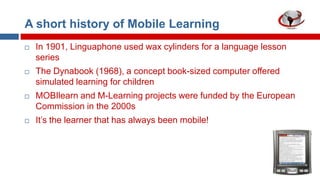
In 1901, Linguaphone used wax cylinders for a language lesson
series



The Dynabook (1968), a concept book-sized computer offered
simulated learning for children



MOBIlearn and M-Learning projects were funded by the European
Commission in the 2000s



It‟s the learner that has always been mobile!
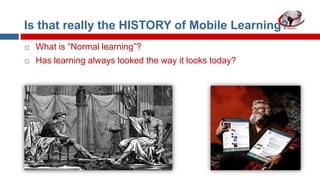
Is that really the HISTORY of Mobile Learning?


What is “Normal learning”?



Has learning always looked the way it looks today?
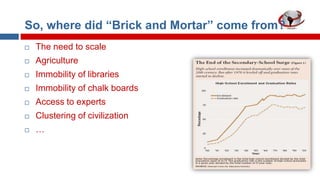
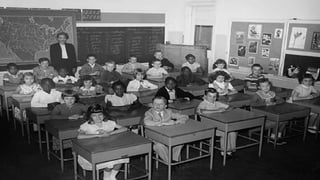
So, where did “Brick and Mortar” come from?


The need to scale



Agriculture



Immobility of libraries



Immobility of chalk boards



Access to experts



Clustering of civilization



…
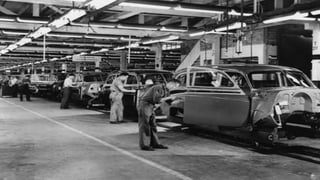
Learning Evolved… and then got
“STUCK”
7
7
8
8
9
9
10
10
11
But it is coming full
circle…
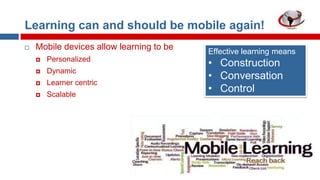
Learning can and should be mobile again!


Mobile devices allow learning to be


Personalized



Dynamic



Learner centric



Scalable

Effective learning means

• Construction
• Conversation
• Control
Market Penetration
Market Penetration


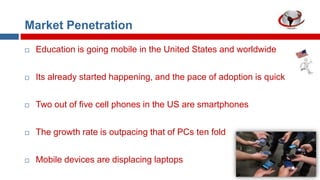
Education is going mobile in the United States and worldwide



Its already started happening, and the pace of adoption is quick



Two out of five cell phones in the US are smartphones



The growth rate is outpacing that of PCs ten fold



Mobile devices are displacing laptops
Mobile Usage Worldwide


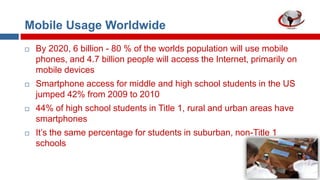
By 2020, 6 billion - 80 % of the worlds population will use mobile
phones, and 4.7 billion people will access the Internet, primarily on
mobile devices



Smartphone access for middle and high school students in the US
jumped 42% from 2009 to 2010



44% of high school students in Title 1, rural and urban areas have
smartphones



It‟s the same percentage for students in suburban, non-Title 1
schools
What does that mean?



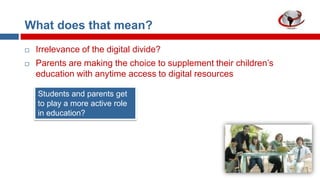
Irrelevance of the digital divide?
Parents are making the choice to supplement their children‟s
education with anytime access to digital resources
Students and parents get
to play a more active role
in education?
The Case for Mobile
Learning
Three Drivers


User (student) expectations



Economics



Delivered value (learning experience and benefits)
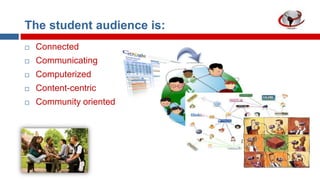
The student audience is:


Connected



Communicating



Computerized



Content-centric



Community oriented
Available Applications and Demand
At this time:


Thousands of educational apps



More parent-child / less teacher-student



Quality?

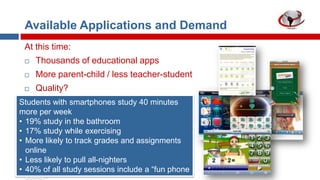
Students with smartphones study 40 minutes
more per week
• 19% study in the bathroom
• 17% study while exercising
• More likely to track grades and assignments
online
• Less likely to pull all-nighters
• 40% of all study sessions include a “fun phone
Worldwide – the market for Mobile Learning


The worldwide market for mobile learning products and services will
grow from $3.2 billion in 2010 to $9.1 billion by 2015



The US is now the #1 purchasing country for mobile learning,
followed by:
 Japan
 South Korea
 UK
 Taiwan
This is 70% of the global mobile learning market
Worldwide – the market for Mobile Learning


All this is changing



By 2015, these countries will only account for 40% of all
expenditures



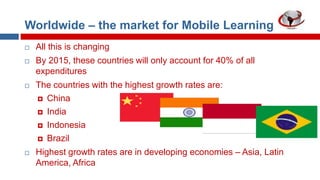
The countries with the highest growth rates are:
 China
 India
 Indonesia
 Brazil



Highest growth rates are in developing economies – Asia, Latin
America, Africa
Worldwide – the market for Mobile Learning


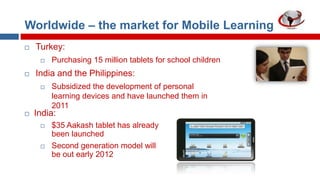
Turkey:




India and the Philippines:




Purchasing 15 million tablets for school children
Subsidized the development of personal
learning devices and have launched them in
2011

India:




$35 Aakash tablet has already
been launched
Second generation model will
be out early 2012
Real World Examples


The Minnesota school board has approved more than $1.1million to
purchase 1450 iPad 2s



The Florida school district has received a $1million gift from a
donor. They are planning on using the money to provide every
student an iPad



A prominent school in Mumbai, India has made it mandatory for all
its students to purchase the iPad 2




The school has ordered approximately 850 iPads for this purpose

http://www.ipadinschools.com
Mobile Learning – "value creation"










Mobile learning has exited the "market creation" phase and has
entered the "value creation" phase in the US
In 1984, there were only 1,000 devices in the world capable of
accessing the Internet
Eight years later, this had reached one million
Last year, it reached one billion
Will double soon
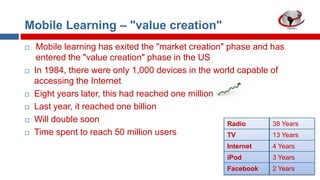
Radio
38 Years
Time spent to reach 50 million users
TV
13 Years
Internet

4 Years

iPod

3 Years

Facebook

2 Years
Mobile Learning – "value creation"



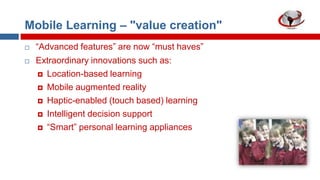
“Advanced features” are now “must haves”
Extraordinary innovations such as:
 Location-based learning
 Mobile augmented reality
 Haptic-enabled (touch based) learning
 Intelligent decision support
 “Smart” personal learning appliances
Ecosystem
Mobile Learning = Ecosystem of Features


These include:
 Mobile commerce
 Near field communications (NFC)
 Mobile advertising
 Mobile web browsing
 Device-independent multimedia
 Location-based services
 eBooks
 And, of course, Mobile Applications
The Content Distribution is expanding rapidly


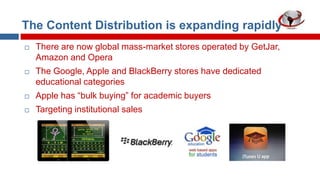
There are now global mass-market stores operated by GetJar,
Amazon and Opera



The Google, Apple and BlackBerry stores have dedicated
educational categories



Apple has “bulk buying” for academic buyers



Targeting institutional sales
Constant change


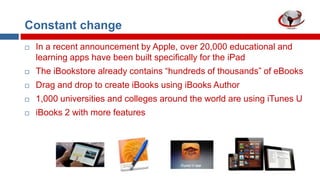
In a recent announcement by Apple, over 20,000 educational and
learning apps have been built specifically for the iPad



The iBookstore already contains “hundreds of thousands” of eBooks



Drag and drop to create iBooks using iBooks Author



1,000 universities and colleges around the world are using iTunes U



iBooks 2 with more features
Everything is Evolving at Lightning Speed




Major spike in sales of smartphones, eBook readers and tablets in
2011
What‟s evolving?
 Cost (lower)
 User interface (better)
 Processing speed (faster)
 Peripherals (sexier)
 Memory and storage (larger)
 Motion sensors (cooler)
 Wireless connectivity (everywhere)
Government spending is down in the US


Weak economy / challenged funding – DRIVING self paced elearning





Increased popularity of “virtual schools”
Recession
State budget cuts
Need for creative solutions
Government spending is down in the US


The US government spends around $900 billion per year on
education in US schools – but can‟t accommodate all US students



Budget cuts are at their highest in 60 years



Huge potential to reduce costs dramatically with mobile education



Cutting costs without compromising quality needs new solutions
Cost-effectiveness


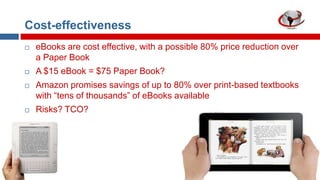
eBooks are cost effective, with a possible 80% price reduction over
a Paper Book



A $15 eBook = $75 Paper Book?



Amazon promises savings of up to 80% over print-based textbooks
with “tens of thousands” of eBooks available



Risks? TCO?
Mobile Learning Projects
(The Case Against Textbooks?)
Some exemplary mobile learning projects


Project K-Nect for secondary at-risk students - focuses on increasing
their math skills using smartphones



The Mobile Learning Network (MoLeNET) in the UK - collaboratively
introduces and supports mobile learning in education and training.



Forsythe County, GA: BYOT (Bring Your Own Technology)
Forsythe County - Considerations


Policy change



Educational acceptance



Instructional adaptation



Common sense
Students are permitted to connect to the district network via the secure
wireless connection provided by the school system, but all access must
be in accordance with Acceptable Use Policy
Students are NOT permitted to use their own computing devices to
access the Internet via personal Wi-Fi accounts or by any manner other
than connecting through the secure wireless connection provided by the
school system
The case against textbooks
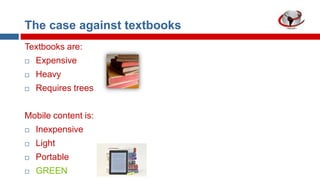
Textbooks are:


Expensive



Heavy



Requires trees

Mobile content is:


Inexpensive



Light



Portable



GREEN
The case against textbooks - findings




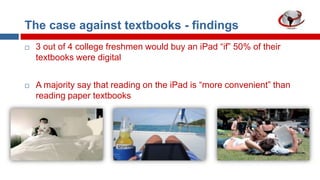
3 out of 4 college freshmen would buy an iPad “if” 50% of their
textbooks were digital
A majority say that reading on the iPad is “more convenient” than
reading paper textbooks
The case against textbooks - findings


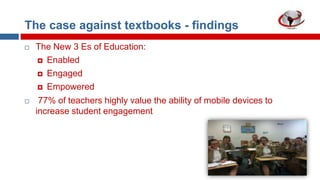
The New 3 Es of Education:
 Enabled
 Engaged
 Empowered



77% of teachers highly value the ability of mobile devices to
increase student engagement
Challenges
The Challenges for education on mobile


Bad press and lethargy



Opposition from traditional publishers



Institutionalized practices
No widely accepted mobile theory of
learning
TCO, long term costs?
Stability of platforms?
Proprietary platforms – Apple‟s textbooks







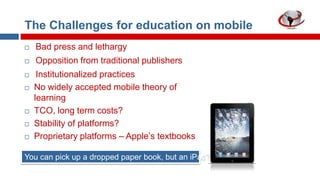
You can pick up a dropped paper book, but an iPad?
In Summary…
History of Mobile Learning


We‟ve covered:



Trends



Technology



Cost benefits




Interesting data

Challenges

The case for Mobile Learning
What Learning should be:


Interactive:




Personalized:




Mobile learning increases “communication” between peers and
instructors
Programs “adapt” to the individual learner‟s strengths

Engaging:


Collaboration, entertaining, immersive



Flexible



Location insensitive



Cost-effective
An opportunity to create the future…


“Guide on the side” v “Sage on the stage”



Advocate! Demand! Articulate! Bear Witness!



Imagine the future



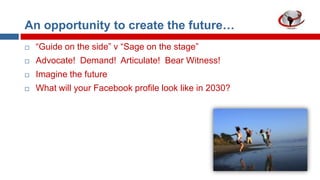
What will your Facebook profile look like in 2030?
Let‟s make learning mobile.
Again!
Thank you!
About Extentia and iXtentia
Established in 1998, Extentia is a global technology consulting organization
that delivers solutions to clients in 5 continents. With strong technical skills in
Microsoft and open source technologies, Extentia has experience across
multiple sectors including education, travel, healthcare and finance. Its much
acclaimed Design Studio is a graphics design and UI group that actively
supports a multi-skilled software development team. Extentia has offices in
India, the United States, the UAE, and the UK.
www.extentia.com
iXtentia is a division of Extentia that focuses on Apple, Android, Windows
Phone, BlackBerry, and other mobile technologies. It also offers consulting for
mobile strategy and marketing. Several iXtentia applications for the iPhone
/iPad are listed among the top 200 on the Apple App Store.
www.ixtentia.com
Contact Us

USA | Australia | Middle East | Singapore | United Kingdom |
Germany
Tel: +91 20 67285200 (India)| +1 408 627 4094 (US)
Email: inquiries@extentia.com
Sources











Wikipedia articles : "A Short History of Mobile Learning", Mike
Sharples, LSRI, University of Nottingham,Wireless Coyote: A
Computer-Supported Field Trip, Communications of the ACM Special issue on technology in K–12 education
AEP Online April 2011
Project Tomorrow 2011 Speak Up National Research Project
Ambient Insight Research, 2011
The Worldwide Market for Mobile Learning Products and Services:
2010-2015 Forecast and Analysis, Ambient Insight, LLC."The
Marvel of Mobile Learning" - Master the New Net, Sept 2011
http://www.ipadinschools.com/
http://articles.timesofindia.indiatimes.com
Sources













Ambient Insight‟s US Market for Mobile Learning Products and
Services: 2010-2015 Forecast and Analysis
http://techcrunch.com/2012/01/19/apple-textbook-event/
http://mashable.com/2012/01/19/apple-ibooks-author/
http://projectknect.org
http://www.molenet.org.uk/
http://k12cellphoneprojects.wikispaces.com/
Is the iPad Ready To Replace the Printed Textbook? - Campus
Technology, June 2011 and Ambient Insight Research, 2011
The results of a classroom poll at Abilene Christian University.
Is the iPad Ready To Replace the Printed Textbook? - Campus
Technology, June 2011 and Ambient Insight Research, 2011
Sources






http://allthingsd.com/20120119/apples-new-math-or-why-a-15ebook-equals-a-75-paper-book/
The Joan Ganz Cooney Center at Sesame Workshop 2010 report “
Learning: Is there an app for that?”
„The Marvel of Mobile Learning‟ - Master the New Net, Sept 2011

Mobile Learning and Global Models – The Next Revolution in Education Industry

  • 1.
    MOBILE LEARNING ANDGLOBAL MODELS www.extentia.com Extentia Information Technology
  • 2.
    Mobile Learning andGlobal Models  A quick history of mobile learning  Market penetration  Catalysts driving the adoption of mobile learning  Ecosystems  The Funding context  Some exemplary mobile learning projects  Challenges  Summary
  • 3.
    A short historyof Mobile Learning  In 1901, Linguaphone used wax cylinders for a language lesson series  The Dynabook (1968), a concept book-sized computer offered simulated learning for children  MOBIlearn and M-Learning projects were funded by the European Commission in the 2000s  It‟s the learner that has always been mobile!
  • 4.
    Is that reallythe HISTORY of Mobile Learning?  What is “Normal learning”?  Has learning always looked the way it looks today?
  • 5.
    So, where did“Brick and Mortar” come from?  The need to scale  Agriculture  Immobility of libraries  Immobility of chalk boards  Access to experts  Clustering of civilization  …
  • 6.
    Learning Evolved… andthen got “STUCK”
  • 7.
  • 8.
  • 9.
  • 10.
  • 11.
  • 12.
    But it iscoming full circle…
  • 13.
    Learning can andshould be mobile again!  Mobile devices allow learning to be  Personalized  Dynamic  Learner centric  Scalable Effective learning means • Construction • Conversation • Control
  • 14.
  • 15.
    Market Penetration  Education isgoing mobile in the United States and worldwide  Its already started happening, and the pace of adoption is quick  Two out of five cell phones in the US are smartphones  The growth rate is outpacing that of PCs ten fold  Mobile devices are displacing laptops
  • 16.
    Mobile Usage Worldwide  By2020, 6 billion - 80 % of the worlds population will use mobile phones, and 4.7 billion people will access the Internet, primarily on mobile devices  Smartphone access for middle and high school students in the US jumped 42% from 2009 to 2010  44% of high school students in Title 1, rural and urban areas have smartphones  It‟s the same percentage for students in suburban, non-Title 1 schools
  • 17.
    What does thatmean?   Irrelevance of the digital divide? Parents are making the choice to supplement their children‟s education with anytime access to digital resources Students and parents get to play a more active role in education?
  • 18.
    The Case forMobile Learning
  • 19.
    Three Drivers  User (student)expectations  Economics  Delivered value (learning experience and benefits)
  • 20.
    The student audienceis:  Connected  Communicating  Computerized  Content-centric  Community oriented
  • 21.
    Available Applications andDemand At this time:  Thousands of educational apps  More parent-child / less teacher-student  Quality? Students with smartphones study 40 minutes more per week • 19% study in the bathroom • 17% study while exercising • More likely to track grades and assignments online • Less likely to pull all-nighters • 40% of all study sessions include a “fun phone
  • 22.
    Worldwide – themarket for Mobile Learning  The worldwide market for mobile learning products and services will grow from $3.2 billion in 2010 to $9.1 billion by 2015  The US is now the #1 purchasing country for mobile learning, followed by:  Japan  South Korea  UK  Taiwan This is 70% of the global mobile learning market
  • 23.
    Worldwide – themarket for Mobile Learning  All this is changing  By 2015, these countries will only account for 40% of all expenditures  The countries with the highest growth rates are:  China  India  Indonesia  Brazil  Highest growth rates are in developing economies – Asia, Latin America, Africa
  • 24.
    Worldwide – themarket for Mobile Learning  Turkey:   India and the Philippines:   Purchasing 15 million tablets for school children Subsidized the development of personal learning devices and have launched them in 2011 India:   $35 Aakash tablet has already been launched Second generation model will be out early 2012
  • 25.
    Real World Examples  TheMinnesota school board has approved more than $1.1million to purchase 1450 iPad 2s  The Florida school district has received a $1million gift from a donor. They are planning on using the money to provide every student an iPad  A prominent school in Mumbai, India has made it mandatory for all its students to purchase the iPad 2   The school has ordered approximately 850 iPads for this purpose http://www.ipadinschools.com
  • 26.
    Mobile Learning –"value creation"       Mobile learning has exited the "market creation" phase and has entered the "value creation" phase in the US In 1984, there were only 1,000 devices in the world capable of accessing the Internet Eight years later, this had reached one million Last year, it reached one billion Will double soon Radio 38 Years Time spent to reach 50 million users TV 13 Years Internet 4 Years iPod 3 Years Facebook 2 Years
  • 27.
    Mobile Learning –"value creation"   “Advanced features” are now “must haves” Extraordinary innovations such as:  Location-based learning  Mobile augmented reality  Haptic-enabled (touch based) learning  Intelligent decision support  “Smart” personal learning appliances
  • 28.
  • 29.
    Mobile Learning =Ecosystem of Features  These include:  Mobile commerce  Near field communications (NFC)  Mobile advertising  Mobile web browsing  Device-independent multimedia  Location-based services  eBooks  And, of course, Mobile Applications
  • 30.
    The Content Distributionis expanding rapidly  There are now global mass-market stores operated by GetJar, Amazon and Opera  The Google, Apple and BlackBerry stores have dedicated educational categories  Apple has “bulk buying” for academic buyers  Targeting institutional sales
  • 31.
    Constant change  In arecent announcement by Apple, over 20,000 educational and learning apps have been built specifically for the iPad  The iBookstore already contains “hundreds of thousands” of eBooks  Drag and drop to create iBooks using iBooks Author  1,000 universities and colleges around the world are using iTunes U  iBooks 2 with more features
  • 32.
    Everything is Evolvingat Lightning Speed   Major spike in sales of smartphones, eBook readers and tablets in 2011 What‟s evolving?  Cost (lower)  User interface (better)  Processing speed (faster)  Peripherals (sexier)  Memory and storage (larger)  Motion sensors (cooler)  Wireless connectivity (everywhere)
  • 33.
    Government spending isdown in the US  Weak economy / challenged funding – DRIVING self paced elearning     Increased popularity of “virtual schools” Recession State budget cuts Need for creative solutions
  • 34.
    Government spending isdown in the US  The US government spends around $900 billion per year on education in US schools – but can‟t accommodate all US students  Budget cuts are at their highest in 60 years  Huge potential to reduce costs dramatically with mobile education  Cutting costs without compromising quality needs new solutions
  • 35.
    Cost-effectiveness  eBooks are costeffective, with a possible 80% price reduction over a Paper Book  A $15 eBook = $75 Paper Book?  Amazon promises savings of up to 80% over print-based textbooks with “tens of thousands” of eBooks available  Risks? TCO?
  • 36.
    Mobile Learning Projects (TheCase Against Textbooks?)
  • 37.
    Some exemplary mobilelearning projects  Project K-Nect for secondary at-risk students - focuses on increasing their math skills using smartphones  The Mobile Learning Network (MoLeNET) in the UK - collaboratively introduces and supports mobile learning in education and training.  Forsythe County, GA: BYOT (Bring Your Own Technology)
  • 38.
    Forsythe County -Considerations  Policy change  Educational acceptance  Instructional adaptation  Common sense Students are permitted to connect to the district network via the secure wireless connection provided by the school system, but all access must be in accordance with Acceptable Use Policy Students are NOT permitted to use their own computing devices to access the Internet via personal Wi-Fi accounts or by any manner other than connecting through the secure wireless connection provided by the school system
  • 39.
    The case againsttextbooks Textbooks are:  Expensive  Heavy  Requires trees Mobile content is:  Inexpensive  Light  Portable  GREEN
  • 40.
    The case againsttextbooks - findings   3 out of 4 college freshmen would buy an iPad “if” 50% of their textbooks were digital A majority say that reading on the iPad is “more convenient” than reading paper textbooks
  • 41.
    The case againsttextbooks - findings  The New 3 Es of Education:  Enabled  Engaged  Empowered  77% of teachers highly value the ability of mobile devices to increase student engagement
  • 42.
  • 43.
    The Challenges foreducation on mobile  Bad press and lethargy  Opposition from traditional publishers  Institutionalized practices No widely accepted mobile theory of learning TCO, long term costs? Stability of platforms? Proprietary platforms – Apple‟s textbooks     You can pick up a dropped paper book, but an iPad?
  • 44.
  • 45.
    History of MobileLearning  We‟ve covered:   Trends  Technology  Cost benefits   Interesting data Challenges The case for Mobile Learning
  • 46.
    What Learning shouldbe:  Interactive:   Personalized:   Mobile learning increases “communication” between peers and instructors Programs “adapt” to the individual learner‟s strengths Engaging:  Collaboration, entertaining, immersive  Flexible  Location insensitive  Cost-effective
  • 47.
    An opportunity tocreate the future…  “Guide on the side” v “Sage on the stage”  Advocate! Demand! Articulate! Bear Witness!  Imagine the future  What will your Facebook profile look like in 2030?
  • 48.
    Let‟s make learningmobile. Again! Thank you!
  • 49.
    About Extentia andiXtentia Established in 1998, Extentia is a global technology consulting organization that delivers solutions to clients in 5 continents. With strong technical skills in Microsoft and open source technologies, Extentia has experience across multiple sectors including education, travel, healthcare and finance. Its much acclaimed Design Studio is a graphics design and UI group that actively supports a multi-skilled software development team. Extentia has offices in India, the United States, the UAE, and the UK. www.extentia.com iXtentia is a division of Extentia that focuses on Apple, Android, Windows Phone, BlackBerry, and other mobile technologies. It also offers consulting for mobile strategy and marketing. Several iXtentia applications for the iPhone /iPad are listed among the top 200 on the Apple App Store. www.ixtentia.com
  • 50.
    Contact Us USA |Australia | Middle East | Singapore | United Kingdom | Germany Tel: +91 20 67285200 (India)| +1 408 627 4094 (US) Email: inquiries@extentia.com
  • 51.
    Sources        Wikipedia articles :"A Short History of Mobile Learning", Mike Sharples, LSRI, University of Nottingham,Wireless Coyote: A Computer-Supported Field Trip, Communications of the ACM Special issue on technology in K–12 education AEP Online April 2011 Project Tomorrow 2011 Speak Up National Research Project Ambient Insight Research, 2011 The Worldwide Market for Mobile Learning Products and Services: 2010-2015 Forecast and Analysis, Ambient Insight, LLC."The Marvel of Mobile Learning" - Master the New Net, Sept 2011 http://www.ipadinschools.com/ http://articles.timesofindia.indiatimes.com
  • 52.
    Sources          Ambient Insight‟s USMarket for Mobile Learning Products and Services: 2010-2015 Forecast and Analysis http://techcrunch.com/2012/01/19/apple-textbook-event/ http://mashable.com/2012/01/19/apple-ibooks-author/ http://projectknect.org http://www.molenet.org.uk/ http://k12cellphoneprojects.wikispaces.com/ Is the iPad Ready To Replace the Printed Textbook? - Campus Technology, June 2011 and Ambient Insight Research, 2011 The results of a classroom poll at Abilene Christian University. Is the iPad Ready To Replace the Printed Textbook? - Campus Technology, June 2011 and Ambient Insight Research, 2011
  • 53.
    Sources    http://allthingsd.com/20120119/apples-new-math-or-why-a-15ebook-equals-a-75-paper-book/ The Joan GanzCooney Center at Sesame Workshop 2010 report “ Learning: Is there an app for that?” „The Marvel of Mobile Learning‟ - Master the New Net, Sept 2011

Editor's Notes

  • #4 Source: Wikipedia articles, and ‘A Short History of Mobile Learning’, Mike Sharples, LSRI, University of Nottingham,Wireless Coyote: A Computer-Supported Field Trip, Communications of the ACM - Special issue on technology in K–12 education
  • #23 Ambient Insight Research, 2011
  • #38 Source: http://projectknect.orghttp://www.molenet.org.uk/http://k12cellphoneprojects.wikispaces.com/