





07/11/2014 Next Steps with Technology Enhanced Learning 
Joan Walker - Jisc RSC Scotland
Next steps with technology enhanced learning 2 
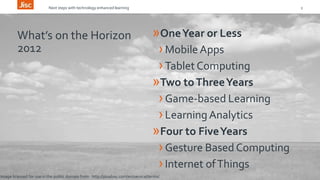
What’s on the Horizon 
2012 
»One Year or Less 
› Mobile Apps 
› Tablet Computing 
»Two to Three Years 
›Game-based Learning 
› Learning Analytics 
»Four to Five Years 
› Gesture Based Computing 
› Internet of Things 
Image licensed for use in the public domain from http://pixabay.com/en/service/terms/
Next steps with technology enhanced learning 3 
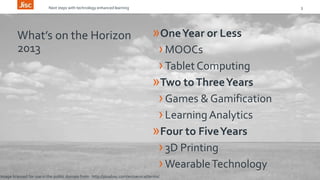
What’s on the Horizon 
2013 
»One Year or Less 
›MOOCs 
› Tablet Computing 
»Two to Three Years 
› Games & Gamification 
› Learning Analytics 
»Four to Five Years 
› 3D Printing 
›Wearable Technology 
Image licensed for use in the public domain from http://pixabay.com/en/service/terms/
Next steps with technology enhanced learning 4 
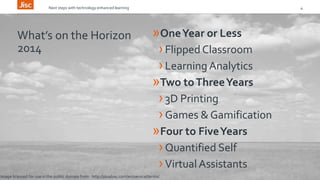
What’s on the Horizon 
2014 
»One Year or Less 
› Flipped Classroom 
› Learning Analytics 
»Two to Three Years 
› 3D Printing 
› Games & Gamification 
»Four to Five Years 
›Quantified Self 
› Virtual Assistants 
Image licensed for use in the public domain from http://pixabay.com/en/service/terms/
Next steps with technology enhanced learning 
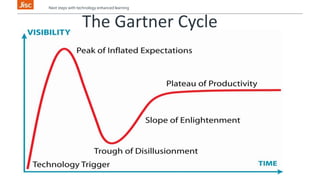
The Gartner Cycle
Next steps with technology enhanced learning 
Current Hot Topics in post 16 
Image licensed for use in the public domain from http://pixabay.com/en/service/terms/ 
Cloud Services 
Image licensed for use in the public domain from http://pixabay.com/en/service/terms/ 
Social 
Media 
WiFi Access 
& BYOD 
Mobile Learning & Using Apps
Next steps with technology enhanced learning 7 
Technical Support for a range of mobile devices & software 
network security 
Provision of mobile friendly resources 
New Skills Sets for staff & students 
Plagiarism 
Authentication 
Accessibility considerations 
eSafety & Safeguarding 
Challenges
Mobile Learning 8 
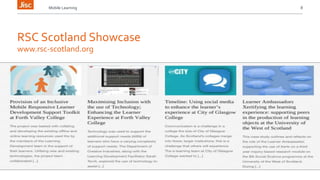
RSC Scotland Showcase 
www.rsc-scotland.org
Next steps with technology enhanced learning 
Key Drivers of Change 
»Pedagogies to engage students supported by 
technologies 
»Open Education 
»Digital Literacies for Digital Learning
Next steps with technology enhanced learning 
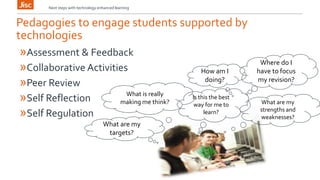
Pedagogies to engage students supported by 
technologies 
»Assessment & Feedback 
»Collaborative Activities 
»Peer Review 
»Self Reflection 
»Self Regulation 
How am I 
doing? 
What is really 
making me think? 
Where do I 
have to focus 
my revision? 
What are my 
targets? 
What are my 
strengths and 
weaknesses? 
Is this the best 
way for me to 
learn?
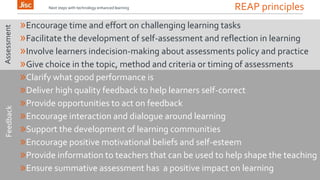
REAP principles 
Next steps with technology enhanced learning 
»Encourage time and effort on challenging learning tasks 
»Facilitate the development of self-assessment and reflection in learning 
»Involve learners indecision-making about assessments policy and practice 
»Give choice in the topic, method and criteria or timing of assessments 
»Clarify what good performance is 
»Deliver high quality feedback to help learners self-correct 
»Provide opportunities to act on feedback 
»Encourage interaction and dialogue around learning 
»Support the development of learning communities 
»Encourage positive motivational beliefs and self-esteem 
»Provide information to teachers that can be used to help shape the teaching 
»Ensure summative assessment has a positive impact on learning 
Feedback Assessment
Next steps with technology enhanced learning 
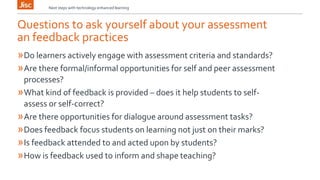
Questions to ask yourself about your assessment 
an feedback practices 
»Do learners actively engage with assessment criteria and standards? 
»Are there formal/informal opportunities for self and peer assessment 
processes? 
»What kind of feedback is provided – does it help students to self-assess 
or self-correct? 
»Are there opportunities for dialogue around assessment tasks? 
»Does feedback focus students on learning not just on their marks? 
»Is feedback attended to and acted upon by students? 
»How is feedback used to inform and shape teaching?
Next steps with technology enhanced learning 
Open Education Practice 
»Open Standards 
»Open Source 
»Open Education Resources 
(OERs) 
»Open Courses 
»Open Data 
»Open Badges
Next steps with technology enhanced learning 14 
An academic’s perspective on OERs
Open Badges: Jisc RSC Y&H Moodle User Group 15/5/14 
Open Badges 
Information infused digital images 
Image by Kyle Bowen
Next steps with technology enhanced learning 16 
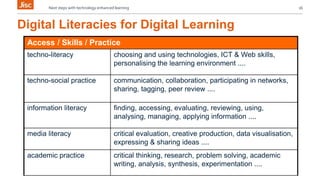
Digital Literacies for Digital Learning 
Access / Skills / Practice 
techno-literacy choosing and using technologies, ICT & Web skills, 
personalising the learning environment .... 
techno-social practice communication, collaboration, participating in networks, 
sharing, tagging, peer review .... 
information literacy finding, accessing, evaluating, reviewing, using, 
analysing, managing, applying information .... 
media literacy critical evaluation, creative production, data visualisation, 
expressing & sharing ideas .... 
academic practice critical thinking, research, problem solving, academic 
writing, analysis, synthesis, experimentation ....
Next steps with technology enhanced learning 17 
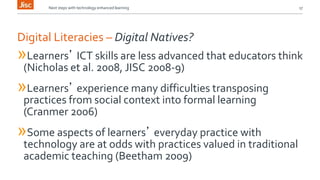
Digital Literacies – Digital Natives? 
»Learners’ ICT skills are less advanced that educators think 
(Nicholas et al. 2008, JISC 2008-9) 
»Learners’ experience many difficulties transposing 
practices from social context into formal learning 
(Cranmer 2006) 
»Some aspects of learners’ everyday practice with 
technology are at odds with practices valued in traditional 
academic teaching (Beetham 2009)
Next steps with technology enhanced learning 18 
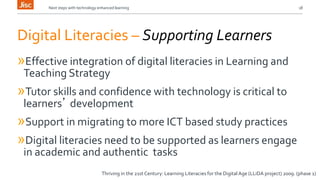
Digital Literacies – Supporting Learners 
»Effective integration of digital literacies in Learning and 
Teaching Strategy 
»Tutor skills and confidence with technology is critical to 
learners’ development 
»Support in migrating to more ICT based study practices 
»Digital literacies need to be supported as learners engage 
in academic and authentic tasks 
Thriving in the 21st Century: Learning Literacies for the Digital Age (LLiDA project) 2009. (phase 1)
Next steps with technology enhanced learning 07/11/2014 19 
Find out more… 
Joan Walker 
Jisc RSC Scotland 
advisor learning & teaching and 
deputy manager 
joan.walker@rsc-scotland.ac.uk 
Except where otherwise noted, this 
work is licensed under CC-BY-NC-ND

Next Steps with Technology Enhanced Learning

  • 1.
    07/11/2014 Next Stepswith Technology Enhanced Learning Joan Walker - Jisc RSC Scotland
  • 2.
    Next steps withtechnology enhanced learning 2 What’s on the Horizon 2012 »One Year or Less › Mobile Apps › Tablet Computing »Two to Three Years ›Game-based Learning › Learning Analytics »Four to Five Years › Gesture Based Computing › Internet of Things Image licensed for use in the public domain from http://pixabay.com/en/service/terms/
  • 3.
    Next steps withtechnology enhanced learning 3 What’s on the Horizon 2013 »One Year or Less ›MOOCs › Tablet Computing »Two to Three Years › Games & Gamification › Learning Analytics »Four to Five Years › 3D Printing ›Wearable Technology Image licensed for use in the public domain from http://pixabay.com/en/service/terms/
  • 4.
    Next steps withtechnology enhanced learning 4 What’s on the Horizon 2014 »One Year or Less › Flipped Classroom › Learning Analytics »Two to Three Years › 3D Printing › Games & Gamification »Four to Five Years ›Quantified Self › Virtual Assistants Image licensed for use in the public domain from http://pixabay.com/en/service/terms/
  • 5.
    Next steps withtechnology enhanced learning The Gartner Cycle
  • 6.
    Next steps withtechnology enhanced learning Current Hot Topics in post 16 Image licensed for use in the public domain from http://pixabay.com/en/service/terms/ Cloud Services Image licensed for use in the public domain from http://pixabay.com/en/service/terms/ Social Media WiFi Access & BYOD Mobile Learning & Using Apps
  • 7.
    Next steps withtechnology enhanced learning 7 Technical Support for a range of mobile devices & software network security Provision of mobile friendly resources New Skills Sets for staff & students Plagiarism Authentication Accessibility considerations eSafety & Safeguarding Challenges
  • 8.
    Mobile Learning 8 RSC Scotland Showcase www.rsc-scotland.org
  • 9.
    Next steps withtechnology enhanced learning Key Drivers of Change »Pedagogies to engage students supported by technologies »Open Education »Digital Literacies for Digital Learning
  • 10.
    Next steps withtechnology enhanced learning Pedagogies to engage students supported by technologies »Assessment & Feedback »Collaborative Activities »Peer Review »Self Reflection »Self Regulation How am I doing? What is really making me think? Where do I have to focus my revision? What are my targets? What are my strengths and weaknesses? Is this the best way for me to learn?
  • 11.
    REAP principles Nextsteps with technology enhanced learning »Encourage time and effort on challenging learning tasks »Facilitate the development of self-assessment and reflection in learning »Involve learners indecision-making about assessments policy and practice »Give choice in the topic, method and criteria or timing of assessments »Clarify what good performance is »Deliver high quality feedback to help learners self-correct »Provide opportunities to act on feedback »Encourage interaction and dialogue around learning »Support the development of learning communities »Encourage positive motivational beliefs and self-esteem »Provide information to teachers that can be used to help shape the teaching »Ensure summative assessment has a positive impact on learning Feedback Assessment
  • 12.
    Next steps withtechnology enhanced learning Questions to ask yourself about your assessment an feedback practices »Do learners actively engage with assessment criteria and standards? »Are there formal/informal opportunities for self and peer assessment processes? »What kind of feedback is provided – does it help students to self-assess or self-correct? »Are there opportunities for dialogue around assessment tasks? »Does feedback focus students on learning not just on their marks? »Is feedback attended to and acted upon by students? »How is feedback used to inform and shape teaching?
  • 13.
    Next steps withtechnology enhanced learning Open Education Practice »Open Standards »Open Source »Open Education Resources (OERs) »Open Courses »Open Data »Open Badges
  • 14.
    Next steps withtechnology enhanced learning 14 An academic’s perspective on OERs
  • 15.
    Open Badges: JiscRSC Y&H Moodle User Group 15/5/14 Open Badges Information infused digital images Image by Kyle Bowen
  • 16.
    Next steps withtechnology enhanced learning 16 Digital Literacies for Digital Learning Access / Skills / Practice techno-literacy choosing and using technologies, ICT & Web skills, personalising the learning environment .... techno-social practice communication, collaboration, participating in networks, sharing, tagging, peer review .... information literacy finding, accessing, evaluating, reviewing, using, analysing, managing, applying information .... media literacy critical evaluation, creative production, data visualisation, expressing & sharing ideas .... academic practice critical thinking, research, problem solving, academic writing, analysis, synthesis, experimentation ....
  • 17.
    Next steps withtechnology enhanced learning 17 Digital Literacies – Digital Natives? »Learners’ ICT skills are less advanced that educators think (Nicholas et al. 2008, JISC 2008-9) »Learners’ experience many difficulties transposing practices from social context into formal learning (Cranmer 2006) »Some aspects of learners’ everyday practice with technology are at odds with practices valued in traditional academic teaching (Beetham 2009)
  • 18.
    Next steps withtechnology enhanced learning 18 Digital Literacies – Supporting Learners »Effective integration of digital literacies in Learning and Teaching Strategy »Tutor skills and confidence with technology is critical to learners’ development »Support in migrating to more ICT based study practices »Digital literacies need to be supported as learners engage in academic and authentic tasks Thriving in the 21st Century: Learning Literacies for the Digital Age (LLiDA project) 2009. (phase 1)
  • 19.
    Next steps withtechnology enhanced learning 07/11/2014 19 Find out more… Joan Walker Jisc RSC Scotland advisor learning & teaching and deputy manager joan.walker@rsc-scotland.ac.uk Except where otherwise noted, this work is licensed under CC-BY-NC-ND

Editor's Notes

  • #6 A hype cycle in can be broken down into five phases: "Technology Trigger" — The first phase of a hype cycle is the "technology trigger" or breakthrough, product launch or other event that generates significant press and interest. "Peak of Inflated Expectations" — In the next phase, a frenzy of publicity typically generates over-enthusiasm and unrealistic expectations. There may be some successful applications of a technology, but there are typically more failures. "Trough of Disillusionment" — Technologies enter the "trough of disillusionment" because they fail to meet expectations and quickly become unfashionable. Consequently, the press usually abandons the topic and the technology. "Slope of Enlightenment" — Although the press may have stopped covering the technology, some businesses continue through the "slope of enlightenment" and experiment to understand the benefits and practical application of the technology. "Plateau of Productivity" — A technology reaches the "plateau of productivity" as the benefits of it become widely demonstrated and accepted.
  • #8 Mobile learning is about the mobility of the learner Mobile learning is about context – what can mobile learning do that desk-bound computing can’t? Mobile learning can provide solutions to personalising learning
  • #11 Any number of technologies can support these – Turnitin / Peerwise / Moodle workshops / ePortfolios / Blogs / Wikis / different Social Media & Apps 7 - The impact of new and ubiquitous technologies enable new paradigms of learning & teaching to be developed which increase the possibilities for Personalised Learning and improve Learner Engagement. Although online instructional materials are widely available and make use of digital images, video animation and are great for understanding and replaying processes – they are still in my opinion rather passive so it’s more about learning activities that engage learners to process & assimilate information in new and more exciting ways.   Discovery learning and enquiry based approaches / like structured web quests using eResources (e.g. simple activity sheets with hyperlinks to rich resources – means that the onus shifts from being given information to learners finding out information & sharing it with peers – a much more proactive activity) Collaborative learning / with collective outputs that exploit new technologies (e.g. planning an event or constructing a and information resource using software features that enable co-editing that results in tangible output of the collaborative process – WIKI, Google doc) Reflective activities using online tools which measures distance travelled and learning taking place rather than assessment of knowledge or skill and demonstrates to learners their own progress. (using Blogs or ePortfolio to record diary type journal entries) Using multimedia creatively and for assessment purposes. Internet access is all that’s required to access, record, store and stream video and audio to the desktop. (e.g. Digital images may provide a mechanism for students to demonstrate and record skills acquisition, using audio may be a vehicle which would allow learners to provide a much richer account of what they have learnt than a written account ) Peer Review – a formal term to describe the process of commenting or adding to others’ contributions (tools that enable comment , discussion or enable a star rating for example) eAssessment / both formative and summative which can provide quick and relevant feedback to learners and support personalisation of the learning experience. (designing e-assessments – especially those that address higher order skills a critical area for staff development) Learning technologies are collectively becoming known as “learning platforms” and there are more alternatives now to choose from and I guess that’s making strategic decisions even more difficult. If you add to that the move towards open source software & the range of free web based applications that are available now its not hard to see how difficult it is for an institution to accommodate individual preferences.
  • #14  over the last 10 years or so the trend for open has become ever more prevalent Open Educational Practices (OEP) have been defined in various ways. Although, there is no one definition, they may be summarised as follows: Open Educational Practices can be described are teaching techniques that draw upon open technologies and high-quality Open Educational Resources (OER) in order to facilitate collaborative and flexible learning.[1][2] Other open movements are Open source, so coders and programmers are a huge community that are probably the best example of reusing and sharing their work to create and develop new services and technologies with other likeminded people Open data, the ability of organisations to make datasets available on many different topics to be mashed up with other sets of data to create new services , data.gov.uk is the governments answer to releasing public data in one searchable website to enable other to create data mashups and create new services and bring together information in different ways has some examples such as Open access publishing… the hot topic in the information sector right now the practice of providing unrestricted access to peer reviewed scholarly research green and gold open access being the two main offers Green open access[7][8] authors publish in any journal and self-archive a version of the article for gratis public use in their institutional repository,[9] in a central repository (such as PubMed Central), or on some other open access website.[10] Open access journals[11] provide immediate open access to all of their articles on the publisher's website.[10] Hybrid open access journals provide Gold open access only for those individual articles for which their authors (or their author's institution or funder) pay an open access publishing fee Open courseware – services such as khan academy, MIT courseware are good examples of this, MIT made their course materials and structure open to everyone, over 200 courses that have had, to date, 125 million visitors
  • #17 Techno - literacies characteristic - rapid change with economic and social drivers Academic literacies typically slow change with cultural and institutional inhibitors Key skills required by learners learning in the cloud / future:
  • #18 Digital Natives - because learners have grown up with computers that there ‘s an expectation that they would in turn have excellent digital literacy skills but research has not corroborated this theory: - As well as the educators perceptions perhaps being inaccurate, learners have little awareness that their information literacies are relatively weak - their skills are focused on a ‘need to know’ or ‘interest’ basis – maybe gaming / communicating but not articulating or reflecting necessarily. Learners’ experience many difficulties transposing practices from social context into formal learning And there is a clash of academic/internet knowledge cultures, particularly around plagiarism, assessment and originality in student writing
  • #19 Some of the issues around digital literacies 1 - A lack of ownership at institutional level means that learning literacies and digital literacies are rarely the basis of an integrated strategy / staff working in the areas that traditionally support information literacy / academic scholarship and ICT still operate in relative isolation from one another 2 - Tutors still insufficiently competent and confident with digital technologies for learning despite evidence that learners are strongly influenced by their example 3 - Still quite poor support for learners to develop strategies to make effective use of technologies for learning - some institutional barriers still exist in terms of the use of personal technologies and social networks 4 - e.g. Be specific about what kinds of collaboration might be appropriate, establish peer review processes and setting group assignments. - in some subjects literacies are so embedded in subject teaching that its not recognised - e.g. visual / media literacies in art and it might be a first step to identify these within programmes