QHSE
Quality Health Safety & Environmental
Awareness Training
Jamaluddin Ma’ruf
IRCA-Certified
QMS Lead Auditor & HSE Expert
More than 16 years experience in developing quality management to increase
productivity and reduce nonconformity in achieve company objectives.
Jakarta, 17 March 2015
TRAINING AGENDA
 09.00 – 09.15 Opening by Management
 09.15 – 09.30 HSE Moment
Section 1
 09.30 – 10.00 QHSE Goal & Effect
 10.00 – 10.15 Coffee Time
 10.15 – 12.00 Part of QA/QC
 12.00 – 13.00 Break and Lunch
Section 2
 13.00 – 14.00 Process Model
Section 3
 14.00 – 15.00 Integrated Management System
Section 4
 15.00 – 15.15 Coffee Time
 15.15 – 16.00 8 Principles Management
 16.00 – 16.30 Document Management System
Jamaluddin M – QMS Lead Auditor 1
Session 1
◦ Goal of QHSE
◦ QHSE Affect
Jamaluddin M – QMS Lead Auditor 2
Awareness Goal
The goal is :
 Audiences able to
understand through out
basic concept of
Integrated Management
System.
3
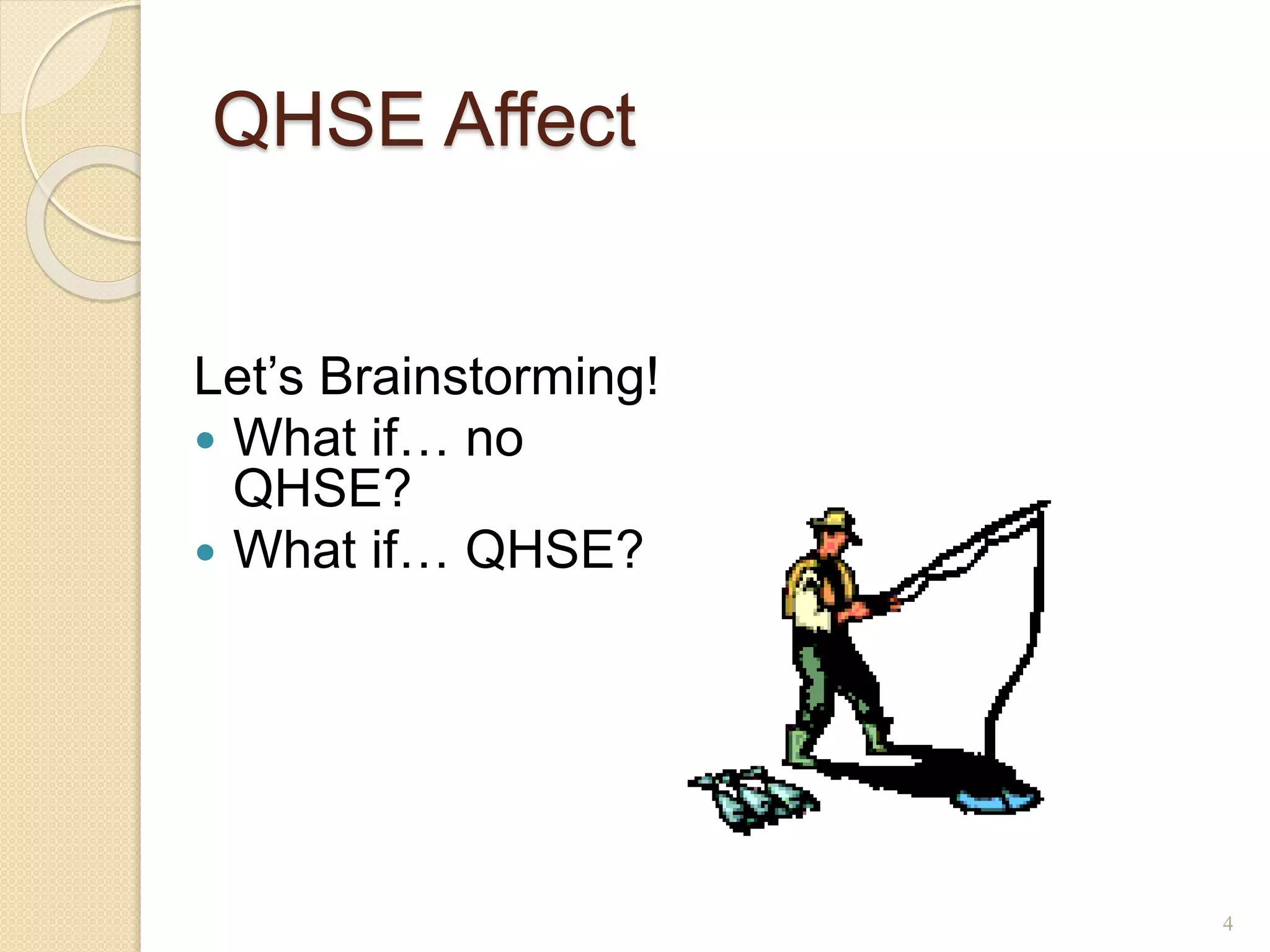
QHSE Affect
Let’s Brainstorming!
 What if… no
QHSE?
 What if… QHSE?
4
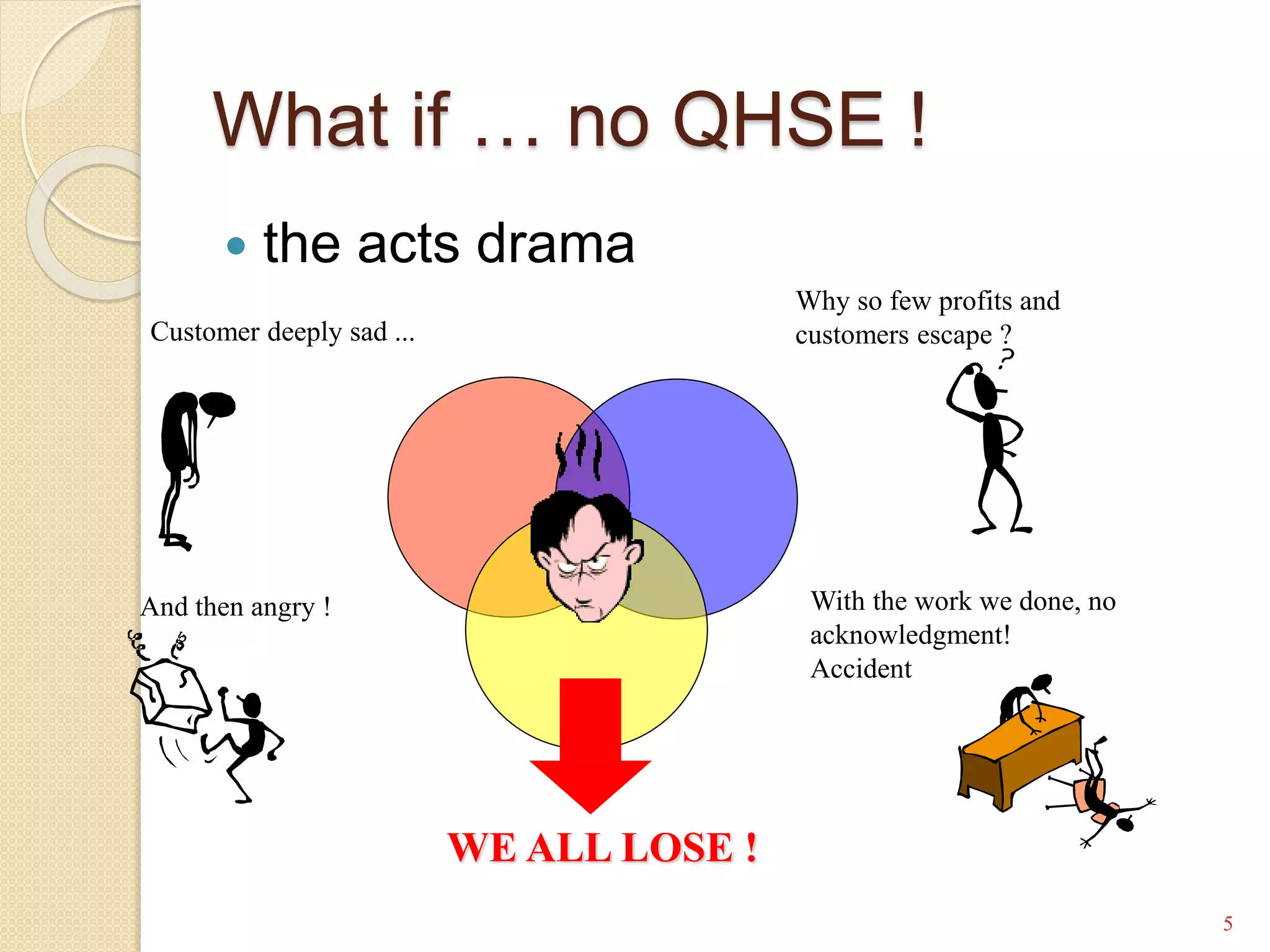
What if … no QHSE !
 the acts drama
WE ALL LOSE !
And then angry !
Why so few profits and
customers escape ?
With the work we done, no
acknowledgment!
Accident
Customer deeply sad ...
5
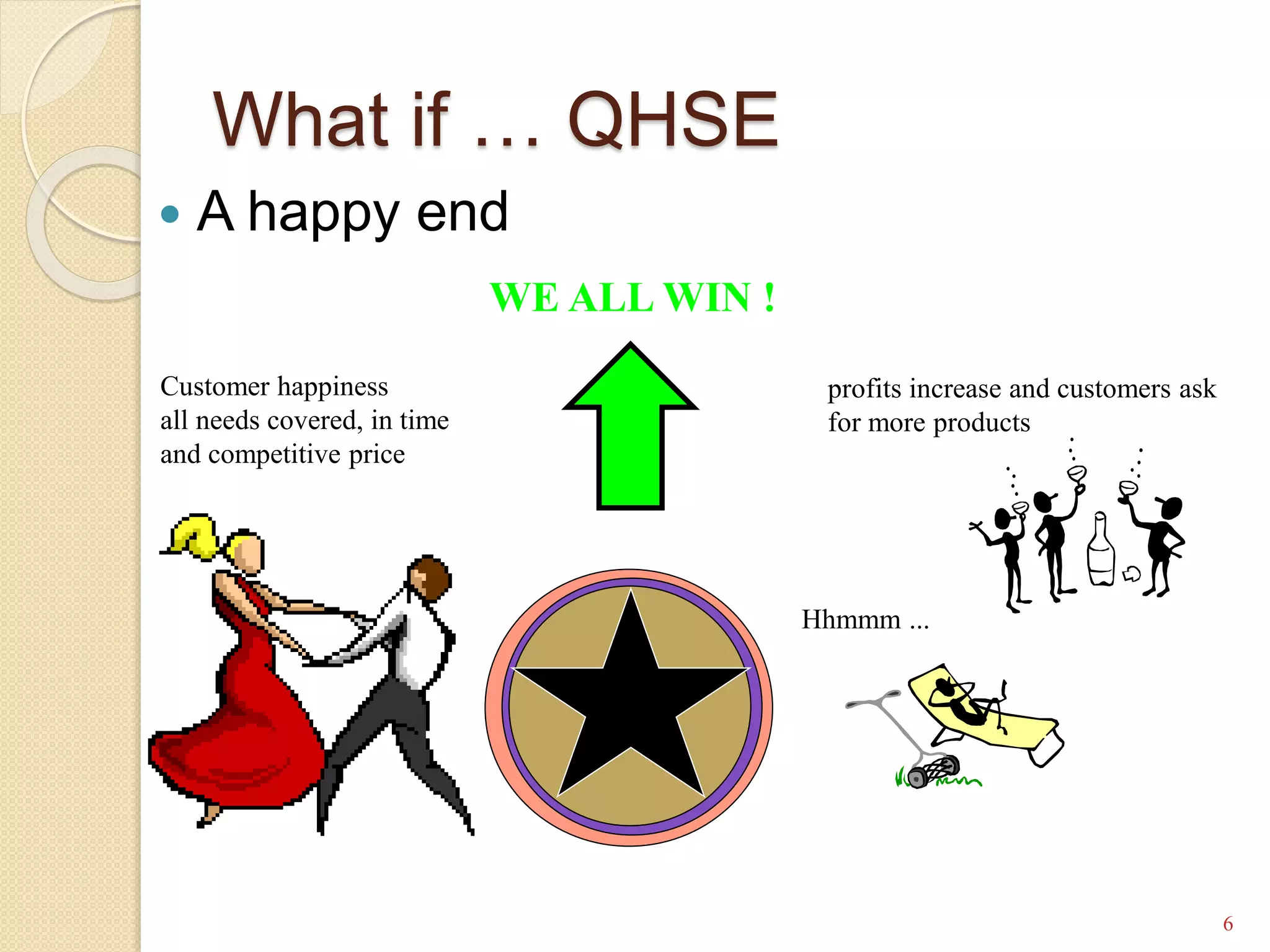
What if … QHSE
 A happy end
Customer happiness
all needs covered, in time
and competitive price
profits increase and customers ask
for more products
Hhmmm ...
WE ALL WIN !
6
Part of QHSE
PART OF QHSE
 Quality Assurance & Quality Control
 Hazard Identification & Risk Control
 Environmental Aspect & Impact
Monitoring & Control
Jamaluddin M – QMS Lead Auditor 7
Quality Assurance & Quality Control
 QA is Quality
Assurance
Warranty to
processes
- part of QHSE focused on providing
confidence that quality requirements will
be fulfilled
 QC is Quality
Control
Warranty to product
- part of QHSE focused on fulfilling
quality requirements.
Jamaluddin M – QA Coordinator 8
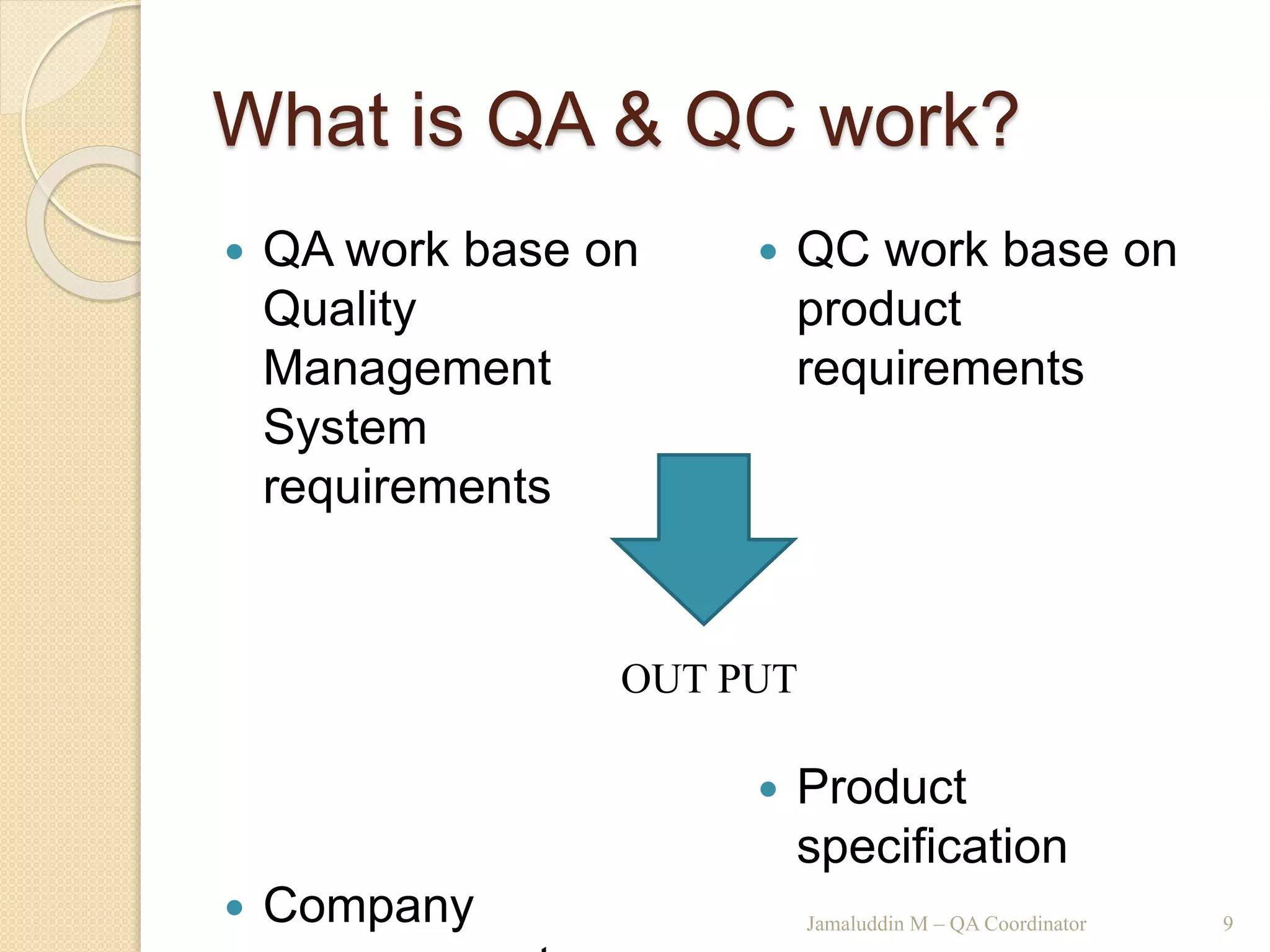
What is QA & QC work?
 QA work base on
Quality
Management
System
requirements
 Company
 QC work base on
product
requirements
 Product
specification
Jamaluddin M – QA Coordinator 9
OUT PUT
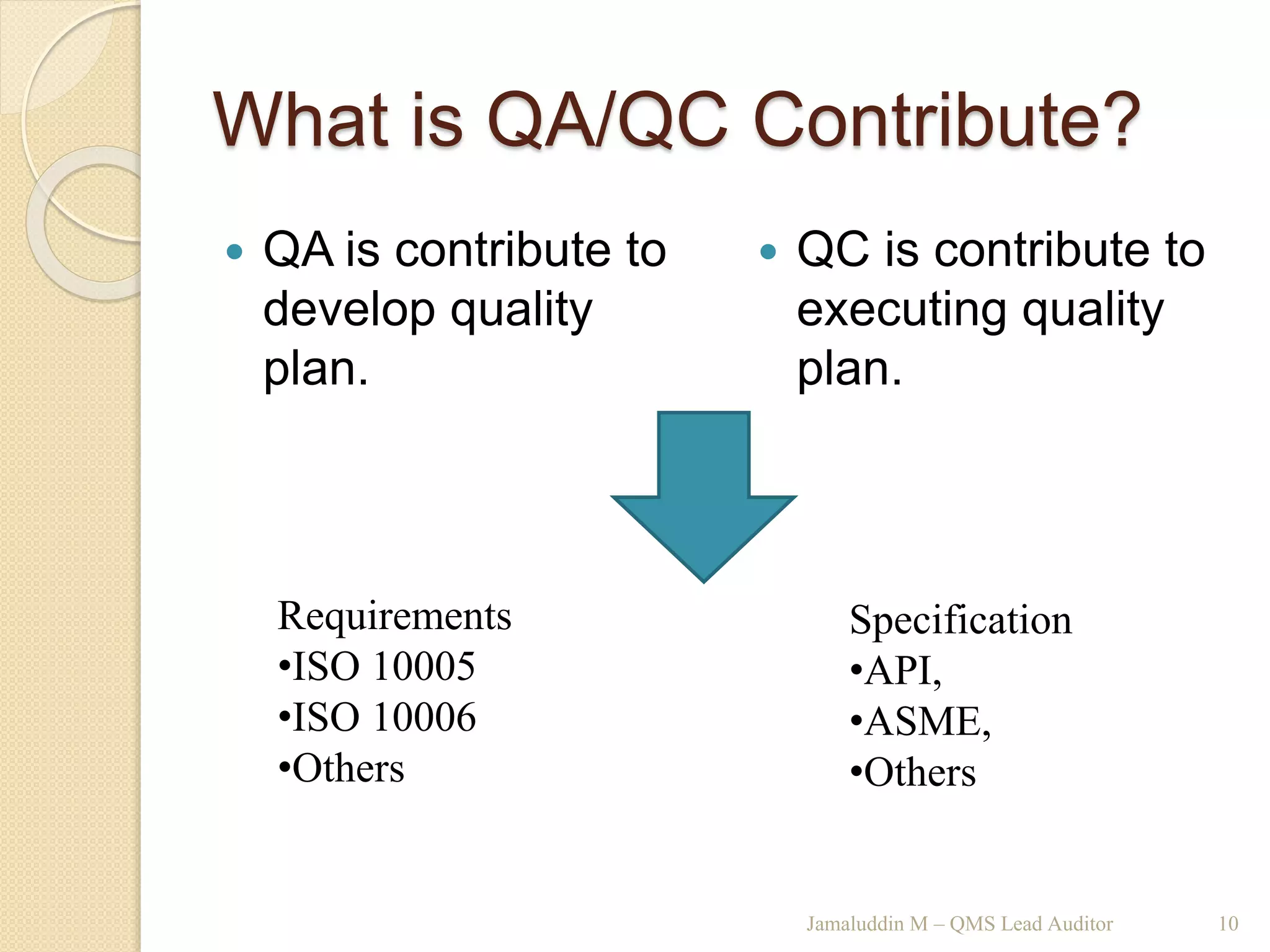
What is QA/QC Contribute?
 QA is contribute to
develop quality
plan.
 QC is contribute to
executing quality
plan.
Jamaluddin M – QMS Lead Auditor 10
Requirements
•ISO 10005
•ISO 10006
•Others
Specification
•API,
•ASME,
•Others
What shall QA & QC monitor?
 QA monitoring of
system
performance
◦ Quality objective
◦ Training & competency
◦ Resources
◦ Competitor
◦ Supplier
◦ Preventive & Corrective
action
◦ Customer complaint &
satisfaction
◦ Document & Data system
 QC monitoring of
product
performance
◦ Statistical product
characteristics
◦ Product quality both of
Incoming, process & final
Jamaluddin M – QA Coordinator 11
What is QA & QC correlation?
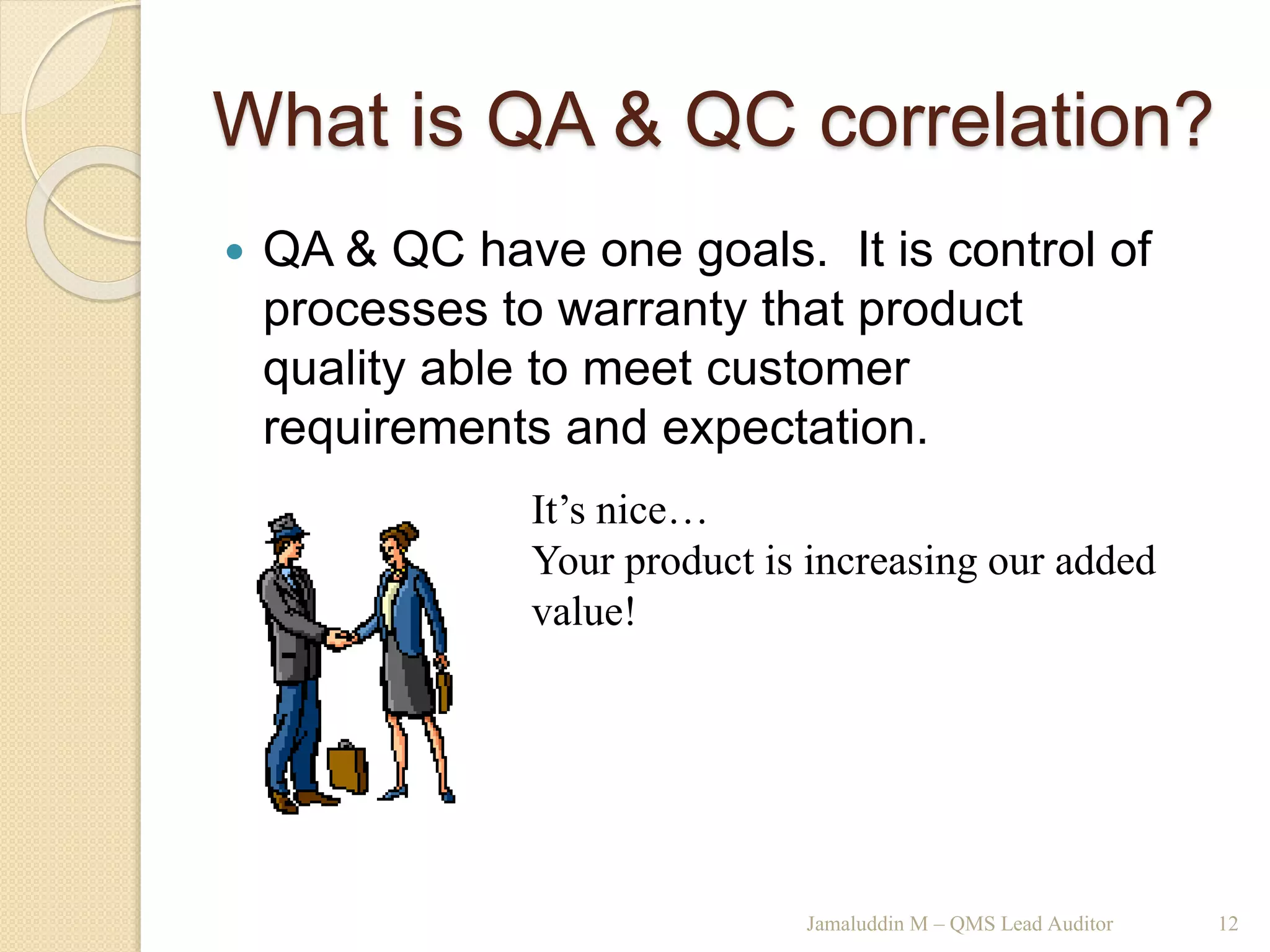
 QA & QC have one goals. It is control of
processes to warranty that product
quality able to meet customer
requirements and expectation.
Jamaluddin M – QMS Lead Auditor 12
It’s nice…
Your product is increasing our added
value!
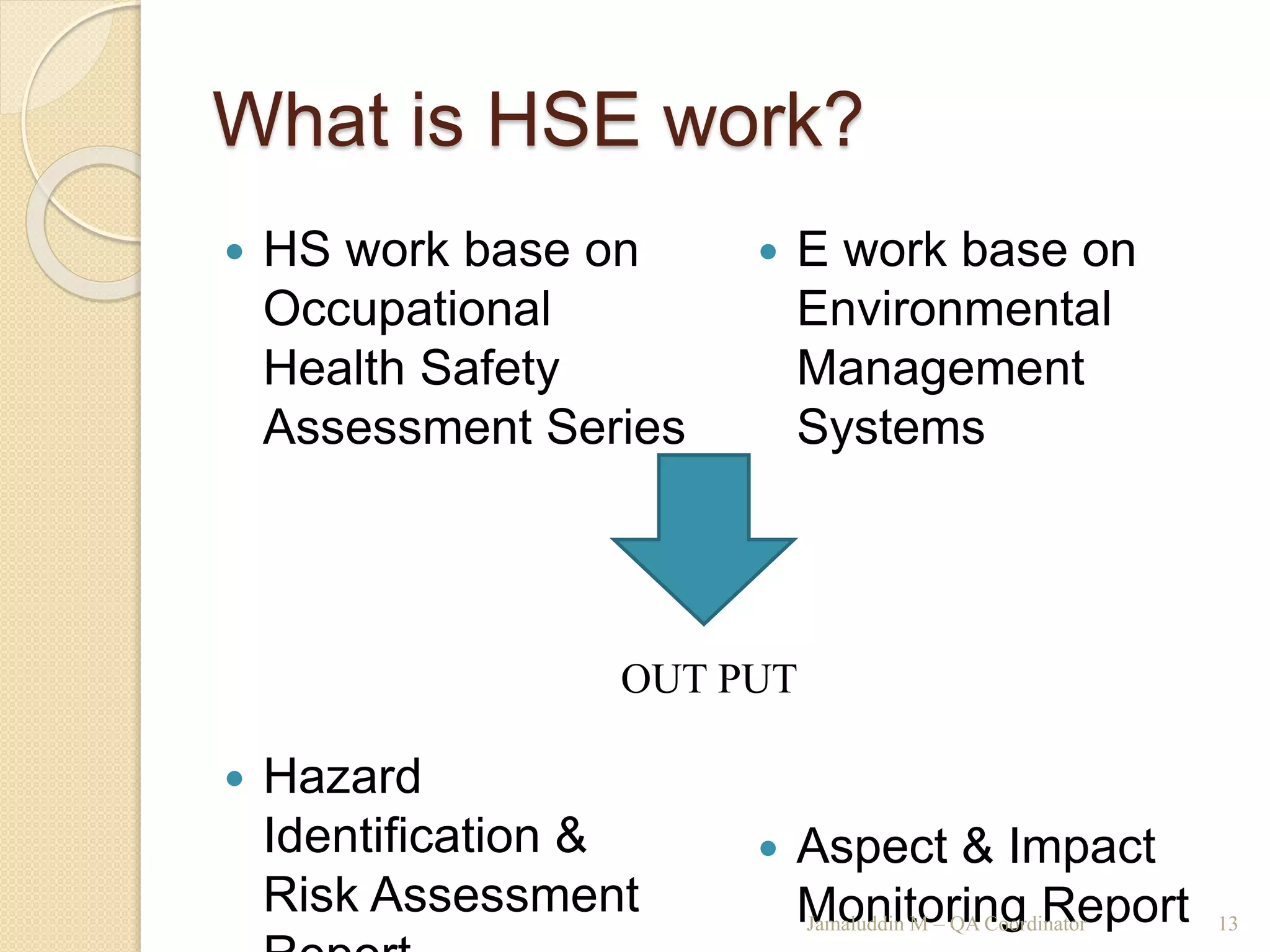
What is HSE work?
 HS work base on
Occupational
Health Safety
Assessment Series
 Hazard
Identification &
Risk Assessment
 E work base on
Environmental
Management
Systems
 Aspect & Impact
Monitoring ReportJamaluddin M – QA Coordinator 13
OUT PUT
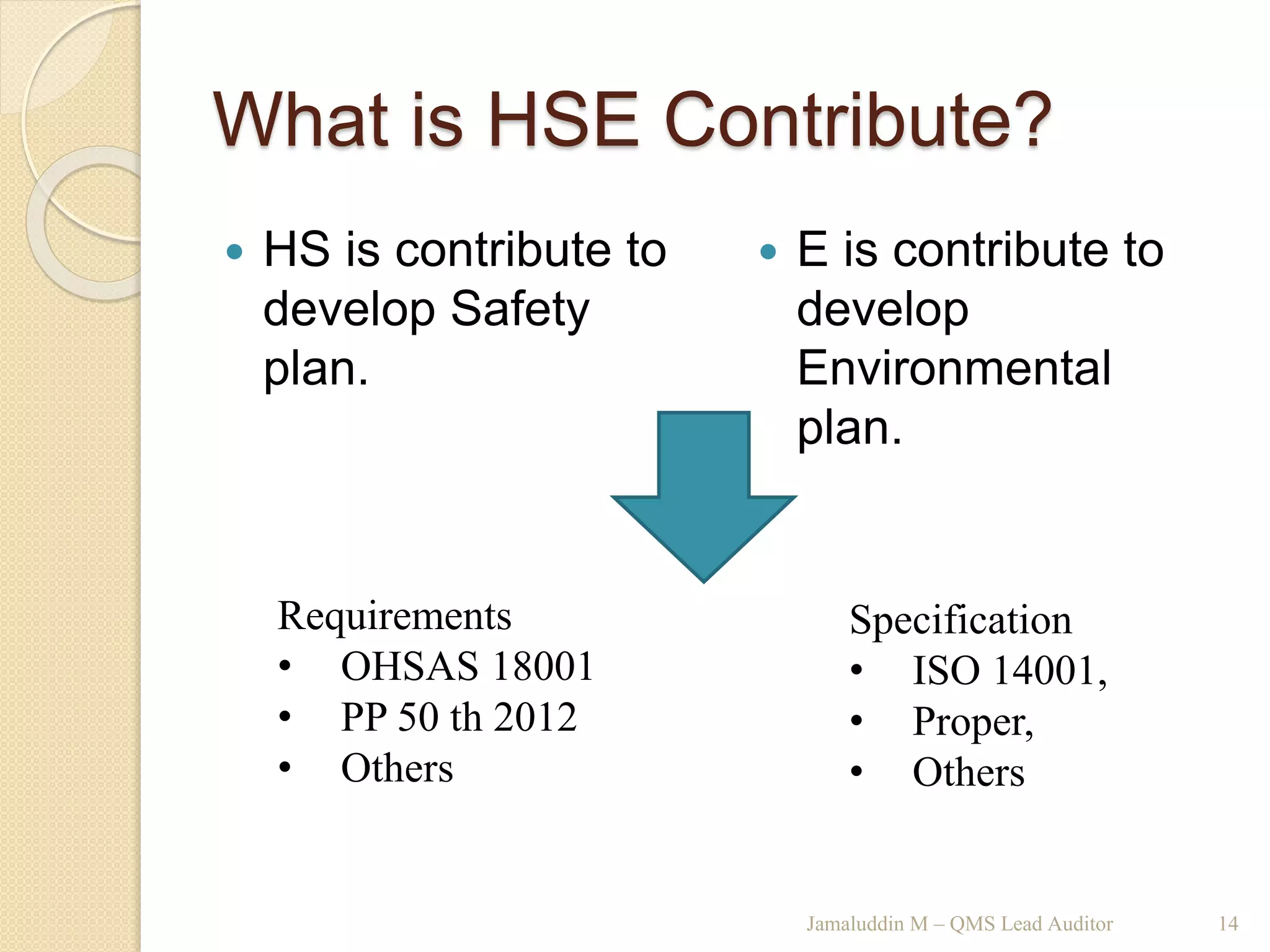
What is HSE Contribute?
 HS is contribute to
develop Safety
plan.
 E is contribute to
develop
Environmental
plan.
Jamaluddin M – QMS Lead Auditor 14
Requirements
• OHSAS 18001
• PP 50 th 2012
• Others
Specification
• ISO 14001,
• Proper,
• Others
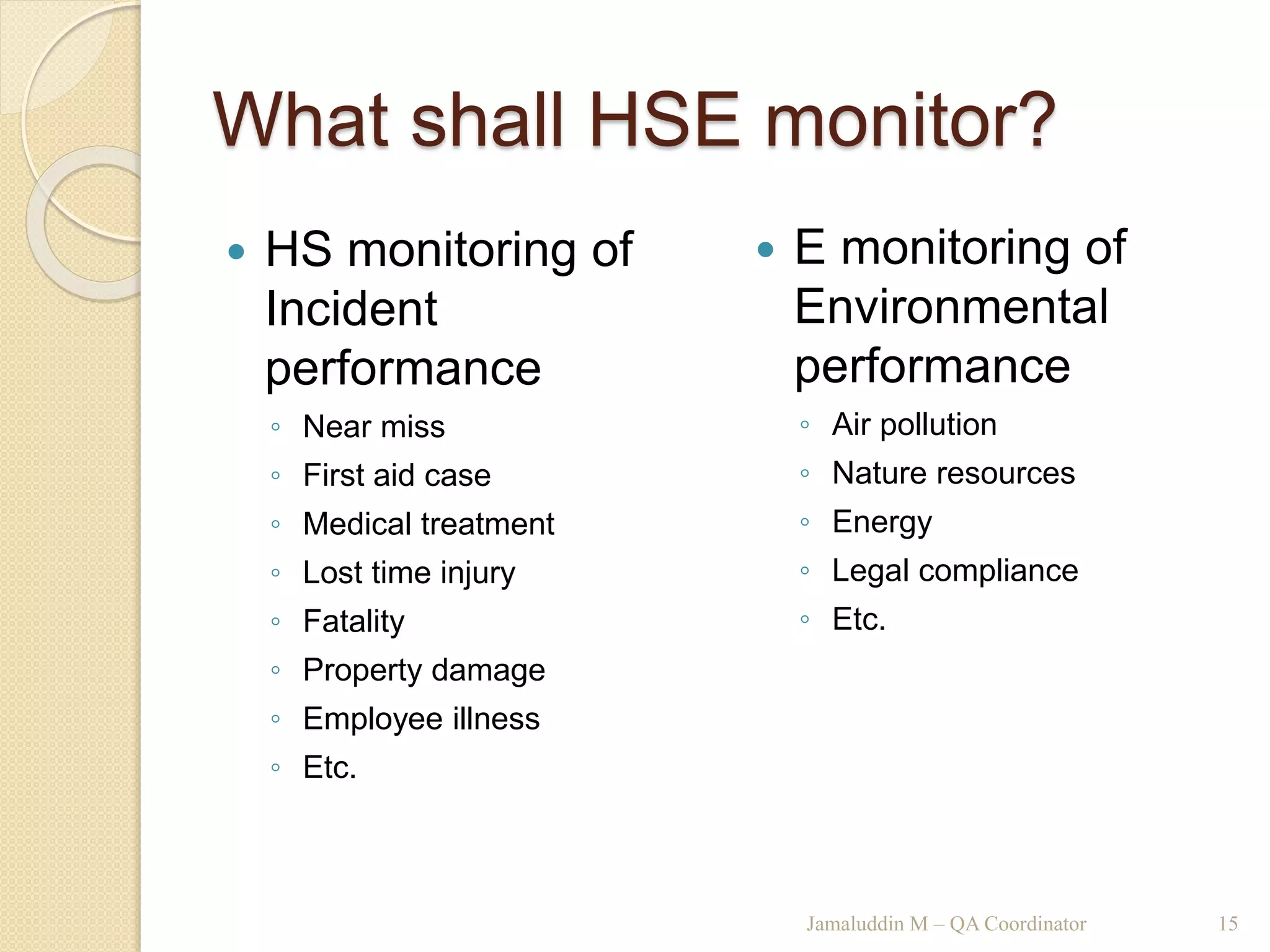
What shall HSE monitor?
 HS monitoring of
Incident
performance
◦ Near miss
◦ First aid case
◦ Medical treatment
◦ Lost time injury
◦ Fatality
◦ Property damage
◦ Employee illness
◦ Etc.
 E monitoring of
Environmental
performance
◦ Air pollution
◦ Nature resources
◦ Energy
◦ Legal compliance
◦ Etc.
Jamaluddin M – QA Coordinator 15
What is HS & E correlation?
 HS & E have one goals.
It is control of
processes to warranty
that processes will not
built personnel injury
and environmental
defects.
Jamaluddin M – QMS Lead Auditor 16
Why QHSE Shall be
integrated
Jamaluddin M – QMS Lead Auditor 17
We are agree :
To achieve
company objective
with reduce
nonconformity and
prevent zero lost
time injury in one
mature system.
Section 2
PROCESS MODEL
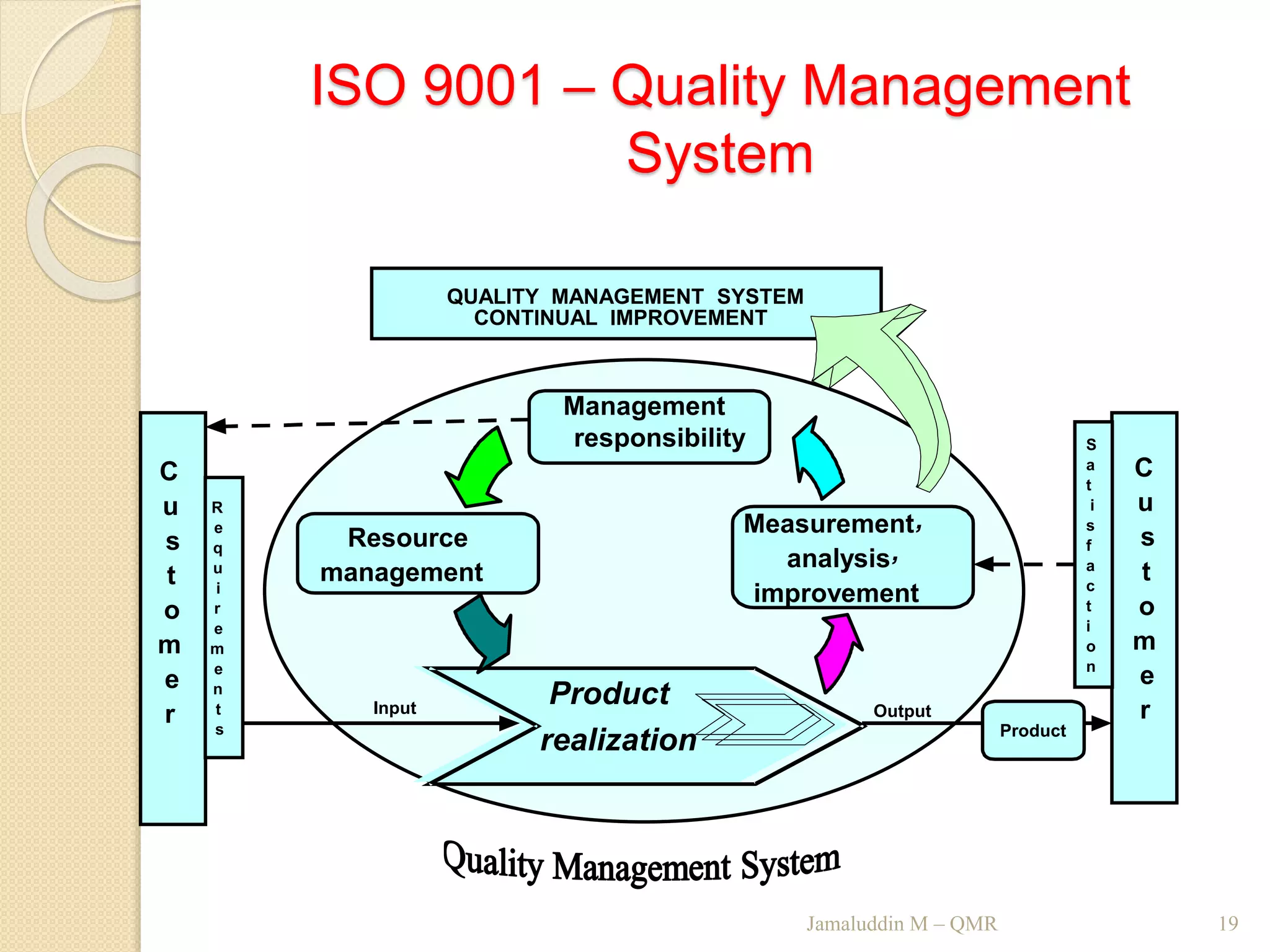
 ISO 9001
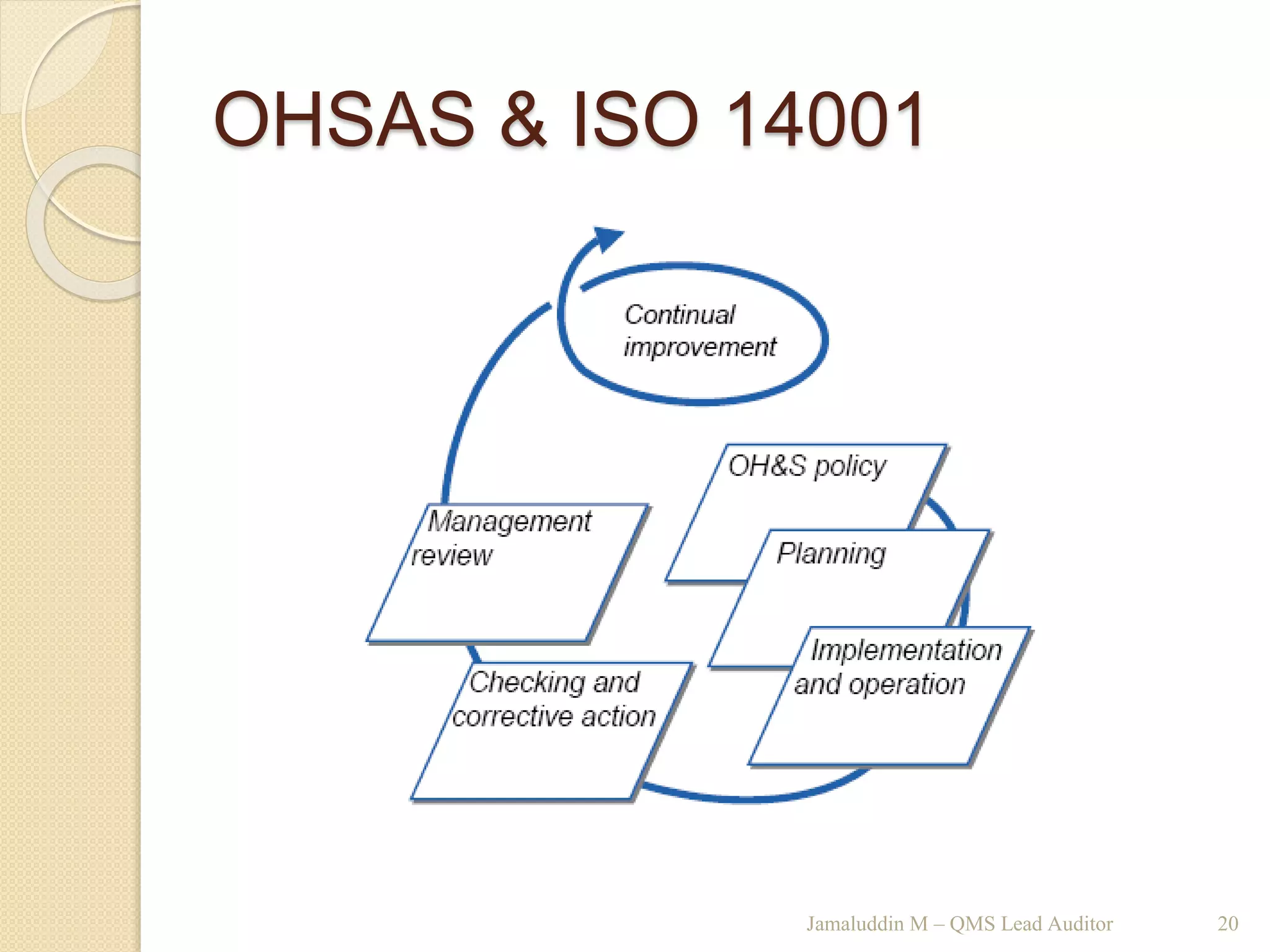
 OHSAS & ISO 14001
Jamaluddin M – QMS Lead Auditor 18
Jamaluddin M – QMR 19
Management
responsibility
Measurement,
analysis,
improvement
Resource
management
Product
realization
C
u
s
t
o
m
e
r
R
e
q
u
i
r
e
m
e
n
t
s
C
u
s
t
o
m
e
r
S
a
t
i
s
f
a
c
t
i
o
n
QUALITY MANAGEMENT SYSTEM
CONTINUAL IMPROVEMENT
Input Output
Product
ISO 9001 – Quality Management
System
OHSAS & ISO 14001
Jamaluddin M – QMS Lead Auditor 20
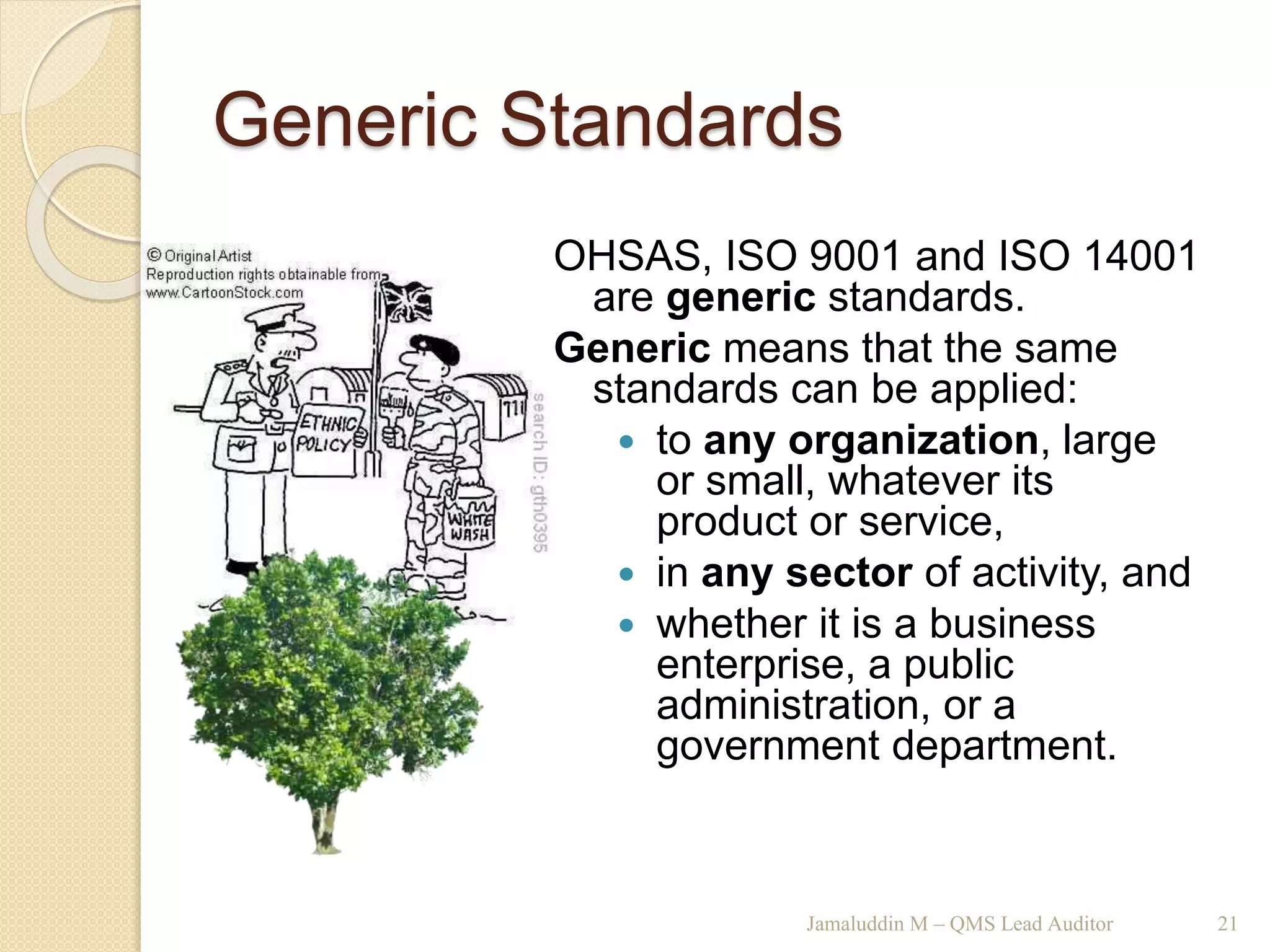
Generic Standards
Jamaluddin M – QMS Lead Auditor 21
OHSAS, ISO 9001 and ISO 14001
are generic standards.
Generic means that the same
standards can be applied:
 to any organization, large
or small, whatever its
product or service,
 in any sector of activity, and
 whether it is a business
enterprise, a public
administration, or a
government department.
Generic standards
Jamaluddin M – QMS Lead Auditor 22
Generic also signifies that
 no matter what the organization's scope of activity
 if it wants to establish a Occupational Health &
Safety Management System, OHSAS 18001 gives
the essential features,
 or if it wants to establish a quality management
system, ISO 9001 gives the essential features
 or if it wants to establish an environmental
management system, ISO 14001 gives the
essential features.
Processes, not products
 Processes affect final products or services.
 OHSAS gives the requirements for what to enable
an organization to control its OH&S risks and
improve its OH&S performance in preventing
personal injure and ill health.
 ISO 9001 gives the requirements for what the
organization must do to manage processes
affecting quality of its products and services.
 ISO 14001 gives the requirements for what the
organization must do to manage processes
affecting the impact of its activities on the
environment.
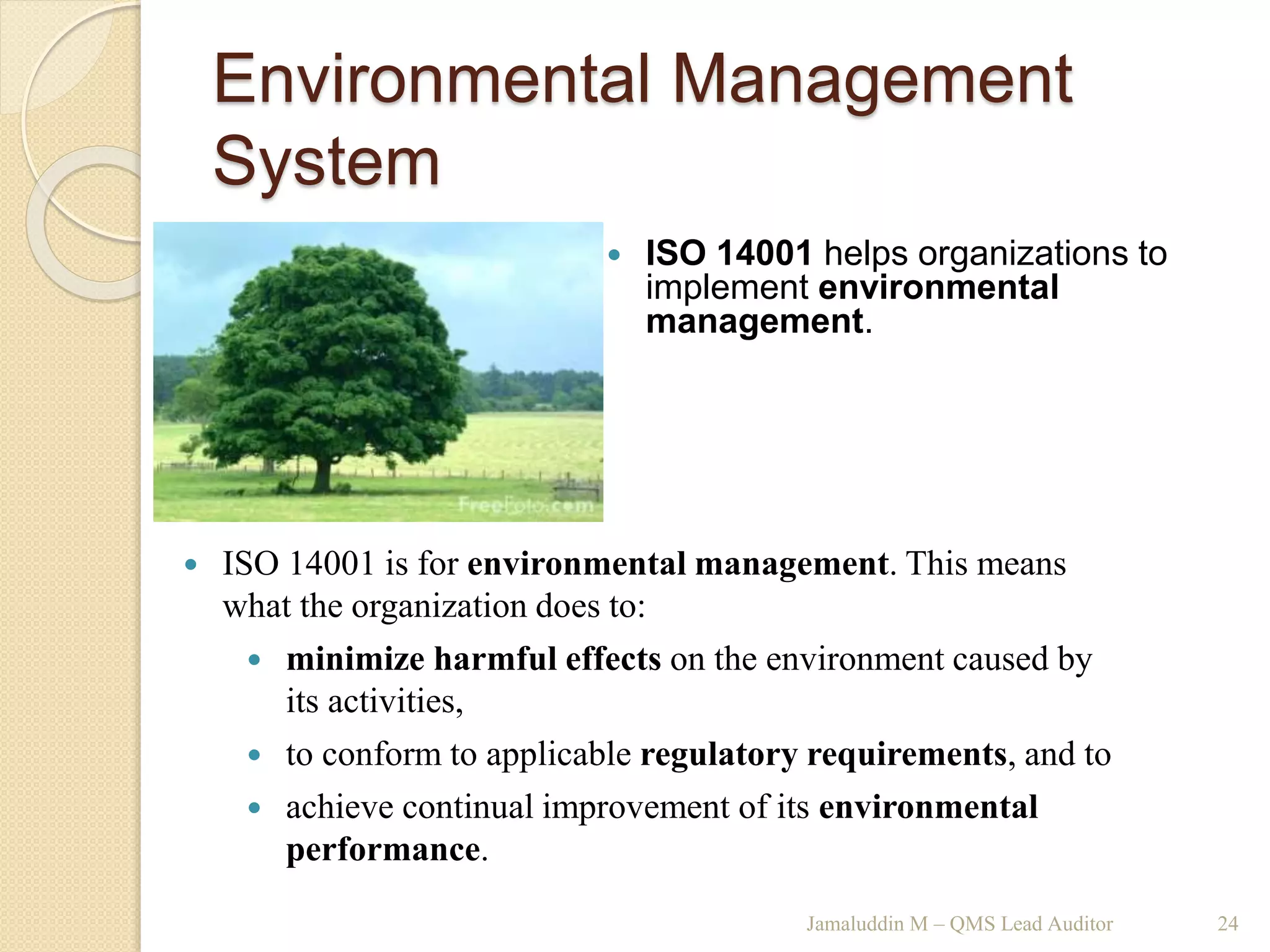
Environmental Management
System
Jamaluddin M – QMS Lead Auditor 24
 ISO 14001 helps organizations to
implement environmental
management.
 ISO 14001 is for environmental management. This means
what the organization does to:
 minimize harmful effects on the environment caused by
its activities,
 to conform to applicable regulatory requirements, and to
 achieve continual improvement of its environmental
performance.
Hazard Identification, Risk
Assessment & Risk Control
Jamaluddin M – QMS Lead Auditor 25
• Conceptually similar to
environmental aspects and
impacts –target of management
program(s)
• Much more detailed than 14001
approach
• Assessment must address:
– routine and non-routine
activities
– all personnel, including
contractors and visitors
– facilities at the workplace,
whether provided by the
organization or by others
Hazard Identification, Risk
Assessment & Risk Control
Jamaluddin M – QMS Lead Auditor 26
• Methodology must be proactive
– in advance of process/equipment
changes
– allow engineering of hazard
controls during design
– implementation of controls as
change occurs
• Success requires strong
Management of Change (MOC)
procedure
Hazard Identification, Risk
Assessment & Risk Control
Jamaluddin M – QMS Lead Auditor 27
• Process overview
– identification of hazards
– evaluation of risks under current
controls
– evaluation of the tolerability of
residual risk
– identification of needed additional
controls
• People are involved
– significant risks must be
controlled
– individual behaviour is a
significant factor
Section 3
Jamaluddin M – QMS Lead Auditor 28
Integrated Management System (IMS)
• Concept model
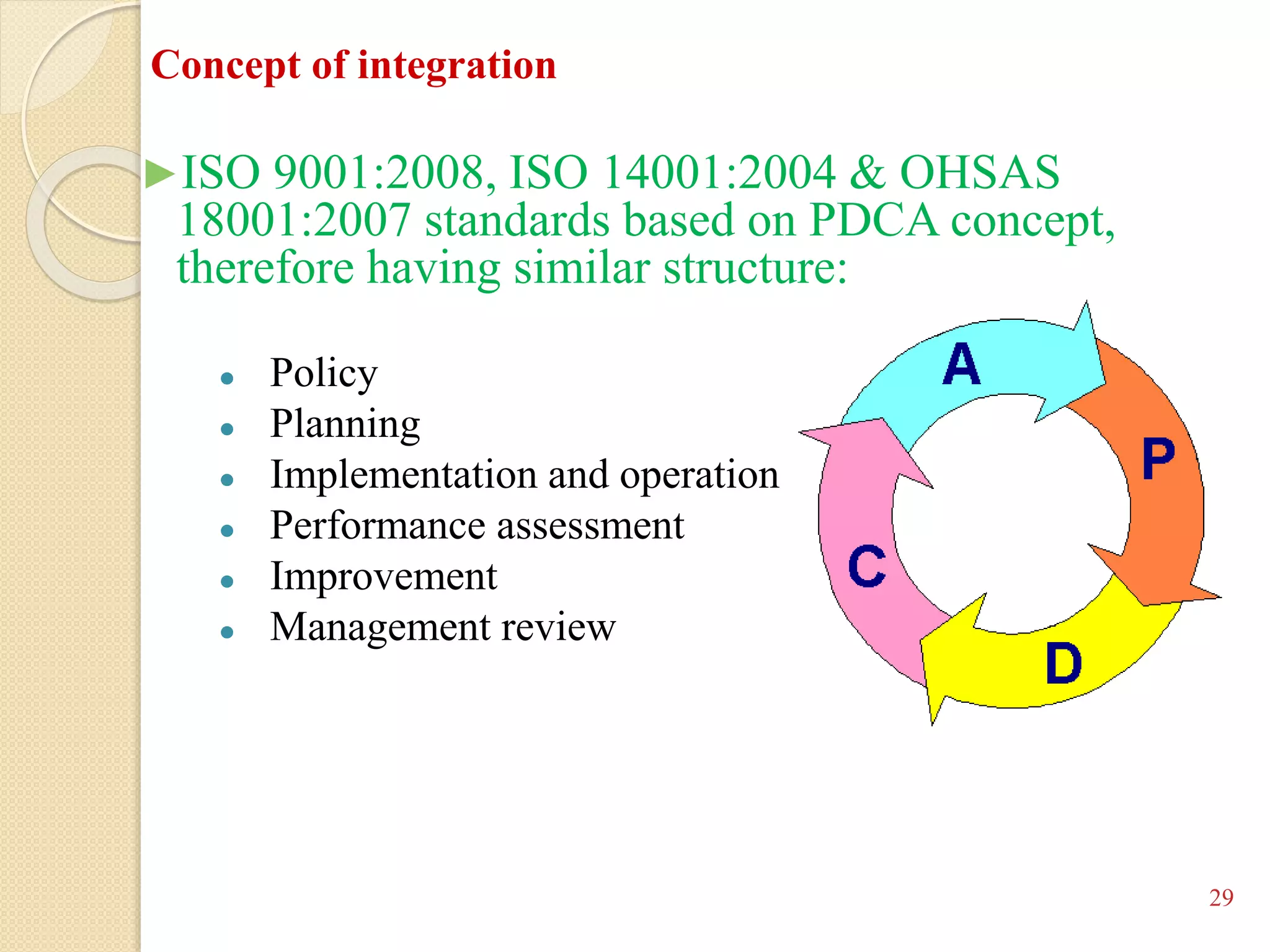
Concept of integration
►ISO 9001:2008, ISO 14001:2004 & OHSAS
18001:2007 standards based on PDCA concept,
therefore having similar structure:
 Policy
 Planning
 Implementation and operation
 Performance assessment
 Improvement
 Management review
29
Integrated Management
Systems
Jamaluddin M – QMS Lead Auditor 30
 Integrated Management system means
what the organization does to manage its
processes, or activities with combine
some standards requirements in order
that
 its products or services meet the
organization’s objectives, such as
 satisfying the customer's quality &
processes requirements,
 complying to regulations, or
 save environmental
Various Standards
One Standards
Integrated Management
Systems
Jamaluddin M – QMS Lead Auditor 31
 To be really efficient and effective,
the organization can manage its
way of doing things by
systemizing it.
 Everyone is clear about who is
responsible for doing what, when,
how, why and where.
 Integrated Management system
provide the organization with an
international, state-of-the-art
model to follow.
Integrated is Processes, not
products
 Both OHSAS, ISO 9001 and ISO
14001 concern the way an
organization goes about its
work.
 They are not product standards.
 They are not service standards.
 They are process parameters.
 They can be used by product
manufacturers and service
providers.
Session 4
◦ 8 Principles Managements
Jamaluddin M – QMS Lead Auditor 33
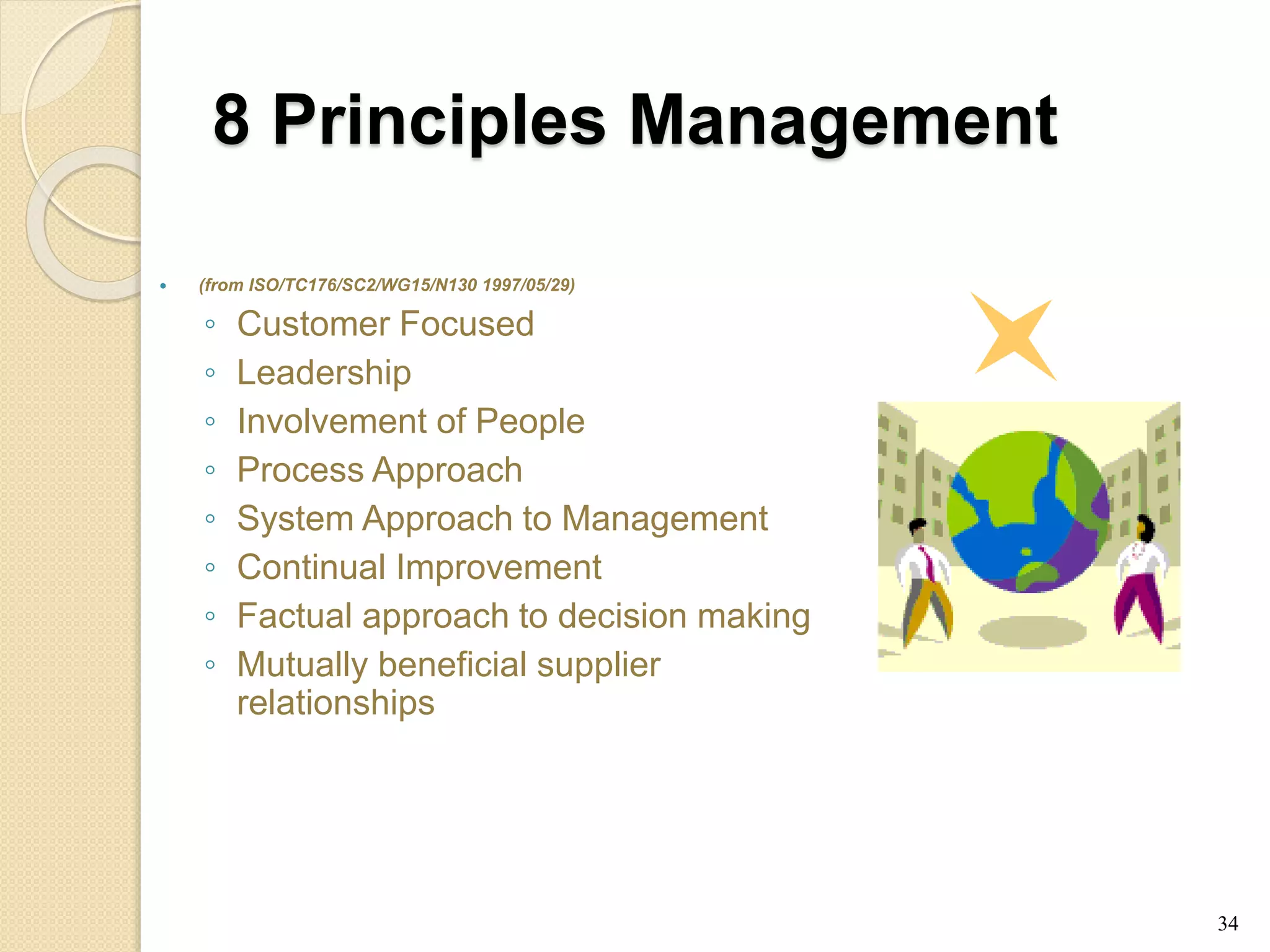
8 Principles Management
 (from ISO/TC176/SC2/WG15/N130 1997/05/29)
◦ Customer Focused
◦ Leadership
◦ Involvement of People
◦ Process Approach
◦ System Approach to Management
◦ Continual Improvement
◦ Factual approach to decision making
◦ Mutually beneficial supplier
relationships
34
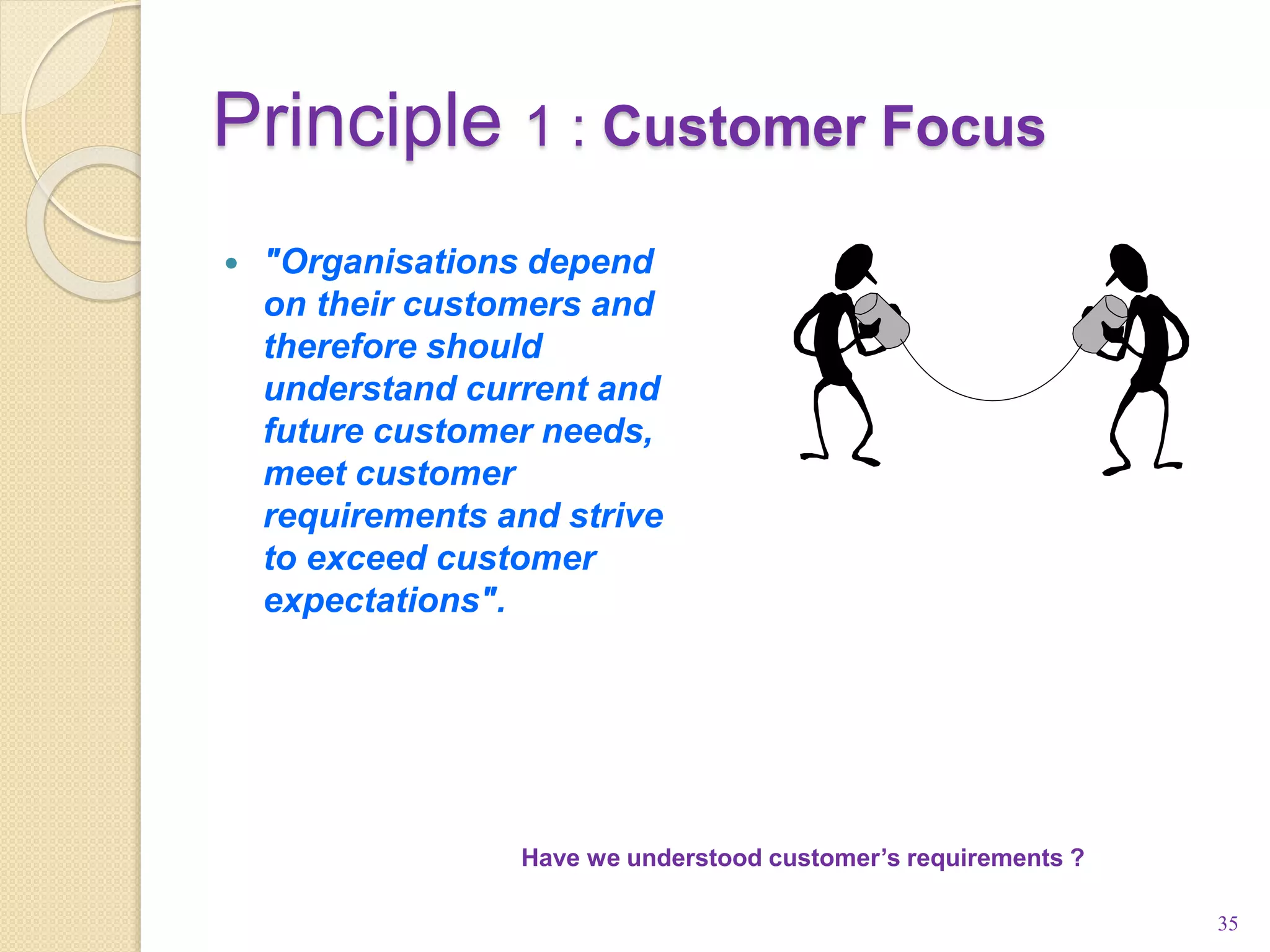
Principle 1 : Customer Focus
35
Have we understood customer’s requirements ?
 "Organisations depend
on their customers and
therefore should
understand current and
future customer needs,
meet customer
requirements and strive
to exceed customer
expectations".
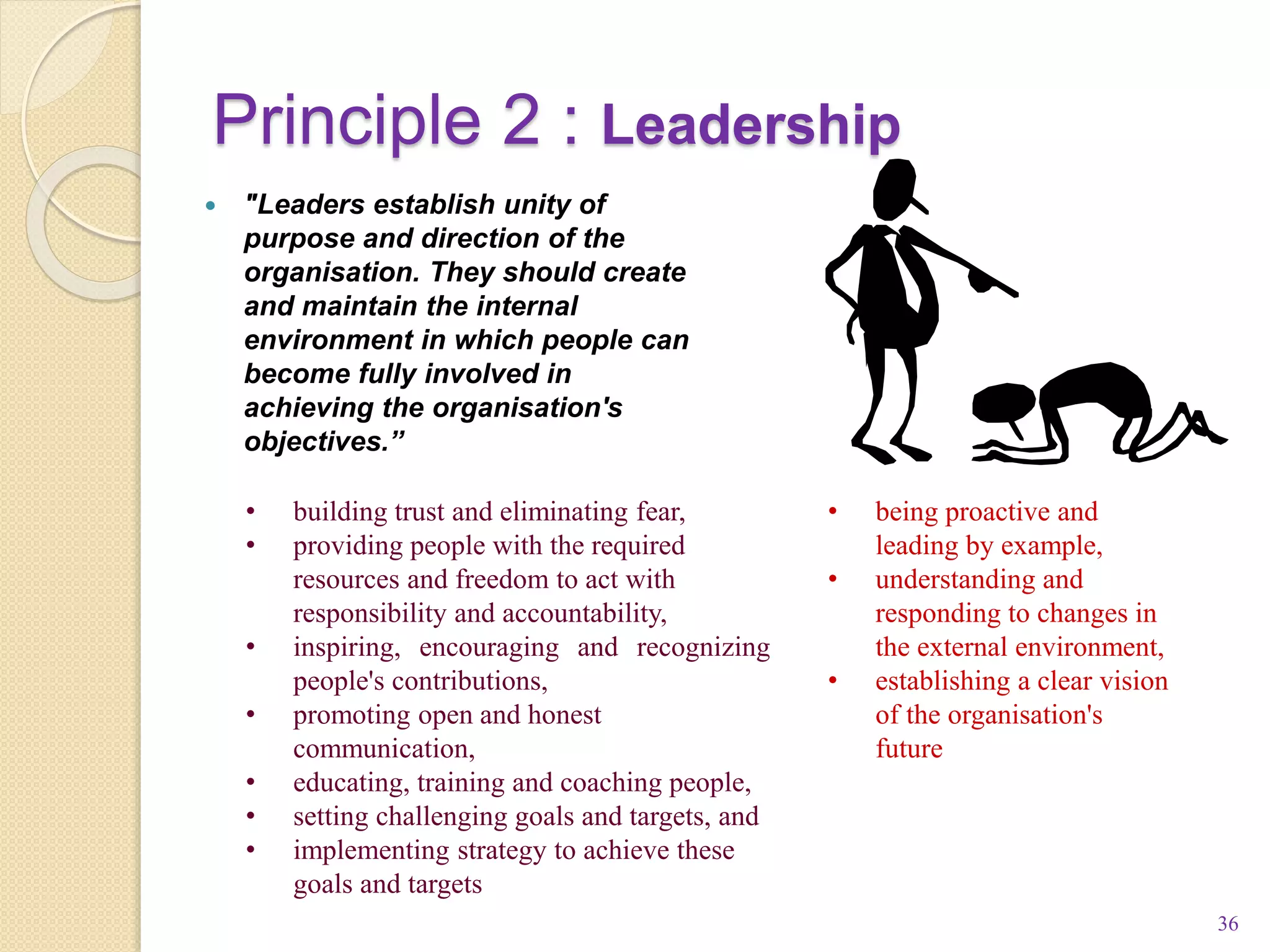
Principle 2 : Leadership
36
 "Leaders establish unity of
purpose and direction of the
organisation. They should create
and maintain the internal
environment in which people can
become fully involved in
achieving the organisation's
objectives.”
• being proactive and
leading by example,
• understanding and
responding to changes in
the external environment,
• establishing a clear vision
of the organisation's
future
• building trust and eliminating fear,
• providing people with the required
resources and freedom to act with
responsibility and accountability,
• inspiring, encouraging and recognizing
people's contributions,
• promoting open and honest
communication,
• educating, training and coaching people,
• setting challenging goals and targets, and
• implementing strategy to achieve these
goals and targets
Principle 3 : Involvements of
People
37
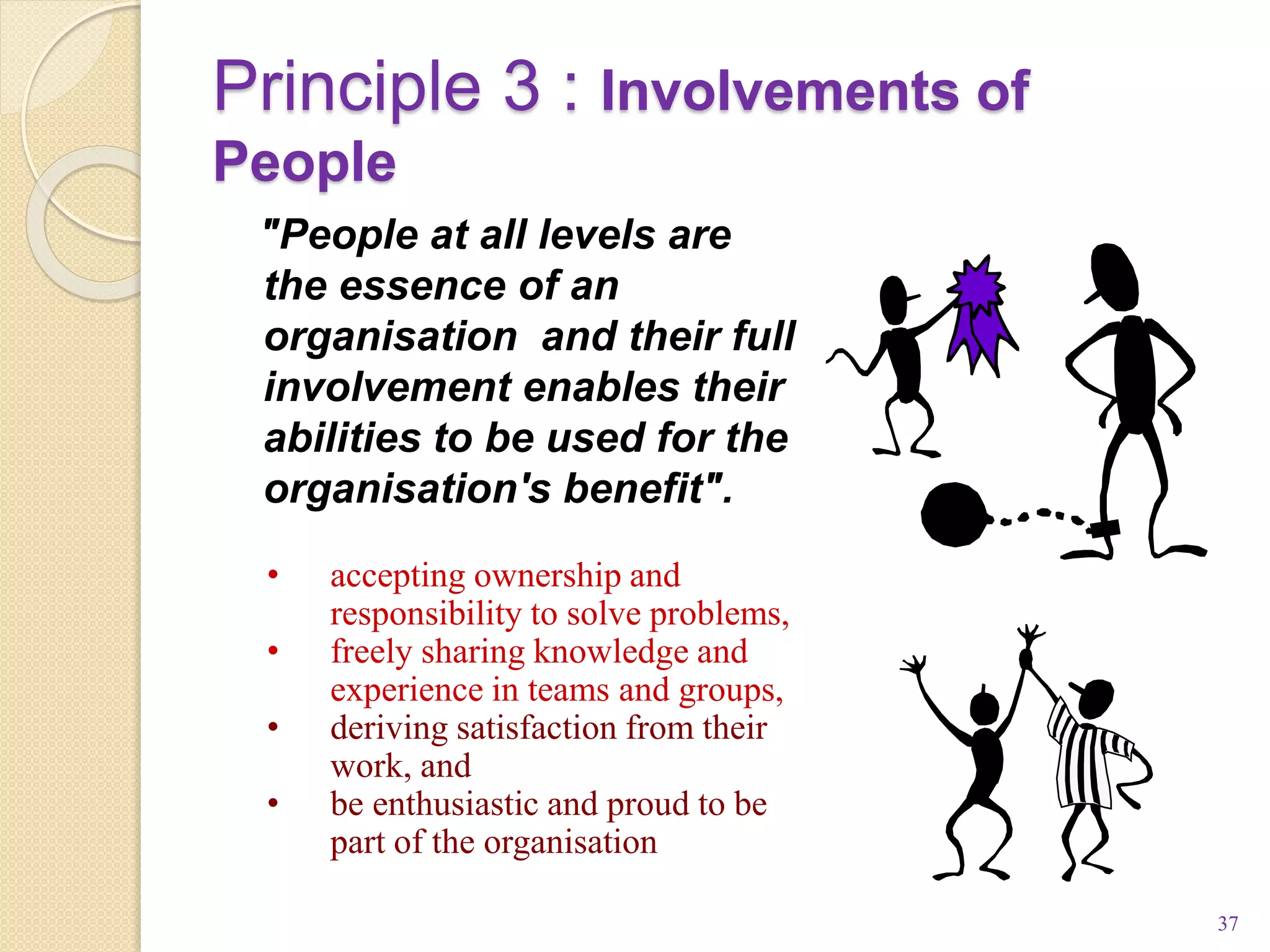
"People at all levels are
the essence of an
organisation and their full
involvement enables their
abilities to be used for the
organisation's benefit".
• accepting ownership and
responsibility to solve problems,
• freely sharing knowledge and
experience in teams and groups,
• deriving satisfaction from their
work, and
• be enthusiastic and proud to be
part of the organisation
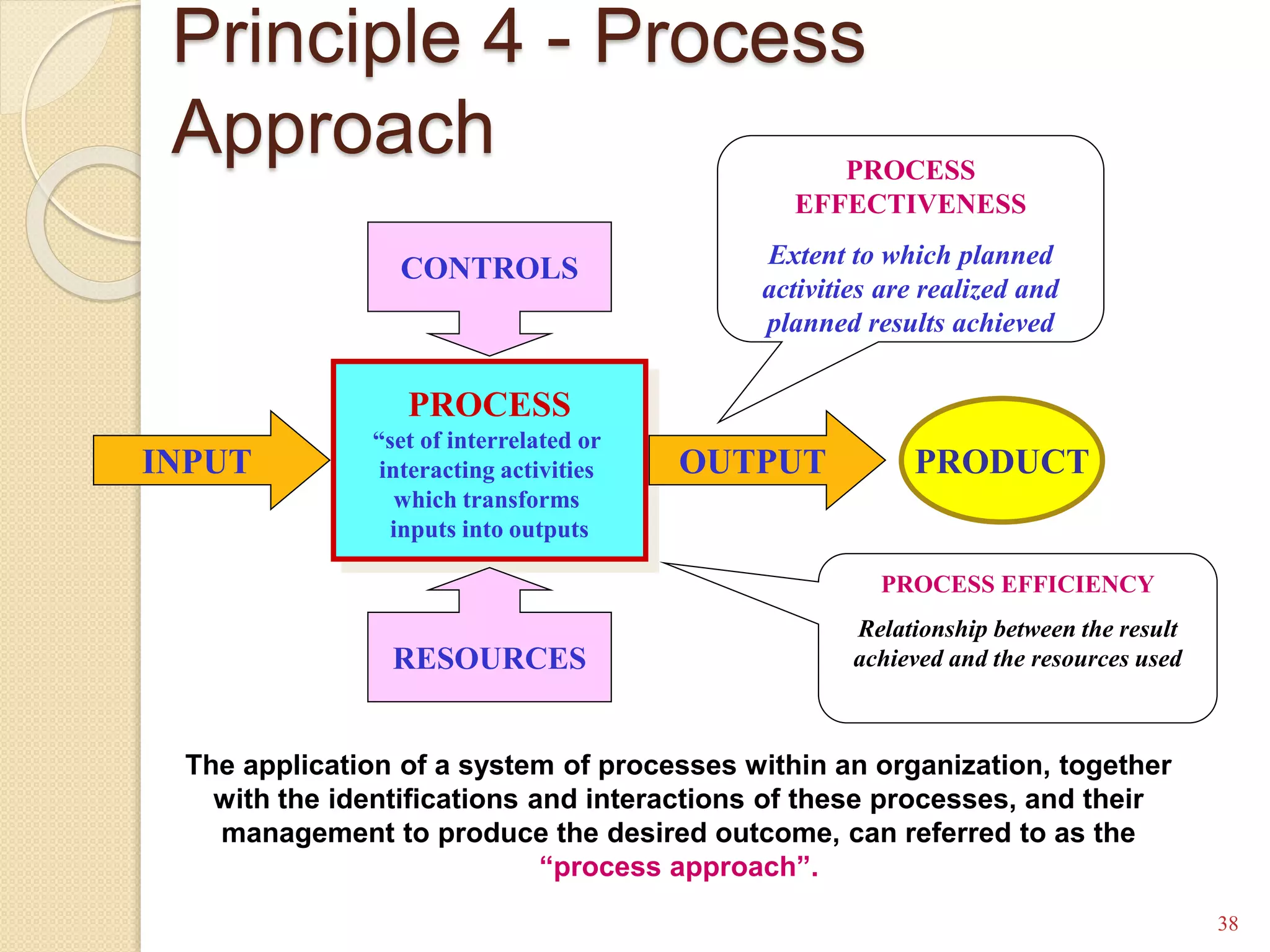
The application of a system of processes within an organization, together
with the identifications and interactions of these processes, and their
management to produce the desired outcome, can referred to as the
“process approach”.
PROCESS
“set of interrelated or
interacting activities
which transforms
inputs into outputs
INPUT OUTPUT
RESOURCES
CONTROLS
PRODUCT
PROCESS
EFFECTIVENESS
Extent to which planned
activities are realized and
planned results achieved
PROCESS EFFICIENCY
Relationship between the result
achieved and the resources used
Principle 4 - Process
Approach
38
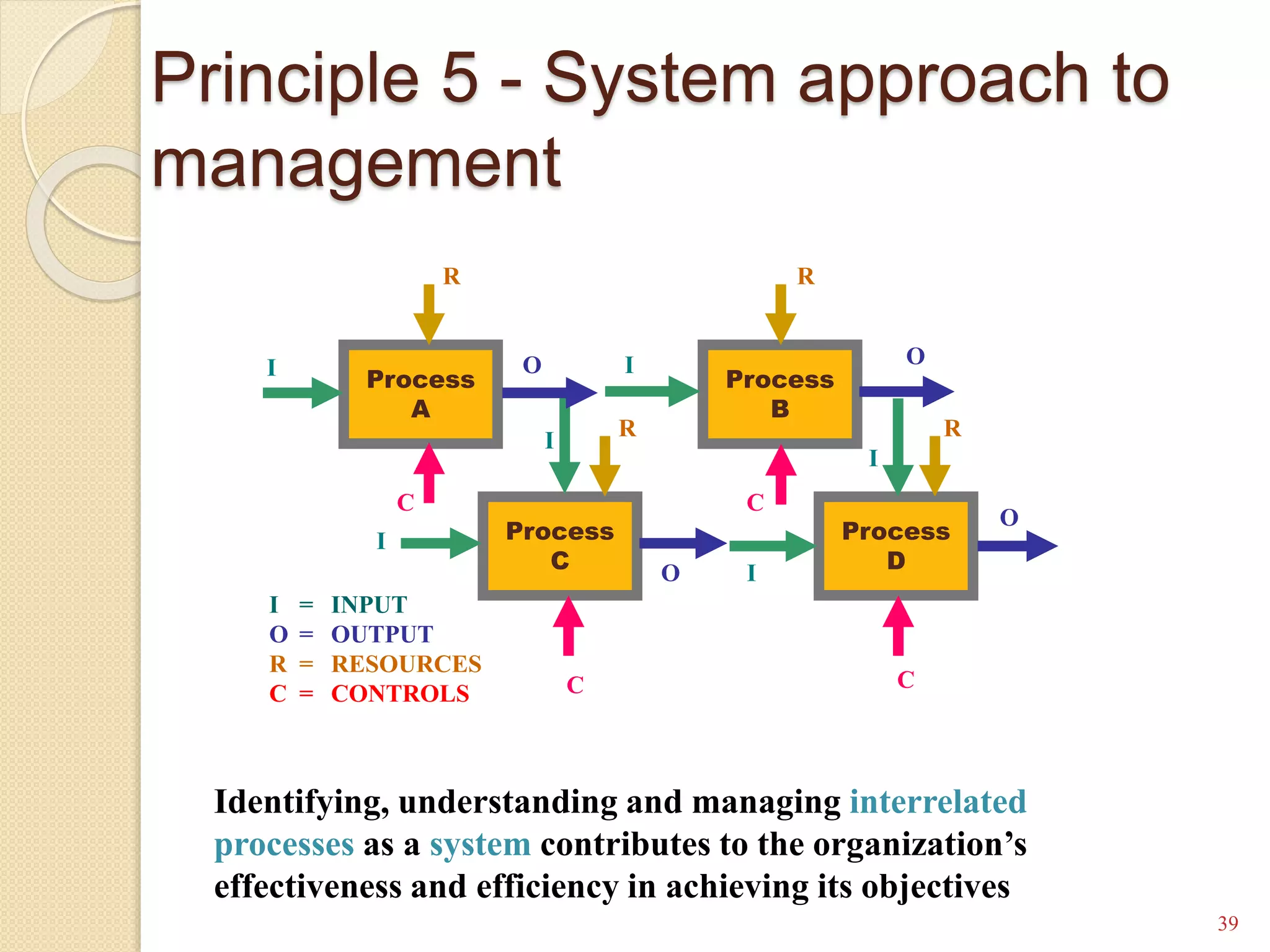
Identifying, understanding and managing interrelated
processes as a system contributes to the organization’s
effectiveness and efficiency in achieving its objectives
Process
A
Process
B
Process
C
Process
D
R R
R R
I
I
I
CC
C C
I O
I
I
O
O
O
I = INPUT
O = OUTPUT
R = RESOURCES
C = CONTROLS
Principle 5 - System approach to
management
39
Principle 6 – Continual Improvement
 Plan: establish the objectives and
processes necessary to deliver results
in accordance with customer
requirements and the organization’s
policies.
 Do: Implement the processes.
 Check: monitor and measure
processes and product against
policies, objectives and requirements
for the product and report the results.
 Act: take actions to continually improve
process performance.
"Continual improvement should be a
permanent objective of the organisation."
40
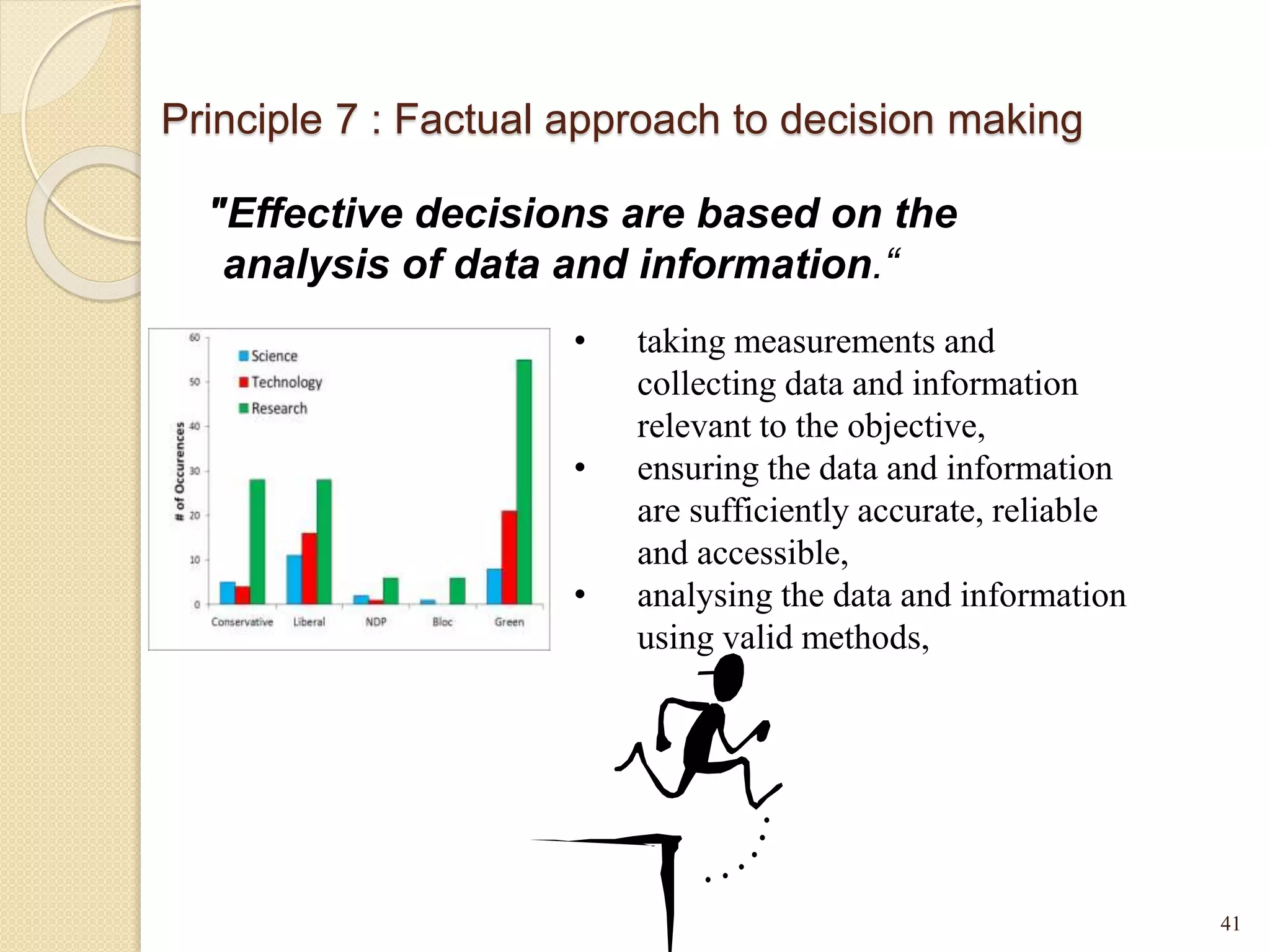
Principle 7 : Factual approach to decision making
41
"Effective decisions are based on the
analysis of data and information.“
• taking measurements and
collecting data and information
relevant to the objective,
• ensuring the data and information
are sufficiently accurate, reliable
and accessible,
• analysing the data and information
using valid methods,
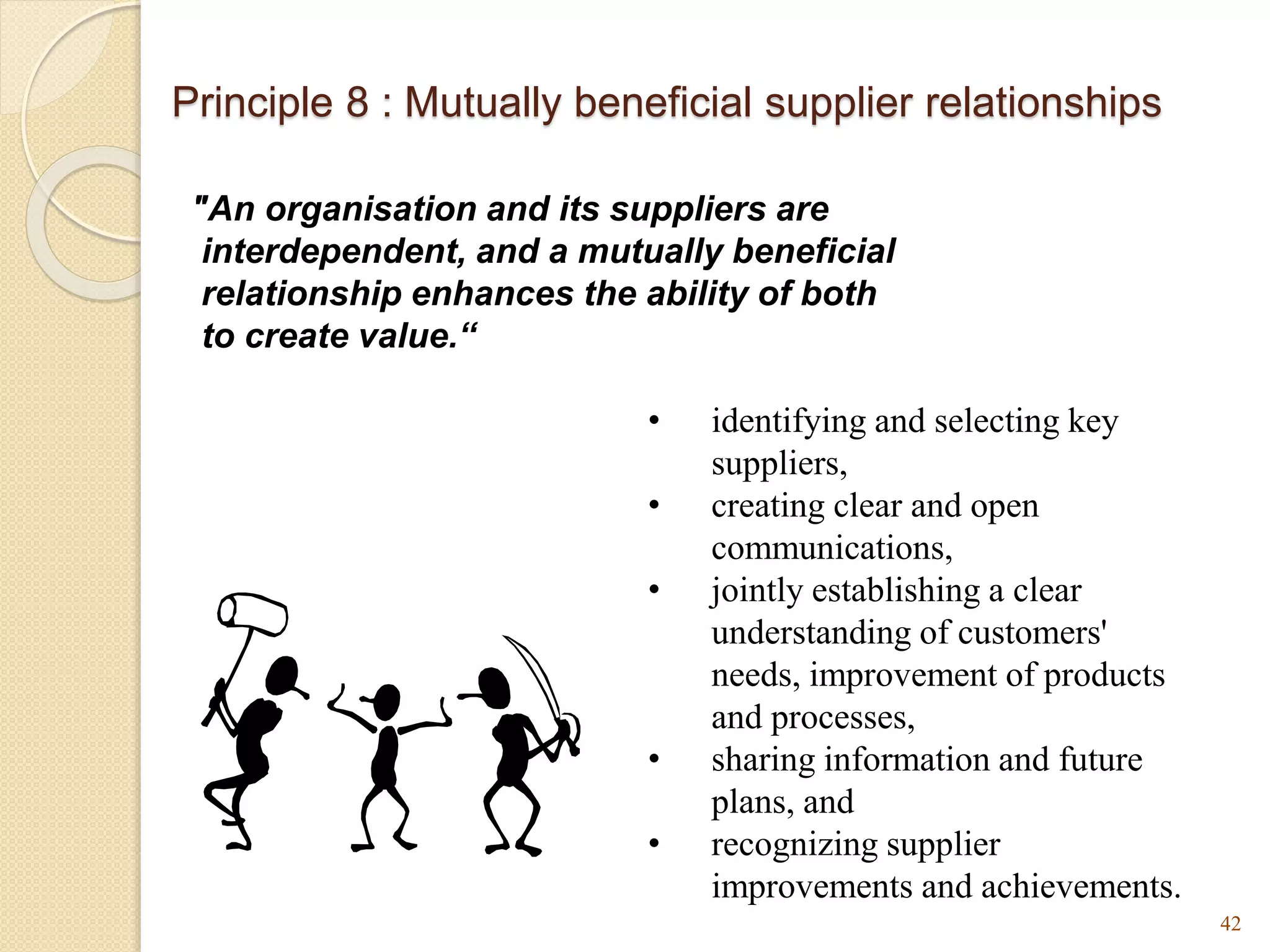
Principle 8 : Mutually beneficial supplier relationships
"An organisation and its suppliers are
interdependent, and a mutually beneficial
relationship enhances the ability of both
to create value.“
42
• identifying and selecting key
suppliers,
• creating clear and open
communications,
• jointly establishing a clear
understanding of customers'
needs, improvement of products
and processes,
• sharing information and future
plans, and
• recognizing supplier
improvements and achievements.
IMS Implementation Program
43
The End
 Thanks of your participation
Jamaluddin M – QA Coordinator 44

Basic of Integrated Management System

  • 1.
    QHSE Quality Health Safety& Environmental Awareness Training Jamaluddin Ma’ruf IRCA-Certified QMS Lead Auditor & HSE Expert More than 16 years experience in developing quality management to increase productivity and reduce nonconformity in achieve company objectives. Jakarta, 17 March 2015
  • 2.
    TRAINING AGENDA  09.00– 09.15 Opening by Management  09.15 – 09.30 HSE Moment Section 1  09.30 – 10.00 QHSE Goal & Effect  10.00 – 10.15 Coffee Time  10.15 – 12.00 Part of QA/QC  12.00 – 13.00 Break and Lunch Section 2  13.00 – 14.00 Process Model Section 3  14.00 – 15.00 Integrated Management System Section 4  15.00 – 15.15 Coffee Time  15.15 – 16.00 8 Principles Management  16.00 – 16.30 Document Management System Jamaluddin M – QMS Lead Auditor 1
  • 3.
    Session 1 ◦ Goalof QHSE ◦ QHSE Affect Jamaluddin M – QMS Lead Auditor 2
  • 4.
    Awareness Goal The goalis :  Audiences able to understand through out basic concept of Integrated Management System. 3
  • 5.
    QHSE Affect Let’s Brainstorming! What if… no QHSE?  What if… QHSE? 4
  • 6.
    What if …no QHSE !  the acts drama WE ALL LOSE ! And then angry ! Why so few profits and customers escape ? With the work we done, no acknowledgment! Accident Customer deeply sad ... 5
  • 7.
    What if …QHSE  A happy end Customer happiness all needs covered, in time and competitive price profits increase and customers ask for more products Hhmmm ... WE ALL WIN ! 6
  • 8.
    Part of QHSE PARTOF QHSE  Quality Assurance & Quality Control  Hazard Identification & Risk Control  Environmental Aspect & Impact Monitoring & Control Jamaluddin M – QMS Lead Auditor 7
  • 9.
    Quality Assurance &Quality Control  QA is Quality Assurance Warranty to processes - part of QHSE focused on providing confidence that quality requirements will be fulfilled  QC is Quality Control Warranty to product - part of QHSE focused on fulfilling quality requirements. Jamaluddin M – QA Coordinator 8
  • 10.
    What is QA& QC work?  QA work base on Quality Management System requirements  Company  QC work base on product requirements  Product specification Jamaluddin M – QA Coordinator 9 OUT PUT
  • 11.
    What is QA/QCContribute?  QA is contribute to develop quality plan.  QC is contribute to executing quality plan. Jamaluddin M – QMS Lead Auditor 10 Requirements •ISO 10005 •ISO 10006 •Others Specification •API, •ASME, •Others
  • 12.
    What shall QA& QC monitor?  QA monitoring of system performance ◦ Quality objective ◦ Training & competency ◦ Resources ◦ Competitor ◦ Supplier ◦ Preventive & Corrective action ◦ Customer complaint & satisfaction ◦ Document & Data system  QC monitoring of product performance ◦ Statistical product characteristics ◦ Product quality both of Incoming, process & final Jamaluddin M – QA Coordinator 11
  • 13.
    What is QA& QC correlation?  QA & QC have one goals. It is control of processes to warranty that product quality able to meet customer requirements and expectation. Jamaluddin M – QMS Lead Auditor 12 It’s nice… Your product is increasing our added value!
  • 14.
    What is HSEwork?  HS work base on Occupational Health Safety Assessment Series  Hazard Identification & Risk Assessment  E work base on Environmental Management Systems  Aspect & Impact Monitoring ReportJamaluddin M – QA Coordinator 13 OUT PUT
  • 15.
    What is HSEContribute?  HS is contribute to develop Safety plan.  E is contribute to develop Environmental plan. Jamaluddin M – QMS Lead Auditor 14 Requirements • OHSAS 18001 • PP 50 th 2012 • Others Specification • ISO 14001, • Proper, • Others
  • 16.
    What shall HSEmonitor?  HS monitoring of Incident performance ◦ Near miss ◦ First aid case ◦ Medical treatment ◦ Lost time injury ◦ Fatality ◦ Property damage ◦ Employee illness ◦ Etc.  E monitoring of Environmental performance ◦ Air pollution ◦ Nature resources ◦ Energy ◦ Legal compliance ◦ Etc. Jamaluddin M – QA Coordinator 15
  • 17.
    What is HS& E correlation?  HS & E have one goals. It is control of processes to warranty that processes will not built personnel injury and environmental defects. Jamaluddin M – QMS Lead Auditor 16
  • 18.
    Why QHSE Shallbe integrated Jamaluddin M – QMS Lead Auditor 17 We are agree : To achieve company objective with reduce nonconformity and prevent zero lost time injury in one mature system.
  • 19.
    Section 2 PROCESS MODEL ISO 9001  OHSAS & ISO 14001 Jamaluddin M – QMS Lead Auditor 18
  • 20.
    Jamaluddin M –QMR 19 Management responsibility Measurement, analysis, improvement Resource management Product realization C u s t o m e r R e q u i r e m e n t s C u s t o m e r S a t i s f a c t i o n QUALITY MANAGEMENT SYSTEM CONTINUAL IMPROVEMENT Input Output Product ISO 9001 – Quality Management System
  • 21.
    OHSAS & ISO14001 Jamaluddin M – QMS Lead Auditor 20
  • 22.
    Generic Standards Jamaluddin M– QMS Lead Auditor 21 OHSAS, ISO 9001 and ISO 14001 are generic standards. Generic means that the same standards can be applied:  to any organization, large or small, whatever its product or service,  in any sector of activity, and  whether it is a business enterprise, a public administration, or a government department.
  • 23.
    Generic standards Jamaluddin M– QMS Lead Auditor 22 Generic also signifies that  no matter what the organization's scope of activity  if it wants to establish a Occupational Health & Safety Management System, OHSAS 18001 gives the essential features,  or if it wants to establish a quality management system, ISO 9001 gives the essential features  or if it wants to establish an environmental management system, ISO 14001 gives the essential features.
  • 24.
    Processes, not products Processes affect final products or services.  OHSAS gives the requirements for what to enable an organization to control its OH&S risks and improve its OH&S performance in preventing personal injure and ill health.  ISO 9001 gives the requirements for what the organization must do to manage processes affecting quality of its products and services.  ISO 14001 gives the requirements for what the organization must do to manage processes affecting the impact of its activities on the environment.
  • 25.
    Environmental Management System Jamaluddin M– QMS Lead Auditor 24  ISO 14001 helps organizations to implement environmental management.  ISO 14001 is for environmental management. This means what the organization does to:  minimize harmful effects on the environment caused by its activities,  to conform to applicable regulatory requirements, and to  achieve continual improvement of its environmental performance.
  • 26.
    Hazard Identification, Risk Assessment& Risk Control Jamaluddin M – QMS Lead Auditor 25 • Conceptually similar to environmental aspects and impacts –target of management program(s) • Much more detailed than 14001 approach • Assessment must address: – routine and non-routine activities – all personnel, including contractors and visitors – facilities at the workplace, whether provided by the organization or by others
  • 27.
    Hazard Identification, Risk Assessment& Risk Control Jamaluddin M – QMS Lead Auditor 26 • Methodology must be proactive – in advance of process/equipment changes – allow engineering of hazard controls during design – implementation of controls as change occurs • Success requires strong Management of Change (MOC) procedure
  • 28.
    Hazard Identification, Risk Assessment& Risk Control Jamaluddin M – QMS Lead Auditor 27 • Process overview – identification of hazards – evaluation of risks under current controls – evaluation of the tolerability of residual risk – identification of needed additional controls • People are involved – significant risks must be controlled – individual behaviour is a significant factor
  • 29.
    Section 3 Jamaluddin M– QMS Lead Auditor 28 Integrated Management System (IMS) • Concept model
  • 30.
    Concept of integration ►ISO9001:2008, ISO 14001:2004 & OHSAS 18001:2007 standards based on PDCA concept, therefore having similar structure:  Policy  Planning  Implementation and operation  Performance assessment  Improvement  Management review 29
  • 31.
    Integrated Management Systems Jamaluddin M– QMS Lead Auditor 30  Integrated Management system means what the organization does to manage its processes, or activities with combine some standards requirements in order that  its products or services meet the organization’s objectives, such as  satisfying the customer's quality & processes requirements,  complying to regulations, or  save environmental Various Standards One Standards
  • 32.
    Integrated Management Systems Jamaluddin M– QMS Lead Auditor 31  To be really efficient and effective, the organization can manage its way of doing things by systemizing it.  Everyone is clear about who is responsible for doing what, when, how, why and where.  Integrated Management system provide the organization with an international, state-of-the-art model to follow.
  • 33.
    Integrated is Processes,not products  Both OHSAS, ISO 9001 and ISO 14001 concern the way an organization goes about its work.  They are not product standards.  They are not service standards.  They are process parameters.  They can be used by product manufacturers and service providers.
  • 34.
    Session 4 ◦ 8Principles Managements Jamaluddin M – QMS Lead Auditor 33
  • 35.
    8 Principles Management (from ISO/TC176/SC2/WG15/N130 1997/05/29) ◦ Customer Focused ◦ Leadership ◦ Involvement of People ◦ Process Approach ◦ System Approach to Management ◦ Continual Improvement ◦ Factual approach to decision making ◦ Mutually beneficial supplier relationships 34
  • 36.
    Principle 1 :Customer Focus 35 Have we understood customer’s requirements ?  "Organisations depend on their customers and therefore should understand current and future customer needs, meet customer requirements and strive to exceed customer expectations".
  • 37.
    Principle 2 :Leadership 36  "Leaders establish unity of purpose and direction of the organisation. They should create and maintain the internal environment in which people can become fully involved in achieving the organisation's objectives.” • being proactive and leading by example, • understanding and responding to changes in the external environment, • establishing a clear vision of the organisation's future • building trust and eliminating fear, • providing people with the required resources and freedom to act with responsibility and accountability, • inspiring, encouraging and recognizing people's contributions, • promoting open and honest communication, • educating, training and coaching people, • setting challenging goals and targets, and • implementing strategy to achieve these goals and targets
  • 38.
    Principle 3 :Involvements of People 37 "People at all levels are the essence of an organisation and their full involvement enables their abilities to be used for the organisation's benefit". • accepting ownership and responsibility to solve problems, • freely sharing knowledge and experience in teams and groups, • deriving satisfaction from their work, and • be enthusiastic and proud to be part of the organisation
  • 39.
    The application ofa system of processes within an organization, together with the identifications and interactions of these processes, and their management to produce the desired outcome, can referred to as the “process approach”. PROCESS “set of interrelated or interacting activities which transforms inputs into outputs INPUT OUTPUT RESOURCES CONTROLS PRODUCT PROCESS EFFECTIVENESS Extent to which planned activities are realized and planned results achieved PROCESS EFFICIENCY Relationship between the result achieved and the resources used Principle 4 - Process Approach 38
  • 40.
    Identifying, understanding andmanaging interrelated processes as a system contributes to the organization’s effectiveness and efficiency in achieving its objectives Process A Process B Process C Process D R R R R I I I CC C C I O I I O O O I = INPUT O = OUTPUT R = RESOURCES C = CONTROLS Principle 5 - System approach to management 39
  • 41.
    Principle 6 –Continual Improvement  Plan: establish the objectives and processes necessary to deliver results in accordance with customer requirements and the organization’s policies.  Do: Implement the processes.  Check: monitor and measure processes and product against policies, objectives and requirements for the product and report the results.  Act: take actions to continually improve process performance. "Continual improvement should be a permanent objective of the organisation." 40
  • 42.
    Principle 7 :Factual approach to decision making 41 "Effective decisions are based on the analysis of data and information.“ • taking measurements and collecting data and information relevant to the objective, • ensuring the data and information are sufficiently accurate, reliable and accessible, • analysing the data and information using valid methods,
  • 43.
    Principle 8 :Mutually beneficial supplier relationships "An organisation and its suppliers are interdependent, and a mutually beneficial relationship enhances the ability of both to create value.“ 42 • identifying and selecting key suppliers, • creating clear and open communications, • jointly establishing a clear understanding of customers' needs, improvement of products and processes, • sharing information and future plans, and • recognizing supplier improvements and achievements.
  • 44.
  • 45.
    The End  Thanksof your participation Jamaluddin M – QA Coordinator 44