
IMS Service Control
Model

Inam Ullah
Director Product Development
EMI Networks
Why More Services?
• Satisfying the Customer’s Communications
Customer’s Needs Wants?
• Customer Loyalty ?
• Filling the data Pipes ?
• Increasing Revenues ?
Exemplary IMS Service
• IP Telephony/VoIP
• Presence
• Conferencing
• Media Servers i.e.
• Voice Mail & IVR
• Gaming
• Video on Demand, IPTV
• 3G Doctors
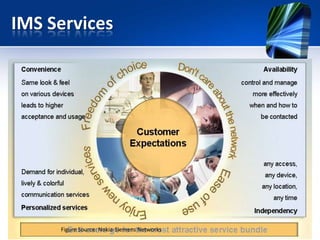
IMS Services

Figure Source: Nokia-Siemens Networks
Problem for Multiple Services
Provisions?
• The need for a flexible and standard platform to
simplify the development and deployment of
new services
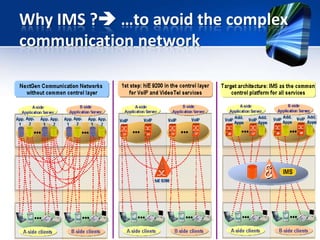
Why IMS ? …to avoid the complex
communication network
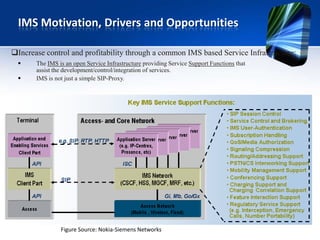
IMS Motivation, Drivers and Opportunities
Increase control and profitability through a common IMS based Service Infrastructure:



The IMS is an open Service Infrastructure providing Service Support Functions that
assist the development/control/integration of services.
IMS is not just a simple SIP-Proxy.

Figure Source: Nokia-Siemens Networks
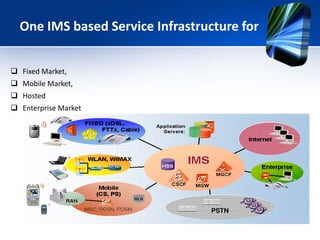
One IMS based Service Infrastructure for
 Fixed Market,

 Mobile Market,
 Hosted
 Enterprise Market
Service Invocation
• Serving Proxies receives the request and applies
the filter criteria and routes it to the SIP AS
• The SIP as can act as User Agent(UA) , Back2BACK
User Agent, Proxy Server
• The CSCF may like to remain in the Path of the
Transaction
Service Proxy Function
• The Serving-CSCF (S-CSCF) provides a common protocol to SIP-based
application services running on platforms such as SIP Application Server,
and legacy services running on Intelligent Network (IN) and Open
System Architecture (OSA) platforms.
• Filter criteria, which are based on SPTs and described in XML, are
downloaded to the S-CSCF from the Home Subscriber Server (HSS),
thereby defining which service platform or platforms are used; and in
which order, based on information received by the S-CSCF
• Based on the ISC interface, there are several ways in which the IMS
Application Server might interact with the CSCF:
–
–
–
–
–

Act as a terminating user agent (UA)
Act as an originating user agent to originate traffic on behalf of a user
Receive requests
Serve as a proxy function
Act as a third party call control applet
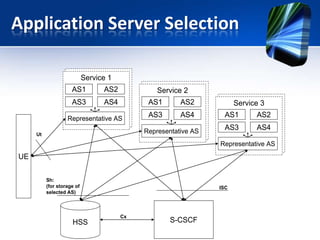
Application Server Selection
Service 1
AS1

AS2

AS3

AS4

Service 2
AS1

Representative AS

AS2

AS3

AS4

Representative AS

Ut

Service 3
AS1

AS2

AS3

AS4

Representative AS

UE
Sh:
(for storage of
selected AS)

HSS

ISC

Cx

S-CSCF
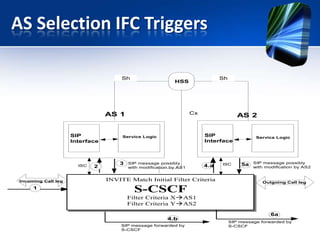
AS Selection IFC Triggers
Sh

Cx

AS 1

SIP
Interface

ISC

Incoming Call leg

1

S
P
I

2

Sh

HSS

SIP
Interface

Service Logic

3

AS 2

SIP message possibly
with modification by AS1

4.a

INVITE Match Initial Filter Criteria

ISC

Service Logic

5a

SIP message possibly
with modification by AS2

Outgoing Call leg

S-CSCF
Filter Criteria XAS1
Filter Criteria YAS2
4.b
SIP message forwarded by
S-CSCF

6a
SIP message forwarded by
S-CSCF
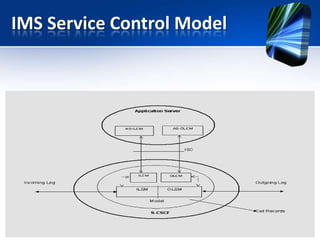
IMS Service Control Model
IMS ISC Interface
• An Interface between CSCF and AS that is used
for the control signaling and is a Bi-Directional
Interface
• Based on SIP (RFC 3261)
• Purpose:
– Service Invocation
– Presenting SIP Parameters to the Applications
– Interaction with Service Proxy for Service Provisioning
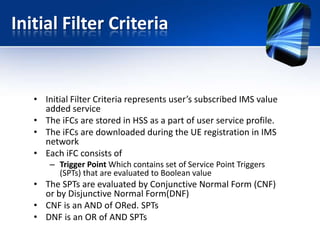
Initial Filter Criteria

• Initial Filter Criteria represents user’s subscribed IMS value
added service
• The iFCs are stored in HSS as a part of user service profile.
• The iFCs are downloaded during the UE registration in IMS
network
• Each iFC consists of
– Trigger Point Which contains set of Service Point Triggers
(SPTs) that are evaluated to Boolean value

• The SPTs are evaluated by Conjunctive Normal Form (CNF)
or by Disjunctive Normal Form(DNF)
• CNF is an AND of ORed. SPTs
• DNF is an OR of AND SPTs
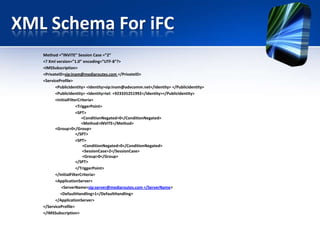
XML Schema For iFC
Method =”INVITE” Session Case =”2”
<? Xml version=”1.0” encoding=”UTF-8”?>
<IMSSubscription>
<PrivateID>sip:inam@mediaroutes.com </PrivateID>
<ServiceProfile>
<PublicIdentity> <Identity>sip:inam@advcomm.net</Identity> </PublicIdentity>
<PublicIdentity> <Identity>tel: +923335251992</Identity></PublicIdentity>
<InitialFilterCriteria>
<TriggerPoint>
<SPT>
<ConditionNegated>0</ConditionNegated>
<Method>INVITE</Method>
<Group>0</Group>
</SPT>
<SPT>
<ConditionNegated>0</ConditionNegated>
<SessionCase>2</SessionCase>
<Group>0</Group>
</SPT>
</TriggerPoint>
</InitialFilterCriteria>
<ApplicationServer>
<ServerName>sip:server@mediaroutes.com </ServerName>
<DefaultHandling>1</DefaultHandling>
</ApplicationServer>
</ServiceProfile>
</IMSSubscription>
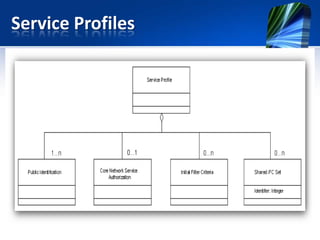
Service Profiles
Thanks

IMS Service Control Model

  • 1.
    IMS Service Control Model InamUllah Director Product Development EMI Networks
  • 2.
    Why More Services? •Satisfying the Customer’s Communications Customer’s Needs Wants? • Customer Loyalty ? • Filling the data Pipes ? • Increasing Revenues ?
  • 3.
    Exemplary IMS Service •IP Telephony/VoIP • Presence • Conferencing • Media Servers i.e. • Voice Mail & IVR • Gaming • Video on Demand, IPTV • 3G Doctors
  • 4.
    IMS Services Figure Source:Nokia-Siemens Networks
  • 5.
    Problem for MultipleServices Provisions? • The need for a flexible and standard platform to simplify the development and deployment of new services
  • 6.
    Why IMS ?…to avoid the complex communication network
  • 7.
    IMS Motivation, Driversand Opportunities Increase control and profitability through a common IMS based Service Infrastructure:   The IMS is an open Service Infrastructure providing Service Support Functions that assist the development/control/integration of services. IMS is not just a simple SIP-Proxy. Figure Source: Nokia-Siemens Networks
  • 8.
    One IMS basedService Infrastructure for  Fixed Market,  Mobile Market,  Hosted  Enterprise Market
  • 9.
    Service Invocation • ServingProxies receives the request and applies the filter criteria and routes it to the SIP AS • The SIP as can act as User Agent(UA) , Back2BACK User Agent, Proxy Server • The CSCF may like to remain in the Path of the Transaction
  • 10.
    Service Proxy Function •The Serving-CSCF (S-CSCF) provides a common protocol to SIP-based application services running on platforms such as SIP Application Server, and legacy services running on Intelligent Network (IN) and Open System Architecture (OSA) platforms. • Filter criteria, which are based on SPTs and described in XML, are downloaded to the S-CSCF from the Home Subscriber Server (HSS), thereby defining which service platform or platforms are used; and in which order, based on information received by the S-CSCF • Based on the ISC interface, there are several ways in which the IMS Application Server might interact with the CSCF: – – – – – Act as a terminating user agent (UA) Act as an originating user agent to originate traffic on behalf of a user Receive requests Serve as a proxy function Act as a third party call control applet
  • 11.
    Application Server Selection Service1 AS1 AS2 AS3 AS4 Service 2 AS1 Representative AS AS2 AS3 AS4 Representative AS Ut Service 3 AS1 AS2 AS3 AS4 Representative AS UE Sh: (for storage of selected AS) HSS ISC Cx S-CSCF
  • 12.
    AS Selection IFCTriggers Sh Cx AS 1 SIP Interface ISC Incoming Call leg 1 S P I 2 Sh HSS SIP Interface Service Logic 3 AS 2 SIP message possibly with modification by AS1 4.a INVITE Match Initial Filter Criteria ISC Service Logic 5a SIP message possibly with modification by AS2 Outgoing Call leg S-CSCF Filter Criteria XAS1 Filter Criteria YAS2 4.b SIP message forwarded by S-CSCF 6a SIP message forwarded by S-CSCF
  • 13.
  • 14.
    IMS ISC Interface •An Interface between CSCF and AS that is used for the control signaling and is a Bi-Directional Interface • Based on SIP (RFC 3261) • Purpose: – Service Invocation – Presenting SIP Parameters to the Applications – Interaction with Service Proxy for Service Provisioning
  • 15.
    Initial Filter Criteria •Initial Filter Criteria represents user’s subscribed IMS value added service • The iFCs are stored in HSS as a part of user service profile. • The iFCs are downloaded during the UE registration in IMS network • Each iFC consists of – Trigger Point Which contains set of Service Point Triggers (SPTs) that are evaluated to Boolean value • The SPTs are evaluated by Conjunctive Normal Form (CNF) or by Disjunctive Normal Form(DNF) • CNF is an AND of ORed. SPTs • DNF is an OR of AND SPTs
  • 16.
    XML Schema ForiFC Method =”INVITE” Session Case =”2” <? Xml version=”1.0” encoding=”UTF-8”?> <IMSSubscription> <PrivateID>sip:inam@mediaroutes.com </PrivateID> <ServiceProfile> <PublicIdentity> <Identity>sip:inam@advcomm.net</Identity> </PublicIdentity> <PublicIdentity> <Identity>tel: +923335251992</Identity></PublicIdentity> <InitialFilterCriteria> <TriggerPoint> <SPT> <ConditionNegated>0</ConditionNegated> <Method>INVITE</Method> <Group>0</Group> </SPT> <SPT> <ConditionNegated>0</ConditionNegated> <SessionCase>2</SessionCase> <Group>0</Group> </SPT> </TriggerPoint> </InitialFilterCriteria> <ApplicationServer> <ServerName>sip:server@mediaroutes.com </ServerName> <DefaultHandling>1</DefaultHandling> </ApplicationServer> </ServiceProfile> </IMSSubscription>
  • 17.
  • 18.