IMMUNO-PATHOLOGY
SUBMITTED TO:-Dr. Ruchi
SUBMITTED BY:- Anu Redhu
INTRODUCTION
 Immunology is the study of the immune system.
 Immune system is a network of immune molecules, cells,
tissues & organs that protects the body against foreign
agents.
 Immune response is the collective /coordinated response
to foreign bodies.
Immunity is the state of protection /resistance from foreign
bodies e.g, viruses, bacteria, tumors
 Immunogen is a molecule that can induce an immune
response in the body.
 Antigen is a molecule that can specifically react with
products(e.g,antibodies) of an immune system.
The Immune System
• Defination:-
The Immune System is a network of immune molecules, cells, tissues &
organs that protects the body against foreign agents.
• Organization:-
The immune system is the body’s response to disease & injury.
 The major functions of immune system are as under;
1.Antibody formation
2.Removal of dead / damaged tissues & cells.
3.Recognition & removal of abnormal cells.
4.Cell-mediated reactions
ORGANS AND CELLS OF IMMUNE SYSTEM
• Although functioning as a system, the organs of immune system are
distributed at different places in the body.
• These are as under:-
a.) Primary lymphoid organs :
- Thymus
- Bone marrow
b.) Secondary lymphoid organs :
- Lymph nodes
- Spleen
- MALT(Mucosa Associated Lymphoid Tissue located in the
respiratory tract and GIT)
CELLS OF IMMUNE SYSTEM & THEIR FUNCTION
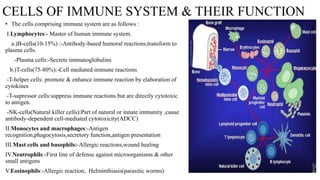
• The cells comprising immune system are as follows :
I.Lymphocytes:- Master of human immune system.
a.)B-cells(10-15%) :-Antibody-based humoral reactions,transform to
plasma cells.
-Plasma cells:-Secrete immunoglobulins
b.)T-cells(75-80%):-Cell mediated immune reactions
-T-helper cells: promote & enhance immune reaction by elaboration of
cytokines
-T-supressor cells:suppress immune reactions but are directly cytotoxic
to antigen.
-NK-cells(Natural killer cells):Part of natural or innate immunity ,cause
antibody-dependent cell-mediated cytotoxicity(ADCC)
II.Monocytes and macrophages:-Antigen
recognition,phagocytosis,secretory function,antigen presentation
III.Mast cells and basophils:-Allergic reactions,wound healing
IV.Neutrophils:-First line of defense against microorganisms & other
small antigens
V.Eosinophils:-Allergic reaction, Helminthiasis(parasitic worms)
IMMUNITY
• Defination:-
Immunity is the state of protection /resistance from foreign bodies e.g,
viruses, bacteria, tumors
Types Of Immunity
1.Inborn or innate immunity:It is present at birth.
It has two main components:-
• Humoral( comprised by complement)
• Cellular( consists of neutrophils,macrophages and natural killer cells.
2.Adaptive or acquired immunity:It is not present at birth.
It too has two main components :-
• Humoral( activation of B-lymphocytes)
• Cellular( by activation of T-lymphocytes)
INNATE IMMUNITY
 Innate immunity which are ontain before the birth.This immunity is genetically
transfer one generation to other generation.
 It is non-specific immunity.
 It is not characterized by memory.
 Cells involved are
many;Neutrophils,eosinophils,basophils,monocytes,macrophages,NK cells
 Types of Innate Immunity:-
1. Species Immunity
2. Racial Immunity
3. Individual Immunity
 Factors affecting Innate Immunity
• Reduce the power of immunity according to age
• Due to low nutrient reduce the power of innate immunity
• Due to hormones disbalance affect a innate immunity. As during diabetes.
ACQUIRED IMMUNITY
• Acquired immunity is also called adoptive immunity which is obtained after the birth.
• This is specific for pathogens.
• This is characterized as memory.
• Cells involved are the B cells and T cells.
• Types of acquired immunity:-
1. Active Immunity
 Produce actively by host immune system
 Longest period but depend on pathogen type
 Memory present
2.Passive Immunity
 Immunoglobulin transfered passive
 No long lasting but develop fast
 No memory
Types of Acquired Immunity
1.Active Acquired Immunity;- It is of two types i.e,
 Natural Active Acquired Immunity:-Develop after exposure of
microbial infection.e.g, chickenpox
 Artificial Active Acquired Immunity:- Induce by
Vaccination.e.g,Bacterial vaccine- BCG-Tuberculosis
2.Passive Acquired Immunity:-It is of two types i.e,
 Natural Active Acquired Immunity:-Maternal antibodies i.e,
IgG AB- transfer from mother to foetus across placenta
IgG AB- mother to foetus by milk
 Artificial Active Acquired Immunity:-transfer readymade prepared
immunoglobulin.e.g, rabies immunoglobulin
DEFINATIONS
• ANTIGEN(Ag) :It is defined as a molecule that can specifically react with
products(e.g,antibodies) of an immune system /response.
• HAPTEN:It is a non-protein substance which has no antigenic-
properties,but on combining with a protein can form a new antigen capable
of forming antibodies.
• EPITOME: Antigenic determinant-the part of antigen that combine with
antibodies.
• ANTIBODY(Ab) :It is a protein substance produced as a result of
antigenic stimulation.Circulating antibodies are immunoglobulins(Igs) of
which there are 5 classes: IgG , IgA , IgM , IgE , IgD
• A molecule that combines with an antigen to form an immune complex.
• CYTOKINES :Group of signaling molecules(proteins) that help cells to
communicate.
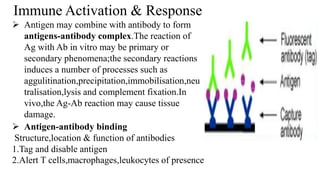
Immune Activation & Response
 Antigen may combine with antibody to form
antigens-antibody complex.The reaction of
Ag with Ab in vitro may be primary or
secondary phenomena;the secondary reactions
induces a number of processes such as
aggulitination,precipitation,immobilisation,neu
tralisation,lysis and complement fixation.In
vivo,the Ag-Ab reaction may cause tissue
damage.
 Antigen-antibody binding
Structure,location & function of antibodies
1.Tag and disable antigen
2.Alert T cells,macrophages,leukocytes of presence
REGULATION OF IMMUNE RESPONSE
• Regulation by Immune Complexes
• Cross-linking of B cells' Fc receptors with their antigen receptors can
inhibit B-cell activation. Moreover, B cells are activated when the
immune complex is presented to B cells via antigen-specific cells.
• The adaptive immune response in B cells, Helper T cells and Cytotoxic
T cells involved four phases: encounter, activation, attack, and
memory.
• Regulation of immune responses is required to protect individuals
from autoreactive T cells that have escaped into the periphery.
Regulation of autoreactivity is present at the level of thymic selection,
but also in the periphery.
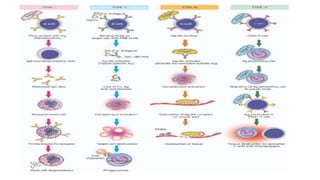
HYPER-SENSITIVITY
• Hypersensitivity refers to a condition in which immune response results in excessive
reactions leading to tissue damage,disease or even death in the sensitised host.
 CLASSIFICATION OF HYPERSENSITIVITY
 Hypersensitivity reactions are classified into two main types,`immediate` and
`delayed` types.
Coomb and Gel (1963) classified hypersensitivity reactions into four major types:
• Type I(Anaphylactic,Atopic):Rapidly developing immune response in a previously
sensitised person.
• Type II( Cytotoxic):Reaction of humoral antibodies that attack cell surface antigens
and cause cell lysis.
• Type III(Immune complex):Results from deposition of antigen-antibody complexes
on tissues.
• Type IV(Delayed or cell mediated):Cell-mediated slow & prolonged response.
Secondary Immune Deficiency including HIV
• These can occur secondary to a number of disease states such as metabolic
disorders,malnutrition,malignancy or as a consequence of certain therapeutic
measures which depress the immune system.
• Secondary immunodeficiences are more common than primary immunodeficiences.
1.Depression of Humeral Immune Responses
This results when B-cells are depleted as in lymphoid malignancy,particularly in
chronic lymphatic leukaemia; when excessive loss of serum proteins occurs as in
exfoliative skin disease and in protein losing enteropathies.In multiple myeloma,there
is excessive production of abnormal immunoglobulins but normal immunoglobulin
level is decreased.
2.Depression of Cell-Mediated Immunity
Cell mediated immunity is depressed in acquired immunodeficiency syndrome
(AIDS), Hodgkin’s lymphoma,obstruction to lymph circulation,lepromatous leprosy
and some cases of sarcoidosis.AIDS is the most important of secondary
immunodeficiency disease.
ORGAN TRANSPLANTATIONS
• It is a useful procedure for replacement of diseased tissues or organs
which are irrepairably damaged.Transplantation is necessary for
restoration of function.The tissue or organ transplanted is called
transplant or graft.
• It has been known for a long time that transplants survive only when
the tissue or organ is taken from the receiptant himself, while grafts
from another individual of the same species or from a different species
would be rejected.
• The immune response induced by the transplantation (HLA) antigens
is the reason for rejection of these exogenous grafts.
TYPES OF TRANSPLANTS
• AUTOGRAFT: It is a tissue or organ taken from one site and
engrafted to another site in the same individual.
• ISOGRAFT: It is a graft taken from an individual and placed on
another individual of the same genetic constitution e.g, grafts made
between identical twins.
• ALLOGRAFT: It is graft transfer between two genetically
nonidentical members of the same species.
• XENOGRAFT(formerly called heterografts):These are grafts
between members of different species are called xenografts.
 Autografts and isografts are usually accepted and survive.
Allografts and xenografts are usually rejected due to genetic and
antigenetic incompatibility.
immunopathology for physiotherapy pathology.pptx

immunopathology for physiotherapy pathology.pptx

  • 1.
  • 2.
    INTRODUCTION  Immunology isthe study of the immune system.  Immune system is a network of immune molecules, cells, tissues & organs that protects the body against foreign agents.  Immune response is the collective /coordinated response to foreign bodies. Immunity is the state of protection /resistance from foreign bodies e.g, viruses, bacteria, tumors  Immunogen is a molecule that can induce an immune response in the body.  Antigen is a molecule that can specifically react with products(e.g,antibodies) of an immune system.
  • 3.
    The Immune System •Defination:- The Immune System is a network of immune molecules, cells, tissues & organs that protects the body against foreign agents. • Organization:- The immune system is the body’s response to disease & injury.  The major functions of immune system are as under; 1.Antibody formation 2.Removal of dead / damaged tissues & cells. 3.Recognition & removal of abnormal cells. 4.Cell-mediated reactions
  • 4.
    ORGANS AND CELLSOF IMMUNE SYSTEM • Although functioning as a system, the organs of immune system are distributed at different places in the body. • These are as under:- a.) Primary lymphoid organs : - Thymus - Bone marrow b.) Secondary lymphoid organs : - Lymph nodes - Spleen - MALT(Mucosa Associated Lymphoid Tissue located in the respiratory tract and GIT)
  • 5.
    CELLS OF IMMUNESYSTEM & THEIR FUNCTION • The cells comprising immune system are as follows : I.Lymphocytes:- Master of human immune system. a.)B-cells(10-15%) :-Antibody-based humoral reactions,transform to plasma cells. -Plasma cells:-Secrete immunoglobulins b.)T-cells(75-80%):-Cell mediated immune reactions -T-helper cells: promote & enhance immune reaction by elaboration of cytokines -T-supressor cells:suppress immune reactions but are directly cytotoxic to antigen. -NK-cells(Natural killer cells):Part of natural or innate immunity ,cause antibody-dependent cell-mediated cytotoxicity(ADCC) II.Monocytes and macrophages:-Antigen recognition,phagocytosis,secretory function,antigen presentation III.Mast cells and basophils:-Allergic reactions,wound healing IV.Neutrophils:-First line of defense against microorganisms & other small antigens V.Eosinophils:-Allergic reaction, Helminthiasis(parasitic worms)
  • 6.
    IMMUNITY • Defination:- Immunity isthe state of protection /resistance from foreign bodies e.g, viruses, bacteria, tumors Types Of Immunity 1.Inborn or innate immunity:It is present at birth. It has two main components:- • Humoral( comprised by complement) • Cellular( consists of neutrophils,macrophages and natural killer cells. 2.Adaptive or acquired immunity:It is not present at birth. It too has two main components :- • Humoral( activation of B-lymphocytes) • Cellular( by activation of T-lymphocytes)
  • 7.
    INNATE IMMUNITY  Innateimmunity which are ontain before the birth.This immunity is genetically transfer one generation to other generation.  It is non-specific immunity.  It is not characterized by memory.  Cells involved are many;Neutrophils,eosinophils,basophils,monocytes,macrophages,NK cells  Types of Innate Immunity:- 1. Species Immunity 2. Racial Immunity 3. Individual Immunity  Factors affecting Innate Immunity • Reduce the power of immunity according to age • Due to low nutrient reduce the power of innate immunity • Due to hormones disbalance affect a innate immunity. As during diabetes.
  • 8.
    ACQUIRED IMMUNITY • Acquiredimmunity is also called adoptive immunity which is obtained after the birth. • This is specific for pathogens. • This is characterized as memory. • Cells involved are the B cells and T cells. • Types of acquired immunity:- 1. Active Immunity  Produce actively by host immune system  Longest period but depend on pathogen type  Memory present 2.Passive Immunity  Immunoglobulin transfered passive  No long lasting but develop fast  No memory
  • 9.
    Types of AcquiredImmunity 1.Active Acquired Immunity;- It is of two types i.e,  Natural Active Acquired Immunity:-Develop after exposure of microbial infection.e.g, chickenpox  Artificial Active Acquired Immunity:- Induce by Vaccination.e.g,Bacterial vaccine- BCG-Tuberculosis 2.Passive Acquired Immunity:-It is of two types i.e,  Natural Active Acquired Immunity:-Maternal antibodies i.e, IgG AB- transfer from mother to foetus across placenta IgG AB- mother to foetus by milk  Artificial Active Acquired Immunity:-transfer readymade prepared immunoglobulin.e.g, rabies immunoglobulin
  • 10.
    DEFINATIONS • ANTIGEN(Ag) :Itis defined as a molecule that can specifically react with products(e.g,antibodies) of an immune system /response. • HAPTEN:It is a non-protein substance which has no antigenic- properties,but on combining with a protein can form a new antigen capable of forming antibodies. • EPITOME: Antigenic determinant-the part of antigen that combine with antibodies. • ANTIBODY(Ab) :It is a protein substance produced as a result of antigenic stimulation.Circulating antibodies are immunoglobulins(Igs) of which there are 5 classes: IgG , IgA , IgM , IgE , IgD • A molecule that combines with an antigen to form an immune complex. • CYTOKINES :Group of signaling molecules(proteins) that help cells to communicate.
  • 11.
    Immune Activation &Response  Antigen may combine with antibody to form antigens-antibody complex.The reaction of Ag with Ab in vitro may be primary or secondary phenomena;the secondary reactions induces a number of processes such as aggulitination,precipitation,immobilisation,neu tralisation,lysis and complement fixation.In vivo,the Ag-Ab reaction may cause tissue damage.  Antigen-antibody binding Structure,location & function of antibodies 1.Tag and disable antigen 2.Alert T cells,macrophages,leukocytes of presence
  • 12.
    REGULATION OF IMMUNERESPONSE • Regulation by Immune Complexes • Cross-linking of B cells' Fc receptors with their antigen receptors can inhibit B-cell activation. Moreover, B cells are activated when the immune complex is presented to B cells via antigen-specific cells. • The adaptive immune response in B cells, Helper T cells and Cytotoxic T cells involved four phases: encounter, activation, attack, and memory. • Regulation of immune responses is required to protect individuals from autoreactive T cells that have escaped into the periphery. Regulation of autoreactivity is present at the level of thymic selection, but also in the periphery.
  • 13.
    HYPER-SENSITIVITY • Hypersensitivity refersto a condition in which immune response results in excessive reactions leading to tissue damage,disease or even death in the sensitised host.  CLASSIFICATION OF HYPERSENSITIVITY  Hypersensitivity reactions are classified into two main types,`immediate` and `delayed` types. Coomb and Gel (1963) classified hypersensitivity reactions into four major types: • Type I(Anaphylactic,Atopic):Rapidly developing immune response in a previously sensitised person. • Type II( Cytotoxic):Reaction of humoral antibodies that attack cell surface antigens and cause cell lysis. • Type III(Immune complex):Results from deposition of antigen-antibody complexes on tissues. • Type IV(Delayed or cell mediated):Cell-mediated slow & prolonged response.
  • 15.
    Secondary Immune Deficiencyincluding HIV • These can occur secondary to a number of disease states such as metabolic disorders,malnutrition,malignancy or as a consequence of certain therapeutic measures which depress the immune system. • Secondary immunodeficiences are more common than primary immunodeficiences. 1.Depression of Humeral Immune Responses This results when B-cells are depleted as in lymphoid malignancy,particularly in chronic lymphatic leukaemia; when excessive loss of serum proteins occurs as in exfoliative skin disease and in protein losing enteropathies.In multiple myeloma,there is excessive production of abnormal immunoglobulins but normal immunoglobulin level is decreased. 2.Depression of Cell-Mediated Immunity Cell mediated immunity is depressed in acquired immunodeficiency syndrome (AIDS), Hodgkin’s lymphoma,obstruction to lymph circulation,lepromatous leprosy and some cases of sarcoidosis.AIDS is the most important of secondary immunodeficiency disease.
  • 16.
    ORGAN TRANSPLANTATIONS • Itis a useful procedure for replacement of diseased tissues or organs which are irrepairably damaged.Transplantation is necessary for restoration of function.The tissue or organ transplanted is called transplant or graft. • It has been known for a long time that transplants survive only when the tissue or organ is taken from the receiptant himself, while grafts from another individual of the same species or from a different species would be rejected. • The immune response induced by the transplantation (HLA) antigens is the reason for rejection of these exogenous grafts.
  • 17.
    TYPES OF TRANSPLANTS •AUTOGRAFT: It is a tissue or organ taken from one site and engrafted to another site in the same individual. • ISOGRAFT: It is a graft taken from an individual and placed on another individual of the same genetic constitution e.g, grafts made between identical twins. • ALLOGRAFT: It is graft transfer between two genetically nonidentical members of the same species. • XENOGRAFT(formerly called heterografts):These are grafts between members of different species are called xenografts.  Autografts and isografts are usually accepted and survive. Allografts and xenografts are usually rejected due to genetic and antigenetic incompatibility.