JSS Medical College, Mysuru
CASE OF THE WEEK
DR KAVITHA K.
DR SHIKHAR GARG
(Post Graduate Residents-Radiology)
PRESENTING COMPLAINT
27 year old man came with history of chronic
dry cough. No h/o fever, hemoptysis, loss of
weight.
He was referred to the radiology department for
further evaluation.
What is the
imaging
modality?
What are your
findings?
What is the
imaging
modality?
What are your
findings?
What are your
differential
diagnosis?
FINDINGS
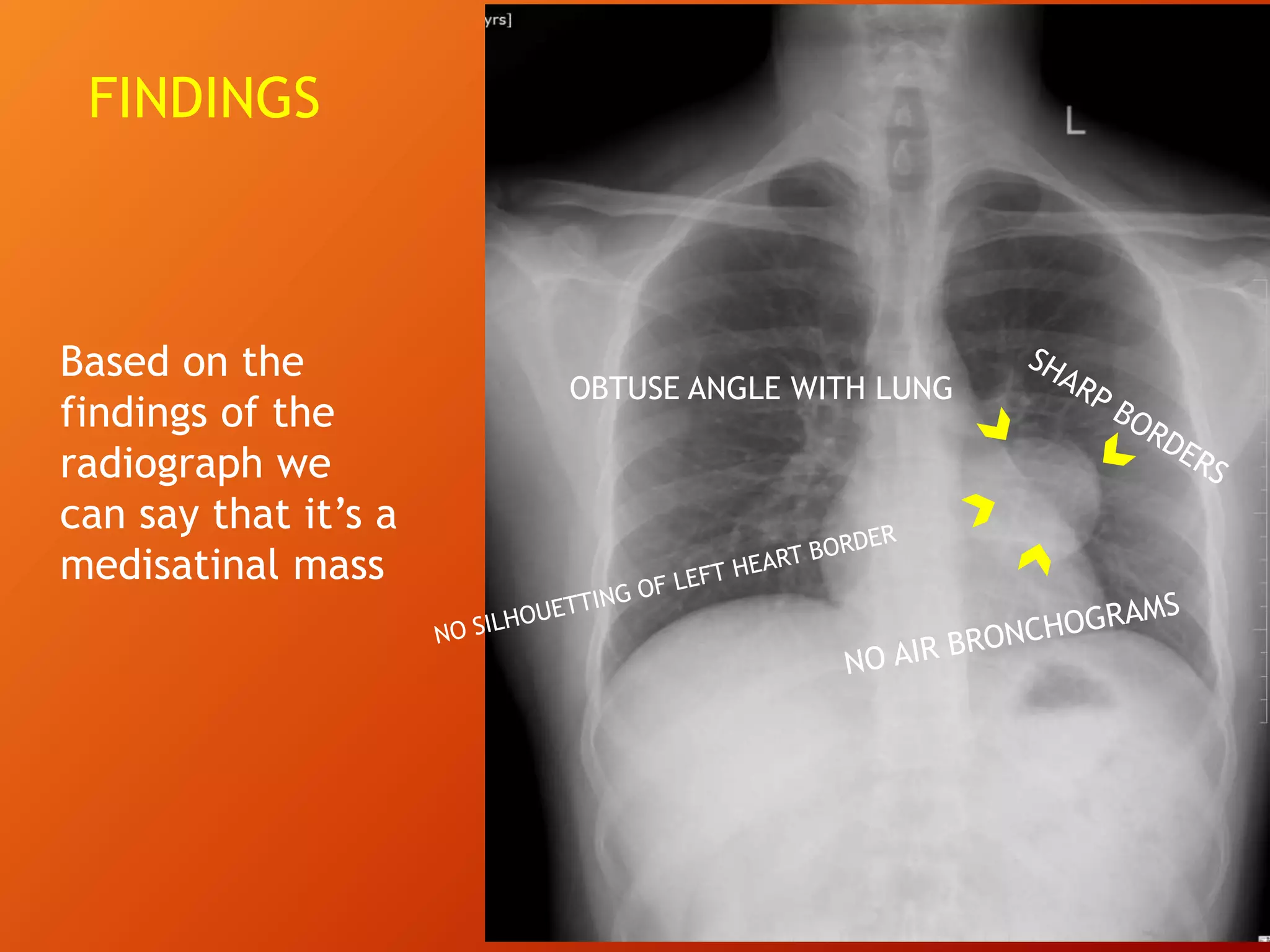
Chest X-Ray PA
view shows a well
defined round
radio-opaque
lesion in the
left perihilar
region.
CHEST X-RAY -
PA VIEW
OBTUSE ANGLE WITH LUNG
Based on the
findings of the
radiograph we
can say that it’s a
medisatinal mass
FINDINGS
DIFFERENTIALDIAGNOSIS
The mass seems to be arising
from left main bronchus.
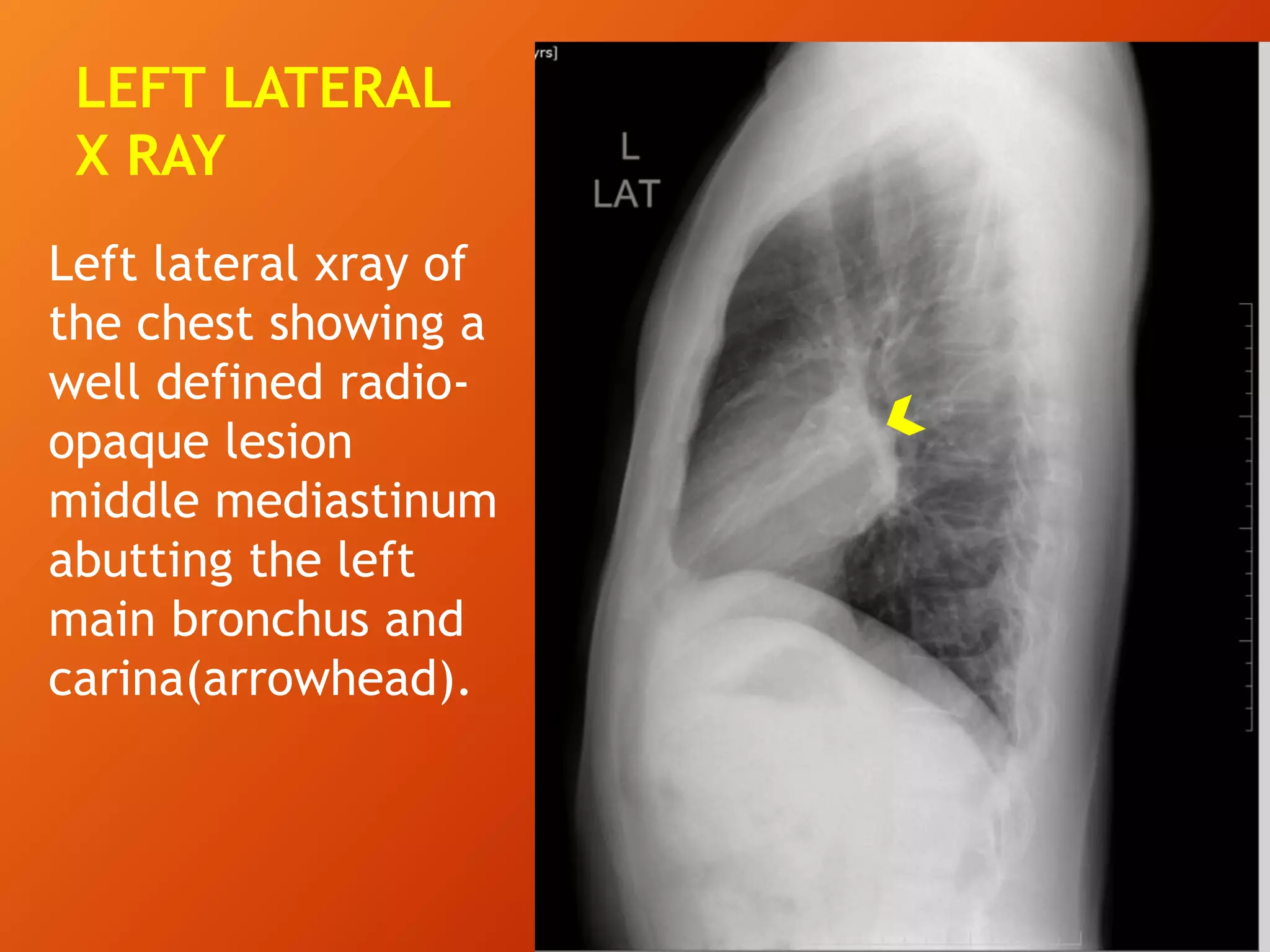
LEFT LATERAL
X RAY
Left lateral xray of
the chest showing a
well defined radio-
opaque lesion
middle mediastinum
abutting the left
main bronchus and
carina(arrowhead).
SO HOW DO WE DIFFERENTIATE
MEDIASTINAL MASS FROM PARENCHYMAL
MASS?
MEDIASTINAL VS PARENCHYMAL MASS
• Unlike lung lesions, a mediastinal mass will not
contain air bronchograms.
• Margins with the lung will be obtuse.
• Will not move with resipration on fluoroscopy.
• Pencil sharp borders.
• Broad based towards the mediastinum.
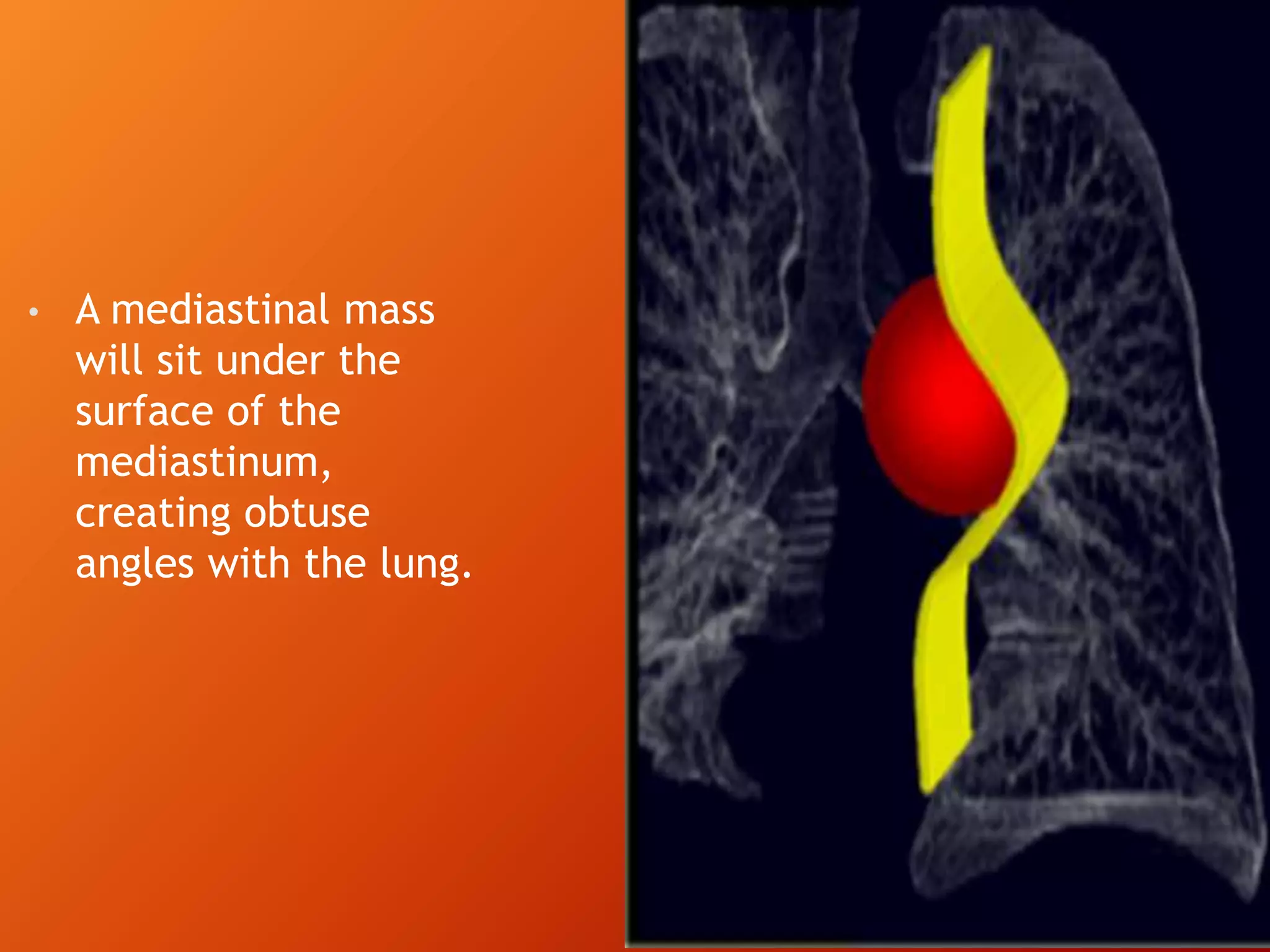
A lung mass abutts the
mediastinal surface
and creates acute
angle with the lung.
• A mediastinal mass
will sit under the
surface of the
mediastinum,
creating obtuse
angles with the lung.
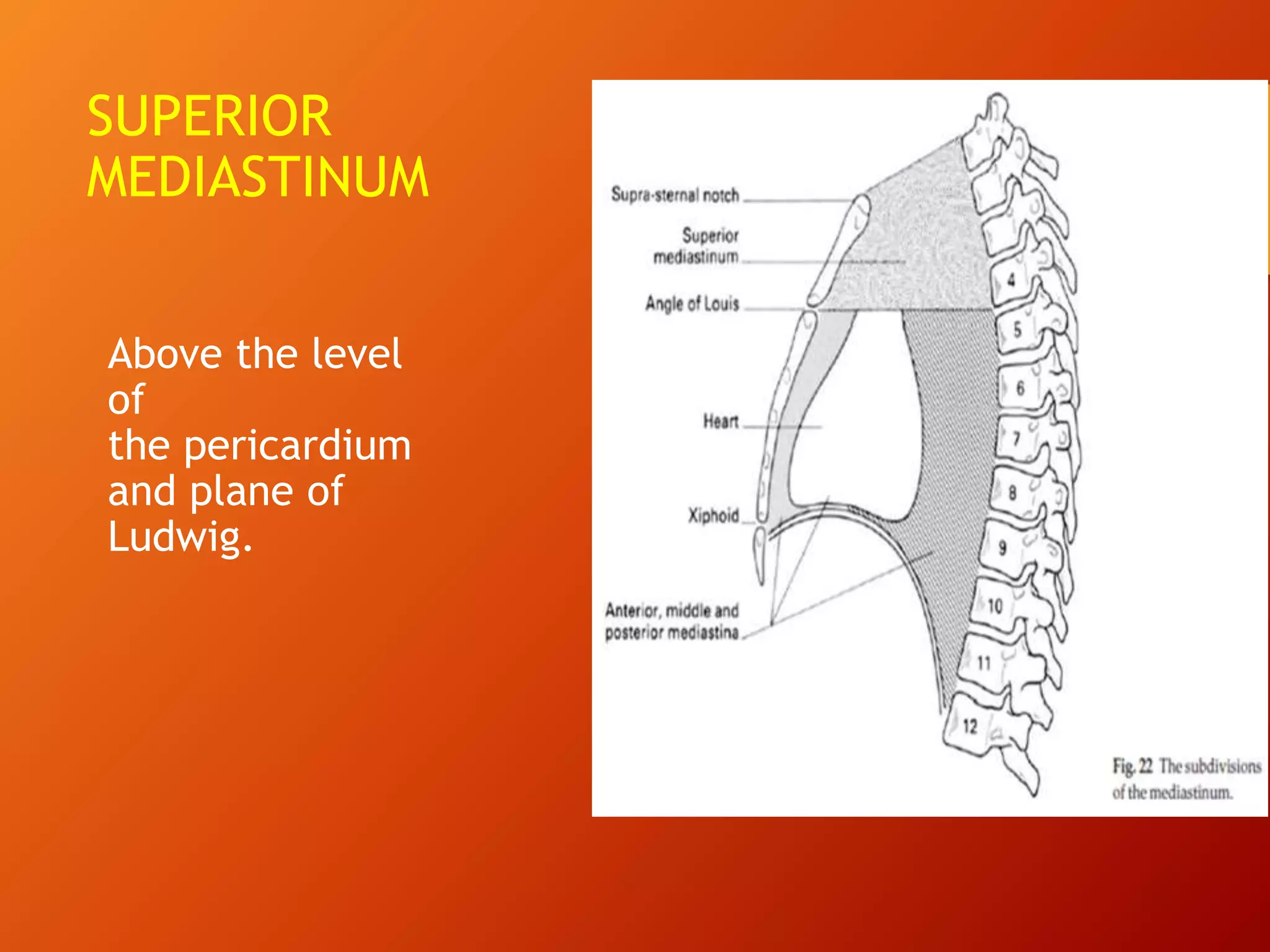
SUPERIOR
MEDIASTINUM
Above the level
of
the pericardium
and plane of
Ludwig.
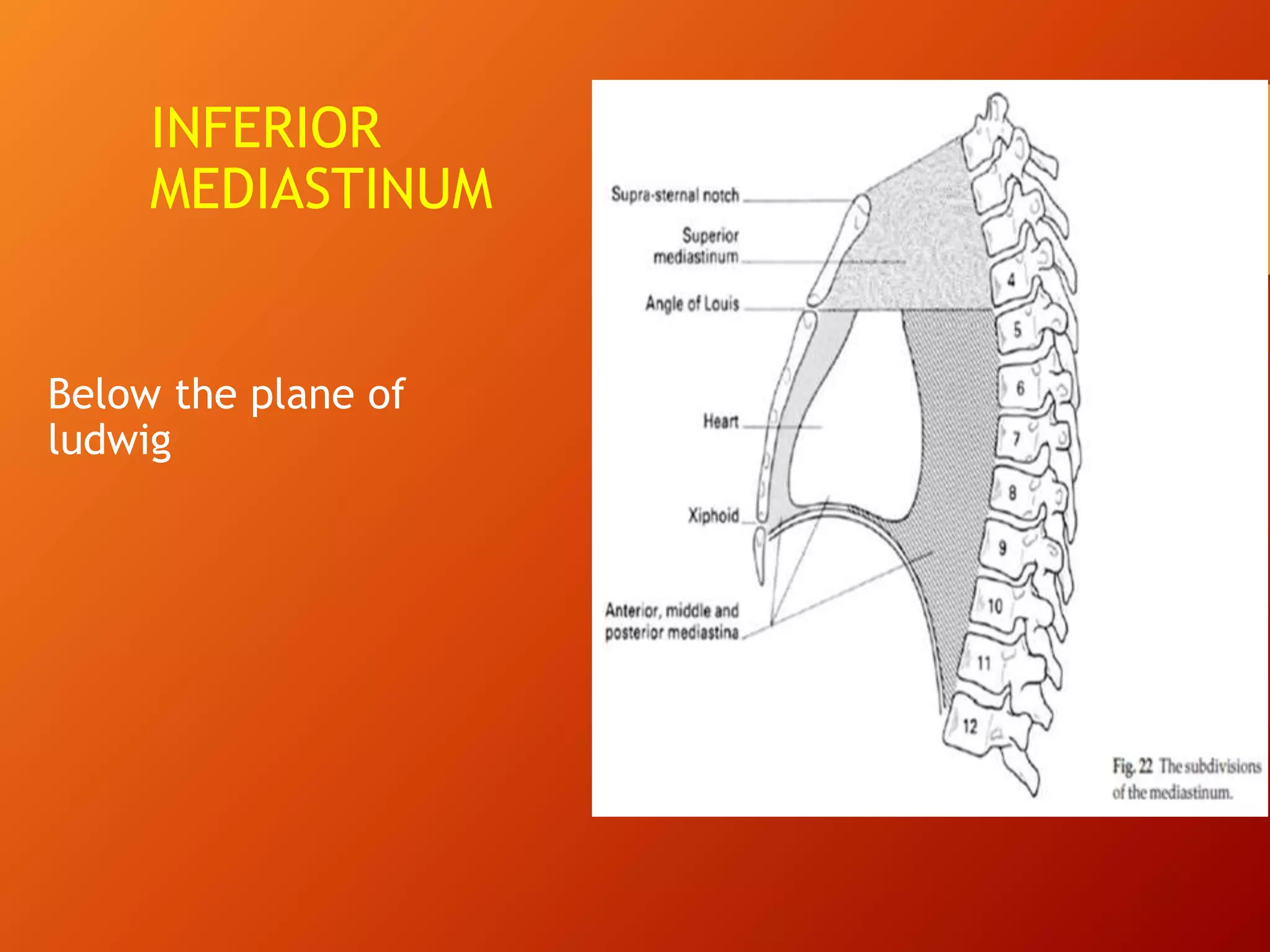
INFERIOR
MEDIASTINUM
Below the plane of
ludwig
Anterior
mediastinum: Anterior to
the pericardium
Middle
mediastinum: Within the
pericardium
Posterior
mediastinum: Posterior
to the pericardium
DIVISIONS OF INFERIOR
MEDIASTINUM
Anterior mediastinum
Thymus, lymph nodes
and
retrosternal thyroid
CONTENTS OF INFERIOR
MEDIASTINUM
Middle mediastinum
The heart,
Pericardium, Great
vessels,
Tracheal bifurcation
and both main
bronchi.
Posterior mediastinum
Descending aorta,
Oesophagus, Thoracic
duct, Azygous &
hemiazygous venous
systems.
LETS LEARN THE SIGNS WHICH HELP US
TO LOCALISE A MEDIASTINAL MASS ON A
FRONTAL RADIOGRAPH
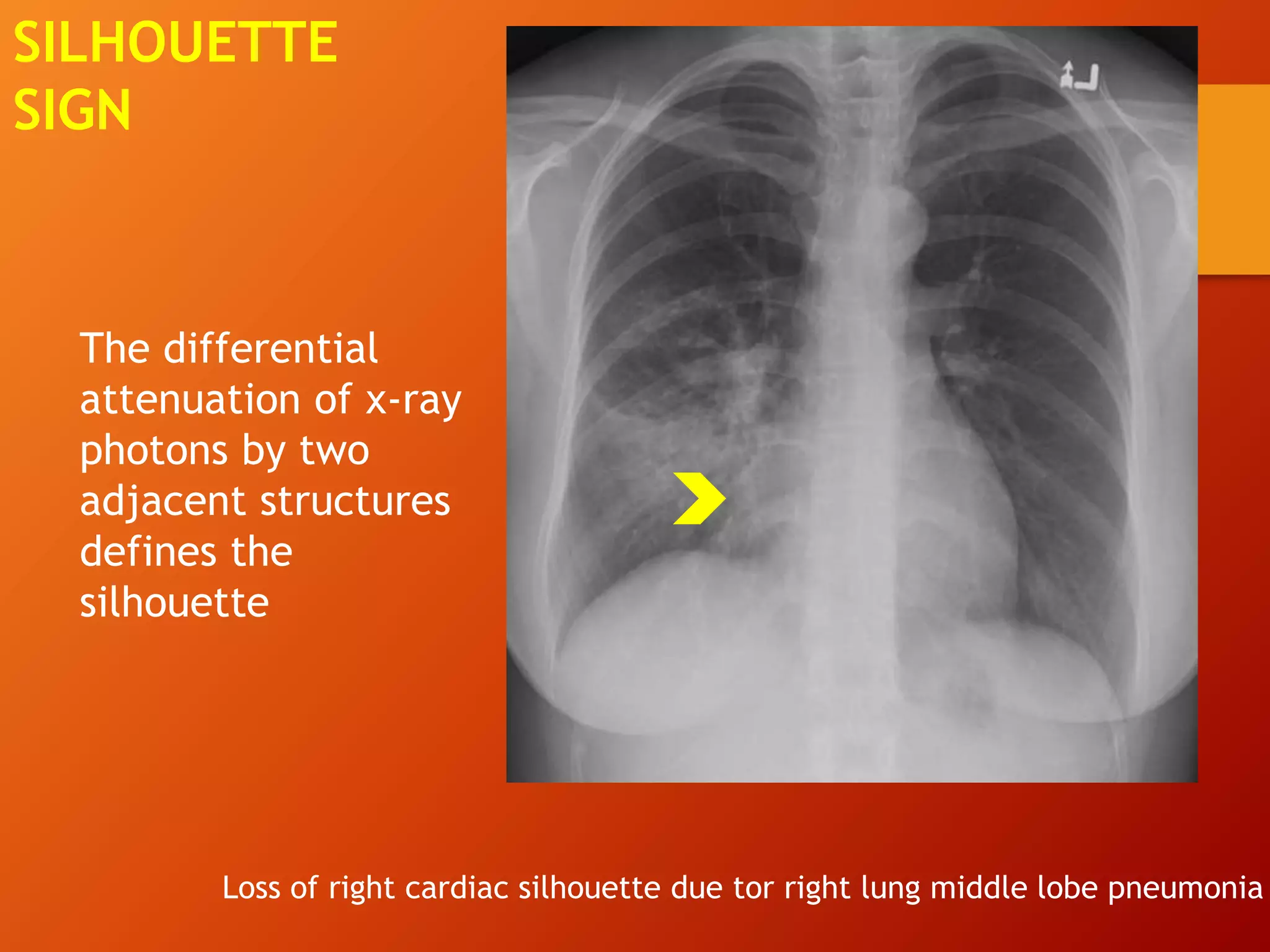
The differential
attenuation of x-ray
photons by two
adjacent structures
defines the
silhouette
SILHOUETTE
SIGN
Loss of right cardiac silhouette due tor right lung middle lobe pneumonia
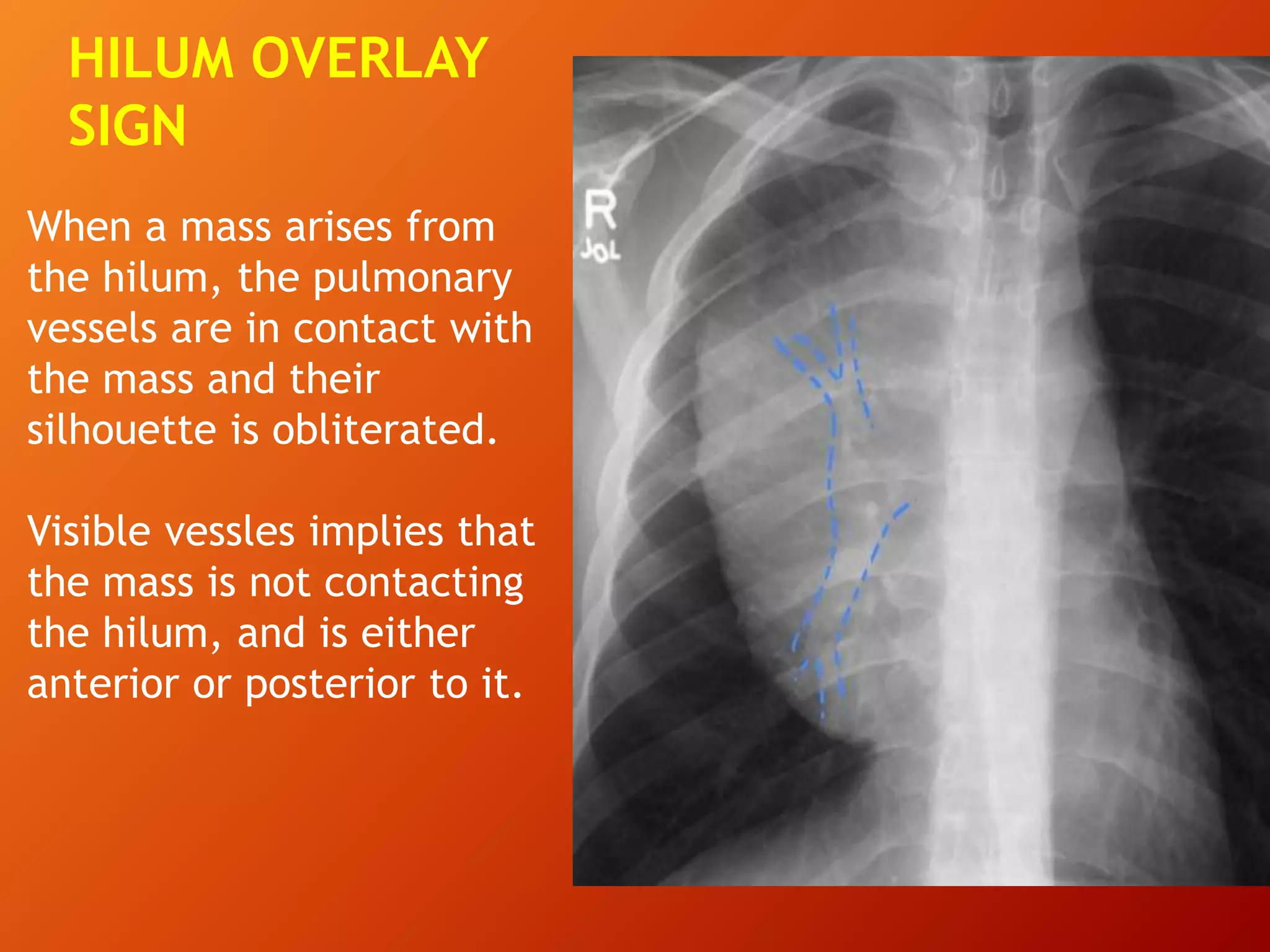
When a mass arises from
the hilum, the pulmonary
vessels are in contact with
the mass and their
silhouette is obliterated.
Visible vessles implies that
the mass is not contacting
the hilum, and is either
anterior or posterior to it.
HILUM OVERLAY
SIGN
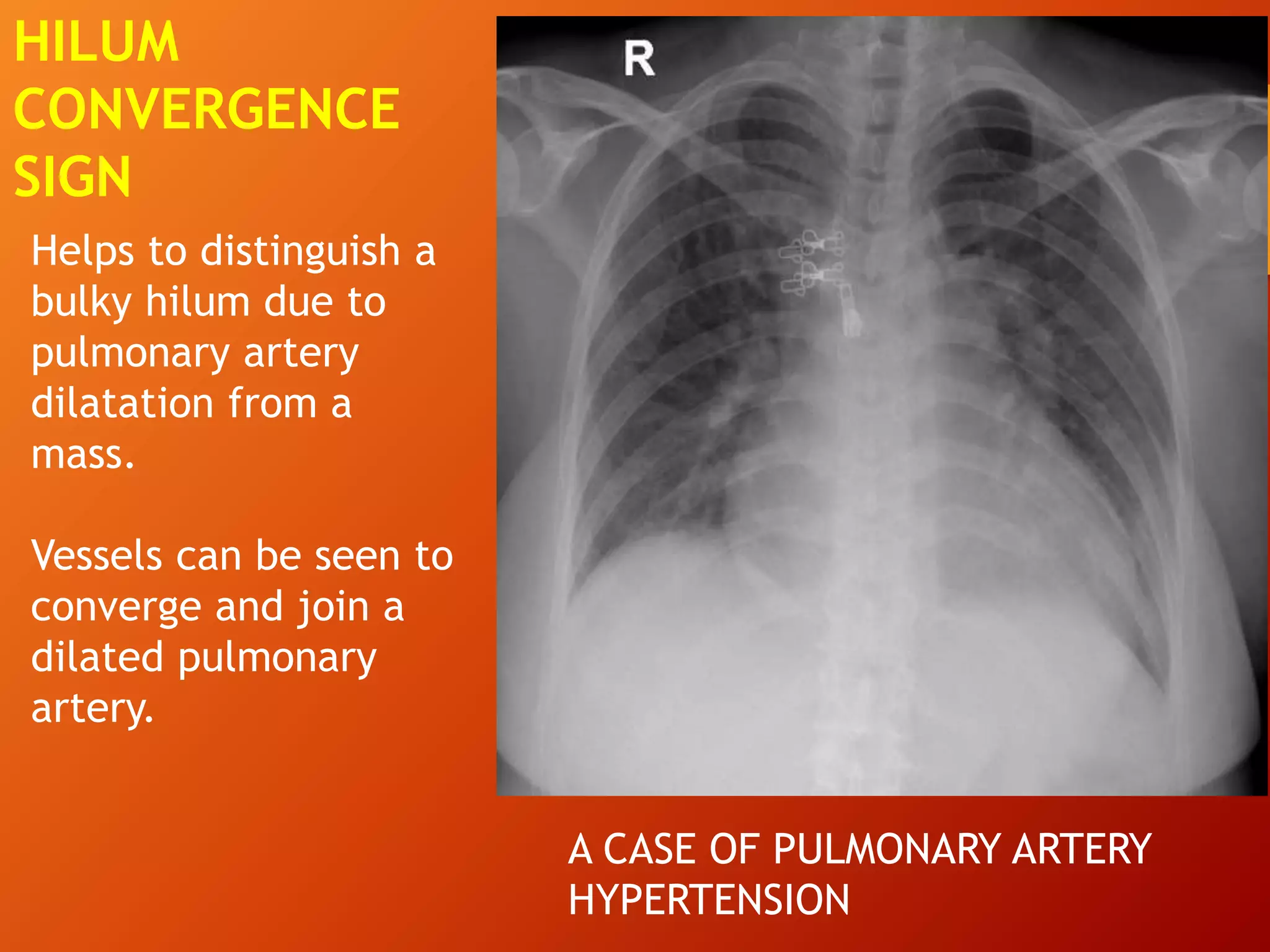
Helps to distinguish a
bulky hilum due to
pulmonary artery
dilatation from a
mass.
Vessels can be seen to
converge and join a
dilated pulmonary
artery.
HILUM
CONVERGENCE
SIGN
A CASE OF PULMONARY ARTERY
HYPERTENSION
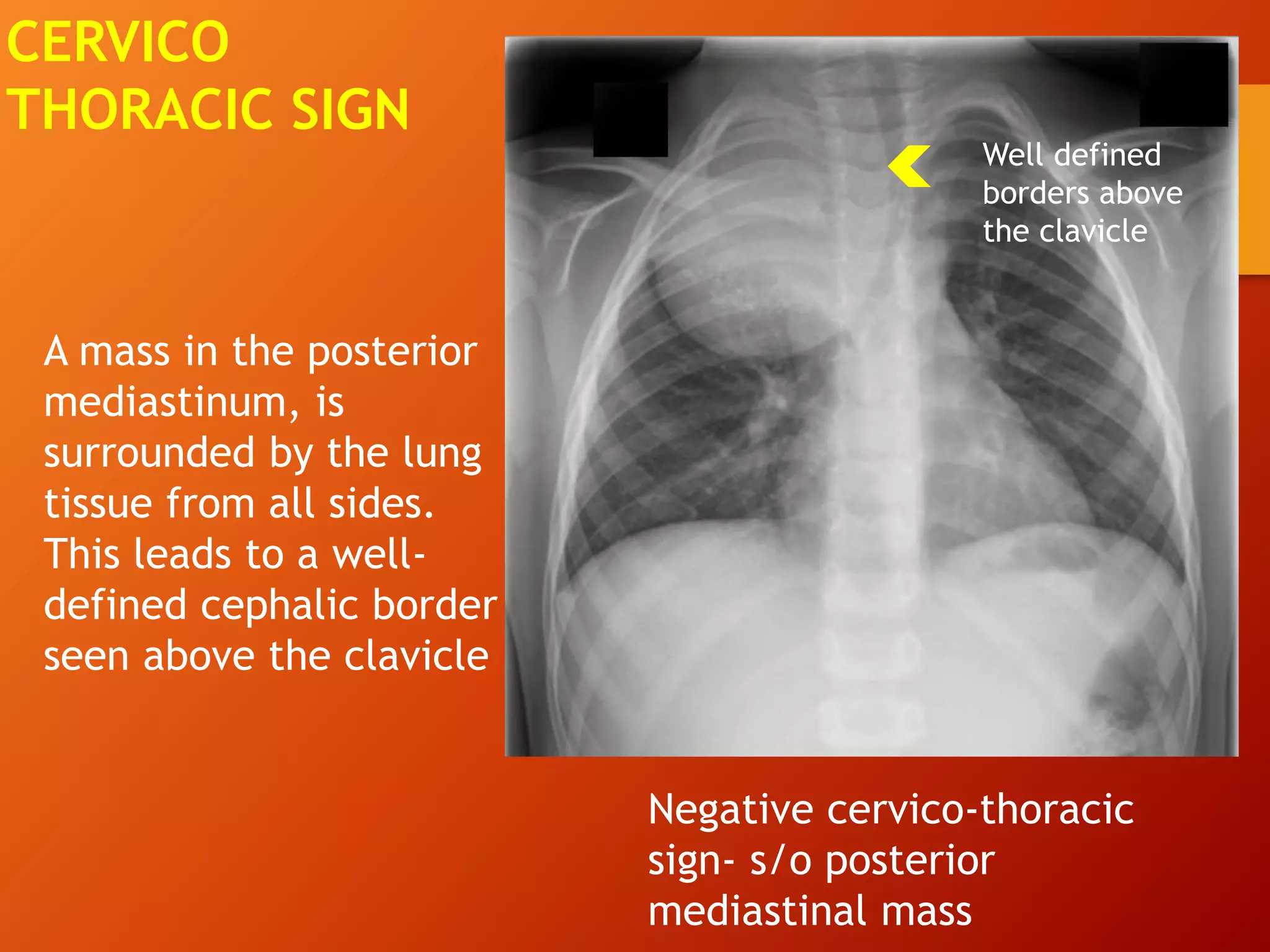
A mass in the posterior
mediastinum, is
surrounded by the lung
tissue from all sides.
This leads to a well-
defined cephalic border
seen above the clavicle
CERVICO
THORACIC SIGN
Negative cervico-thoracic
sign- s/o posterior
mediastinal mass
Well defined
borders above
the clavicle
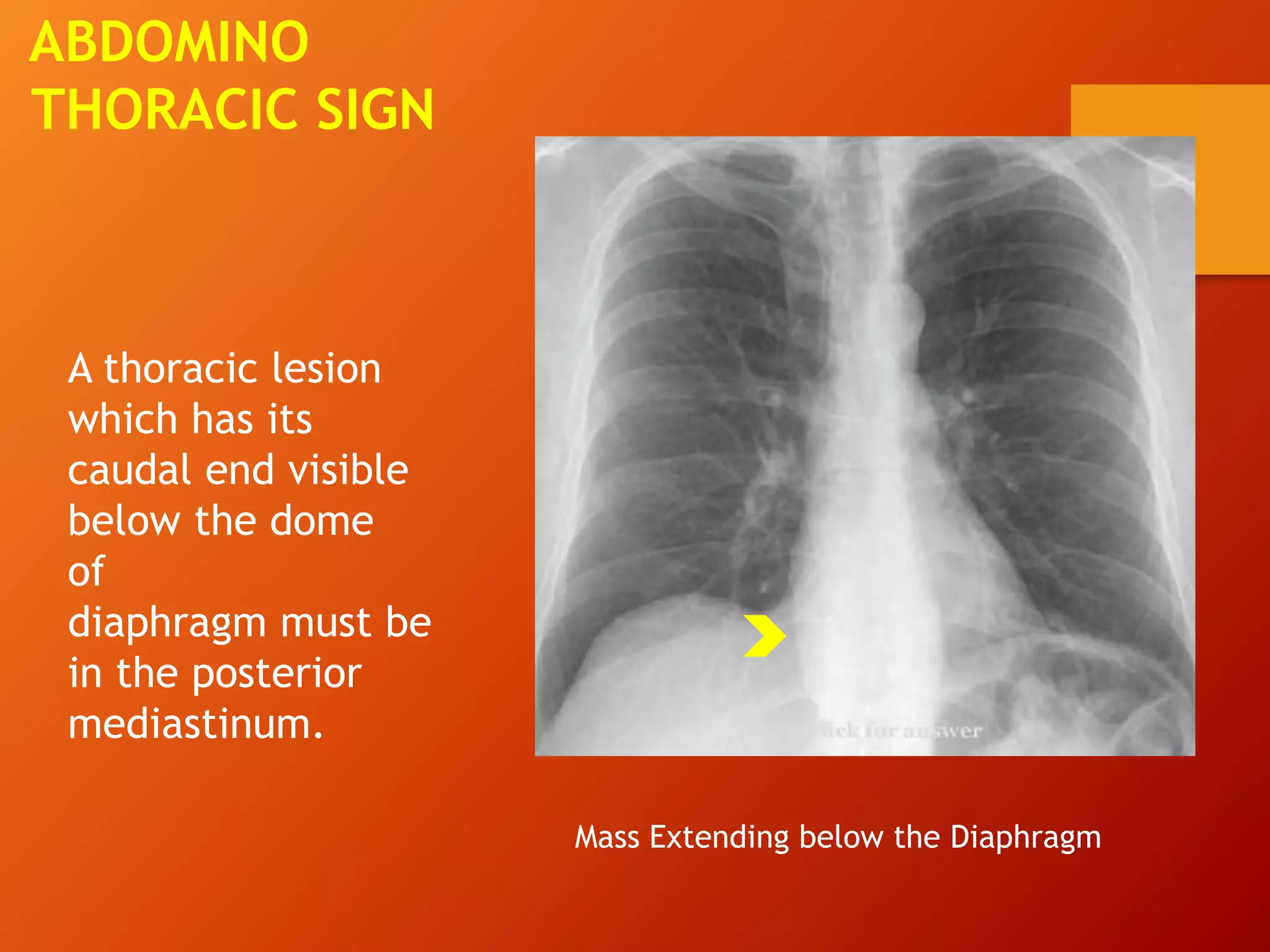
ABDOMINO
THORACIC SIGN
A thoracic lesion
which has its
caudal end visible
below the dome
of
diaphragm must be
in the posterior
mediastinum.
Mass Extending below the Diaphragm
DIVISIONS ON LATERAL IMAGING
DIFFERENTIAL DIAGNOSES OF
MEDIASTINAL MASSES
CT AND MRI WILL HELP US TO LOCALIZE,
FURTHER CHARACTERISE VARIOUS
MEDISTINAL MASS AND ALSO HELPS IN
EVALUTING INVASION INTO ADJACENT
STRUCTURES.
FURTHER IMAGING
Final conclusion: Well demarcated radio-opaque mass in
the middle mediastinum arising from the left main
bronchus.
BASED ON THE XRAY FINDINGS
DIFFERENTIALS –
Oesophageal duplication cysts - Thick walled cysts
found adjacent to the oesophagus
Bronchogenic Duplication cysts - Sharply demarcated
round/ oval thin walled mass filled with proteinacious
fluid usually in the medial 1/3 of lungs arising from the
bronchus.
FINAL DIAGNOSIS
BRONCHOGENIC CYST
BRONCHOGENIC CYST
Bronchogenic cysts are congenital malformations of the bronchial tree.
They can present as a mediastinal mass that may enlarge and cause local
compression.
It is also considered the commonest of foregut duplication cysts.
Bronchogenic cysts are asymptomatic and are found
incidentally.
When large, mass effect may result in bronchial
obstruction leading to air trapping and respiratory
distress.
CLINICAL PRESENTATION
Sharply demarcated round mass in the medial 1/3 of
lungs.
They do not communicate with the bronchial tree, and
are therefore not air filled.
They contain fluid ,variable amounts of proteinaceous
material, blood products, and calcium oxalate .
It is the latter three components that result in
increased attenuation mimicking solid lesions.
FEATURES
CT findings
Well circumscribed
spherical mass of
variable
attenuation with
variable fluid
composition explaining
the different CT
attenuations observed.
The degree of CT
attenuation often
depends on the amount
of internal proteinaceous
content .
FURTHER IMAGING
MRI
T2WI
High signal intensity
due to fluid content
Mediastinal mass

Mediastinal mass

  • 1.
    JSS Medical College,Mysuru CASE OF THE WEEK DR KAVITHA K. DR SHIKHAR GARG (Post Graduate Residents-Radiology)
  • 2.
    PRESENTING COMPLAINT 27 yearold man came with history of chronic dry cough. No h/o fever, hemoptysis, loss of weight. He was referred to the radiology department for further evaluation.
  • 3.
  • 4.
    What is the imaging modality? Whatare your findings? What are your differential diagnosis?
  • 5.
  • 6.
    Chest X-Ray PA viewshows a well defined round radio-opaque lesion in the left perihilar region. CHEST X-RAY - PA VIEW
  • 7.
    OBTUSE ANGLE WITHLUNG Based on the findings of the radiograph we can say that it’s a medisatinal mass FINDINGS
  • 8.
    DIFFERENTIALDIAGNOSIS The mass seemsto be arising from left main bronchus.
  • 9.
    LEFT LATERAL X RAY Leftlateral xray of the chest showing a well defined radio- opaque lesion middle mediastinum abutting the left main bronchus and carina(arrowhead).
  • 10.
    SO HOW DOWE DIFFERENTIATE MEDIASTINAL MASS FROM PARENCHYMAL MASS?
  • 11.
    MEDIASTINAL VS PARENCHYMALMASS • Unlike lung lesions, a mediastinal mass will not contain air bronchograms. • Margins with the lung will be obtuse. • Will not move with resipration on fluoroscopy. • Pencil sharp borders. • Broad based towards the mediastinum.
  • 12.
    A lung massabutts the mediastinal surface and creates acute angle with the lung.
  • 13.
    • A mediastinalmass will sit under the surface of the mediastinum, creating obtuse angles with the lung.
  • 14.
    SUPERIOR MEDIASTINUM Above the level of thepericardium and plane of Ludwig.
  • 15.
  • 16.
    Anterior mediastinum: Anterior to thepericardium Middle mediastinum: Within the pericardium Posterior mediastinum: Posterior to the pericardium DIVISIONS OF INFERIOR MEDIASTINUM
  • 17.
    Anterior mediastinum Thymus, lymphnodes and retrosternal thyroid CONTENTS OF INFERIOR MEDIASTINUM Middle mediastinum The heart, Pericardium, Great vessels, Tracheal bifurcation and both main bronchi. Posterior mediastinum Descending aorta, Oesophagus, Thoracic duct, Azygous & hemiazygous venous systems.
  • 18.
    LETS LEARN THESIGNS WHICH HELP US TO LOCALISE A MEDIASTINAL MASS ON A FRONTAL RADIOGRAPH
  • 19.
    The differential attenuation ofx-ray photons by two adjacent structures defines the silhouette SILHOUETTE SIGN Loss of right cardiac silhouette due tor right lung middle lobe pneumonia
  • 20.
    When a massarises from the hilum, the pulmonary vessels are in contact with the mass and their silhouette is obliterated. Visible vessles implies that the mass is not contacting the hilum, and is either anterior or posterior to it. HILUM OVERLAY SIGN
  • 21.
    Helps to distinguisha bulky hilum due to pulmonary artery dilatation from a mass. Vessels can be seen to converge and join a dilated pulmonary artery. HILUM CONVERGENCE SIGN A CASE OF PULMONARY ARTERY HYPERTENSION
  • 22.
    A mass inthe posterior mediastinum, is surrounded by the lung tissue from all sides. This leads to a well- defined cephalic border seen above the clavicle CERVICO THORACIC SIGN Negative cervico-thoracic sign- s/o posterior mediastinal mass Well defined borders above the clavicle
  • 23.
    ABDOMINO THORACIC SIGN A thoraciclesion which has its caudal end visible below the dome of diaphragm must be in the posterior mediastinum. Mass Extending below the Diaphragm
  • 24.
  • 25.
  • 26.
    CT AND MRIWILL HELP US TO LOCALIZE, FURTHER CHARACTERISE VARIOUS MEDISTINAL MASS AND ALSO HELPS IN EVALUTING INVASION INTO ADJACENT STRUCTURES. FURTHER IMAGING
  • 27.
    Final conclusion: Welldemarcated radio-opaque mass in the middle mediastinum arising from the left main bronchus.
  • 28.
    BASED ON THEXRAY FINDINGS DIFFERENTIALS – Oesophageal duplication cysts - Thick walled cysts found adjacent to the oesophagus Bronchogenic Duplication cysts - Sharply demarcated round/ oval thin walled mass filled with proteinacious fluid usually in the medial 1/3 of lungs arising from the bronchus.
  • 29.
  • 30.
    BRONCHOGENIC CYST Bronchogenic cystsare congenital malformations of the bronchial tree. They can present as a mediastinal mass that may enlarge and cause local compression. It is also considered the commonest of foregut duplication cysts.
  • 31.
    Bronchogenic cysts areasymptomatic and are found incidentally. When large, mass effect may result in bronchial obstruction leading to air trapping and respiratory distress. CLINICAL PRESENTATION
  • 32.
    Sharply demarcated roundmass in the medial 1/3 of lungs. They do not communicate with the bronchial tree, and are therefore not air filled. They contain fluid ,variable amounts of proteinaceous material, blood products, and calcium oxalate . It is the latter three components that result in increased attenuation mimicking solid lesions. FEATURES
  • 33.
    CT findings Well circumscribed sphericalmass of variable attenuation with variable fluid composition explaining the different CT attenuations observed. The degree of CT attenuation often depends on the amount of internal proteinaceous content . FURTHER IMAGING
  • 34.