DR. MOHIT GOEL
JR1
18 SEPT. 2012
Congenital "lung" lesions
1. Cystic Adenomatoid Malformation
2. Pulmonary Sequestration
3. Bronchogenic Cyst
4. Congenital Lobar Emphysema
5. Congenital Diaphragmatic Hernia
6. Bronchial Atresia
7. Scimitar syndrome
Neonatal Chest Issues
1. Surfactant Deficient Disease
2. Meconium Aspiration Syndrome
3. Transient Tachypnea of the Newborn
4. Pulmonary Interstitial Emphysema
5. Bronchopulmonary Dysplasia
Congenital pulmonary airway malformation
(congenital cystic adenomatoid malformation (CCAM))
Congenital"lung" lesions
o Multicystic mass with air in cysts
o Imaging appearance depends upon size of cysts and whether cysts fluid filled.
o Cysts communicate with bronchial tree at birth and fill with air early in life
Location
o No lobar predilection
o Most lesions confined to single lobe
o Most lesions solitary.
Three types based on size of cysts in lesion at imaging/pathology –
• CCAM type 1 (50%): 1 or more large (2-10 cm) cysts
• CCAM type 2 (40%): Numerous small cysts (< 2 cm) of uniform size
• CCAM type 3 (10%): Appears solid on gross inspection and imaging but have
microcysts
Radiographic features
Antenatal ultrasound-
These lesions appear as an isolated cystic
or solid intrathoracic mass. A solid thoracic
mass is usually indicative of a type III
CPAM and is typically hyperechoic.
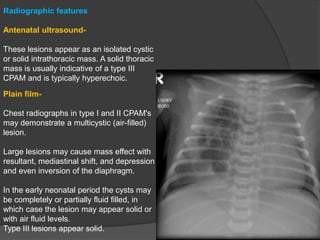
Plain film-
Chest radiographs in type I and II CPAM's
may demonstrate a multicystic (air-filled)
lesion.
Large lesions may cause mass effect with
resultant, mediastinal shift, and depression
and even inversion of the diaphragm.
In the early neonatal period the cysts may
be completely or partially fluid filled, in
which case the lesion may appear solid or
with air fluid levels.
Type III lesions appear solid.
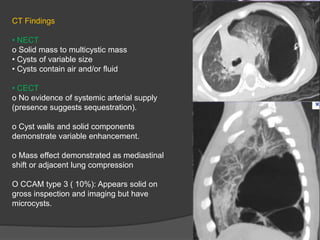
CT Findings
• NECT
o Solid mass to multicystic mass
• Cysts of variable size
• Cysts contain air and/or fluid
• CECT
o No evidence of systemic arterial supply
(presence suggests sequestration).
o Cyst walls and solid components
demonstrate variable enhancement.
o Mass effect demonstrated as mediastinal
shift or adjacent lung compression
O CCAM type 3 ( 10%): Appears solid on
gross inspection and imaging but have
microcysts.
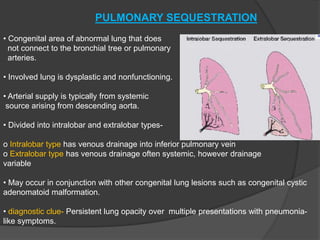
PULMONARY SEQUESTRATION
• Congenital area of abnormal lung that does
not connect to the bronchial tree or pulmonary
arteries.
• Involved lung is dysplastic and nonfunctioning.
• Arterial supply is typically from systemic
source arising from descending aorta.
• Divided into intralobar and extralobar types-
o Intralobar type has venous drainage into inferior pulmonary vein
o Extralobar type has venous drainage often systemic, however drainage
variable
• May occur in conjunction with other congenital lung lesions such as congenital cystic
adenomatoid malformation.
• diagnostic clue- Persistent lung opacity over multiple presentations with pneumonia-
like symptoms.
Location
o Most common location is left lower lobe, followed by right lower lobe
o Systemic arterial supply most commonly arises from descending aorta
May arise from below the hemidiaphragm in 20% of cases
• Diagnostic feature: Systemic artery arising from the aorta and feeding sequestration.
Radiographic Findings
Radiography
o Often seen as persistent lower lobe opacity that is unchanged over multiple
radiographs.
o Does not typically contain air unless infected
o Does not appear as air-containing mass during neonatal period
o If infected, may appear as multi-cystic air-containing mass.
CT Findings
• NECT
o Opacification of lower lobe lung parenchyma
o May have cystic air-filled components if infected
or if occurring in conjunction with congenital cystic
adenomatoid malformation
• CECT
o Systemic arterial supply demonstrated
o Typically artery arises from descending aorta
and extends into abnormal area of lung
o Systemic artery may arise from other systemic
sources as well.
Grayscale Ultrasound
o Ultrasound may be used in newborns to
demonstrate systemic arterial supply via Doppler
o Abnormal lung is often opacified providing
acoustic window.
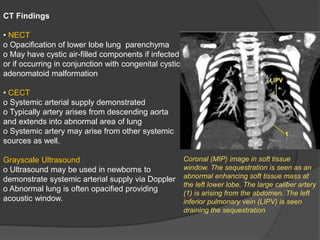
Coronal (MIP) image in soft tissue
window. The sequestration is seen as an
abnormal enhancing soft tissue mass at
the left lower lobe. The large caliber artery
(1) is arising from the abdomen. The left
inferior pulmonary vein (LIPV) is seen
draining the sequestration
BRONCHOGENIC CYST
They are developmental lesions that result from abnormal ventral budding of the
tracheobronchial tree between the 26th and 40th days of gestation.
• Location
Mediastinal location is more common than pulmonary
o Mediastinal 65-90%
Majority in the middle mediastinum
Typically para tracheal, carinal, or hilar
Pericarinal most common
o Pulmonary: Majority in the medial third of the lungs, More frequent in the lower lobes
Typically do not communicate with airway and do not contain air, Air presence indicates
infection.
CT Findings
• NECT
o Homogeneous well circumscribed lesion
o Cyst contents variable: Water to proteinaceous
o Hence CT attenuation is variable
• CECT
o Well-defined, typically with nonenhancing or minimally enhancing thin wall
o More prominent wall enhancement and wall thickening may be seen with infection
o No central enhancement
MR Findings
• TlWI : o Well-circumscribed lesion
o Homogeneous signal intensity unless infected
o Variable signal due to varying amounts of proteinaceous material, but usually
water signal
o Imperceptible wall
• T2WI: Signal is almost always equal to or greater than cerebrospinal fluid (CSF)
• STIR: Markedly increased signal, equal to or greater than CSF
• Tl C+ : o May have a thin rim of mild enhancement
o Thicker enhancing wall implies infection
o No central enhancement
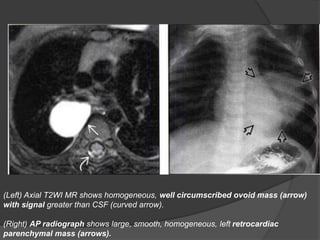
(Left) Axial T2WI MR shows homogeneous, well circumscribed ovoid mass (arrow)
with signal greater than CSF (curved arrow).
(Right) AP radiograph shows large, smooth, homogeneous, left retrocardiac
parenchymal mass (arrows).
CONGENITAL LOBAR EMPHYSEMA
A congenital lobar emphysema (CLE) refers to an over inflation of one or more lung
lobes presumably due to various factors including a possible obstructive check valve
mechanism at a bronchial level.
Location
• Left upper lobe: 42%
• Right middle lobe: 35%
• Right upper lobe: 21%
•Chest radiograph
o Initially after birth, lobe may be filled with fetal lung fluid and appear as radiodensity
o May have a reticular pattern as fluid is cleared via distended lymphatics
o Fluid eventually replaced by air
• Hyperlucent, hyperexpanded lobe
o Deviation of mediastinum to contralateral side
o Increased retrosternal lucency on lateral view
o Pulmonary vessels may appear attenuated and displaced.
o Classic progression: Radiodense lobe that becomes progressively hyperlucent and
hyperexpanded
CT Findings
•Lucency caused by air in distended alveoli - Hyperlucent lung
•Vessels attenuated: Smaller than those in adjacent lung
•Mediastinal and tracheal deviation
•Compression of remainder of ipsilateral lung
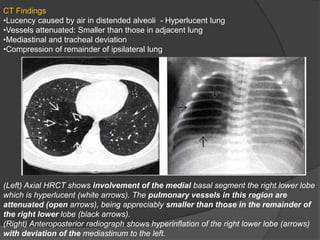
(Left) Axial HRCT shows involvement of the medial basal segment the right lower lobe
which is hyperlucent (white arrows). The pulmonary vessels in this region are
attenuated (open arrows), being appreciably smaller than those in the remainder of
the right lower lobe (black arrows).
(Right) Anteroposterior radiograph shows hyperinflation of the right lower lobe (arrows)
with deviation of the mediastinum to the left.
CONGENITAL DIAPHRAGMATIC HERNIA
• Location
o More common on left than right (5:1)
o May contain variable abdominal contents: Stomach, small and large bowel, liver
Radiography
o Radiographic appearance depends on hernia contents and whether air present within
herniated bowel
o XR initially after birth may show hernia as radiodense (prior to air introduced into
bowel)
o Later when air introduced into bowel: Appears as air-containing cystic mass
resembling bowel
o Decreased bowel gas in abdomen
o Right-sided hernia often contains liver and not bowel (soft tissue density)
o Mediastinal shift away from hernia
o Low volumes of ipsilateral or contralateral lung (from hypoplasia)

o Abnormal position of support apparatus may be clue to diagnosis-
• NG tube lodged with tip at esophagogastric junction
• NG tube above diaphragm documenting stomach in hernia
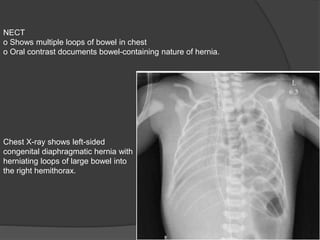
NECT
o Shows multiple loops of bowel in chest
o Oral contrast documents bowel-containing nature of hernia.
Chest X-ray shows left-sided
congenital diaphragmatic hernia with
herniating loops of large bowel into
the right hemithorax.
BRONCHIAL ATRESIA
Bronchial atresia is a congenital abnormality resulting from focal interruption of a lobar,
segmental, or subsegmental bronchus with associated peripheral mucus impaction
(bronchocele, mucocele) and associated hyperinflation of the obstructed lung segment
Location
o Most common location: Apicoposterior segment left upper lobe
o Next most likely: Right upper lobe, right middle lobe ; lower lobe bronchi rare.
Morphology
o Round or branching tubular mass of dilated fluid-filled bronchi distal to an atretic
proximal segmental bronchus.
Radiographic Findings
• Round or ovoid mass adjacent to the hilum (bronchocele)
• Branching tubular opacities (mucoid impaction of dilated bronchi) distal to segmental
bronchus
• Distal lung hyperinflated
• Diminished vascularity
• Neonates; lobe or segment may be fluid filled, gradually replaced by air
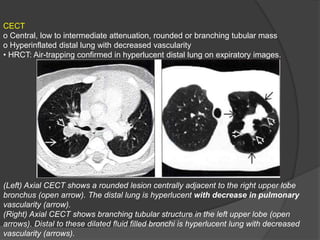
CECT
o Central, low to intermediate attenuation, rounded or branching tubular mass
o Hyperinflated distal lung with decreased vascularity
• HRCT: Air-trapping confirmed in hyperlucent distal lung on expiratory images.
(Left) Axial CECT shows a rounded lesion centrally adjacent to the right upper lobe
bronchus (open arrow). The distal lung is hyperlucent with decrease in pulmonary
vascularity (arrow).
(Right) Axial CECT shows branching tubular structure in the left upper lobe (open
arrows). Distal to these dilated fluid filled bronchi is hyperlucent lung with decreased
vascularity (arrows).
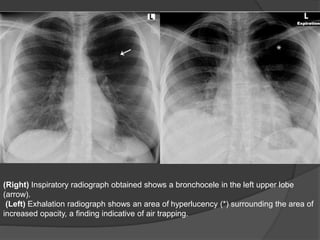
(Right) Inspiratory radiograph obtained shows a bronchocele in the left upper lobe
(arrow).
(Left) Exhalation radiograph shows an area of hyperlucency (*) surrounding the area of
increased opacity, a finding indicative of air trapping.
Scimitar syndrome
(also known as pulmonary venolobar syndrome or hypogenetic lung syndrome)
Pathology
It is essentially a combination of pulmonary hypoplasia and partial anomalous pulmonary
venous return (PAPVR). It almost exclusively occurs on the right side.
Haemodynamically, there is an acyanotic left to right shunt.
The anomalous vein usually drains into –
•IVC : most common
•right atrium or portal vein
The lung is frequently perfused by the aorta, but the bronchial tree is still connected and
thus the lung is not sequestered.
Radiographic features
The diagnosis is made by by CT or MR angiography.
Plain film
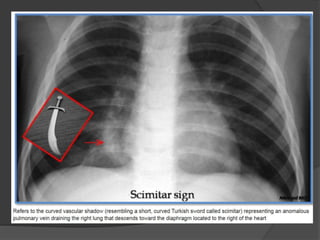
CXR findings are that of a small lung with ipsilateral mediastinal shift,
The anomalous draining vein may be seen as a tubular structure paralleling the
right heart border in the shape of a Turkish sword (“scimitar”).
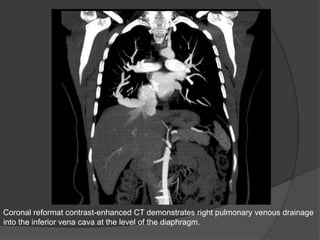
Coronal reformat contrast-enhanced CT demonstrates right pulmonary venous drainage
into the inferior vena cava at the level of the diaphragm.
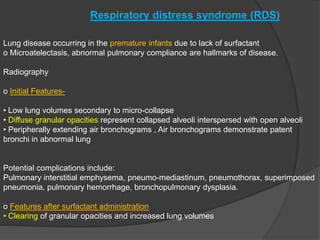
Respiratory distress syndrome (RDS)
Lung disease occurring in the premature infants due to lack of surfactant
o Microatelectasis, abnormal pulmonary compliance are hallmarks of disease.
Radiography
o Initial Features-
• Low lung volumes secondary to micro-collapse
• Diffuse granular opacities represent collapsed alveoli interspersed with open alveoli
• Peripherally extending air bronchograms , Air bronchograms demonstrate patent
bronchi in abnormal lung
Potential complications include:
Pulmonary interstitial emphysema, pneumo-mediastinum, pneumothorax, superimposed
pneumonia, pulmonary hemorrhage, bronchopulmonary dysplasia.
o Features after surfactant administration
• Clearing of granular opacities and increased lung volumes
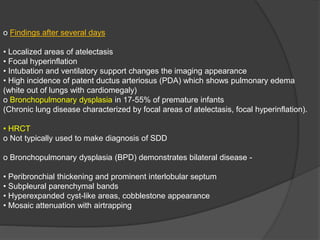
o Findings after several days
• Localized areas of atelectasis
• Focal hyperinflation
• Intubation and ventilatory support changes the imaging appearance
• High incidence of patent ductus arteriosus (PDA) which shows pulmonary edema
(white out of lungs with cardiomegaly)
o Bronchopulmonary dysplasia in 17-55% of premature infants
(Chronic lung disease characterized by focal areas of atelectasis, focal hyperinflation).
• HRCT
o Not typically used to make diagnosis of SDD
o Bronchopulmonary dysplasia (BPD) demonstrates bilateral disease -
• Peribronchial thickening and prominent interlobular septum
• Subpleural parenchymal bands
• Hyperexpanded cyst-like areas, cobblestone appearance
• Mosaic attenuation with airtrapping
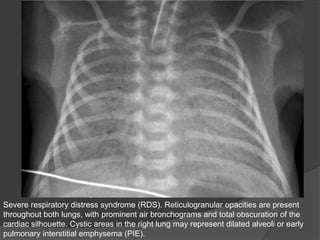
Severe respiratory distress syndrome (RDS). Reticulogranular opacities are present
throughout both lungs, with prominent air bronchograms and total obscuration of the
cardiac silhouette. Cystic areas in the right lung may represent dilated alveoli or early
pulmonary interstitial emphysema (PIE).
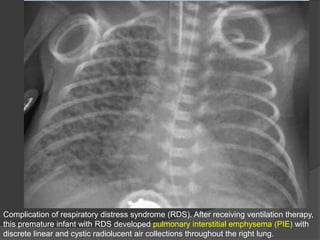
Complication of respiratory distress syndrome (RDS). After receiving ventilation therapy,
this premature infant with RDS developed pulmonary interstitial emphysema (PIE) with
discrete linear and cystic radiolucent air collections throughout the right lung.
MECONIUM ASPIRATION SYNDROME
Radiography
•Imaging findings Bilateral diffuse grossly patchy / coarse opacities (atelectasis and
consolidation)
•Rope-like perihilar densities
•Hyperinflation of lungs
•Areas of emphysema (air-trapping)
•Spontaneous pneumothorax and pneumomediastinum
•25% requiring no therapy
•Small pleural effusions (20%)
•Rapid clearing usually within 48 hours
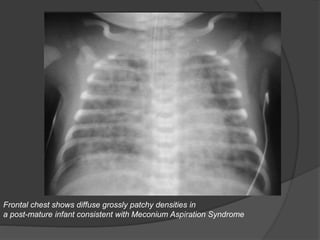
Frontal chest shows diffuse grossly patchy densities in
a post-mature infant consistent with Meconium Aspiration Syndrome
TRANSIENT TACHYPNEA OF THE NEWBORN
(Wet lung disease)
Definitions
• Transient tachypnea occurs when liquid in the fetal lung is removed slowly or
incompletely from newborn lung and there is increased absorption by lymphatics
and capillaries
o Lack of normal thoracic compression that normally occurs during vaginal delivery and
is bipassed via C-sections
o Lack of normal breathing may occur with sedated infants
Best diagnostic clue: Prominent interstitial pattern in lung with history of C-section.
The lungs usually are affected diffusely and symmetrically, and the condition is
commonly accompanied by a small pleural effusion.
Chest radiographs
• Findings similar to pulmonary edema
• Prominent intersitial markings with normal heart size
• Diffuse, bilateral and somewhat symmetric increase in lung markings
• Pleural effusions may be present
• Fluid in the fissures
• Normal to hyperinflated lung volumes
• Interstitial pattern and other findings resolve and is normal within 72 hours. Clearing
continues from peripheral to central and from upper to lower lung.
•The radiographic appearance can mimic the diffuse granular appearance of hyaline
membrane disease but without the pulmonary underaeration.
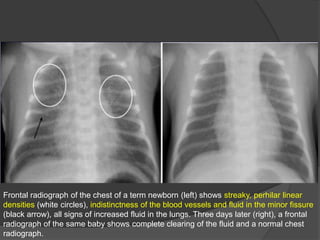
Frontal radiograph of the chest of a term newborn (left) shows streaky, perhilar linear
densities (white circles), indistinctness of the blood vessels and fluid in the minor fissure
(black arrow), all signs of increased fluid in the lungs. Three days later (right), a frontal
radiograph of the same baby shows complete clearing of the fluid and a normal chest
radiograph.
PULMONARY INTERSTITIAL EMPHYSEMA
Definitions
• Abnormal location of pulmonary air within the interstitium and lymphatics; usually
secondary to barotrauma. This collection develops as a result of alveolar and terminal
bronchiolar rupture. It is more frequent in premature infants who require mechanical
ventilation for severe lung disease.
Radiography
o Bubble-like or linear lucencies within the lung
o Lucencies typically uniform in size
o Often radiate from hilum
o May be focal (one lobe) or diffuse and bilateral
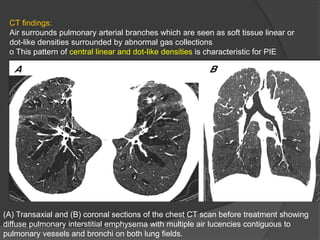
CT findings:
Air surrounds pulmonary arterial branches which are seen as soft tissue linear or
dot-like densities surrounded by abnormal gas collections
o This pattern of central linear and dot-like densities is characteristic for PIE
(A) Transaxial and (B) coronal sections of the chest CT scan before treatment showing
diffuse pulmonary interstitial emphysema with multiple air lucencies contiguous to
pulmonary vessels and bronchi on both lung fields.
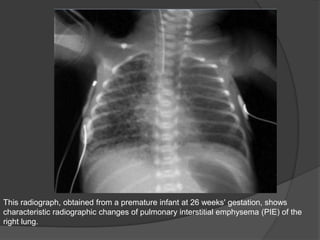
This radiograph, obtained from a premature infant at 26 weeks' gestation, shows
characteristic radiographic changes of pulmonary interstitial emphysema (PIE) of the
right lung.
BRONCHOPULMONARY DYSPLASIA
(chronic lung disease of infancy, chronic lung disease of prematurity (CLD))
Bronchopulmonary dysplasia (BPD) is a form of chronic lung disease that develops in
preterm neonates treated with oxygen and positive-pressure ventilation (PPV).
Radiography
o Early
• Homogeneously increased opacities bilaterally primarily related to retained fluid and/or
patent ductus arteriosus
Pathology
Occurs from a paradoxical combination of hypoxia and oxygen toxicity. There is Initial
capillary wall damage, leading to interstitial fluid seepage.
o Subsequently
• Heterogeneous appearance with focal lucencies separated by coarse reticular and
band-like opacities of fibrosis and atelectasis
• More opacities in the upper lobes with hyperinflation at the bases
HRCT
o Mosaic attenuation
o Foci of air trapping on expiratory images
o Subpleural triangular opacities
o Linear and reticular opacities
o Reduced bronchial lumen: Pulmonary arterial ratio
Complication of ventilation therapy. Bronchopulmonary dysplasia. AP chest radiograph in
a 4-week-old premature infant with history of RDS and receiving mechanical ventilation
shows moderate pulmonary hyperinflation, coarse interstitial opacities throughout both
lungs, and atelectasis in the right upper lobe.
Thank U

Pediatric chest

  • 1.
  • 2.
    Congenital "lung" lesions 1.Cystic Adenomatoid Malformation 2. Pulmonary Sequestration 3. Bronchogenic Cyst 4. Congenital Lobar Emphysema 5. Congenital Diaphragmatic Hernia 6. Bronchial Atresia 7. Scimitar syndrome Neonatal Chest Issues 1. Surfactant Deficient Disease 2. Meconium Aspiration Syndrome 3. Transient Tachypnea of the Newborn 4. Pulmonary Interstitial Emphysema 5. Bronchopulmonary Dysplasia
  • 3.
    Congenital pulmonary airwaymalformation (congenital cystic adenomatoid malformation (CCAM)) Congenital"lung" lesions o Multicystic mass with air in cysts o Imaging appearance depends upon size of cysts and whether cysts fluid filled. o Cysts communicate with bronchial tree at birth and fill with air early in life Location o No lobar predilection o Most lesions confined to single lobe o Most lesions solitary. Three types based on size of cysts in lesion at imaging/pathology – • CCAM type 1 (50%): 1 or more large (2-10 cm) cysts • CCAM type 2 (40%): Numerous small cysts (< 2 cm) of uniform size • CCAM type 3 (10%): Appears solid on gross inspection and imaging but have microcysts
  • 4.
    Radiographic features Antenatal ultrasound- Theselesions appear as an isolated cystic or solid intrathoracic mass. A solid thoracic mass is usually indicative of a type III CPAM and is typically hyperechoic. Plain film- Chest radiographs in type I and II CPAM's may demonstrate a multicystic (air-filled) lesion. Large lesions may cause mass effect with resultant, mediastinal shift, and depression and even inversion of the diaphragm. In the early neonatal period the cysts may be completely or partially fluid filled, in which case the lesion may appear solid or with air fluid levels. Type III lesions appear solid.
  • 5.
    CT Findings • NECT oSolid mass to multicystic mass • Cysts of variable size • Cysts contain air and/or fluid • CECT o No evidence of systemic arterial supply (presence suggests sequestration). o Cyst walls and solid components demonstrate variable enhancement. o Mass effect demonstrated as mediastinal shift or adjacent lung compression O CCAM type 3 ( 10%): Appears solid on gross inspection and imaging but have microcysts.
  • 6.
    PULMONARY SEQUESTRATION • Congenitalarea of abnormal lung that does not connect to the bronchial tree or pulmonary arteries. • Involved lung is dysplastic and nonfunctioning. • Arterial supply is typically from systemic source arising from descending aorta. • Divided into intralobar and extralobar types- o Intralobar type has venous drainage into inferior pulmonary vein o Extralobar type has venous drainage often systemic, however drainage variable • May occur in conjunction with other congenital lung lesions such as congenital cystic adenomatoid malformation. • diagnostic clue- Persistent lung opacity over multiple presentations with pneumonia- like symptoms.
  • 7.
    Location o Most commonlocation is left lower lobe, followed by right lower lobe o Systemic arterial supply most commonly arises from descending aorta May arise from below the hemidiaphragm in 20% of cases • Diagnostic feature: Systemic artery arising from the aorta and feeding sequestration. Radiographic Findings Radiography o Often seen as persistent lower lobe opacity that is unchanged over multiple radiographs. o Does not typically contain air unless infected o Does not appear as air-containing mass during neonatal period o If infected, may appear as multi-cystic air-containing mass.
  • 8.
    CT Findings • NECT oOpacification of lower lobe lung parenchyma o May have cystic air-filled components if infected or if occurring in conjunction with congenital cystic adenomatoid malformation • CECT o Systemic arterial supply demonstrated o Typically artery arises from descending aorta and extends into abnormal area of lung o Systemic artery may arise from other systemic sources as well. Grayscale Ultrasound o Ultrasound may be used in newborns to demonstrate systemic arterial supply via Doppler o Abnormal lung is often opacified providing acoustic window. Coronal (MIP) image in soft tissue window. The sequestration is seen as an abnormal enhancing soft tissue mass at the left lower lobe. The large caliber artery (1) is arising from the abdomen. The left inferior pulmonary vein (LIPV) is seen draining the sequestration
  • 9.
    BRONCHOGENIC CYST They aredevelopmental lesions that result from abnormal ventral budding of the tracheobronchial tree between the 26th and 40th days of gestation. • Location Mediastinal location is more common than pulmonary o Mediastinal 65-90% Majority in the middle mediastinum Typically para tracheal, carinal, or hilar Pericarinal most common o Pulmonary: Majority in the medial third of the lungs, More frequent in the lower lobes Typically do not communicate with airway and do not contain air, Air presence indicates infection. CT Findings • NECT o Homogeneous well circumscribed lesion o Cyst contents variable: Water to proteinaceous o Hence CT attenuation is variable
  • 10.
    • CECT o Well-defined,typically with nonenhancing or minimally enhancing thin wall o More prominent wall enhancement and wall thickening may be seen with infection o No central enhancement MR Findings • TlWI : o Well-circumscribed lesion o Homogeneous signal intensity unless infected o Variable signal due to varying amounts of proteinaceous material, but usually water signal o Imperceptible wall • T2WI: Signal is almost always equal to or greater than cerebrospinal fluid (CSF) • STIR: Markedly increased signal, equal to or greater than CSF • Tl C+ : o May have a thin rim of mild enhancement o Thicker enhancing wall implies infection o No central enhancement
  • 11.
    (Left) Axial T2WIMR shows homogeneous, well circumscribed ovoid mass (arrow) with signal greater than CSF (curved arrow). (Right) AP radiograph shows large, smooth, homogeneous, left retrocardiac parenchymal mass (arrows).
  • 12.
    CONGENITAL LOBAR EMPHYSEMA Acongenital lobar emphysema (CLE) refers to an over inflation of one or more lung lobes presumably due to various factors including a possible obstructive check valve mechanism at a bronchial level. Location • Left upper lobe: 42% • Right middle lobe: 35% • Right upper lobe: 21% •Chest radiograph o Initially after birth, lobe may be filled with fetal lung fluid and appear as radiodensity o May have a reticular pattern as fluid is cleared via distended lymphatics o Fluid eventually replaced by air • Hyperlucent, hyperexpanded lobe o Deviation of mediastinum to contralateral side o Increased retrosternal lucency on lateral view o Pulmonary vessels may appear attenuated and displaced. o Classic progression: Radiodense lobe that becomes progressively hyperlucent and hyperexpanded
  • 13.
    CT Findings •Lucency causedby air in distended alveoli - Hyperlucent lung •Vessels attenuated: Smaller than those in adjacent lung •Mediastinal and tracheal deviation •Compression of remainder of ipsilateral lung (Left) Axial HRCT shows involvement of the medial basal segment the right lower lobe which is hyperlucent (white arrows). The pulmonary vessels in this region are attenuated (open arrows), being appreciably smaller than those in the remainder of the right lower lobe (black arrows). (Right) Anteroposterior radiograph shows hyperinflation of the right lower lobe (arrows) with deviation of the mediastinum to the left.
  • 14.
    CONGENITAL DIAPHRAGMATIC HERNIA •Location o More common on left than right (5:1) o May contain variable abdominal contents: Stomach, small and large bowel, liver Radiography o Radiographic appearance depends on hernia contents and whether air present within herniated bowel o XR initially after birth may show hernia as radiodense (prior to air introduced into bowel) o Later when air introduced into bowel: Appears as air-containing cystic mass resembling bowel o Decreased bowel gas in abdomen o Right-sided hernia often contains liver and not bowel (soft tissue density) o Mediastinal shift away from hernia o Low volumes of ipsilateral or contralateral lung (from hypoplasia) o Abnormal position of support apparatus may be clue to diagnosis- • NG tube lodged with tip at esophagogastric junction • NG tube above diaphragm documenting stomach in hernia
  • 15.
    NECT o Shows multipleloops of bowel in chest o Oral contrast documents bowel-containing nature of hernia. Chest X-ray shows left-sided congenital diaphragmatic hernia with herniating loops of large bowel into the right hemithorax.
  • 16.
    BRONCHIAL ATRESIA Bronchial atresiais a congenital abnormality resulting from focal interruption of a lobar, segmental, or subsegmental bronchus with associated peripheral mucus impaction (bronchocele, mucocele) and associated hyperinflation of the obstructed lung segment Location o Most common location: Apicoposterior segment left upper lobe o Next most likely: Right upper lobe, right middle lobe ; lower lobe bronchi rare. Morphology o Round or branching tubular mass of dilated fluid-filled bronchi distal to an atretic proximal segmental bronchus. Radiographic Findings • Round or ovoid mass adjacent to the hilum (bronchocele) • Branching tubular opacities (mucoid impaction of dilated bronchi) distal to segmental bronchus • Distal lung hyperinflated • Diminished vascularity • Neonates; lobe or segment may be fluid filled, gradually replaced by air
  • 17.
    CECT o Central, lowto intermediate attenuation, rounded or branching tubular mass o Hyperinflated distal lung with decreased vascularity • HRCT: Air-trapping confirmed in hyperlucent distal lung on expiratory images. (Left) Axial CECT shows a rounded lesion centrally adjacent to the right upper lobe bronchus (open arrow). The distal lung is hyperlucent with decrease in pulmonary vascularity (arrow). (Right) Axial CECT shows branching tubular structure in the left upper lobe (open arrows). Distal to these dilated fluid filled bronchi is hyperlucent lung with decreased vascularity (arrows).
  • 18.
    (Right) Inspiratory radiographobtained shows a bronchocele in the left upper lobe (arrow). (Left) Exhalation radiograph shows an area of hyperlucency (*) surrounding the area of increased opacity, a finding indicative of air trapping.
  • 19.
    Scimitar syndrome (also knownas pulmonary venolobar syndrome or hypogenetic lung syndrome) Pathology It is essentially a combination of pulmonary hypoplasia and partial anomalous pulmonary venous return (PAPVR). It almost exclusively occurs on the right side. Haemodynamically, there is an acyanotic left to right shunt. The anomalous vein usually drains into – •IVC : most common •right atrium or portal vein The lung is frequently perfused by the aorta, but the bronchial tree is still connected and thus the lung is not sequestered.
  • 20.
    Radiographic features The diagnosisis made by by CT or MR angiography. Plain film CXR findings are that of a small lung with ipsilateral mediastinal shift, The anomalous draining vein may be seen as a tubular structure paralleling the right heart border in the shape of a Turkish sword (“scimitar”).
  • 22.
    Coronal reformat contrast-enhancedCT demonstrates right pulmonary venous drainage into the inferior vena cava at the level of the diaphragm.
  • 23.
    Respiratory distress syndrome(RDS) Lung disease occurring in the premature infants due to lack of surfactant o Microatelectasis, abnormal pulmonary compliance are hallmarks of disease. Radiography o Initial Features- • Low lung volumes secondary to micro-collapse • Diffuse granular opacities represent collapsed alveoli interspersed with open alveoli • Peripherally extending air bronchograms , Air bronchograms demonstrate patent bronchi in abnormal lung Potential complications include: Pulmonary interstitial emphysema, pneumo-mediastinum, pneumothorax, superimposed pneumonia, pulmonary hemorrhage, bronchopulmonary dysplasia. o Features after surfactant administration • Clearing of granular opacities and increased lung volumes
  • 24.
    o Findings afterseveral days • Localized areas of atelectasis • Focal hyperinflation • Intubation and ventilatory support changes the imaging appearance • High incidence of patent ductus arteriosus (PDA) which shows pulmonary edema (white out of lungs with cardiomegaly) o Bronchopulmonary dysplasia in 17-55% of premature infants (Chronic lung disease characterized by focal areas of atelectasis, focal hyperinflation). • HRCT o Not typically used to make diagnosis of SDD o Bronchopulmonary dysplasia (BPD) demonstrates bilateral disease - • Peribronchial thickening and prominent interlobular septum • Subpleural parenchymal bands • Hyperexpanded cyst-like areas, cobblestone appearance • Mosaic attenuation with airtrapping
  • 25.
    Severe respiratory distresssyndrome (RDS). Reticulogranular opacities are present throughout both lungs, with prominent air bronchograms and total obscuration of the cardiac silhouette. Cystic areas in the right lung may represent dilated alveoli or early pulmonary interstitial emphysema (PIE).
  • 26.
    Complication of respiratorydistress syndrome (RDS). After receiving ventilation therapy, this premature infant with RDS developed pulmonary interstitial emphysema (PIE) with discrete linear and cystic radiolucent air collections throughout the right lung.
  • 27.
    MECONIUM ASPIRATION SYNDROME Radiography •Imagingfindings Bilateral diffuse grossly patchy / coarse opacities (atelectasis and consolidation) •Rope-like perihilar densities •Hyperinflation of lungs •Areas of emphysema (air-trapping) •Spontaneous pneumothorax and pneumomediastinum •25% requiring no therapy •Small pleural effusions (20%) •Rapid clearing usually within 48 hours
  • 28.
    Frontal chest showsdiffuse grossly patchy densities in a post-mature infant consistent with Meconium Aspiration Syndrome
  • 29.
    TRANSIENT TACHYPNEA OFTHE NEWBORN (Wet lung disease) Definitions • Transient tachypnea occurs when liquid in the fetal lung is removed slowly or incompletely from newborn lung and there is increased absorption by lymphatics and capillaries o Lack of normal thoracic compression that normally occurs during vaginal delivery and is bipassed via C-sections o Lack of normal breathing may occur with sedated infants Best diagnostic clue: Prominent interstitial pattern in lung with history of C-section. The lungs usually are affected diffusely and symmetrically, and the condition is commonly accompanied by a small pleural effusion.
  • 30.
    Chest radiographs • Findingssimilar to pulmonary edema • Prominent intersitial markings with normal heart size • Diffuse, bilateral and somewhat symmetric increase in lung markings • Pleural effusions may be present • Fluid in the fissures • Normal to hyperinflated lung volumes • Interstitial pattern and other findings resolve and is normal within 72 hours. Clearing continues from peripheral to central and from upper to lower lung. •The radiographic appearance can mimic the diffuse granular appearance of hyaline membrane disease but without the pulmonary underaeration.
  • 31.
    Frontal radiograph ofthe chest of a term newborn (left) shows streaky, perhilar linear densities (white circles), indistinctness of the blood vessels and fluid in the minor fissure (black arrow), all signs of increased fluid in the lungs. Three days later (right), a frontal radiograph of the same baby shows complete clearing of the fluid and a normal chest radiograph.
  • 32.
    PULMONARY INTERSTITIAL EMPHYSEMA Definitions •Abnormal location of pulmonary air within the interstitium and lymphatics; usually secondary to barotrauma. This collection develops as a result of alveolar and terminal bronchiolar rupture. It is more frequent in premature infants who require mechanical ventilation for severe lung disease. Radiography o Bubble-like or linear lucencies within the lung o Lucencies typically uniform in size o Often radiate from hilum o May be focal (one lobe) or diffuse and bilateral
  • 33.
    CT findings: Air surroundspulmonary arterial branches which are seen as soft tissue linear or dot-like densities surrounded by abnormal gas collections o This pattern of central linear and dot-like densities is characteristic for PIE (A) Transaxial and (B) coronal sections of the chest CT scan before treatment showing diffuse pulmonary interstitial emphysema with multiple air lucencies contiguous to pulmonary vessels and bronchi on both lung fields.
  • 34.
    This radiograph, obtainedfrom a premature infant at 26 weeks' gestation, shows characteristic radiographic changes of pulmonary interstitial emphysema (PIE) of the right lung.
  • 35.
    BRONCHOPULMONARY DYSPLASIA (chronic lungdisease of infancy, chronic lung disease of prematurity (CLD)) Bronchopulmonary dysplasia (BPD) is a form of chronic lung disease that develops in preterm neonates treated with oxygen and positive-pressure ventilation (PPV). Radiography o Early • Homogeneously increased opacities bilaterally primarily related to retained fluid and/or patent ductus arteriosus Pathology Occurs from a paradoxical combination of hypoxia and oxygen toxicity. There is Initial capillary wall damage, leading to interstitial fluid seepage.
  • 36.
    o Subsequently • Heterogeneousappearance with focal lucencies separated by coarse reticular and band-like opacities of fibrosis and atelectasis • More opacities in the upper lobes with hyperinflation at the bases HRCT o Mosaic attenuation o Foci of air trapping on expiratory images o Subpleural triangular opacities o Linear and reticular opacities o Reduced bronchial lumen: Pulmonary arterial ratio
  • 37.
    Complication of ventilationtherapy. Bronchopulmonary dysplasia. AP chest radiograph in a 4-week-old premature infant with history of RDS and receiving mechanical ventilation shows moderate pulmonary hyperinflation, coarse interstitial opacities throughout both lungs, and atelectasis in the right upper lobe.
  • 38.