IJRET: International Journal of Research in Engineering and Technology eISSN: 2319-1163 | pISSN: 2321-7308
_______________________________________________________________________________________
Volume: 04 Issue: 02 | Feb-2015, Available @ http://www.ijret.org 310
IMAGE ENCRYPTION TECHNIQUE INCORPORATING WAVELET
TRANSFORM AND HASH INTEGRITY
Manish Mishra1
, Shraddha Pandit2
1
ICOT, M.Tech. Student, Department of Computer Science, Bhopal, MP, India
2
Asst. Prof, Department of Computer Science and Engineering, ICOT, Bhopal, MP, India
Abstract
This paper is basically designed for image encryption using wavelet Transform Techniques and its integrity incorporating hash
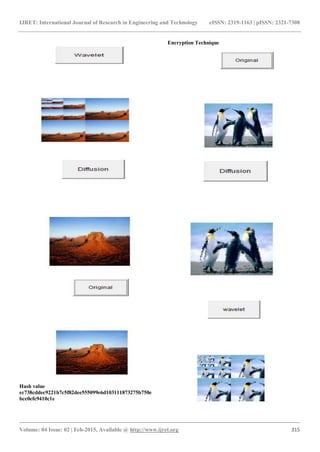
value with SHA-256. Techniques which is involved in encryption is image confusion, image diffusion, wavelet Transform, Inverse
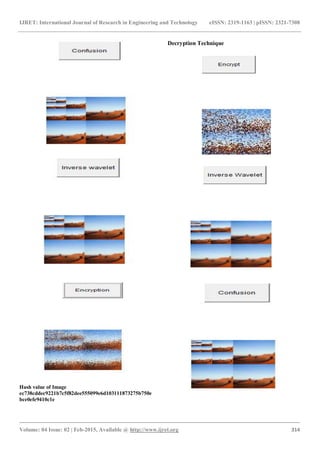
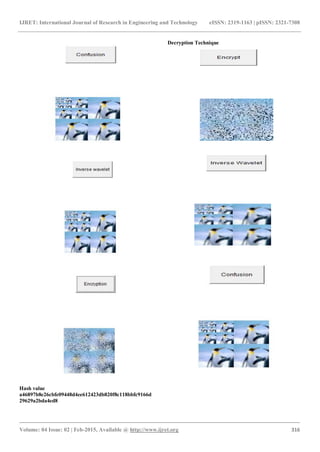
wavelet Transform and finally hash value computation of original image. Techniques which are involved for Decryption is reverse
of Encryption.
Keywords: wavelet Transform, Hash value, Encryption, Decryption.
--------------------------------------------------------------------***------------------------------------------------------------------
1. INTRODUCTION
Encryption is a Technique which is used to encode the data
of any object such as image, video, audio and Text.
Decryption is a Technique which is used to decode the
encoded information based on our specific requirement [3].
In this paper wavelet transform has been used to encode the
information and reverse for decode the information. This
paper has been also introduced the integrity with security and
integrity is a higher level of security maintenance; here SHA-
256 has been used to balance the integrity approach of
cryptography.
1.1 Wavelet Transform
Wavelet Transform is used to have local parametric interval
based on time series. It is observed by two different passes
i.e. high pass and low pass. Low pass Technique is used to
find the nearest co-efficient and it goes further as a recursive
parameter, where as High pass is always constant. Discrete
Wavelet Transform (DWT) is used to find local time interval
[1].
Equation of wavelet Transform
γ (s, τ)=ʃ f(t)Ψ*
s, τ(t) dt ----------(i)
γ (s, τ) is the coefficient of wavelet with scale ‘s’ and time ‘τ’
, f(t) denotes time series, s, τ(t) dt is complex conjugate of
wavelet with scale ‘s’ and time ‘τ’, Ψ*
is used for assuming
real wavelet transform.
Ψ *
s, τ(t)=1/√s Ψ(t- τ)/S -------------- (ii)
Ψ *
s, τ(t) wavelet with scale ‘s’ and time ‘τ’.
1/√s are normalization and (t-τ) means shift in time.
S means change in scale of wavelet.
Ψ means mother wavelet.
Ψ= 2sinɵ(2t)-sinɵ(t) -----------------(iii)
Fig 1 Mother wavelet to find nearest co-efficient
IJRET: International Journal of Research in Engineering and Technology eISSN: 2319-1163 | pISSN: 2321-7308
_______________________________________________________________________________________
Volume: 04 Issue: 02 | Feb-2015, Available @ http://www.ijret.org 311
Fig 2 Discrete Wavelet Transform to find coefficient.
γ (s1, τ) : N/2 Co-efficient. γ (s2, τ) : N/4 Co-efficient.
γ (s3, τ) : N/8 Co-efficient. Total: N Co-efficient.
Figure 2 effects have been shown in result.
Fig 3 Time Series of Low and High Pass Co-efficient
IJRET: International Journal of Research in Engineering and Technology eISSN: 2319-1163 | pISSN: 2321-7308
_______________________________________________________________________________________
Volume: 04 Issue: 02 | Feb-2015, Available @ http://www.ijret.org 312
1.2 Diffusion /Confusion Technique
In Image Cryptography confusion is a technique which is
used for image pixel permutation in a secret order, without
any changes in their values. The function of the diffusion is
to modify the pixel values sequentially so that tiny changes in
one pixel are spread out of many pixels, hopefully the whole
image. To decorrelate the relationship between adjacent
pixels, the confusion stage is performed n times where n is
usually larger than 1. This is followed by the diffusion stage.
The whole n-round confusion and single round diffusion
repeat for m times, with m usually larger than 1, so as to
achieve a satisfactory level of security. The parameter of
permutation is calculated with equation (iv) in 2D.
Xk+1= (xk +yk +rx + ry) MOD N (iv)
Yk+1= (yk + ry + Kc sin ( 2Πxk+1/ N) MOD N
Kc is a positive integer.
rx and ry are a random value of permutation.
xk and yk are original value of image pixel.
Fig 4 for confusion and diffusion process
1.3 Inverse Wavelet Transform
Inverse wavelet is used to reconstruct the data from the given
co-efficient by performing single level or multilevel of
inverse discrete wavelet transform.
ƒ(t)=ʃ ʃ γ (s, τ) Ψ s, τ(t)dτds -------------(v)
Ψ s, τ(t)=1/√s Ψ(τ-t)/S ------------------(vi)
ƒ(t) denotes time series.
γ (s, τ)denotes coefficient of wavelet.
Ψ s, τ(t)dτds denotes wavelet with scale s and time τ.
1.4 Hash Value Computation
A hash function is used to produce a fixed length output for
arbitrary input message. The fixed length output or hash
value is generated by decomposing the message into smaller
equal size block, now these blocks are operated sequentially
using compression function[5]. The last block processed also
indicates the length of message, which enhances the
properties of the hash. The majority of the hash functions like
MD4, MD5, and SHA family are used in this form.
1.5 Proposed Methodology
The survey of the several research papers show that
encryption is used for security but security does not have
integrity alone so maintaining the integrity Hash function has
been used in proposed algorithm. The proposed work will
help in safely delivering and sharing of information and
avoid the access of unauthorized users. The proposed method
has been summarized in figure 5.
Fig 5 Flowchart of Proposed Method
2. ANALYSIS OF WAVELET TRANSFORM
2.1 Wavelet and DCT
Discrete Cosine Transform (DCT) Technique is used for
compression of image and Decompression of image but in
this technique mean square error (MSE) are high as well as
pick signal to noise ratio (PSNR) is very low. DCT is not
having local change in coefficient because of its PSNR effect
as well as MSE [11]. Wavelet Transform is used to have
compression and decompression but it is having very low
MSE and high PSNR so that local effect of image can be
easily maintained [4].
IJRET: International Journal of Research in Engineering and Technology eISSN: 2319-1163 | pISSN: 2321-7308
_______________________________________________________________________________________
Volume: 04 Issue: 02 | Feb-2015, Available @ http://www.ijret.org 313
2.2 Wavelet and Fourier Transform
Wavelets are localized in both time and frequency whereas
the standard Fourier transform is only localized in frequency.
The wavelet transform take advantage of the intermediate
cases of the Uncertainty Principle. Each wavelet
measurement (the wavelet transform corresponding to a fixed
parameter) tells you something about the temporal extent of
the signal, as well as something about the frequency
spectrum of the signal. That is to say, from the parameter w
(which is the analogue of the frequency parameter k for the
Fourier transform), we can derive a characteristic frequency
k(w) and a characteristic time t(w), and say that our initial
function includes a signal of "roughly frequency k(w)" that
happened at "roughly time t(w)". The classical Fourier
transform of a function allows you to make a measurement
with 0 bandwidth: the evaluation f^(k) tells us precisely the
size of the component of frequency k. But by doing so you
lose all control on spatial duration: you do not know when in
time the signal is sounded. This is the limiting case of the
Uncertainty Principle: absolute precision on frequency and
zero control on temporal spread [19]. (Whereas the original
signal, when measured at a fixed time, gives you only
absolute precision on the amplitude at that fixed time, but
zero information about the frequency spectrum of the signal,
and represents the other extreme of the Uncertainty
Principle.)
3. ANALYSIS OF HASH VALUE
There is several well-known hash functions used in
cryptography. These include the message-digest hash
functions MD2, MD4, and MD5, used for hashing digital
signatures into a shorter value called a message-digest, and
the Secure Hash Algorithm (SHA), a standard algorithm, that
makes a larger (60-bit) message digest and is similar to MD4.
A hash function that works well for database storage and
retrieval, however, might not work as for cryptographic or
error-checking purposes but it can work for integrity. A hash
function hash is a transformation that takes an input sequence
of bits m (the message) and returns a fixed-size string, which
is called the hash value(also the message digest, the digital
fingerprint). The basic requirement for a cryptographic hash
function is that the hash value does not reveal any
information about the message itself, and moreover that it is
hard to find other messages that produce the same hash value.
If only a single bit of the message is changed, it is expected
that the new hash value is dramatically different from the
original one. A hash function is required to have the
following features: Preimage resistant. A hash function hash
is said to be preimage resistant if it is hard to invert, where
“hard to invert” means that given a hash value h, it is
computationally infeasible to find some input x such that
hash (x)=h Second preimage resistant. If, given a message x ,
it is computationally infeasible to find a message y different
from x such that hash(x)=hash(y), then hash is said to be
second preimage resistant Collision-resistant. A hash
function hash is said to be collision-resistant if it is
computationally infeasible to find two distinct messages x
and y such that hash(x)=hash(y).
Result
Encryption Technique
IJRET: International Journal of Research in Engineering and Technology eISSN: 2319-1163 | pISSN: 2321-7308
_______________________________________________________________________________________
Volume: 04 Issue: 02 | Feb-2015, Available @ http://www.ijret.org 314
Hash value of Image
ec738cddec9221b7c5f82dee555099e6d103111873275b750e
bce0efe9410c1e
Decryption Technique
IJRET: International Journal of Research in Engineering and Technology eISSN: 2319-1163 | pISSN: 2321-7308
_______________________________________________________________________________________
Volume: 04 Issue: 02 | Feb-2015, Available @ http://www.ijret.org 315
Hash value
ec738cddec9221b7c5f82dee555099e6d103111873275b750e
bce0efe9410c1e
Encryption Technique
IJRET: International Journal of Research in Engineering and Technology eISSN: 2319-1163 | pISSN: 2321-7308
_______________________________________________________________________________________
Volume: 04 Issue: 02 | Feb-2015, Available @ http://www.ijret.org 316
Hash value
a46897b8e26cbfe09448d4ee612423db820f8c118bbfc9166d
29629a2bda4ed8
Decryption Technique
IJRET: International Journal of Research in Engineering and Technology eISSN: 2319-1163 | pISSN: 2321-7308
_______________________________________________________________________________________
Volume: 04 Issue: 02 | Feb-2015, Available @ http://www.ijret.org 317
Hash value
a46897b8e26cbfe09448d4ee612423db820f8c118bbfc9166d
29629a2bda4ed8
4. CONCLUSION AND FEATURE
ENHANCEMENT
This paper is used with cryptography technique using
wavelet transform. In this paper Hash value is matched for
making integrity of original image. The image encryption
techniques have been implemented using DWT (discrete
wavelet transforms). This paper shows that the method have
been achieved to maintain the privacy of the image as well as
integrity of the image in unreliable channel, so increase in
demand of internet and the information which is being shared
on it requires the method which can maintain privacy and
integrity of the image during the transmission from
unauthorized and illegal access. Therefore this paper presents
a new method for the encryption of image. The proposed
method is efficient and will deliver the image safely to the
receiver. This Technique (Wavelet) can also be used for
Compression of image and other source of file.
REFERENCES
[1] D. Sinha and A. Tewfik. “Low Bit Rate Transparent
Audio Compression using Adapted Wavelets”, IEEE
Trans. ASSP, Vol. 41, No. 12, December 1993
[2] P. Srinivasan and L. H. Jamieson. “High Quality
Audio Compression Using an Adaptive Wavelet
Packet Decomposition and Psychoacoustic
Modeling”, IEEE Transactions on Signal Processing,
Vol. 46, No. 4, April 1998.
[3] Burrus, C.S., Gopinath, R.A., Guo, H.,
1998.Introduction to Wavelets and Wavelet
Transforms New Jersey: Prentice-Hall.
[4] PrabhakarTelagarapu, V.Jagan Naveen,
A.Lakshmi..Prasanthi,G.Vijaya Santhi, “Image
Compression using DCT and Wavelet Transform” in
International Journal of Signal Processing, Image
Processing and Pattern Recognition(IJSIP). Vol 4. 3
September,2011
[5] Khalifa O. O., Review of Wavelet theory and its
application to Image Data Compression, International
Islamic University Malaysia Engineering Journal,
Vol.4, No.1, p25-43, 2003.
[6] Khars, M., & Brandenburg, K., 1998.Applications of
Digital Signal Processing to Audio and Acoustics.
Massachusetts: Kluwer Academic Publishers.
[7] Philip P. Dang and Paul M. Chau, ”Image Encryption
for Secure Internet Multimedia Application”, IEEE
Transaction on Consumer Electronics , Vol 46, No. 3
pp. 395-403 AUGUST 2000.
[8] S. Singh, and G. Agarwal, "Use of image to secure
text message with the help of LSB replacement,"
International Journal of Applied Engineering
Research, Dindigul, Vol. 1, No. 1, 2010, pp. 200–
205.
[9] C. Chan, and L. Cheng, "Hiding data in images by
simple LSB substitution," Pattern Recognition, Vol.
37, 2004, pp. 469–474.
[10] K. Kumar, K. Raja, R. Chhotaray, and S. Pattanaik,
"Bit Length Replacement Steganography Based on
DCT Coefficients," International Journal of
IJRET: International Journal of Research in Engineering and Technology eISSN: 2319-1163 | pISSN: 2321-7308
_______________________________________________________________________________________
Volume: 04 Issue: 02 | Feb-2015, Available @ http://www.ijret.org 318
Engineering Science and Technology, Vol. 2, No. 8,
2010, pp. 356–570.
[11] C. Lin, and P. Shiu, "High Capacity Data Hiding
Scheme for DCT-based Images," Journal of
Information Hiding and Multimedia Signal
Processing, Vol. 1, No. 3, 2010, pp. 220–240.
[12] A. Al-Ataby, and F. Al-Naima, "A Modified High
Capacity Image Steganography Technique Based on
Wavelet Transform," The International Arab Journal
of Information Technology, Vol. 7, No. 4, 2010, pp.
358–364.
[13] P. Chen, and H. Lin, "A DWT Based Approach for
Image Steganography," International Journal of
Applied Science and Engineering, Vol. 4, No. 3,
2006, pp. 275–290.
[14] L. Ganesan, and S. Jinna, "Reversible Image Data
Hiding Using Lifting Wavelet Transform and
Histogram Shifting," International Journal of
Computer Science and Information Security, Vol. 7,
No. 3, 2010, pp. 283–290.
[15] S. Singh, and T. Siddiqui, "A security Enhanced
Robust Steganography Algorithm for Data Hiding,"
International Journal of Computer Science Issues,
Vol. 9, No. 1, 2012, pp. 131- 139.
[16] C. Kung, S. Chao, Y. Tu, and Y. Yan, "A Robust
Watermarking and Image Authentication Scheme
used for Digital Contant Application," Journal of
Multimedia, Vol. 4, No. 3, 2009, pp. 112-119.
[17] G. Xuan, Y. Shi, C. Yang, Y. Zheng, D. Zou, and P.
Chai, "Lossless Data Hiding Using Integer Wavelet
Transform and Threshold Embedding Technique,"
Multimedia and Expo, ICME, IEEE International
Conference, 2005, pp. 1520–1523.
[18] C. Chang, P. Pai, C. Yeh, and Y. Chan. "A high
payload frequency-based reversible image hiding
method," Information Science, Elsevier 180, 2010,
pp. 2286–2298.
[19] J. Shapiro, "Embedded Image Coding Using
Zerotrees of Wavelet Coefficients," IEEE
Transaction On Signal Processing, Vol. 4, No. 12,
1993, pp. 3445–3462.
[20] M. Abu Zaher, "Modified Least Significant Bit
(MLSB)," Computer and Information Science, Vol.
4, No. 1, 2011, pp. 60–67.

Image encryption technique incorporating wavelet transform and hash integrity

  • 1.
    IJRET: International Journalof Research in Engineering and Technology eISSN: 2319-1163 | pISSN: 2321-7308 _______________________________________________________________________________________ Volume: 04 Issue: 02 | Feb-2015, Available @ http://www.ijret.org 310 IMAGE ENCRYPTION TECHNIQUE INCORPORATING WAVELET TRANSFORM AND HASH INTEGRITY Manish Mishra1 , Shraddha Pandit2 1 ICOT, M.Tech. Student, Department of Computer Science, Bhopal, MP, India 2 Asst. Prof, Department of Computer Science and Engineering, ICOT, Bhopal, MP, India Abstract This paper is basically designed for image encryption using wavelet Transform Techniques and its integrity incorporating hash value with SHA-256. Techniques which is involved in encryption is image confusion, image diffusion, wavelet Transform, Inverse wavelet Transform and finally hash value computation of original image. Techniques which are involved for Decryption is reverse of Encryption. Keywords: wavelet Transform, Hash value, Encryption, Decryption. --------------------------------------------------------------------***------------------------------------------------------------------ 1. INTRODUCTION Encryption is a Technique which is used to encode the data of any object such as image, video, audio and Text. Decryption is a Technique which is used to decode the encoded information based on our specific requirement [3]. In this paper wavelet transform has been used to encode the information and reverse for decode the information. This paper has been also introduced the integrity with security and integrity is a higher level of security maintenance; here SHA- 256 has been used to balance the integrity approach of cryptography. 1.1 Wavelet Transform Wavelet Transform is used to have local parametric interval based on time series. It is observed by two different passes i.e. high pass and low pass. Low pass Technique is used to find the nearest co-efficient and it goes further as a recursive parameter, where as High pass is always constant. Discrete Wavelet Transform (DWT) is used to find local time interval [1]. Equation of wavelet Transform γ (s, τ)=ʃ f(t)Ψ* s, τ(t) dt ----------(i) γ (s, τ) is the coefficient of wavelet with scale ‘s’ and time ‘τ’ , f(t) denotes time series, s, τ(t) dt is complex conjugate of wavelet with scale ‘s’ and time ‘τ’, Ψ* is used for assuming real wavelet transform. Ψ * s, τ(t)=1/√s Ψ(t- τ)/S -------------- (ii) Ψ * s, τ(t) wavelet with scale ‘s’ and time ‘τ’. 1/√s are normalization and (t-τ) means shift in time. S means change in scale of wavelet. Ψ means mother wavelet. Ψ= 2sinɵ(2t)-sinɵ(t) -----------------(iii) Fig 1 Mother wavelet to find nearest co-efficient
  • 2.
    IJRET: International Journalof Research in Engineering and Technology eISSN: 2319-1163 | pISSN: 2321-7308 _______________________________________________________________________________________ Volume: 04 Issue: 02 | Feb-2015, Available @ http://www.ijret.org 311 Fig 2 Discrete Wavelet Transform to find coefficient. γ (s1, τ) : N/2 Co-efficient. γ (s2, τ) : N/4 Co-efficient. γ (s3, τ) : N/8 Co-efficient. Total: N Co-efficient. Figure 2 effects have been shown in result. Fig 3 Time Series of Low and High Pass Co-efficient
  • 3.
    IJRET: International Journalof Research in Engineering and Technology eISSN: 2319-1163 | pISSN: 2321-7308 _______________________________________________________________________________________ Volume: 04 Issue: 02 | Feb-2015, Available @ http://www.ijret.org 312 1.2 Diffusion /Confusion Technique In Image Cryptography confusion is a technique which is used for image pixel permutation in a secret order, without any changes in their values. The function of the diffusion is to modify the pixel values sequentially so that tiny changes in one pixel are spread out of many pixels, hopefully the whole image. To decorrelate the relationship between adjacent pixels, the confusion stage is performed n times where n is usually larger than 1. This is followed by the diffusion stage. The whole n-round confusion and single round diffusion repeat for m times, with m usually larger than 1, so as to achieve a satisfactory level of security. The parameter of permutation is calculated with equation (iv) in 2D. Xk+1= (xk +yk +rx + ry) MOD N (iv) Yk+1= (yk + ry + Kc sin ( 2Πxk+1/ N) MOD N Kc is a positive integer. rx and ry are a random value of permutation. xk and yk are original value of image pixel. Fig 4 for confusion and diffusion process 1.3 Inverse Wavelet Transform Inverse wavelet is used to reconstruct the data from the given co-efficient by performing single level or multilevel of inverse discrete wavelet transform. ƒ(t)=ʃ ʃ γ (s, τ) Ψ s, τ(t)dτds -------------(v) Ψ s, τ(t)=1/√s Ψ(τ-t)/S ------------------(vi) ƒ(t) denotes time series. γ (s, τ)denotes coefficient of wavelet. Ψ s, τ(t)dτds denotes wavelet with scale s and time τ. 1.4 Hash Value Computation A hash function is used to produce a fixed length output for arbitrary input message. The fixed length output or hash value is generated by decomposing the message into smaller equal size block, now these blocks are operated sequentially using compression function[5]. The last block processed also indicates the length of message, which enhances the properties of the hash. The majority of the hash functions like MD4, MD5, and SHA family are used in this form. 1.5 Proposed Methodology The survey of the several research papers show that encryption is used for security but security does not have integrity alone so maintaining the integrity Hash function has been used in proposed algorithm. The proposed work will help in safely delivering and sharing of information and avoid the access of unauthorized users. The proposed method has been summarized in figure 5. Fig 5 Flowchart of Proposed Method 2. ANALYSIS OF WAVELET TRANSFORM 2.1 Wavelet and DCT Discrete Cosine Transform (DCT) Technique is used for compression of image and Decompression of image but in this technique mean square error (MSE) are high as well as pick signal to noise ratio (PSNR) is very low. DCT is not having local change in coefficient because of its PSNR effect as well as MSE [11]. Wavelet Transform is used to have compression and decompression but it is having very low MSE and high PSNR so that local effect of image can be easily maintained [4].
  • 4.
    IJRET: International Journalof Research in Engineering and Technology eISSN: 2319-1163 | pISSN: 2321-7308 _______________________________________________________________________________________ Volume: 04 Issue: 02 | Feb-2015, Available @ http://www.ijret.org 313 2.2 Wavelet and Fourier Transform Wavelets are localized in both time and frequency whereas the standard Fourier transform is only localized in frequency. The wavelet transform take advantage of the intermediate cases of the Uncertainty Principle. Each wavelet measurement (the wavelet transform corresponding to a fixed parameter) tells you something about the temporal extent of the signal, as well as something about the frequency spectrum of the signal. That is to say, from the parameter w (which is the analogue of the frequency parameter k for the Fourier transform), we can derive a characteristic frequency k(w) and a characteristic time t(w), and say that our initial function includes a signal of "roughly frequency k(w)" that happened at "roughly time t(w)". The classical Fourier transform of a function allows you to make a measurement with 0 bandwidth: the evaluation f^(k) tells us precisely the size of the component of frequency k. But by doing so you lose all control on spatial duration: you do not know when in time the signal is sounded. This is the limiting case of the Uncertainty Principle: absolute precision on frequency and zero control on temporal spread [19]. (Whereas the original signal, when measured at a fixed time, gives you only absolute precision on the amplitude at that fixed time, but zero information about the frequency spectrum of the signal, and represents the other extreme of the Uncertainty Principle.) 3. ANALYSIS OF HASH VALUE There is several well-known hash functions used in cryptography. These include the message-digest hash functions MD2, MD4, and MD5, used for hashing digital signatures into a shorter value called a message-digest, and the Secure Hash Algorithm (SHA), a standard algorithm, that makes a larger (60-bit) message digest and is similar to MD4. A hash function that works well for database storage and retrieval, however, might not work as for cryptographic or error-checking purposes but it can work for integrity. A hash function hash is a transformation that takes an input sequence of bits m (the message) and returns a fixed-size string, which is called the hash value(also the message digest, the digital fingerprint). The basic requirement for a cryptographic hash function is that the hash value does not reveal any information about the message itself, and moreover that it is hard to find other messages that produce the same hash value. If only a single bit of the message is changed, it is expected that the new hash value is dramatically different from the original one. A hash function is required to have the following features: Preimage resistant. A hash function hash is said to be preimage resistant if it is hard to invert, where “hard to invert” means that given a hash value h, it is computationally infeasible to find some input x such that hash (x)=h Second preimage resistant. If, given a message x , it is computationally infeasible to find a message y different from x such that hash(x)=hash(y), then hash is said to be second preimage resistant Collision-resistant. A hash function hash is said to be collision-resistant if it is computationally infeasible to find two distinct messages x and y such that hash(x)=hash(y). Result Encryption Technique
  • 5.
    IJRET: International Journalof Research in Engineering and Technology eISSN: 2319-1163 | pISSN: 2321-7308 _______________________________________________________________________________________ Volume: 04 Issue: 02 | Feb-2015, Available @ http://www.ijret.org 314 Hash value of Image ec738cddec9221b7c5f82dee555099e6d103111873275b750e bce0efe9410c1e Decryption Technique
  • 6.
    IJRET: International Journalof Research in Engineering and Technology eISSN: 2319-1163 | pISSN: 2321-7308 _______________________________________________________________________________________ Volume: 04 Issue: 02 | Feb-2015, Available @ http://www.ijret.org 315 Hash value ec738cddec9221b7c5f82dee555099e6d103111873275b750e bce0efe9410c1e Encryption Technique
  • 7.
    IJRET: International Journalof Research in Engineering and Technology eISSN: 2319-1163 | pISSN: 2321-7308 _______________________________________________________________________________________ Volume: 04 Issue: 02 | Feb-2015, Available @ http://www.ijret.org 316 Hash value a46897b8e26cbfe09448d4ee612423db820f8c118bbfc9166d 29629a2bda4ed8 Decryption Technique
  • 8.
    IJRET: International Journalof Research in Engineering and Technology eISSN: 2319-1163 | pISSN: 2321-7308 _______________________________________________________________________________________ Volume: 04 Issue: 02 | Feb-2015, Available @ http://www.ijret.org 317 Hash value a46897b8e26cbfe09448d4ee612423db820f8c118bbfc9166d 29629a2bda4ed8 4. CONCLUSION AND FEATURE ENHANCEMENT This paper is used with cryptography technique using wavelet transform. In this paper Hash value is matched for making integrity of original image. The image encryption techniques have been implemented using DWT (discrete wavelet transforms). This paper shows that the method have been achieved to maintain the privacy of the image as well as integrity of the image in unreliable channel, so increase in demand of internet and the information which is being shared on it requires the method which can maintain privacy and integrity of the image during the transmission from unauthorized and illegal access. Therefore this paper presents a new method for the encryption of image. The proposed method is efficient and will deliver the image safely to the receiver. This Technique (Wavelet) can also be used for Compression of image and other source of file. REFERENCES [1] D. Sinha and A. Tewfik. “Low Bit Rate Transparent Audio Compression using Adapted Wavelets”, IEEE Trans. ASSP, Vol. 41, No. 12, December 1993 [2] P. Srinivasan and L. H. Jamieson. “High Quality Audio Compression Using an Adaptive Wavelet Packet Decomposition and Psychoacoustic Modeling”, IEEE Transactions on Signal Processing, Vol. 46, No. 4, April 1998. [3] Burrus, C.S., Gopinath, R.A., Guo, H., 1998.Introduction to Wavelets and Wavelet Transforms New Jersey: Prentice-Hall. [4] PrabhakarTelagarapu, V.Jagan Naveen, A.Lakshmi..Prasanthi,G.Vijaya Santhi, “Image Compression using DCT and Wavelet Transform” in International Journal of Signal Processing, Image Processing and Pattern Recognition(IJSIP). Vol 4. 3 September,2011 [5] Khalifa O. O., Review of Wavelet theory and its application to Image Data Compression, International Islamic University Malaysia Engineering Journal, Vol.4, No.1, p25-43, 2003. [6] Khars, M., & Brandenburg, K., 1998.Applications of Digital Signal Processing to Audio and Acoustics. Massachusetts: Kluwer Academic Publishers. [7] Philip P. Dang and Paul M. Chau, ”Image Encryption for Secure Internet Multimedia Application”, IEEE Transaction on Consumer Electronics , Vol 46, No. 3 pp. 395-403 AUGUST 2000. [8] S. Singh, and G. Agarwal, "Use of image to secure text message with the help of LSB replacement," International Journal of Applied Engineering Research, Dindigul, Vol. 1, No. 1, 2010, pp. 200– 205. [9] C. Chan, and L. Cheng, "Hiding data in images by simple LSB substitution," Pattern Recognition, Vol. 37, 2004, pp. 469–474. [10] K. Kumar, K. Raja, R. Chhotaray, and S. Pattanaik, "Bit Length Replacement Steganography Based on DCT Coefficients," International Journal of
  • 9.
    IJRET: International Journalof Research in Engineering and Technology eISSN: 2319-1163 | pISSN: 2321-7308 _______________________________________________________________________________________ Volume: 04 Issue: 02 | Feb-2015, Available @ http://www.ijret.org 318 Engineering Science and Technology, Vol. 2, No. 8, 2010, pp. 356–570. [11] C. Lin, and P. Shiu, "High Capacity Data Hiding Scheme for DCT-based Images," Journal of Information Hiding and Multimedia Signal Processing, Vol. 1, No. 3, 2010, pp. 220–240. [12] A. Al-Ataby, and F. Al-Naima, "A Modified High Capacity Image Steganography Technique Based on Wavelet Transform," The International Arab Journal of Information Technology, Vol. 7, No. 4, 2010, pp. 358–364. [13] P. Chen, and H. Lin, "A DWT Based Approach for Image Steganography," International Journal of Applied Science and Engineering, Vol. 4, No. 3, 2006, pp. 275–290. [14] L. Ganesan, and S. Jinna, "Reversible Image Data Hiding Using Lifting Wavelet Transform and Histogram Shifting," International Journal of Computer Science and Information Security, Vol. 7, No. 3, 2010, pp. 283–290. [15] S. Singh, and T. Siddiqui, "A security Enhanced Robust Steganography Algorithm for Data Hiding," International Journal of Computer Science Issues, Vol. 9, No. 1, 2012, pp. 131- 139. [16] C. Kung, S. Chao, Y. Tu, and Y. Yan, "A Robust Watermarking and Image Authentication Scheme used for Digital Contant Application," Journal of Multimedia, Vol. 4, No. 3, 2009, pp. 112-119. [17] G. Xuan, Y. Shi, C. Yang, Y. Zheng, D. Zou, and P. Chai, "Lossless Data Hiding Using Integer Wavelet Transform and Threshold Embedding Technique," Multimedia and Expo, ICME, IEEE International Conference, 2005, pp. 1520–1523. [18] C. Chang, P. Pai, C. Yeh, and Y. Chan. "A high payload frequency-based reversible image hiding method," Information Science, Elsevier 180, 2010, pp. 2286–2298. [19] J. Shapiro, "Embedded Image Coding Using Zerotrees of Wavelet Coefficients," IEEE Transaction On Signal Processing, Vol. 4, No. 12, 1993, pp. 3445–3462. [20] M. Abu Zaher, "Modified Least Significant Bit (MLSB)," Computer and Information Science, Vol. 4, No. 1, 2011, pp. 60–67.