DIGITAL WATERMARKING
Shashwat Shriparv
dwivedishashwat@gmail.com
Overview
 Introduction
 What is Watermarking?
 What is Digital Watermarking?
 Behind the Technology.
 Importance
 Types of Watermarking.
 Digital Watermarking Techniques.
 Features of Digital Watermarking.
 Applications
 Attacks to Digital Watermarking.
 Conclusion.
Introduction
 Advantages of Digital Data
 Copy right problems with digital data
 Encryption & Decryption
 Problems with Encryption & Decryption
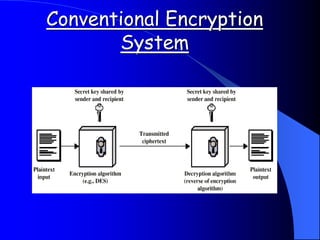
Conventional Encryption
System
Watermark
“ Watermarking can be considered as a special
technique of steganography where one message is
embedded in another and the two messages are
related to each other in some way. “
Example :-
The presence of specific patterns in currency notes
which are visible only when the note is held to light is
a well known example for watermark.
What is Watermarking?
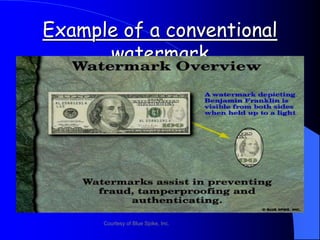
Example of a conventional
watermark
Courtesy of Blue Spike, Inc.
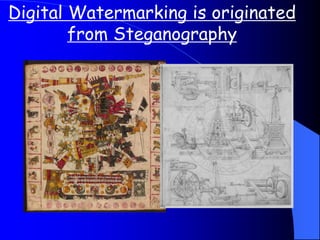
Digital Watermarking is originated
from Steganography
What is Digital Watermarking?
“ Digital watermarking is similar to watermarking
physical objects, except that the watermarking technique
is used for digital content instead of physical objects. “
Digital Watermark
Digital Watermark (Contn..)
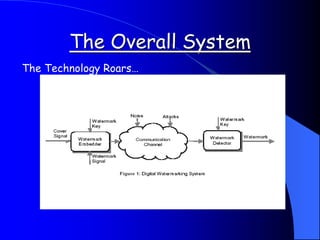
In digital watermarking a low-energy signal is
imperceptibly embedded in another signal. The
low-energy signal is called watermark.
The main signal in which the watermark is
embedded is referred to as cover signal since it
covers the watermark.
An entity called watermark key used for
embedding and detecting watermark signal
Watermark key is private
Behind The Technology
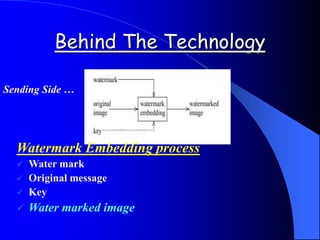
Sending Side …
Watermark Embedding process
 Water mark
 Original message
 Key
 Water marked image
Behind The Technology
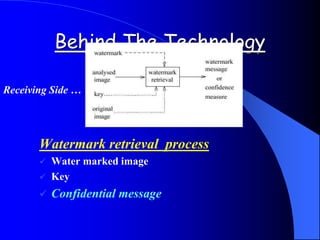
Watermark retrieval process
 Water marked image
 Key
 Confidential message
Receiving Side …
The Overall System
The Technology Roars…
Importance Of Digital
Watermarking
© Copyright Information
© On-line music industry
© News gathering using digital cameras
Types of Digital
Watermarking.
 Robust & Fragile Watermarking
 Visible & Invisible Watermarking
 Public & Private Watermarking
 Asymmetric & Symmetric
Watermarking
 Steganograhic & Non-
Steganographic watermarking
Variety Adds…
Robust & Fragile
Watermarking
 Robust Watermarking:-Modification of
watermarked content will not affect watermark
 Fragile Watermarking:-Watermark get
destroyed when watermarked content is
modified or tampered with
Visible & Invisible
Watermarking
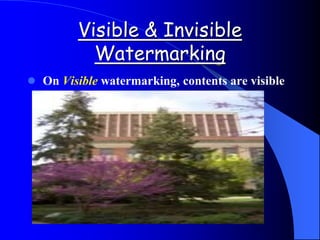
 On Visible watermarking, contents are visible
Visible & Invisible
Watermarking (Contn..)
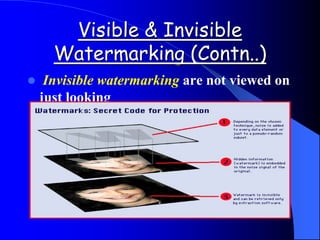
 Invisible watermarking are not viewed on
just looking
Public & Private
Watermarking
• Public Watermarking
Users of content are authorized to detect
watermark
• Private Watermarking
Users not authorized to detect watermark
Asymmetric & Symmetric
watermarking
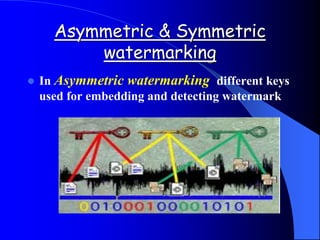
 In Asymmetric watermarking different keys
used for embedding and detecting watermark
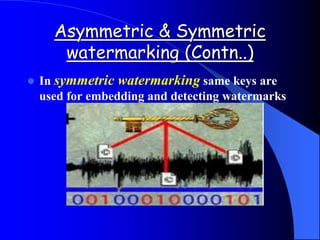
Asymmetric & Symmetric
watermarking (Contn..)
 In symmetric watermarking same keys are
used for embedding and detecting watermarks
Steganographic & Non-
Steganographic
Watermarking
 Steganographic Watermarking
User unaware of the presence of a watermark
eg:-Used in finger printing applications
 Non-Steganographic WM:-
User aware of the presence of a watermark.
e.g.:-User to detect piracy
Digital Watermarking
Techniques
 LSB Watermarking
 Color Separation Technique
 Bit Stream Watermarking
 Word Space Coding, Line Space Coding
&Character Coding
LSB Watermarking
 Lower order bits of selected pixels in the
image are used to store watermarks
 Replacing lower order bits of each pixel with
higher order bit of different image
Color Separation Technique
 Watermark appears only in one of the color
bands
 Used to watermark in still images
 Can be extended to moving images
Bit Stream Watermarking
 Used in audio watermarking
 Data is directly inserted into compressed
audio files
Word Space Coding, Line Space
Coding &Character Coding
 Used for watermarking in text documents
 In word space coding, the spaces between
words are altered to embed watermark code. In
line space coding the space between the lines
are altered and in character coding some of
the characters are imperceptibly modified (i.e.,
made larger, serifs enhanced, etc).
Features of Digital Watermarking
 Imperceptibility
 Robustness
 Security
Applications of Digital
Watermarking.
 Copy Protection
 Content Authentication
 Copyright Protection
 Metadata Tagging
Copy Protection
 It limits the access to copyrighted material
and inhibit the copy process
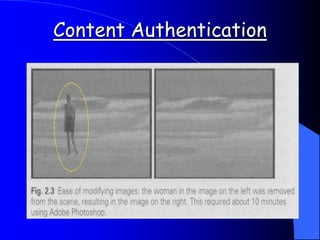
Content Authentication
 Robust watermarks are used in this area
Example:-A photographic information that may
be presented as evidence in court. Since digital
images can be easily manipulated, there is a
need to provide proof that an image has not
been altered.
Content Authentication
Copyright Protection
 One of the main application
 Embedding watermarks in digital
photographs
Metadata Tagging
 Watermarks convey object specific information
to users of the object.
 Used to attach patient identification data to
medical images, or to highlight regions of
diagnostic significance.
Attacks to Digital
Watermarking
 Stirmark
 Mosaic Attack
Stirmark
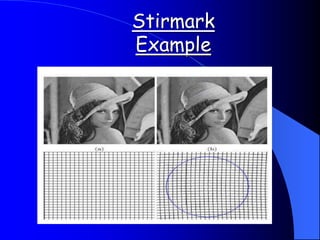
 It is tool developed to test the robustness of
image marking system
 Stirmark is commonly produced by printers
and scanners
 IBM researchers have recently announced a
technique that defeats the stir mark attack.
 Detects and measures the geometric
distortions in images, and removes the
distortion to restore image geometry
Stirmark
Example
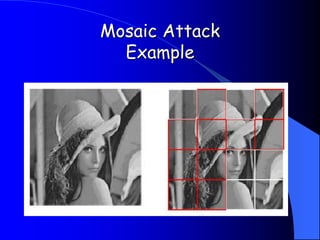
Mosaic Attack
 Use of a web crawler
 Dividing into sub images with rendition
instructions
 Browser will be rearranging the sub images to
appear as the original
 Sub images will be sufficiently small that no
single image on its own will contain a
recognizable mark.
Mosaic Attack
Example
Conclusion
 DRM systems and content management are important
for protection of rights of digital multimedia creations
that are distributed on the Internet. Digital
watermarking is an effective technique for embedding
rights information in digital multimedia data.
 Digital watermark technology can be used in consumer
electronic devices like digital still camera, digital video
camera, DVD players, MP3 players, etc., for various
applications like providing controlled access,
preventing illegal replication and watermark
embedding
Conclusion (Contd..)
 Digital information can easily be disseminated
and copied via global networks.
 The future of digital watermarking relies on
setting standards and creating applications so
that creators of digital content can easily
implement it.
References
 www.watermarkingworld.org
 www.digital-watermark.com
Shashwat Shriparv
dwivedishashwat@gmail.com
InfinitySoft

Digital water marking

  • 1.
  • 2.
    Overview  Introduction  Whatis Watermarking?  What is Digital Watermarking?  Behind the Technology.  Importance  Types of Watermarking.  Digital Watermarking Techniques.  Features of Digital Watermarking.  Applications  Attacks to Digital Watermarking.  Conclusion.
  • 3.
    Introduction  Advantages ofDigital Data  Copy right problems with digital data  Encryption & Decryption  Problems with Encryption & Decryption
  • 4.
  • 5.
    Watermark “ Watermarking canbe considered as a special technique of steganography where one message is embedded in another and the two messages are related to each other in some way. “ Example :- The presence of specific patterns in currency notes which are visible only when the note is held to light is a well known example for watermark. What is Watermarking?
  • 6.
    Example of aconventional watermark Courtesy of Blue Spike, Inc.
  • 7.
    Digital Watermarking isoriginated from Steganography
  • 8.
    What is DigitalWatermarking? “ Digital watermarking is similar to watermarking physical objects, except that the watermarking technique is used for digital content instead of physical objects. “ Digital Watermark
  • 9.
    Digital Watermark (Contn..) Indigital watermarking a low-energy signal is imperceptibly embedded in another signal. The low-energy signal is called watermark. The main signal in which the watermark is embedded is referred to as cover signal since it covers the watermark. An entity called watermark key used for embedding and detecting watermark signal Watermark key is private
  • 10.
    Behind The Technology SendingSide … Watermark Embedding process  Water mark  Original message  Key  Water marked image
  • 11.
    Behind The Technology Watermarkretrieval process  Water marked image  Key  Confidential message Receiving Side …
  • 12.
    The Overall System TheTechnology Roars…
  • 13.
    Importance Of Digital Watermarking ©Copyright Information © On-line music industry © News gathering using digital cameras
  • 14.
    Types of Digital Watermarking. Robust & Fragile Watermarking  Visible & Invisible Watermarking  Public & Private Watermarking  Asymmetric & Symmetric Watermarking  Steganograhic & Non- Steganographic watermarking Variety Adds…
  • 15.
    Robust & Fragile Watermarking Robust Watermarking:-Modification of watermarked content will not affect watermark  Fragile Watermarking:-Watermark get destroyed when watermarked content is modified or tampered with
  • 16.
    Visible & Invisible Watermarking On Visible watermarking, contents are visible
  • 17.
    Visible & Invisible Watermarking(Contn..)  Invisible watermarking are not viewed on just looking
  • 18.
    Public & Private Watermarking •Public Watermarking Users of content are authorized to detect watermark • Private Watermarking Users not authorized to detect watermark
  • 19.
    Asymmetric & Symmetric watermarking In Asymmetric watermarking different keys used for embedding and detecting watermark
  • 20.
    Asymmetric & Symmetric watermarking(Contn..)  In symmetric watermarking same keys are used for embedding and detecting watermarks
  • 21.
    Steganographic & Non- Steganographic Watermarking Steganographic Watermarking User unaware of the presence of a watermark eg:-Used in finger printing applications  Non-Steganographic WM:- User aware of the presence of a watermark. e.g.:-User to detect piracy
  • 22.
    Digital Watermarking Techniques  LSBWatermarking  Color Separation Technique  Bit Stream Watermarking  Word Space Coding, Line Space Coding &Character Coding
  • 23.
    LSB Watermarking  Lowerorder bits of selected pixels in the image are used to store watermarks  Replacing lower order bits of each pixel with higher order bit of different image
  • 24.
    Color Separation Technique Watermark appears only in one of the color bands  Used to watermark in still images  Can be extended to moving images
  • 25.
    Bit Stream Watermarking Used in audio watermarking  Data is directly inserted into compressed audio files
  • 26.
    Word Space Coding,Line Space Coding &Character Coding  Used for watermarking in text documents  In word space coding, the spaces between words are altered to embed watermark code. In line space coding the space between the lines are altered and in character coding some of the characters are imperceptibly modified (i.e., made larger, serifs enhanced, etc).
  • 27.
    Features of DigitalWatermarking  Imperceptibility  Robustness  Security
  • 28.
    Applications of Digital Watermarking. Copy Protection  Content Authentication  Copyright Protection  Metadata Tagging
  • 29.
    Copy Protection  Itlimits the access to copyrighted material and inhibit the copy process
  • 30.
    Content Authentication  Robustwatermarks are used in this area Example:-A photographic information that may be presented as evidence in court. Since digital images can be easily manipulated, there is a need to provide proof that an image has not been altered.
  • 31.
  • 32.
    Copyright Protection  Oneof the main application  Embedding watermarks in digital photographs
  • 33.
    Metadata Tagging  Watermarksconvey object specific information to users of the object.  Used to attach patient identification data to medical images, or to highlight regions of diagnostic significance.
  • 34.
    Attacks to Digital Watermarking Stirmark  Mosaic Attack
  • 35.
    Stirmark  It istool developed to test the robustness of image marking system  Stirmark is commonly produced by printers and scanners  IBM researchers have recently announced a technique that defeats the stir mark attack.  Detects and measures the geometric distortions in images, and removes the distortion to restore image geometry
  • 36.
  • 37.
    Mosaic Attack  Useof a web crawler  Dividing into sub images with rendition instructions  Browser will be rearranging the sub images to appear as the original  Sub images will be sufficiently small that no single image on its own will contain a recognizable mark.
  • 38.
  • 39.
    Conclusion  DRM systemsand content management are important for protection of rights of digital multimedia creations that are distributed on the Internet. Digital watermarking is an effective technique for embedding rights information in digital multimedia data.  Digital watermark technology can be used in consumer electronic devices like digital still camera, digital video camera, DVD players, MP3 players, etc., for various applications like providing controlled access, preventing illegal replication and watermark embedding
  • 40.
    Conclusion (Contd..)  Digitalinformation can easily be disseminated and copied via global networks.  The future of digital watermarking relies on setting standards and creating applications so that creators of digital content can easily implement it.
  • 41.
  • 42.