IJSRD - International Journal for Scientific Research & Development| Vol. 1, Issue 3, 2013 | ISSN (online): 2321-0613
All rights reserved by www.ijsrd.com 579
A Review on Image Denoising using Wavelet Transform
Manish J. Kodiyatar1
Prof. Kruti Pancholi2
1, 2
Department of Electronics and communication
1, 2
L. J. Institute of Engineering and Technology, Ahmedabad, Gujarat, India
Abstract— this paper proposes different approaches of
wavelet based image denoising methods. The search for
efficient image denoising methods is still a valid challenge
at the crossing of functional analysis and statistics. Wavelet
algorithms are very useful tool for signal processing such as
image denoising. The main of modify the coefficient is
remove the noise from data or signal. In this paper, the
technique was extended up to almost remove noise
Gaussian,
Keywords: Image; Denoising; Wavelet Transform,
I. INTRODUCTION
The wavelet transform (WT) is a powerful tool of
signal processing for its Multiresolution Possibilities. Unlike
the Fourier transform, the WT is suitable for application to
non-stationary signals with Transitory phenomena, whose
frequency response varies in time .Usually image has Noise
which is not easily remove. There are many algorithm and
techniques has been developed to eliminate noise. But
wavelet transform is very successful to overcome noise in
data. There are two main types of wavelet transform –
Continuous Wavelet Transform and Discrete Wavelet
Transform, But here, cause of DWT have more sufficient
transform techniques in this paper we will discuss about it.
The denoising of a natural image corrupted by Gaussian
noise is a classic problem in signal processing. The Wavelet
transform has become an important tool for this problem due
to its energy compaction property. Indeed, wavelets provide
a framework for signal decomposition in the form of a
sequence of signals known as approximation signals with
decreasing resolution supplemented by a sequence of
additional touches called details. Denoising or estimation of
functions, involves reconstituting the signal as well as
possible on the basis of the observations of a useful signal
corrupted by noise. The methods based on wavelet
representations yield very simple algorithms that are often
more powerful and easy to work with than traditional
methods of function estimation. It consists of decomposing
the observed signal into wavelets and using thresholds to
select the coefficients, from which a signal is synthesized.
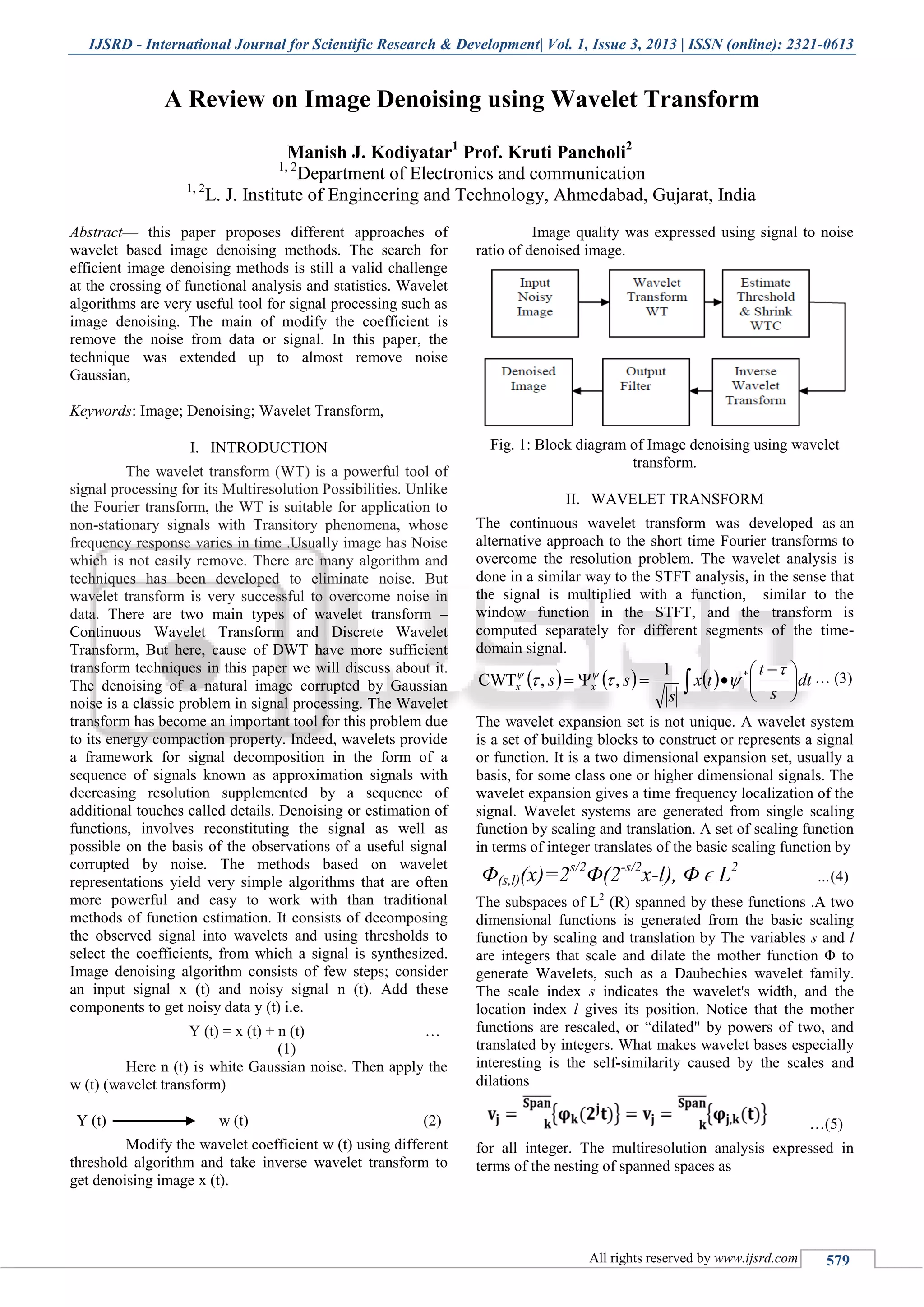
Image denoising algorithm consists of few steps; consider
an input signal x (t) and noisy signal n (t). Add these
components to get noisy data y (t) i.e.
Y (t) = x (t) + n (t) …
(1)
Here n (t) is white Gaussian noise. Then apply the
w (t) (wavelet transform)
Y (t) w (t) (2)
Modify the wavelet coefficient w (t) using different
threshold algorithm and take inverse wavelet transform to
get denoising image x (t).
Image quality was expressed using signal to noise
ratio of denoised image.
Fig. 1: Block diagram of Image denoising using wavelet
transform.
II. WAVELET TRANSFORM
The continuous wavelet transform was developed as an
alternative approach to the short time Fourier transforms to
overcome the resolution problem. The wavelet analysis is
done in a similar way to the STFT analysis, in the sense that
the signal is multiplied with a function, similar to the
window function in the STFT, and the transform is
computed separately for different segments of the time-
domain signal.
      dt
s
t
tx
s
ss xx 




 
 

  *1
,,CWT … (3)
The wavelet expansion set is not unique. A wavelet system
is a set of building blocks to construct or represents a signal
or function. It is a two dimensional expansion set, usually a
basis, for some class one or higher dimensional signals. The
wavelet expansion gives a time frequency localization of the
signal. Wavelet systems are generated from single scaling
function by scaling and translation. A set of scaling function
in terms of integer translates of the basic scaling function by
Φ(s,l)(x)=2s/2
Φ(2-s/2
x-l), Φ ϵ L2
…(4)
The subspaces of L2
(R) spanned by these functions .A two
dimensional functions is generated from the basic scaling
function by scaling and translation by The variables s and l
are integers that scale and dilate the mother function Φ to
generate Wavelets, such as a Daubechies wavelet family.
The scale index s indicates the wavelet's width, and the
location index l gives its position. Notice that the mother
functions are rescaled, or “dilated" by powers of two, and
translated by integers. What makes wavelet bases especially
interesting is the self-similarity caused by the scales and
dilations
…(5)
for all integer. The multiresolution analysis expressed in
terms of the nesting of spanned spaces as
A Review on Image Denoising using Wavelet Transform
(IJSRD/Vol. 1/Issue 3/2013/0046)
All rights reserved by www.ijsrd.com
580
…(6)
The spaces that contain high resolution signals will contain
those of lower resolution also. The spaces should satisfy
natural scaling condition which
ensures elements in space are simply scaled version of the
next space. The nesting of the spans of k)
denoted by i.e. is in , it is also in ,the space
spanned by . This can be expressed in weighted
sum of shifted as
…(7)
Where the h (n) is scaling function. The factor √ used for
normalization of the scaling function. The important feature
of signal expressed in terms of wavelet function Ψ not
in scaling function . The orthogonal complement of
in is defined as , we require,
[Φj,k(t) Ψj,l(t)]= ∫ Φj,k(t) Ψj,l(t) d(t) …(8)
III. DECOMPOSITION AND MULTIRESOLUTION
ANALYSIS
An image at a given resolution can be divided into coarser
approximations at a lower resolution. Suppose the original
image has a resolution rj and its lower resolution
approximation image has resolution rj−1. Then, the details
missing in the lower resolution representation are given by
the difference between the original image and the
approximation image. At coarser resolutions, only the large
objects are visible and the viewer gets only a rough idea of
the image context. The original image can be reconstructed
as successive details are added to the approximations and
the finer details of the image become visible. of
multiresolution are given below
Fig. 2: Different level Decomposition
The basic operations for calculating the DWT is convolving
the samples of the input with the low-pass and high-pass
filters of the wavelet and downsampling the output.
Daubechies realized that this method of computing the
DWT involved a lot of redundancy as half of the samples
computed are discarded by the downsampling operator.
They proposed the lifting scheme, which calculates the
DWT in approximately half the number of steps required to
calculate the DWT through filtering and downsampling.
Fig. 3: Two level decomposition with block diagram
IV. THRESHOLDING
Estimating a signal that is corrupted by additive noise has
been of interest to many researchers for practical as well as
theoretical reasons. The problem is to recover the original
signal from the noisy data. We want the recovered signal to
be as close as possible to the original signal, retaining most
of its important properties (e.g. smoothness). Traditional
denoising schemes are based on linear methods, where the
most common choice is the Wiener filtering. Recently,
nonlinear methods, especially those based on wavelets have
become increasingly popular.
Let us consider a signal xi, which is corrupted by
additive i.i.d. Gaussian random noise
zi ~ N(0, σ2) as follows.
yi = xi + zi (i = 0, 1, . . . , N − 1) … (9)
We first take the wavelet transformation of the noisy signal
and pass it through the thresholding function T(·). The
output is then inverse wavelet transformed to obtain the
estimate ˜x. The most common choices for T(·) are the hard-
thresholding function and the soft-thresholding function
(which is also known as the wavelet shrinkage function).
The hard-thresholding function chooses all wavelet
coefficients that are greater than the given threshold λ and
sets the others to zero.
( ) { …(10)
The threshold λ is chosen according to the signal energy and
the noise variance σ2. If a wavelet coefficient is greater than
λ, we assume that it is significant and attribute it to the
original signal. Otherwise, we consider it to be due to the
additive noise and discard the value. The soft-thresholding
function has a somewhat different rule from the hard-
thresholding function. It shrinks the wavelet coefficients by
λ towards zero, which is the reason why it is also called the
wavelet shrinkage function
( ) { … (10)
Note that the hard-thresholding function is discontinuous at
|x| = λ. Due to this discontinuity at the threshold, the hard
thresholding function is known to yield abrupt artifacts in
the denoised signal, especially when the noise level is
significant.
Fig. 4: Soft and Hard thresholding
A Review on Image Denoising using Wavelet Transform
(IJSRD/Vol. 1/Issue 3/2013/0046)
All rights reserved by www.ijsrd.com
581
Estimation error than the optimal hard-thresholding
estimator. For this reason, soft-thresholding is generally
preferred to hard- thresholding. However, for some class of
signals, we could see that hard thresholding results in
superior estimates to that of soft- thresholding despite some
of its disadvantages.
V. CONCLUSION
This technique is computationally faster and gives better
results. Some aspects that were analyzed in this paper may
be useful for other denoising schemes, objective criteria for
evaluating noise suppression performance of different
significance measures. Our new threshold function is better
as compare to other threshold function. Some function gives
better edge perseverance, background information, contrast
stretching, in spatial domain. In future we can use same
threshold function for medical images as well as texture
images to get denoised image with improved performance
parameter.
REFERENCE
[1]. Wavelet Based Image Denoising Technique” by Sachin
D Ruikar and Dharmpal D Doye
[2]. “The best introduction About Wavelet Transform” By
Amara graps
[3]. A survey on Wavelet Application in Data Mining
“Shenghuo Zhu and MItsunori Oghihara
[4]. “Adaptive Wavelet Thresholding for Image Denoising
and Compression” S. Grace Chang Student Member,
IEEE, Bin Yu, Senior Member, IEEE,
[5]. “ A Comparative Study of Wavelet Denoising for
Multifunction Myoelectric Control” International
Conference on Computer and Automation Engineering
by Angkoon phinyomark1, Chusak Limsakul, Pornchai
Phukpattaranont
[6]. Wavelet-Based Image Estimation: An Empirical Bayes
Approach Using Jeffreys’Noninformative Prior IEEE
TRANSACTIONS ON IMAGE
PROCESSING,VOL10,NO.9,SEPTEMBER 2001
[7]. “Wavelet Tutorial” by Robi Polikar
[8]. “The SURE-LET Approach to Image Denoising”,
Thierry Blu, Senior Member, IEEE and Florian Lousier
[9]. “Image Compression Based on Fuzzy Algorithms for
Learning Vector Quantization And Wavelet Image
Decomposition”, Nicolaos B. Karayiannis, IEEE
TRANSACTIONS ON IMAGE PROCESSING, VOL.
7, NO. 8, AUGUST 1998
[10]. “Practical Image and Video Processing Using
MATLAB” - O. Marques (Wiley_IEEE, 2011) BBS
[11]. “Primer on Wavelets and Their Scientific Applications
”~tqw-_darksiderg
[12]. “A BIVARIATE SHRINKAGE FUNCTION FOR
WAVELET-BASED DENOISING” By Levent
S¸endur, Ivan W. Selesnick
[13]. D. L. Donoho, “De-noising by soft-thresholding,” IEEE
Trans. Inform. Theory, vol. 41, pp. 613–627, May
1995
[14]. “Moving Window-Based Double Haar Wavelet
Transform for Image Processing” By Xin Wang IEEE
TRANSACTIONS ON IMAGE PROCESSING, VOL.
15, NO. 9, SEPTEMBER 2006
[15]. Interpretation and Improvement of an Iterative Wavelet-
Based Denoising Method By R. Ranta, C. Heinrich
IEEE SIGNAL PROCESSING LETTERS, VOL. 10,
NO. 8, AUGUST 2003
[16]. J. Portilla, V. Strela, M. J. Wainwright, and E. P.
Simoncelli, “Image denoising using scale mixtures of
Gaussians in the wavelet domain,” IEEE Trans. Image
Process., vol. 12, no. 11, pp. 1338–1351, Nov. 2003,
2001

A Review on Image Denoising using Wavelet Transform

  • 1.
    IJSRD - InternationalJournal for Scientific Research & Development| Vol. 1, Issue 3, 2013 | ISSN (online): 2321-0613 All rights reserved by www.ijsrd.com 579 A Review on Image Denoising using Wavelet Transform Manish J. Kodiyatar1 Prof. Kruti Pancholi2 1, 2 Department of Electronics and communication 1, 2 L. J. Institute of Engineering and Technology, Ahmedabad, Gujarat, India Abstract— this paper proposes different approaches of wavelet based image denoising methods. The search for efficient image denoising methods is still a valid challenge at the crossing of functional analysis and statistics. Wavelet algorithms are very useful tool for signal processing such as image denoising. The main of modify the coefficient is remove the noise from data or signal. In this paper, the technique was extended up to almost remove noise Gaussian, Keywords: Image; Denoising; Wavelet Transform, I. INTRODUCTION The wavelet transform (WT) is a powerful tool of signal processing for its Multiresolution Possibilities. Unlike the Fourier transform, the WT is suitable for application to non-stationary signals with Transitory phenomena, whose frequency response varies in time .Usually image has Noise which is not easily remove. There are many algorithm and techniques has been developed to eliminate noise. But wavelet transform is very successful to overcome noise in data. There are two main types of wavelet transform – Continuous Wavelet Transform and Discrete Wavelet Transform, But here, cause of DWT have more sufficient transform techniques in this paper we will discuss about it. The denoising of a natural image corrupted by Gaussian noise is a classic problem in signal processing. The Wavelet transform has become an important tool for this problem due to its energy compaction property. Indeed, wavelets provide a framework for signal decomposition in the form of a sequence of signals known as approximation signals with decreasing resolution supplemented by a sequence of additional touches called details. Denoising or estimation of functions, involves reconstituting the signal as well as possible on the basis of the observations of a useful signal corrupted by noise. The methods based on wavelet representations yield very simple algorithms that are often more powerful and easy to work with than traditional methods of function estimation. It consists of decomposing the observed signal into wavelets and using thresholds to select the coefficients, from which a signal is synthesized. Image denoising algorithm consists of few steps; consider an input signal x (t) and noisy signal n (t). Add these components to get noisy data y (t) i.e. Y (t) = x (t) + n (t) … (1) Here n (t) is white Gaussian noise. Then apply the w (t) (wavelet transform) Y (t) w (t) (2) Modify the wavelet coefficient w (t) using different threshold algorithm and take inverse wavelet transform to get denoising image x (t). Image quality was expressed using signal to noise ratio of denoised image. Fig. 1: Block diagram of Image denoising using wavelet transform. II. WAVELET TRANSFORM The continuous wavelet transform was developed as an alternative approach to the short time Fourier transforms to overcome the resolution problem. The wavelet analysis is done in a similar way to the STFT analysis, in the sense that the signal is multiplied with a function, similar to the window function in the STFT, and the transform is computed separately for different segments of the time- domain signal.       dt s t tx s ss xx             *1 ,,CWT … (3) The wavelet expansion set is not unique. A wavelet system is a set of building blocks to construct or represents a signal or function. It is a two dimensional expansion set, usually a basis, for some class one or higher dimensional signals. The wavelet expansion gives a time frequency localization of the signal. Wavelet systems are generated from single scaling function by scaling and translation. A set of scaling function in terms of integer translates of the basic scaling function by Φ(s,l)(x)=2s/2 Φ(2-s/2 x-l), Φ ϵ L2 …(4) The subspaces of L2 (R) spanned by these functions .A two dimensional functions is generated from the basic scaling function by scaling and translation by The variables s and l are integers that scale and dilate the mother function Φ to generate Wavelets, such as a Daubechies wavelet family. The scale index s indicates the wavelet's width, and the location index l gives its position. Notice that the mother functions are rescaled, or “dilated" by powers of two, and translated by integers. What makes wavelet bases especially interesting is the self-similarity caused by the scales and dilations …(5) for all integer. The multiresolution analysis expressed in terms of the nesting of spanned spaces as
  • 2.
    A Review onImage Denoising using Wavelet Transform (IJSRD/Vol. 1/Issue 3/2013/0046) All rights reserved by www.ijsrd.com 580 …(6) The spaces that contain high resolution signals will contain those of lower resolution also. The spaces should satisfy natural scaling condition which ensures elements in space are simply scaled version of the next space. The nesting of the spans of k) denoted by i.e. is in , it is also in ,the space spanned by . This can be expressed in weighted sum of shifted as …(7) Where the h (n) is scaling function. The factor √ used for normalization of the scaling function. The important feature of signal expressed in terms of wavelet function Ψ not in scaling function . The orthogonal complement of in is defined as , we require, [Φj,k(t) Ψj,l(t)]= ∫ Φj,k(t) Ψj,l(t) d(t) …(8) III. DECOMPOSITION AND MULTIRESOLUTION ANALYSIS An image at a given resolution can be divided into coarser approximations at a lower resolution. Suppose the original image has a resolution rj and its lower resolution approximation image has resolution rj−1. Then, the details missing in the lower resolution representation are given by the difference between the original image and the approximation image. At coarser resolutions, only the large objects are visible and the viewer gets only a rough idea of the image context. The original image can be reconstructed as successive details are added to the approximations and the finer details of the image become visible. of multiresolution are given below Fig. 2: Different level Decomposition The basic operations for calculating the DWT is convolving the samples of the input with the low-pass and high-pass filters of the wavelet and downsampling the output. Daubechies realized that this method of computing the DWT involved a lot of redundancy as half of the samples computed are discarded by the downsampling operator. They proposed the lifting scheme, which calculates the DWT in approximately half the number of steps required to calculate the DWT through filtering and downsampling. Fig. 3: Two level decomposition with block diagram IV. THRESHOLDING Estimating a signal that is corrupted by additive noise has been of interest to many researchers for practical as well as theoretical reasons. The problem is to recover the original signal from the noisy data. We want the recovered signal to be as close as possible to the original signal, retaining most of its important properties (e.g. smoothness). Traditional denoising schemes are based on linear methods, where the most common choice is the Wiener filtering. Recently, nonlinear methods, especially those based on wavelets have become increasingly popular. Let us consider a signal xi, which is corrupted by additive i.i.d. Gaussian random noise zi ~ N(0, σ2) as follows. yi = xi + zi (i = 0, 1, . . . , N − 1) … (9) We first take the wavelet transformation of the noisy signal and pass it through the thresholding function T(·). The output is then inverse wavelet transformed to obtain the estimate ˜x. The most common choices for T(·) are the hard- thresholding function and the soft-thresholding function (which is also known as the wavelet shrinkage function). The hard-thresholding function chooses all wavelet coefficients that are greater than the given threshold λ and sets the others to zero. ( ) { …(10) The threshold λ is chosen according to the signal energy and the noise variance σ2. If a wavelet coefficient is greater than λ, we assume that it is significant and attribute it to the original signal. Otherwise, we consider it to be due to the additive noise and discard the value. The soft-thresholding function has a somewhat different rule from the hard- thresholding function. It shrinks the wavelet coefficients by λ towards zero, which is the reason why it is also called the wavelet shrinkage function ( ) { … (10) Note that the hard-thresholding function is discontinuous at |x| = λ. Due to this discontinuity at the threshold, the hard thresholding function is known to yield abrupt artifacts in the denoised signal, especially when the noise level is significant. Fig. 4: Soft and Hard thresholding
  • 3.
    A Review onImage Denoising using Wavelet Transform (IJSRD/Vol. 1/Issue 3/2013/0046) All rights reserved by www.ijsrd.com 581 Estimation error than the optimal hard-thresholding estimator. For this reason, soft-thresholding is generally preferred to hard- thresholding. However, for some class of signals, we could see that hard thresholding results in superior estimates to that of soft- thresholding despite some of its disadvantages. V. CONCLUSION This technique is computationally faster and gives better results. Some aspects that were analyzed in this paper may be useful for other denoising schemes, objective criteria for evaluating noise suppression performance of different significance measures. Our new threshold function is better as compare to other threshold function. Some function gives better edge perseverance, background information, contrast stretching, in spatial domain. In future we can use same threshold function for medical images as well as texture images to get denoised image with improved performance parameter. REFERENCE [1]. Wavelet Based Image Denoising Technique” by Sachin D Ruikar and Dharmpal D Doye [2]. “The best introduction About Wavelet Transform” By Amara graps [3]. A survey on Wavelet Application in Data Mining “Shenghuo Zhu and MItsunori Oghihara [4]. “Adaptive Wavelet Thresholding for Image Denoising and Compression” S. Grace Chang Student Member, IEEE, Bin Yu, Senior Member, IEEE, [5]. “ A Comparative Study of Wavelet Denoising for Multifunction Myoelectric Control” International Conference on Computer and Automation Engineering by Angkoon phinyomark1, Chusak Limsakul, Pornchai Phukpattaranont [6]. Wavelet-Based Image Estimation: An Empirical Bayes Approach Using Jeffreys’Noninformative Prior IEEE TRANSACTIONS ON IMAGE PROCESSING,VOL10,NO.9,SEPTEMBER 2001 [7]. “Wavelet Tutorial” by Robi Polikar [8]. “The SURE-LET Approach to Image Denoising”, Thierry Blu, Senior Member, IEEE and Florian Lousier [9]. “Image Compression Based on Fuzzy Algorithms for Learning Vector Quantization And Wavelet Image Decomposition”, Nicolaos B. Karayiannis, IEEE TRANSACTIONS ON IMAGE PROCESSING, VOL. 7, NO. 8, AUGUST 1998 [10]. “Practical Image and Video Processing Using MATLAB” - O. Marques (Wiley_IEEE, 2011) BBS [11]. “Primer on Wavelets and Their Scientific Applications ”~tqw-_darksiderg [12]. “A BIVARIATE SHRINKAGE FUNCTION FOR WAVELET-BASED DENOISING” By Levent S¸endur, Ivan W. Selesnick [13]. D. L. Donoho, “De-noising by soft-thresholding,” IEEE Trans. Inform. Theory, vol. 41, pp. 613–627, May 1995 [14]. “Moving Window-Based Double Haar Wavelet Transform for Image Processing” By Xin Wang IEEE TRANSACTIONS ON IMAGE PROCESSING, VOL. 15, NO. 9, SEPTEMBER 2006 [15]. Interpretation and Improvement of an Iterative Wavelet- Based Denoising Method By R. Ranta, C. Heinrich IEEE SIGNAL PROCESSING LETTERS, VOL. 10, NO. 8, AUGUST 2003 [16]. J. Portilla, V. Strela, M. J. Wainwright, and E. P. Simoncelli, “Image denoising using scale mixtures of Gaussians in the wavelet domain,” IEEE Trans. Image Process., vol. 12, no. 11, pp. 1338–1351, Nov. 2003, 2001