http://www.iaeme.com/IJEET/index.asp 1 editor@iaeme.com
International Journal of Electrical Engineering & Technology (IJEET)
Volume 6, Issue 8, Sep-Oct, 2015, pp.01-07, Article ID: IJEET_06_08_001
Available online at
http://www.iaeme.com/IJEETissues.asp?JType=IJEET&VType=6&IType=8
ISSN Print: 0976-6545 and ISSN Online: 0976-6553
© IAEME Publication
___________________________________________________________________________
NUMERICAL CRITERIA FOR ROBUST
CONTROL OF CONTINUOUS SYSTEMS
NDZANA Benoît
Senior lecturer, National Advanced School of Engineering,
University of Yaoundé I, Cameroun
LEKINI NKODO Claude Bernard
Ph.D. Student, National Advanced School of Engineering,
University of Yaoundé I, Cameroun
ABSTRACT
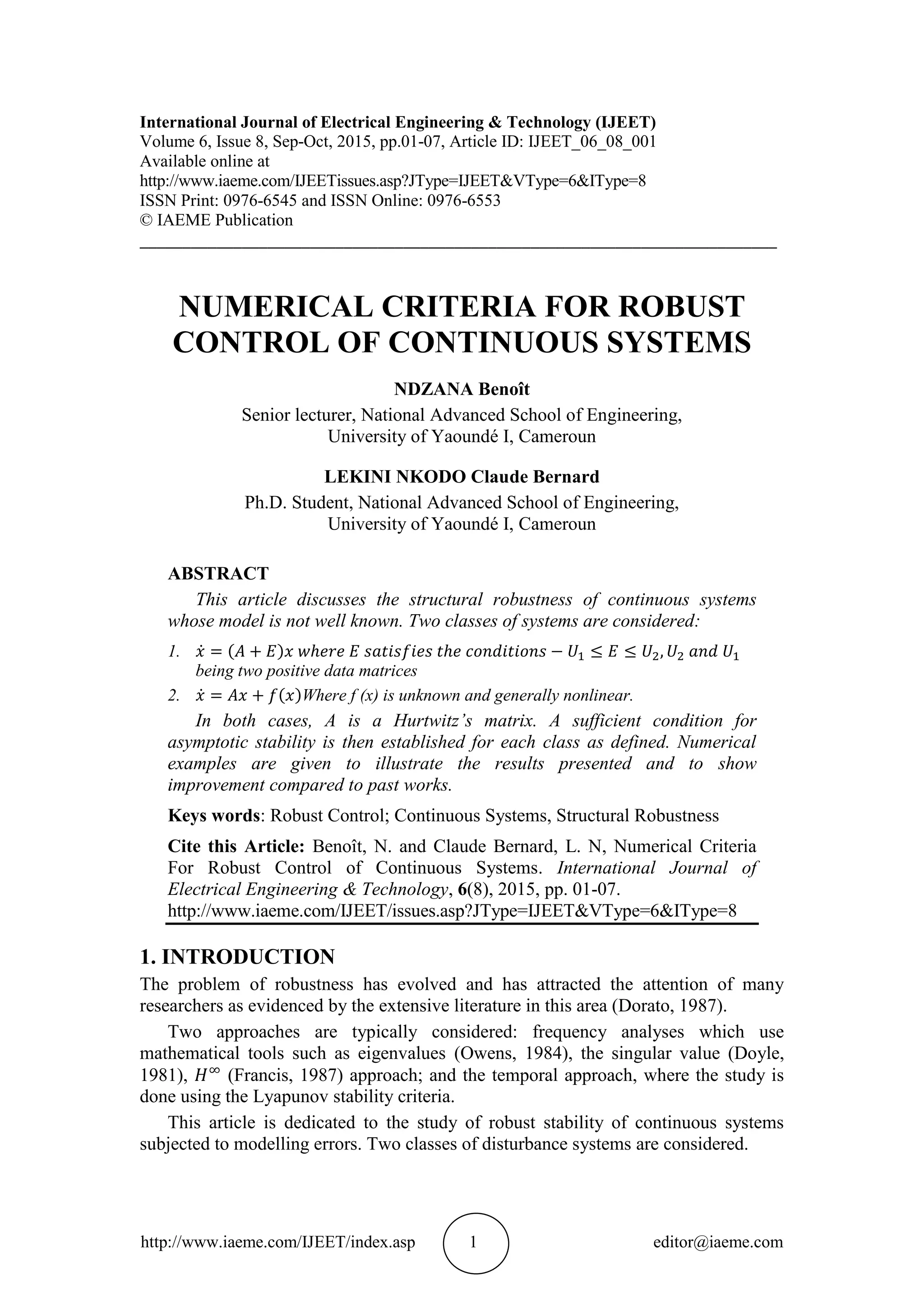
This article discusses the structural robustness of continuous systems
whose model is not well known. Two classes of systems are considered:
1.
being two positive data matrices
2. Where f (x) is unknown and generally nonlinear.
In both cases, A is a Hurtwitz’s matrix. A sufficient condition for
asymptotic stability is then established for each class as defined. Numerical
examples are given to illustrate the results presented and to show
improvement compared to past works.
Keys words: Robust Control; Continuous Systems, Structural Robustness
Cite this Article: Benoît, N. and Claude Bernard, L. N, Numerical Criteria
For Robust Control of Continuous Systems. International Journal of
Electrical Engineering & Technology, 6(8), 2015, pp. 01-07.
http://www.iaeme.com/IJEET/issues.asp?JType=IJEET&VType=6&IType=8
1. INTRODUCTION
The problem of robustness has evolved and has attracted the attention of many
researchers as evidenced by the extensive literature in this area (Dorato, 1987).
Two approaches are typically considered: frequency analyses which use
mathematical tools such as eigenvalues (Owens, 1984), the singular value (Doyle,
1981), (Francis, 1987) approach; and the temporal approach, where the study is
done using the Lyapunov stability criteria.
This article is dedicated to the study of robust stability of continuous systems
subjected to modelling errors. Two classes of disturbance systems are considered.
Ndzana Benoît and Lekini Nkodo Claude Bernard
http://www.iaeme.com/IJEET/index.asp 2 editor@iaeme.com
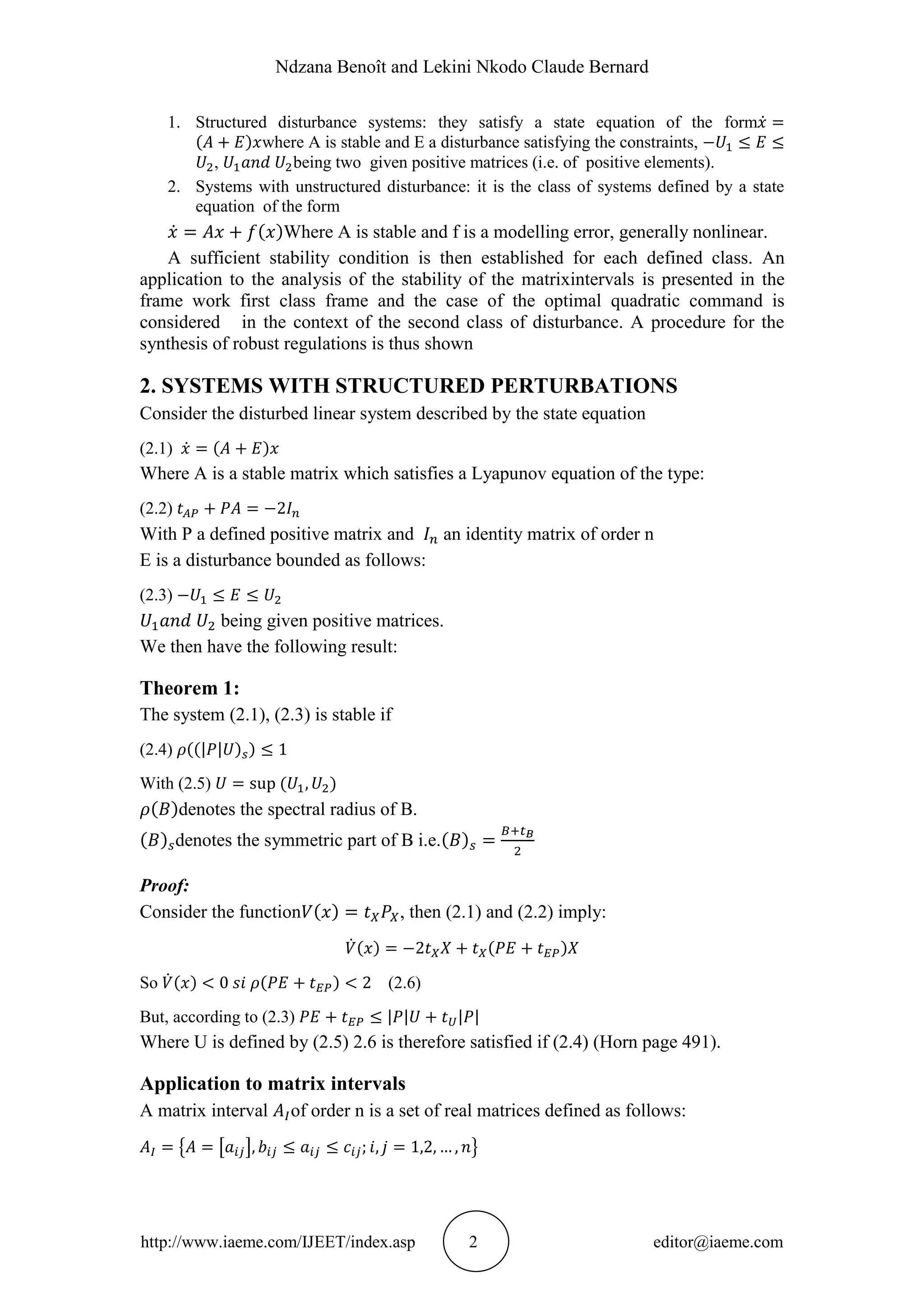
1. Structured disturbance systems: they satisfy a state equation of the form
where A is stable and E a disturbance satisfying the constraints,
, being two given positive matrices (i.e. of positive elements).
2. Systems with unstructured disturbance: it is the class of systems defined by a state
equation of the form
Where A is stable and f is a modelling error, generally nonlinear.
A sufficient stability condition is then established for each defined class. An
application to the analysis of the stability of the matrixintervals is presented in the
frame work first class frame and the case of the optimal quadratic command is
considered in the context of the second class of disturbance. A procedure for the
synthesis of robust regulations is thus shown
2. SYSTEMS WITH STRUCTURED PERTURBATIONS
Consider the disturbed linear system described by the state equation
(2.1)
Where A is a stable matrix which satisfies a Lyapunov equation of the type:
(2.2)
With P a defined positive matrix and an identity matrix of order n
E is a disturbance bounded as follows:
(2.3)
being given positive matrices.
We then have the following result:
Theorem 1:
The system (2.1), (2.3) is stable if
(2.4)
With (2.5)
denotes the spectral radius of B.
denotes the symmetric part of B i.e.
Proof:
Consider the function , then (2.1) and (2.2) imply:
So (2.6)
But, according to (2.3)
Where U is defined by (2.5) 2.6 is therefore satisfied if (2.4) (Horn page 491).
Application to matrix intervals
A matrix interval of order n is a set of real matrices defined as follows:
Numerical Criteria For Robust Control of Continuous Systems
http://www.iaeme.com/IJEET/index.asp 3 editor@iaeme.com
Stability matrix intervals have been studied by many authors using very different
techniques (Yedavalli (1986), Jiang (1988)).
If the matrices B and C are such that B≤0 and C≥0, theorem 2 is directly
applicable; in the general case, we have the following result whose proof is obvious
from Theorem 1:
Theorem 2:
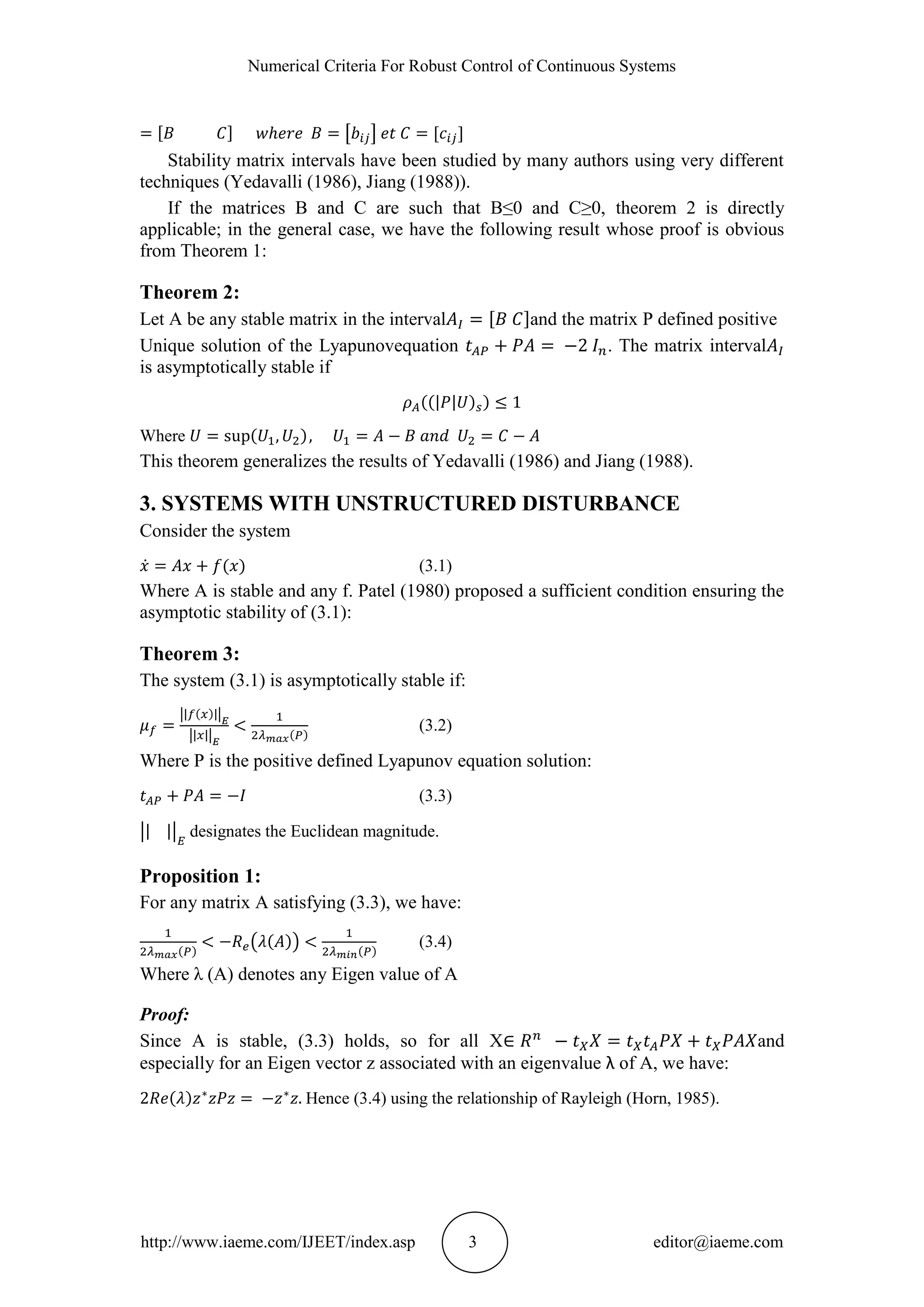
Let A be any stable matrix in the interval and the matrix P defined positive
Unique solution of the Lyapunovequation . The matrix interval
is asymptotically stable if
Where
This theorem generalizes the results of Yedavalli (1986) and Jiang (1988).
3. SYSTEMS WITH UNSTRUCTURED DISTURBANCE
Consider the system
(3.1)
Where A is stable and any f. Patel (1980) proposed a sufficient condition ensuring the
asymptotic stability of (3.1):
Theorem 3:
The system (3.1) is asymptotically stable if:
(3.2)
Where P is the positive defined Lyapunov equation solution:
(3.3)
designates the Euclidean magnitude.
Proposition 1:
For any matrix A satisfying (3.3), we have:
(3.4)
Where λ (A) denotes any Eigen value of A
Proof:
Since A is stable, (3.3) holds, so for all X and
especially for an Eigen vector z associated with an eigenvalue λ of A, we have:
Hence (3.4) using the relationship of Rayleigh (Horn, 1985).
Ndzana Benoît and Lekini Nkodo Claude Bernard
http://www.iaeme.com/IJEET/index.asp 4 editor@iaeme.com
Note 1:
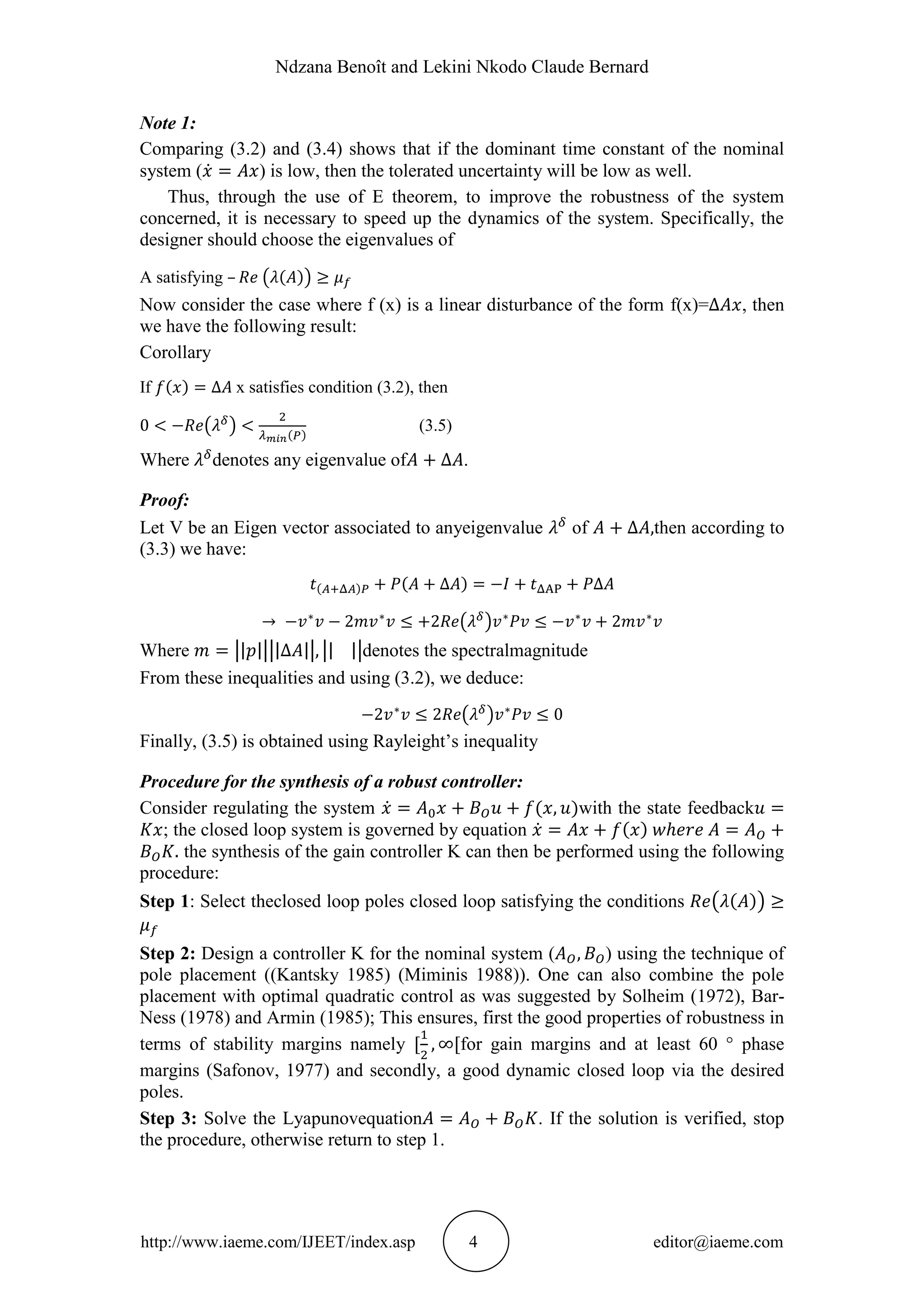
Comparing (3.2) and (3.4) shows that if the dominant time constant of the nominal
system ( ) is low, then the tolerated uncertainty will be low as well.
Thus, through the use of E theorem, to improve the robustness of the system
concerned, it is necessary to speed up the dynamics of the system. Specifically, the
designer should choose the eigenvalues of
A satisfying –
Now consider the case where f (x) is a linear disturbance of the form f(x)= , then
we have the following result:
Corollary
If x satisfies condition (3.2), then
(3.5)
Where denotes any eigenvalue of .
Proof:
Let V be an Eigen vector associated to anyeigenvalue of then according to
(3.3) we have:
Where denotes the spectralmagnitude
From these inequalities and using (3.2), we deduce:
Finally, (3.5) is obtained using Rayleight’s inequality
Procedure for the synthesis of a robust controller:
Consider regulating the system with the state feedback
; the closed loop system is governed by equation
the synthesis of the gain controller K can then be performed using the following
procedure:
Step 1: Select theclosed loop poles closed loop satisfying the conditions
Step 2: Design a controller K for the nominal system ( ) using the technique of
pole placement ((Kantsky 1985) (Miminis 1988)). One can also combine the pole
placement with optimal quadratic control as was suggested by Solheim (1972), Bar-
Ness (1978) and Armin (1985); This ensures, first the good properties of robustness in
terms of stability margins namely for gain margins and at least 60 ° phase
margins (Safonov, 1977) and secondly, a good dynamic closed loop via the desired
poles.
Step 3: Solve the Lyapunovequation . If the solution is verified, stop
the procedure, otherwise return to step 1.
Numerical Criteria For Robust Control of Continuous Systems
http://www.iaeme.com/IJEET/index.asp 5 editor@iaeme.com
It is not necessary to specify exactly the poles of the closed loop system. In effect, an
alternative to steps 1 and 2 above is to design a regulator minimizing a quadratic
criterion of the form:
Where one must choose
The closed loop state matrix is where K is given by
, being the unique defined positive solution to the Ricartti (Anderson,
1971) equation:
4. NUMERICAL EXAMPLES
Example 1:
To illustrate Theorem 2, consider the matrix interval where
Note that B and C are stable. The application of Theorem 2 with the choice of A to be
proposed by Yedavalli (1986) and Jiang (1988) provides:
Thus, these results do not permit to conclude about the stability of if we choose
The matrix
Then the theorem gives it can be concluded that is a stable
interval.
Example 2:
Consider the uncertain system:
E is a bounded disturbance such that
The Eigen values of are +2 and -3. We desire to realise, by n pole placement a
robust controller placing the unstable pole +2 in new σ<0. According to Note 1, we
must take The application of Theorem 3 with σ = -4, gives:
Thus the state feedback controller gain placing the poles -4, -3
gives a satisfactory solution. If we had a larger disturbance, for example such that|
Ndzana Benoît and Lekini Nkodo Claude Bernard
http://www.iaeme.com/IJEET/index.asp 6 editor@iaeme.com
then we have to move the two poles +2 and -3 to for
example , Theorem 3 gives:
The closed-loop system is thus robust for .
5. CONCLUSION
In this paper, we proposed sufficient conditions for robust stability for a specific class
of continuous linear systems with uncertain parameters. Upper bounds and lower
bounds were obtained for the roles of the nominal closed loop system. Also for the
poles of globally disturbed closed loop system. These results represent a prior
knowledge to guide the designer and the user. A procedure for the synthesis of robust
controllers has been presented and illustrated by numerical examples.
BIBLIOGRAPHY
[1] AMIN M.H., Optimal pole shifting for continuous multivariable linear systems,
Int. J. C, 41(1), 1985.
[2] ANDERSON B.D.O & J.B. MOORE, Linear Optimal Control. Englewood Cliffs,
New Jersey, 1971
[3] BAR-NESS Y, Optimal closed poles assignment, Int. J. C, 27(3), 1978.
[4] DORATO P. (Editor), Robust Control, IEEE Press, 1987
[5] DOYLE J.C. & G. STEIN, Multivariable feedback design: concepts for a
classical/modern synthesis. IEEE Trans. Autom. Cont., Vol AC-26, 1981.
[6] FRANCIS B, A Course in H^∞ control theory. Springer Verlag. 1987
[7] HORN R.A & C.R. JOHNSON, Matrix analysis. Cambridge, University Press.
1985
[8] JIANG C.L., Another sufficient condition for the stability of interval matrices.
1988
[9] I.J.C., 47(1).
[10] KAUTSKY J. & N.K. NICHOLS, Robust multiple eigenvalue assignment of
times invariant muli-input linear systems using state feedback. Automatica, 24,
(3), 1985.
[11] OWENS D.H. & A. CHOTAI, on eigenvalues, eigenvectors and singular values
in robust stability analysis. I.J.C, 40(2), 1984
[12] PATER R.V & M. TODA, Quantitative measures of robustness for multivariable
systems. Proc. Of Joint Automatic Cont., Vol. AC-22, pp. 143-179, 1980
[13] YEDA VALLI R.K, Perturbation bounds for robust stability in linear state space
models. Int. J.C., Vol. 42., 1985
[14] Rajiv Ranjan and Dr. Pankaj Rai, Robust Model Reference Adaptive Control For
A Second Order System, International Journal of Electrical Engineering &
Technology, 4(1), 2013, pp. 09-18.
[15] Nudrat Liaqat, Dr. Suhail. A. Qureshi, Liaqat Ali, Muhammad Khalid Liaqat and
Muhammad Afraz Liaqat, Designing of An Application Based Control System
For Robust And Intelligent 1dof Exoskeleton, International Journal of Electrical
Engineering & Technology, 5(4), 2014, pp. 11-19.
Numerical Criteria For Robust Control of Continuous Systems
http://www.iaeme.com/IJEET/index.asp 7 editor@iaeme.com
[16] Ndzana Benoît Biya Motto And Lekini Nkodo Claude Bernard, State Feedback
Controller with Non Symmetrical Constraints, International journal of
Electronics and Communication Engineering &Technology 6(3), 2015, pp. 18-23.
[17] Ndzana Benoît Biya Motto and Lekini Nkodo Claude Bernard, Iterative Methods
For The Solution of Saddle Point Problem, International Journal of Advanced
Research in Engineering & Technology, 6(3), 2015, pp. 62 - 69.
[18] Ndzana Benoît, Biya Motto and Lekini Nkodo Claude Bernard, A Computation
Model For Real-Time Systems, International Journal of Electrical Engineering
& Technology, 6(3), 2015, pp. 07-16.
[19] Ndzana Benoît Biya Motto and Lekini Nkodo Claude Bernard, Adaptive
Temperature Control in Continuous Stirred Tank Reactor, International Journal
of Electrical Engineering & Technology, 6(3), 2015, pp. 01-06.

Ijeet 06 08_001

  • 1.
    http://www.iaeme.com/IJEET/index.asp 1 editor@iaeme.com InternationalJournal of Electrical Engineering & Technology (IJEET) Volume 6, Issue 8, Sep-Oct, 2015, pp.01-07, Article ID: IJEET_06_08_001 Available online at http://www.iaeme.com/IJEETissues.asp?JType=IJEET&VType=6&IType=8 ISSN Print: 0976-6545 and ISSN Online: 0976-6553 © IAEME Publication ___________________________________________________________________________ NUMERICAL CRITERIA FOR ROBUST CONTROL OF CONTINUOUS SYSTEMS NDZANA Benoît Senior lecturer, National Advanced School of Engineering, University of Yaoundé I, Cameroun LEKINI NKODO Claude Bernard Ph.D. Student, National Advanced School of Engineering, University of Yaoundé I, Cameroun ABSTRACT This article discusses the structural robustness of continuous systems whose model is not well known. Two classes of systems are considered: 1. being two positive data matrices 2. Where f (x) is unknown and generally nonlinear. In both cases, A is a Hurtwitz’s matrix. A sufficient condition for asymptotic stability is then established for each class as defined. Numerical examples are given to illustrate the results presented and to show improvement compared to past works. Keys words: Robust Control; Continuous Systems, Structural Robustness Cite this Article: Benoît, N. and Claude Bernard, L. N, Numerical Criteria For Robust Control of Continuous Systems. International Journal of Electrical Engineering & Technology, 6(8), 2015, pp. 01-07. http://www.iaeme.com/IJEET/issues.asp?JType=IJEET&VType=6&IType=8 1. INTRODUCTION The problem of robustness has evolved and has attracted the attention of many researchers as evidenced by the extensive literature in this area (Dorato, 1987). Two approaches are typically considered: frequency analyses which use mathematical tools such as eigenvalues (Owens, 1984), the singular value (Doyle, 1981), (Francis, 1987) approach; and the temporal approach, where the study is done using the Lyapunov stability criteria. This article is dedicated to the study of robust stability of continuous systems subjected to modelling errors. Two classes of disturbance systems are considered.
  • 2.
    Ndzana Benoît andLekini Nkodo Claude Bernard http://www.iaeme.com/IJEET/index.asp 2 editor@iaeme.com 1. Structured disturbance systems: they satisfy a state equation of the form where A is stable and E a disturbance satisfying the constraints, , being two given positive matrices (i.e. of positive elements). 2. Systems with unstructured disturbance: it is the class of systems defined by a state equation of the form Where A is stable and f is a modelling error, generally nonlinear. A sufficient stability condition is then established for each defined class. An application to the analysis of the stability of the matrixintervals is presented in the frame work first class frame and the case of the optimal quadratic command is considered in the context of the second class of disturbance. A procedure for the synthesis of robust regulations is thus shown 2. SYSTEMS WITH STRUCTURED PERTURBATIONS Consider the disturbed linear system described by the state equation (2.1) Where A is a stable matrix which satisfies a Lyapunov equation of the type: (2.2) With P a defined positive matrix and an identity matrix of order n E is a disturbance bounded as follows: (2.3) being given positive matrices. We then have the following result: Theorem 1: The system (2.1), (2.3) is stable if (2.4) With (2.5) denotes the spectral radius of B. denotes the symmetric part of B i.e. Proof: Consider the function , then (2.1) and (2.2) imply: So (2.6) But, according to (2.3) Where U is defined by (2.5) 2.6 is therefore satisfied if (2.4) (Horn page 491). Application to matrix intervals A matrix interval of order n is a set of real matrices defined as follows:
  • 3.
    Numerical Criteria ForRobust Control of Continuous Systems http://www.iaeme.com/IJEET/index.asp 3 editor@iaeme.com Stability matrix intervals have been studied by many authors using very different techniques (Yedavalli (1986), Jiang (1988)). If the matrices B and C are such that B≤0 and C≥0, theorem 2 is directly applicable; in the general case, we have the following result whose proof is obvious from Theorem 1: Theorem 2: Let A be any stable matrix in the interval and the matrix P defined positive Unique solution of the Lyapunovequation . The matrix interval is asymptotically stable if Where This theorem generalizes the results of Yedavalli (1986) and Jiang (1988). 3. SYSTEMS WITH UNSTRUCTURED DISTURBANCE Consider the system (3.1) Where A is stable and any f. Patel (1980) proposed a sufficient condition ensuring the asymptotic stability of (3.1): Theorem 3: The system (3.1) is asymptotically stable if: (3.2) Where P is the positive defined Lyapunov equation solution: (3.3) designates the Euclidean magnitude. Proposition 1: For any matrix A satisfying (3.3), we have: (3.4) Where λ (A) denotes any Eigen value of A Proof: Since A is stable, (3.3) holds, so for all X and especially for an Eigen vector z associated with an eigenvalue λ of A, we have: Hence (3.4) using the relationship of Rayleigh (Horn, 1985).
  • 4.
    Ndzana Benoît andLekini Nkodo Claude Bernard http://www.iaeme.com/IJEET/index.asp 4 editor@iaeme.com Note 1: Comparing (3.2) and (3.4) shows that if the dominant time constant of the nominal system ( ) is low, then the tolerated uncertainty will be low as well. Thus, through the use of E theorem, to improve the robustness of the system concerned, it is necessary to speed up the dynamics of the system. Specifically, the designer should choose the eigenvalues of A satisfying – Now consider the case where f (x) is a linear disturbance of the form f(x)= , then we have the following result: Corollary If x satisfies condition (3.2), then (3.5) Where denotes any eigenvalue of . Proof: Let V be an Eigen vector associated to anyeigenvalue of then according to (3.3) we have: Where denotes the spectralmagnitude From these inequalities and using (3.2), we deduce: Finally, (3.5) is obtained using Rayleight’s inequality Procedure for the synthesis of a robust controller: Consider regulating the system with the state feedback ; the closed loop system is governed by equation the synthesis of the gain controller K can then be performed using the following procedure: Step 1: Select theclosed loop poles closed loop satisfying the conditions Step 2: Design a controller K for the nominal system ( ) using the technique of pole placement ((Kantsky 1985) (Miminis 1988)). One can also combine the pole placement with optimal quadratic control as was suggested by Solheim (1972), Bar- Ness (1978) and Armin (1985); This ensures, first the good properties of robustness in terms of stability margins namely for gain margins and at least 60 ° phase margins (Safonov, 1977) and secondly, a good dynamic closed loop via the desired poles. Step 3: Solve the Lyapunovequation . If the solution is verified, stop the procedure, otherwise return to step 1.
  • 5.
    Numerical Criteria ForRobust Control of Continuous Systems http://www.iaeme.com/IJEET/index.asp 5 editor@iaeme.com It is not necessary to specify exactly the poles of the closed loop system. In effect, an alternative to steps 1 and 2 above is to design a regulator minimizing a quadratic criterion of the form: Where one must choose The closed loop state matrix is where K is given by , being the unique defined positive solution to the Ricartti (Anderson, 1971) equation: 4. NUMERICAL EXAMPLES Example 1: To illustrate Theorem 2, consider the matrix interval where Note that B and C are stable. The application of Theorem 2 with the choice of A to be proposed by Yedavalli (1986) and Jiang (1988) provides: Thus, these results do not permit to conclude about the stability of if we choose The matrix Then the theorem gives it can be concluded that is a stable interval. Example 2: Consider the uncertain system: E is a bounded disturbance such that The Eigen values of are +2 and -3. We desire to realise, by n pole placement a robust controller placing the unstable pole +2 in new σ<0. According to Note 1, we must take The application of Theorem 3 with σ = -4, gives: Thus the state feedback controller gain placing the poles -4, -3 gives a satisfactory solution. If we had a larger disturbance, for example such that|
  • 6.
    Ndzana Benoît andLekini Nkodo Claude Bernard http://www.iaeme.com/IJEET/index.asp 6 editor@iaeme.com then we have to move the two poles +2 and -3 to for example , Theorem 3 gives: The closed-loop system is thus robust for . 5. CONCLUSION In this paper, we proposed sufficient conditions for robust stability for a specific class of continuous linear systems with uncertain parameters. Upper bounds and lower bounds were obtained for the roles of the nominal closed loop system. Also for the poles of globally disturbed closed loop system. These results represent a prior knowledge to guide the designer and the user. A procedure for the synthesis of robust controllers has been presented and illustrated by numerical examples. BIBLIOGRAPHY [1] AMIN M.H., Optimal pole shifting for continuous multivariable linear systems, Int. J. C, 41(1), 1985. [2] ANDERSON B.D.O & J.B. MOORE, Linear Optimal Control. Englewood Cliffs, New Jersey, 1971 [3] BAR-NESS Y, Optimal closed poles assignment, Int. J. C, 27(3), 1978. [4] DORATO P. (Editor), Robust Control, IEEE Press, 1987 [5] DOYLE J.C. & G. STEIN, Multivariable feedback design: concepts for a classical/modern synthesis. IEEE Trans. Autom. Cont., Vol AC-26, 1981. [6] FRANCIS B, A Course in H^∞ control theory. Springer Verlag. 1987 [7] HORN R.A & C.R. JOHNSON, Matrix analysis. Cambridge, University Press. 1985 [8] JIANG C.L., Another sufficient condition for the stability of interval matrices. 1988 [9] I.J.C., 47(1). [10] KAUTSKY J. & N.K. NICHOLS, Robust multiple eigenvalue assignment of times invariant muli-input linear systems using state feedback. Automatica, 24, (3), 1985. [11] OWENS D.H. & A. CHOTAI, on eigenvalues, eigenvectors and singular values in robust stability analysis. I.J.C, 40(2), 1984 [12] PATER R.V & M. TODA, Quantitative measures of robustness for multivariable systems. Proc. Of Joint Automatic Cont., Vol. AC-22, pp. 143-179, 1980 [13] YEDA VALLI R.K, Perturbation bounds for robust stability in linear state space models. Int. J.C., Vol. 42., 1985 [14] Rajiv Ranjan and Dr. Pankaj Rai, Robust Model Reference Adaptive Control For A Second Order System, International Journal of Electrical Engineering & Technology, 4(1), 2013, pp. 09-18. [15] Nudrat Liaqat, Dr. Suhail. A. Qureshi, Liaqat Ali, Muhammad Khalid Liaqat and Muhammad Afraz Liaqat, Designing of An Application Based Control System For Robust And Intelligent 1dof Exoskeleton, International Journal of Electrical Engineering & Technology, 5(4), 2014, pp. 11-19.
  • 7.
    Numerical Criteria ForRobust Control of Continuous Systems http://www.iaeme.com/IJEET/index.asp 7 editor@iaeme.com [16] Ndzana Benoît Biya Motto And Lekini Nkodo Claude Bernard, State Feedback Controller with Non Symmetrical Constraints, International journal of Electronics and Communication Engineering &Technology 6(3), 2015, pp. 18-23. [17] Ndzana Benoît Biya Motto and Lekini Nkodo Claude Bernard, Iterative Methods For The Solution of Saddle Point Problem, International Journal of Advanced Research in Engineering & Technology, 6(3), 2015, pp. 62 - 69. [18] Ndzana Benoît, Biya Motto and Lekini Nkodo Claude Bernard, A Computation Model For Real-Time Systems, International Journal of Electrical Engineering & Technology, 6(3), 2015, pp. 07-16. [19] Ndzana Benoît Biya Motto and Lekini Nkodo Claude Bernard, Adaptive Temperature Control in Continuous Stirred Tank Reactor, International Journal of Electrical Engineering & Technology, 6(3), 2015, pp. 01-06.