INC 692: The Overview of Optimal and
Robust Control
Dr.-Ing. Sudchai Boonto
Assistant Professor
Department of Control System and Instrumentation Engineering
King Mongkut’s Unniversity of Technology Thonburi Thailand
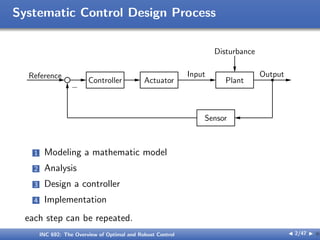
Systematic Control Design Process
Reference
Controller Actuator
Input
Plant
Disturbance
Output
Sensor
−
1 Modeling a mathematic model
2 Analysis
3 Design a controller
4 Implementation
each step can be repeated.
INC 692: The Overview of Optimal and Robust Control J 2/47 I }
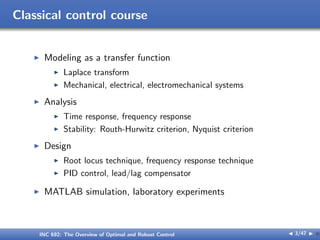
Classical control course
I Modeling as a transfer function
I Laplace transform
I Mechanical, electrical, electromechanical systems
I Analysis
I Time response, frequency response
I Stability: Routh-Hurwitz criterion, Nyquist criterion
I Design
I Root locus technique, frequency response technique
I PID control, lead/lag compensator
I MATLAB simulation, laboratory experiments
INC 692: The Overview of Optimal and Robust Control J 3/47 I }
Classical control course
Classical control in the 1930’s and 1940’s Bode, Nyquist, Nichols,...
I Feedback (speaker) amplifier design, Single Input Single
Output (SISO)
I Frequency domain, Graphical techniques, trials and errors
I Emphasized design tradeoffs
I Effects of uncertainty
I Nonminimum phase systems
I Performance vs. Robustness
I Problems with classical control – Overwhelmed by complex
systems
I Highly coupled multiple input, multiple output systems
I Nonlinear systems
I Time-domain performance specifications
INC 692: The Overview of Optimal and Robust Control J 4/47 I }
State-space control course
I Modeling as a state-space model
I Differential or difference equation
I Linear algebra
I Analysis
I Stability, controllability, observability
I Realization, minimality
I Design
I State feedback, observer
I LQR, LQG
I MATLAB simulation, laboratory experiments
INC 692: The Overview of Optimal and Robust Control J 5/47 I }
State-space control course
The origins of modern control theory
Early Year:
I Wiener (1930’s - 1950’s) Generalized harmonic analysis,
cybernetics, filtering , prediction, smoothing
I Kolmogorov (1940’s) Stochastic processes
I Linear and nonlinear programming (1940’s -)
Optimal Control:
I Bellman’s Dynamic Programming (1950’s)
I Pontryagin’s Maximum Principle (1950’s)
I Linear optimal control (late 1950’s and 1960’s)
I Kalman Filtering
I Linear-Quadratic (LQ) regulator problem
I Stochastic optimal control (LQG)
INC 692: The Overview of Optimal and Robust Control J 6/47 I }
Brief history of control theory
I Classical control (-1950)
I Transfer function
I Frequency domain
I Modern control (1960-)
I State-space model
I Time domain
I Post(neo)-modern control (1980-)
I Robust control
I LPV control
I etc.
INC 692: The Overview of Optimal and Robust Control J 7/47 I }
Brief history of control theory
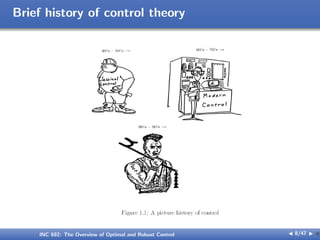
Figure: From Kemlin Zhou book
INC 692: The Overview of Optimal and Robust Control J 8/47 I }
Brief history of control theory
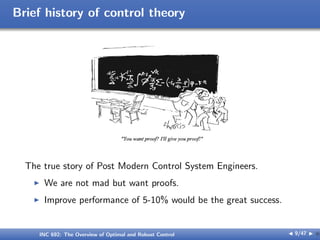
The true story of Post Modern Control System Engineers.
I We are not mad but want proofs.
I Improve performance of 5-10% would be the great success.
INC 692: The Overview of Optimal and Robust Control J 9/47 I }
Motivation: ACC Benchmark problem
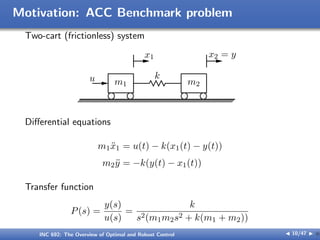
Two-cart (frictionless) system
m1 m2
x1 x2 = y
u k
Differential equations
m1ẍ1 = u(t) − k(x1(t) − y(t))
m2ÿ = −k(y(t) − x1(t))
Transfer function
P(s) =
y(s)
u(s)
=
k
s2(m1m2s2 + k(m1 + m2))
INC 692: The Overview of Optimal and Robust Control J 10/47 I }
ACC Benchmark problem
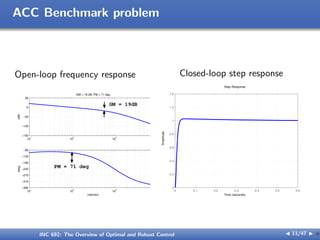
Open-loop frequency response
10
1
10
2
10
3
10
4
−150
−100
−50
0
50
(dB)
GM = 19 dB, PM = 71 deg
10
1
10
2
10
3
10
4
−360
−315
−270
−225
−180
−135
−90
(deg)
(rad/sec)
PM = 71 deg
GM = 19dB
Closed-loop step response
0 0.1 0.2 0.3 0.4 0.5 0.6
0
0.2
0.4
0.6
0.8
1
1.2
1.4
Step Response
Time (seconds)
Amplitude
INC 692: The Overview of Optimal and Robust Control J 11/47 I }
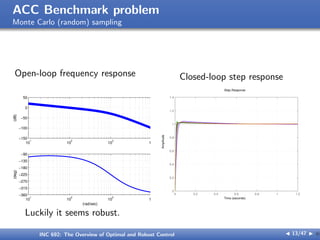
ACC Benchmark problem
Monte Carlo (random) sampling
I New assumption
I Mass and spring constant are uncertain
k, m1, m2 ∈ [0.8, 1.2]
P(s) =
k
s2(m1m2s2 + k(m1 + m2))
I For perturbations of these parameters, how will the CL
stability and performance change?
INC 692: The Overview of Optimal and Robust Control J 12/47 I }
ACC Benchmark problem
Monte Carlo (random) sampling
Open-loop frequency response
10
1
10
2
10
3
10
4
−150
−100
−50
0
50
(dB)
10
1
10
2
10
3
10
4
−360
−315
−270
−225
−180
−135
−90
(deg)
(rad/sec)
Closed-loop step response
0 0.2 0.4 0.6 0.8 1 1.2
0
0.2
0.4
0.6
0.8
1
1.2
1.4
Step Response
Time (seconds)
Amplitude
Luckily it seems robust.
INC 692: The Overview of Optimal and Robust Control J 13/47 I }
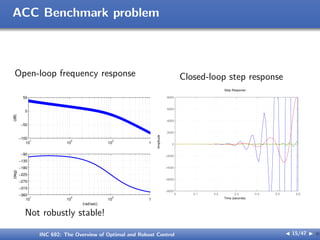
ACC Benchmark problem
I New assumption
I Mass and spring constant are uncertain
k = 6 ± 20%, m1, m2 ∈ [0.8, 1.2]
P(s) =
k
s2(m1m2s2 + k(m1 + m2))
I For perturbations of these parameters, how will the CL
stability and performance change?
INC 692: The Overview of Optimal and Robust Control J 14/47 I }
ACC Benchmark problem
Open-loop frequency response
10
1
10
2
10
3
10
4
−100
−50
0
50
(dB)
10
1
10
2
10
3
10
4
−360
−315
−270
−225
−180
−135
−90
(deg)
(rad/sec)
Closed-loop step response
0 0.1 0.2 0.3 0.4 0.5 0.6
−8000
−6000
−4000
−2000
0
2000
4000
6000
8000
Step Response
Time (seconds)
Amplitude
Not robustly stable!
INC 692: The Overview of Optimal and Robust Control J 15/47 I }
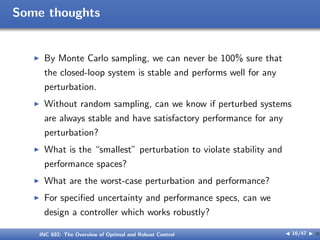
Some thoughts
I By Monte Carlo sampling, we can never be 100% sure that
the closed-loop system is stable and performs well for any
perturbation.
I Without random sampling, can we know if perturbed systems
are always stable and have satisfactory performance for any
perturbation?
I What is the “smallest” perturbation to violate stability and
performance spaces?
I What are the worst-case perturbation and performance?
I For specified uncertainty and performance specs, can we
design a controller which works robustly?
INC 692: The Overview of Optimal and Robust Control J 16/47 I }
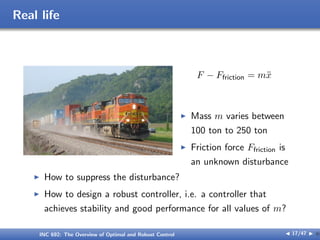
Real life
F − Ffriction = mẍ
I Mass m varies between
100 ton to 250 ton
I Friction force Ffriction is
an unknown disturbance
I How to suppress the disturbance?
I How to design a robust controller, i.e. a controller that
achieves stability and good performance for all values of m?
INC 692: The Overview of Optimal and Robust Control J 17/47 I }
MIMO System Example
Consider a multi-input/multi-output (MIMO) system:
[
Y1(s)
Y2(s)
]
= G(s)
[
U1(s)
U2(s)
]
with G(s) =
[
1
s+1
4
s+8
0.5
s+1
1
s+1
]
Suppose we neglect off-diagonal terms and choose the control
structure
U1(s) = K1(s)(R1(s) − Y1(s)) and U2(s) = K2(s)(R2(s) − Y2(s)), i.e.,
[
U1(s)
U2(s)
]
= K(s)
[
R1(s) − Y1(s)
R2(s) − Y2(s)
]
with K(s) =
[
K1(s) 0
0 K2(s)
]
with K1(s) = 20 and K2(s) = 18.
INC 692: The Overview of Optimal and Robust Control J 18/47 I }
MIMO System Example
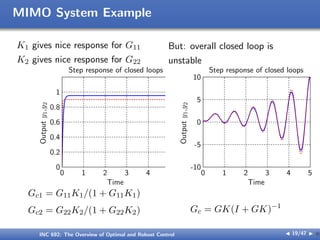
K1 gives nice response for G11
K2 gives nice response for G22
But: overall closed loop is
unstable
Time
Output
y
1
,y
2
Step response of closed loops
0 1 2 3 4 5
0
0.2
0.4
0.6
0.8
1
Time
Output
y
1
,y
2
Step response of closed loops
0 1 2 3 4 5
-10
-5
0
5
10
Gc1 = G11K1/(1 + G11K1)
Gc2 = G22K2/(1 + G22K2) Gc = GK(I + GK)−1
INC 692: The Overview of Optimal and Robust Control J 19/47 I }
MIMO System Example
Why is the closed loop unstable?
ans: G has zero in right half-plane, and controllers gains are too
big
G(s) =
[
1
s+1
4
s+8
0.5
s+1
1
s+1
]
I How can we determine properties of MIMO systems?
I How should we design MIMO controllers for MIMO plants?
INC 692: The Overview of Optimal and Robust Control J 20/47 I }
MIMO System Example 2
Real system:
Greal(s) =
1
s + 1
·
1
(0.1s + 1)2
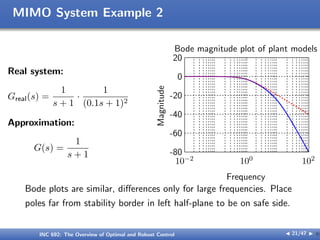
Approximation:
G(s) =
1
s + 1
Frequency
Magnitude
Bode magnitude plot of plant models
10−2 100 102
-80
-60
-40
-20
0
20
Bode plots are similar, differences only for large frequencies. Place
poles far from stability border in left half-plane to be on safe side.
INC 692: The Overview of Optimal and Robust Control J 21/47 I }
MIMO System Example 2
Controller:
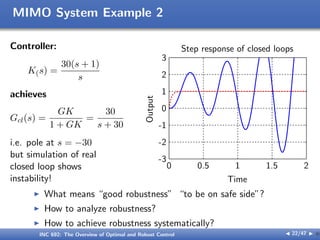
K(s) =
30(s + 1)
s
achieves
Gcl(s) =
GK
1 + GK
=
30
s + 30
i.e. pole at s = −30
but simulation of real
closed loop shows
instability! Time
Output
Step response of closed loops
0 0.5 1 1.5 2
-3
-2
-1
0
1
2
3
I What means “good robustness” “to be on safe side”?
I How to analyze robustness?
I How to achieve robustness systematically?
INC 692: The Overview of Optimal and Robust Control J 22/47 I }
Why is robust control important?
I A model is never precise!
I Difficulty in identifying parameters and high frequency plant
dynamics
I Product variability
I Uncertainty in disturbances, references, and measurement noise
I Without taking such uncertainties into account, we never
know if the designed controller works in actual
implementations.
INC 692: The Overview of Optimal and Robust Control J 23/47 I }
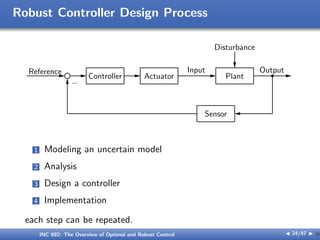
Robust Controller Design Process
Reference
Controller Actuator
Input
Plant
Disturbance
Output
Sensor
−
1 Modeling an uncertain model
2 Analysis
3 Design a controller
4 Implementation
each step can be repeated.
INC 692: The Overview of Optimal and Robust Control J 24/47 I }
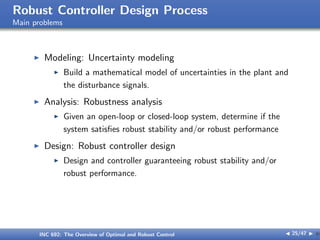
Robust Controller Design Process
Main problems
I Modeling: Uncertainty modeling
I Build a mathematical model of uncertainties in the plant and
the disturbance signals.
I Analysis: Robustness analysis
I Given an open-loop or closed-loop system, determine if the
system satisfies robust stability and/or robust performance
I Design: Robust controller design
I Design and controller guaranteeing robust stability and/or
robust performance.
INC 692: The Overview of Optimal and Robust Control J 25/47 I }
Robust Controller Design Process
Some terminologies
I A system (open-loop or closed-loop)
I is nominally stable (NS) if it is stable with no model
uncertainty.
I satisfies nominal performance (NP) if it satisfies performance
spaces with no model uncertainty.
I is robustly stable (RS) if it is stable for any plant with
specified model uncertainty.
I satisfies robust performance (RP) if it satisfies performance
specs for any plant with specified model uncertainty.
INC 692: The Overview of Optimal and Robust Control J 26/47 I }
Example 2: Space Shuttle Reentry Control
x =




β
p
r
ϕ



 =




side slip angle
roll rate
yaw rate
bank angle




y =




p
r
ny
ϕ



 , ny = lateral acceleration
u =


θele
θrud
dgust

 =


elevon surface angle
rudder surface angle
lateral wind gusts


[1] Doyle, et al, “Design example using µ-synthesis: space shuttle lateral axis FCS
during reentry”, IEEE CDC, 1986
[2] Mu toolbox for MATLAB, user guide
INC 692: The Overview of Optimal and Robust Control J 27/47 I }
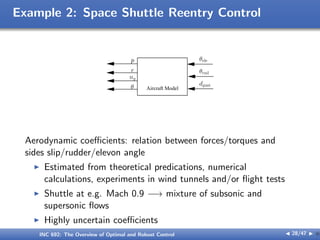
Example 2: Space Shuttle Reentry Control
Aircraft Model
dgust
θrud
θele
p
r
ny
θ
p
Aerodynamic coefficients: relation between forces/torques and
sides slip/rudder/elevon angle
I Estimated from theoretical predications, numerical
calculations, experiments in wind tunnels and/or flight tests
I Shuttle at e.g. Mach 0.9 −→ mixture of subsonic and
supersonic flows
I Highly uncertain coefficients
INC 692: The Overview of Optimal and Robust Control J 28/47 I }
Example 2: Space Shuttle Reentry Control
Aircraft Model
dgust
θrud
θele
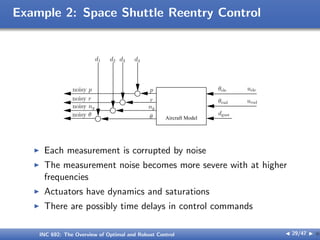
d1 d2 d3 d4
uele
urud
noisy p
noisy r
noisy ny
noisy θ
p
r
ny
θ
I Each measurement is corrupted by noise
I The measurement noise becomes more severe with at higher
frequencies
I Actuators have dynamics and saturations
I There are possibly time delays in control commands
INC 692: The Overview of Optimal and Robust Control J 29/47 I }
Example 2: Space Shuttle Reentry Control
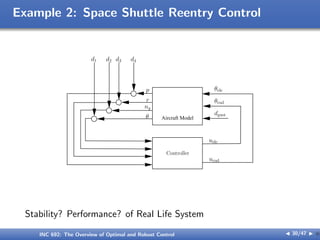
Aircraft Model
dgust
θrud
Controller
θele
d1 d2 d3 d4
uele
urud
p
r
ny
θ
Stability? Performance? of Real Life System
INC 692: The Overview of Optimal and Robust Control J 30/47 I }
Example 3: Hard Disk Drive Control
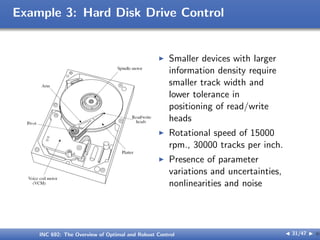
I Smaller devices with larger
information density require
smaller track width and
lower tolerance in
positioning of read/write
heads
I Rotational speed of 15000
rpm., 30000 tracks per inch.
I Presence of parameter
variations and uncertainties,
nonlinearities and noise
INC 692: The Overview of Optimal and Robust Control J 31/47 I }
Example 3: Hard Disk Drive Control
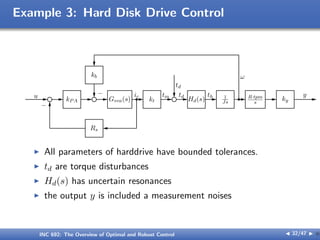
u kPA Gvca(s) kt
tm td
Hd(s)
th 1
Js
R·tpm
s
ky
y
ω
kb
−
Rs
ic
−
td
I All parameters of harddrive have bounded tolerances.
I td are torque disturbances
I Hd(s) has uncertain resonances
I the output y is included a measurement noises
INC 692: The Overview of Optimal and Robust Control J 32/47 I }
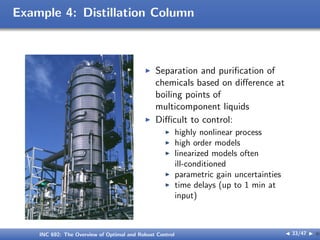
Example 4: Distillation Column
I Separation and purification of
chemicals based on difference at
boiling points of
multicomponent liquids
I Difficult to control:
I highly nonlinear process
I high order models
I linearized models often
ill-conditioned
I parametric gain uncertainties
I time delays (up to 1 min at
input)
INC 692: The Overview of Optimal and Robust Control J 33/47 I }
Example 4: Distillation Column
[1 ] Skogestad, et al., Robust Control of ill-conditioned plants: high purity distillation, IEEE TAC, 1988
[2 ] Gu, Petkov, Konstantinov, Robust Control Design with MATLAB, Springer-Verlag, 2005
INC 692: The Overview of Optimal and Robust Control J 34/47 I }
Conclusion
I Space shuttle reentry control: ensure robust stability
(safety) and trajectory tracking in spite of complex physics
(subsonic and supersonic aerodynamics),
I Harddrive control: pushing the performance of the devices
to the limits, while accounting for tolerances in series device
production
I Distillation column: increase efficiency of high order
nonlinear system
INC 692: The Overview of Optimal and Robust Control J 35/47 I }
Sources of uncertainty:
I Signal uncertainty:
I noise, exogenous disturbances;
I unknown reference tracking commands.
I Dynamic uncertainty:
I unmodeled dynamics;
I parametric variations;
I operating point changes;
I nonlinearities not captured by the linear model;
I non-repeatable system behavior.
I Dynamic uncertainty is potentially destabilizing under
feedback
I Robust control techniques: deal with uncertainty in a
systematic way. We have to model the uncertainties.
INC 692: The Overview of Optimal and Robust Control J 36/47 I }
Parametric Uncertainty
e k+Tds
1+T0s
u g
s2(1+θs)
y
−
G(s) =
g
s2(1 + sθ)
, g ∈ [g1, g2] , θ ∈ [θ1, θ2]
g = g0 +
g2 − g1
2
δg, g0 =
g1 + g2
2
, |δg| ≤ 1
θ = θ0 +
θ2 − θ1
2
δθ, θ0 =
θ1 + θ2
2
, |δθ| ≤ 1
Nominal system: G0(s) =
g0
s2(1 + sθ0)
A set of perturbed systems: G(s) =
g(δ)
s2(1 + sθ(δ))
INC 692: The Overview of Optimal and Robust Control J 37/47 I }
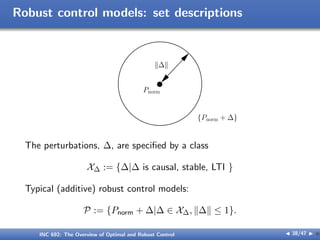
Robust control models: set descriptions
∥∆∥
Pnorm
{Pnorm + ∆}
The perturbations, ∆, are specified by a class
X∆ := {∆|∆ is causal, stable, LTI }
Typical (additive) robust control models:
P := {Pnorm + ∆|∆ ∈ X∆, ∥∆∥ ≤ 1}.
INC 692: The Overview of Optimal and Robust Control J 38/47 I }
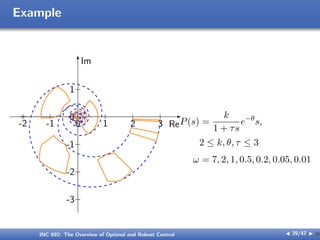
Example
Re
-2 -1 0 1 2 3
Im
-3
-2
-1
0
1
P(s) =
k
1 + τs
e−θ
s,
2 ≤ k, θ, τ ≤ 3
ω = 7, 2, 1, 0.5, 0.2, 0.05, 0.01
INC 692: The Overview of Optimal and Robust Control J 39/47 I }
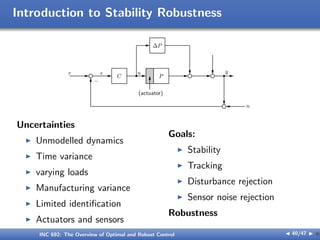
Introduction to Stability Robustness
r e
C
u
P
∆P
y
n
−
(actuator)
Uncertainties
I Unmodelled dynamics
I Time variance
I varying loads
I Manufacturing variance
I Limited identification
I Actuators and sensors
Goals:
I Stability
I Tracking
I Disturbance rejection
I Sensor noise rejection
Robustness
INC 692: The Overview of Optimal and Robust Control J 40/47 I }
Parametric Uncertainty
e k+Tds
1+T0s
u g
s2(1+θs)
y
−
I Nominal plat: g = g0 = 1, θ = 0
I Controller : k = 1, Td =
√
2, T0 = 1/10
I Perturbed plant: g ∈ [g, g], θ ∈ [0, θ]
INC 692: The Overview of Optimal and Robust Control J 41/47 I }
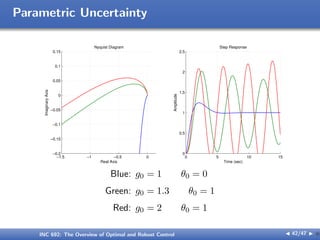
Parametric Uncertainty
−1.5 −1 −0.5 0
−0.2
−0.15
−0.1
−0.05
0
0.05
0.1
0.15
Real Axis
Imaginary
Axis Nyquist Diagram
0 5 10 15
0
0.5
1
1.5
2
2.5
Time (sec)
Amplitude
Step Response
Blue: g0 = 1 θ0 = 0
Green: g0 = 1.3 θ0 = 1
Red: g0 = 2 θ0 = 1
INC 692: The Overview of Optimal and Robust Control J 42/47 I }
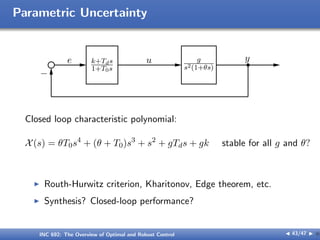
Parametric Uncertainty
e k+Tds
1+T0s
u g
s2(1+θs)
y
−
Closed loop characteristic polynomial:
X(s) = θT0s4
+ (θ + T0)s3
+ s2
+ gTds + gk stable for all g and θ?
I Routh-Hurwitz criterion, Kharitonov, Edge theorem, etc.
I Synthesis? Closed-loop performance?
INC 692: The Overview of Optimal and Robust Control J 43/47 I }
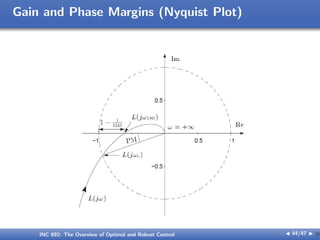
Gain and Phase Margins (Nyquist Plot)
INC 692: The Overview of Optimal and Robust Control J 44/47 I }
Gain and Phase Margins (Nyquist Plot)
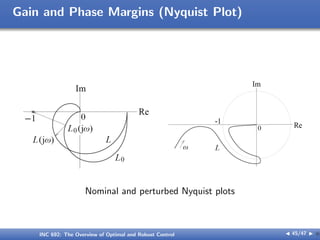
Nominal and perturbed Nyquist plots
INC 692: The Overview of Optimal and Robust Control J 45/47 I }
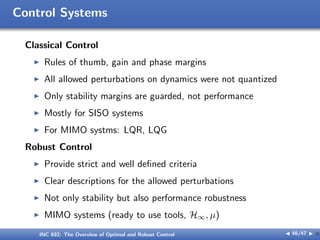
Control Systems
Classical Control
I Rules of thumb, gain and phase margins
I All allowed perturbations on dynamics were not quantized
I Only stability margins are guarded, not performance
I Mostly for SISO systems
I For MIMO systms: LQR, LQG
Robust Control
I Provide strict and well defined criteria
I Clear descriptions for the allowed perturbations
I Not only stability but also performance robustness
I MIMO systems (ready to use tools, H∞, µ)
INC 692: The Overview of Optimal and Robust Control J 46/47 I }
Reference
1 A. Damen and S. Weiland, Robust Control, Lecture Notes,
TU/e, 2002.
2 S. Skogestad and I. Postelthwaite, Multivariable Feedback
Control: Analysis and Design, 2nd Edition, Wiley.
3 C. W. Scherer, Theory of Robust Control, Lecture Notes,
Delft University of Technology, 2001.
4 G. E. Dullerud and F. Paganini, A Course in Robust Control
Theory: A Convex Approach, Springer, 1999.
5 J. C. Doyle, B. A. Francis and A. R. Tannenbaum, Feedback
Control Theory, McMillan, 1992.
6 R. Nagamune, A Lecture note on Multivariable feedback
control
INC 692: The Overview of Optimal and Robust Control J 47/47 I }

The Overview of Optimal and Robust Control

  • 1.
    INC 692: TheOverview of Optimal and Robust Control Dr.-Ing. Sudchai Boonto Assistant Professor Department of Control System and Instrumentation Engineering King Mongkut’s Unniversity of Technology Thonburi Thailand
  • 2.
    Systematic Control DesignProcess Reference Controller Actuator Input Plant Disturbance Output Sensor − 1 Modeling a mathematic model 2 Analysis 3 Design a controller 4 Implementation each step can be repeated. INC 692: The Overview of Optimal and Robust Control J 2/47 I }
  • 3.
    Classical control course IModeling as a transfer function I Laplace transform I Mechanical, electrical, electromechanical systems I Analysis I Time response, frequency response I Stability: Routh-Hurwitz criterion, Nyquist criterion I Design I Root locus technique, frequency response technique I PID control, lead/lag compensator I MATLAB simulation, laboratory experiments INC 692: The Overview of Optimal and Robust Control J 3/47 I }
  • 4.
    Classical control course Classicalcontrol in the 1930’s and 1940’s Bode, Nyquist, Nichols,... I Feedback (speaker) amplifier design, Single Input Single Output (SISO) I Frequency domain, Graphical techniques, trials and errors I Emphasized design tradeoffs I Effects of uncertainty I Nonminimum phase systems I Performance vs. Robustness I Problems with classical control – Overwhelmed by complex systems I Highly coupled multiple input, multiple output systems I Nonlinear systems I Time-domain performance specifications INC 692: The Overview of Optimal and Robust Control J 4/47 I }
  • 5.
    State-space control course IModeling as a state-space model I Differential or difference equation I Linear algebra I Analysis I Stability, controllability, observability I Realization, minimality I Design I State feedback, observer I LQR, LQG I MATLAB simulation, laboratory experiments INC 692: The Overview of Optimal and Robust Control J 5/47 I }
  • 6.
    State-space control course Theorigins of modern control theory Early Year: I Wiener (1930’s - 1950’s) Generalized harmonic analysis, cybernetics, filtering , prediction, smoothing I Kolmogorov (1940’s) Stochastic processes I Linear and nonlinear programming (1940’s -) Optimal Control: I Bellman’s Dynamic Programming (1950’s) I Pontryagin’s Maximum Principle (1950’s) I Linear optimal control (late 1950’s and 1960’s) I Kalman Filtering I Linear-Quadratic (LQ) regulator problem I Stochastic optimal control (LQG) INC 692: The Overview of Optimal and Robust Control J 6/47 I }
  • 7.
    Brief history ofcontrol theory I Classical control (-1950) I Transfer function I Frequency domain I Modern control (1960-) I State-space model I Time domain I Post(neo)-modern control (1980-) I Robust control I LPV control I etc. INC 692: The Overview of Optimal and Robust Control J 7/47 I }
  • 8.
    Brief history ofcontrol theory Figure: From Kemlin Zhou book INC 692: The Overview of Optimal and Robust Control J 8/47 I }
  • 9.
    Brief history ofcontrol theory The true story of Post Modern Control System Engineers. I We are not mad but want proofs. I Improve performance of 5-10% would be the great success. INC 692: The Overview of Optimal and Robust Control J 9/47 I }
  • 10.
    Motivation: ACC Benchmarkproblem Two-cart (frictionless) system m1 m2 x1 x2 = y u k Differential equations m1ẍ1 = u(t) − k(x1(t) − y(t)) m2ÿ = −k(y(t) − x1(t)) Transfer function P(s) = y(s) u(s) = k s2(m1m2s2 + k(m1 + m2)) INC 692: The Overview of Optimal and Robust Control J 10/47 I }
  • 11.
    ACC Benchmark problem Open-loopfrequency response 10 1 10 2 10 3 10 4 −150 −100 −50 0 50 (dB) GM = 19 dB, PM = 71 deg 10 1 10 2 10 3 10 4 −360 −315 −270 −225 −180 −135 −90 (deg) (rad/sec) PM = 71 deg GM = 19dB Closed-loop step response 0 0.1 0.2 0.3 0.4 0.5 0.6 0 0.2 0.4 0.6 0.8 1 1.2 1.4 Step Response Time (seconds) Amplitude INC 692: The Overview of Optimal and Robust Control J 11/47 I }
  • 12.
    ACC Benchmark problem MonteCarlo (random) sampling I New assumption I Mass and spring constant are uncertain k, m1, m2 ∈ [0.8, 1.2] P(s) = k s2(m1m2s2 + k(m1 + m2)) I For perturbations of these parameters, how will the CL stability and performance change? INC 692: The Overview of Optimal and Robust Control J 12/47 I }
  • 13.
    ACC Benchmark problem MonteCarlo (random) sampling Open-loop frequency response 10 1 10 2 10 3 10 4 −150 −100 −50 0 50 (dB) 10 1 10 2 10 3 10 4 −360 −315 −270 −225 −180 −135 −90 (deg) (rad/sec) Closed-loop step response 0 0.2 0.4 0.6 0.8 1 1.2 0 0.2 0.4 0.6 0.8 1 1.2 1.4 Step Response Time (seconds) Amplitude Luckily it seems robust. INC 692: The Overview of Optimal and Robust Control J 13/47 I }
  • 14.
    ACC Benchmark problem INew assumption I Mass and spring constant are uncertain k = 6 ± 20%, m1, m2 ∈ [0.8, 1.2] P(s) = k s2(m1m2s2 + k(m1 + m2)) I For perturbations of these parameters, how will the CL stability and performance change? INC 692: The Overview of Optimal and Robust Control J 14/47 I }
  • 15.
    ACC Benchmark problem Open-loopfrequency response 10 1 10 2 10 3 10 4 −100 −50 0 50 (dB) 10 1 10 2 10 3 10 4 −360 −315 −270 −225 −180 −135 −90 (deg) (rad/sec) Closed-loop step response 0 0.1 0.2 0.3 0.4 0.5 0.6 −8000 −6000 −4000 −2000 0 2000 4000 6000 8000 Step Response Time (seconds) Amplitude Not robustly stable! INC 692: The Overview of Optimal and Robust Control J 15/47 I }
  • 16.
    Some thoughts I ByMonte Carlo sampling, we can never be 100% sure that the closed-loop system is stable and performs well for any perturbation. I Without random sampling, can we know if perturbed systems are always stable and have satisfactory performance for any perturbation? I What is the “smallest” perturbation to violate stability and performance spaces? I What are the worst-case perturbation and performance? I For specified uncertainty and performance specs, can we design a controller which works robustly? INC 692: The Overview of Optimal and Robust Control J 16/47 I }
  • 17.
    Real life F −Ffriction = mẍ I Mass m varies between 100 ton to 250 ton I Friction force Ffriction is an unknown disturbance I How to suppress the disturbance? I How to design a robust controller, i.e. a controller that achieves stability and good performance for all values of m? INC 692: The Overview of Optimal and Robust Control J 17/47 I }
  • 18.
    MIMO System Example Considera multi-input/multi-output (MIMO) system: [ Y1(s) Y2(s) ] = G(s) [ U1(s) U2(s) ] with G(s) = [ 1 s+1 4 s+8 0.5 s+1 1 s+1 ] Suppose we neglect off-diagonal terms and choose the control structure U1(s) = K1(s)(R1(s) − Y1(s)) and U2(s) = K2(s)(R2(s) − Y2(s)), i.e., [ U1(s) U2(s) ] = K(s) [ R1(s) − Y1(s) R2(s) − Y2(s) ] with K(s) = [ K1(s) 0 0 K2(s) ] with K1(s) = 20 and K2(s) = 18. INC 692: The Overview of Optimal and Robust Control J 18/47 I }
  • 19.
    MIMO System Example K1gives nice response for G11 K2 gives nice response for G22 But: overall closed loop is unstable Time Output y 1 ,y 2 Step response of closed loops 0 1 2 3 4 5 0 0.2 0.4 0.6 0.8 1 Time Output y 1 ,y 2 Step response of closed loops 0 1 2 3 4 5 -10 -5 0 5 10 Gc1 = G11K1/(1 + G11K1) Gc2 = G22K2/(1 + G22K2) Gc = GK(I + GK)−1 INC 692: The Overview of Optimal and Robust Control J 19/47 I }
  • 20.
    MIMO System Example Whyis the closed loop unstable? ans: G has zero in right half-plane, and controllers gains are too big G(s) = [ 1 s+1 4 s+8 0.5 s+1 1 s+1 ] I How can we determine properties of MIMO systems? I How should we design MIMO controllers for MIMO plants? INC 692: The Overview of Optimal and Robust Control J 20/47 I }
  • 21.
    MIMO System Example2 Real system: Greal(s) = 1 s + 1 · 1 (0.1s + 1)2 Approximation: G(s) = 1 s + 1 Frequency Magnitude Bode magnitude plot of plant models 10−2 100 102 -80 -60 -40 -20 0 20 Bode plots are similar, differences only for large frequencies. Place poles far from stability border in left half-plane to be on safe side. INC 692: The Overview of Optimal and Robust Control J 21/47 I }
  • 22.
    MIMO System Example2 Controller: K(s) = 30(s + 1) s achieves Gcl(s) = GK 1 + GK = 30 s + 30 i.e. pole at s = −30 but simulation of real closed loop shows instability! Time Output Step response of closed loops 0 0.5 1 1.5 2 -3 -2 -1 0 1 2 3 I What means “good robustness” “to be on safe side”? I How to analyze robustness? I How to achieve robustness systematically? INC 692: The Overview of Optimal and Robust Control J 22/47 I }
  • 23.
    Why is robustcontrol important? I A model is never precise! I Difficulty in identifying parameters and high frequency plant dynamics I Product variability I Uncertainty in disturbances, references, and measurement noise I Without taking such uncertainties into account, we never know if the designed controller works in actual implementations. INC 692: The Overview of Optimal and Robust Control J 23/47 I }
  • 24.
    Robust Controller DesignProcess Reference Controller Actuator Input Plant Disturbance Output Sensor − 1 Modeling an uncertain model 2 Analysis 3 Design a controller 4 Implementation each step can be repeated. INC 692: The Overview of Optimal and Robust Control J 24/47 I }
  • 25.
    Robust Controller DesignProcess Main problems I Modeling: Uncertainty modeling I Build a mathematical model of uncertainties in the plant and the disturbance signals. I Analysis: Robustness analysis I Given an open-loop or closed-loop system, determine if the system satisfies robust stability and/or robust performance I Design: Robust controller design I Design and controller guaranteeing robust stability and/or robust performance. INC 692: The Overview of Optimal and Robust Control J 25/47 I }
  • 26.
    Robust Controller DesignProcess Some terminologies I A system (open-loop or closed-loop) I is nominally stable (NS) if it is stable with no model uncertainty. I satisfies nominal performance (NP) if it satisfies performance spaces with no model uncertainty. I is robustly stable (RS) if it is stable for any plant with specified model uncertainty. I satisfies robust performance (RP) if it satisfies performance specs for any plant with specified model uncertainty. INC 692: The Overview of Optimal and Robust Control J 26/47 I }
  • 27.
    Example 2: SpaceShuttle Reentry Control x =     β p r ϕ     =     side slip angle roll rate yaw rate bank angle     y =     p r ny ϕ     , ny = lateral acceleration u =   θele θrud dgust   =   elevon surface angle rudder surface angle lateral wind gusts   [1] Doyle, et al, “Design example using µ-synthesis: space shuttle lateral axis FCS during reentry”, IEEE CDC, 1986 [2] Mu toolbox for MATLAB, user guide INC 692: The Overview of Optimal and Robust Control J 27/47 I }
  • 28.
    Example 2: SpaceShuttle Reentry Control Aircraft Model dgust θrud θele p r ny θ p Aerodynamic coefficients: relation between forces/torques and sides slip/rudder/elevon angle I Estimated from theoretical predications, numerical calculations, experiments in wind tunnels and/or flight tests I Shuttle at e.g. Mach 0.9 −→ mixture of subsonic and supersonic flows I Highly uncertain coefficients INC 692: The Overview of Optimal and Robust Control J 28/47 I }
  • 29.
    Example 2: SpaceShuttle Reentry Control Aircraft Model dgust θrud θele d1 d2 d3 d4 uele urud noisy p noisy r noisy ny noisy θ p r ny θ I Each measurement is corrupted by noise I The measurement noise becomes more severe with at higher frequencies I Actuators have dynamics and saturations I There are possibly time delays in control commands INC 692: The Overview of Optimal and Robust Control J 29/47 I }
  • 30.
    Example 2: SpaceShuttle Reentry Control Aircraft Model dgust θrud Controller θele d1 d2 d3 d4 uele urud p r ny θ Stability? Performance? of Real Life System INC 692: The Overview of Optimal and Robust Control J 30/47 I }
  • 31.
    Example 3: HardDisk Drive Control I Smaller devices with larger information density require smaller track width and lower tolerance in positioning of read/write heads I Rotational speed of 15000 rpm., 30000 tracks per inch. I Presence of parameter variations and uncertainties, nonlinearities and noise INC 692: The Overview of Optimal and Robust Control J 31/47 I }
  • 32.
    Example 3: HardDisk Drive Control u kPA Gvca(s) kt tm td Hd(s) th 1 Js R·tpm s ky y ω kb − Rs ic − td I All parameters of harddrive have bounded tolerances. I td are torque disturbances I Hd(s) has uncertain resonances I the output y is included a measurement noises INC 692: The Overview of Optimal and Robust Control J 32/47 I }
  • 33.
    Example 4: DistillationColumn I Separation and purification of chemicals based on difference at boiling points of multicomponent liquids I Difficult to control: I highly nonlinear process I high order models I linearized models often ill-conditioned I parametric gain uncertainties I time delays (up to 1 min at input) INC 692: The Overview of Optimal and Robust Control J 33/47 I }
  • 34.
    Example 4: DistillationColumn [1 ] Skogestad, et al., Robust Control of ill-conditioned plants: high purity distillation, IEEE TAC, 1988 [2 ] Gu, Petkov, Konstantinov, Robust Control Design with MATLAB, Springer-Verlag, 2005 INC 692: The Overview of Optimal and Robust Control J 34/47 I }
  • 35.
    Conclusion I Space shuttlereentry control: ensure robust stability (safety) and trajectory tracking in spite of complex physics (subsonic and supersonic aerodynamics), I Harddrive control: pushing the performance of the devices to the limits, while accounting for tolerances in series device production I Distillation column: increase efficiency of high order nonlinear system INC 692: The Overview of Optimal and Robust Control J 35/47 I }
  • 36.
    Sources of uncertainty: ISignal uncertainty: I noise, exogenous disturbances; I unknown reference tracking commands. I Dynamic uncertainty: I unmodeled dynamics; I parametric variations; I operating point changes; I nonlinearities not captured by the linear model; I non-repeatable system behavior. I Dynamic uncertainty is potentially destabilizing under feedback I Robust control techniques: deal with uncertainty in a systematic way. We have to model the uncertainties. INC 692: The Overview of Optimal and Robust Control J 36/47 I }
  • 37.
    Parametric Uncertainty e k+Tds 1+T0s ug s2(1+θs) y − G(s) = g s2(1 + sθ) , g ∈ [g1, g2] , θ ∈ [θ1, θ2] g = g0 + g2 − g1 2 δg, g0 = g1 + g2 2 , |δg| ≤ 1 θ = θ0 + θ2 − θ1 2 δθ, θ0 = θ1 + θ2 2 , |δθ| ≤ 1 Nominal system: G0(s) = g0 s2(1 + sθ0) A set of perturbed systems: G(s) = g(δ) s2(1 + sθ(δ)) INC 692: The Overview of Optimal and Robust Control J 37/47 I }
  • 38.
    Robust control models:set descriptions ∥∆∥ Pnorm {Pnorm + ∆} The perturbations, ∆, are specified by a class X∆ := {∆|∆ is causal, stable, LTI } Typical (additive) robust control models: P := {Pnorm + ∆|∆ ∈ X∆, ∥∆∥ ≤ 1}. INC 692: The Overview of Optimal and Robust Control J 38/47 I }
  • 39.
    Example Re -2 -1 01 2 3 Im -3 -2 -1 0 1 P(s) = k 1 + τs e−θ s, 2 ≤ k, θ, τ ≤ 3 ω = 7, 2, 1, 0.5, 0.2, 0.05, 0.01 INC 692: The Overview of Optimal and Robust Control J 39/47 I }
  • 40.
    Introduction to StabilityRobustness r e C u P ∆P y n − (actuator) Uncertainties I Unmodelled dynamics I Time variance I varying loads I Manufacturing variance I Limited identification I Actuators and sensors Goals: I Stability I Tracking I Disturbance rejection I Sensor noise rejection Robustness INC 692: The Overview of Optimal and Robust Control J 40/47 I }
  • 41.
    Parametric Uncertainty e k+Tds 1+T0s ug s2(1+θs) y − I Nominal plat: g = g0 = 1, θ = 0 I Controller : k = 1, Td = √ 2, T0 = 1/10 I Perturbed plant: g ∈ [g, g], θ ∈ [0, θ] INC 692: The Overview of Optimal and Robust Control J 41/47 I }
  • 42.
    Parametric Uncertainty −1.5 −1−0.5 0 −0.2 −0.15 −0.1 −0.05 0 0.05 0.1 0.15 Real Axis Imaginary Axis Nyquist Diagram 0 5 10 15 0 0.5 1 1.5 2 2.5 Time (sec) Amplitude Step Response Blue: g0 = 1 θ0 = 0 Green: g0 = 1.3 θ0 = 1 Red: g0 = 2 θ0 = 1 INC 692: The Overview of Optimal and Robust Control J 42/47 I }
  • 43.
    Parametric Uncertainty e k+Tds 1+T0s ug s2(1+θs) y − Closed loop characteristic polynomial: X(s) = θT0s4 + (θ + T0)s3 + s2 + gTds + gk stable for all g and θ? I Routh-Hurwitz criterion, Kharitonov, Edge theorem, etc. I Synthesis? Closed-loop performance? INC 692: The Overview of Optimal and Robust Control J 43/47 I }
  • 44.
    Gain and PhaseMargins (Nyquist Plot) INC 692: The Overview of Optimal and Robust Control J 44/47 I }
  • 45.
    Gain and PhaseMargins (Nyquist Plot) Nominal and perturbed Nyquist plots INC 692: The Overview of Optimal and Robust Control J 45/47 I }
  • 46.
    Control Systems Classical Control IRules of thumb, gain and phase margins I All allowed perturbations on dynamics were not quantized I Only stability margins are guarded, not performance I Mostly for SISO systems I For MIMO systms: LQR, LQG Robust Control I Provide strict and well defined criteria I Clear descriptions for the allowed perturbations I Not only stability but also performance robustness I MIMO systems (ready to use tools, H∞, µ) INC 692: The Overview of Optimal and Robust Control J 46/47 I }
  • 47.
    Reference 1 A. Damenand S. Weiland, Robust Control, Lecture Notes, TU/e, 2002. 2 S. Skogestad and I. Postelthwaite, Multivariable Feedback Control: Analysis and Design, 2nd Edition, Wiley. 3 C. W. Scherer, Theory of Robust Control, Lecture Notes, Delft University of Technology, 2001. 4 G. E. Dullerud and F. Paganini, A Course in Robust Control Theory: A Convex Approach, Springer, 1999. 5 J. C. Doyle, B. A. Francis and A. R. Tannenbaum, Feedback Control Theory, McMillan, 1992. 6 R. Nagamune, A Lecture note on Multivariable feedback control INC 692: The Overview of Optimal and Robust Control J 47/47 I }