This document provides an introduction to finite element analysis and stiffness matrices. It discusses modeling a linear spring and elastic bar as finite elements. The key points are:
1. The stiffness matrix contains information about an element's resistance to deformation from applied loads. It relates nodal displacements and forces for the element.
2. A linear spring and elastic bar can each be modeled as a finite element with a 2x2 stiffness matrix. Their matrices are derived from relating nodal displacements to forces based on Hooke's law and the element's geometry.
3. A system of multiple elements is modeled by assembling the individual element stiffness matrices into a global system stiffness matrix, relating total nodal displacements and forces
STIFFNESS MATRICES, SPRINGAND BAR ELEMENTS
The primary characteristics of a finite element method is embodied in the element stiffness matrix.
• For a structural finite element, the stiffness matrix contains the geometric and material behavior information
that indicates the resistance of the element to deformation when subjected to loading.
• Such deformation may include axial, bending, shear, and torsional effects.
• For finite elements used in non-structural analyses, such as fluid flow and heat transfer, the term stiffness
matrix is also used, since the matrix represents the resistance of the element to change when subjected to
external influences.
LINEAR SPRING AS A FINITE ELEMENT
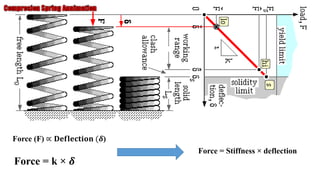
• A linear elastic spring is a mechanical device capable of supporting axial loading only and constructed such
that, over a reasonable operating range (meaning extension or compression beyond undeformed length), the
elongation or contraction of the spring is directly proportional to the applied axial load.
• The constant of proportionality between deformation and load is referred to as the spring constant, spring
rate, or spring stiffness, generally denoted as k, and has units of force per unit length.
3.
Force (F) ∝𝐃𝐞𝐟𝐥𝐞𝐜𝐭𝐢𝐨𝐧 (𝜹)
Force = k × 𝜹
Force = Stiffness × deflection
4.
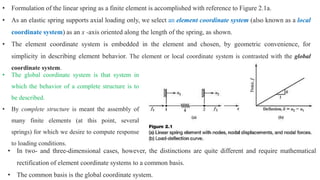
• Formulation ofthe linear spring as a finite element is accomplished with reference to Figure 2.1a.
• As an elastic spring supports axial loading only, we select an element coordinate system (also known as a local
coordinate system) as an x -axis oriented along the length of the spring, as shown.
• The element coordinate system is embedded in the element and chosen, by geometric convenience, for
simplicity in describing element behavior. The element or local coordinate system is contrasted with the global
coordinate system.
• The global coordinate system is that system in
which the behavior of a complete structure is to
be described.
• By complete structure is meant the assembly of
many finite elements (at this point, several
springs) for which we desire to compute response
to loading conditions.
• In two- and three-dimensional cases, however, the distinctions are quite different and require mathematical
rectification of element coordinate systems to a common basis.
• The common basis is the global coordinate system.
5.
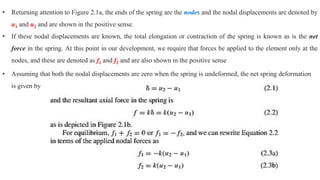
• Returning attentionto Figure 2.1a, the ends of the spring are the nodes and the nodal displacements are denoted by
u1 and u2 and are shown in the positive sense.
• If these nodal displacements are known, the total elongation or contraction of the spring is known as is the net
force in the spring. At this point in our development, we require that forces be applied to the element only at the
nodes, and these are denoted as f1 and f2 and are also shown in the positive sense
• Assuming that both the nodal displacements are zero when the spring is undeformed, the net spring deformation
is given by
6.
which can beexpressed in matrix
form as
• [ke] is defined as the element stiffness matrix in the element coordinate system (or local system), {u} is the
column matrix (vector) of nodal displacements, and {f} is the column matrix (vector) of element nodal
forces.
• A general matrix is designated by brackets [ ] and a column matrix (vector) by braces { }.
• Equation 2.6 shows that the element stiffness matrix for the linear spring element is a 2 × 2 matrix.
• This corresponds to the fact that the element exhibits two nodal displacements and that the two displacements
are not independent (that is, the body is continuous and elastic).
• Furthermore, the matrix is symmetric.
7.
• A symmetricmatrix has off-diagonal terms such that kij = kji. Symmetry of the stiffness matrix is indicative of
the fact that the body is linearly elastic and each displacement is related to the other by the same physical
phenomenon.
• For example, if a force F (positive, tensile) is applied at node 2 with node 1 held fixed, the relative displacement
of the two nodes is the same as if the force is applied symmetrically (negative, tensile) at node 1 with node 2
fixed.
• As will be seen as more complicated structural elements are developed, this is a general result: An element
exhibiting N degrees of freedom has a corresponding N × N, symmetric stiffness matrix.
• Next consider solution of the system of equations represented by Equation 2.4.
• In general, the nodal forces are prescribed and the objective is to solve for the unknown nodal displacements.
Formally, the solution is represented by
where [ke]-1 is the inverse of the element stiffness matrix.
8.
SYSTEM ASSEMBLY INGLOBAL COORDINATES
• Derivation of the element stiffness matrix for a spring element was based on equilibrium conditions.
• The same procedure can be applied to a connected system of spring elements by writing the equilibrium
equation for each node.
• However, rather than drawing free-body diagrams of each node and formally writing the equilibrium equations,
the nodal equilibrium equations can be obtained more efficiently by considering the effect of each element
separately and adding the element force contribution to each nodal equation.
• The process is described as “assembly,” as we take individual stiffness components and “put them together”
to obtain the system equations.
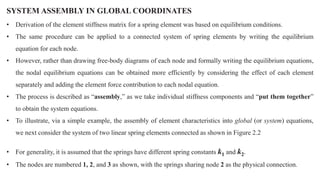
• To illustrate, via a simple example, the assembly of element characteristics into global (or system) equations,
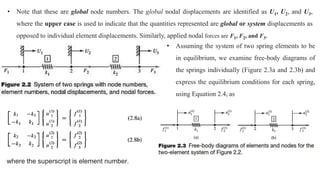
we next consider the system of two linear spring elements connected as shown in Figure 2.2
• For generality, it is assumed that the springs have different spring constants k1 and k2.
• The nodes are numbered 1, 2, and 3 as shown, with the springs sharing node 2 as the physical connection.
9.
• Note thatthese are global node numbers. The global nodal displacements are identified as U1, U2, and U3,
where the upper case is used to indicate that the quantities represented are global or system displacements as
opposed to individual element displacements. Similarly, applied nodal forces are F1, F2, and F3.
• Assuming the system of two spring elements to be
in equilibrium, we examine free-body diagrams of
the springs individually (Figure 2.3a and 2.3b) and
express the equilibrium conditions for each spring,
using Equation 2.4, as
where the superscript is element number.
10.
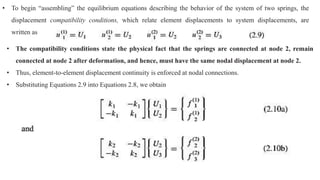
• To begin“assembling” the equilibrium equations describing the behavior of the system of two springs, the
displacement compatibility conditions, which relate element displacements to system displacements, are
written as
• The compatibility conditions state the physical fact that the springs are connected at node 2, remain
connected at node 2 after deformation, and hence, must have the same nodal displacement at node 2.
• Thus, element-to-element displacement continuity is enforced at nodal connections.
• Substituting Equations 2.9 into Equations 2.8, we obtain
11.
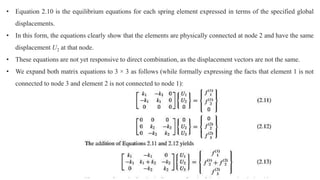
• Equation 2.10is the equilibrium equations for each spring element expressed in terms of the specified global
displacements.
• In this form, the equations clearly show that the elements are physically connected at node 2 and have the same
displacement U2 at that node.
• These equations are not yet responsive to direct combination, as the displacement vectors are not the same.
• We expand both matrix equations to 3 × 3 as follows (while formally expressing the facts that element 1 is not
connected to node 3 and element 2 is not connected to node 1):
12.
Next, we referto the free-body diagrams of each of the three nodes. The equilibrium conditions for nodes 1, 2, and
3 show that
Substituting into Equation 2.13, we obtain the final result:
which is of the form [K]{U} = {F}, similar to Equation 2.5.
However, Equation 2.15 represents the equations governing the system composed of two connected spring
elements. By direct consideration of the equilibrium conditions, we obtain the system stiffness matrix [K] (note
use of upper case) as
respectively.
13.
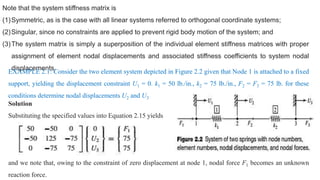
Note that thesystem stiffness matrix is
(1)Symmetric, as is the case with all linear systems referred to orthogonal coordinate systems;
(2)Singular, since no constraints are applied to prevent rigid body motion of the system; and
(3)The system matrix is simply a superposition of the individual element stiffness matrices with proper
assignment of element nodal displacements and associated stiffness coefficients to system nodal
displacements.
EXAMPLE 2.1: Consider the two element system depicted in Figure 2.2 given that Node 1 is attached to a fixed
support, yielding the displacement constraint U1 = 0. k1 = 50 lb./in., k2 = 75 lb./in., F2 = F3 = 75 lb. for these
conditions determine nodal displacements U2 and U3
Solution
Substituting the specified values into Equation 2.15 yields
and we note that, owing to the constraint of zero displacement at node 1, nodal force F1 becomes an unknown
reaction force.
14.
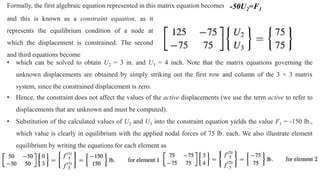
Formally, the firstalgebraic equation represented in this matrix equation becomes -50U2=F1
and this is known as a constraint equation, as it
represents the equilibrium condition of a node at
which the displacement is constrained. The second
and third equations become
• which can be solved to obtain U2 = 3 in. and U3 = 4 inch. Note that the matrix equations governing the
unknown displacements are obtained by simply striking out the first row and column of the 3 × 3 matrix
system, since the constrained displacement is zero.
• Hence, the constraint does not affect the values of the active displacements (we use the term active to refer to
displacements that are unknown and must be computed).
• Substitution of the calculated values of U2 and U3 into the constraint equation yields the value F1 = -150 lb.,
which value is clearly in equilibrium with the applied nodal forces of 75 lb. each. We also illustrate element
equilibrium by writing the equations for each element as
15.
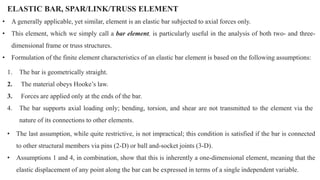
ELASTIC BAR, SPAR/LINK/TRUSSELEMENT
• A generally applicable, yet similar, element is an elastic bar subjected to axial forces only.
• This element, which we simply call a bar element, is particularly useful in the analysis of both two- and three-
dimensional frame or truss structures.
• Formulation of the finite element characteristics of an elastic bar element is based on the following assumptions:
1. The bar is geometrically straight.
2. The material obeys Hooke’s law.
3. Forces are applied only at the ends of the bar.
4. The bar supports axial loading only; bending, torsion, and shear are not transmitted to the element via the
nature of its connections to other elements.
• The last assumption, while quite restrictive, is not impractical; this condition is satisfied if the bar is connected
to other structural members via pins (2-D) or ball and-socket joints (3-D).
• Assumptions 1 and 4, in combination, show that this is inherently a one-dimensional element, meaning that the
elastic displacement of any point along the bar can be expressed in terms of a single independent variable.
16.
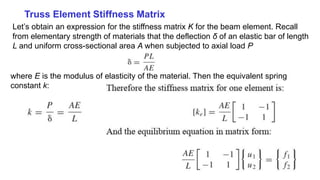
Truss Element StiffnessMatrix
Let’s obtain an expression for the stiffness matrix K for the beam element. Recall
from elementary strength of materials that the deflection δ of an elastic bar of length
L and uniform cross-sectional area A when subjected to axial load P
where E is the modulus of elasticity of the material. Then the equivalent spring
constant k:
17.
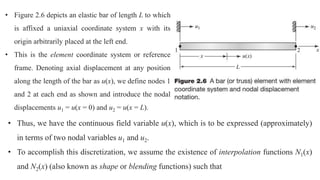
• Figure 2.6depicts an elastic bar of length L to which
is affixed a uniaxial coordinate system x with its
origin arbitrarily placed at the left end.
• This is the element coordinate system or reference
frame. Denoting axial displacement at any position
along the length of the bar as u(x), we define nodes 1
and 2 at each end as shown and introduce the nodal
displacements u1 = u(x = 0) and u2 = u(x = L).
• Thus, we have the continuous field variable u(x), which is to be expressed (approximately)
in terms of two nodal variables u1 and u2.
• To accomplish this discretization, we assume the existence of interpolation functions N1(x)
and N2(x) (also known as shape or blending functions) such that
18.
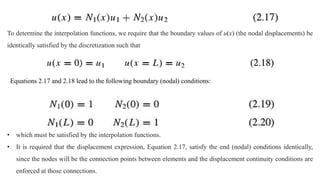
To determine theinterpolation functions, we require that the boundary values of u(x) (the nodal displacements) be
identically satisfied by the discretization such that
Equations 2.17 and 2.18 lead to the following boundary (nodal) conditions:
• which must be satisfied by the interpolation functions.
• It is required that the displacement expression, Equation 2.17, satisfy the end (nodal) conditions identically,
since the nodes will be the connection points between elements and the displacement continuity conditions are
enforced at those connections.
19.
As we havetwo conditions that must be satisfied by each of two one-dimensional functions, the simplest
forms for the interpolation functions are polynomial forms:
where the polynomial coefficients are to be determined via satisfaction of the boundary (nodal) conditions.
Application of conditions represented by Equation 2.19 yields a0 = 1, b0 = 0 while
Equation 2.20 results in a1 = -(1/L) and b1 = x/L . Therefore, the interpolation functions are
and the continuous displacement function is represented by the discretization
As will be found most convenient subsequently, Equation 2.25 can be expressed in matrix form as
where [N ] is the row matrix of interpolation functions and {u} is the column matrix (vector) of nodal
displacements.
20.
• Having expressedthe displacement field in terms of the nodal variables, the task remains to determine the
relation between the nodal displacements and applied forces to obtain the stiffness matrix for the bar element.
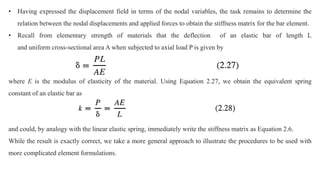
• Recall from elementary strength of materials that the deflection of an elastic bar of length L
and uniform cross-sectional area A when subjected to axial load P is given by
where E is the modulus of elasticity of the material. Using Equation 2.27, we obtain the equivalent spring
constant of an elastic bar as
and could, by analogy with the linear elastic spring, immediately write the stiffness matrix as Equation 2.6.
While the result is exactly correct, we take a more general approach to illustrate the procedures to be used with
more complicated element formulations.
21.
• Ultimately, wewish to compute the nodal displacements given some loading condition on the element.
• To obtain the necessary equilibrium equations relating the displacements to applied forces, we proceed from
displacement to strain, strain to stress, and stress to loading, as follows.
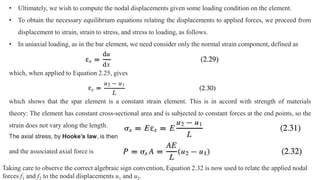
• In uniaxial loading, as in the bar element, we need consider only the normal strain component, defined as
which, when applied to Equation 2.25, gives
which shows that the spar element is a constant strain element. This is in accord with strength of materials
theory: The element has constant cross-sectional area and is subjected to constant forces at the end points, so the
strain does not vary along the length.
The axial stress, by Hooke’s law, is then
and the associated axial force is
Taking care to observe the correct algebraic sign convention, Equation 2.32 is now used to relate the applied nodal
forces f1 and f2 to the nodal displacements u1 and u2.
22.
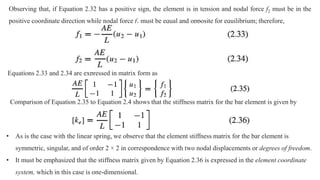
Observing that, ifEquation 2.32 has a positive sign, the element is in tension and nodal force f2 must be in the
positive coordinate direction while nodal force f1 must be equal and opposite for equilibrium; therefore,
Equations 2.33 and 2.34 are expressed in matrix form as
Comparison of Equation 2.35 to Equation 2.4 shows that the stiffness matrix for the bar element is given by
• As is the case with the linear spring, we observe that the element stiffness matrix for the bar element is
symmetric, singular, and of order 2 × 2 in correspondence with two nodal displacements or degrees of freedom.
• It must be emphasized that the stiffness matrix given by Equation 2.36 is expressed in the element coordinate
system, which in this case is one-dimensional.
23.
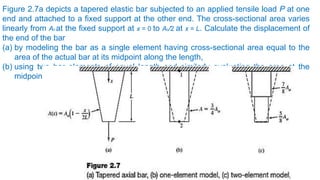
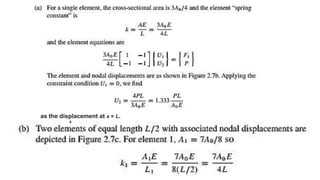
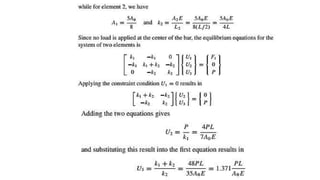
Figure 2.7a depictsa tapered elastic bar subjected to an applied tensile load P at one
end and attached to a fixed support at the other end. The cross-sectional area varies
linearly from A0 at the fixed support at x = 0 to A0/2 at x = L. Calculate the displacement of
the end of the bar
(a) by modeling the bar as a single element having cross-sectional area equal to the
area of the actual bar at its midpoint along the length,
(b) using two bar elements of equal length and similarly evaluating the area at the
midpoint of each.