ME 2353 – FINITE ELEMENT ANALYSIS 
P. A. COLLEGE OF ENGINEERING AND TECHNOLOGY 
Page 1 of 11 
(Affiliated to Anna University, Chennai and Approved by AICTE - New Delhi) 
(An ISO 9001 : 2008 Certified Institution) 
PALLADAM ROAD, POLLACHI - 642 002 
DEPARTMENT OF MECHANICAL ENGINEERING 
ME 2353 
FINITE ELEMENT ANALYSIS 
TWO MARK QUESTIONS WITH ANSWERS 
ACADEMIC YEAR 2013 - 2014 
Prepared By 
M.JAYARAJ, M.E., 
Assistant Professor, 
Department of Mechanical Engineering.
ME 2353 – FINITE ELEMENT ANALYSIS 
Page 2 of 11 
UNIT I 
FINITE ELEMENT FORMULATION OF BOUNDARY VALUE 
1.Name the variational methods. 
1. Ritz method 
2. Rayleigh –Ritz method 
2. Name the weighted residual methods. 
1. Point collocation method 
2. Sub-domain collocation method 
3. Least squares method 
4. Galerkin’s method. 
3. What is Raleigh – Ritz method? 
Rayleigh-Ritz method is an integral method which is useful for solving complex 
structural problems, encountered in finite element analysis. This method is possible only 
if a suitable functional is available. 
4.What is meant by discretization and assembly? 
The art of sub dividing the structure into a convenient number of smaller components 
is known as discretisation. 
The smaller components are put together and this process of combining all the 
elements together is known as assemblage. 
5. What is aspects ratio? 
Aspect ratio is the ratio of the largest dimension of the element to the smallest 
dimension of the element. In many cases, if the aspect ratio increases the inaccuracy of the 
solution increases. The aspect ratio should be close to unity as for as possible. 
6. What is meant by finite element analysis? 
Finite element methods is a numerical method for solving problems of engineering 
and mathematical physics. 
In this method, instead of solving the problem for the entire body in one operation, we 
formulate equations for each element and combine them to obtain the solution for the 
whole body. 
7.What are the types of boundary condition? 
There are two types of boundary condition. They are: 
1. Primary boundary condition 
2. Secondary boundary condition 
8.What are the methods generally associated with the finite element analysis? 
Force method and Displacement or stiffness method are the two methods. 
9.Expalin force method. 
In force method, internal forces are considered as unknowns of the problem. In 
displacement or stiffness method, the displacements are considered as unknowns of the 
problem. Among the two methods , displacement method is desirable.
ME 2353 – FINITE ELEMENT ANALYSIS 
10.Why polynomial type of interpolation functions are mostly used due to the following 
Page 3 of 11 
reasons: 
1. It is easy to formulate and computerize the finite element equations 
2. It is easy to perform differentiation or integration 
3. The accuracy of the results can be improved by increasing the order of the 
polynomial. 
11. What are ‘h’ and ‘p’ versions of finite element method? 
In ‘h’ version, the order of the polynomial approximation for all elements is kept 
constant and the number of elements increased. 
In ‘p’ version the number of elements is maintained constant and the order of 
polynomial approximation of element is increased. 
12. Name any four FEA software’s. 
1. ANSYS 
2.NASTRAN 
3. COSMOS 
4. NISA 
13. Differentiate between global and local axes. 
Local axes are established in an element, they change with change in orientation of 
the element. The direction differs from element to element. 
Global axes are defined for the entire system. They have the same direction for all the 
elements even though the elements are differently oriented. 
UNIT II 
ONE DIMENSIONAL FINITE ELEMENT ANALYSIS 
1. What are the types loading acting on a structure? 
There are three type of loading acting on a structure. They are, 
1. Body force (f) 
2. Traction force (T) 
3. Point load (P) 
2. Define body force. 
A body force is distributed force acting on every elemental volume of the body. 
Unit: force per unit volume 
3. Define traction force. 
Traction force is defined as distributed force acting on the surface of the body. 
Unit: Force per unit area 
Examples: Frictional resistance, viscous 
4. What is a point load? 
Point load is load acting at a particular point which causes displacement. 
5. What are the basic steps involved in the finite element modeling. 
Finite element modeling consists of the following: 
1. Discretisation of the structure
ME 2353 – FINITE ELEMENT ANALYSIS 
Page 4 of 11 
2. Numbering of the nodes. 
6. What are the classifications of the co-ordinates? 
The co-ordinates are generally classified as , 
1. Global co-coordinates 
2. Local Co-ordinates 
3. Natural co-ordinates 
7. What is natural co-ordinates? 
A natural co-ordinate system is used to define any point inside the element by a set of 
dimensionless numbers, whose magnitude never exceeds unity. This system is useful in 
assembling of stiffness matrices. 
8. Define shape function. 
In finite element method, field variables within an element are generally expressed by 
the following approximate relation: 
 (x,y) = N1(x,y) 1+N2 (x,y) 2+ N3(x,y) 3 where 1 2 3 4 are the values of 
the field variable at the nodes and N1 N2 N3 N4 are interpolation function. N1 N2 N3 
N4 are called shape functions because they are used to express the geometry or shape of the 
element. 
9. What are the characteristics of shape function? 
The characteristics of the shape functions are follows: 
1. The shape function has unit value at one nodal point and zero value at the 
other nodes. 
2. The sum of the shape function is equal to one. 
10. Why polynomials are generally used as shape function? 
Polynomials are generally used as shape functions due to the following reasons: 
1. Differentiation and integration of polynomials are quite easy. 
2. The accuracy of the results can be improved by increasing the order of the 
polynomial. 
3. It is easy to formulate and computerize the finite element equations. 
11. Give the expression for element stiffness matrix. 
Stiffness matrix [K] = [ B]T [D ][ D] dv 
Where, [B] matrix is a strain displacement matrix 
[D] matrix is stress, strain relationship matrix 
12. Write down the expression of stiffness matrix for one dimensional element bar element. 
AE 1 1 
Stiffness matrix [K] = 
l 1 1 
Where, 
A is the area of the bar element 
E is the young’s modulus of the bar element 
L is the length of the bar element
ME 2353 – FINITE ELEMENT ANALYSIS 
Page 5 of 11 
13. State the properties of a stiffness matrix. 
The properties of the stiffness matrix [K] are, 
1. It is a symmetric matrix 
2. The sum of the elements in any column must be equal to zero. 
3. It i s an unstable element, so the determinant is equal to zero. 
14. Write down the general finite element equation. 
General finite element equation is, 
{F}=[K]{u} 
Where, {F} is a force vector 
[K] is the stiffness matrix {u} is the 
degrees of freedom 
15. state the assumptions made in the case of truss element. 
The following assumptions are made in the case of truss element, 
1. All the members are pin jointed. 
2. The truss is loaded only at the joints 
3. The self weight of the members are neglected unless stated. 
16. Write down the expression of stiffness matrix for a truss element 
Where, A is the area 
E is the young’s modulus 
Le is the length of the elment 
L,m are direction cosines 
17. Write down the expression of shape function N and displacement u for one 
dimensional bar element. 
For on dimensional bar element, 
Displacement function, u = N1 u1 + N2 u 2 
Where, Shape function N1=l-x/l 
N2=x/l 
18. State the principle of minimum potential energy. 
The total potential energy of an elastic body is defined as the sum of total strain 
energy 
U and the potential energy of the external forces, (W)
ME 2353 – FINITE ELEMENT ANALYSIS 
19. Distinguish between essential boundary condition and natural boundary condition. 
There are two type of boundary conditions. They are, 
Page 6 of 11 
1. Primary boundary condition (or) essential boundary condition: 
The boundary condition which in terms of the field variables is known as primary 
boundary condition 
2. Secondary boundary condition or natural boundary condition: 
The boundary conditions which are in the differential form of field variables is known as 
secondary boundary condition. 
20. What are the difference between boundary value problem and initial value problem? 
The solution of differential equation obtained for physical problems which satisfies 
some specified conditions known as boundary conditions. 
If the solution of differential equation is obtained together with initial conditions then 
it is known as initial value problem. 
If the solution of differential equation is obtained together with boundary conditions 
thenit is known as boundary value problem. 
UNIT III 
TWO DIMENSIONAL FINITE ELEMENT ANALYSIS 
1. What is a CST element? 
Three nodded triangular element is known as constant strain triangular elelment. It 
has 6 unknown degrees of freedom called u1, v1, u2, v2, u3, v3. The element is called CST 
because it has constant strain throughout it. 
2. What is LST element? 
Six nodded triangular element is known as Linear Strain Triangular element. It has 
12 unknown displacement degrees of freedom. The displacement function for the element 
are quadratic instead of linear as in the CST. 
3. What is a QST element? 
Ten nodded triangular element is known as Quadratic Strain Triangle. 
4. What is meant by plane stress analysis? 
Plane stress is defined as a state of stress in which the normal stress (ϭ) and the 
shear stress ( ) directed perpendicular to the plane are zero. 
5. Define plane strain. 
Plane strain is defined to be a state of strain in which the strain normal to the xy 
plane and the shear strains are assumed to be zero. 
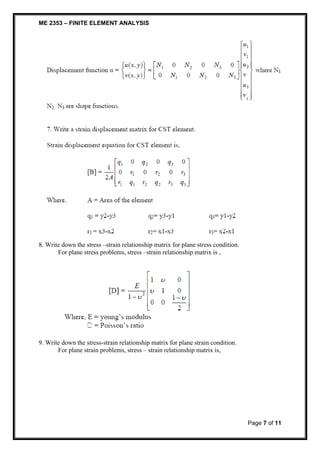
6. Write the displacement function for a CST element.
ME 2353 – FINITE ELEMENT ANALYSIS 
Page 7 of 11 
8. Write down the stress –strain relationship matrix for plane stress condition. 
For plane stress problems, stress –strain relationship matrix is , 
9. Write down the stress-strain relationship matrix for plane strain condition. 
For plane strain problems, stress – strain relationship matrix is,
ME 2353 – FINITE ELEMENT ANALYSIS 
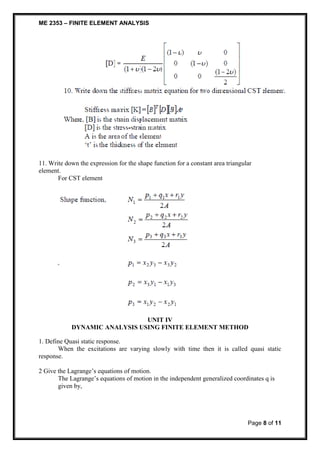
11. Write down the expression for the shape function for a constant area triangular 
element. 
Page 8 of 11 
For CST element 
UNIT IV 
DYNAMIC ANALYSIS USING FINITE ELEMENT METHOD 
1. Define Quasi static response. 
When the excitations are varying slowly with time then it is called quasi static 
response. 
2 Give the Lagrange’s equations of motion. 
The Lagrange’s equations of motion in the independent generalized coordinates q is 
given by,
ME 2353 – FINITE ELEMENT ANALYSIS 
Page 9 of 11 
3. What are the conditions for a problem to axi symmetric? 
1. The problem domain must be symmetric about the axis of rotation. 
2. All the boundary conditions must be symmetric about the axis of rotation. 
3. All loading conditions must be symmetric about the axis of rotation. 
3. What is HRZ Lumping scheme. 
The essential idea in this scheme is to simply use only diagonal elements of the 
consistent mass matrix but to scale them in such a way that total mass of the element is 
preserved. 
5. State the methods of solution to eigen value problems. 
There are essentially three groups of methods of solution of eigen value problems. 
i) Determinent based methods 
ii) Transformation based method 
iii) Vector iteration based method 
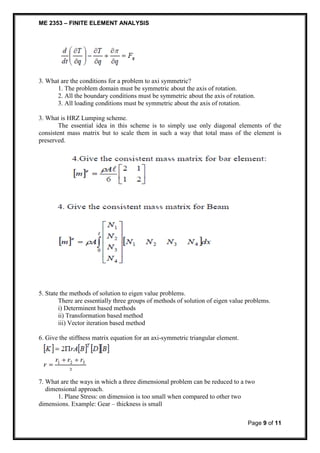
6. Give the stiffness matrix equation for an axi-symmetric triangular element. 
7. What are the ways in which a three dimensional problem can be reduced to a two 
dimensional approach. 
1. Plane Stress: on dimension is too small when compared to other two 
dimensions. Example: Gear – thickness is small
ME 2353 – FINITE ELEMENT ANALYSIS 
Page 10 of 11 
2. Plane Strain: one dimension is too large when compared to other two 
dimensions. Examples: Long Pipe (length is long compared to diameter) 
UNIT 5 
APPLICATIONS IN HEAT TRANSFER & FLUID 
MECHANICS 
1. What is the purpose of Iso parametric elements? 
It is difficult to represent the curved boundaries by straight edges finite elements. A 
largenumber of finite elements may be used to obtain reasonable resemblance between 
original body and assemblage. In order to overcome this drawback, iso parametric 
elements are used i.e for problems involving curved boundaries, a family of elements 
known as ‘iso parametric elements are used. 
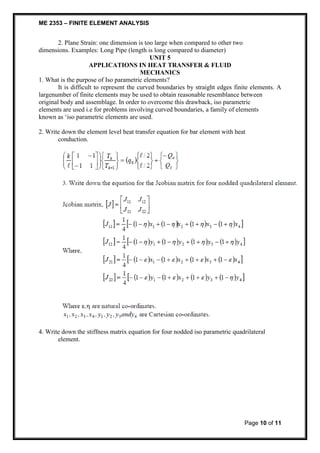
2. Write down the element level heat transfer equation for bar element with heat 
conduction. 
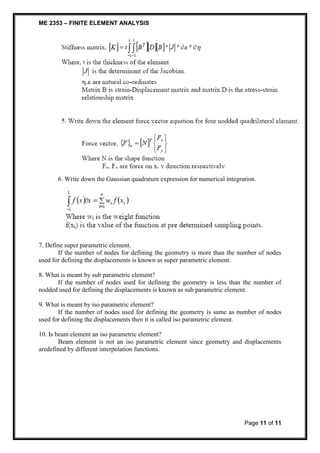
4. Write down the stiffness matrix equation for four nodded iso parametric quadrilateral 
element.
ME 2353 – FINITE ELEMENT ANALYSIS 
6. Write down the Gaussian quadrature expression for numerical integration. 
Page 11 of 11 
7. Define super parametric element. 
If the number of nodes for defining the geometry is more than the number of nodes 
used for defining the displacements is known as super parametric element. 
8. What is meant by sub parametric element? 
If the number of nodes used for defining the geometry is less than the number of 
nodded used for defining the displacements is known as sub parametric element. 
9. What is meant by iso parametric element? 
If the number of nodes used for defining the geometry is same as number of nodes 
used for defining the displacements then it is called iso parametric element. 
10. Is beam element an iso parametric element? 
Beam element is not an iso parametric element since geometry and displacements 
aredefined by different interpolation functions.

Fea 2 mark

  • 1.
    ME 2353 –FINITE ELEMENT ANALYSIS P. A. COLLEGE OF ENGINEERING AND TECHNOLOGY Page 1 of 11 (Affiliated to Anna University, Chennai and Approved by AICTE - New Delhi) (An ISO 9001 : 2008 Certified Institution) PALLADAM ROAD, POLLACHI - 642 002 DEPARTMENT OF MECHANICAL ENGINEERING ME 2353 FINITE ELEMENT ANALYSIS TWO MARK QUESTIONS WITH ANSWERS ACADEMIC YEAR 2013 - 2014 Prepared By M.JAYARAJ, M.E., Assistant Professor, Department of Mechanical Engineering.
  • 2.
    ME 2353 –FINITE ELEMENT ANALYSIS Page 2 of 11 UNIT I FINITE ELEMENT FORMULATION OF BOUNDARY VALUE 1.Name the variational methods. 1. Ritz method 2. Rayleigh –Ritz method 2. Name the weighted residual methods. 1. Point collocation method 2. Sub-domain collocation method 3. Least squares method 4. Galerkin’s method. 3. What is Raleigh – Ritz method? Rayleigh-Ritz method is an integral method which is useful for solving complex structural problems, encountered in finite element analysis. This method is possible only if a suitable functional is available. 4.What is meant by discretization and assembly? The art of sub dividing the structure into a convenient number of smaller components is known as discretisation. The smaller components are put together and this process of combining all the elements together is known as assemblage. 5. What is aspects ratio? Aspect ratio is the ratio of the largest dimension of the element to the smallest dimension of the element. In many cases, if the aspect ratio increases the inaccuracy of the solution increases. The aspect ratio should be close to unity as for as possible. 6. What is meant by finite element analysis? Finite element methods is a numerical method for solving problems of engineering and mathematical physics. In this method, instead of solving the problem for the entire body in one operation, we formulate equations for each element and combine them to obtain the solution for the whole body. 7.What are the types of boundary condition? There are two types of boundary condition. They are: 1. Primary boundary condition 2. Secondary boundary condition 8.What are the methods generally associated with the finite element analysis? Force method and Displacement or stiffness method are the two methods. 9.Expalin force method. In force method, internal forces are considered as unknowns of the problem. In displacement or stiffness method, the displacements are considered as unknowns of the problem. Among the two methods , displacement method is desirable.
  • 3.
    ME 2353 –FINITE ELEMENT ANALYSIS 10.Why polynomial type of interpolation functions are mostly used due to the following Page 3 of 11 reasons: 1. It is easy to formulate and computerize the finite element equations 2. It is easy to perform differentiation or integration 3. The accuracy of the results can be improved by increasing the order of the polynomial. 11. What are ‘h’ and ‘p’ versions of finite element method? In ‘h’ version, the order of the polynomial approximation for all elements is kept constant and the number of elements increased. In ‘p’ version the number of elements is maintained constant and the order of polynomial approximation of element is increased. 12. Name any four FEA software’s. 1. ANSYS 2.NASTRAN 3. COSMOS 4. NISA 13. Differentiate between global and local axes. Local axes are established in an element, they change with change in orientation of the element. The direction differs from element to element. Global axes are defined for the entire system. They have the same direction for all the elements even though the elements are differently oriented. UNIT II ONE DIMENSIONAL FINITE ELEMENT ANALYSIS 1. What are the types loading acting on a structure? There are three type of loading acting on a structure. They are, 1. Body force (f) 2. Traction force (T) 3. Point load (P) 2. Define body force. A body force is distributed force acting on every elemental volume of the body. Unit: force per unit volume 3. Define traction force. Traction force is defined as distributed force acting on the surface of the body. Unit: Force per unit area Examples: Frictional resistance, viscous 4. What is a point load? Point load is load acting at a particular point which causes displacement. 5. What are the basic steps involved in the finite element modeling. Finite element modeling consists of the following: 1. Discretisation of the structure
  • 4.
    ME 2353 –FINITE ELEMENT ANALYSIS Page 4 of 11 2. Numbering of the nodes. 6. What are the classifications of the co-ordinates? The co-ordinates are generally classified as , 1. Global co-coordinates 2. Local Co-ordinates 3. Natural co-ordinates 7. What is natural co-ordinates? A natural co-ordinate system is used to define any point inside the element by a set of dimensionless numbers, whose magnitude never exceeds unity. This system is useful in assembling of stiffness matrices. 8. Define shape function. In finite element method, field variables within an element are generally expressed by the following approximate relation:  (x,y) = N1(x,y) 1+N2 (x,y) 2+ N3(x,y) 3 where 1 2 3 4 are the values of the field variable at the nodes and N1 N2 N3 N4 are interpolation function. N1 N2 N3 N4 are called shape functions because they are used to express the geometry or shape of the element. 9. What are the characteristics of shape function? The characteristics of the shape functions are follows: 1. The shape function has unit value at one nodal point and zero value at the other nodes. 2. The sum of the shape function is equal to one. 10. Why polynomials are generally used as shape function? Polynomials are generally used as shape functions due to the following reasons: 1. Differentiation and integration of polynomials are quite easy. 2. The accuracy of the results can be improved by increasing the order of the polynomial. 3. It is easy to formulate and computerize the finite element equations. 11. Give the expression for element stiffness matrix. Stiffness matrix [K] = [ B]T [D ][ D] dv Where, [B] matrix is a strain displacement matrix [D] matrix is stress, strain relationship matrix 12. Write down the expression of stiffness matrix for one dimensional element bar element. AE 1 1 Stiffness matrix [K] = l 1 1 Where, A is the area of the bar element E is the young’s modulus of the bar element L is the length of the bar element
  • 5.
    ME 2353 –FINITE ELEMENT ANALYSIS Page 5 of 11 13. State the properties of a stiffness matrix. The properties of the stiffness matrix [K] are, 1. It is a symmetric matrix 2. The sum of the elements in any column must be equal to zero. 3. It i s an unstable element, so the determinant is equal to zero. 14. Write down the general finite element equation. General finite element equation is, {F}=[K]{u} Where, {F} is a force vector [K] is the stiffness matrix {u} is the degrees of freedom 15. state the assumptions made in the case of truss element. The following assumptions are made in the case of truss element, 1. All the members are pin jointed. 2. The truss is loaded only at the joints 3. The self weight of the members are neglected unless stated. 16. Write down the expression of stiffness matrix for a truss element Where, A is the area E is the young’s modulus Le is the length of the elment L,m are direction cosines 17. Write down the expression of shape function N and displacement u for one dimensional bar element. For on dimensional bar element, Displacement function, u = N1 u1 + N2 u 2 Where, Shape function N1=l-x/l N2=x/l 18. State the principle of minimum potential energy. The total potential energy of an elastic body is defined as the sum of total strain energy U and the potential energy of the external forces, (W)
  • 6.
    ME 2353 –FINITE ELEMENT ANALYSIS 19. Distinguish between essential boundary condition and natural boundary condition. There are two type of boundary conditions. They are, Page 6 of 11 1. Primary boundary condition (or) essential boundary condition: The boundary condition which in terms of the field variables is known as primary boundary condition 2. Secondary boundary condition or natural boundary condition: The boundary conditions which are in the differential form of field variables is known as secondary boundary condition. 20. What are the difference between boundary value problem and initial value problem? The solution of differential equation obtained for physical problems which satisfies some specified conditions known as boundary conditions. If the solution of differential equation is obtained together with initial conditions then it is known as initial value problem. If the solution of differential equation is obtained together with boundary conditions thenit is known as boundary value problem. UNIT III TWO DIMENSIONAL FINITE ELEMENT ANALYSIS 1. What is a CST element? Three nodded triangular element is known as constant strain triangular elelment. It has 6 unknown degrees of freedom called u1, v1, u2, v2, u3, v3. The element is called CST because it has constant strain throughout it. 2. What is LST element? Six nodded triangular element is known as Linear Strain Triangular element. It has 12 unknown displacement degrees of freedom. The displacement function for the element are quadratic instead of linear as in the CST. 3. What is a QST element? Ten nodded triangular element is known as Quadratic Strain Triangle. 4. What is meant by plane stress analysis? Plane stress is defined as a state of stress in which the normal stress (ϭ) and the shear stress ( ) directed perpendicular to the plane are zero. 5. Define plane strain. Plane strain is defined to be a state of strain in which the strain normal to the xy plane and the shear strains are assumed to be zero. 6. Write the displacement function for a CST element.
  • 7.
    ME 2353 –FINITE ELEMENT ANALYSIS Page 7 of 11 8. Write down the stress –strain relationship matrix for plane stress condition. For plane stress problems, stress –strain relationship matrix is , 9. Write down the stress-strain relationship matrix for plane strain condition. For plane strain problems, stress – strain relationship matrix is,
  • 8.
    ME 2353 –FINITE ELEMENT ANALYSIS 11. Write down the expression for the shape function for a constant area triangular element. Page 8 of 11 For CST element UNIT IV DYNAMIC ANALYSIS USING FINITE ELEMENT METHOD 1. Define Quasi static response. When the excitations are varying slowly with time then it is called quasi static response. 2 Give the Lagrange’s equations of motion. The Lagrange’s equations of motion in the independent generalized coordinates q is given by,
  • 9.
    ME 2353 –FINITE ELEMENT ANALYSIS Page 9 of 11 3. What are the conditions for a problem to axi symmetric? 1. The problem domain must be symmetric about the axis of rotation. 2. All the boundary conditions must be symmetric about the axis of rotation. 3. All loading conditions must be symmetric about the axis of rotation. 3. What is HRZ Lumping scheme. The essential idea in this scheme is to simply use only diagonal elements of the consistent mass matrix but to scale them in such a way that total mass of the element is preserved. 5. State the methods of solution to eigen value problems. There are essentially three groups of methods of solution of eigen value problems. i) Determinent based methods ii) Transformation based method iii) Vector iteration based method 6. Give the stiffness matrix equation for an axi-symmetric triangular element. 7. What are the ways in which a three dimensional problem can be reduced to a two dimensional approach. 1. Plane Stress: on dimension is too small when compared to other two dimensions. Example: Gear – thickness is small
  • 10.
    ME 2353 –FINITE ELEMENT ANALYSIS Page 10 of 11 2. Plane Strain: one dimension is too large when compared to other two dimensions. Examples: Long Pipe (length is long compared to diameter) UNIT 5 APPLICATIONS IN HEAT TRANSFER & FLUID MECHANICS 1. What is the purpose of Iso parametric elements? It is difficult to represent the curved boundaries by straight edges finite elements. A largenumber of finite elements may be used to obtain reasonable resemblance between original body and assemblage. In order to overcome this drawback, iso parametric elements are used i.e for problems involving curved boundaries, a family of elements known as ‘iso parametric elements are used. 2. Write down the element level heat transfer equation for bar element with heat conduction. 4. Write down the stiffness matrix equation for four nodded iso parametric quadrilateral element.
  • 11.
    ME 2353 –FINITE ELEMENT ANALYSIS 6. Write down the Gaussian quadrature expression for numerical integration. Page 11 of 11 7. Define super parametric element. If the number of nodes for defining the geometry is more than the number of nodes used for defining the displacements is known as super parametric element. 8. What is meant by sub parametric element? If the number of nodes used for defining the geometry is less than the number of nodded used for defining the displacements is known as sub parametric element. 9. What is meant by iso parametric element? If the number of nodes used for defining the geometry is same as number of nodes used for defining the displacements then it is called iso parametric element. 10. Is beam element an iso parametric element? Beam element is not an iso parametric element since geometry and displacements aredefined by different interpolation functions.