Lecture 1:Introduction to FEA
School of Mechanical Engineering
Basic Concepts1
Content
Review of Matrix Algebra2
Spring Element3
Spring System4
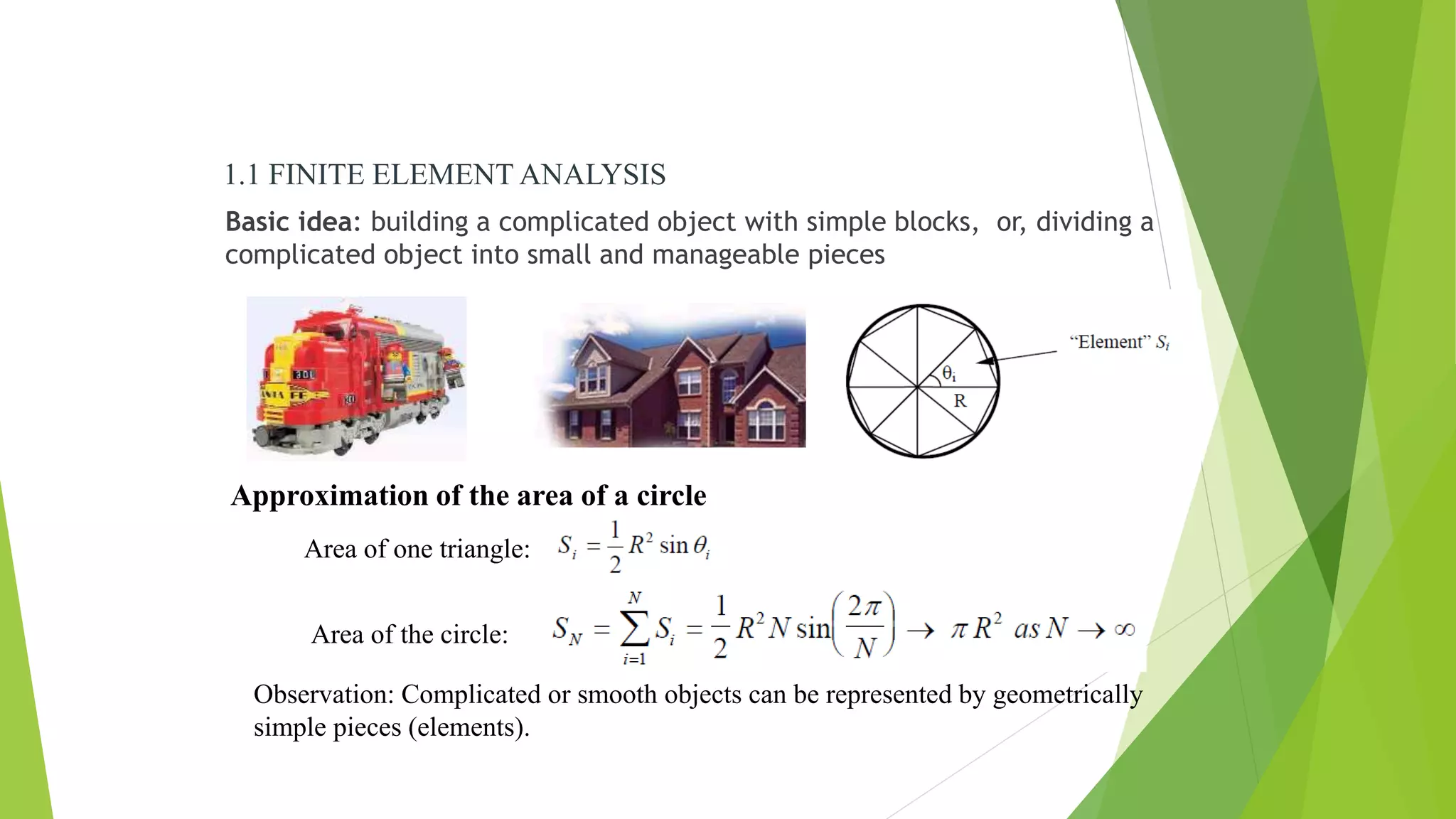
Basic idea: building a complicated object with simple blocks, or, dividing a
complicated object into small and manageable pieces
Approximation of the area of a circle
Area of one triangle:
Area of the circle:
Observation: Complicated or smooth objects can be represented by geometrically
simple pieces (elements).
1.1 FINITE ELEMENT ANALYSIS
What is FEA?
 FEA is a method for numerical solution of field problems;
 A field problem requires that we determine the spatial distribution of one or
more dependent variables;
 FEA provides an approximate solution
 Individual finite elements can be visualized as small pieces of a structure
 In each element a field quantity has a simple spatial variation, described
by polynomial terms.
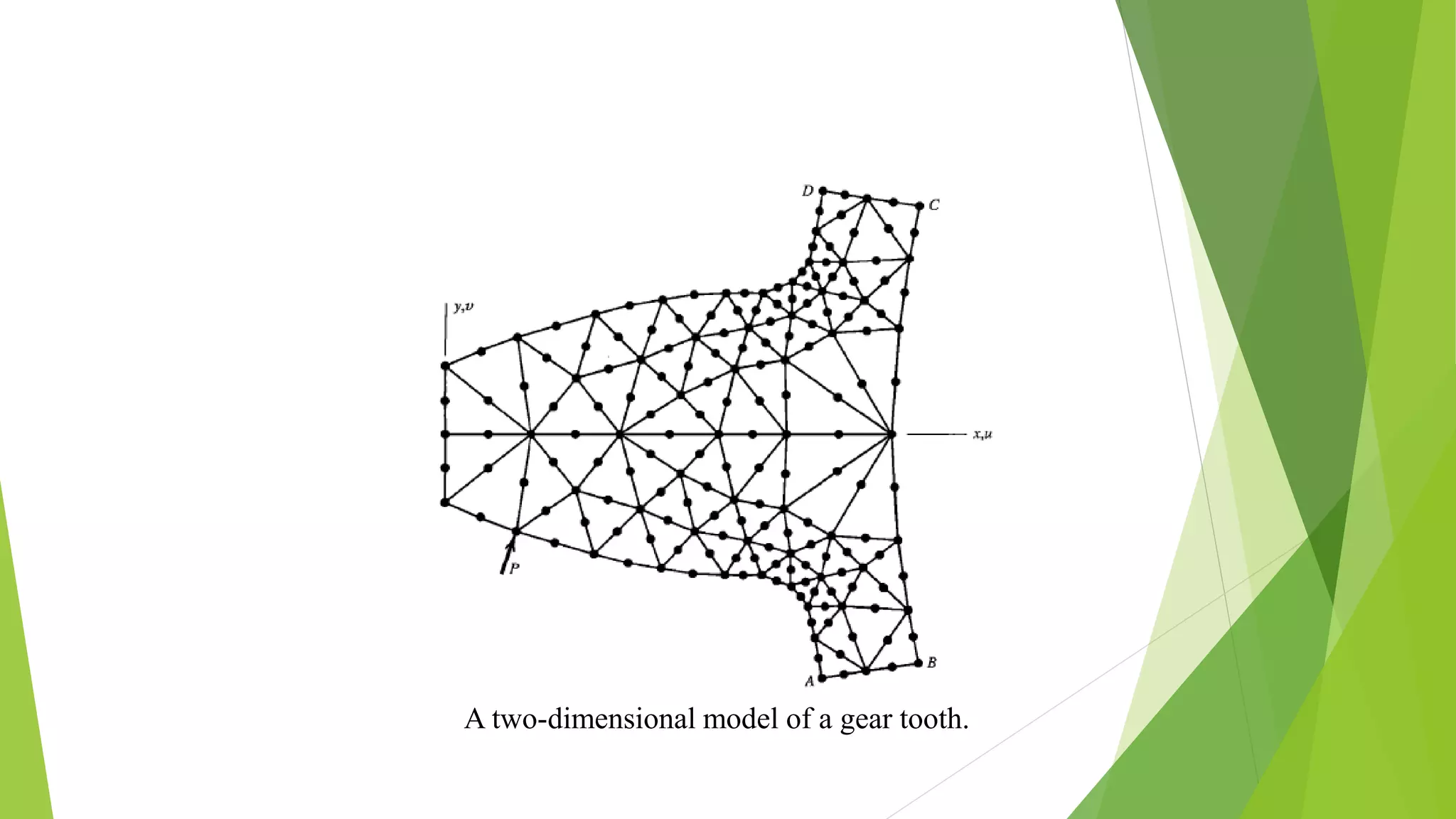
 Elements are connected at points called nodes
 The assemblage of elements is called a finite element structure
 The particular arrangement of elements is called a mesh
 Nodal unknowns are values of the field quantity
 The solution for nodal quantities completely determines the spatial
variation of the field in that element
 The field quantity over the entire structure is approximated element by
element, in piecewise fashion.
A two-dimensional model of a gear tooth.
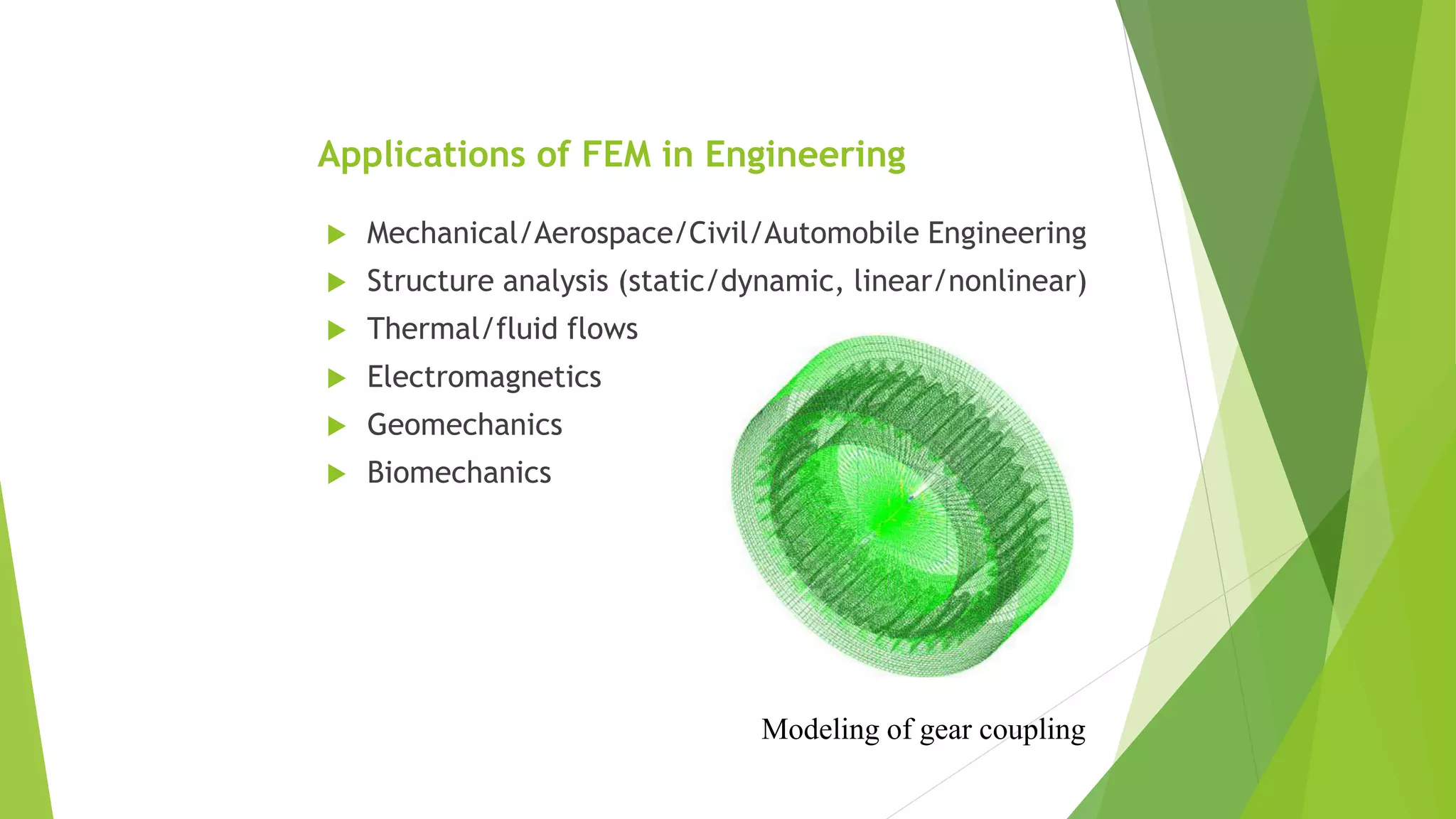
Applications of FEM in Engineering
 Mechanical/Aerospace/Civil/Automobile Engineering
 Structure analysis (static/dynamic, linear/nonlinear)
 Thermal/fluid flows
 Electromagnetics
 Geomechanics
 Biomechanics
Modeling of gear coupling
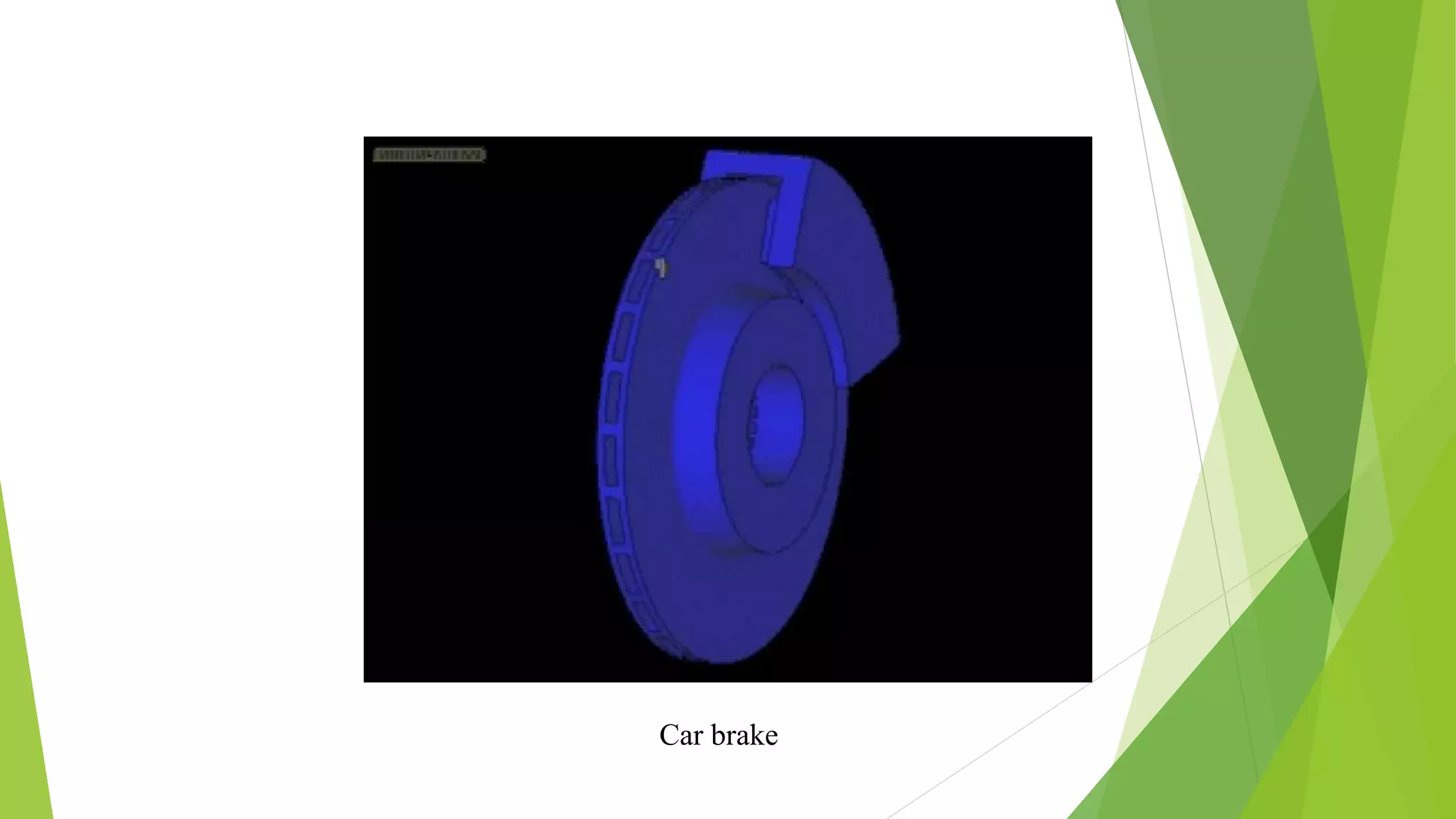
Car brake
Airbag
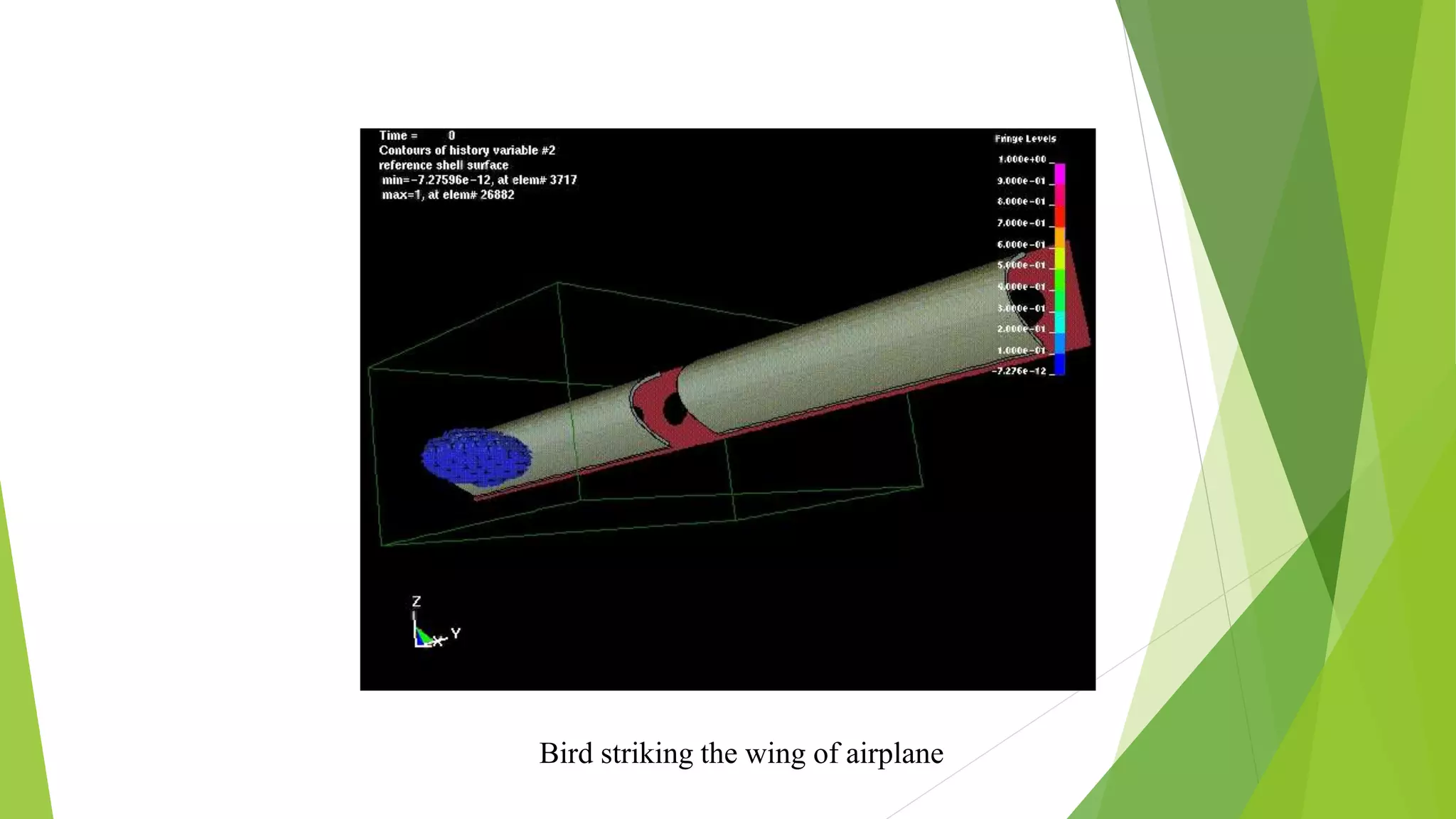
Bird striking the wing of airplane
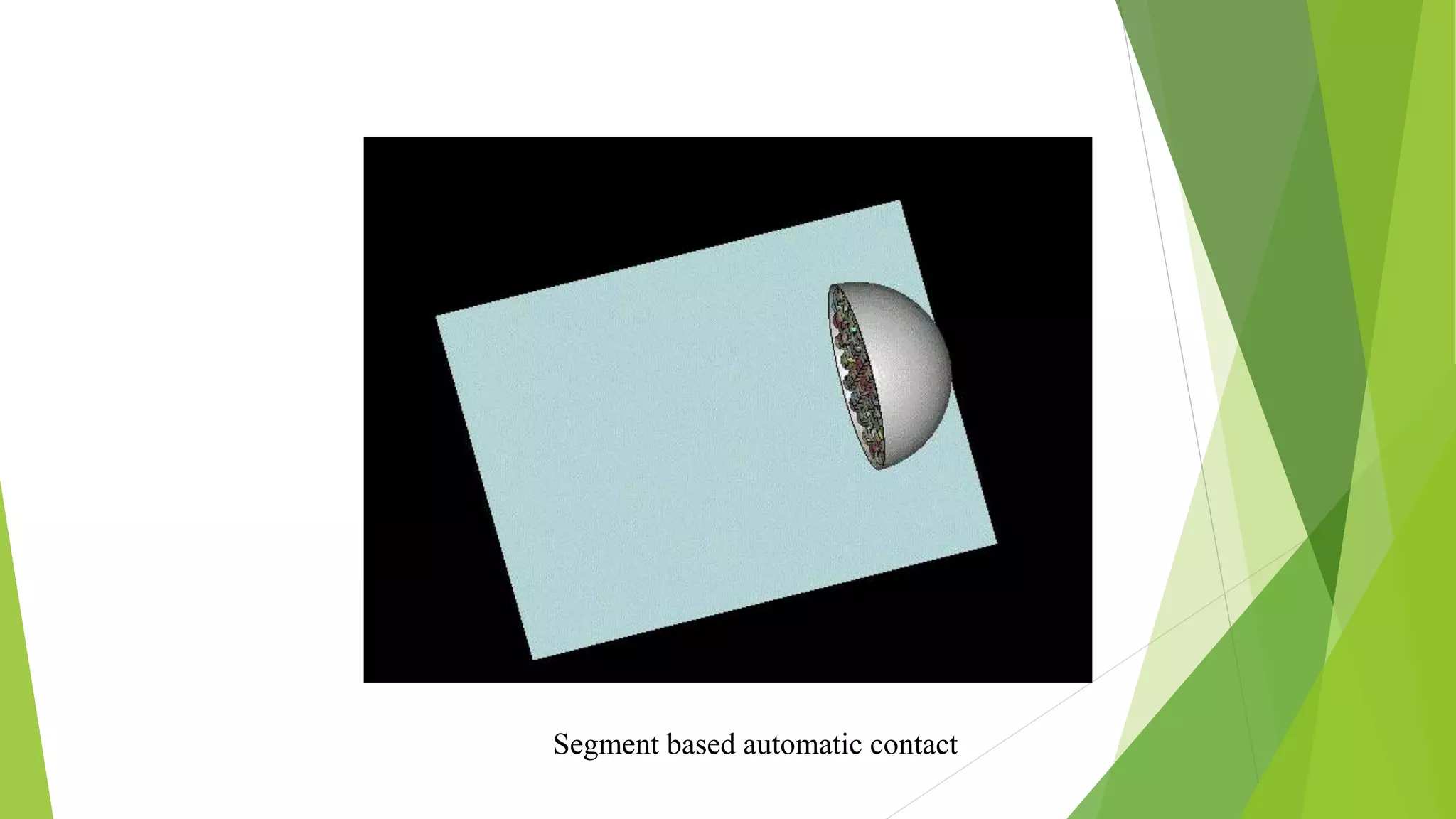
Segment based automatic contact
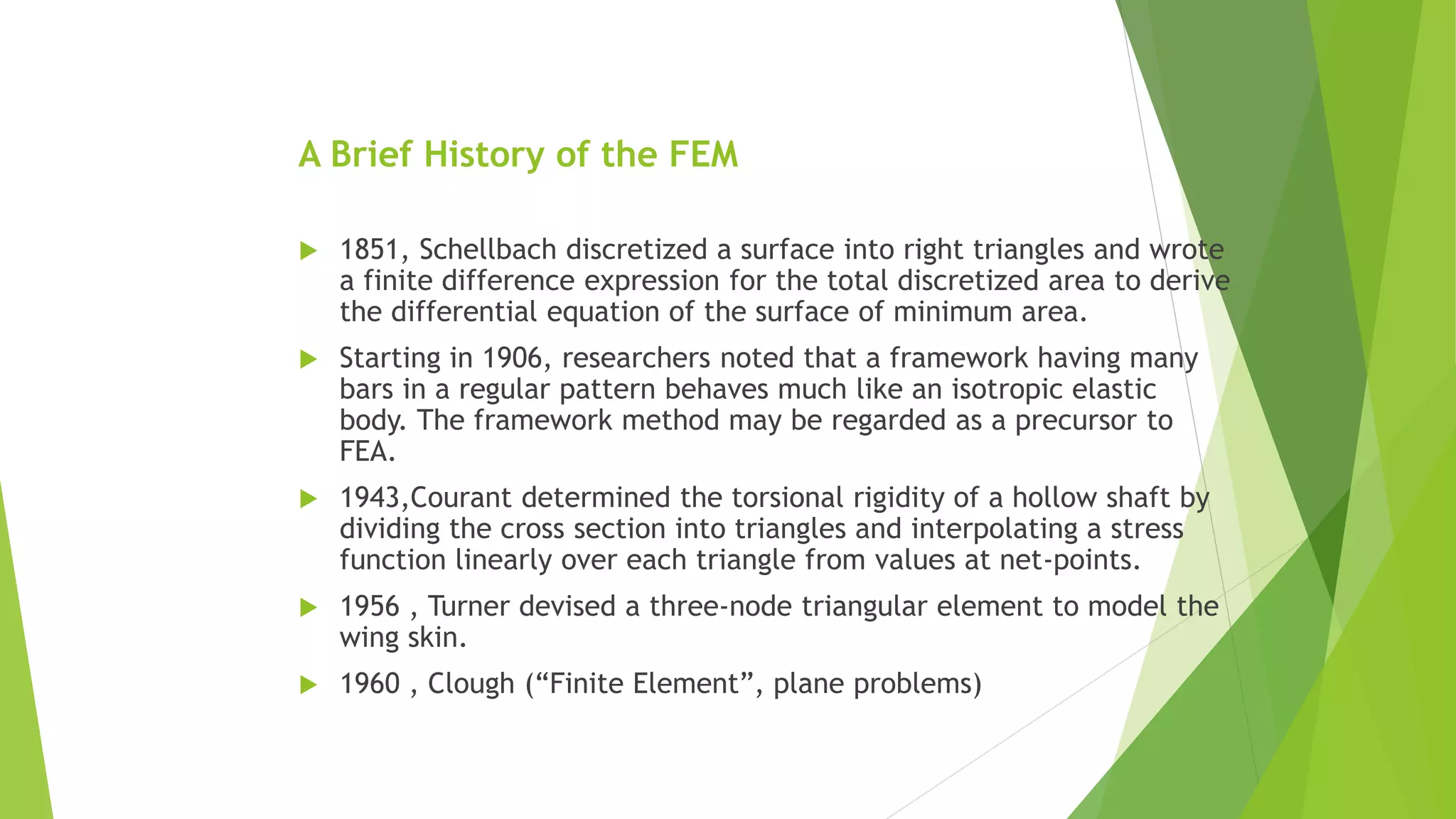
A Brief History of the FEM
 1851, Schellbach discretized a surface into right triangles and wrote
a finite difference expression for the total discretized area to derive
the differential equation of the surface of minimum area.
 Starting in 1906, researchers noted that a framework having many
bars in a regular pattern behaves much like an isotropic elastic
body. The framework method may be regarded as a precursor to
FEA.
 1943,Courant determined the torsional rigidity of a hollow shaft by
dividing the cross section into triangles and interpolating a stress
function linearly over each triangle from values at net-points.
 1956 , Turner devised a three-node triangular element to model the
wing skin.
 1960 , Clough (“Finite Element”, plane problems)
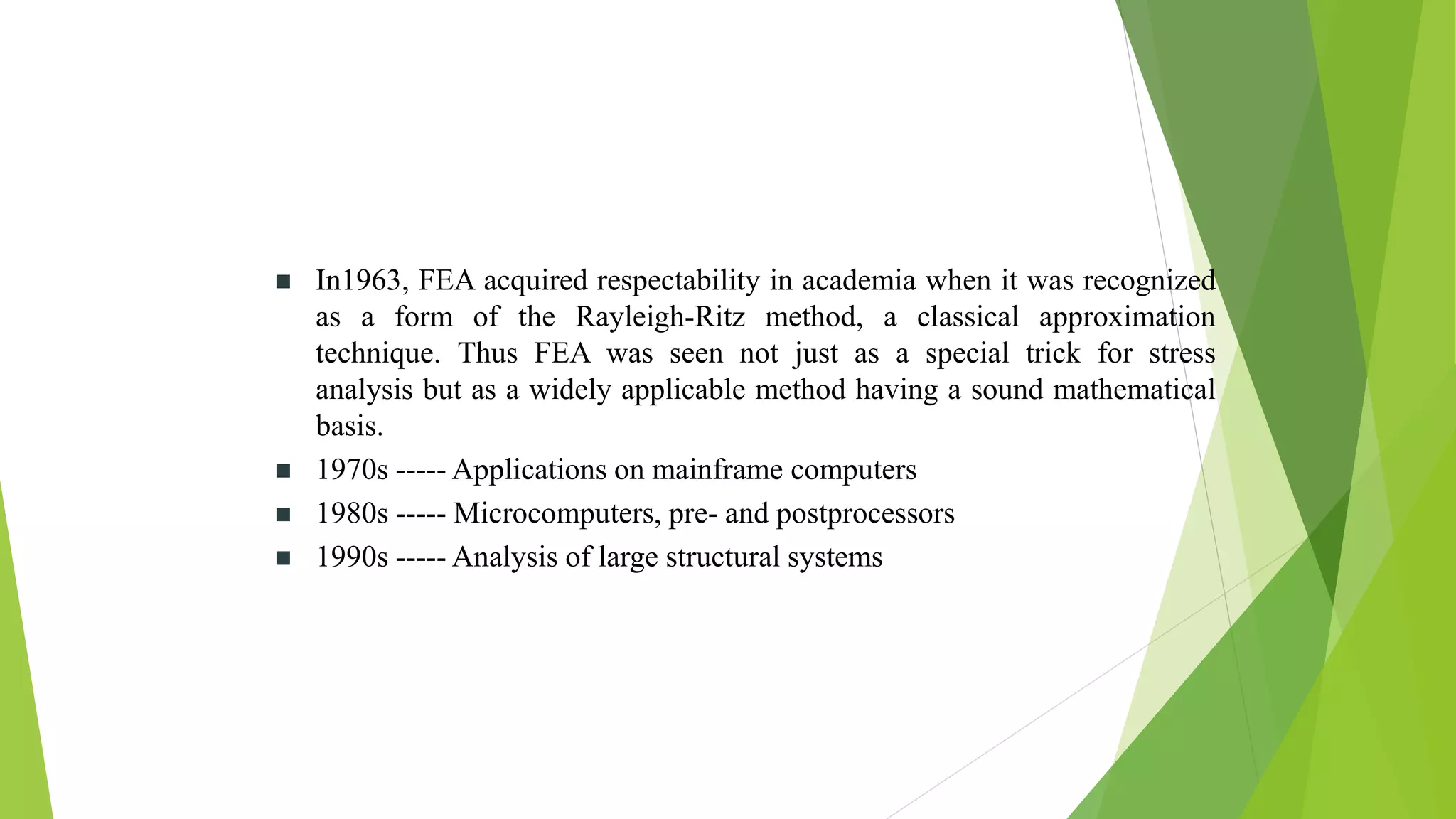
 In1963, FEA acquired respectability in academia when it was recognized
as a form of the Rayleigh-Ritz method, a classical approximation
technique. Thus FEA was seen not just as a special trick for stress
analysis but as a widely applicable method having a sound mathematical
basis.
 1970s ----- Applications on mainframe computers
 1980s ----- Microcomputers, pre- and postprocessors
 1990s ----- Analysis of large structural systems
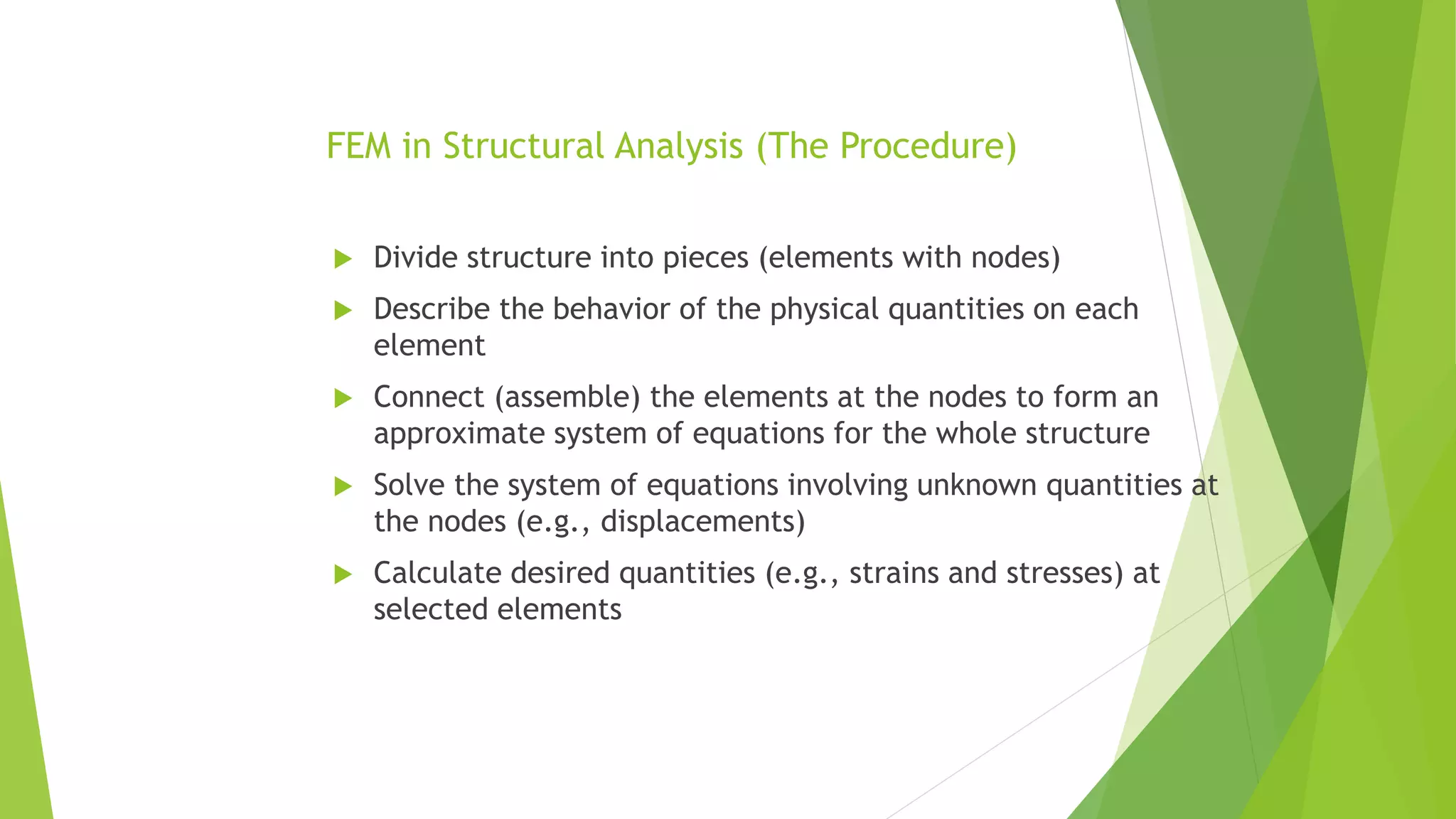
FEM in Structural Analysis (The Procedure)
 Divide structure into pieces (elements with nodes)
 Describe the behavior of the physical quantities on each
element
 Connect (assemble) the elements at the nodes to form an
approximate system of equations for the whole structure
 Solve the system of equations involving unknown quantities at
the nodes (e.g., displacements)
 Calculate desired quantities (e.g., strains and stresses) at
selected elements
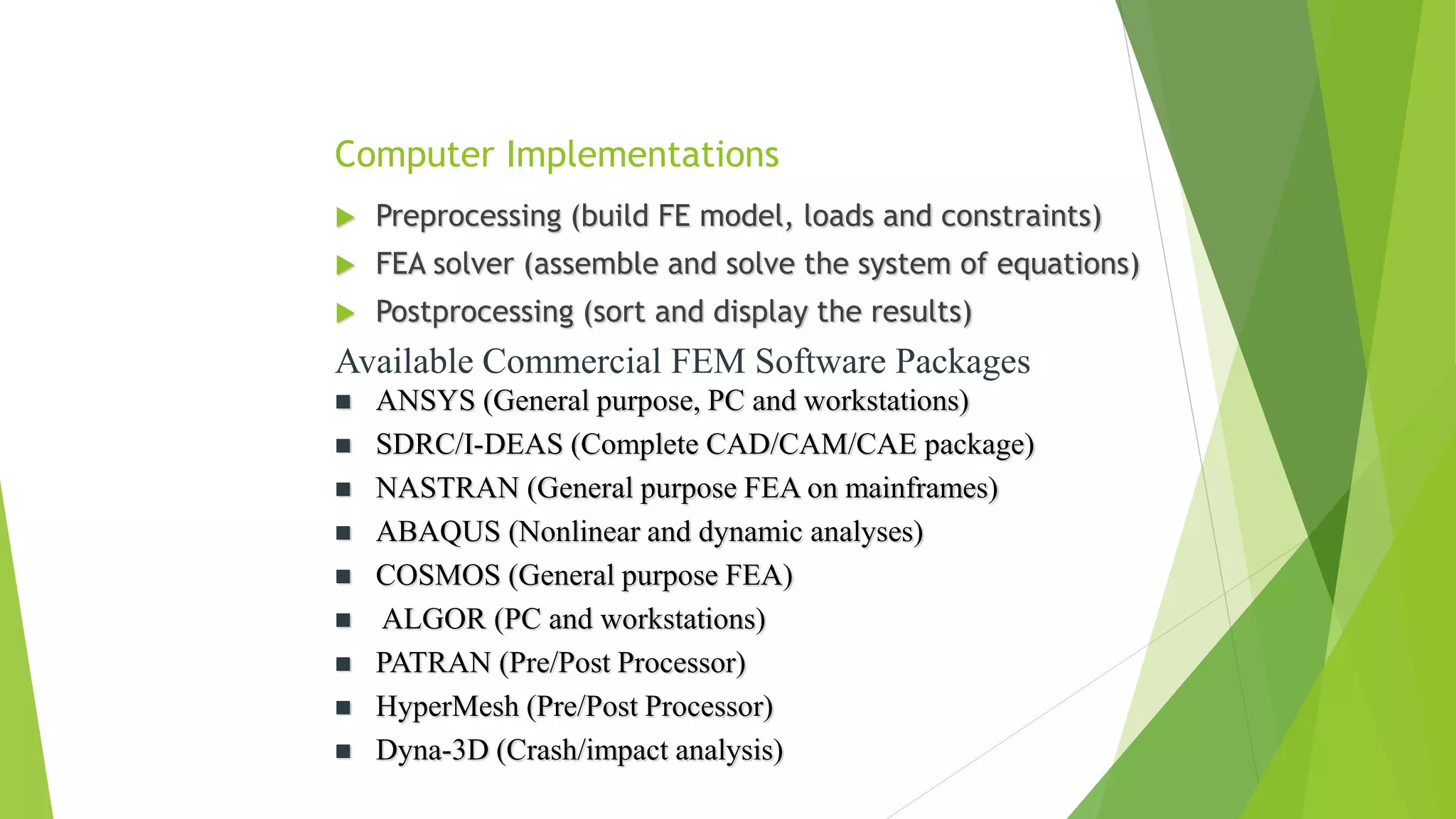
Computer Implementations
 Preprocessing (build FE model, loads and constraints)
 FEA solver (assemble and solve the system of equations)
 Postprocessing (sort and display the results)
Available Commercial FEM Software Packages
 ANSYS (General purpose, PC and workstations)
 SDRC/I-DEAS (Complete CAD/CAM/CAE package)
 NASTRAN (General purpose FEA on mainframes)
 ABAQUS (Nonlinear and dynamic analyses)
 COSMOS (General purpose FEA)
 ALGOR (PC and workstations)
 PATRAN (Pre/Post Processor)
 HyperMesh (Pre/Post Processor)
 Dyna-3D (Crash/impact analysis)
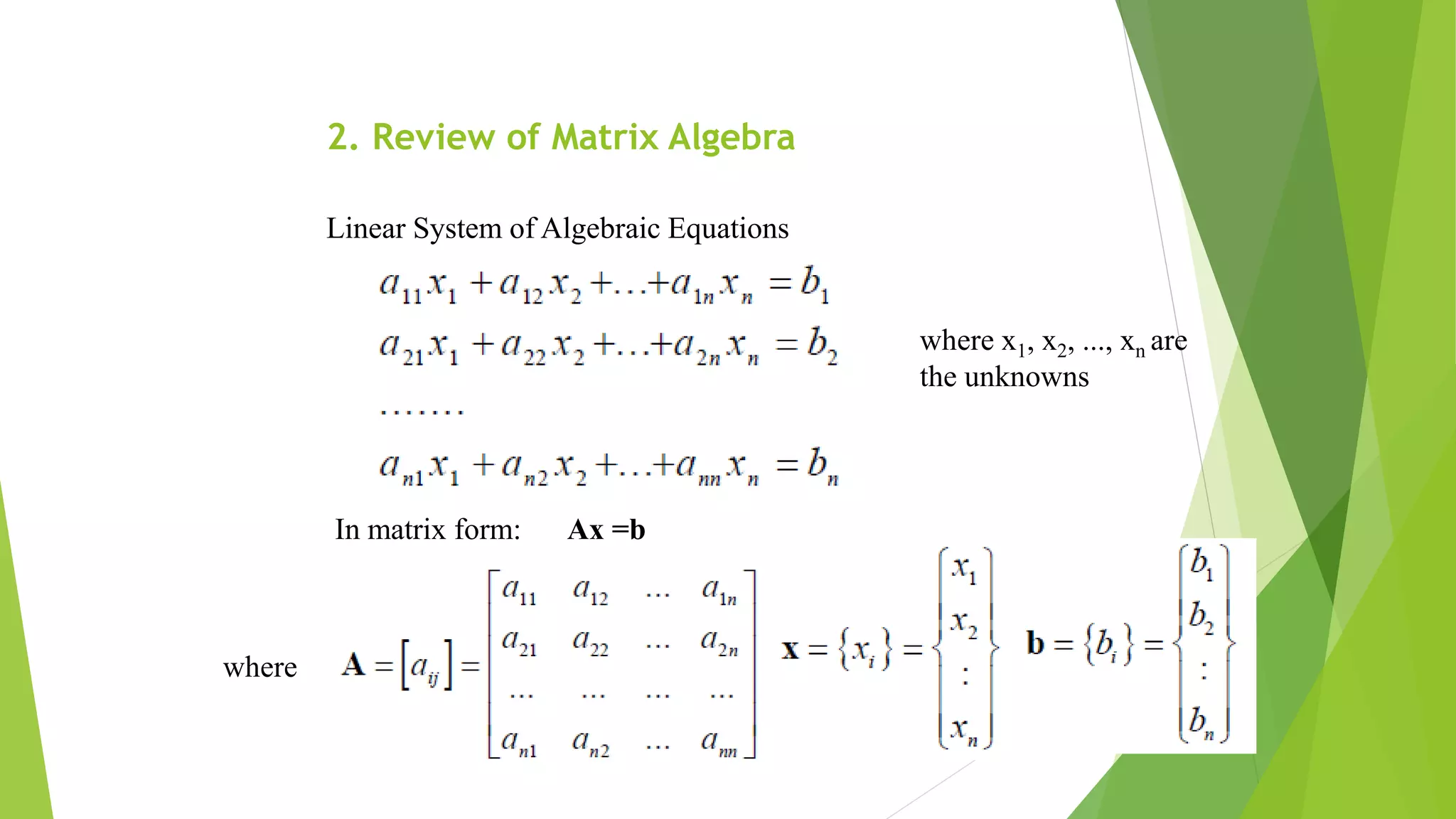
2. Review of Matrix Algebra
Linear System of Algebraic Equations
where x1, x2, ..., xn are
the unknowns
In matrix form: Ax =b
where
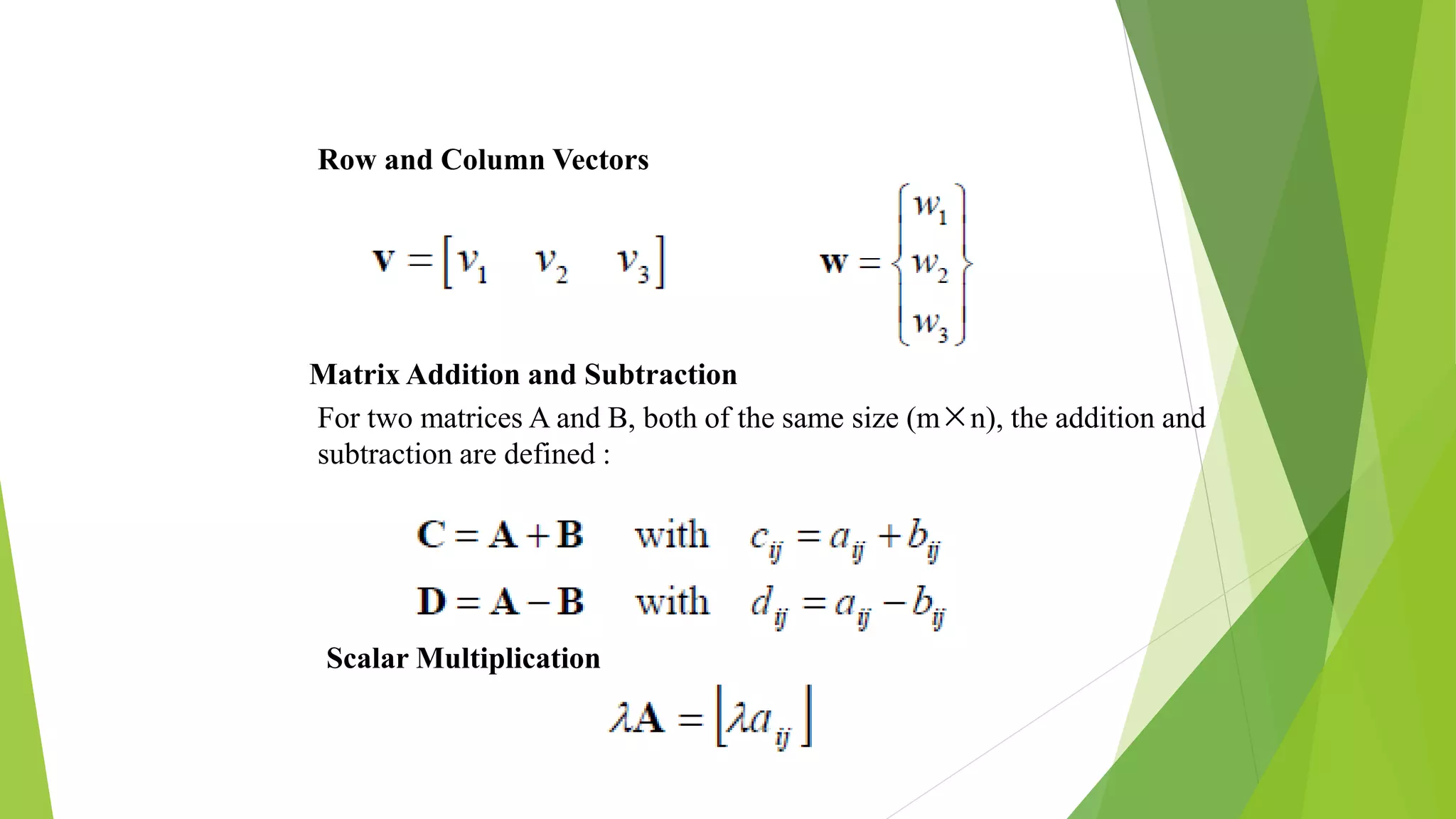
Row and Column Vectors
Matrix Addition and Subtraction
For two matrices A and B, both of the same size (m×n), the addition and
subtraction are defined :
Scalar Multiplication
Matrix Multiplication
For two matrices A (of size l×m) and B (of size m×n), the product of AB
is defined by
where i = 1, 2, ..., l; j = 1, 2, ..., n.
Transpose of a Matrix
If A = [aij], then the transpose of A is
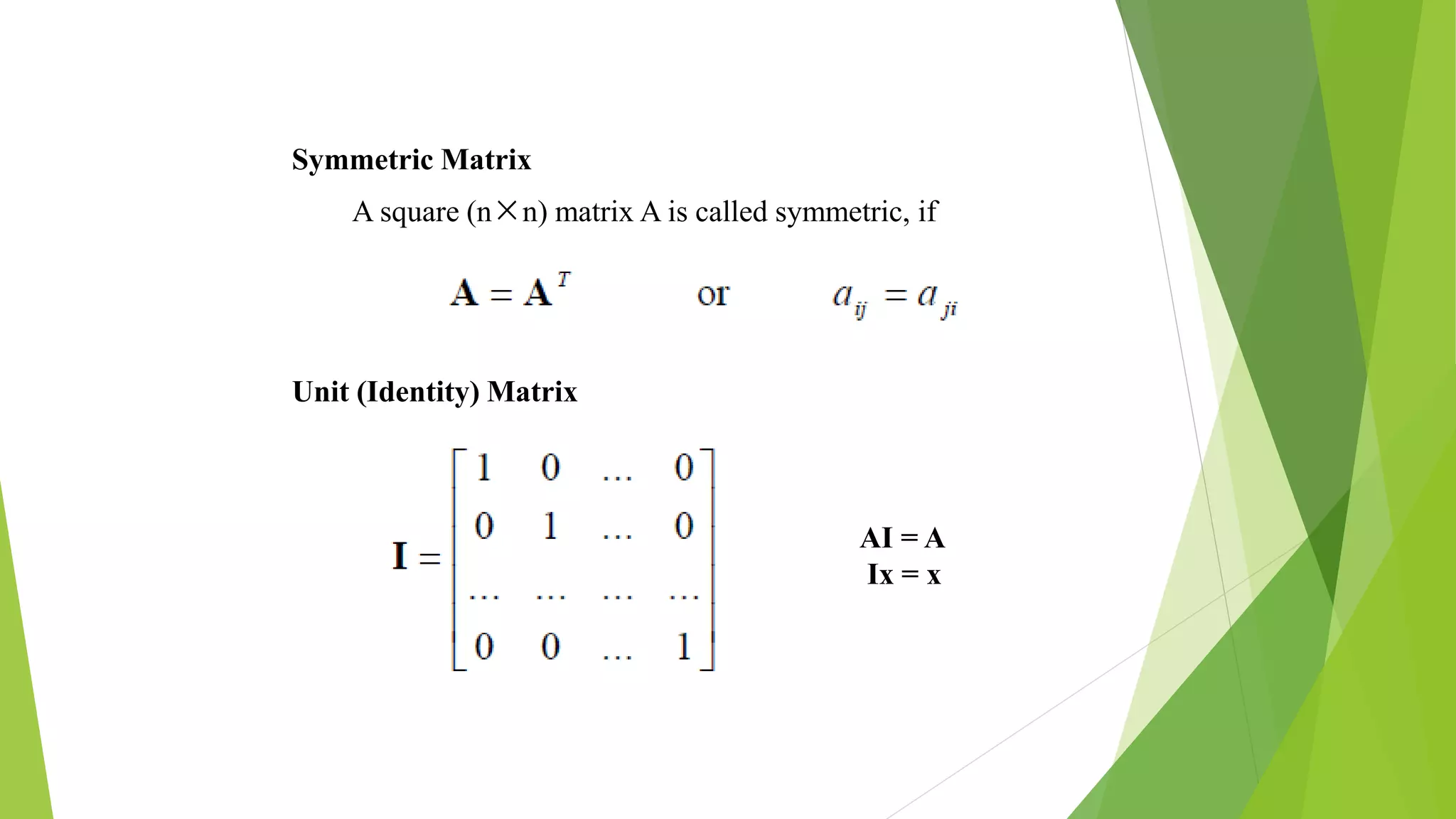
Symmetric Matrix
A square (n×n) matrix A is called symmetric, if
Unit (Identity) Matrix
AI = A
Ix = x
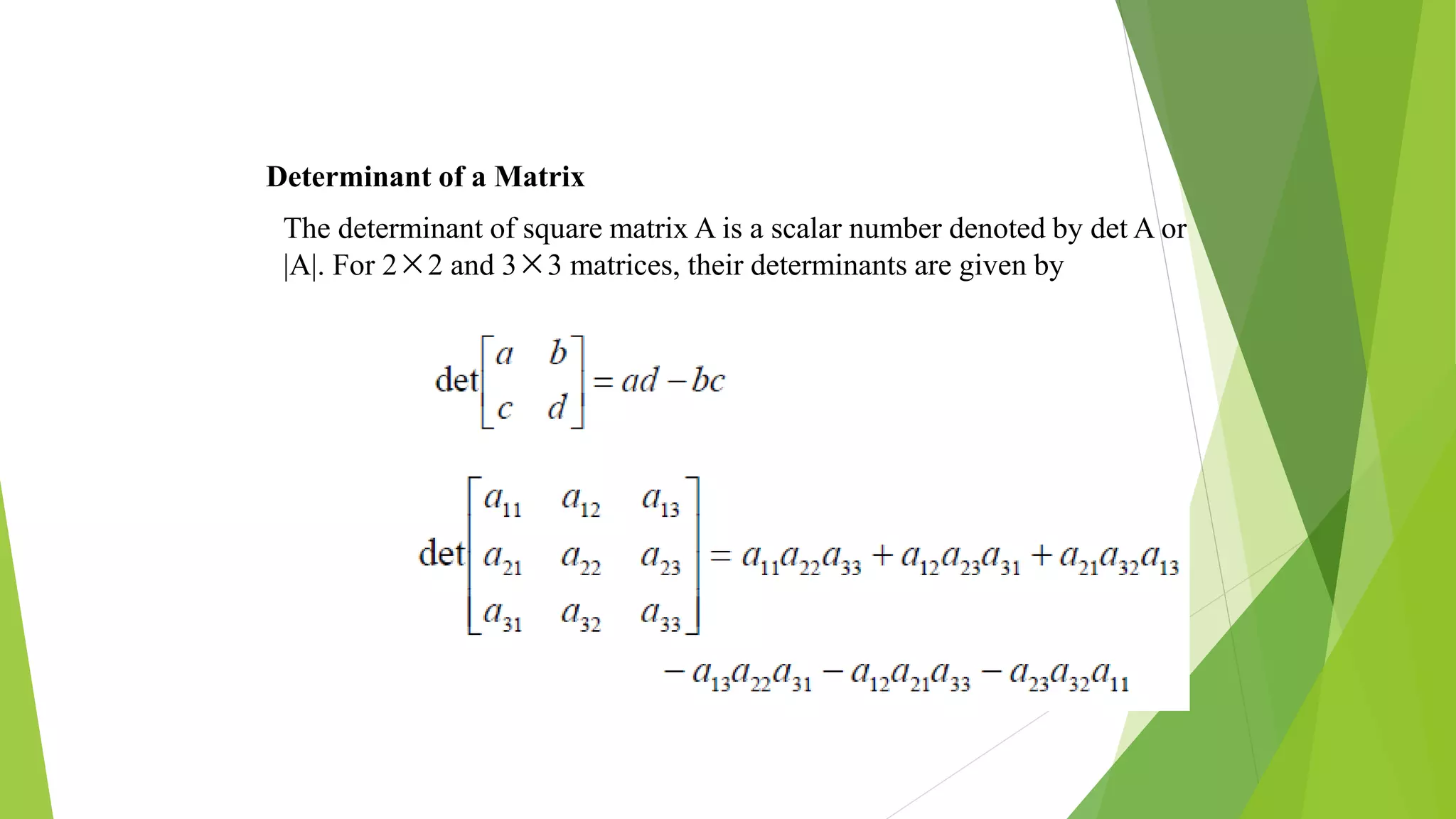
The determinant of square matrix A is a scalar number denoted by det A or
|A|. For 2×2 and 3×3 matrices, their determinants are given by
Determinant of a Matrix
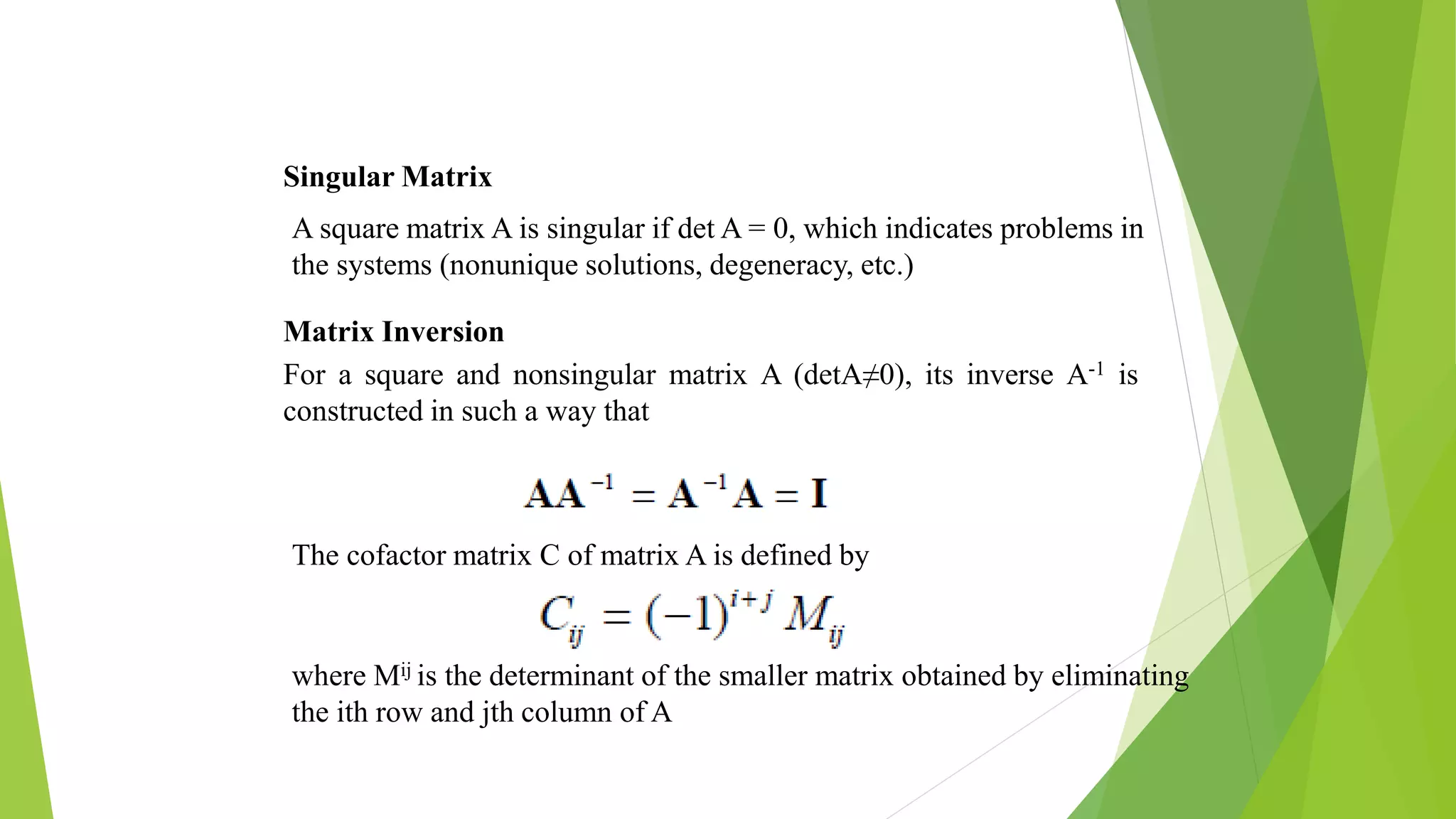
Singular Matrix
A square matrix A is singular if det A = 0, which indicates problems in
the systems (nonunique solutions, degeneracy, etc.)
Matrix Inversion
For a square and nonsingular matrix A (detA≠0), its inverse A-1 is
constructed in such a way that
The cofactor matrix C of matrix A is defined by
where Mij is the determinant of the smaller matrix obtained by eliminating
the ith row and jth column of A
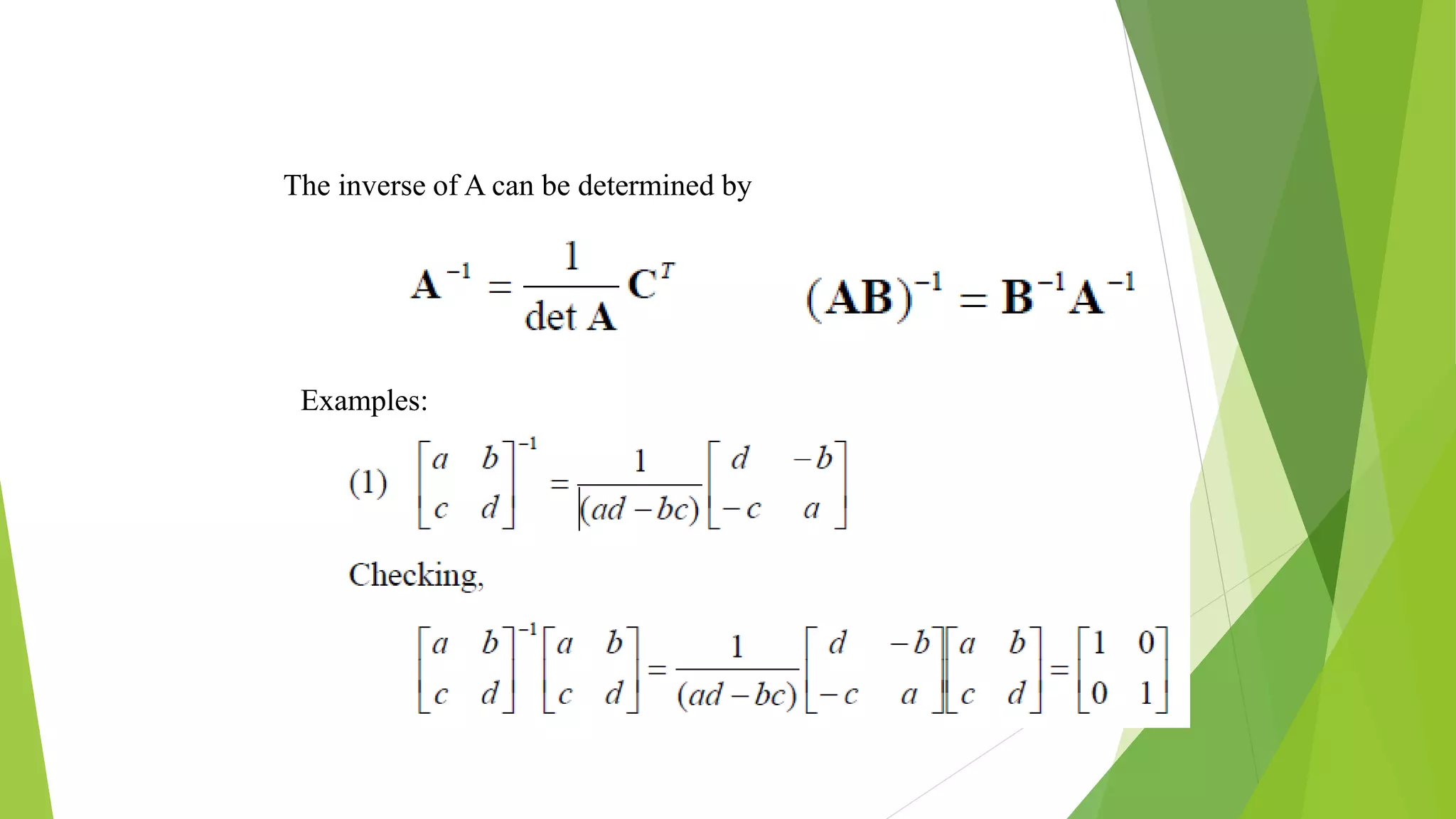
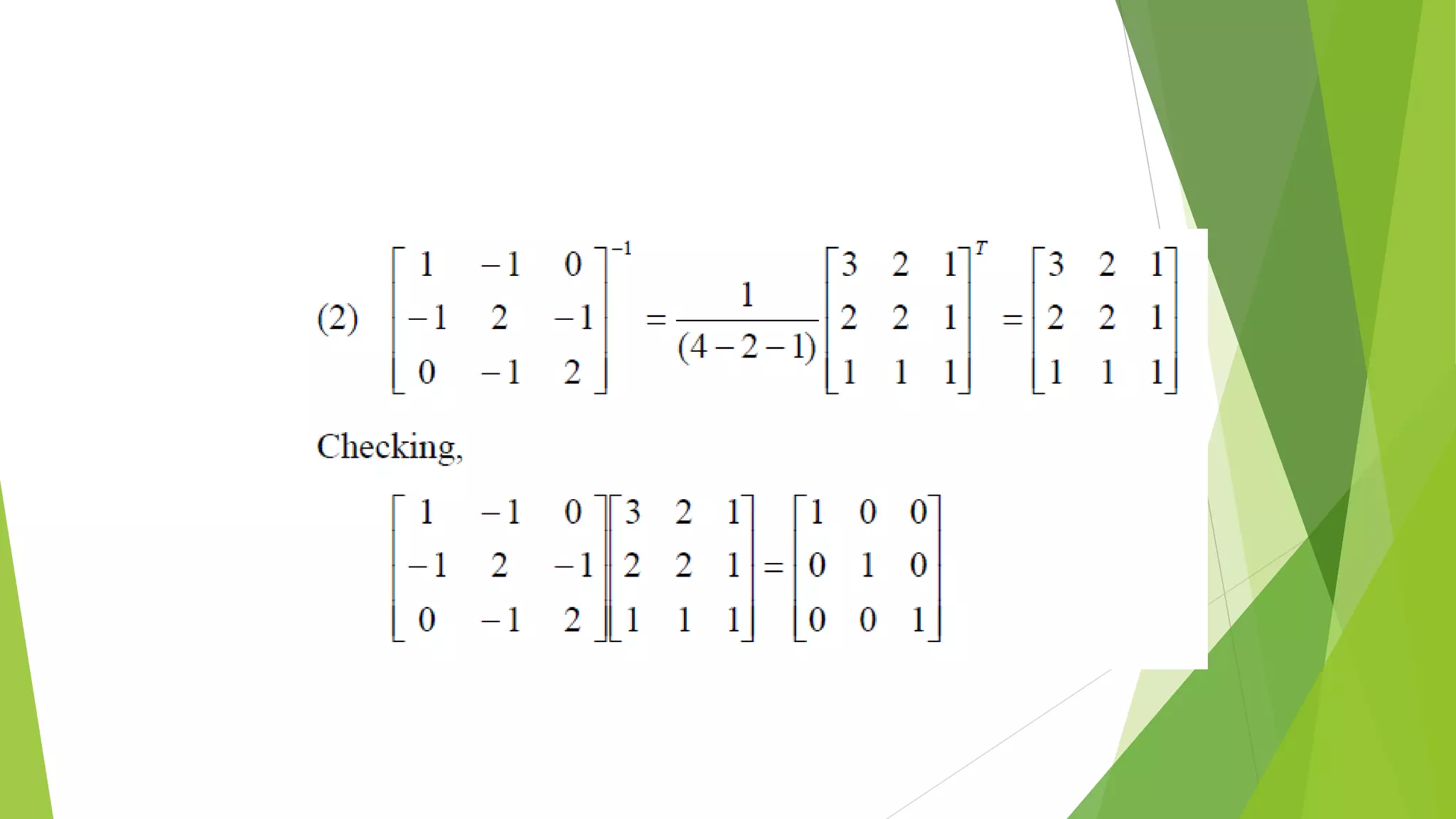
The inverse of A can be determined by
Examples:
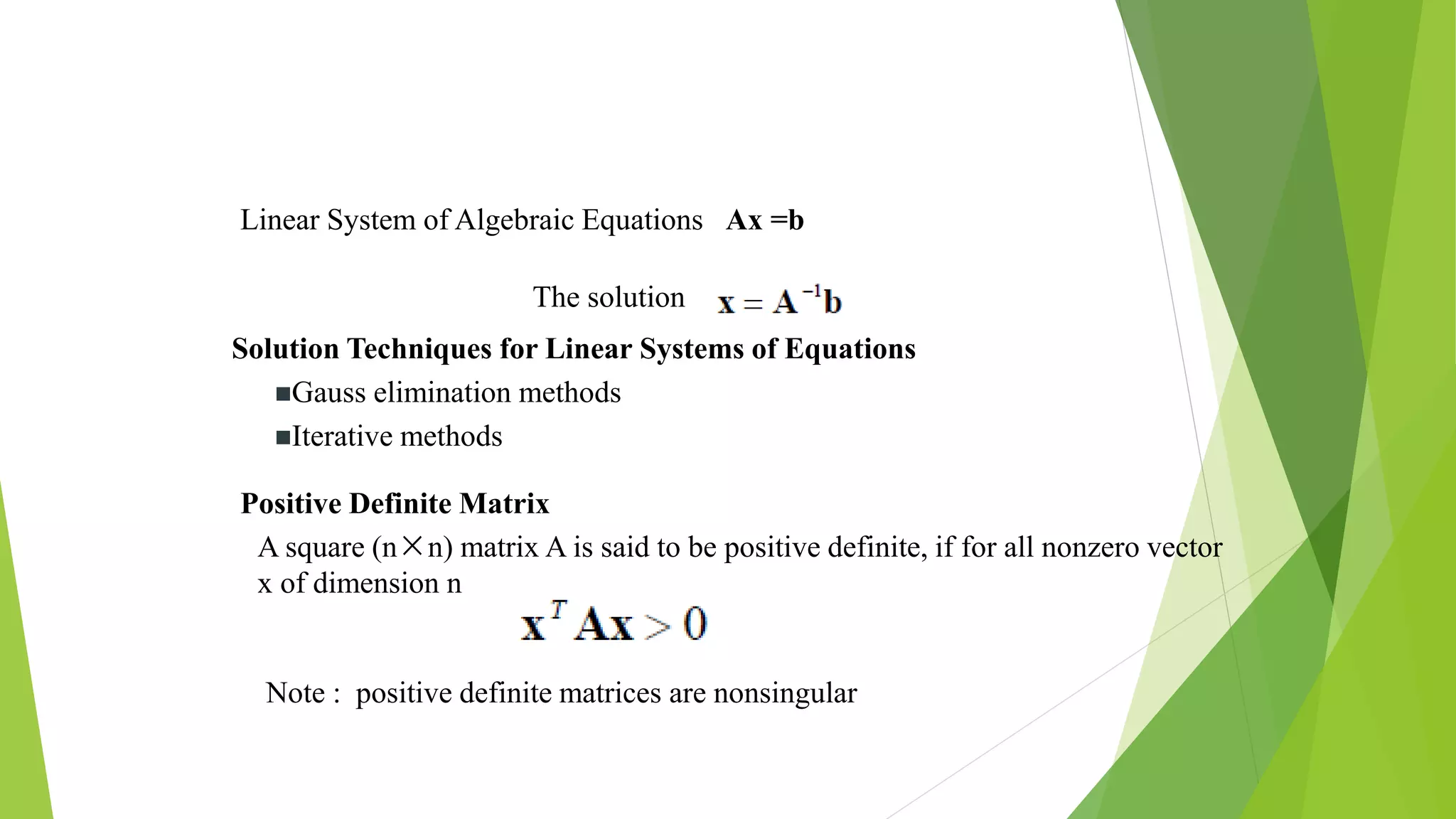
Linear System of Algebraic Equations Ax =b
The solution
Solution Techniques for Linear Systems of Equations
Gauss elimination methods
Iterative methods
Positive Definite Matrix
A square (n×n) matrix A is said to be positive definite, if for all nonzero vector
x of dimension n
Note : positive definite matrices are nonsingular
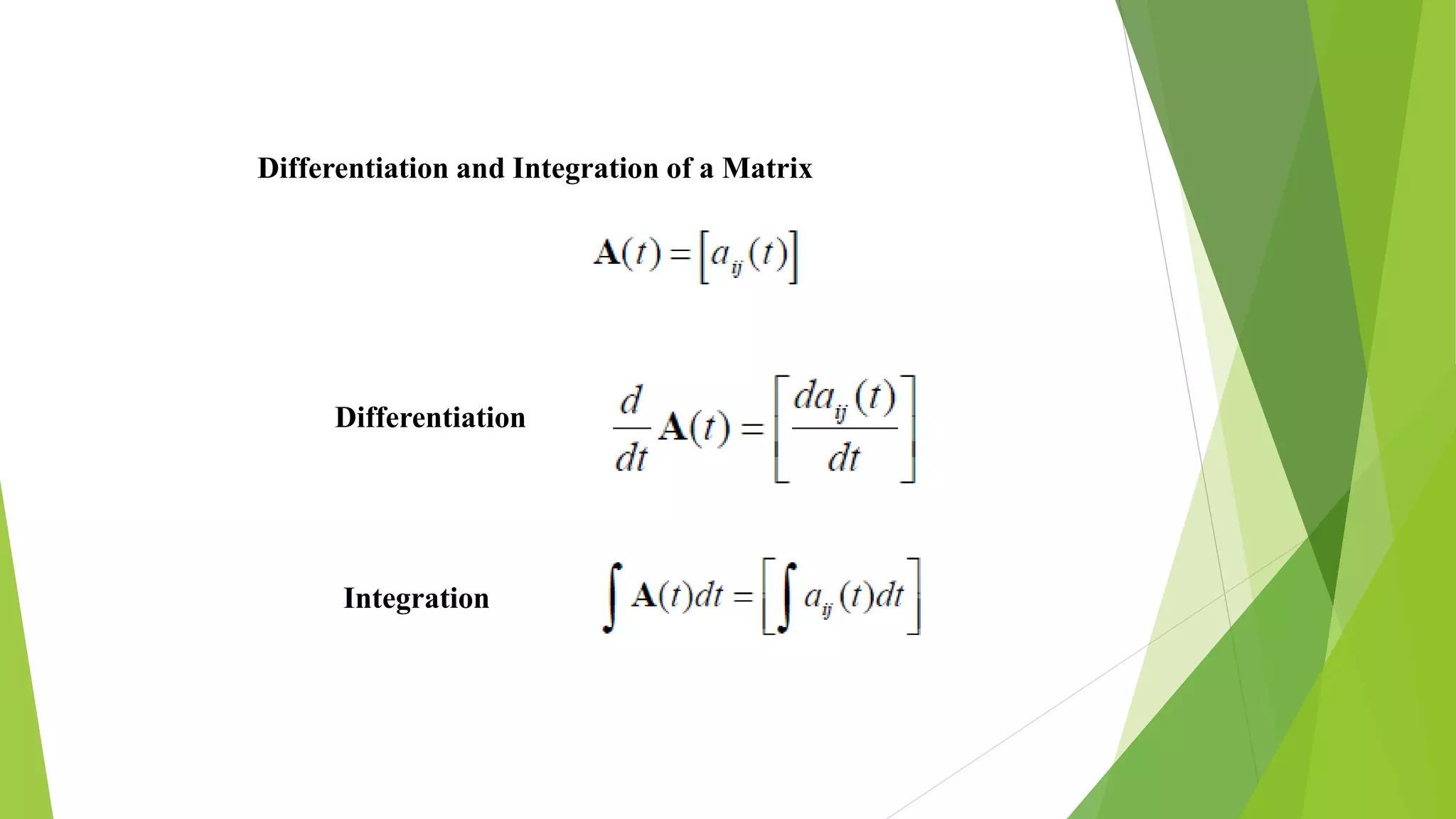
Differentiation and Integration of a Matrix
Differentiation
Integration
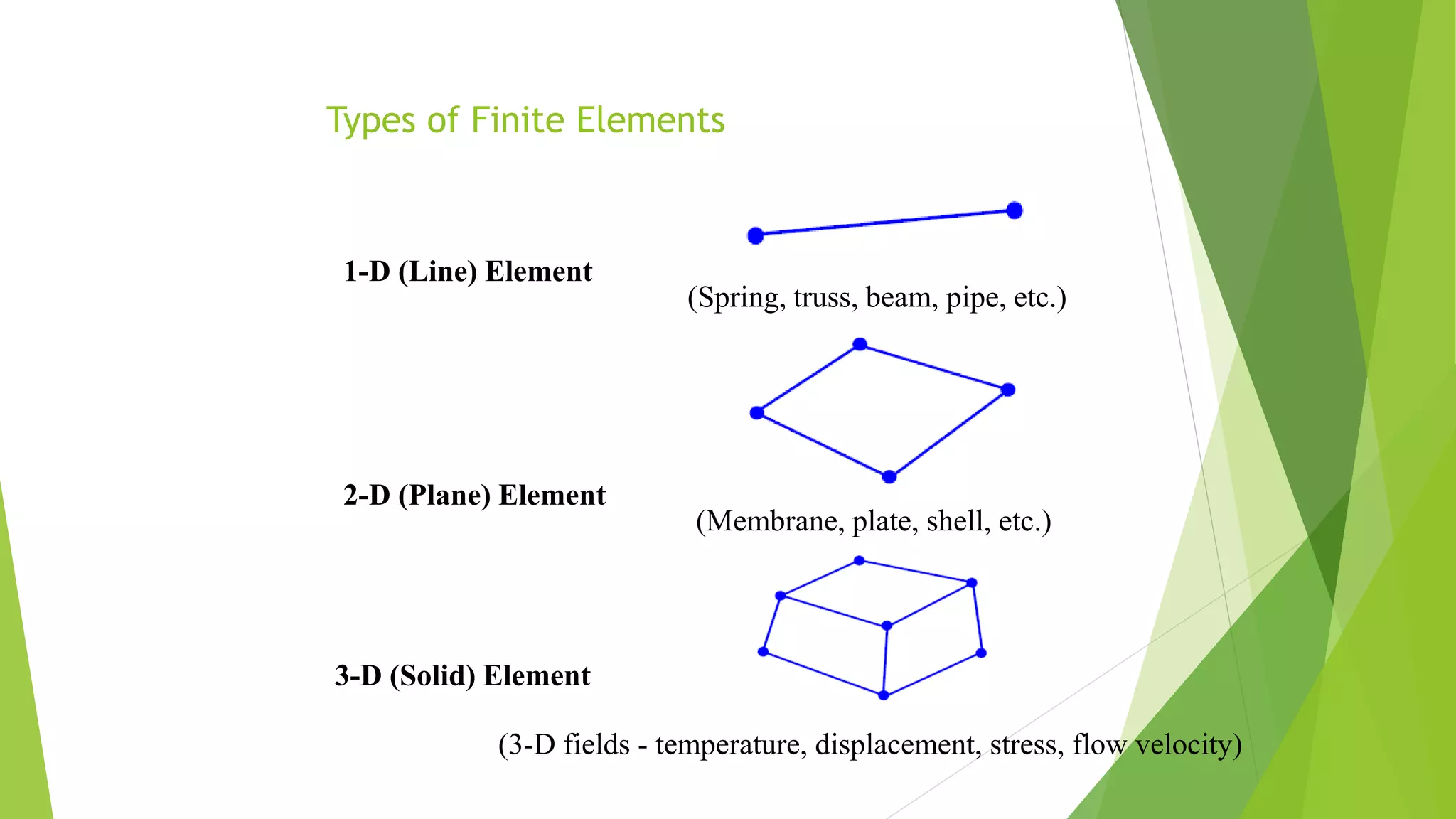
Types of Finite Elements
1-D (Line) Element
(Spring, truss, beam, pipe, etc.)
2-D (Plane) Element
(Membrane, plate, shell, etc.)
3-D (Solid) Element
(3-D fields - temperature, displacement, stress, flow velocity)
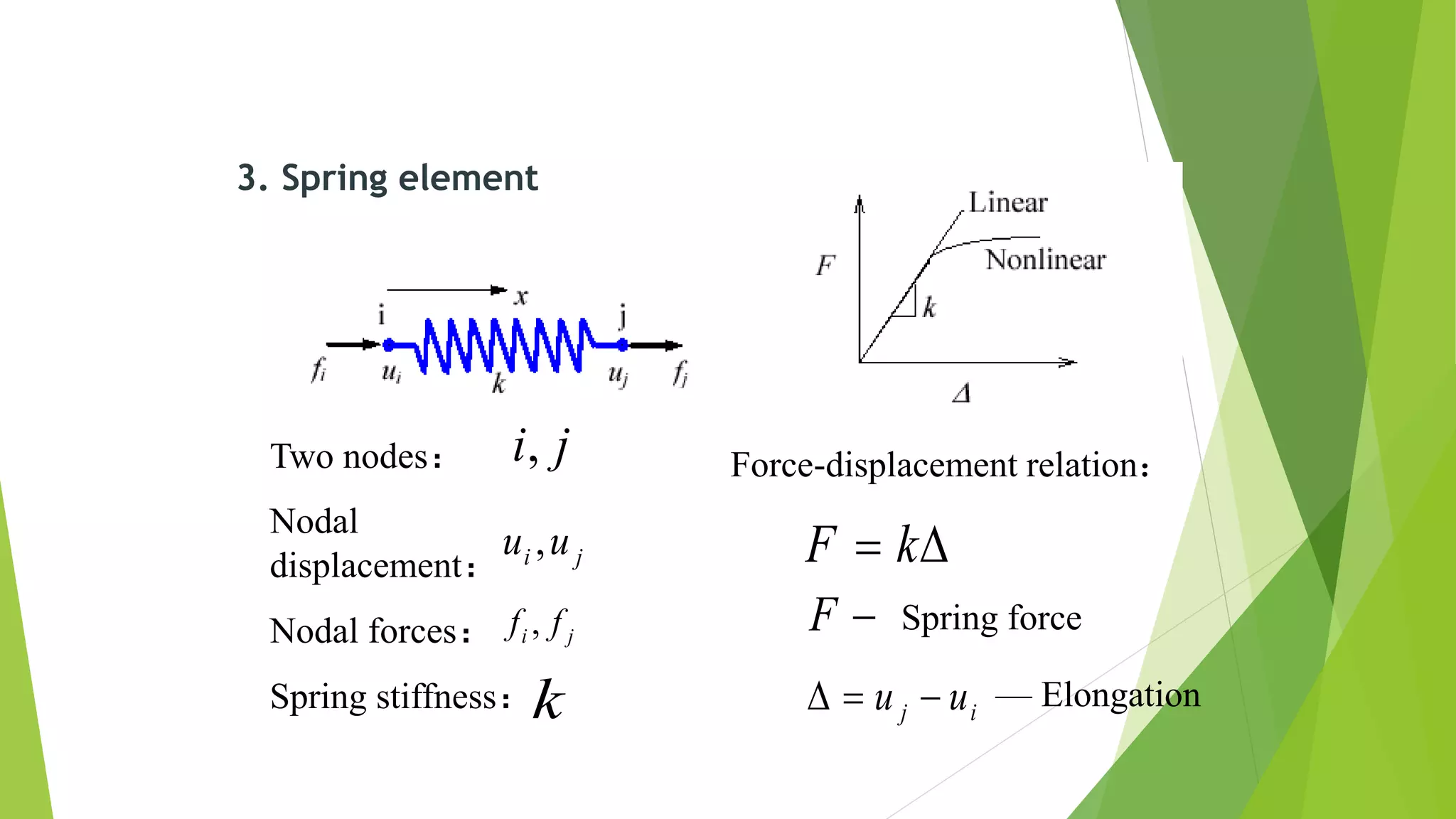
3. Spring element
Two nodes:
Nodal
displacement:
Nodal forces:
Spring stiffness:
ji,
ji uu ,
ji ff ,
k
Force-displacement relation:
 kF
ij uu 
F Spring force
— Elongation
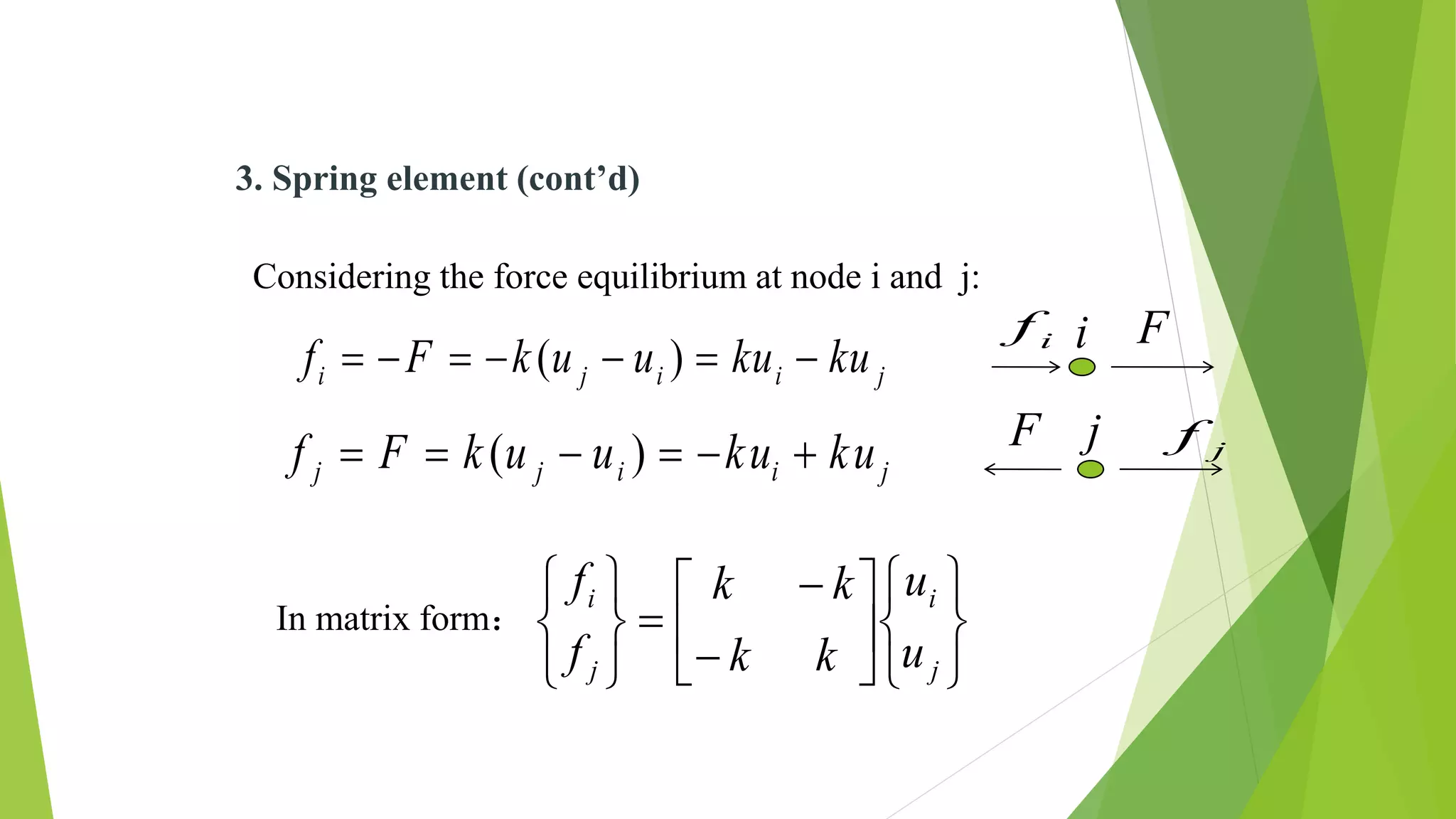
Considering the force equilibrium at node i and j:
( )i j i i jf F k u u ku ku      
jiijj kukuuukFf  )(
In matrix form:





















j
i
j
i
u
u
kk
kk
f
f
3. Spring element (cont’d)
if Fi
jfF j
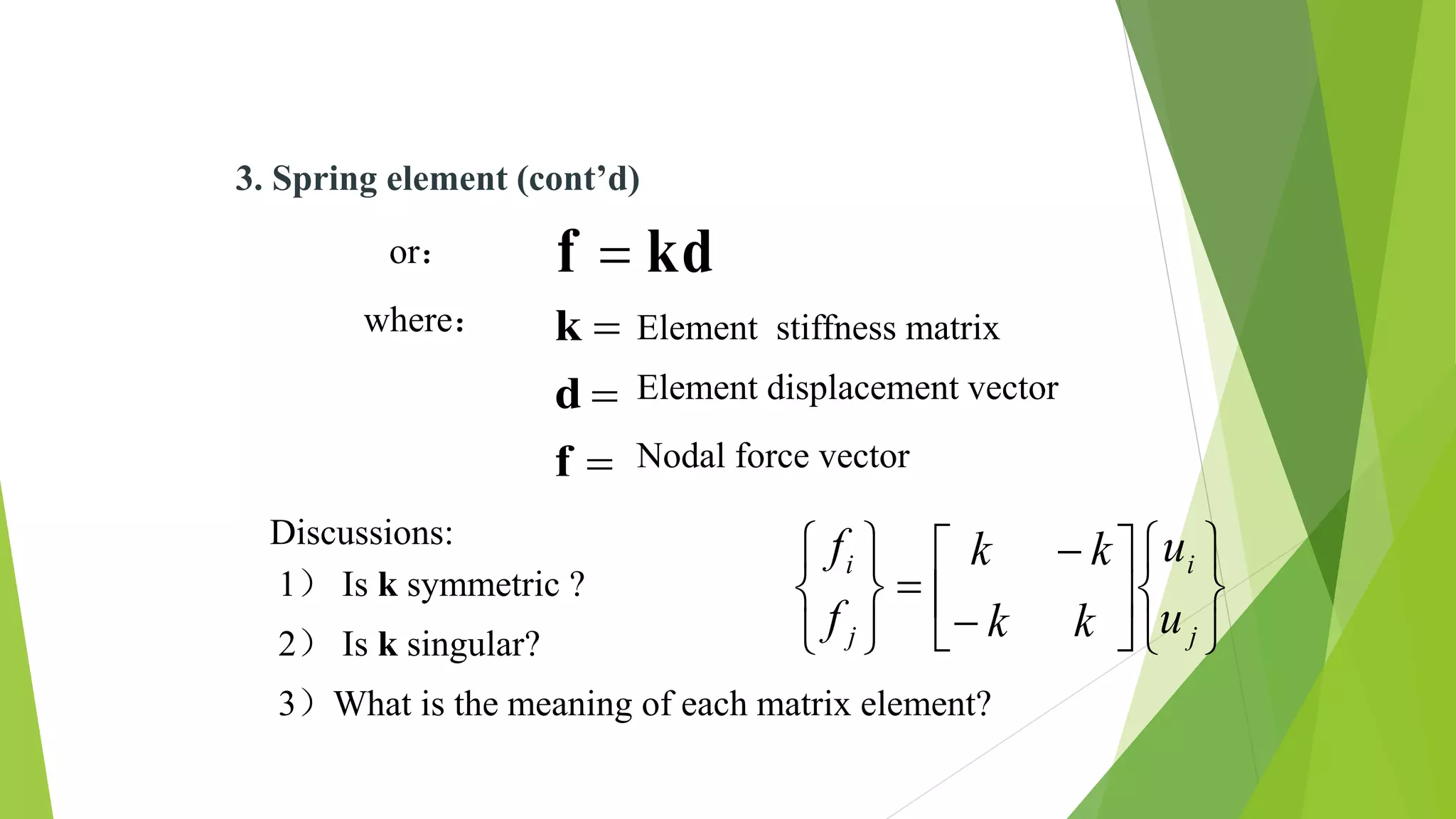
Discussions:
or:
Nodal force vector
where:



f
d
k
Element displacement vector
Element stiffness matrix
kdf 
1) Is k symmetric ?
2) Is k singular?
3)What is the meaning of each matrix element?





















j
i
j
i
u
u
kk
kk
f
f
3. Spring element (cont’d)
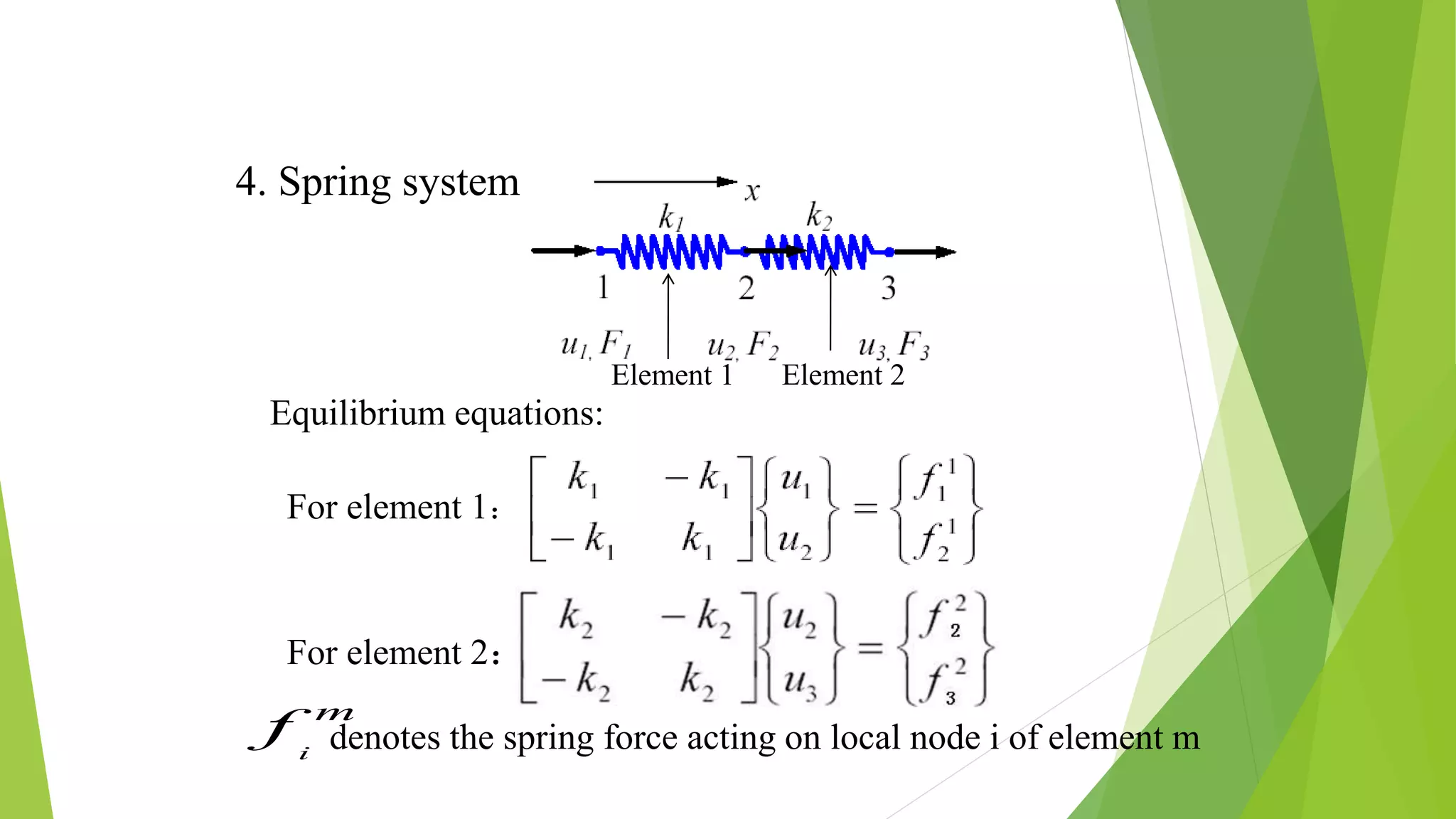
Equilibrium equations:
For element 2:
4. Spring system
For element 1:
Element 1 Element 2
denotes the spring force acting on local node i of element mi
m
f
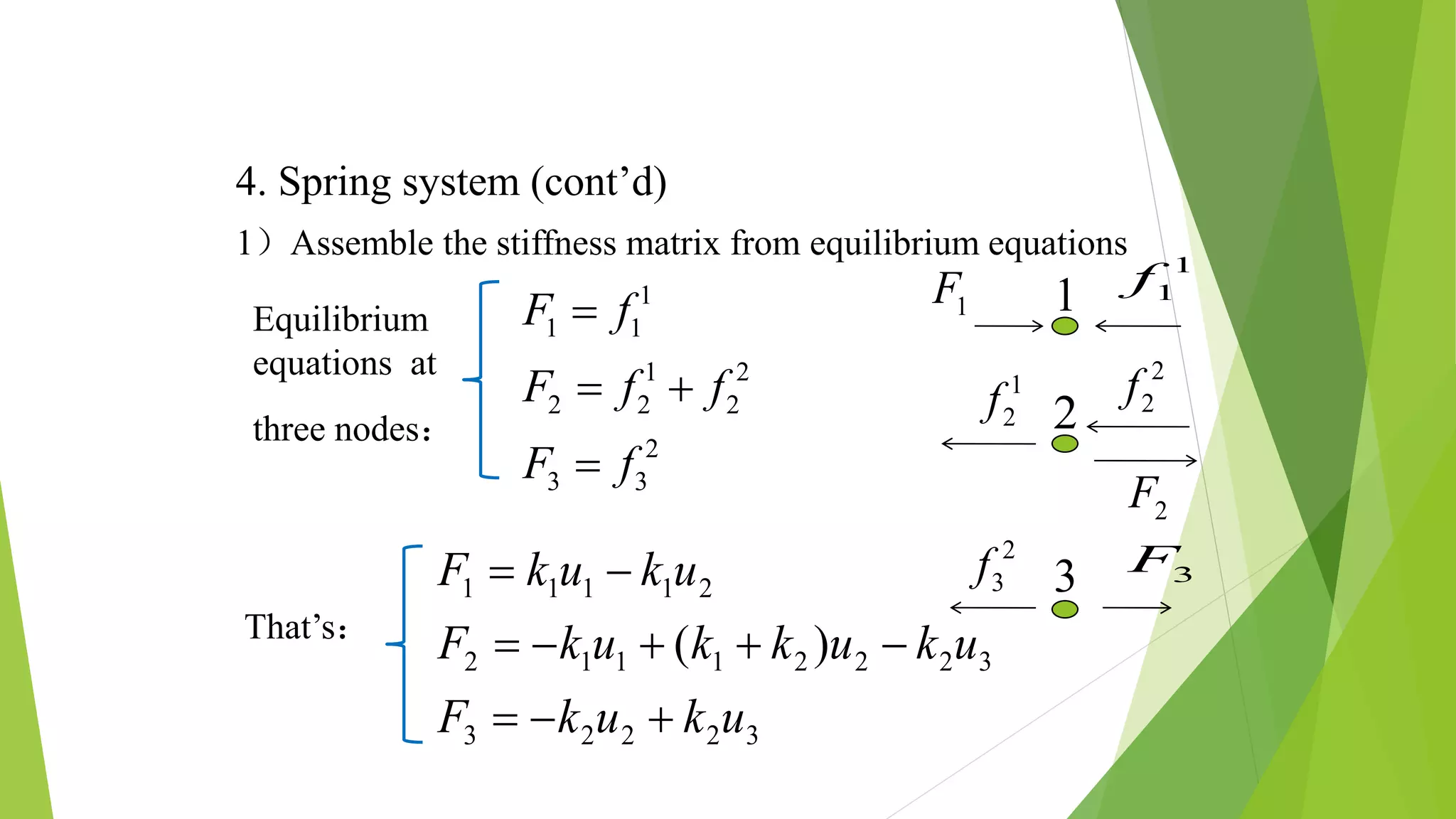
1)Assemble the stiffness matrix from equilibrium equations
That’s:
4. Spring system (cont’d)
Equilibrium
equations at
three nodes:
1
1 1
1 2
2 2 2
2
3 3
F f
F f f
F f

 

32223
32221112
21111
)(
ukukF
ukukkukF
ukukF



1
1f
1F 1
1
2f 2
2
2f
2F
3F2
3f 3
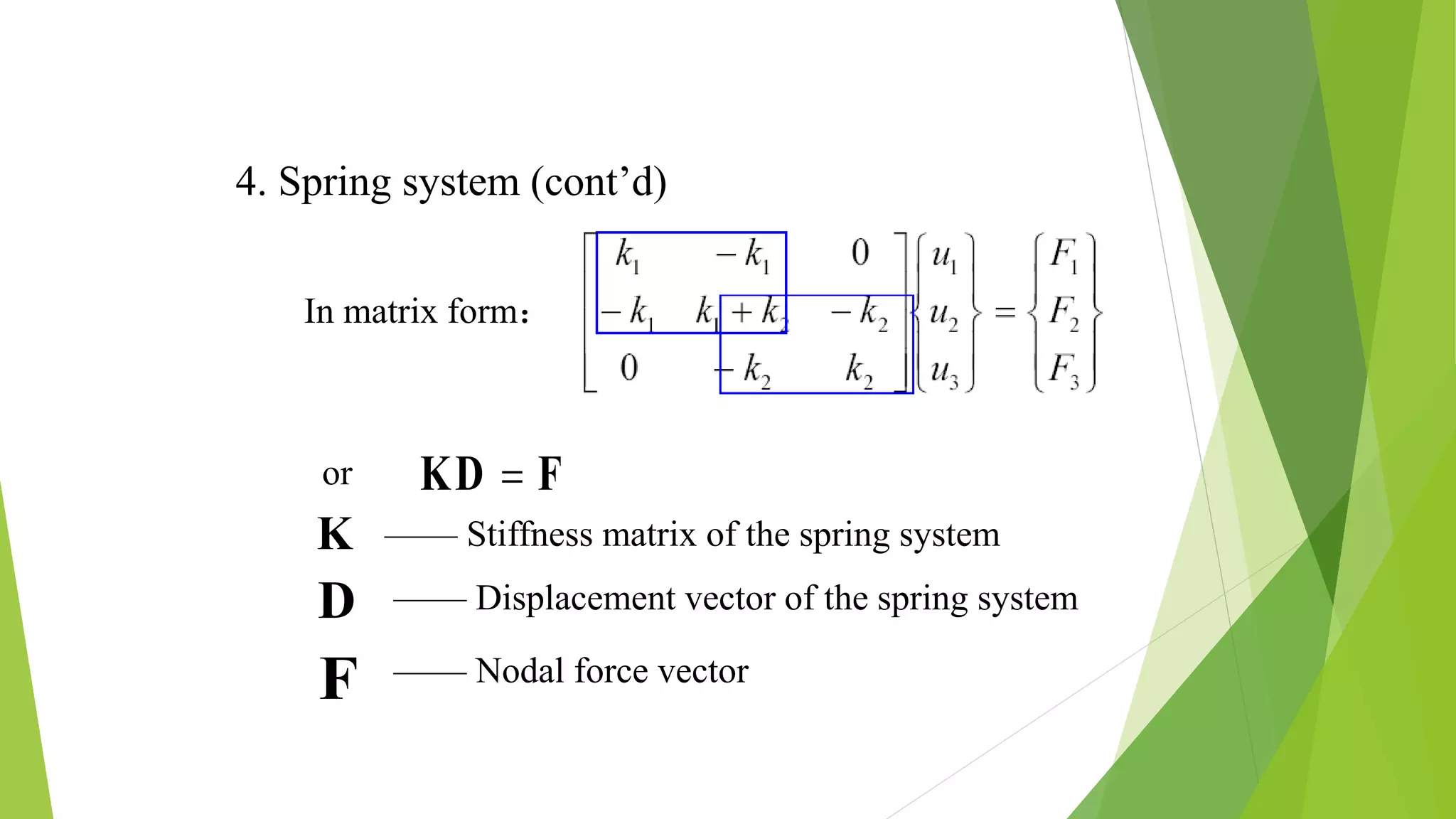
In matrix form:
or FKD 
K —— Stiffness matrix of the spring system
F —— Nodal force vector
D —— Displacement vector of the spring system
4. Spring system (cont’d)
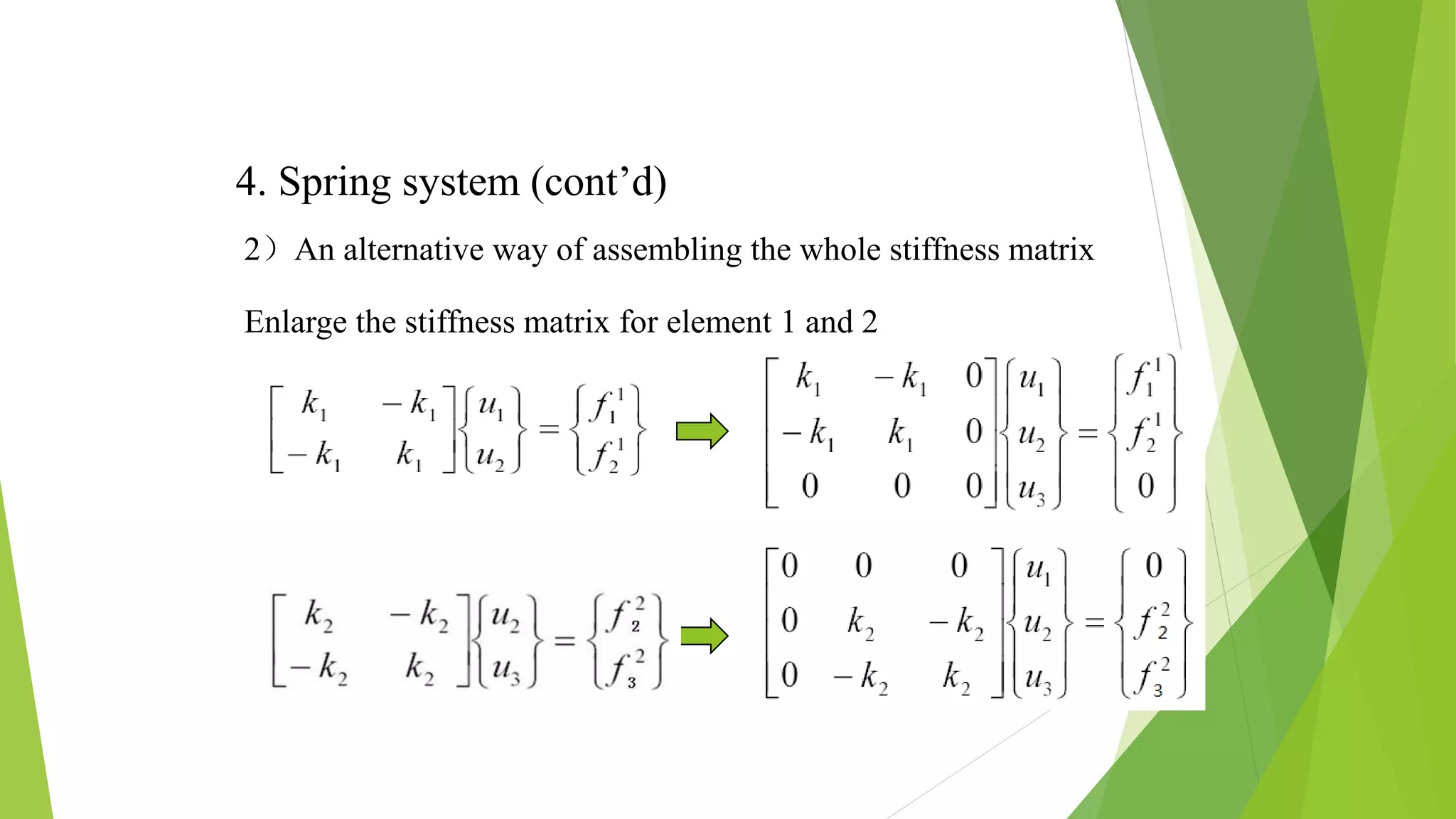
2)An alternative way of assembling the whole stiffness matrix
4. Spring system (cont’d)
Enlarge the stiffness matrix for element 1 and 2
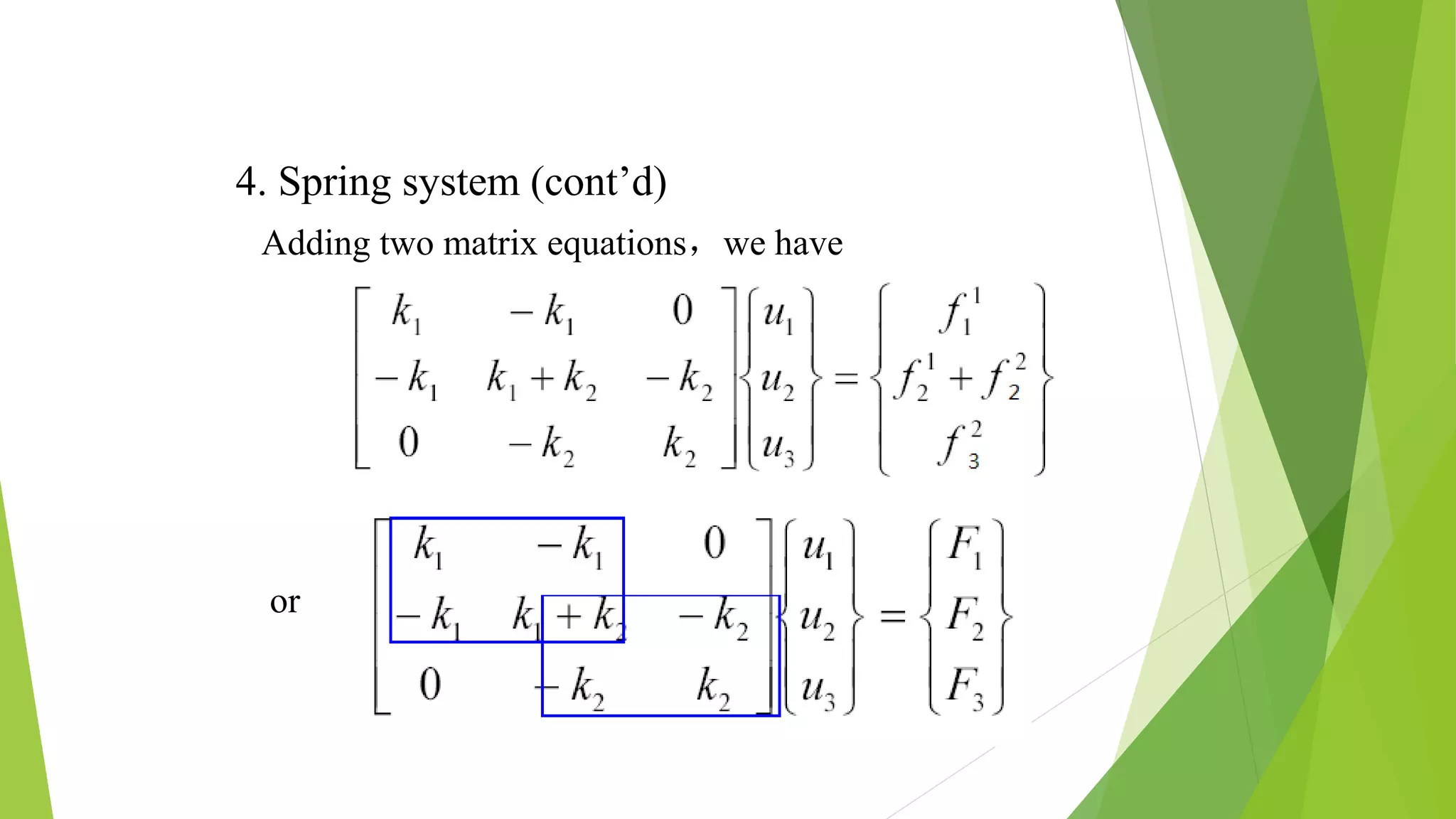
or
Adding two matrix equations,we have
4. Spring system (cont’d)
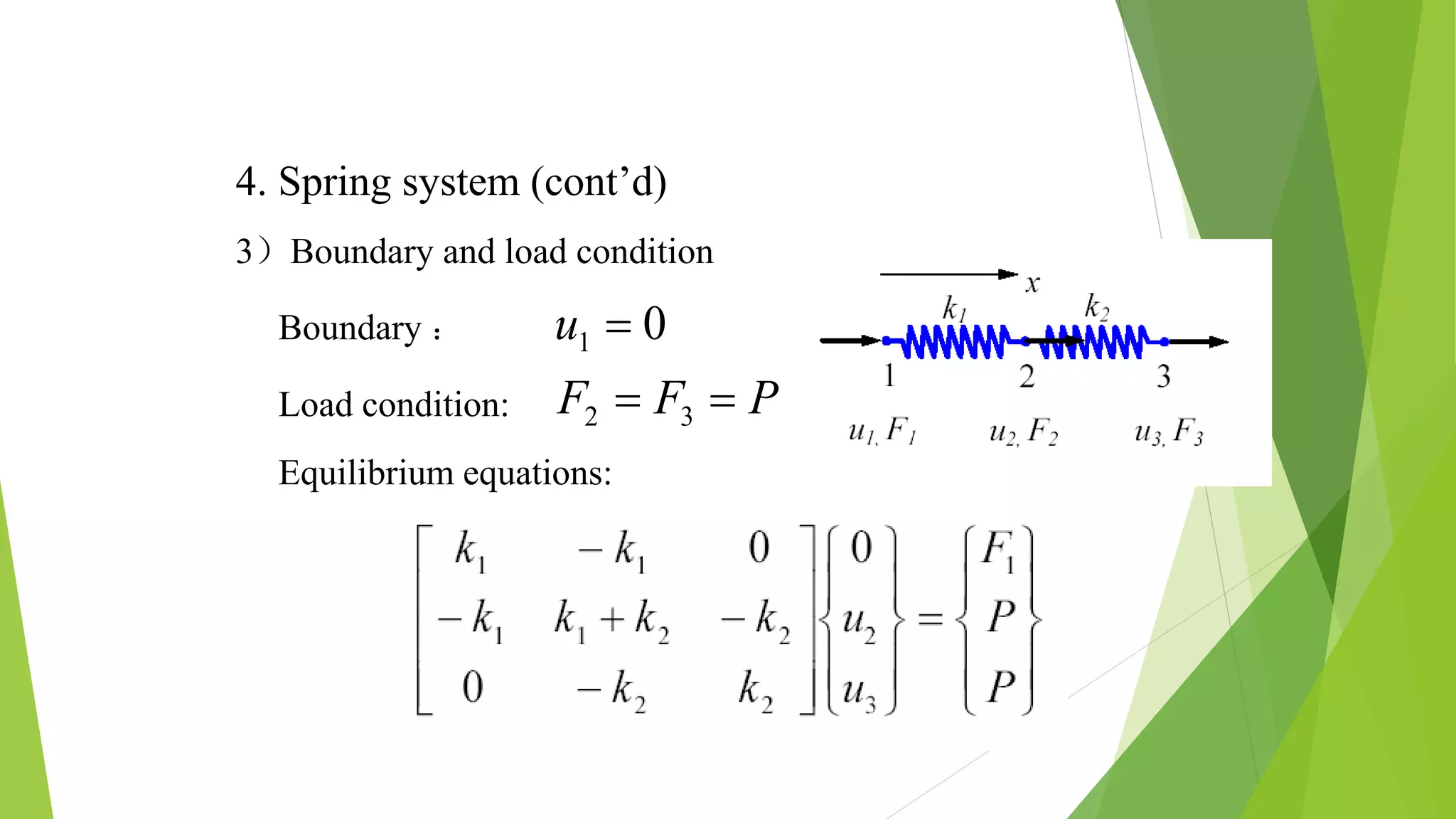
3)Boundary and load condition
Equilibrium equations:
PFF
u


32
1 0Boundary :
Load condition:
4. Spring system (cont’d)
Reduce the equilibrium equations to :
Unknowns:
Solving equations, we get:
u2,u3 , F1
4. Spring system (cont’d)
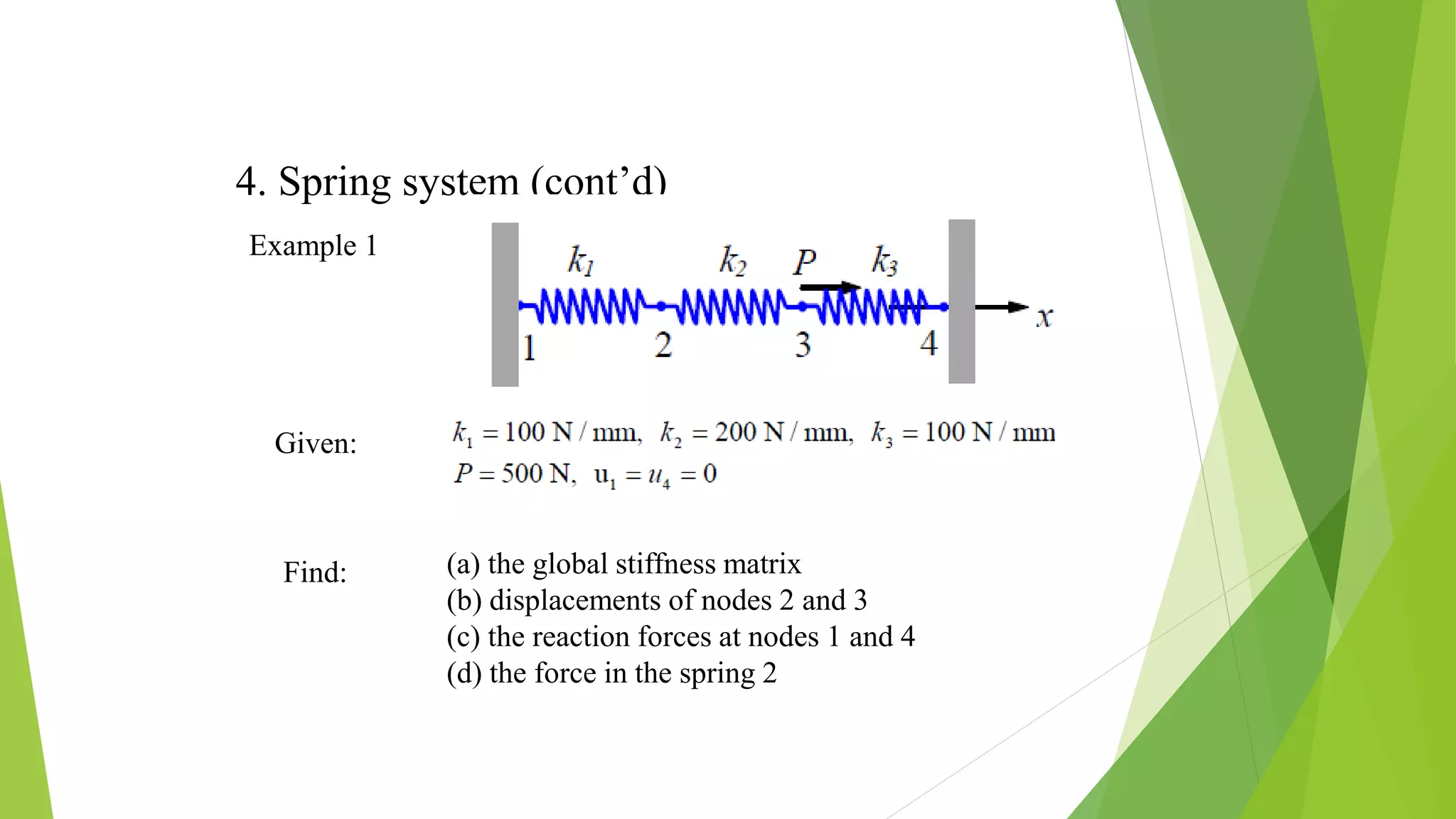
Example 1
Given:
Find: (a) the global stiffness matrix
(b) displacements of nodes 2 and 3
(c) the reaction forces at nodes 1 and 4
(d) the force in the spring 2
4. Spring system (cont’d)
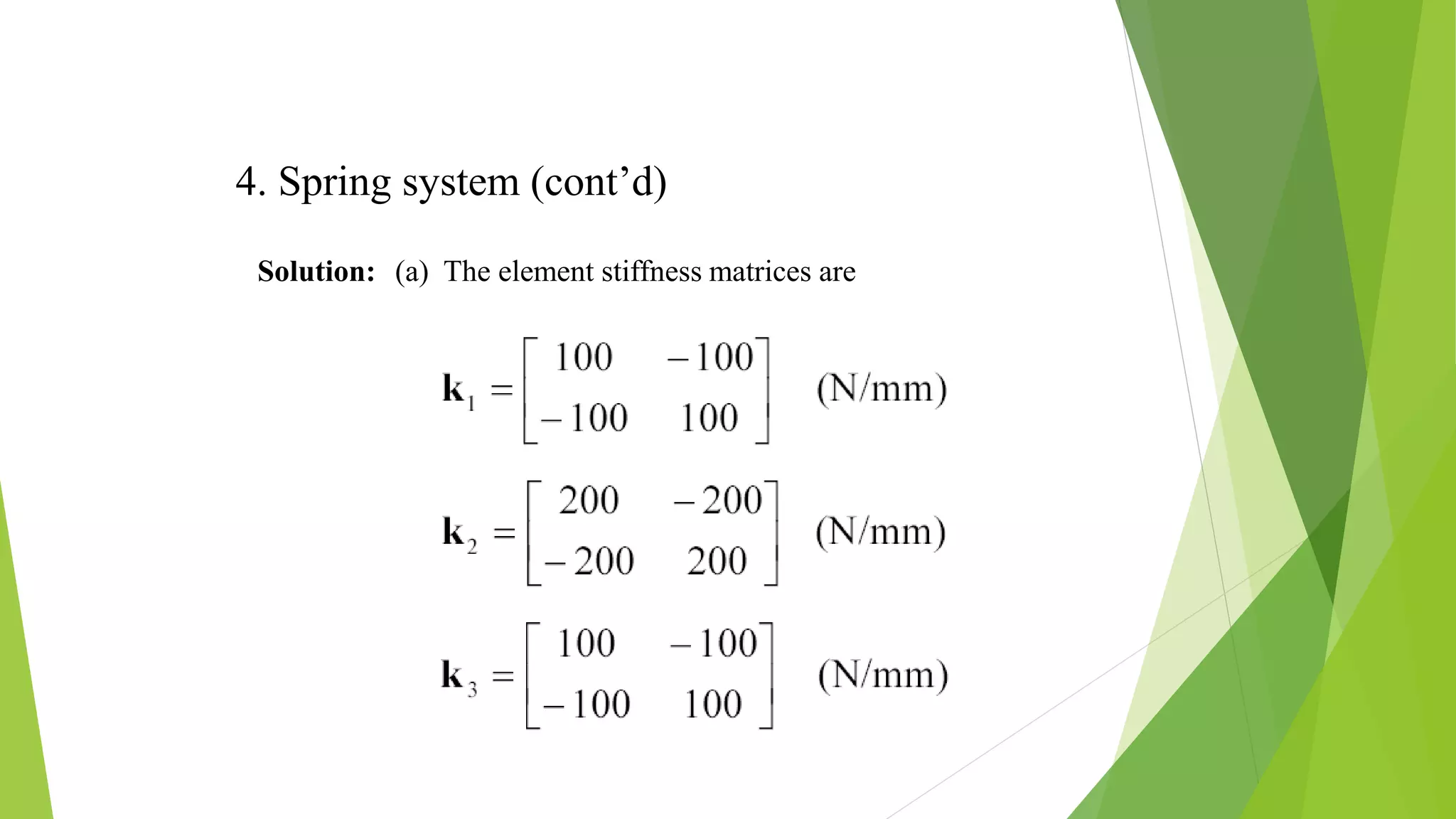
Solution: (a) The element stiffness matrices are
4. Spring system (cont’d)
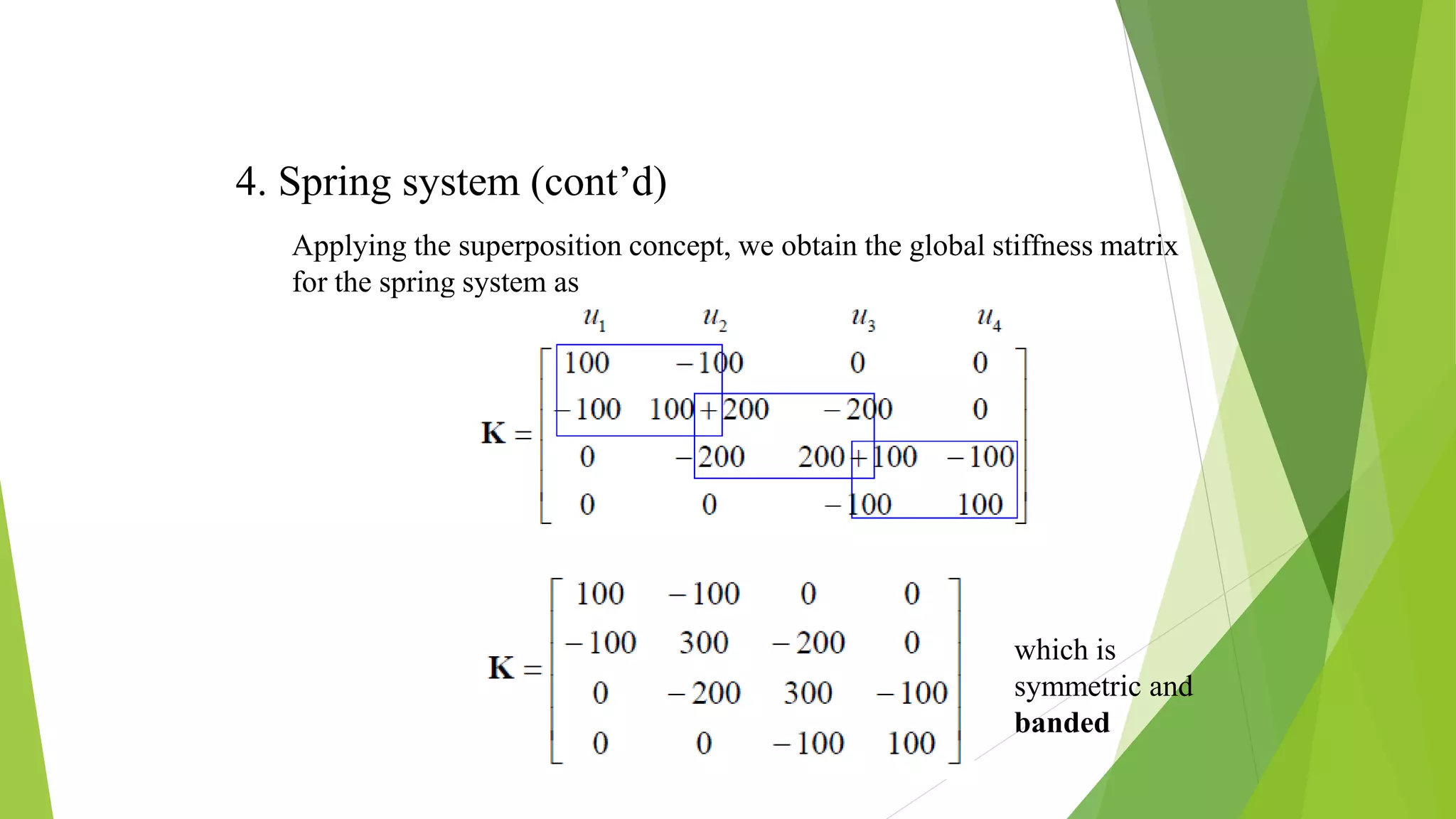
Applying the superposition concept, we obtain the global stiffness matrix
for the spring system as
which is
symmetric and
banded
4. Spring system (cont’d)
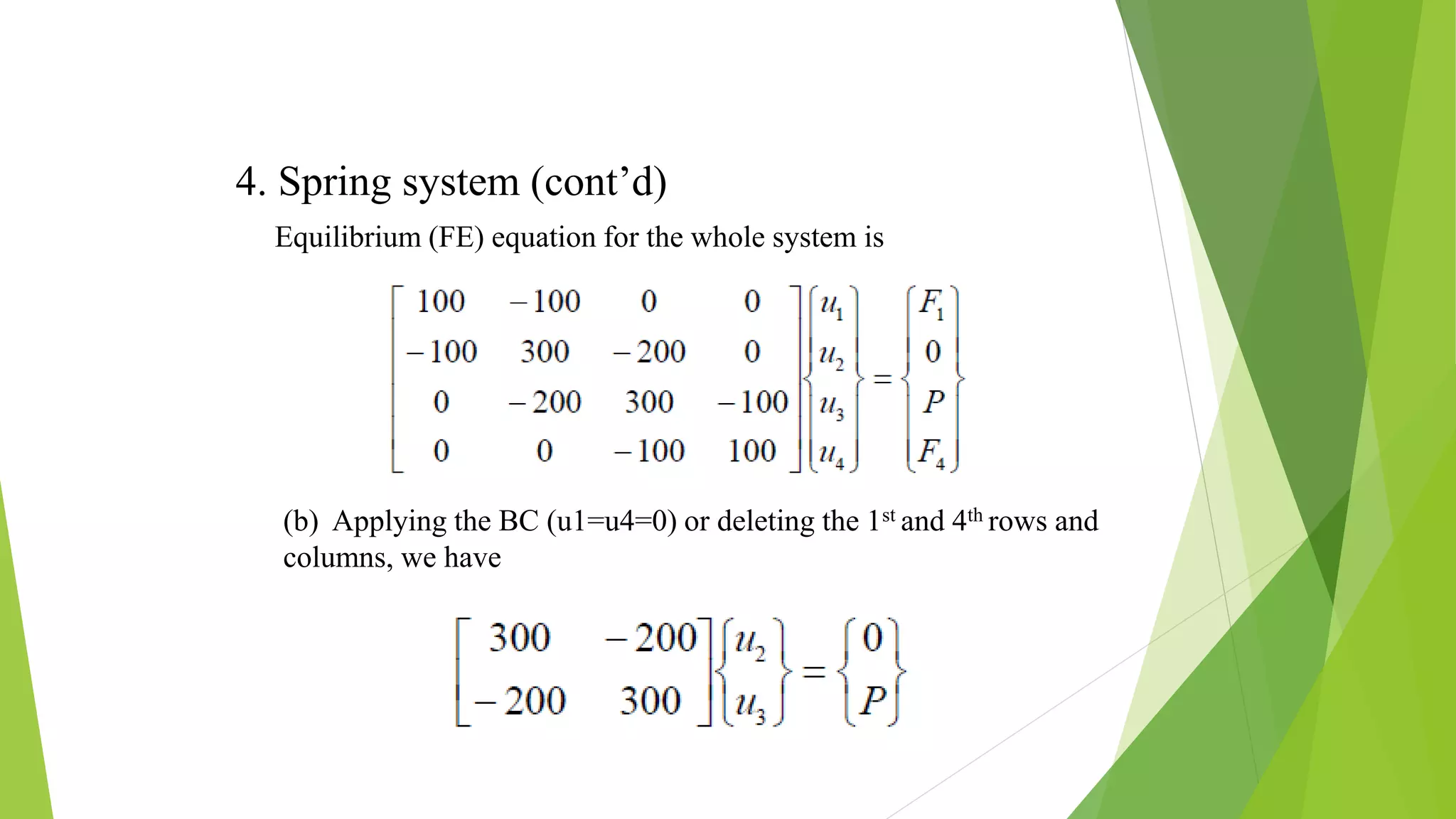
Equilibrium (FE) equation for the whole system is
(b) Applying the BC (u1=u4=0) or deleting the 1st and 4th rows and
columns, we have
4. Spring system (cont’d)
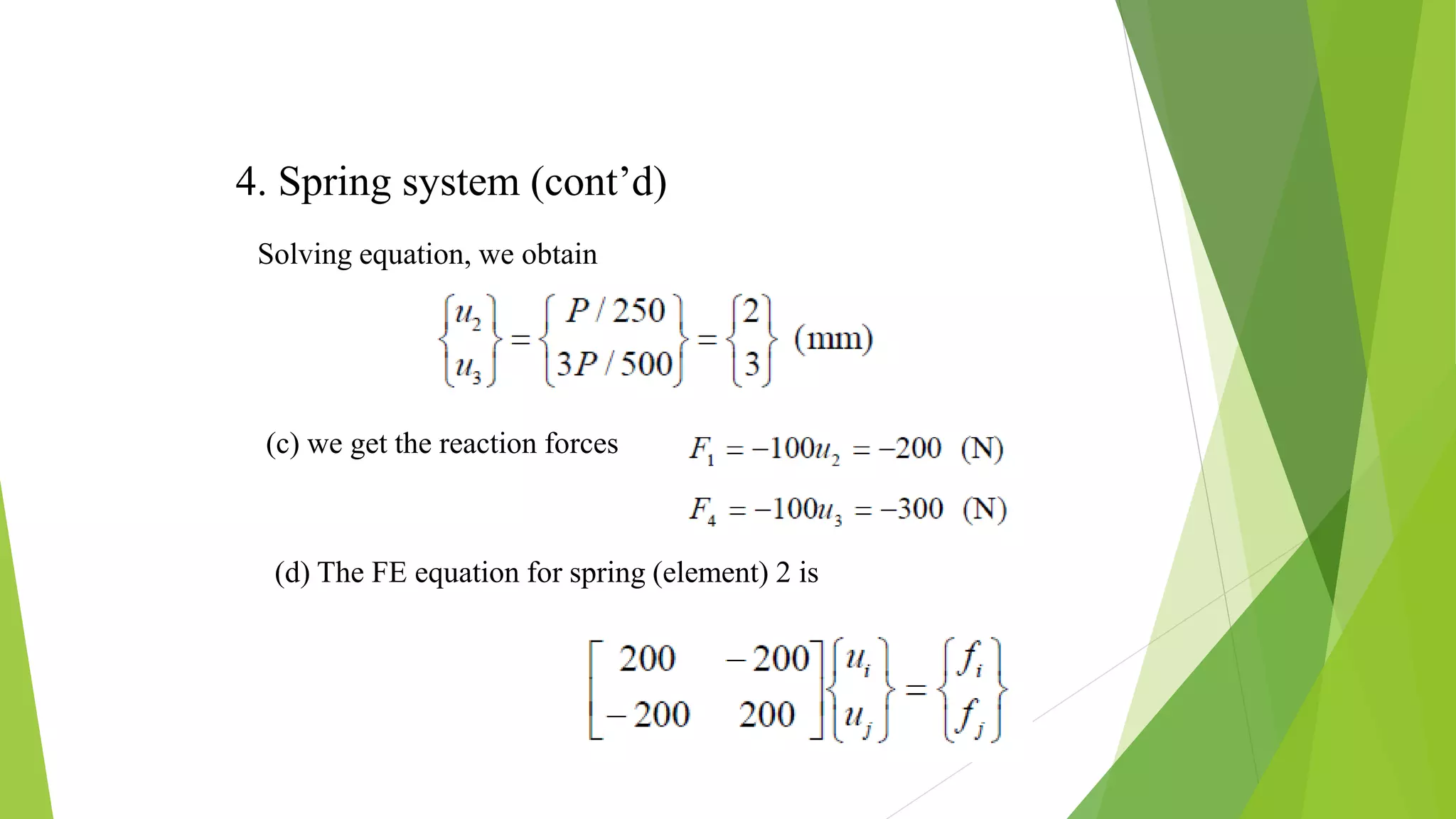
Solving equation, we obtain
(c) we get the reaction forces
(d) The FE equation for spring (element) 2 is
4. Spring system (cont’d)
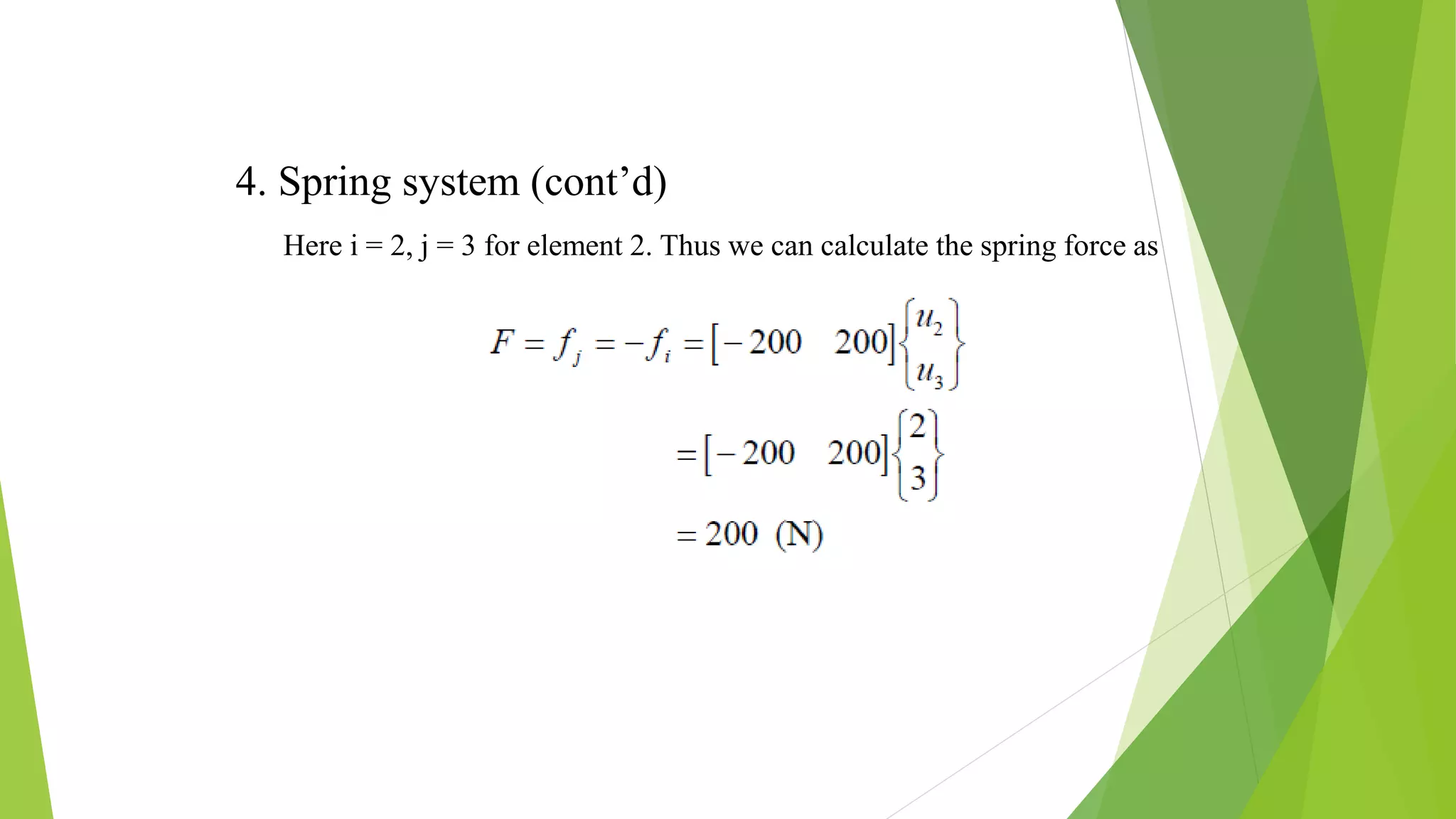
Here i = 2, j = 3 for element 2. Thus we can calculate the spring force as
4. Spring system (cont’d)
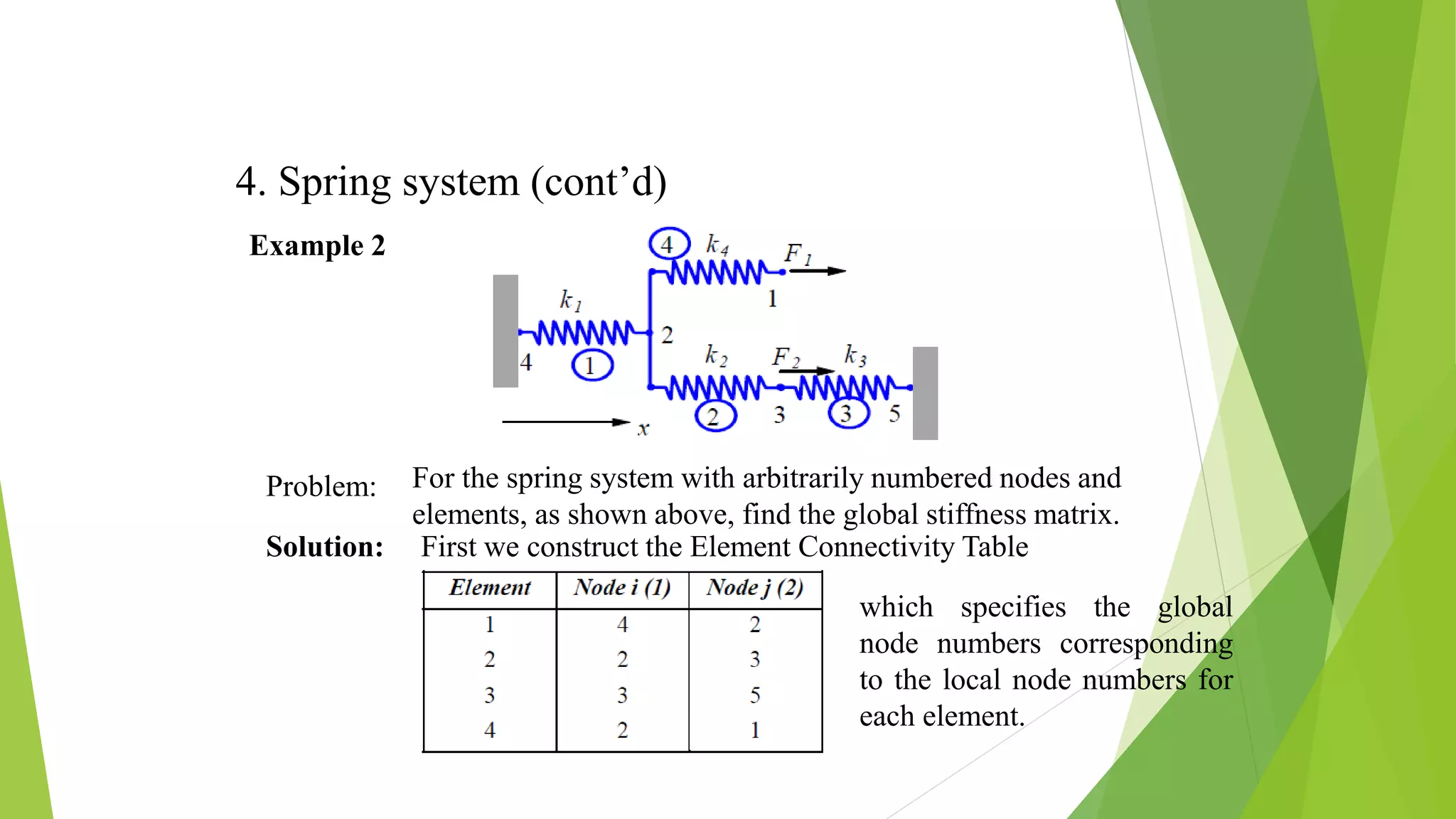
Example 2
Problem: For the spring system with arbitrarily numbered nodes and
elements, as shown above, find the global stiffness matrix.
Solution: First we construct the Element Connectivity Table
which specifies the global
node numbers corresponding
to the local node numbers for
each element.
4. Spring system (cont’d)
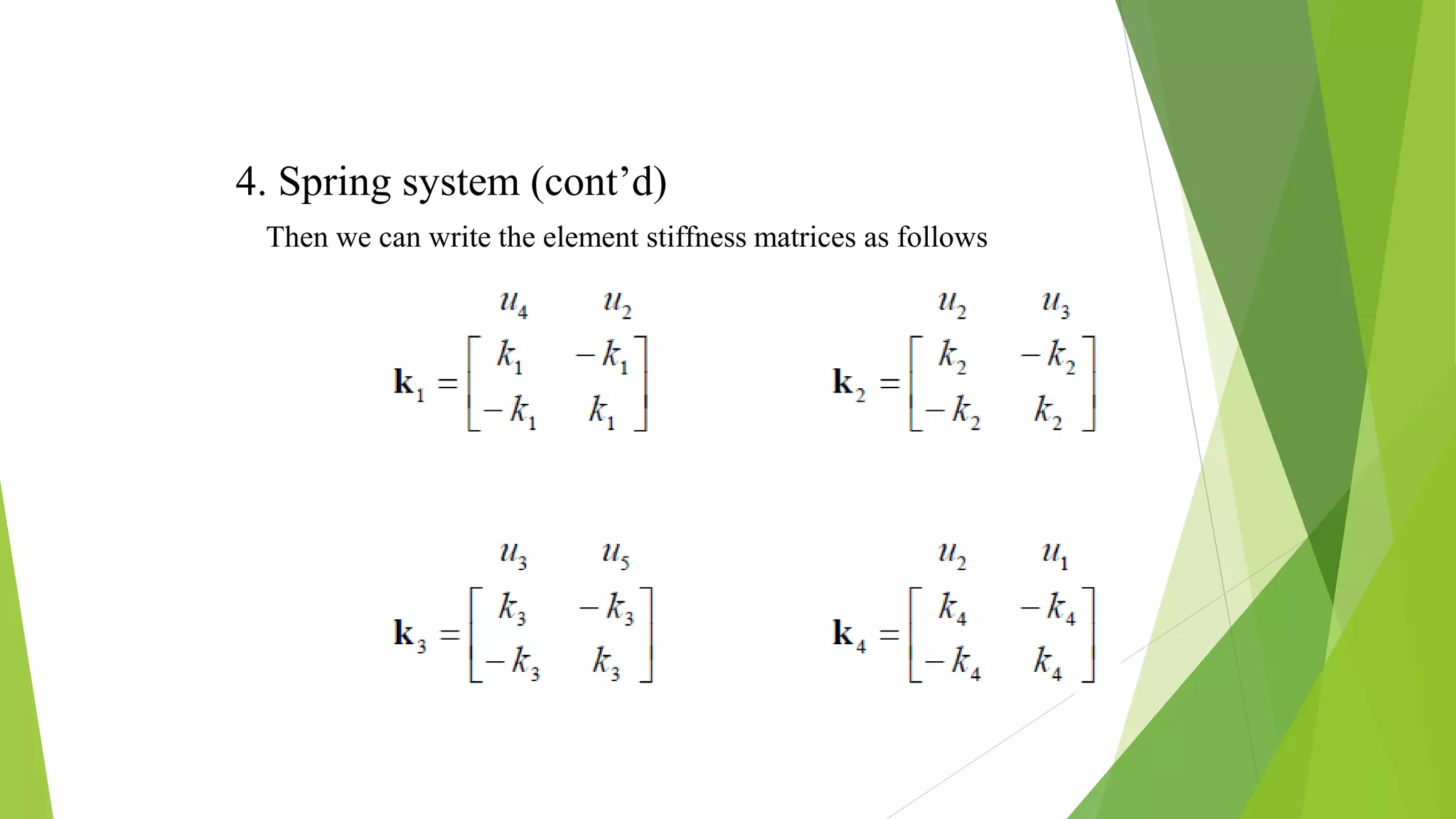
Then we can write the element stiffness matrices as follows
4. Spring system (cont’d)
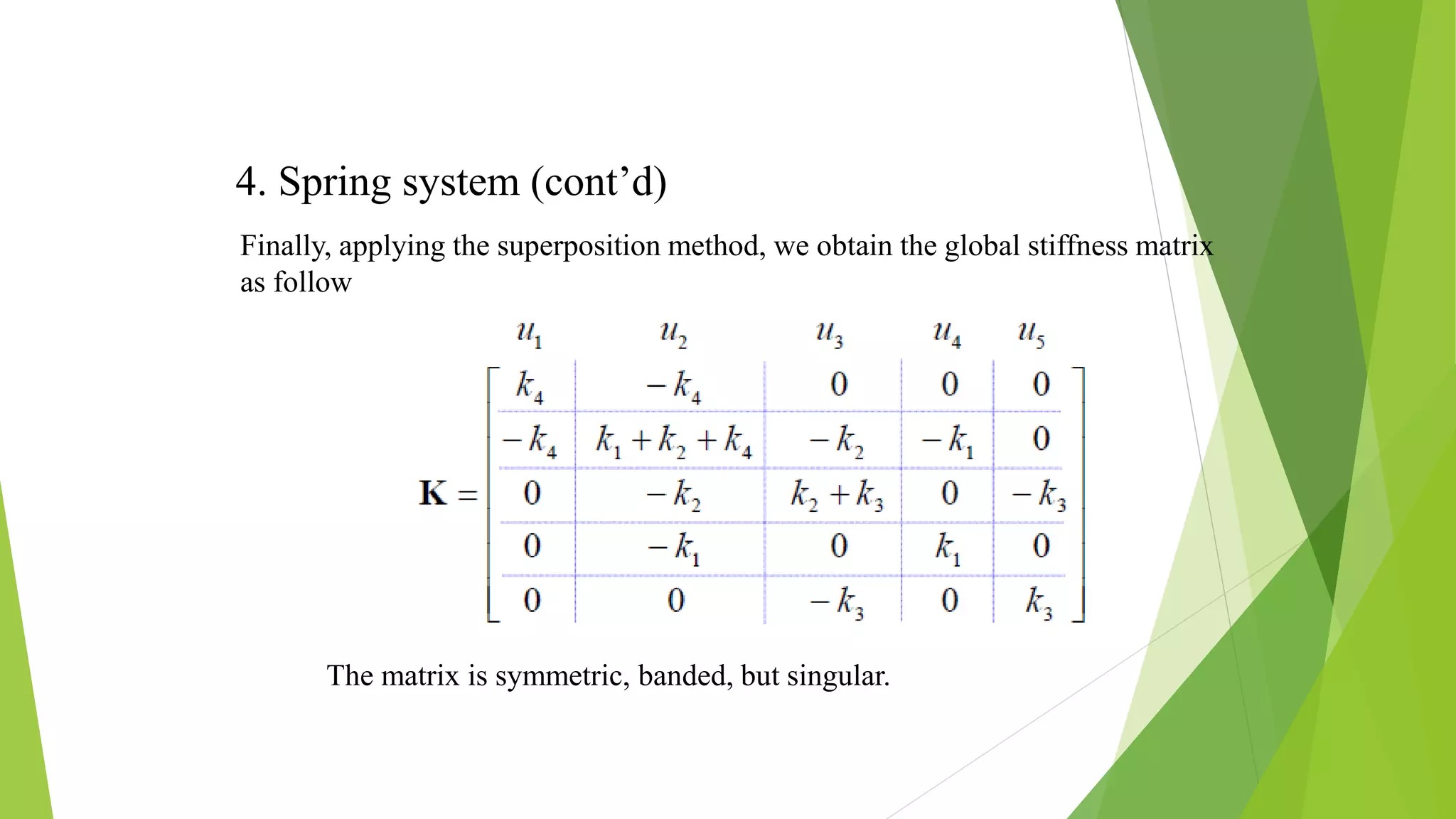
Finally, applying the superposition method, we obtain the global stiffness matrix
as follow
The matrix is symmetric, banded, but singular.
Thanks!
&
Questions?

Introduction fea

  • 1.
    Lecture 1:Introduction toFEA School of Mechanical Engineering
  • 2.
    Basic Concepts1 Content Review ofMatrix Algebra2 Spring Element3 Spring System4
  • 3.
    Basic idea: buildinga complicated object with simple blocks, or, dividing a complicated object into small and manageable pieces Approximation of the area of a circle Area of one triangle: Area of the circle: Observation: Complicated or smooth objects can be represented by geometrically simple pieces (elements). 1.1 FINITE ELEMENT ANALYSIS
  • 4.
    What is FEA? FEA is a method for numerical solution of field problems;  A field problem requires that we determine the spatial distribution of one or more dependent variables;  FEA provides an approximate solution  Individual finite elements can be visualized as small pieces of a structure  In each element a field quantity has a simple spatial variation, described by polynomial terms.  Elements are connected at points called nodes  The assemblage of elements is called a finite element structure  The particular arrangement of elements is called a mesh  Nodal unknowns are values of the field quantity  The solution for nodal quantities completely determines the spatial variation of the field in that element  The field quantity over the entire structure is approximated element by element, in piecewise fashion.
  • 5.
    A two-dimensional modelof a gear tooth.
  • 6.
    Applications of FEMin Engineering  Mechanical/Aerospace/Civil/Automobile Engineering  Structure analysis (static/dynamic, linear/nonlinear)  Thermal/fluid flows  Electromagnetics  Geomechanics  Biomechanics Modeling of gear coupling
  • 7.
  • 8.
  • 9.
    Bird striking thewing of airplane
  • 10.
  • 11.
    A Brief Historyof the FEM  1851, Schellbach discretized a surface into right triangles and wrote a finite difference expression for the total discretized area to derive the differential equation of the surface of minimum area.  Starting in 1906, researchers noted that a framework having many bars in a regular pattern behaves much like an isotropic elastic body. The framework method may be regarded as a precursor to FEA.  1943,Courant determined the torsional rigidity of a hollow shaft by dividing the cross section into triangles and interpolating a stress function linearly over each triangle from values at net-points.  1956 , Turner devised a three-node triangular element to model the wing skin.  1960 , Clough (“Finite Element”, plane problems)
  • 12.
     In1963, FEAacquired respectability in academia when it was recognized as a form of the Rayleigh-Ritz method, a classical approximation technique. Thus FEA was seen not just as a special trick for stress analysis but as a widely applicable method having a sound mathematical basis.  1970s ----- Applications on mainframe computers  1980s ----- Microcomputers, pre- and postprocessors  1990s ----- Analysis of large structural systems
  • 13.
    FEM in StructuralAnalysis (The Procedure)  Divide structure into pieces (elements with nodes)  Describe the behavior of the physical quantities on each element  Connect (assemble) the elements at the nodes to form an approximate system of equations for the whole structure  Solve the system of equations involving unknown quantities at the nodes (e.g., displacements)  Calculate desired quantities (e.g., strains and stresses) at selected elements
  • 14.
    Computer Implementations  Preprocessing(build FE model, loads and constraints)  FEA solver (assemble and solve the system of equations)  Postprocessing (sort and display the results) Available Commercial FEM Software Packages  ANSYS (General purpose, PC and workstations)  SDRC/I-DEAS (Complete CAD/CAM/CAE package)  NASTRAN (General purpose FEA on mainframes)  ABAQUS (Nonlinear and dynamic analyses)  COSMOS (General purpose FEA)  ALGOR (PC and workstations)  PATRAN (Pre/Post Processor)  HyperMesh (Pre/Post Processor)  Dyna-3D (Crash/impact analysis)
  • 15.
    2. Review ofMatrix Algebra Linear System of Algebraic Equations where x1, x2, ..., xn are the unknowns In matrix form: Ax =b where
  • 16.
    Row and ColumnVectors Matrix Addition and Subtraction For two matrices A and B, both of the same size (m×n), the addition and subtraction are defined : Scalar Multiplication
  • 17.
    Matrix Multiplication For twomatrices A (of size l×m) and B (of size m×n), the product of AB is defined by where i = 1, 2, ..., l; j = 1, 2, ..., n. Transpose of a Matrix If A = [aij], then the transpose of A is
  • 18.
    Symmetric Matrix A square(n×n) matrix A is called symmetric, if Unit (Identity) Matrix AI = A Ix = x
  • 19.
    The determinant ofsquare matrix A is a scalar number denoted by det A or |A|. For 2×2 and 3×3 matrices, their determinants are given by Determinant of a Matrix
  • 20.
    Singular Matrix A squarematrix A is singular if det A = 0, which indicates problems in the systems (nonunique solutions, degeneracy, etc.) Matrix Inversion For a square and nonsingular matrix A (detA≠0), its inverse A-1 is constructed in such a way that The cofactor matrix C of matrix A is defined by where Mij is the determinant of the smaller matrix obtained by eliminating the ith row and jth column of A
  • 21.
    The inverse ofA can be determined by Examples:
  • 23.
    Linear System ofAlgebraic Equations Ax =b The solution Solution Techniques for Linear Systems of Equations Gauss elimination methods Iterative methods Positive Definite Matrix A square (n×n) matrix A is said to be positive definite, if for all nonzero vector x of dimension n Note : positive definite matrices are nonsingular
  • 24.
    Differentiation and Integrationof a Matrix Differentiation Integration
  • 25.
    Types of FiniteElements 1-D (Line) Element (Spring, truss, beam, pipe, etc.) 2-D (Plane) Element (Membrane, plate, shell, etc.) 3-D (Solid) Element (3-D fields - temperature, displacement, stress, flow velocity)
  • 26.
    3. Spring element Twonodes: Nodal displacement: Nodal forces: Spring stiffness: ji, ji uu , ji ff , k Force-displacement relation:  kF ij uu  F Spring force — Elongation
  • 27.
    Considering the forceequilibrium at node i and j: ( )i j i i jf F k u u ku ku       jiijj kukuuukFf  )( In matrix form:                      j i j i u u kk kk f f 3. Spring element (cont’d) if Fi jfF j
  • 28.
    Discussions: or: Nodal force vector where:    f d k Elementdisplacement vector Element stiffness matrix kdf  1) Is k symmetric ? 2) Is k singular? 3)What is the meaning of each matrix element?                      j i j i u u kk kk f f 3. Spring element (cont’d)
  • 29.
    Equilibrium equations: For element2: 4. Spring system For element 1: Element 1 Element 2 denotes the spring force acting on local node i of element mi m f
  • 30.
    1)Assemble the stiffnessmatrix from equilibrium equations That’s: 4. Spring system (cont’d) Equilibrium equations at three nodes: 1 1 1 1 2 2 2 2 2 3 3 F f F f f F f     32223 32221112 21111 )( ukukF ukukkukF ukukF    1 1f 1F 1 1 2f 2 2 2f 2F 3F2 3f 3
  • 31.
    In matrix form: orFKD  K —— Stiffness matrix of the spring system F —— Nodal force vector D —— Displacement vector of the spring system 4. Spring system (cont’d)
  • 32.
    2)An alternative wayof assembling the whole stiffness matrix 4. Spring system (cont’d) Enlarge the stiffness matrix for element 1 and 2
  • 33.
    or Adding two matrixequations,we have 4. Spring system (cont’d)
  • 34.
    3)Boundary and loadcondition Equilibrium equations: PFF u   32 1 0Boundary : Load condition: 4. Spring system (cont’d)
  • 35.
    Reduce the equilibriumequations to : Unknowns: Solving equations, we get: u2,u3 , F1 4. Spring system (cont’d)
  • 36.
    4. Spring system(cont’d) Example 1 Given: Find: (a) the global stiffness matrix (b) displacements of nodes 2 and 3 (c) the reaction forces at nodes 1 and 4 (d) the force in the spring 2
  • 37.
    4. Spring system(cont’d) Solution: (a) The element stiffness matrices are
  • 38.
    4. Spring system(cont’d) Applying the superposition concept, we obtain the global stiffness matrix for the spring system as which is symmetric and banded
  • 39.
    4. Spring system(cont’d) Equilibrium (FE) equation for the whole system is (b) Applying the BC (u1=u4=0) or deleting the 1st and 4th rows and columns, we have
  • 40.
    4. Spring system(cont’d) Solving equation, we obtain (c) we get the reaction forces (d) The FE equation for spring (element) 2 is
  • 41.
    4. Spring system(cont’d) Here i = 2, j = 3 for element 2. Thus we can calculate the spring force as
  • 42.
    4. Spring system(cont’d) Example 2 Problem: For the spring system with arbitrarily numbered nodes and elements, as shown above, find the global stiffness matrix. Solution: First we construct the Element Connectivity Table which specifies the global node numbers corresponding to the local node numbers for each element.
  • 43.
    4. Spring system(cont’d) Then we can write the element stiffness matrices as follows
  • 44.
    4. Spring system(cont’d) Finally, applying the superposition method, we obtain the global stiffness matrix as follow The matrix is symmetric, banded, but singular.
  • 45.