
ID3 Algorithm &
 ROC Analysis
     Talha KABAKUŞ
talha.kabakus@ibu.edu.tr
Agenda
●   Where are we now?
●   Decision Trees
●   What is ID3?
●   Entropy
●   Information Gain
●   Pros and Cons of ID3
●   An Example - The Simpsons
●   What is ROC Analysis?
●   ROC Space
●   ROC Space Example over predictions
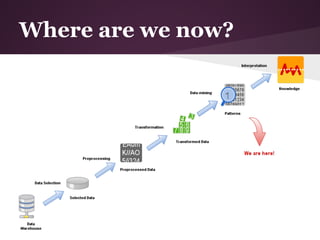
Where are we now?
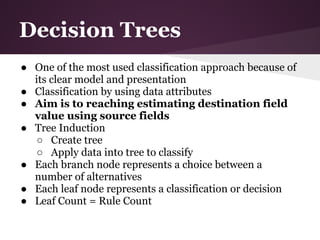
Decision Trees
● One of the most used classification approach because of
  its clear model and presentation
● Classification by using data attributes
● Aim is to reaching estimating destination field
  value using source fields
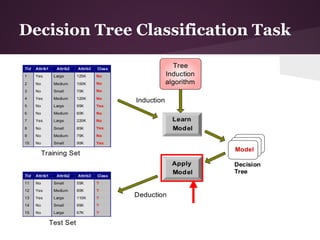
● Tree Induction
  ○ Create tree
  ○ Apply data into tree to classify
● Each branch node represents a choice between a
  number of alternatives
● Each leaf node represents a classification or decision
● Leaf Count = Rule Count
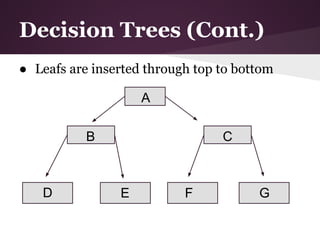
Decision Trees (Cont.)
● Leafs are inserted through top to bottom

                    A

           B                     C


   D            E          F           G
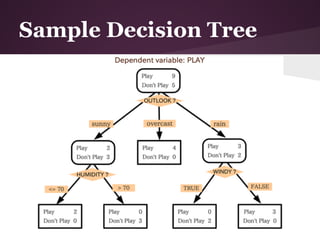
Sample Decision Tree
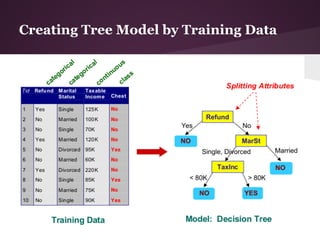
Creating Tree Model by Training Data
Decision Tree Classification Task
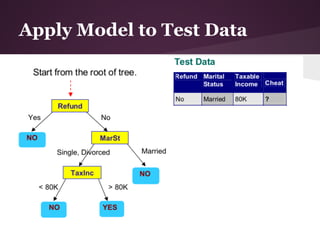
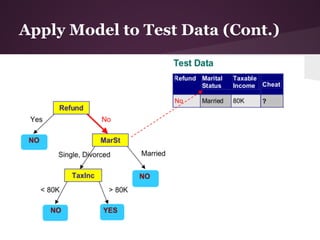
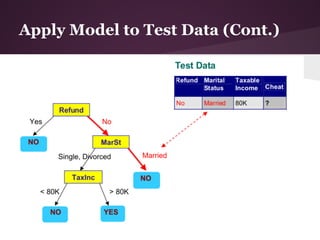
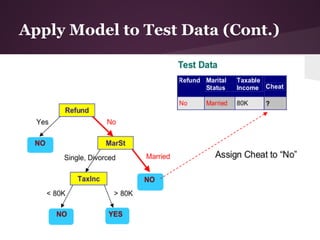
Apply Model to Test Data
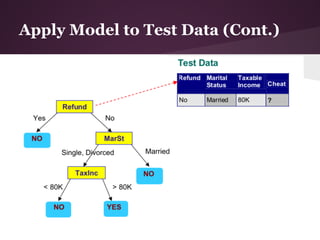
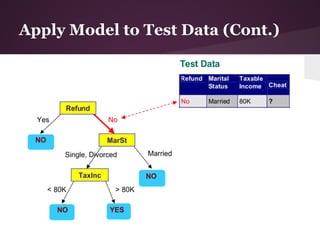
Apply Model to Test Data (Cont.)
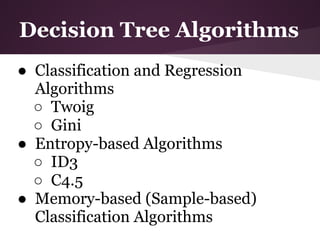
Decision Tree Algorithms
● Classification and Regression
  Algorithms
  ○ Twoig
  ○ Gini
● Entropy-based Algorithms
  ○ ID3
  ○ C4.5
● Memory-based (Sample-based)
  Classification Algorithms
Decision Trees by Variable Type

● Single Variable Decision Trees
  ○ Classifications are done with asking
     questions over only one variable
● Hybrid Decision Trees
  ○ Classifications are done with asking
     questions over both single and multiple
     variables
● Multiple Variables Decision Trees
  ○ Classifications are done with asking
     questions over multiple variables
ID3 Algorithm
●   Iterative Dichotomizer 3
●   Developed by J. Ross Quinlan in 1979
●   Based on Entropy
●   Only works for discrete data
●   Can not work with defective data
●   Advantage over Hunt's algorithm is choosing
    the right attribute while classification.
    (Hunt's algorithm chooses randomly)
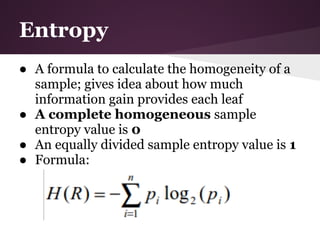
Entropy
● A formula to calculate the homogeneity of a
  sample; gives idea about how much
  information gain provides each leaf
● A complete homogeneous sample
  entropy value is 0
● An equally divided sample entropy value is 1
● Formula:
Information Gain (IG)
● Information Gain calculates effective change
  in entropy after making a decision based on
  the value of an attribute.
● Which attribute creates the most
  homogeneous branches?
● First the entropy of the total dataset is
  calculated.
● The dataset is then split on the different
  attributes.
Information Gain (Cont.)
● The entropy for each branch is calculated.
  Then it is added proportionally, to get total
  entropy for the split.
● The resulting entropy is subtracted from the
  entropy before the split.
● The result is the Information Gain, or
  decrease in entropy.
● The attribute that yields the largest IG is
  chosen for the decision node.
Information Gain (Cont.)
● A branch set with entropy of 0 is a
  leaf node.
● Otherwise, the branch needs further
  splitting to classify its dataset.
● The ID3 algorithm is run recursively
  on the non-leaf branches, until all data
  is classified.
ID3 Algorithm Steps
function ID3 (R: a set of non-categorical attributes,
          C: the categorical attribute,
          S: a training set) returns a decision tree;
   begin
    If S is empty, return a single node with value Failure;
    If S consists of records all with the same value for
       the categorical attribute,
       return a single node with that value;
    If R is empty, then return a single node with as value
       the most frequent of the values of the categorical attribute
       that are found in records of S; [note that then there
       will be errors, that is, records that will be improperly
       classified];
    Let D be the attribute with largest Gain( D,S)
       among attributes in R;
    Let {dj| j=1,2, .., m} be the values of attribute D;
    Let {Sj| j=1,2, .., m} be the subsets of S consisting
       respectively of records with value dj for attribute D;
    Return a tree with root labeled D and arcs labeled
       d1, d2, .., dm going respectively to the trees

         ID3(R-{D}, C, S1), ID3(R-{D}, C, S2), .., ID3(R-{D}, C, Sm);
   end ID3;
Pros of ID3 Algorithm
● Builds decision tree in min. steps
  ○ The most important point while tree
    induction is collecting enough reliable
    associated data over specific properties.
  ○ Asking right questions determines tree
    induction.
● Each level benefits from previous level
  choices
● Whole dataset is scanned to create tree
Cons of ID3 Algorithm
● Tree can not be updated when new
  data is classified incorrectly, instead
  a new tree must be generated.
● Only one attribute at a time is tested
  for making a decision.
● Can not work with defective data
● Can not work with numerical
  attributes
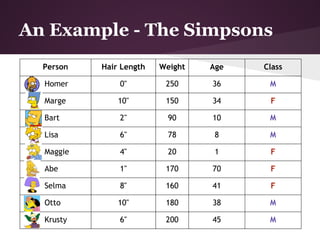
An Example - The Simpsons
  Person   Hair Length   Weight   Age   Class

  Homer        0''        250     36     M

  Marge        10''       150     34     F

  Bart         2''         90     10     M

  Lisa         6''         78      8     M

  Maggie       4''         20      1     F

  Abe          1''        170     70     F

  Selma        8''        160     41     F

  Otto         10''       180     38     M

  Krusty       6''        200     45     M
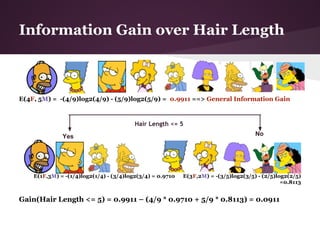
Information Gain over Hair Length


E(4F, 5M) = -(4/9)log2(4/9) - (5/9)log2(5/9) = 0.9911 ==> General Information Gain


                                         Hair Length <= 5

              Yes                                                                    No


    E(1F,3M) = -(1/4)log2(1/4) - (3/4)log2(3/4) = 0.9710   E(3F,2M) = -(3/5)log2(3/5) - (2/5)log2(2/5)
                                                                                               =0.8113


Gain(Hair Length <= 5) = 0.9911 – (4/9 * 0.9710 + 5/9 * 0.8113) = 0.0911
Information Gain over Weight


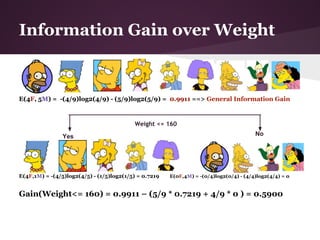
E(4F, 5M) = -(4/9)log2(4/9) - (5/9)log2(5/9) = 0.9911 ==> General Information Gain


                                          Weight <= 160

                Yes                                                                     No


E(4F,1M) = -(4/5)log2(4/5) - (1/5)log2(1/5) = 0.7219   E(0F,4M) = -(0/4)log2(0/4) - (4/4)log2(4/4) = 0


Gain(Weight<= 160) = 0.9911 – (5/9 * 0.7219 + 4/9 * 0 ) = 0.5900
Information Gain over Age


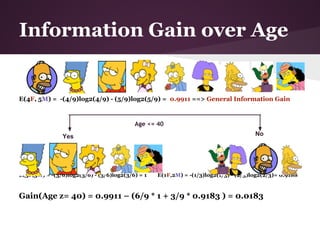
E(4F, 5M) = -(4/9)log2(4/9) - (5/9)log2(5/9) = 0.9911 ==> General Information Gain


                                          Age <= 40

                Yes                                                                  No


E(3F,3M) = -(3/6)log2(3/6) - (3/6)log2(3/6) = 1   E(1F,2M) = -(1/3)log2(1/3) - (2/3)log2(2/3)= 0.9188


Gain(Age z= 40) = 0.9911 – (6/9 * 1 + 3/9 * 0.9183 ) = 0.0183
Results
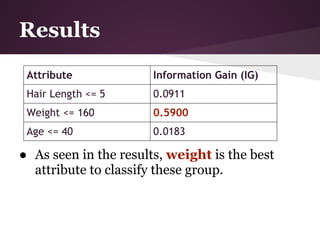
 Attribute             Information Gain (IG)
 Hair Length <= 5      0.0911
 Weight <= 160         0.5900
 Age <= 40             0.0183

● As seen in the results, weight is the best
  attribute to classify these group.
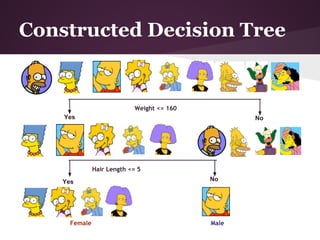
Constructed Decision Tree


                             Weight <= 160
    Yes                                             No


               Hair Length <= 5

    Yes                                      No


      Female                                 Male
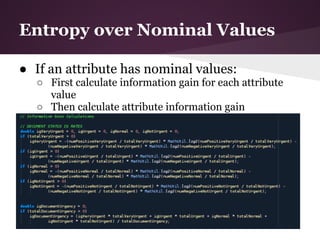
Entropy over Nominal Values

● If an attribute has nominal values:
  ○ First calculate information gain for each attribute
    value
  ○ Then calculate attribute information gain
Example II


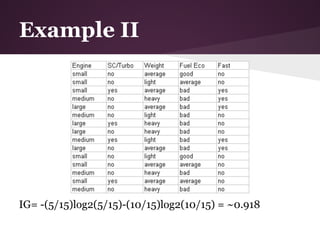
IG= -(5/15)log2(5/15)-(10/15)log2(10/15) = ~0.918
Example II (Cont.)
            Information Gain over Engine
 ● Engine: 6 small, 5 medium, 4 large
 ● 3 values for attribute engine, so we need 3 entropy
    calculations
 ● small: 5 no, 1 yes
    ○ IGsmall = -(5/6)log2(5/6)-(1/6)log2(1/6) = ~0.65
 ● medium: 3 no, 2 yes
    ○ IGmedium = -(3/5)log2(3/5)-(2/5)log2(2/5) = ~0.97
 ● large: 2 no, 2 yes
    ○ IGlarge = 1 (evenly distributed subset)
=> IGEngine = IE(S) – [(6/15)*IGsmall + (5/15)*IGmedium +
(4/15)*Ilarge]
    = IGEngine = 0.918 – 0.85 = 0.068
Example II (Cont.)
          Information Gain over SC/Turbo
● SC/Turbo: 4 yes, 11 no
● 2 values for attribute SC/Turbo, so we need 2 entropy
  calculations
● yes: 2 yes, 2 no
  ○ IGturbo = 1 (evenly distributed subset)
● no: 3 yes, 8 no
  ○ IGnoturbo = -(3/11)log2(3/11)-(8/11)log2(8/11) = ~0.84

  IGturbo = IE(S) – [(4/15)*IGturbo + (11/15)*IGnoturbo]
  IGturbo = 0.918 – 0.886 = 0.032
Example II (Cont.)
              Information Gain over Weight
● Weight: 6 Average, 4 Light, 5 Heavy
● 3 values for attribute weight, so we need 3 entropy
  calculations
● average: 3 no, 3 yes
   ○ IGaverage = 1 (evenly distributed subset)
● light: 3 no, 1 yes
   ○ IGlight = -(3/4)log2(3/4)-(1/4)log2(1/4) = ~0.81
● heavy: 4 no, 1 yes
   ○ IGheavy = -(4/5)log2(4/5)-(1/5)log2(1/5) = ~0.72

   IGWeight = IE(S) – [(6/15)*IGaverage + (4/15)*IGlight + (5/15)*IGheavy]
   IGWeight = 0.918 – 0.856 = 0.062
Example II (Cont.)
             Information Gain over Full Eco
● Fuel Economy: 2 good, 3 average, 10 bad
● 3 values for attribute Fuel Eco, so we need 3 entropy
  calculations
● good: 0 yes, 2 no
  ○ IGgood = 0 (no variability)
● average: 0 yes, 3 no
  ○ IGaverage = 0 (no variability)
● bad: 5 yes, 5 no
  ○ IGbad = 1 (evenly distributed subset)
    We can omit calculations for good and average since they always
end up not fast.
    IGFuelEco = IE(S) – [(10/15)*IGbad]
    IGFuelEco = 0.918 – 0.667 = 0.251
Example II (Cont.)
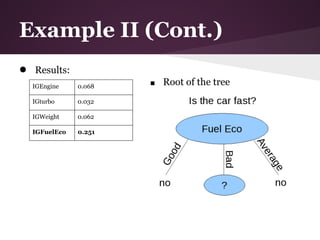
●   Results:
    IGEngine    0.068
                        ■   Root of the tree
    IGturbo     0.032

    IGWeight    0.062

    IGFuelEco   0.251
Example II (Cont.)
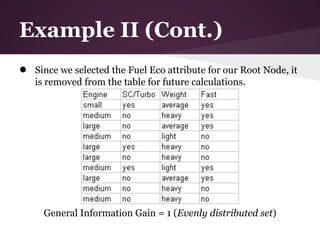
●   Since we selected the Fuel Eco attribute for our Root Node, it
    is removed from the table for future calculations.


      General Information Gain = 1 (Evenly distributed set)
Example II (Cont.)
              Information Gain over Engine
● Engine: 1 small, 5 medium, 4 large
● 3 values for attribute engine, so we need 3 entropy calculations
● small: 1 yes, 0 no
   ○ IGsmall = 0 (no variability)
● medium: 2 yes, 3 no
   ○ IGmedium = -(2/5)log2(2/5)-(3/5)log2(3/5) = ~0.97
● large: 2 no, 2 yes
   ○ IGlarge = 1 (evenly distributed subset)

   IGEngine = IE(SFuelEco) – (5/10)*IGmedium + (4/10)*IGlarge]
   IGEngine = 1 – 0.885 = 0.115
Example II (Cont.)
            Information Gain over SC/Turbo
● SC/Turbo: 3 yes, 7 no
● 2 values for attribute SC/Turbo, so we need 2 entropy calculations
● yes: 2 yes, 1 no
   ○ IGturbo = -(2/3)log2(2/3)-(1/3)log2(1/3) = ~0.84
● no: 3 yes, 4 no
   ○ IGnoturbo = -(3/7)log2(3/7)-(4/7)log2(4/7) = ~0.84

   IGturbo = IE(SFuelEco) – [(3/10)*IGturbo + (7/10)*IGnoturbo]
   IGturbo = 1 – 0.965 = 0.035
Example II (Cont.)
              Information Gain over Weight
● Weight: 3 average, 5 heavy, 2 light
● 3 values for attribute weight, so we need 3 entropy calculations
● average: 3 yes, 0 no
   ○ IGaverage = 0 (no variability)
● heavy: 1 yes, 4 no
   ○ IGheavy = -(1/5)log2(1/5)-(4/5)log2(4/5) = ~0.72
● light: 1 yes, 1 no
   ○ IlGight = 1 (evenly distributed subset)

   IGEngine = IE(SFuel Eco) – [(5/10)*IGheavy+(2/10)*IGlight]
   IGEngine = 1 – 0.561 = 0.439
Example II (Cont.)
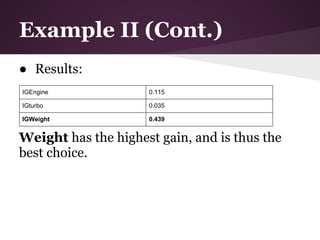
● Results:
IGEngine             0.115

IGturbo              0.035

IGWeight             0.439


Weight has the highest gain, and is thus the
best choice.
Example II (Cont.)
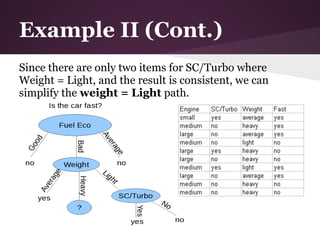
Since there are only two items for SC/Turbo where
Weight = Light, and the result is consistent, we can
simplify the weight = Light path.
Example II (Cont.)
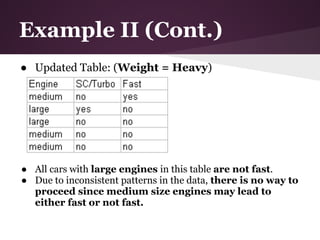
● Updated Table: (Weight = Heavy)


● All cars with large engines in this table are not fast.
● Due to inconsistent patterns in the data, there is no way to
  proceed since medium size engines may lead to
  either fast or not fast.
ROC Analysis
● Receiver Operating Characteristic
● The limitations of diagnostic “accuracy” as a measure
  of decision performance require introduction of the
  concepts of the “sensitivity” and “specificity” of a
  diagnostic test. These measures and the related
  indices, “true positive rate” and “false positive
  rate”, are more meaningful than “accuracy”.
● ROC curve is shown to be a complete description of
  this decision threshold effect, indicating all possible
  combinations of the relative frequencies of the various
  kinds of correct and incorrect decisions.
ROC Analysis (Cont.)
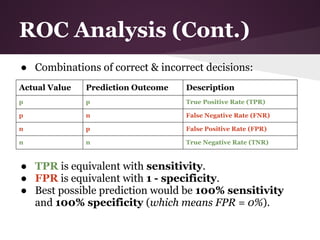
● Combinations of correct & incorrect decisions:
Actual Value   Prediction Outcome   Description
p              p                    True Positive Rate (TPR)

p              n                    False Negative Rate (FNR)

n              p                    False Positive Rate (FPR)

n              n                    True Negative Rate (TNR)


● TPR is equivalent with sensitivity.
● FPR is equivalent with 1 - specificity.
● Best possible prediction would be 100% sensitivity
  and 100% specificity (which means FPR = 0%).
ROC Space
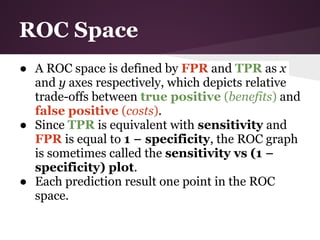
● A ROC space is defined by FPR and TPR as x
  and y axes respectively, which depicts relative
  trade-offs between true positive (benefits) and
  false positive (costs).
● Since TPR is equivalent with sensitivity and
  FPR is equal to 1 − specificity, the ROC graph
  is sometimes called the sensitivity vs (1 −
  specificity) plot.
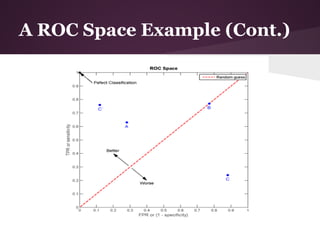
● Each prediction result one point in the ROC
  space.
Calculations
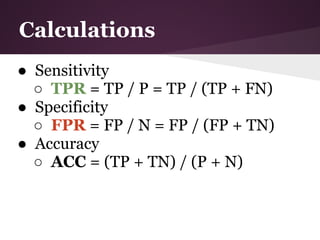
● Sensitivity
  ○ TPR = TP / P = TP / (TP + FN)
● Specificity
  ○ FPR = FP / N = FP / (FP + TN)
● Accuracy
  ○ ACC = (TP + TN) / (P + N)
A ROC Space Example
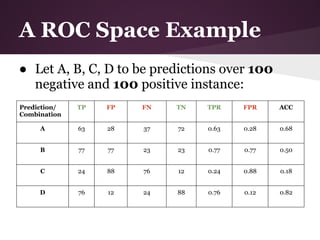
● Let A, B, C, D to be predictions over 100
  negative and 100 positive instance:
Prediction/   TP   FP   FN   TN   TPR    FPR    ACC
Combination

     A        63   28   37   72   0.63   0.28   0.68


     B        77   77   23   23   0.77   0.77   0.50


     C        24   88   76   12   0.24   0.88   0.18


     D        76   12   24   88   0.76   0.12   0.82
A ROC Space Example (Cont.)
References
1. Data Mining Course Lectures, Ass. Prof. Nilüfer
   Yurtay
2. Quinlan, J.R. 1986, Machine Learning, 1, 81
3. http://www.cse.unsw.edu.
   au/~billw/cs9414/notes/ml/06prop/id3/id3.html
4. J. Han, M. Kamber, J. Pie, Data Mining Concepts and
   Techniques, 3rd Edition, Elsevier, 2011.
5. http://www.cise.ufl.edu/~ddd/cap6635/Fall-
   97/Short-papers/2.htm
6. C. E. Metz, Basic Principles of ROC Analysis,
   Seminars in Nuclear Medicine, Volume 8, Issue 4, P
   283-298

ID3 Algorithm & ROC Analysis

  • 1.
    ID3 Algorithm & ROC Analysis Talha KABAKUŞ talha.kabakus@ibu.edu.tr
  • 2.
    Agenda ● Where are we now? ● Decision Trees ● What is ID3? ● Entropy ● Information Gain ● Pros and Cons of ID3 ● An Example - The Simpsons ● What is ROC Analysis? ● ROC Space ● ROC Space Example over predictions
  • 3.
  • 4.
    Decision Trees ● Oneof the most used classification approach because of its clear model and presentation ● Classification by using data attributes ● Aim is to reaching estimating destination field value using source fields ● Tree Induction ○ Create tree ○ Apply data into tree to classify ● Each branch node represents a choice between a number of alternatives ● Each leaf node represents a classification or decision ● Leaf Count = Rule Count
  • 5.
    Decision Trees (Cont.) ●Leafs are inserted through top to bottom A B C D E F G
  • 6.
  • 7.
    Creating Tree Modelby Training Data
  • 8.
  • 9.
    Apply Model toTest Data
  • 10.
    Apply Model toTest Data (Cont.)
  • 11.
    Apply Model toTest Data (Cont.)
  • 12.
    Apply Model toTest Data (Cont.)
  • 13.
    Apply Model toTest Data (Cont.)
  • 14.
    Apply Model toTest Data (Cont.)
  • 15.
    Decision Tree Algorithms ●Classification and Regression Algorithms ○ Twoig ○ Gini ● Entropy-based Algorithms ○ ID3 ○ C4.5 ● Memory-based (Sample-based) Classification Algorithms
  • 16.
    Decision Trees byVariable Type ● Single Variable Decision Trees ○ Classifications are done with asking questions over only one variable ● Hybrid Decision Trees ○ Classifications are done with asking questions over both single and multiple variables ● Multiple Variables Decision Trees ○ Classifications are done with asking questions over multiple variables
  • 17.
    ID3 Algorithm ● Iterative Dichotomizer 3 ● Developed by J. Ross Quinlan in 1979 ● Based on Entropy ● Only works for discrete data ● Can not work with defective data ● Advantage over Hunt's algorithm is choosing the right attribute while classification. (Hunt's algorithm chooses randomly)
  • 18.
    Entropy ● A formulato calculate the homogeneity of a sample; gives idea about how much information gain provides each leaf ● A complete homogeneous sample entropy value is 0 ● An equally divided sample entropy value is 1 ● Formula:
  • 19.
    Information Gain (IG) ●Information Gain calculates effective change in entropy after making a decision based on the value of an attribute. ● Which attribute creates the most homogeneous branches? ● First the entropy of the total dataset is calculated. ● The dataset is then split on the different attributes.
  • 20.
    Information Gain (Cont.) ●The entropy for each branch is calculated. Then it is added proportionally, to get total entropy for the split. ● The resulting entropy is subtracted from the entropy before the split. ● The result is the Information Gain, or decrease in entropy. ● The attribute that yields the largest IG is chosen for the decision node.
  • 21.
    Information Gain (Cont.) ●A branch set with entropy of 0 is a leaf node. ● Otherwise, the branch needs further splitting to classify its dataset. ● The ID3 algorithm is run recursively on the non-leaf branches, until all data is classified.
  • 22.
    ID3 Algorithm Steps functionID3 (R: a set of non-categorical attributes, C: the categorical attribute, S: a training set) returns a decision tree; begin If S is empty, return a single node with value Failure; If S consists of records all with the same value for the categorical attribute, return a single node with that value; If R is empty, then return a single node with as value the most frequent of the values of the categorical attribute that are found in records of S; [note that then there will be errors, that is, records that will be improperly classified]; Let D be the attribute with largest Gain( D,S) among attributes in R; Let {dj| j=1,2, .., m} be the values of attribute D; Let {Sj| j=1,2, .., m} be the subsets of S consisting respectively of records with value dj for attribute D; Return a tree with root labeled D and arcs labeled d1, d2, .., dm going respectively to the trees ID3(R-{D}, C, S1), ID3(R-{D}, C, S2), .., ID3(R-{D}, C, Sm); end ID3;
  • 23.
    Pros of ID3Algorithm ● Builds decision tree in min. steps ○ The most important point while tree induction is collecting enough reliable associated data over specific properties. ○ Asking right questions determines tree induction. ● Each level benefits from previous level choices ● Whole dataset is scanned to create tree
  • 24.
    Cons of ID3Algorithm ● Tree can not be updated when new data is classified incorrectly, instead a new tree must be generated. ● Only one attribute at a time is tested for making a decision. ● Can not work with defective data ● Can not work with numerical attributes
  • 25.
    An Example -The Simpsons Person Hair Length Weight Age Class Homer 0'' 250 36 M Marge 10'' 150 34 F Bart 2'' 90 10 M Lisa 6'' 78 8 M Maggie 4'' 20 1 F Abe 1'' 170 70 F Selma 8'' 160 41 F Otto 10'' 180 38 M Krusty 6'' 200 45 M
  • 26.
    Information Gain overHair Length E(4F, 5M) = -(4/9)log2(4/9) - (5/9)log2(5/9) = 0.9911 ==> General Information Gain Hair Length <= 5 Yes No E(1F,3M) = -(1/4)log2(1/4) - (3/4)log2(3/4) = 0.9710 E(3F,2M) = -(3/5)log2(3/5) - (2/5)log2(2/5) =0.8113 Gain(Hair Length <= 5) = 0.9911 – (4/9 * 0.9710 + 5/9 * 0.8113) = 0.0911
  • 27.
    Information Gain overWeight E(4F, 5M) = -(4/9)log2(4/9) - (5/9)log2(5/9) = 0.9911 ==> General Information Gain Weight <= 160 Yes No E(4F,1M) = -(4/5)log2(4/5) - (1/5)log2(1/5) = 0.7219 E(0F,4M) = -(0/4)log2(0/4) - (4/4)log2(4/4) = 0 Gain(Weight<= 160) = 0.9911 – (5/9 * 0.7219 + 4/9 * 0 ) = 0.5900
  • 28.
    Information Gain overAge E(4F, 5M) = -(4/9)log2(4/9) - (5/9)log2(5/9) = 0.9911 ==> General Information Gain Age <= 40 Yes No E(3F,3M) = -(3/6)log2(3/6) - (3/6)log2(3/6) = 1 E(1F,2M) = -(1/3)log2(1/3) - (2/3)log2(2/3)= 0.9188 Gain(Age z= 40) = 0.9911 – (6/9 * 1 + 3/9 * 0.9183 ) = 0.0183
  • 29.
    Results Attribute Information Gain (IG) Hair Length <= 5 0.0911 Weight <= 160 0.5900 Age <= 40 0.0183 ● As seen in the results, weight is the best attribute to classify these group.
  • 30.
    Constructed Decision Tree Weight <= 160 Yes No Hair Length <= 5 Yes No Female Male
  • 31.
    Entropy over NominalValues ● If an attribute has nominal values: ○ First calculate information gain for each attribute value ○ Then calculate attribute information gain
  • 32.
  • 33.
    Example II (Cont.) Information Gain over Engine ● Engine: 6 small, 5 medium, 4 large ● 3 values for attribute engine, so we need 3 entropy calculations ● small: 5 no, 1 yes ○ IGsmall = -(5/6)log2(5/6)-(1/6)log2(1/6) = ~0.65 ● medium: 3 no, 2 yes ○ IGmedium = -(3/5)log2(3/5)-(2/5)log2(2/5) = ~0.97 ● large: 2 no, 2 yes ○ IGlarge = 1 (evenly distributed subset) => IGEngine = IE(S) – [(6/15)*IGsmall + (5/15)*IGmedium + (4/15)*Ilarge] = IGEngine = 0.918 – 0.85 = 0.068
  • 34.
    Example II (Cont.) Information Gain over SC/Turbo ● SC/Turbo: 4 yes, 11 no ● 2 values for attribute SC/Turbo, so we need 2 entropy calculations ● yes: 2 yes, 2 no ○ IGturbo = 1 (evenly distributed subset) ● no: 3 yes, 8 no ○ IGnoturbo = -(3/11)log2(3/11)-(8/11)log2(8/11) = ~0.84 IGturbo = IE(S) – [(4/15)*IGturbo + (11/15)*IGnoturbo] IGturbo = 0.918 – 0.886 = 0.032
  • 35.
    Example II (Cont.) Information Gain over Weight ● Weight: 6 Average, 4 Light, 5 Heavy ● 3 values for attribute weight, so we need 3 entropy calculations ● average: 3 no, 3 yes ○ IGaverage = 1 (evenly distributed subset) ● light: 3 no, 1 yes ○ IGlight = -(3/4)log2(3/4)-(1/4)log2(1/4) = ~0.81 ● heavy: 4 no, 1 yes ○ IGheavy = -(4/5)log2(4/5)-(1/5)log2(1/5) = ~0.72 IGWeight = IE(S) – [(6/15)*IGaverage + (4/15)*IGlight + (5/15)*IGheavy] IGWeight = 0.918 – 0.856 = 0.062
  • 36.
    Example II (Cont.) Information Gain over Full Eco ● Fuel Economy: 2 good, 3 average, 10 bad ● 3 values for attribute Fuel Eco, so we need 3 entropy calculations ● good: 0 yes, 2 no ○ IGgood = 0 (no variability) ● average: 0 yes, 3 no ○ IGaverage = 0 (no variability) ● bad: 5 yes, 5 no ○ IGbad = 1 (evenly distributed subset) We can omit calculations for good and average since they always end up not fast. IGFuelEco = IE(S) – [(10/15)*IGbad] IGFuelEco = 0.918 – 0.667 = 0.251
  • 37.
    Example II (Cont.) ● Results: IGEngine 0.068 ■ Root of the tree IGturbo 0.032 IGWeight 0.062 IGFuelEco 0.251
  • 38.
    Example II (Cont.) ● Since we selected the Fuel Eco attribute for our Root Node, it is removed from the table for future calculations. General Information Gain = 1 (Evenly distributed set)
  • 39.
    Example II (Cont.) Information Gain over Engine ● Engine: 1 small, 5 medium, 4 large ● 3 values for attribute engine, so we need 3 entropy calculations ● small: 1 yes, 0 no ○ IGsmall = 0 (no variability) ● medium: 2 yes, 3 no ○ IGmedium = -(2/5)log2(2/5)-(3/5)log2(3/5) = ~0.97 ● large: 2 no, 2 yes ○ IGlarge = 1 (evenly distributed subset) IGEngine = IE(SFuelEco) – (5/10)*IGmedium + (4/10)*IGlarge] IGEngine = 1 – 0.885 = 0.115
  • 40.
    Example II (Cont.) Information Gain over SC/Turbo ● SC/Turbo: 3 yes, 7 no ● 2 values for attribute SC/Turbo, so we need 2 entropy calculations ● yes: 2 yes, 1 no ○ IGturbo = -(2/3)log2(2/3)-(1/3)log2(1/3) = ~0.84 ● no: 3 yes, 4 no ○ IGnoturbo = -(3/7)log2(3/7)-(4/7)log2(4/7) = ~0.84 IGturbo = IE(SFuelEco) – [(3/10)*IGturbo + (7/10)*IGnoturbo] IGturbo = 1 – 0.965 = 0.035
  • 41.
    Example II (Cont.) Information Gain over Weight ● Weight: 3 average, 5 heavy, 2 light ● 3 values for attribute weight, so we need 3 entropy calculations ● average: 3 yes, 0 no ○ IGaverage = 0 (no variability) ● heavy: 1 yes, 4 no ○ IGheavy = -(1/5)log2(1/5)-(4/5)log2(4/5) = ~0.72 ● light: 1 yes, 1 no ○ IlGight = 1 (evenly distributed subset) IGEngine = IE(SFuel Eco) – [(5/10)*IGheavy+(2/10)*IGlight] IGEngine = 1 – 0.561 = 0.439
  • 42.
    Example II (Cont.) ●Results: IGEngine 0.115 IGturbo 0.035 IGWeight 0.439 Weight has the highest gain, and is thus the best choice.
  • 43.
    Example II (Cont.) Sincethere are only two items for SC/Turbo where Weight = Light, and the result is consistent, we can simplify the weight = Light path.
  • 44.
    Example II (Cont.) ●Updated Table: (Weight = Heavy) ● All cars with large engines in this table are not fast. ● Due to inconsistent patterns in the data, there is no way to proceed since medium size engines may lead to either fast or not fast.
  • 45.
    ROC Analysis ● ReceiverOperating Characteristic ● The limitations of diagnostic “accuracy” as a measure of decision performance require introduction of the concepts of the “sensitivity” and “specificity” of a diagnostic test. These measures and the related indices, “true positive rate” and “false positive rate”, are more meaningful than “accuracy”. ● ROC curve is shown to be a complete description of this decision threshold effect, indicating all possible combinations of the relative frequencies of the various kinds of correct and incorrect decisions.
  • 46.
    ROC Analysis (Cont.) ●Combinations of correct & incorrect decisions: Actual Value Prediction Outcome Description p p True Positive Rate (TPR) p n False Negative Rate (FNR) n p False Positive Rate (FPR) n n True Negative Rate (TNR) ● TPR is equivalent with sensitivity. ● FPR is equivalent with 1 - specificity. ● Best possible prediction would be 100% sensitivity and 100% specificity (which means FPR = 0%).
  • 47.
    ROC Space ● AROC space is defined by FPR and TPR as x and y axes respectively, which depicts relative trade-offs between true positive (benefits) and false positive (costs). ● Since TPR is equivalent with sensitivity and FPR is equal to 1 − specificity, the ROC graph is sometimes called the sensitivity vs (1 − specificity) plot. ● Each prediction result one point in the ROC space.
  • 48.
    Calculations ● Sensitivity ○ TPR = TP / P = TP / (TP + FN) ● Specificity ○ FPR = FP / N = FP / (FP + TN) ● Accuracy ○ ACC = (TP + TN) / (P + N)
  • 49.
    A ROC SpaceExample ● Let A, B, C, D to be predictions over 100 negative and 100 positive instance: Prediction/ TP FP FN TN TPR FPR ACC Combination A 63 28 37 72 0.63 0.28 0.68 B 77 77 23 23 0.77 0.77 0.50 C 24 88 76 12 0.24 0.88 0.18 D 76 12 24 88 0.76 0.12 0.82
  • 50.
    A ROC SpaceExample (Cont.)
  • 51.
    References 1. Data MiningCourse Lectures, Ass. Prof. Nilüfer Yurtay 2. Quinlan, J.R. 1986, Machine Learning, 1, 81 3. http://www.cse.unsw.edu. au/~billw/cs9414/notes/ml/06prop/id3/id3.html 4. J. Han, M. Kamber, J. Pie, Data Mining Concepts and Techniques, 3rd Edition, Elsevier, 2011. 5. http://www.cise.ufl.edu/~ddd/cap6635/Fall- 97/Short-papers/2.htm 6. C. E. Metz, Basic Principles of ROC Analysis, Seminars in Nuclear Medicine, Volume 8, Issue 4, P 283-298