Machine 
Learning 
Approach bbaasseedd oonn DDeecciissiioonn TTrreeeess
• DDeecciissiioonn TTrreeee LLeeaarrnniinngg 
– Practical inductive inference method 
– Same goal as Candidate-Elimination algorithm 
• Find Boolean function of attributes 
• Decision trees can be extended to functions with 
more than two output values. 
–Widely used 
– Robust to noise 
– Can handle disjunctive (OR’s) expressions 
– Completely expressive hypothesis space 
– Easily interpretable (tree structure, if-then rules)
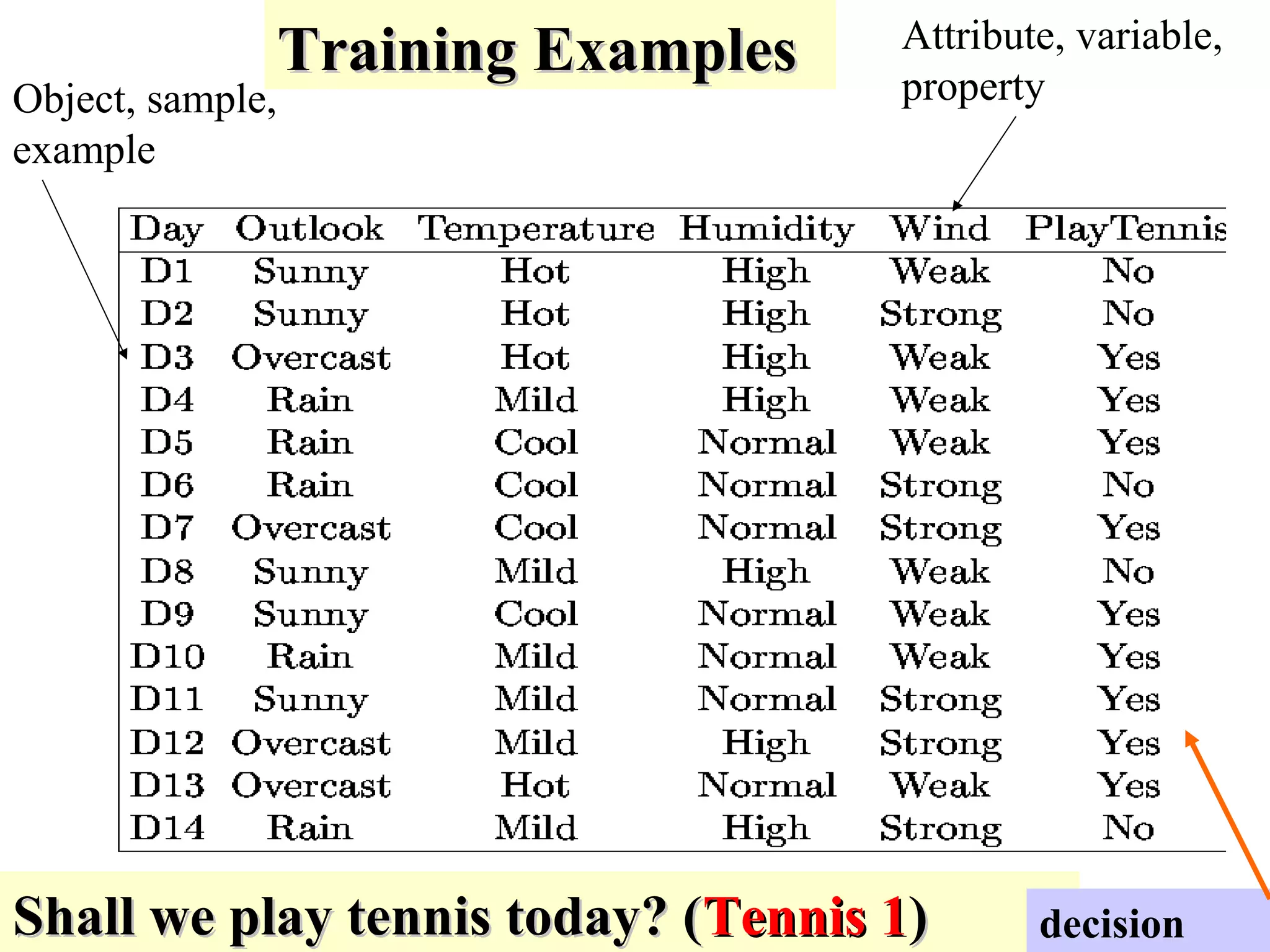
TTrraaiinniinngg EExxaammpplleess 
Attribute, variable, 
Object, sample, property 
example 
SShhaallll wwee ppllaayy tteennnniiss ttooddaayy?? ((TTeennnniiss 11)) 
decision
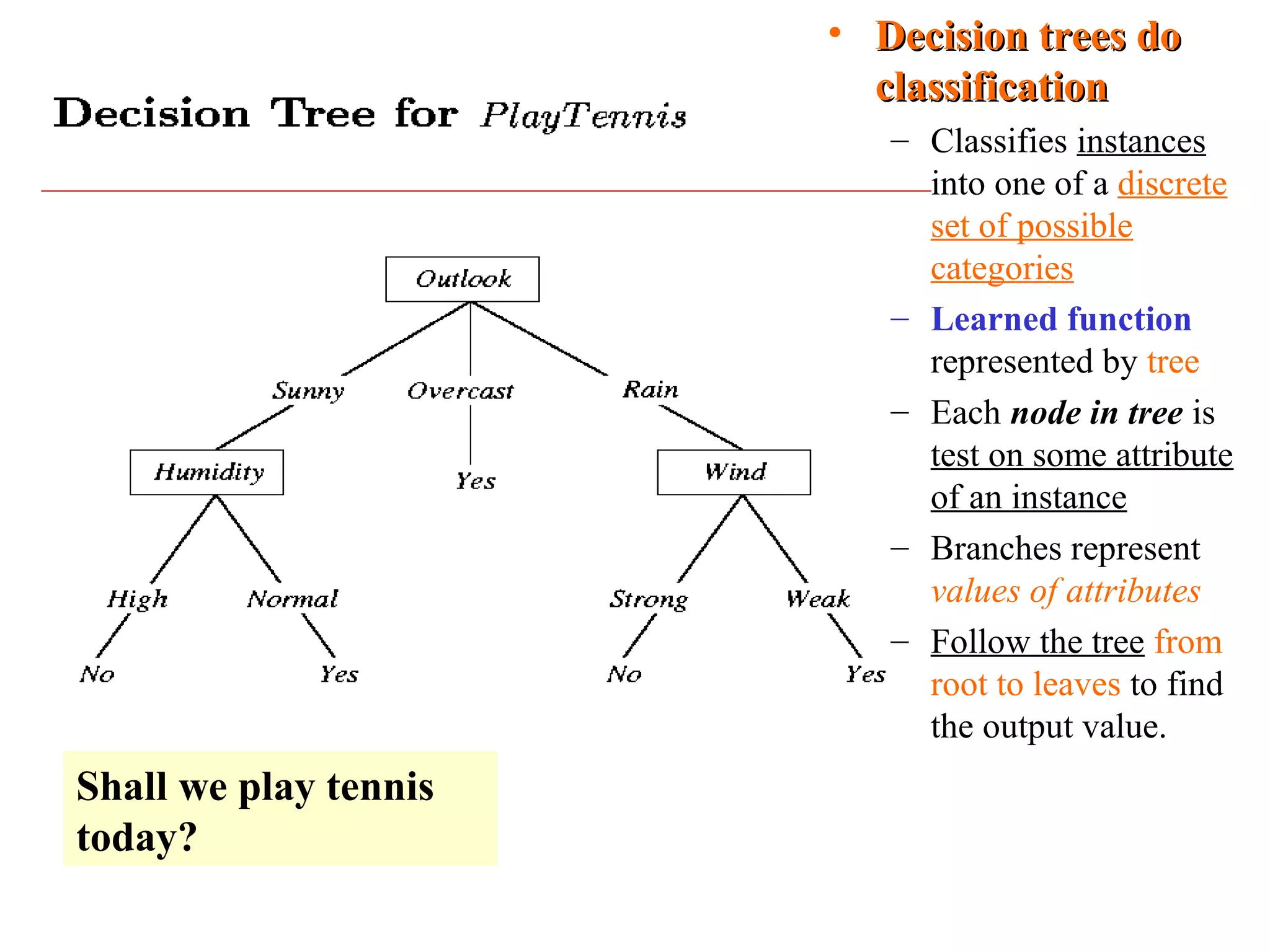
Shall we play tennis 
today? 
• DDeecciissiioonn ttrreeeess ddoo 
ccllaassssiiffiiccaattiioonn 
– Classifies instances 
into one of a discrete 
set of possible 
categories 
– Learned function 
represented by tree 
– Each node in tree is 
test on some attribute 
of an instance 
– Branches represent 
values of attributes 
– Follow the tree from 
root to leaves to find 
the output value.
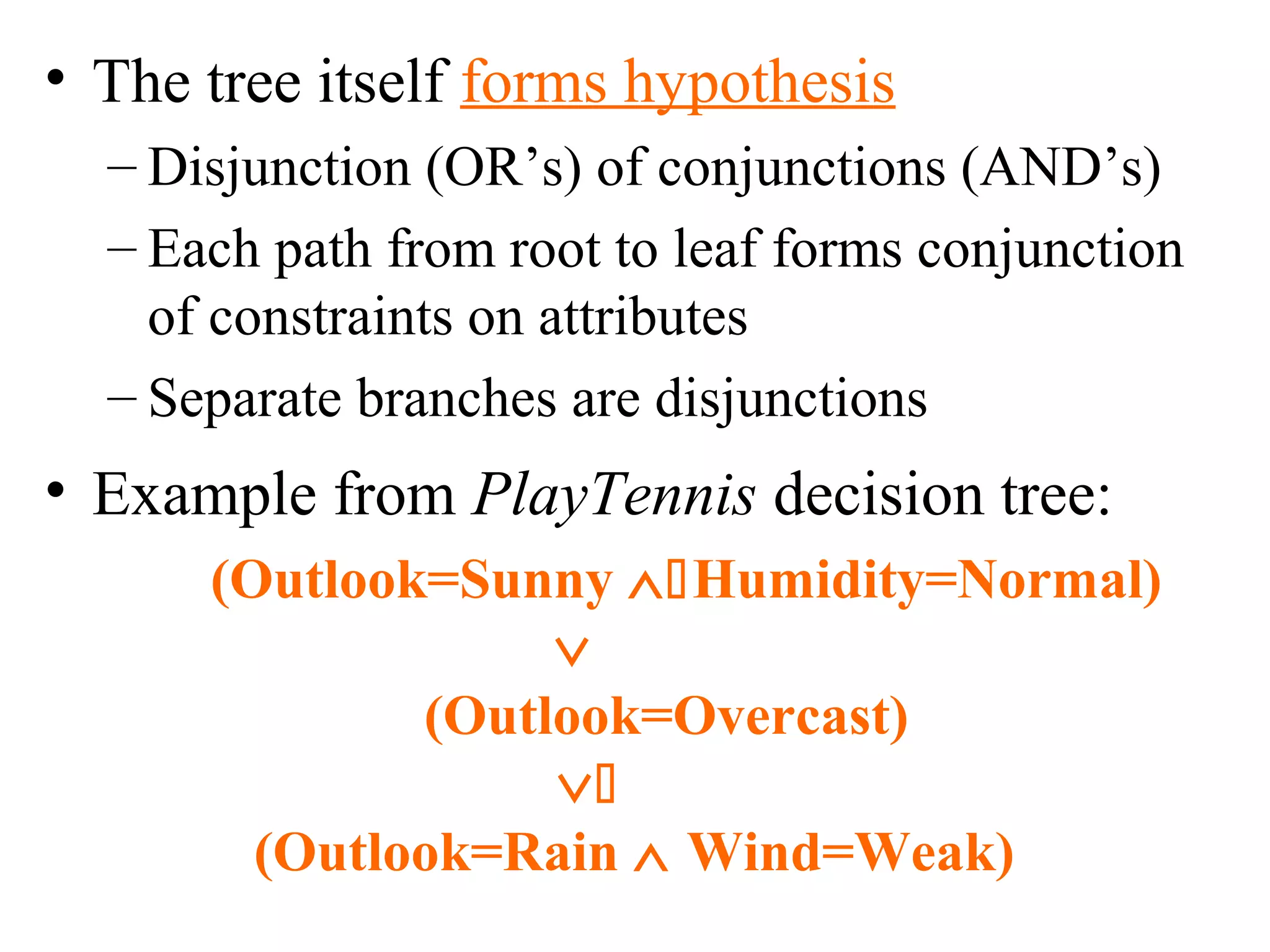
• The tree itself forms hypothesis 
– Disjunction (OR’s) of conjunctions (AND’s) 
– Each path from root to leaf forms conjunction 
of constraints on attributes 
– Separate branches are disjunctions 
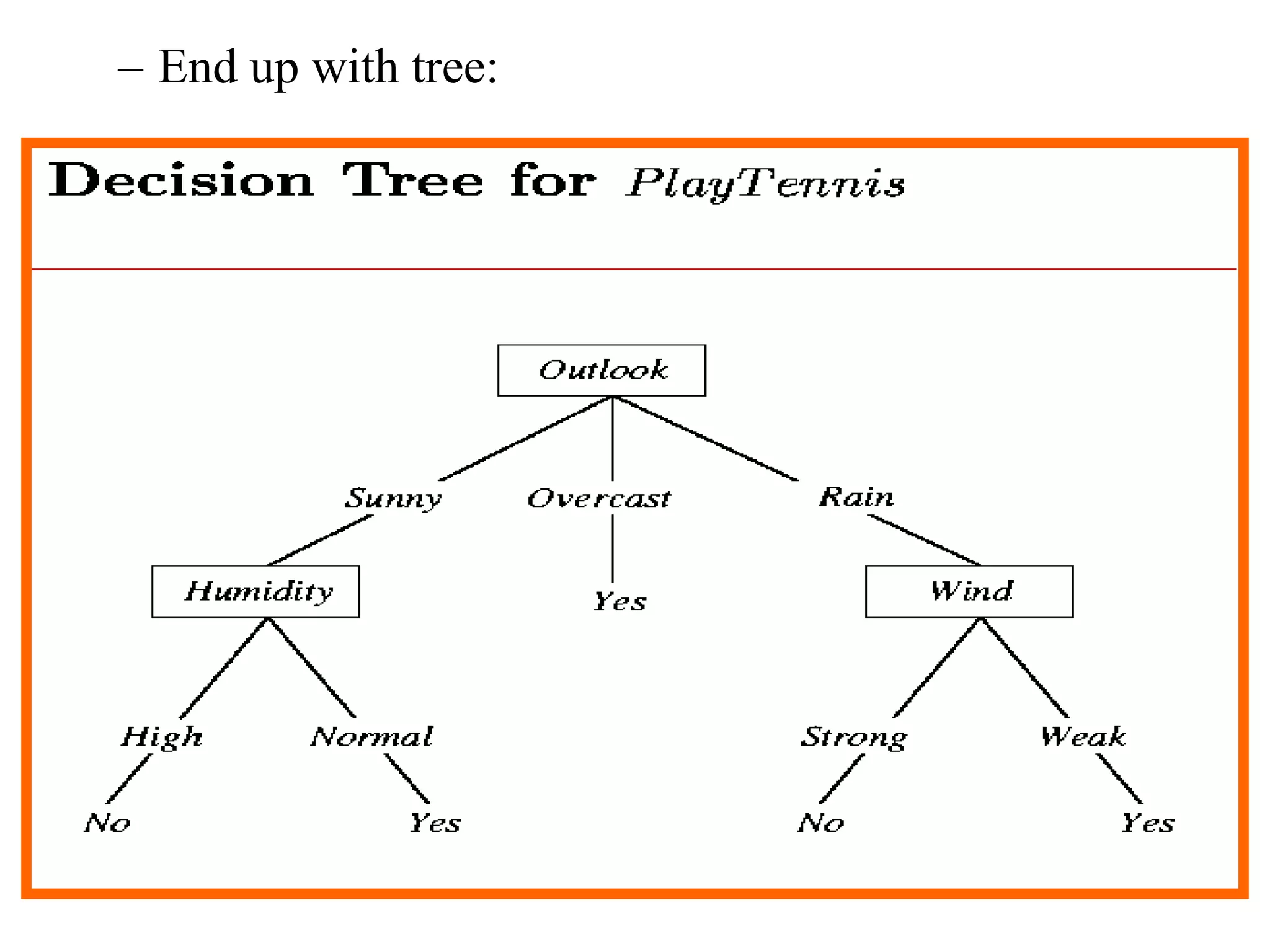
• Example from PlayTennis decision tree: 
(Outlook=Sunny ÙHumidity=Normal) 
Ú 
(Outlook=Overcast) 
Ú 
(Outlook=Rain Ù Wind=Weak)
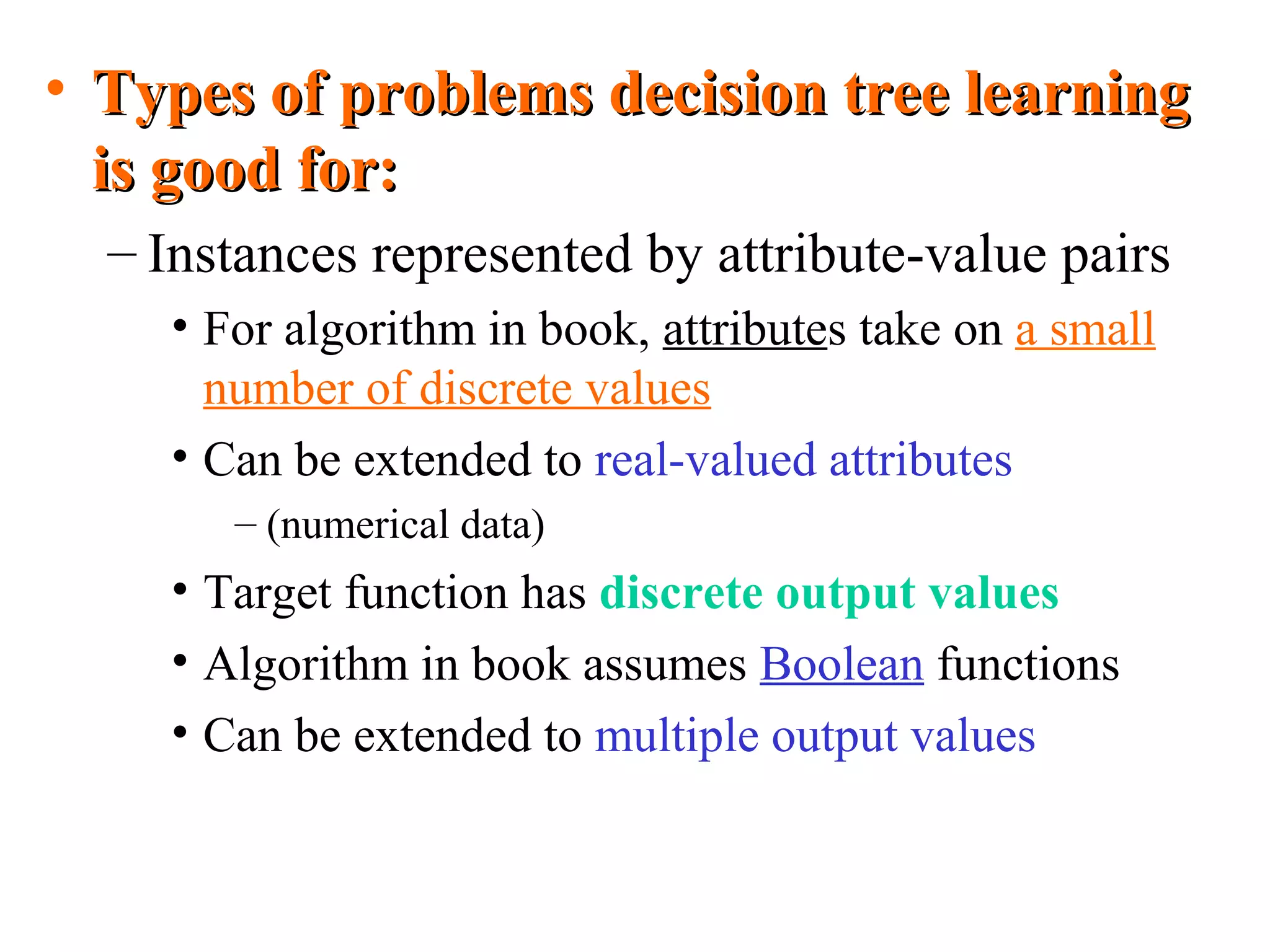
• TTyyppeess ooff pprroobblleemmss ddeecciissiioonn ttrreeee lleeaarrnniinngg 
iiss ggoooodd ffoorr:: 
– Instances represented by attribute-value pairs 
• For algorithm in book, attributes take on a small 
number of discrete values 
• Can be extended to real-valued attributes 
– (numerical data) 
• Target function has discrete output values 
• Algorithm in book assumes Boolean functions 
• Can be extended to multiple output values
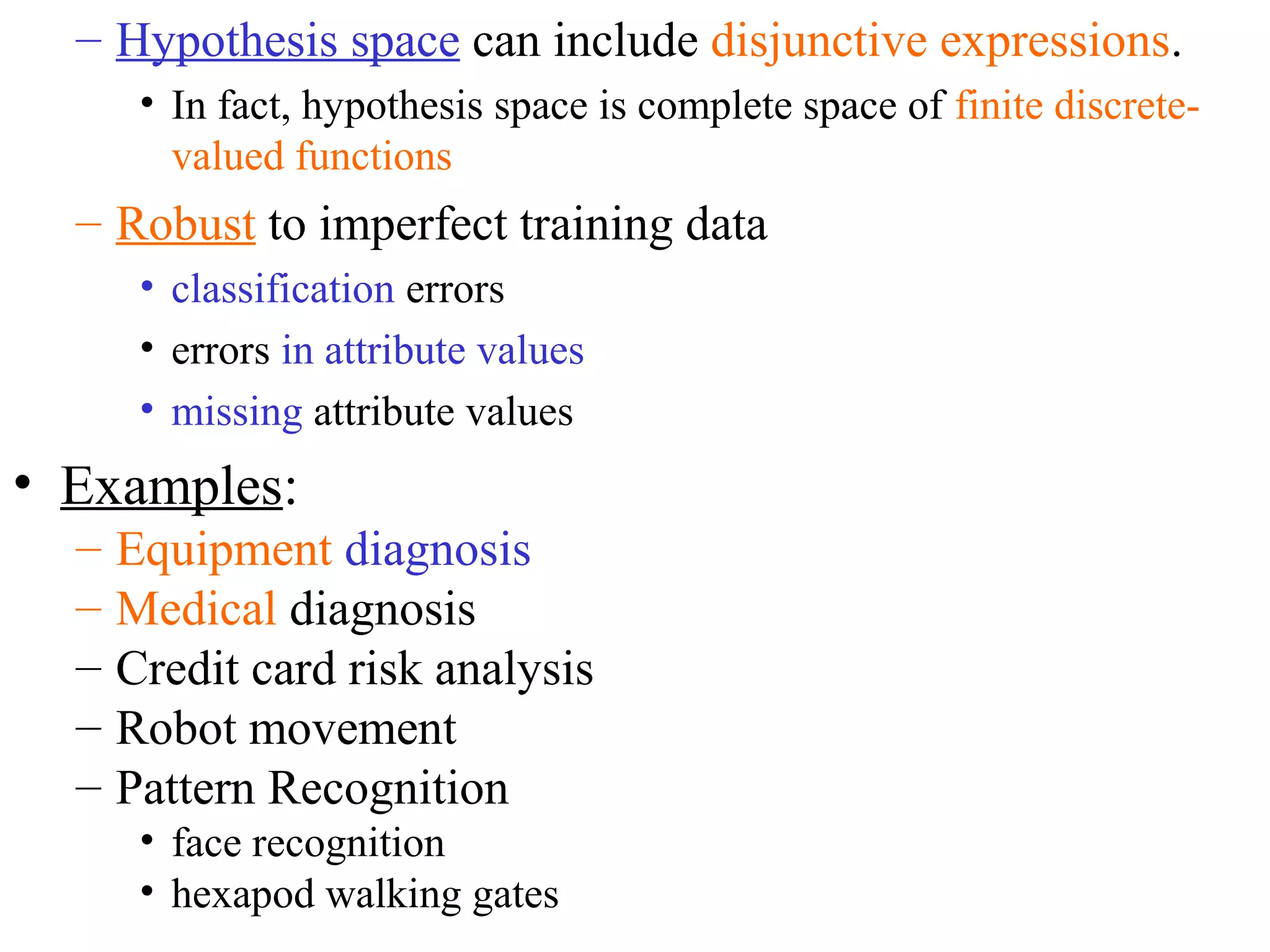
– Hypothesis space can include disjunctive expressions. 
• In fact, hypothesis space is complete space of finite discrete-valued 
functions 
– Robust to imperfect training data 
• classification errors 
• errors in attribute values 
• missing attribute values 
• Examples: 
– Equipment diagnosis 
– Medical diagnosis 
– Credit card risk analysis 
– Robot movement 
– Pattern Recognition 
• face recognition 
• hexapod walking gates
• ID3 Algorithm 
– Top-down, greedy search through space of 
possible decision trees 
• Remember, decision trees represent hypotheses, 
so this is a search through hypothesis space. 
–What is top-down? 
• How to start tree? 
– What attribute should represent the root? 
• As you proceed down tree, choose attribute for 
each successive node. 
• No backtracking: 
– So, algorithm proceeds from top to bottom
The ID3 algorithm is used to build a decision tree, given a set of non-categorical attributes 
C1, C2, .., Cn, the categorical attribute C, and a training set T of records. 
function ID3 (R: a set of non-categorical attributes, 
C: the categorical attribute, 
S: a training set) returns a decision tree; 
begin 
If S is empty, return a single node with value Failure; 
If every example in S has the same value for categorical 
attribute, return single node with that value; 
If R is empty, then return a single node with most 
frequent of the values of the categorical attribute found in 
examples S; [note: there will be errors, i.e., improperly 
classified records]; 
Let D be attribute with largest Gain(D,S) among R’s attributes; 
Let {dj| j=1,2, .., m} be the values of attribute D; 
Let {Sj| j=1,2, .., m} be the subsets of S consisting 
respectively of records with value dj for attribute D; 
Return a tree with root labeled D and arcs labeled 
d1, d2, .., dm going respectively to the trees 
ID3(R-{D},C,S1), ID3(R-{D},C,S2) ,.., ID3(R-{D},C,Sm); 
end ID3;
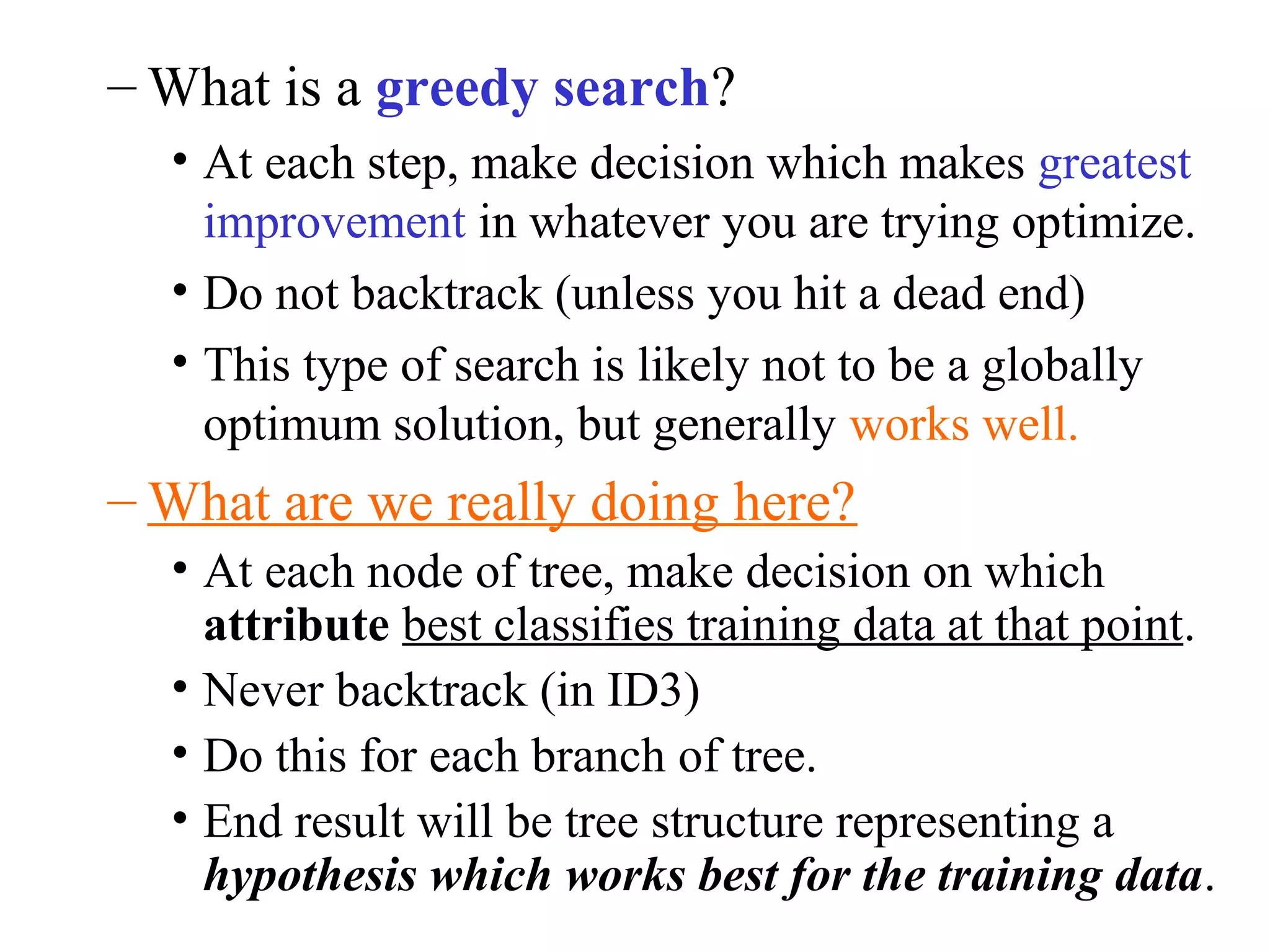
–What is a greedy search? 
• At each step, make decision which makes greatest 
improvement in whatever you are trying optimize. 
• Do not backtrack (unless you hit a dead end) 
• This type of search is likely not to be a globally 
optimum solution, but generally works well. 
–What are we really doing here? 
• At each node of tree, make decision on which 
attribute best classifies training data at that point. 
• Never backtrack (in ID3) 
• Do this for each branch of tree. 
• End result will be tree structure representing a 
hypothesis which works best for the training data.
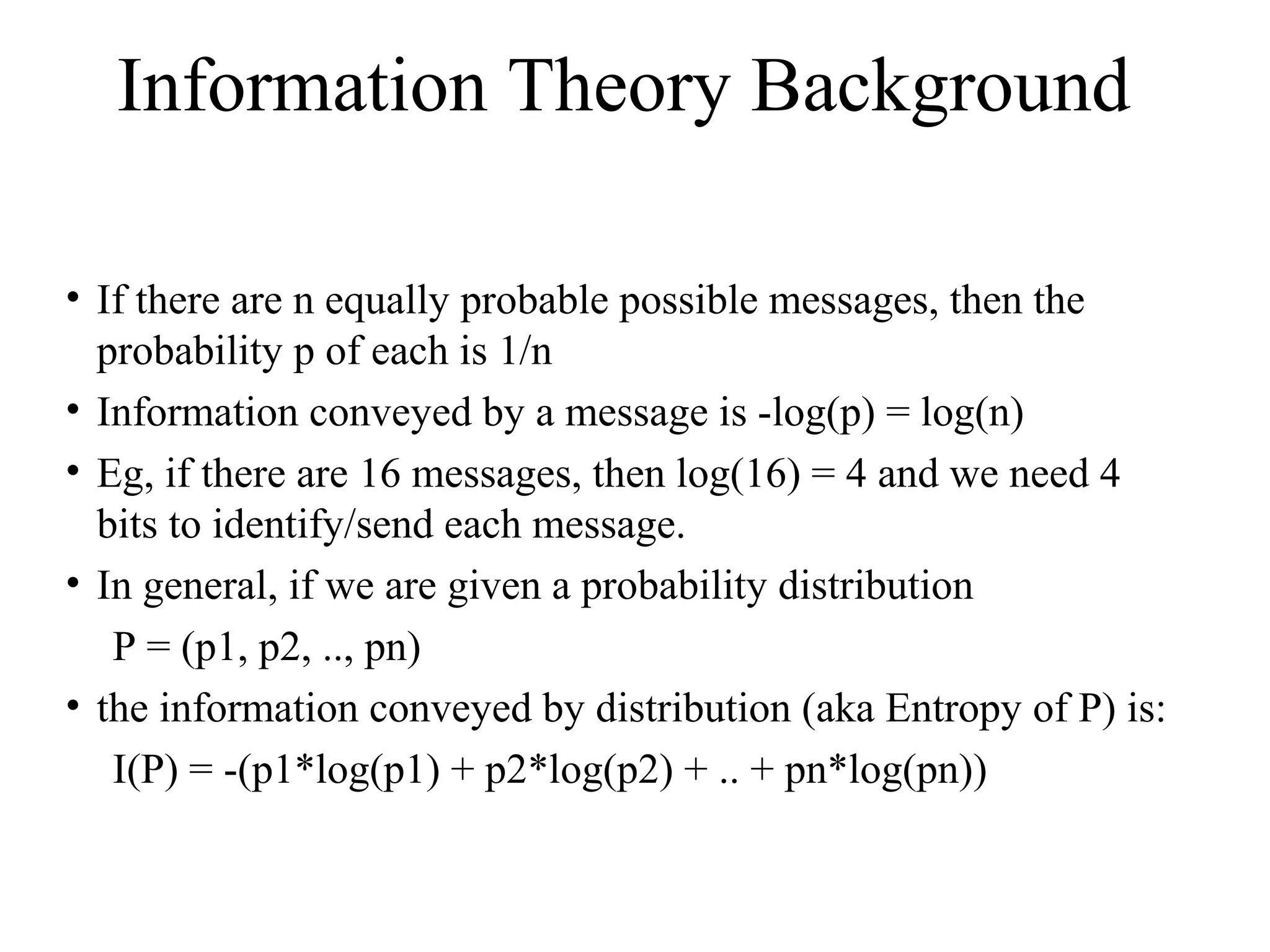
Information Theory Background 
• If there are n equally probable possible messages, then the 
probability p of each is 1/n 
• Information conveyed by a message is -log(p) = log(n) 
• Eg, if there are 16 messages, then log(16) = 4 and we need 4 
bits to identify/send each message. 
• In general, if we are given a probability distribution 
P = (p1, p2, .., pn) 
• the information conveyed by distribution (aka Entropy of P) is: 
I(P) = -(p1*log(p1) + p2*log(p2) + .. + pn*log(pn))
Question? 
How do you determine which 
attribute best classifies data? 
Answer: Entropy! 
• Information gain: 
– Statistical quantity measuring how well an 
attribute classifies the data. 
• Calculate the information gain for each attribute. 
• Choose attribute with greatest information gain.
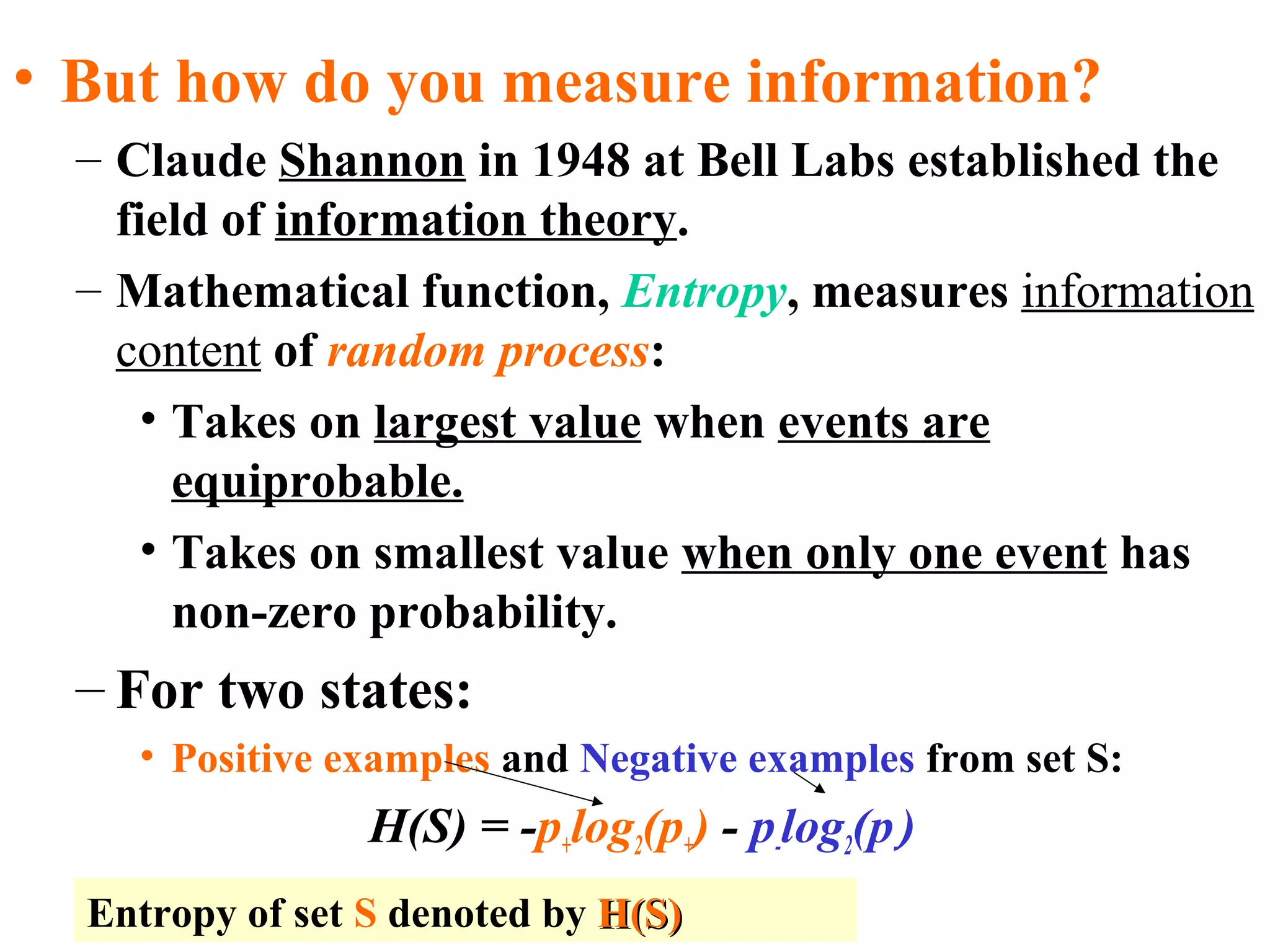
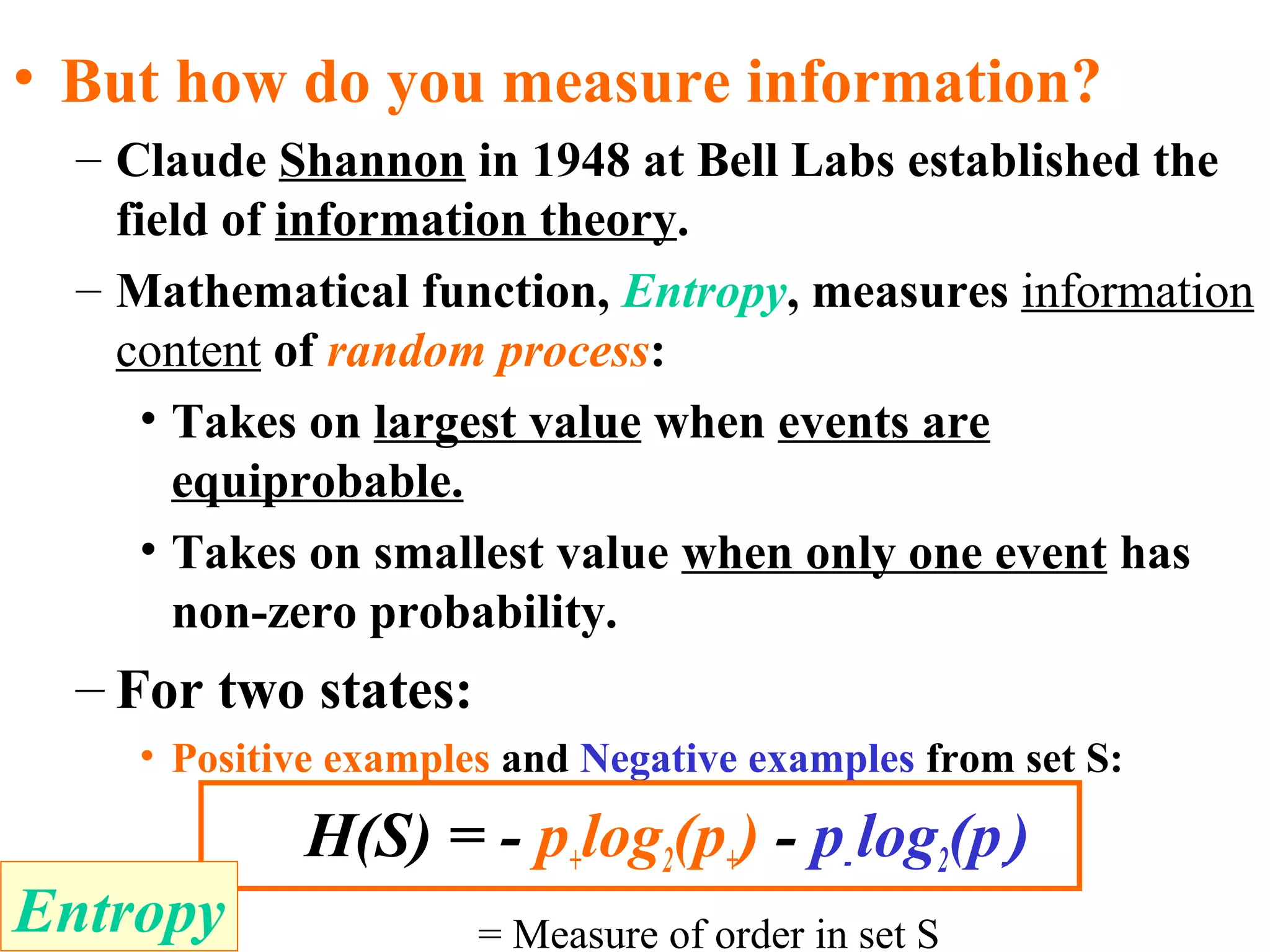
• But how do you measure information? 
– Claude Shannon in 1948 at Bell Labs established the 
field of information theory. 
– Mathematical function, Entropy, measures information 
content of random process: 
• Takes on largest value when events are 
equiprobable. 
• Takes on smallest value when only one event has 
non-zero probability. 
– For two states: 
• Positive examples and Negative examples from set S: 
H(S) = -p+log2(p+) - p-log2(p-) 
Entropy of set S denoted by HH((SS))
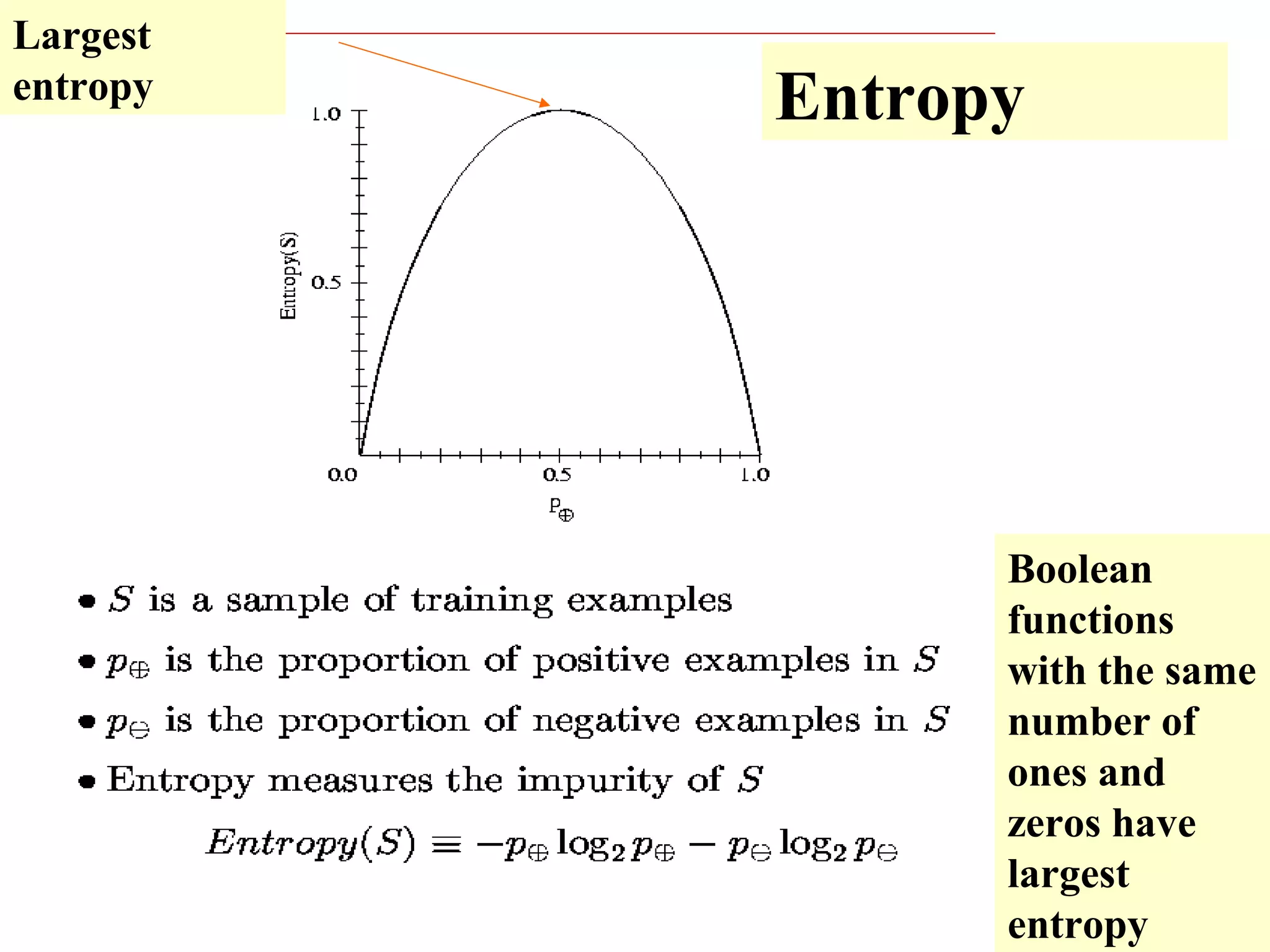
Entropy 
Largest 
entropy 
Boolean 
functions 
with the same 
number of 
ones and 
zeros have 
largest 
entropy
• But how do you measure information? 
– Claude Shannon in 1948 at Bell Labs established the 
field of information theory. 
– Mathematical function, Entropy, measures information 
content of random process: 
• Takes on largest value when events are 
equiprobable. 
• Takes on smallest value when only one event has 
non-zero probability. 
– For two states: 
• Positive examples and Negative examples from set S: 
H(S) = - p+log2(p+) - p- log2(p-) 
Entropy = Measure of order in set S
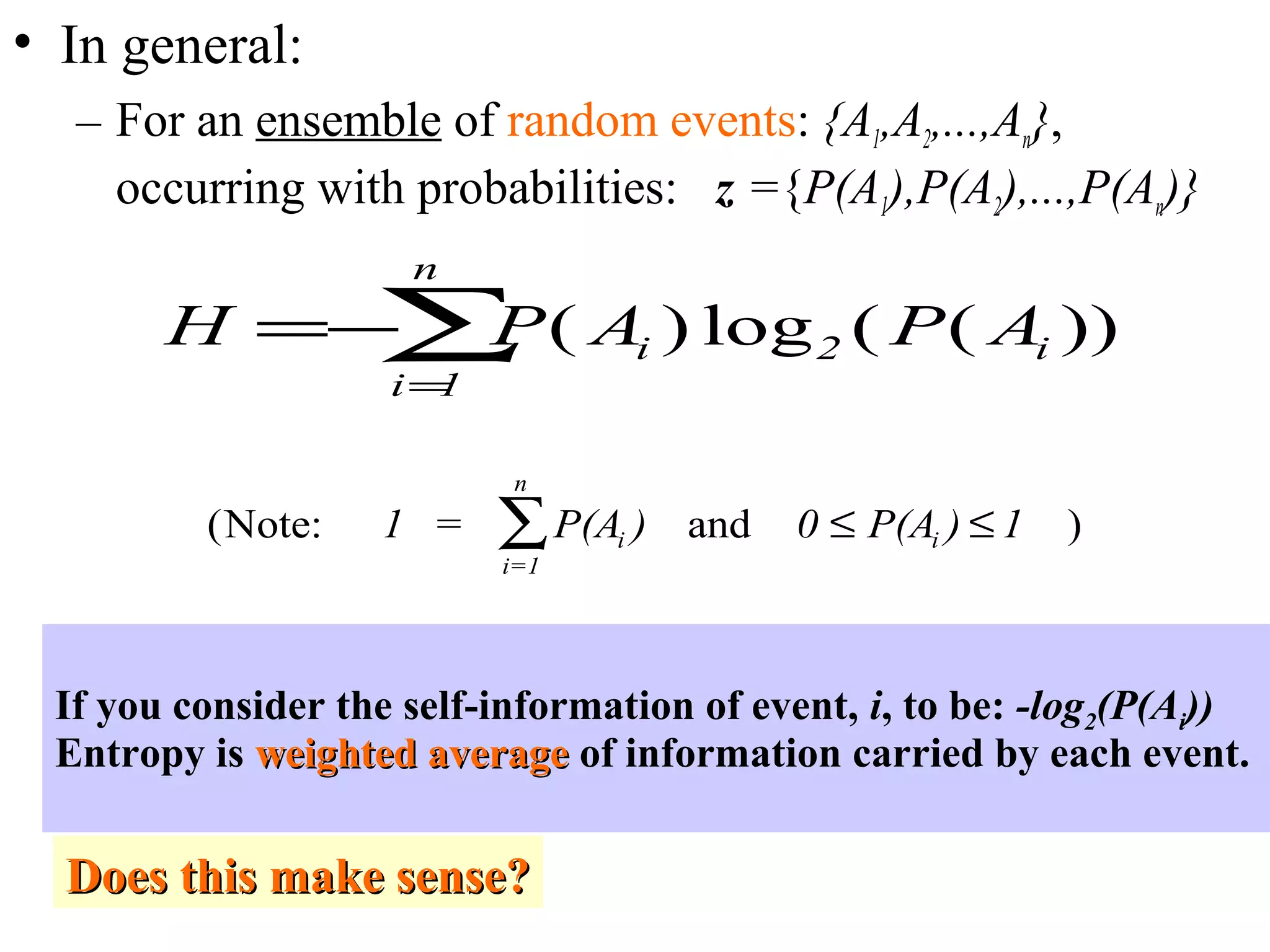
• In general: 
– For an ensemble of random events: {A1,A2,...,An}, 
occurring with probabilities: z ={P(A1),P(A2),...,P(An)} 
H P A P A i i 
= å 
i 
n 
=- 
( ) log ( ( )) 2 
1 
n 
i å £ £ 
(Note: = 1 and 0 1 ) 
1 
P(A ) P(A ) i 
i= 
If you consider the self-information of event, i, to be: -log2(P(Ai)) 
Entropy is wweeiigghhtteedd aavveerraaggee of information carried by each event. 
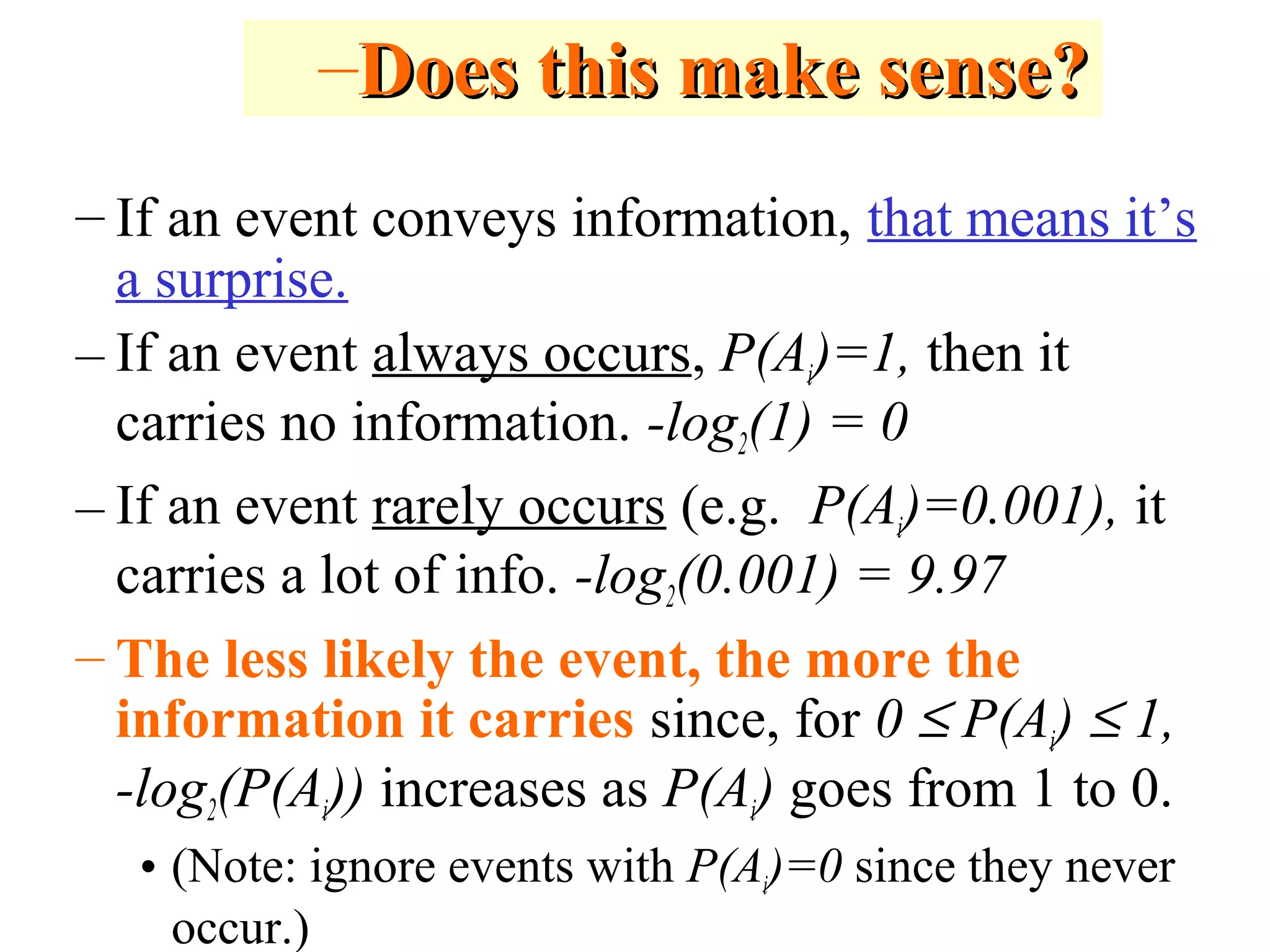
DDooeess tthhiiss mmaakkee sseennssee??
– If an event conveys information, that means it’s 
a surprise. 
– If an event always occurs, P(Ai)=1, then it 
carries no information. -log2(1) = 0 
– If an event rarely occurs (e.g. P(Ai)=0.001), it 
carries a lot of info. -log2(0.001) = 9.97 
– The less likely the event, the more the 
information it carries since, for 0 £ P(Ai) £ 1, 
-log2(P(Ai)) increases as P(Ai) goes from 1 to 0. 
• (Note: ignore events with P(Ai)=0 since they never 
occur.) 
–DDooeess tthhiiss mmaakkee sseennssee??
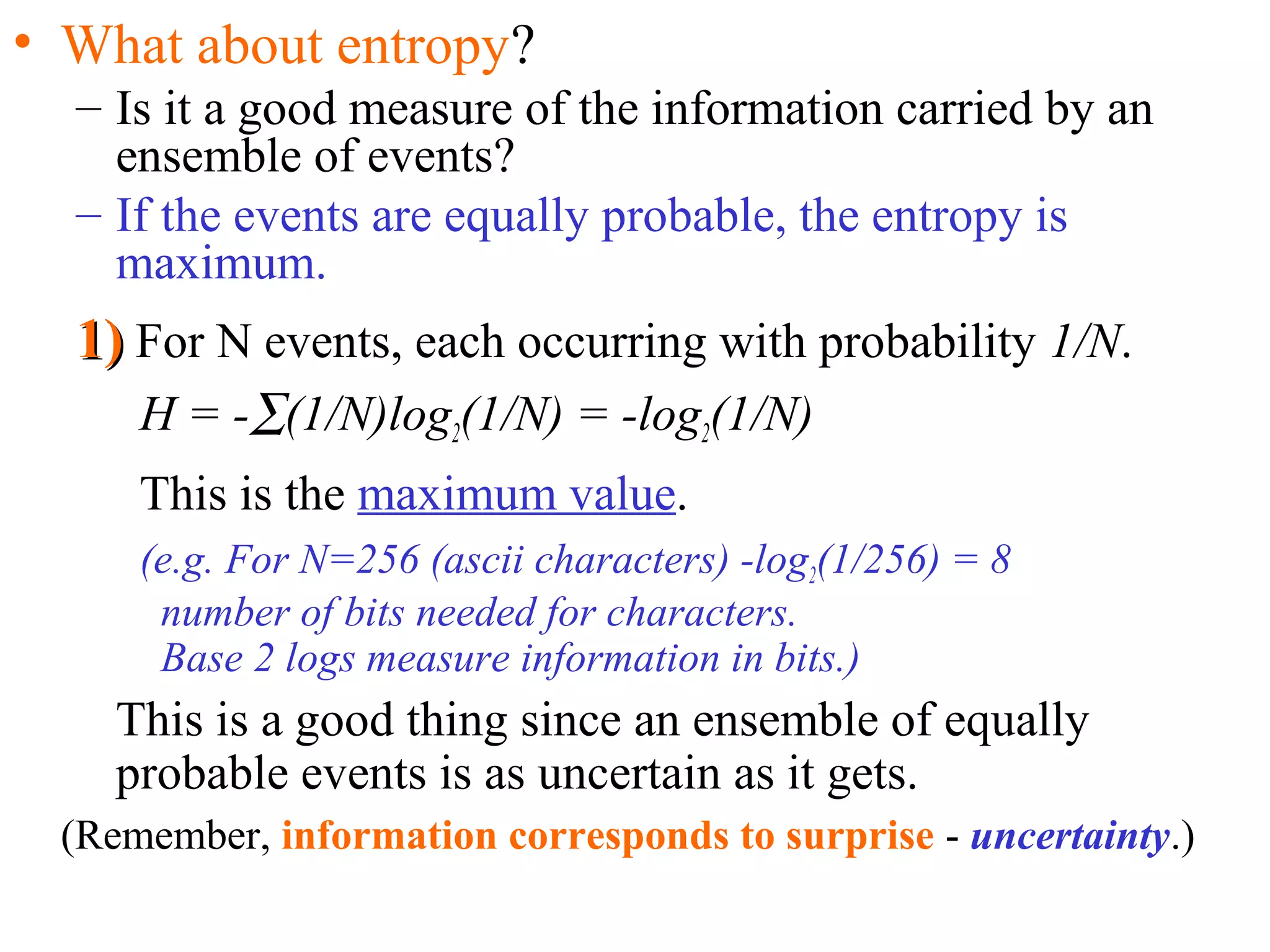
• What about entropy? 
– Is it a good measure of the information carried by an 
ensemble of events? 
– If the events are equally probable, the entropy is 
maximum. 
11)) For N events, each occurring with probability 1/N. 
H = -å(1/N)log2(1/N) = -log2(1/N) 
This is the maximum value. 
(e.g. For N=256 (ascii characters) -log2(1/256) = 8 
number of bits needed for characters. 
Base 2 logs measure information in bits.) 
This is a good thing since an ensemble of equally 
probable events is as uncertain as it gets. 
(Remember, information corresponds to surprise - uncertainty.)
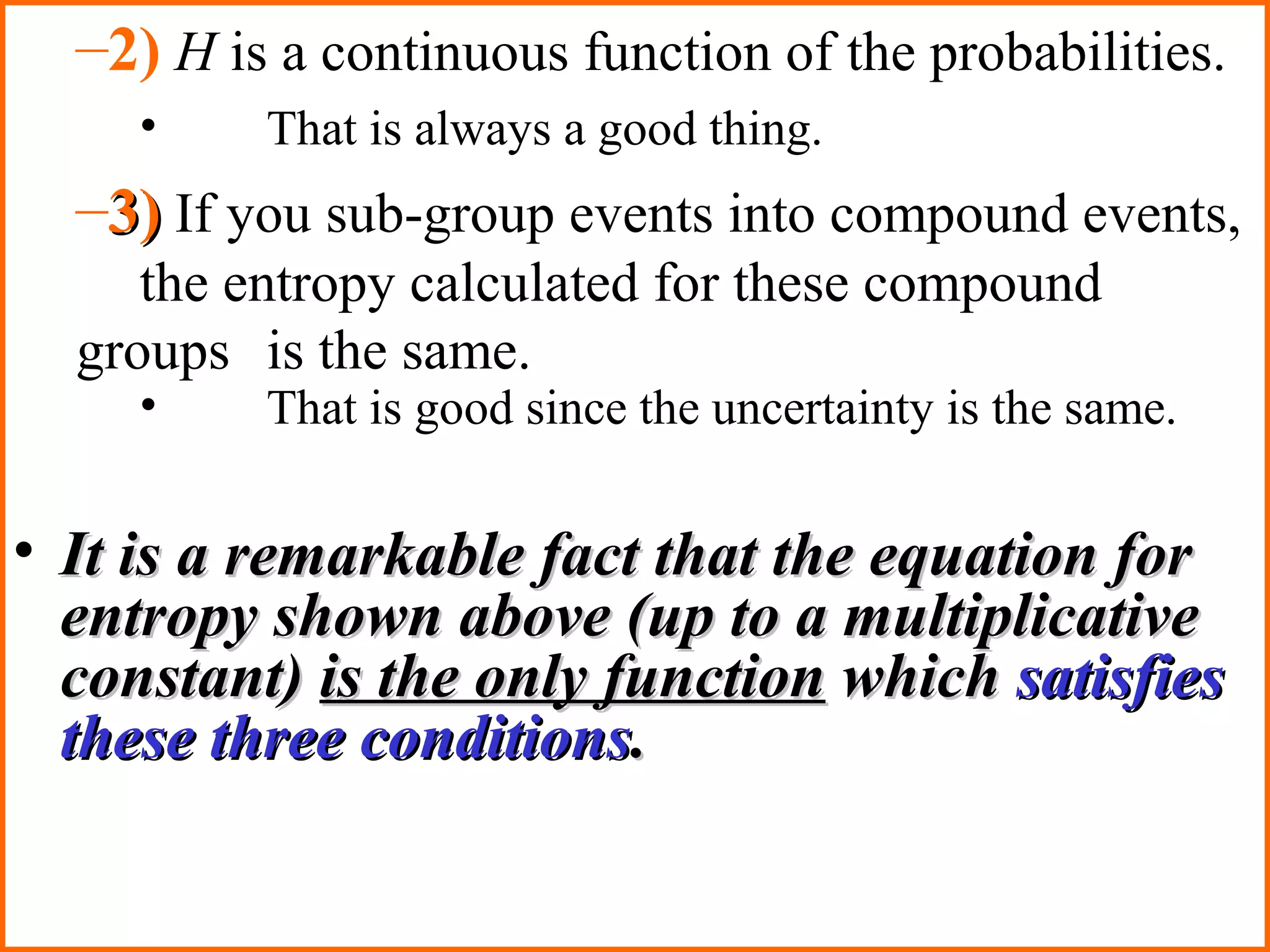
–2) H is a continuous function of the probabilities. 
• That is always a good thing. 
–33)) If you sub-group events into compound events, 
the entropy calculated for these compound 
groups is the same. 
• That is good since the uncertainty is the same. 
• IItt iiss aa rreemmaarrkkaabbllee ffaacctt tthhaatt tthhee eeqquuaattiioonn ffoorr 
eennttrrooppyy sshhoowwnn aabboovvee ((uupp ttoo aa mmuullttiipplliiccaattiivvee 
ccoonnssttaanntt)) iiss tthhee oonnllyy ffuunnccttiioonn wwhhiicchh ssaattiissffiieess 
tthheessee tthhrreeee ccoonnddiittiioonnss..
• Choice of base 2 log corresponds to 
choosing units of information.(BIT’s) 
• AAnnootthheerr rreemmaarrkkaabbllee tthhiinngg:: 
–This is the same definition of entropy used in 
statistical mechanics for the measure of 
disorder. 
– Corresponds to macroscopic thermodynamic 
quantity of Second Law of Thermodynamics.
• The concept of a quantitative measure for information 
content plays an important role in many areas: 
• For example, 
– Data communications (channel capacity) 
– Data compression (limits on error-free encoding) 
• Entropy in a message corresponds to minimum number 
of bits needed to encode that message. 
• In our case, for a set of training data, the entropy 
measures the number of bits needed to encode 
classification for an instance. 
– Use probabilities found from entire set of training data. 
– Prob(Class=Pos) = Num. of positive cases / Total case 
– Prob(Class=Neg) = Num. of negative cases / Total cases
(Back to the story of ID3) 
• Information gain is our metric for how well 
one attribute A i classifies the training data. 
• Information gain for a particular attribute = 
Information about target function, 
given the value of that attribute. 
(conditional entropy) 
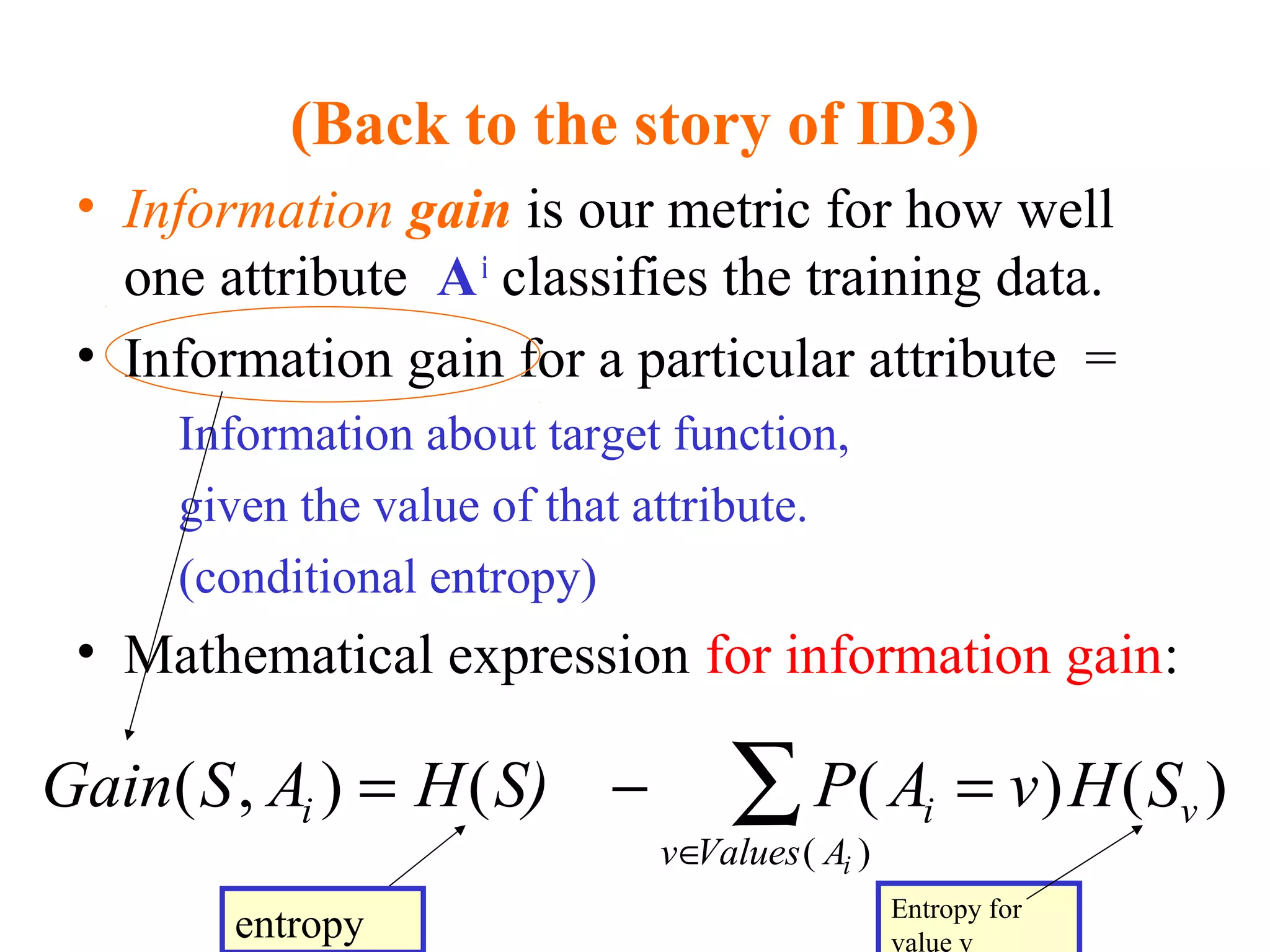
• Mathematical expression for information gain: 
Gain S A = H S) - P A = 
v H S i i v 
( , ) ( ( ) ( ) 
v Values Ai 
( ) 
Î 
å 
entropy Entropy for 
value v
• ID3 algorithm (for boolean-valued function) 
– Calculate the entropy for all training examples 
• positive and negative cases 
• p+ = #pos/Tot p- = #neg/Tot 
• H(S) = -p+log2(p+) - p-log2(p-) 
– Determine which single attribute best classifies the 
training examples using information gain. 
• For each attribute find: 
å 
Gain S A = H S) - P A = 
v H S i i v 
( , ) ( ( ) ( ) 
v Values Ai 
( ) 
Î 
• Use attribute with greatest information gain aass aa rroooott
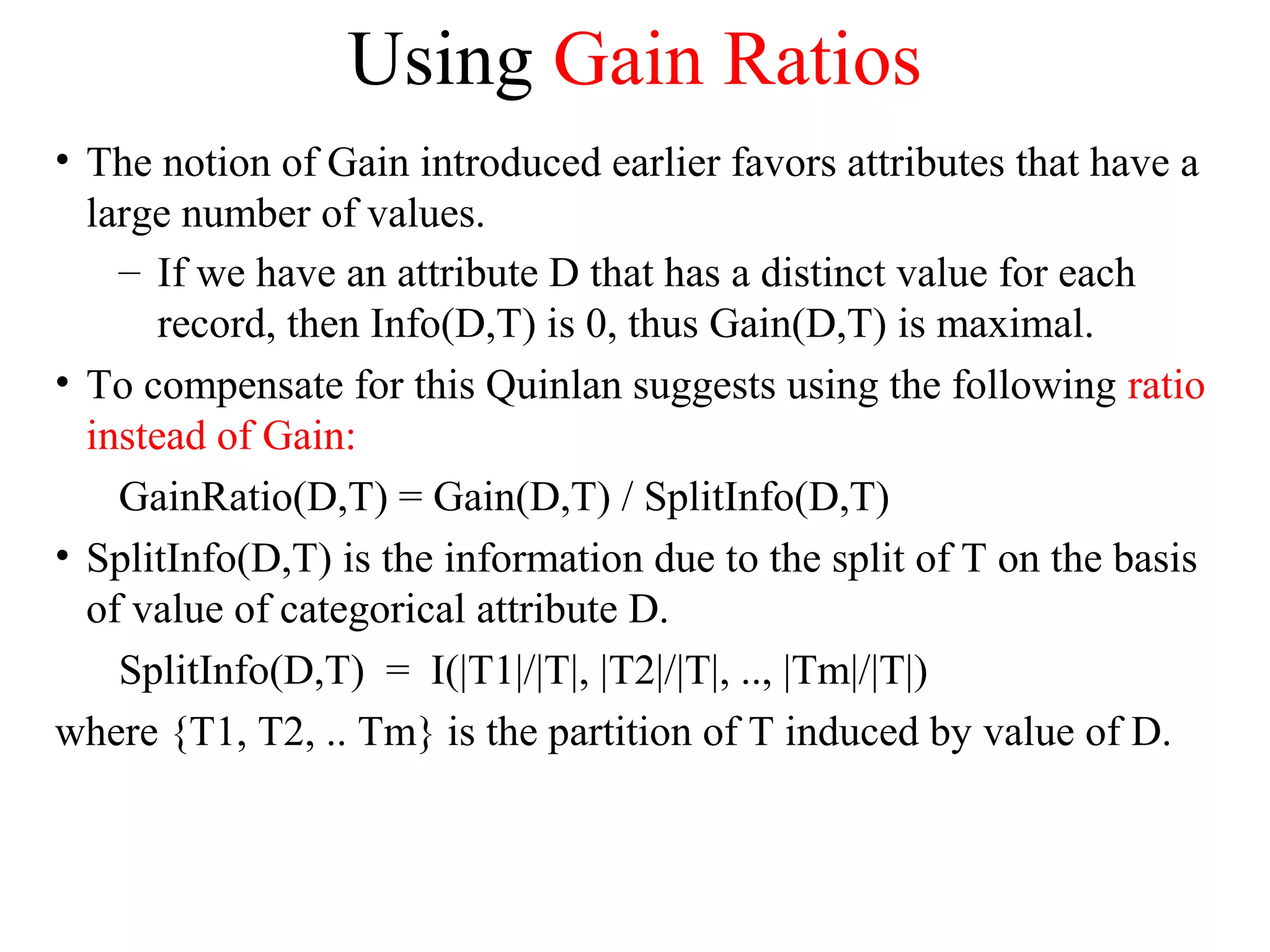
Using Gain Ratios 
• The notion of Gain introduced earlier favors attributes that have a 
large number of values. 
– If we have an attribute D that has a distinct value for each 
record, then Info(D,T) is 0, thus Gain(D,T) is maximal. 
• To compensate for this Quinlan suggests using the following ratio 
instead of Gain: 
GainRatio(D,T) = Gain(D,T) / SplitInfo(D,T) 
• SplitInfo(D,T) is the information due to the split of T on the basis 
of value of categorical attribute D. 
SplitInfo(D,T) = I(|T1|/|T|, |T2|/|T|, .., |Tm|/|T|) 
where {T1, T2, .. Tm} is the partition of T induced by value of D.
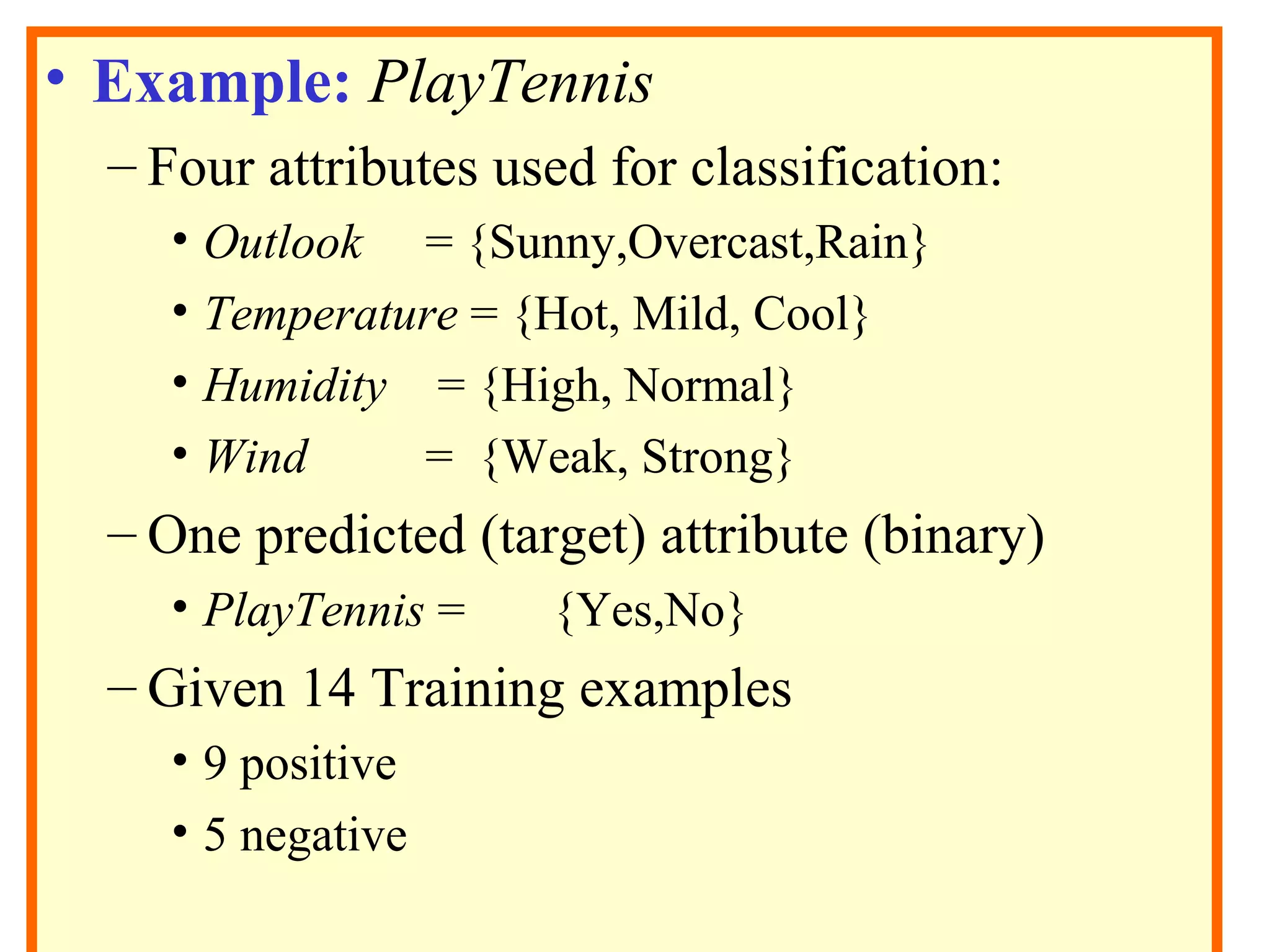
• Example: PlayTennis 
– Four attributes used for classification: 
• Outlook = {Sunny,Overcast,Rain} 
• Temperature = {Hot, Mild, Cool} 
• Humidity = {High, Normal} 
• Wind = {Weak, Strong} 
– One predicted (target) attribute (binary) 
• PlayTennis = {Yes,No} 
– Given 14 Training examples 
• 9 positive 
• 5 negative
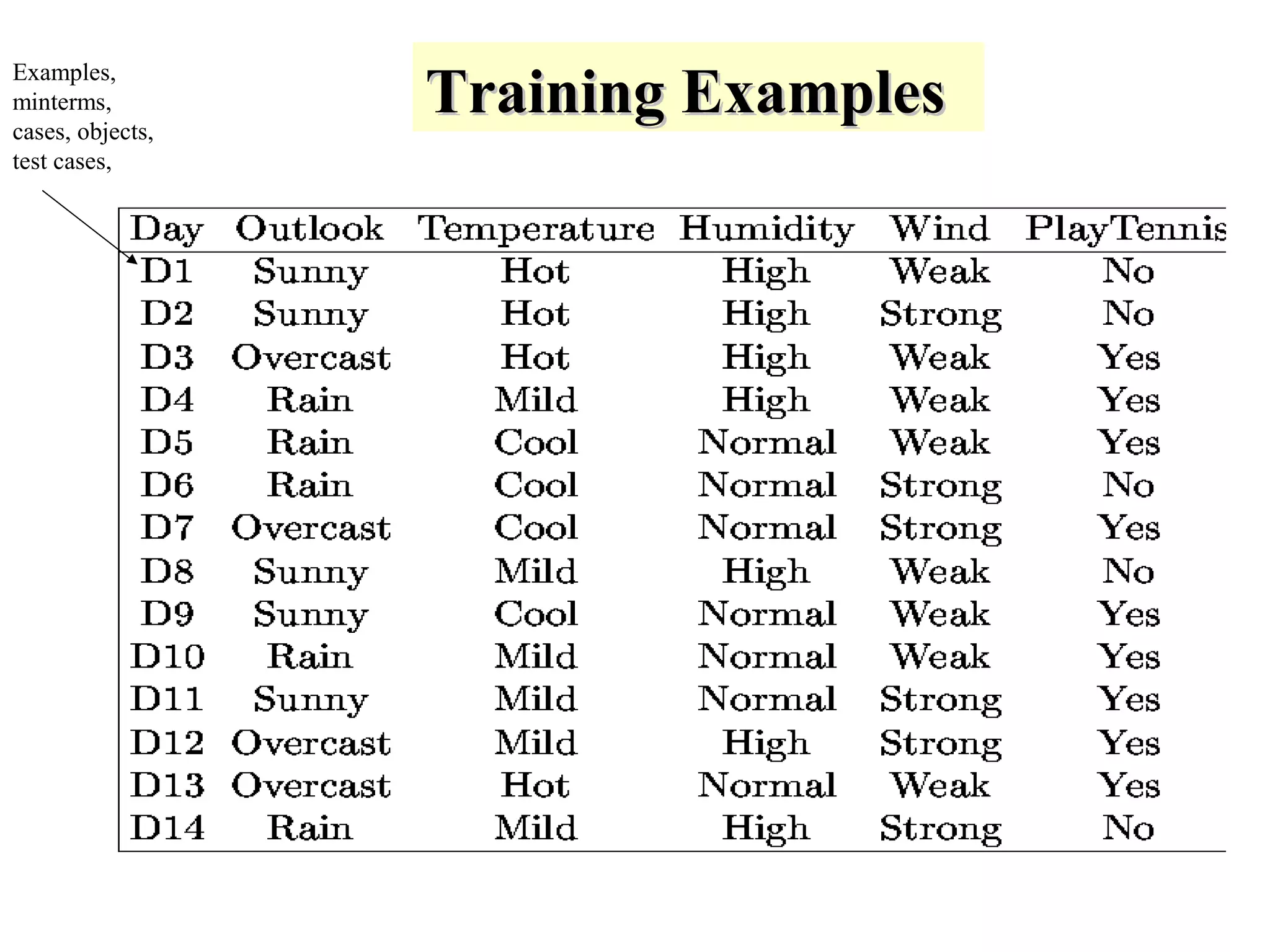
TTrraaiinniinngg EExxaammpplleess Examples, 
minterms, 
cases, objects, 
test cases,
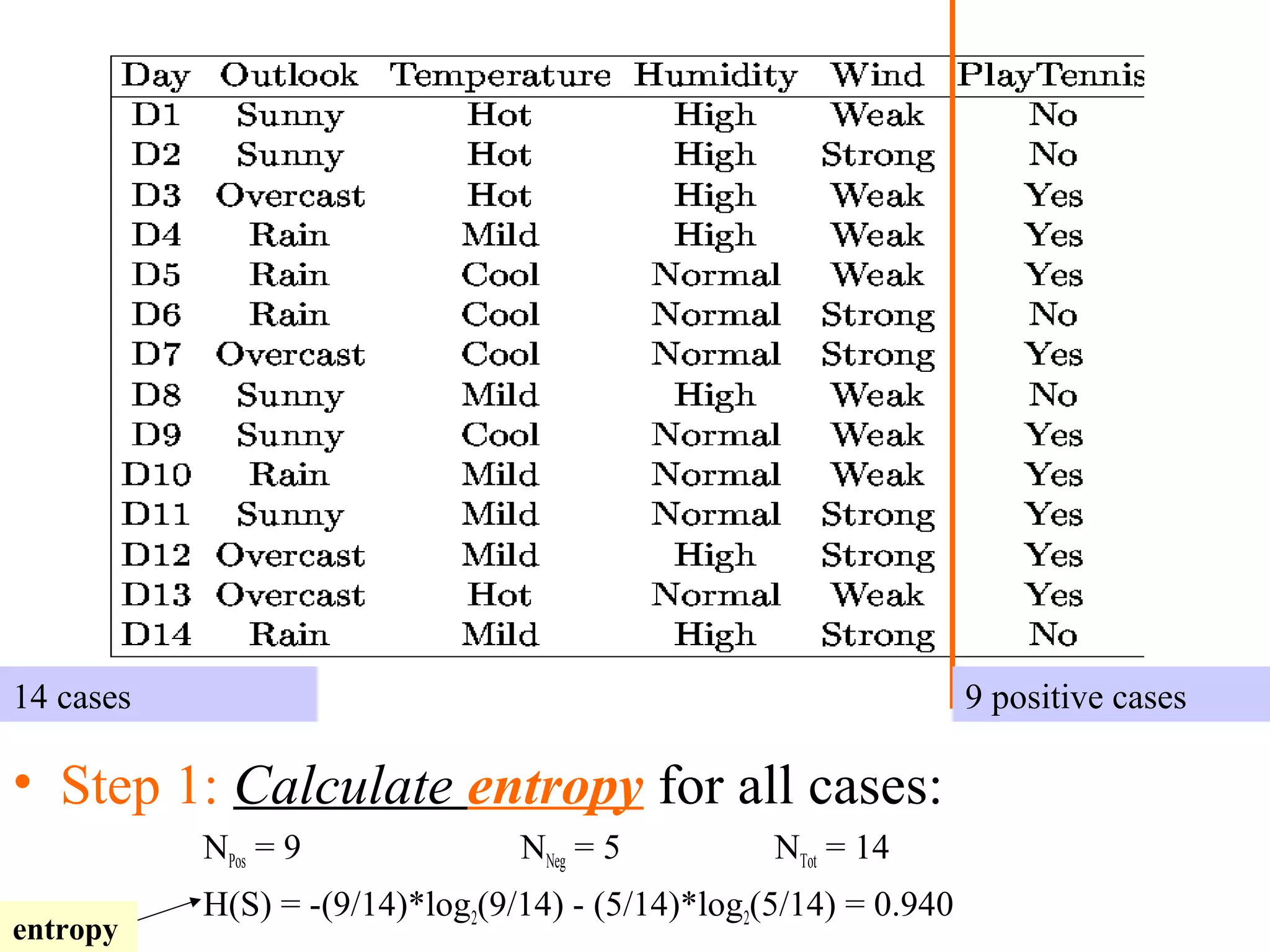
14 cases 9 positive cases 
• Step 1: Calculate entropy for all cases: 
NPos = 9 NNeg = 5 NTot = 14 
H(S) = -(9/14)*log2(9/14) - (5/14)*log2(5/14) = 0.940 
entropy
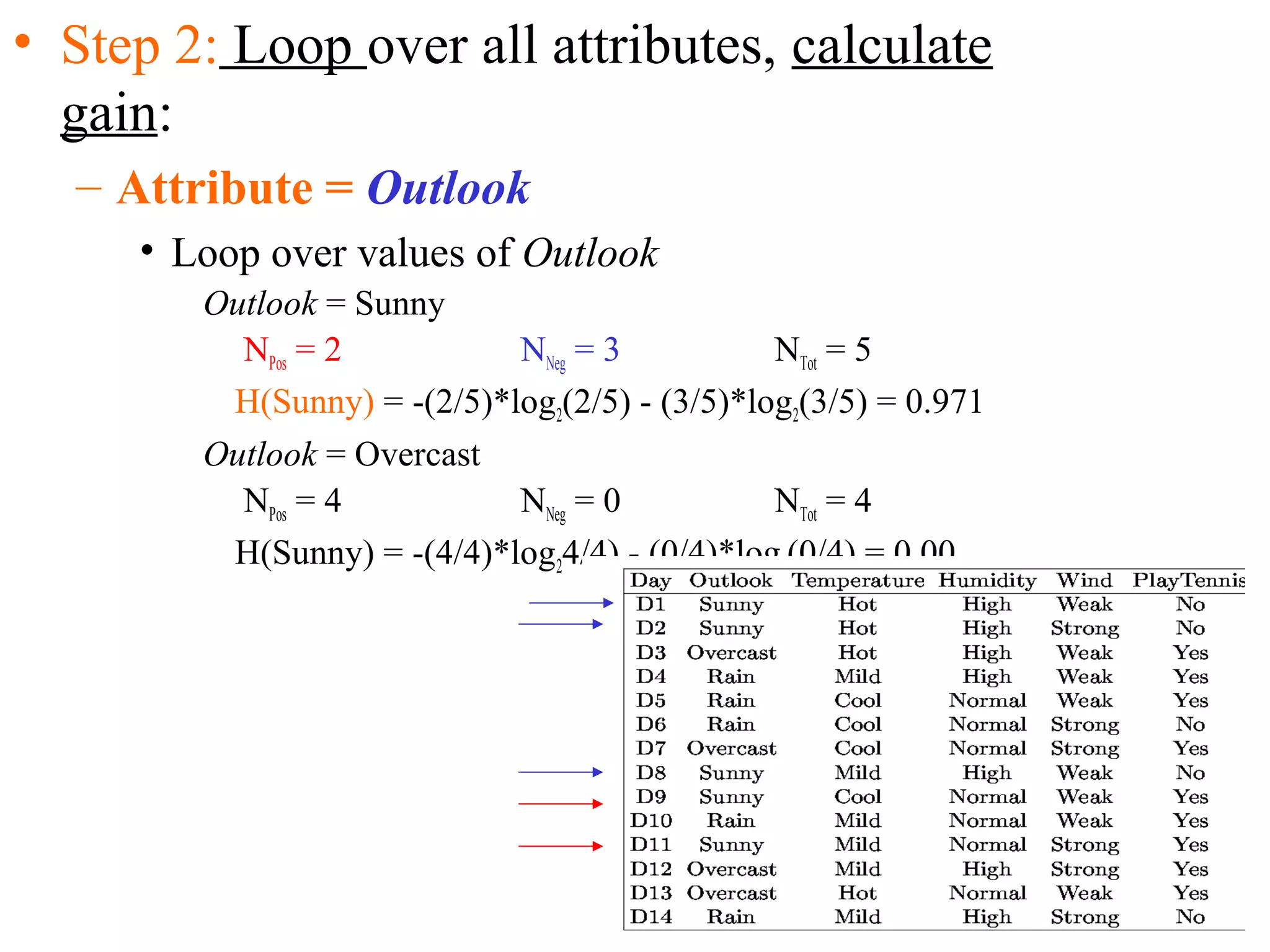
• Step 2: Loop over all attributes, calculate 
gain: 
– Attribute = Outlook 
• Loop over values of Outlook 
Outlook = Sunny 
NPos = 2 NNeg = 3 NTot = 5 
H(Sunny) = -(2/5)*log2(2/5) - (3/5)*log2(3/5) = 0.971 
Outlook = Overcast 
NPos = 4 NNeg = 0 NTot = 4 
H(Sunny) = -(4/4)*log24/4) - (0/4)*log2(0/4) = 0.00
Outlook = Rain 
NPos = 3 NNeg = 2 NTot = 5 
H(Sunny) = -(3/5)*log2(3/5) - (2/5)*log2(2/5) = 0.971 
• Calculate Information Gain for attribute Outlook 
Gain(S,Outlook) = H(S) - NSunny/NTot*H(Sunny) 
- NOver/NTot*H(Overcast) 
- NRain/NTot*H(Rainy) 
Gain(S,Outlook) = 9.40 - (5/14)*0.971 - (4/14)*0 - (5/14)*0.971 
Gain(S,Outlook) = 0.246 
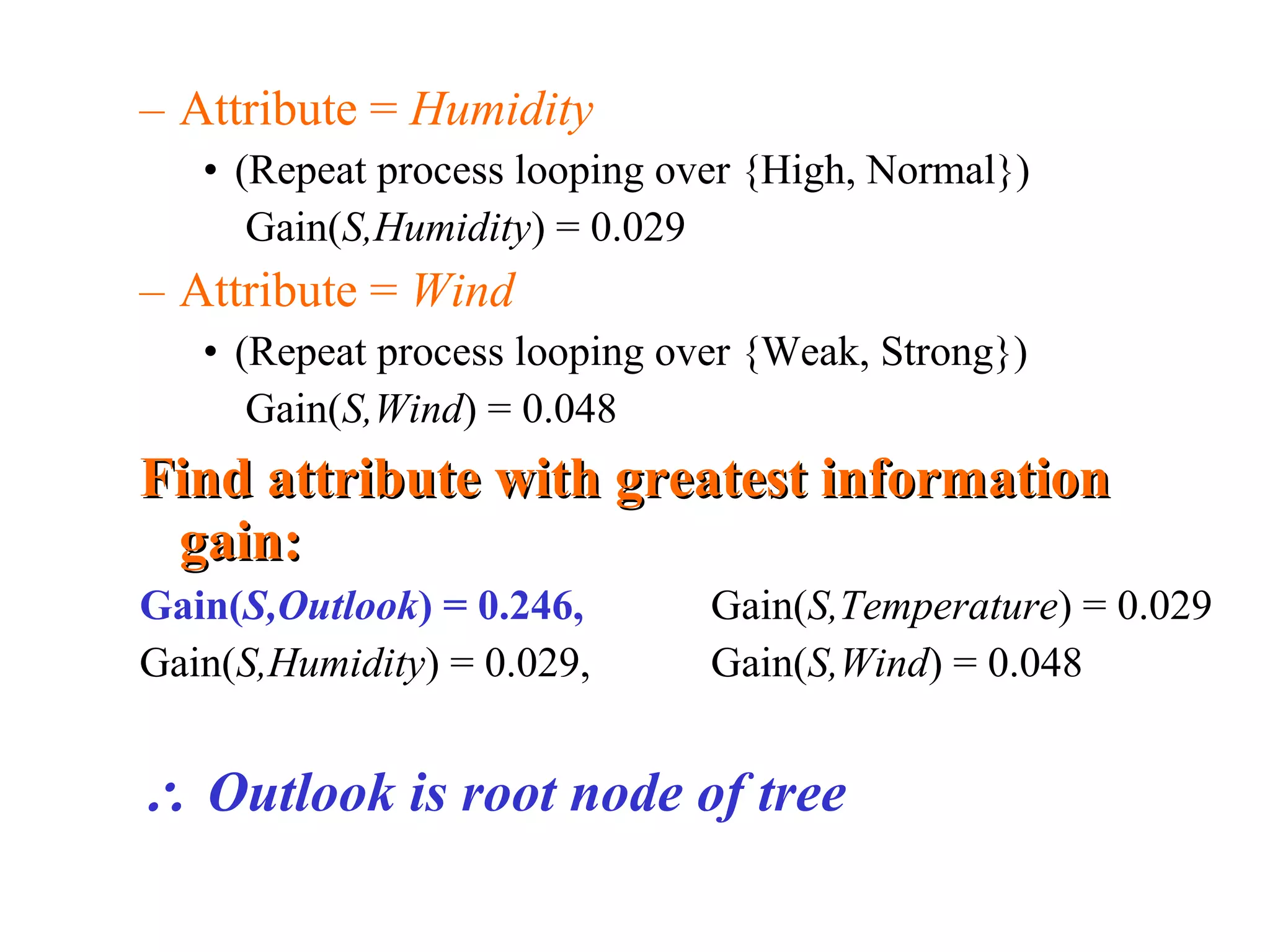
– Attribute = Temperature 
• (Repeat process looping over {Hot, Mild, Cool}) 
Gain(S,Temperature) = 0.029
– Attribute = Humidity 
• (Repeat process looping over {High, Normal}) 
Gain(S,Humidity) = 0.029 
– Attribute = Wind 
• (Repeat process looping over {Weak, Strong}) 
Gain(S,Wind) = 0.048 
Find attribute wwiitthh ggrreeaatteesstt iinnffoorrmmaattiioonn 
ggaaiinn:: 
Gain(S,Outlook) = 0.246, Gain(S,Temperature) = 0.029 
Gain(S,Humidity) = 0.029, Gain(S,Wind) = 0.048 
 Outlook is root node of tree
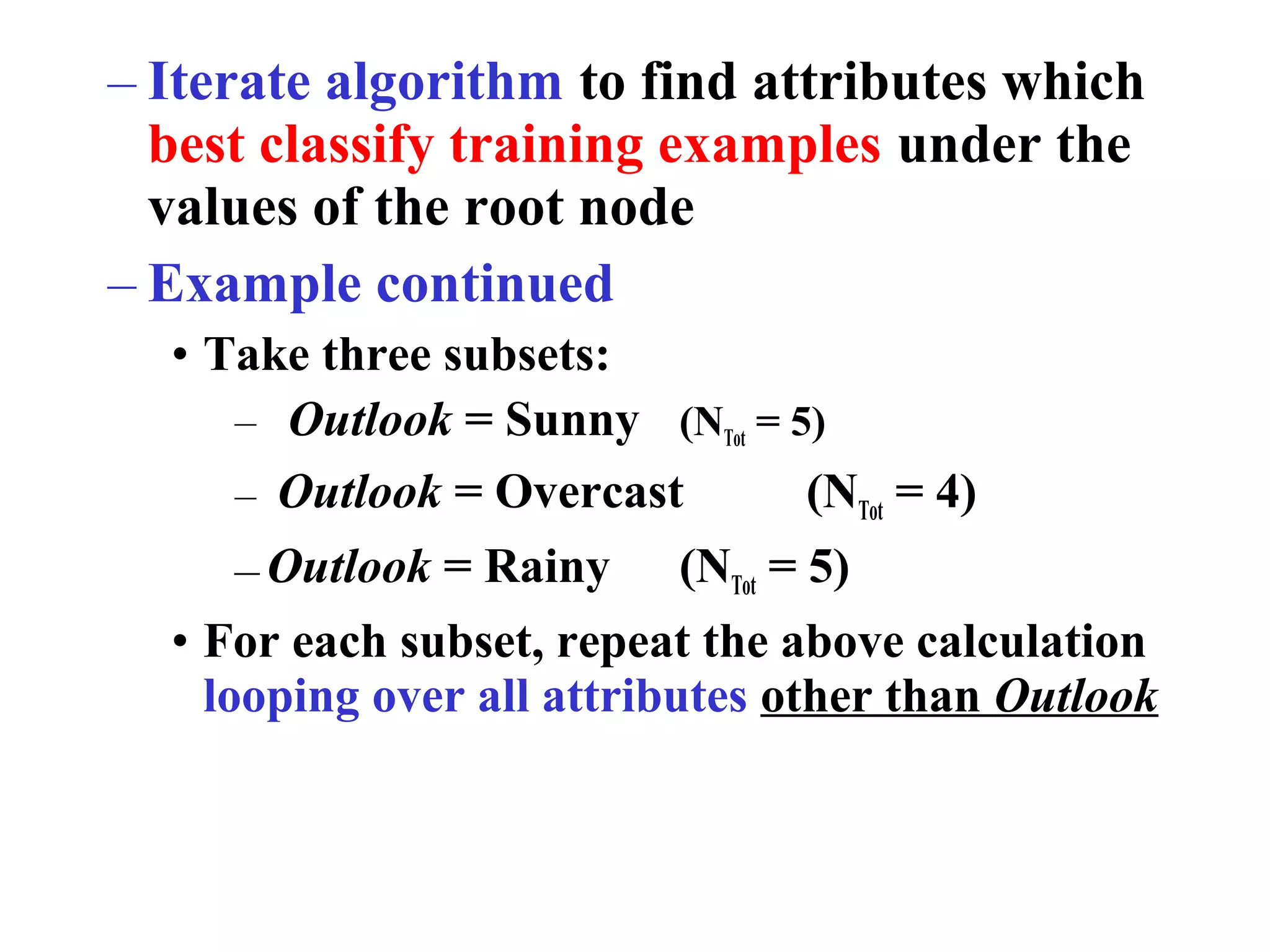
– Iterate algorithm to find attributes which 
best classify training examples under the 
values of the root node 
– Example continued 
• Take three subsets: 
– Outlook = Sunny (NTot = 5) 
– Outlook = Overcast (NTot = 4) 
–Outlook = Rainy (NTot = 5) 
• For each subset, repeat the above calculation 
looping over all attributes other than Outlook
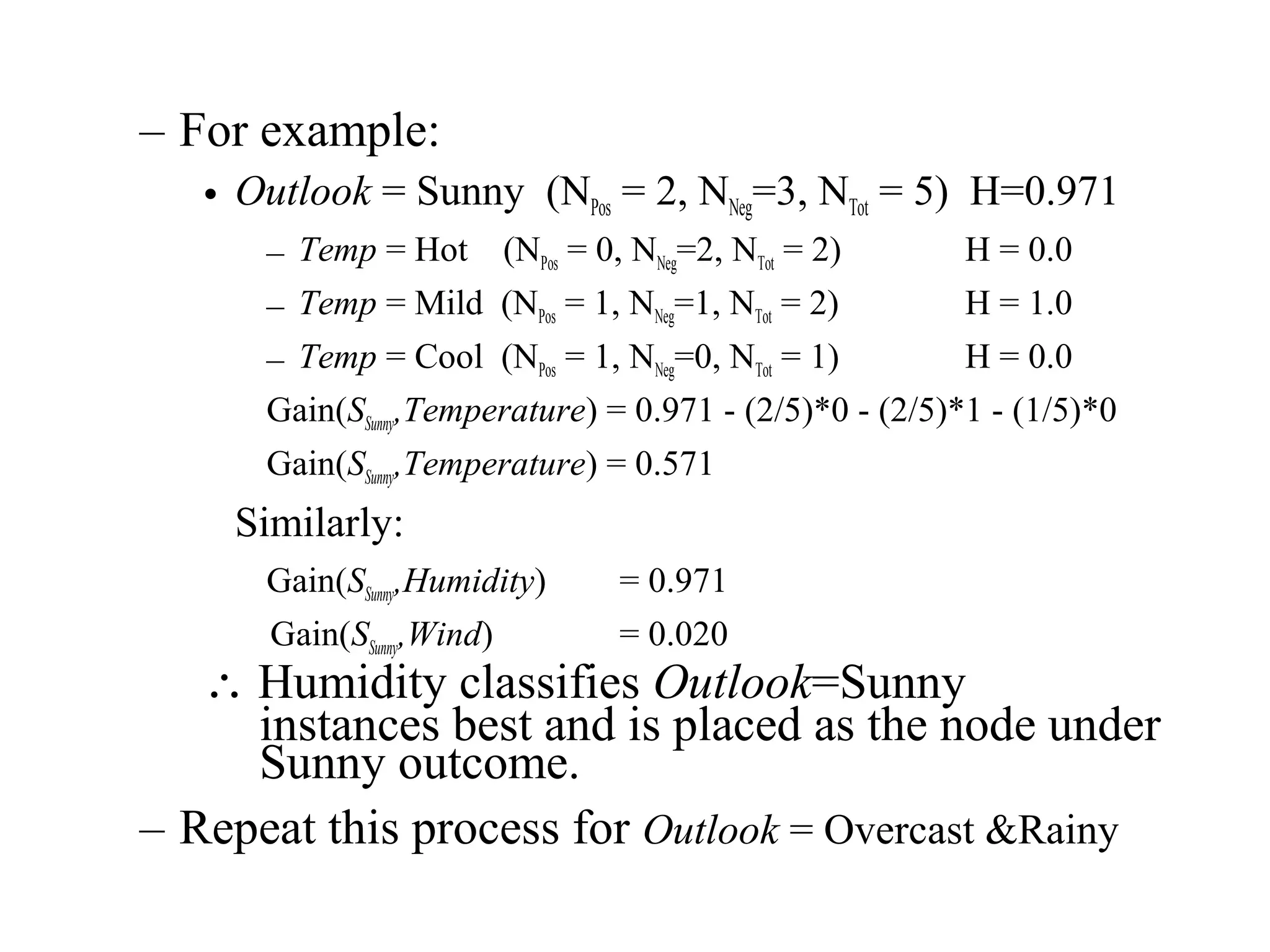
– For example: 
• Outlook = Sunny (NPos = 2, NNeg=3, NTot = 5) H=0.971 
– Temp = Hot (NPos = 0, NNeg=2, NTot = 2) H = 0.0 
– Temp = Mild (NPos = 1, NNeg=1, NTot = 2) H = 1.0 
– Temp = Cool (NPos = 1, NNeg=0, NTot = 1) H = 0.0 
Gain(SSunny,Temperature) = 0.971 - (2/5)*0 - (2/5)*1 - (1/5)*0 
Gain(SSunny,Temperature) = 0.571 
Similarly: 
Gain(SSunny,Humidity) = 0.971 
Gain(SSunny,Wind) = 0.020 
 Humidity classifies Outlook=Sunny 
instances best and is placed as the node under 
Sunny outcome. 
– Repeat this process for Outlook = Overcast &Rainy
–Important: 
• Attributes are excluded from consideration 
if they appear higher in the tree 
– Process continues for each new leaf node 
until: 
• Every attribute has already been included 
along path through the tree 
or 
• Training examples associated with this leaf 
all have same target attribute value.
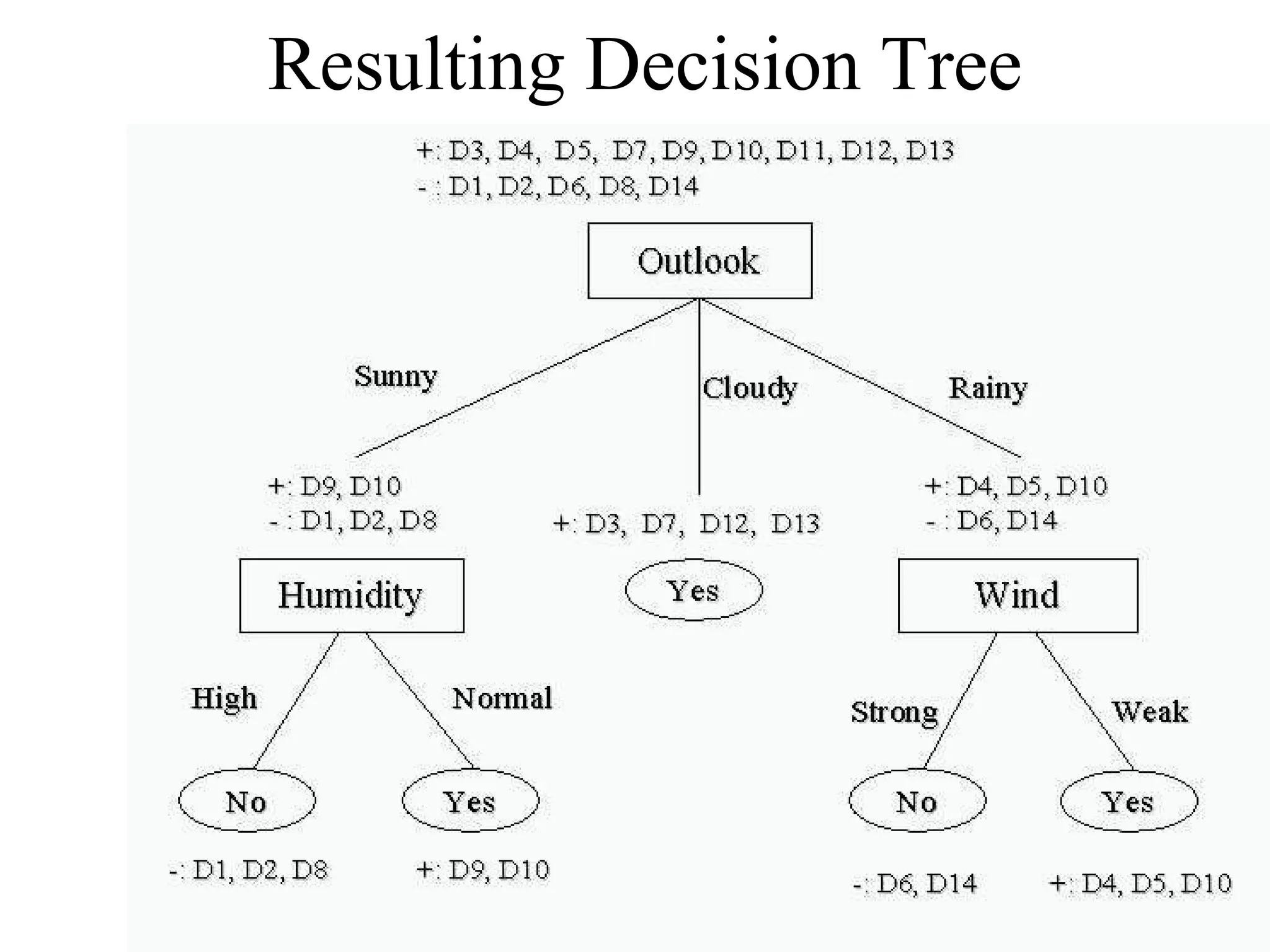
– End up with tree:
– Note: In this example data were perfect. 
• No contradictions 
• Branches led to unambiguous Yes, No decisions 
• If there are contradictions take the majority vote 
– This handles noisy data. 
– Another note: 
• Attributes are eliminated when they are assigned to 
a node and never reconsidered. 
– e.g. You would not go back and reconsider Outlook 
under Humidity 
– ID3 uses all of the training data at once 
• Contrast to Candidate-Elimination 
• Can hhaannddllee nnooiissyy ddaattaa..
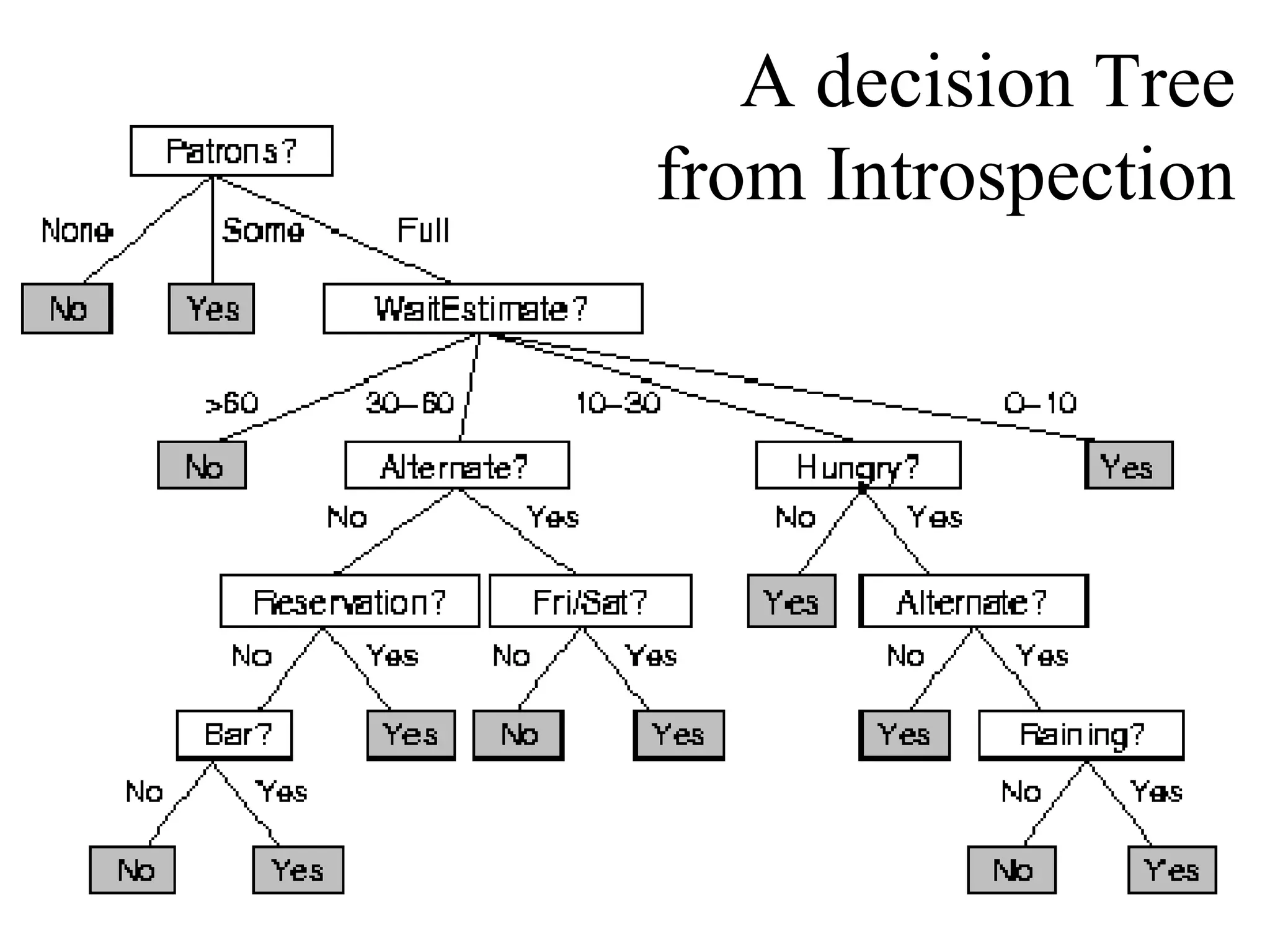
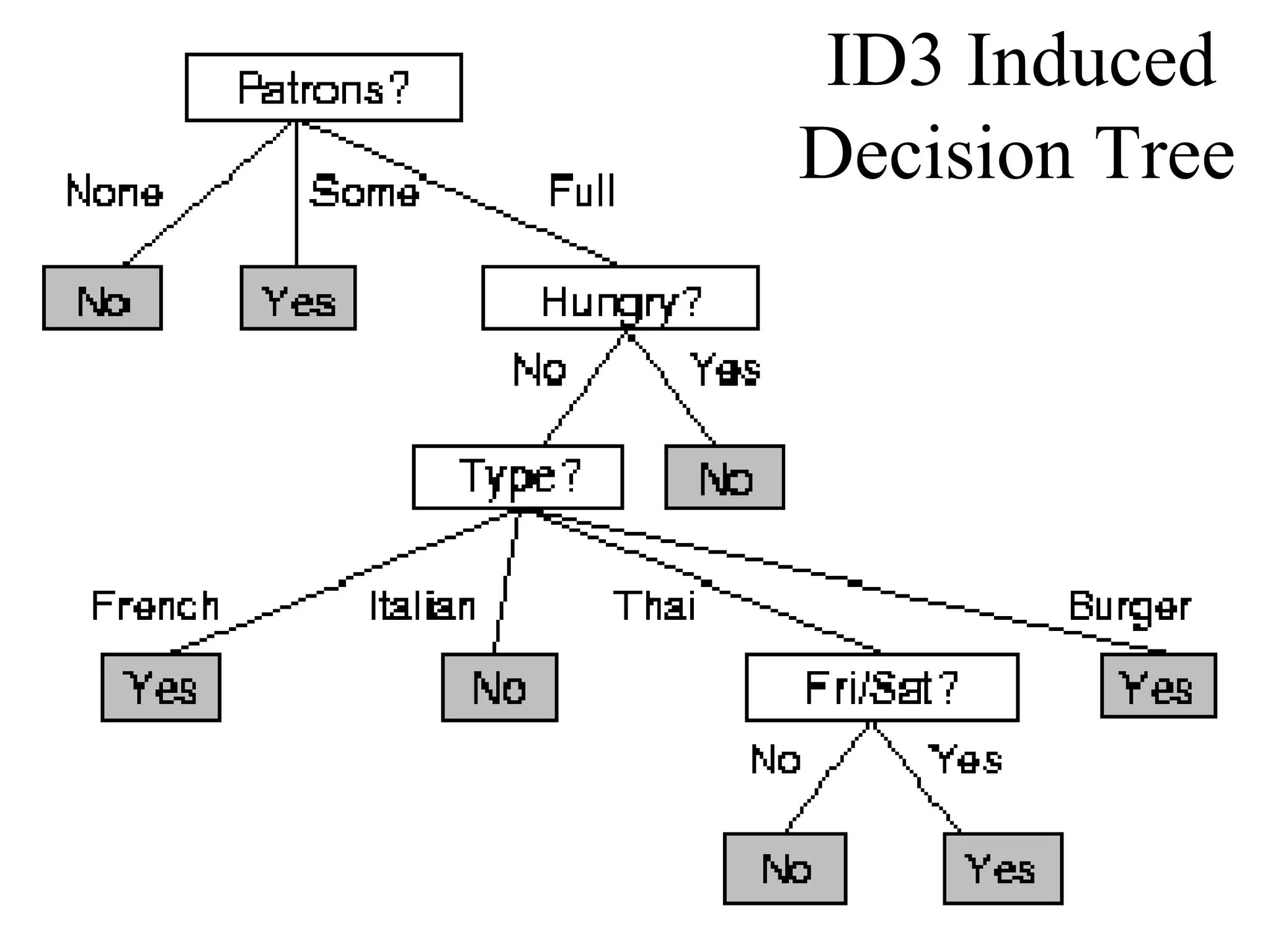
Another Example: Russell’s and Norvig’s 
Restaurant Domain 
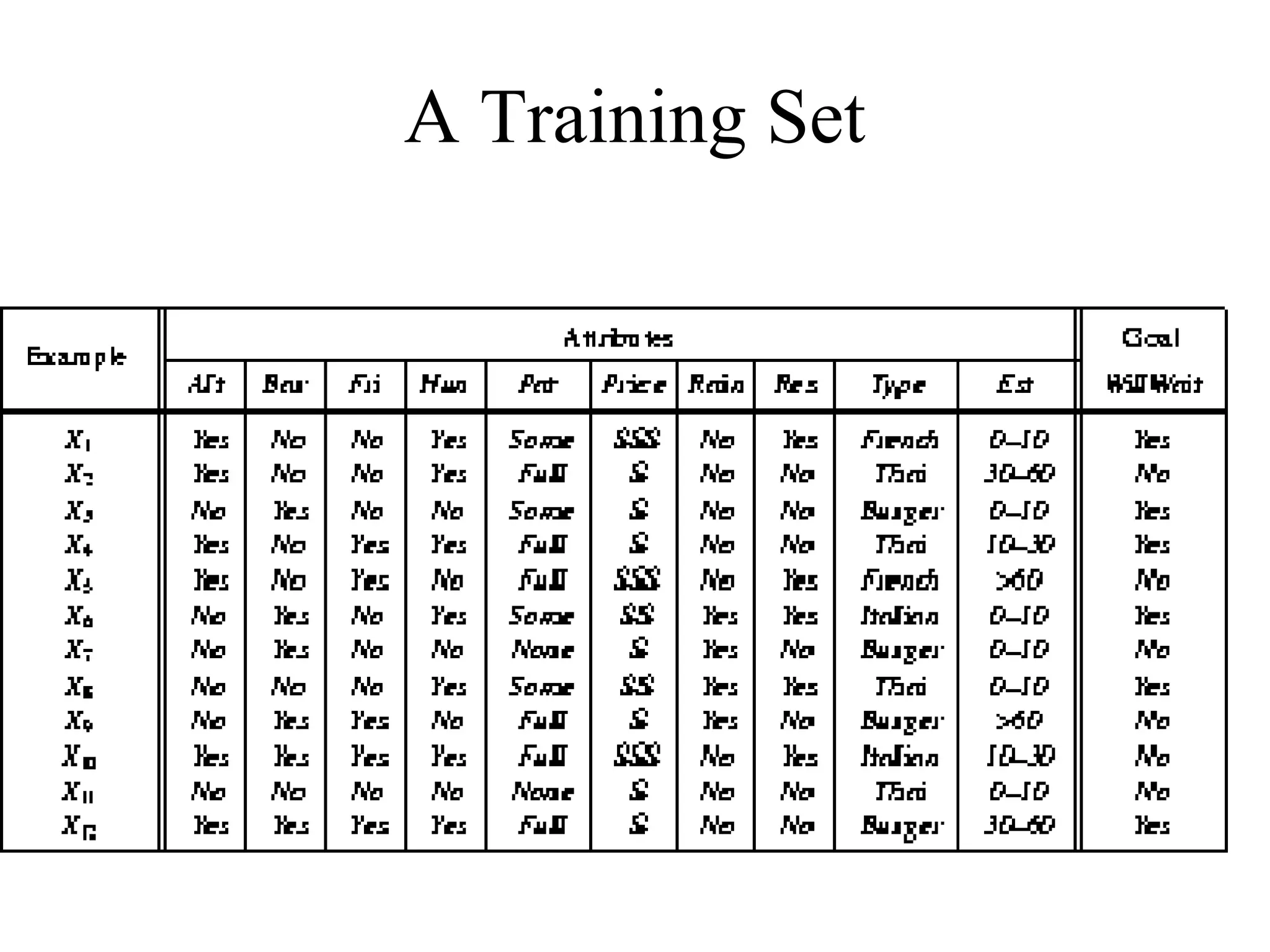
• Develop a decision tree to model the decision a patron 
makes when deciding whether or not to wait for a table at 
a restaurant. 
• Two classes: wait, leave 
• Ten attributes: alternative restaurant available?, bar in 
restaurant?, is it Friday?, are we hungry?, how full is the 
restaurant?, how expensive?, is it raining?,do we have a 
reservation?, what type of restaurant is it?, what's the 
purported waiting time? 
• Training set of 12 examples 
• ~ 7000 possible cases
A Training Set
A decision Tree 
from Introspection
ID3 Induced 
Decision Tree
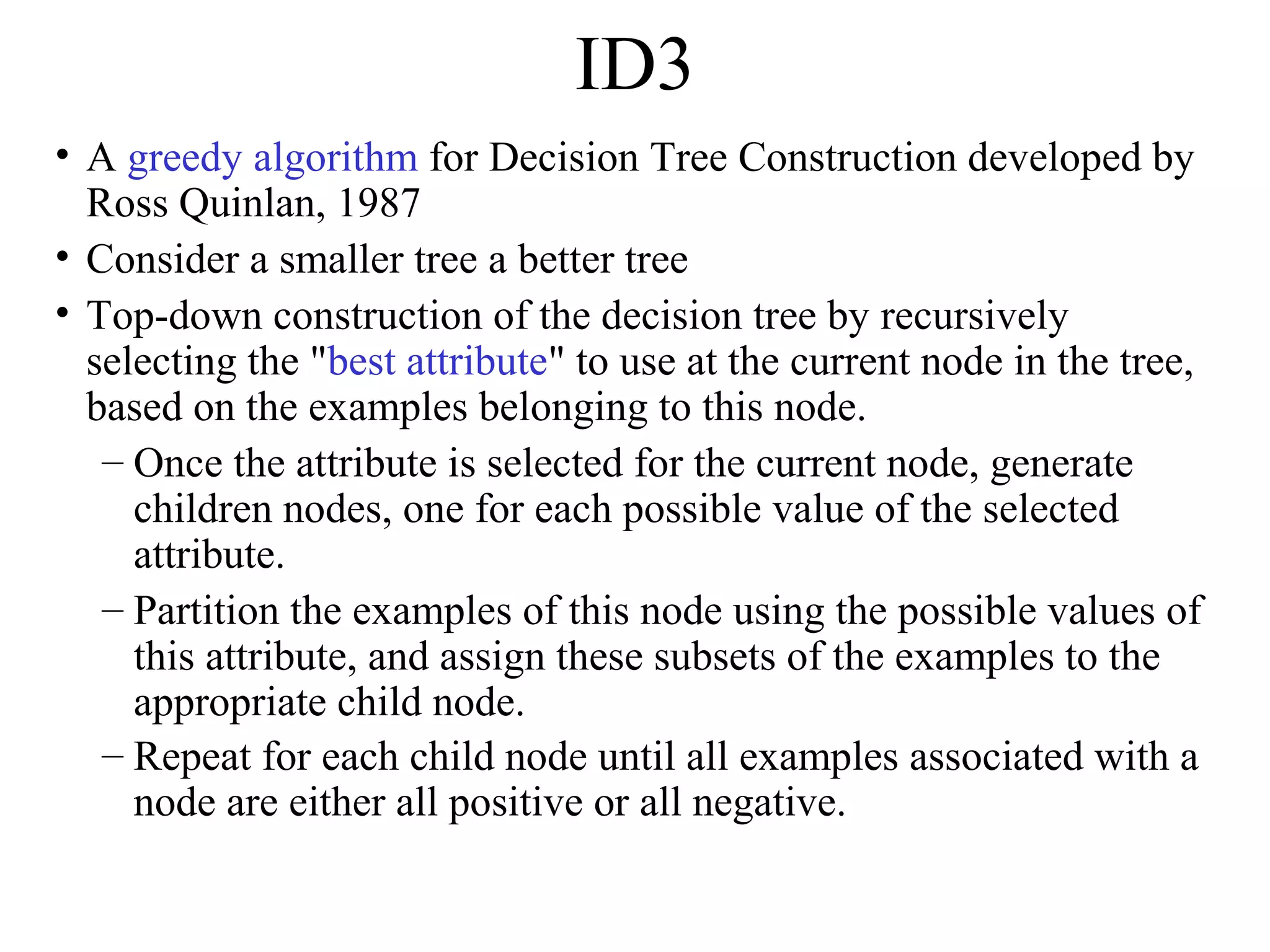
ID3 
• A greedy algorithm for Decision Tree Construction developed by 
Ross Quinlan, 1987 
• Consider a smaller tree a better tree 
• Top-down construction of the decision tree by recursively 
selecting the "best attribute" to use at the current node in the tree, 
based on the examples belonging to this node. 
– Once the attribute is selected for the current node, generate 
children nodes, one for each possible value of the selected 
attribute. 
– Partition the examples of this node using the possible values of 
this attribute, and assign these subsets of the examples to the 
appropriate child node. 
– Repeat for each child node until all examples associated with a 
node are either all positive or all negative.
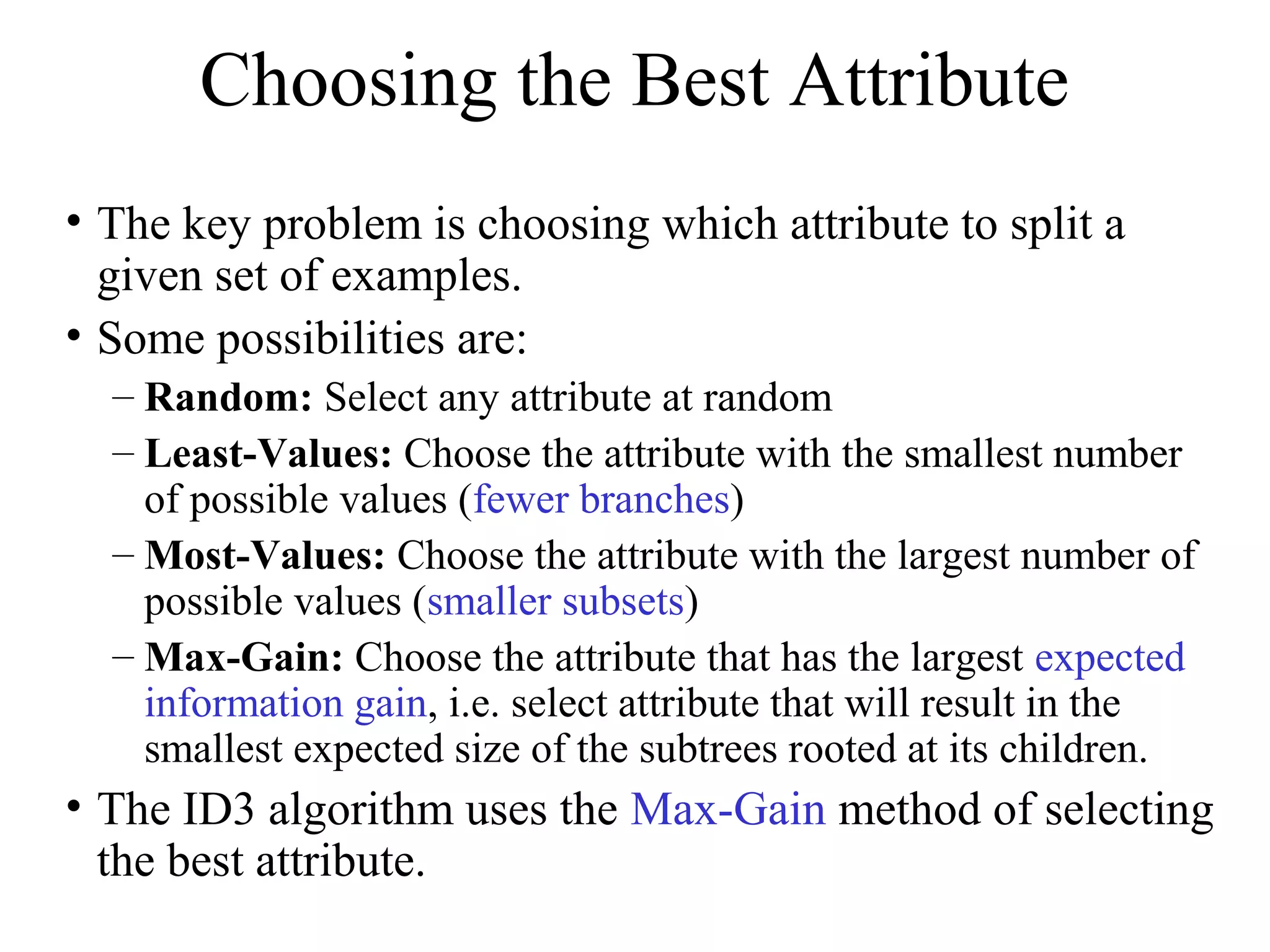
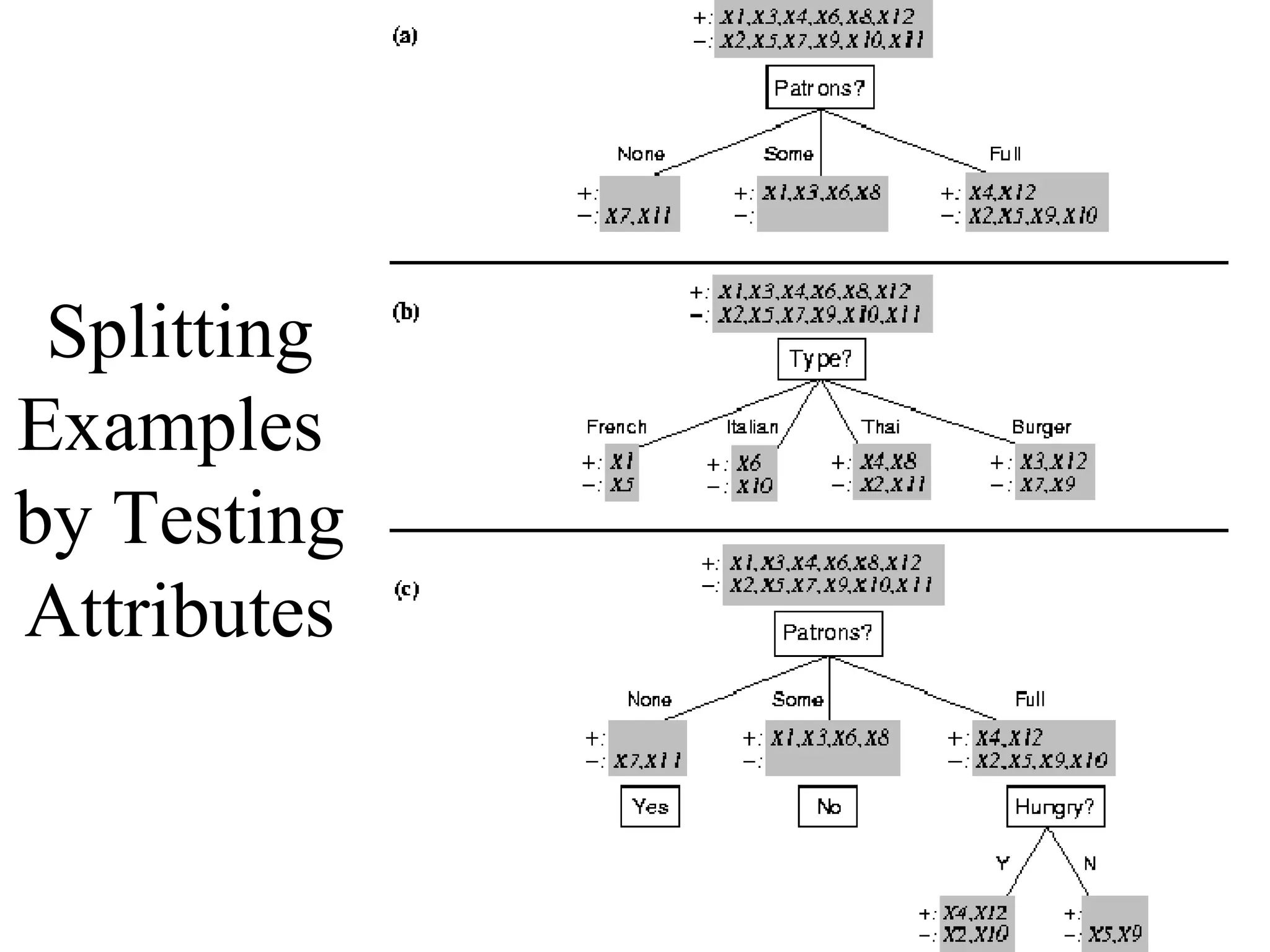
Choosing the Best Attribute 
• The key problem is choosing which attribute to split a 
given set of examples. 
• Some possibilities are: 
– Random: Select any attribute at random 
– Least-Values: Choose the attribute with the smallest number 
of possible values (fewer branches) 
– Most-Values: Choose the attribute with the largest number of 
possible values (smaller subsets) 
– Max-Gain: Choose the attribute that has the largest expected 
information gain, i.e. select attribute that will result in the 
smallest expected size of the subtrees rooted at its children. 
• The ID3 algorithm uses the Max-Gain method of selecting 
the best attribute.
Splitting 
Examples 
by Testing 
Attributes
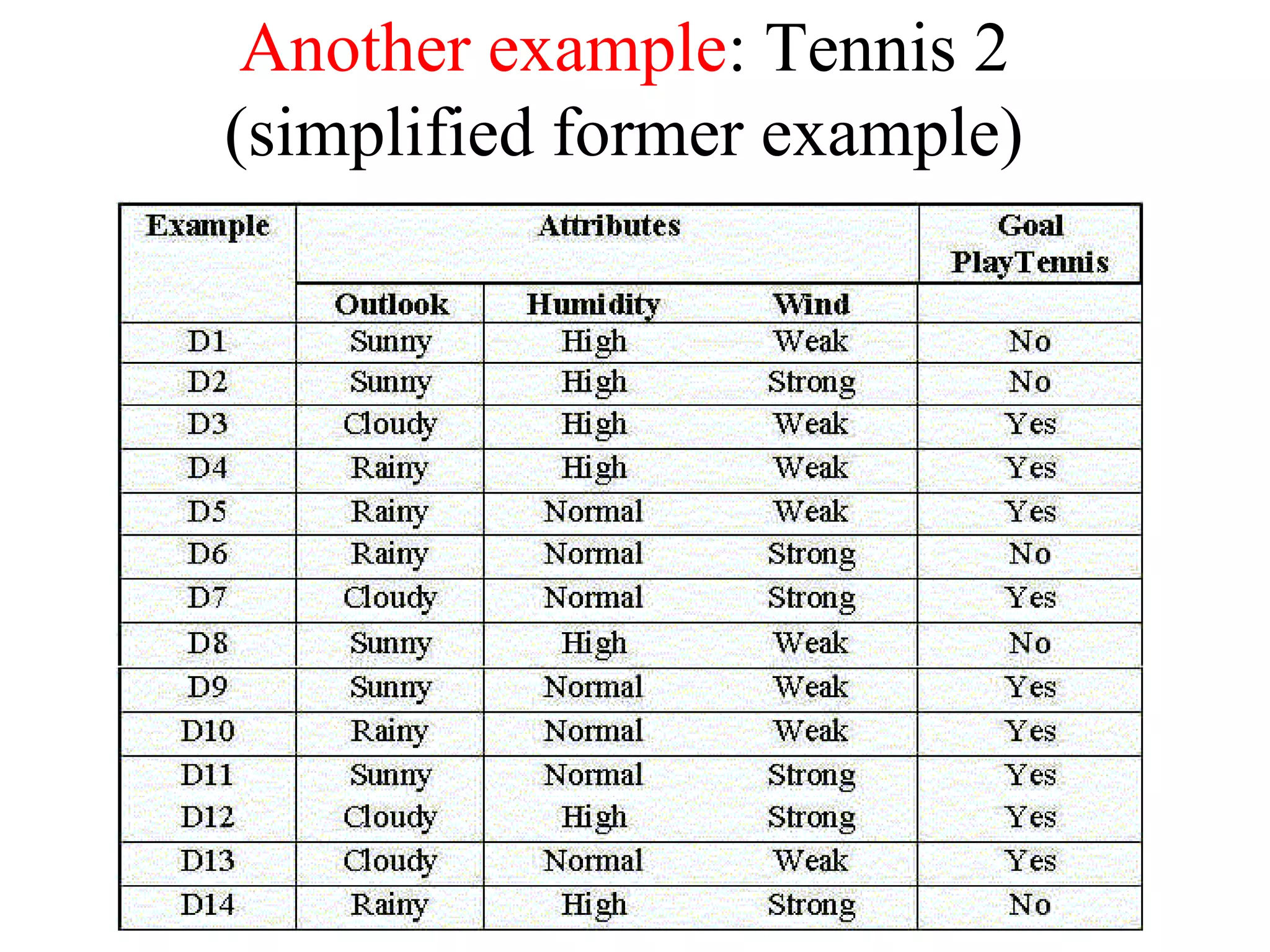
Another example: Tennis 2 
(simplified former example)
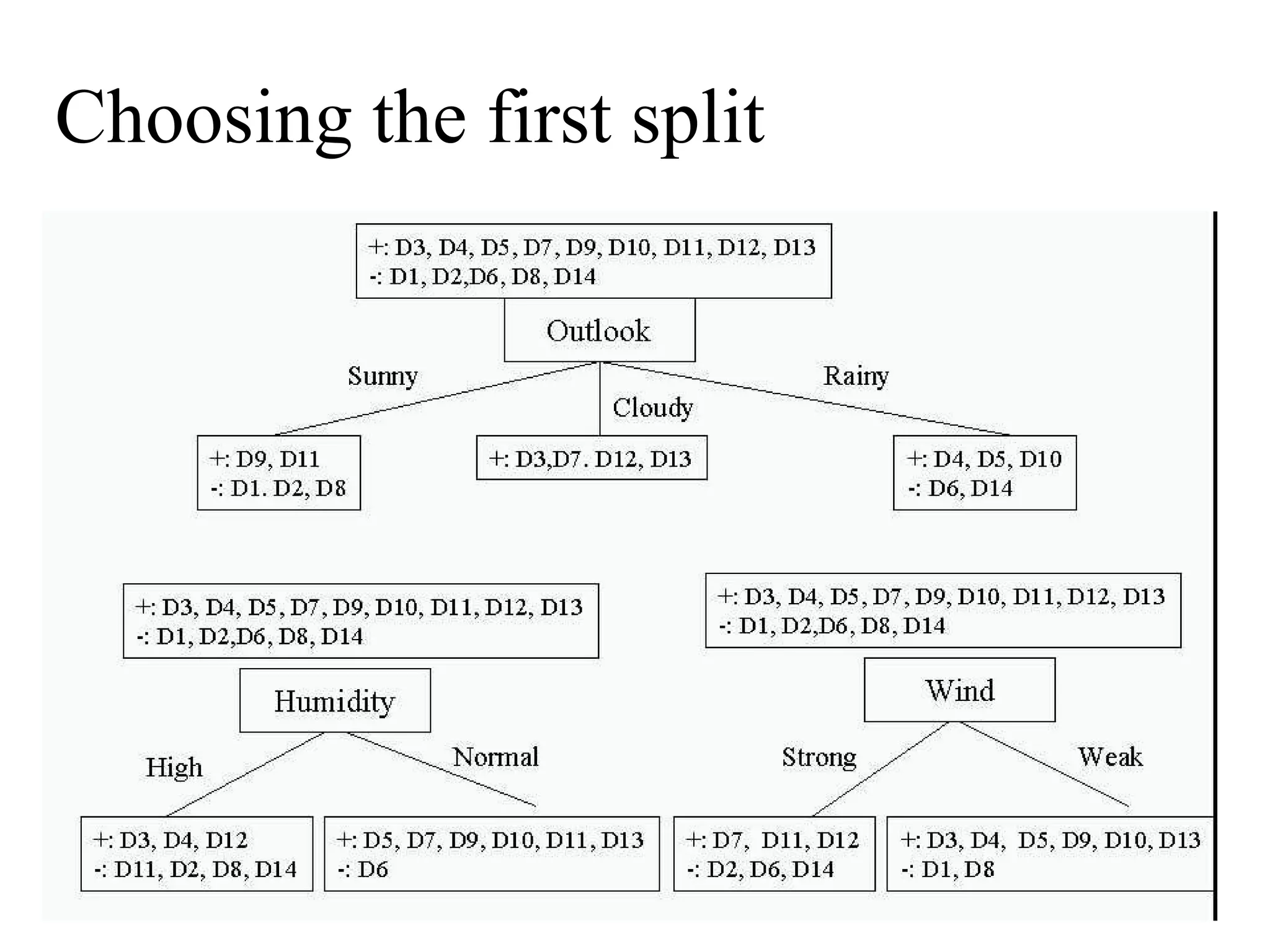
Choosing the first split
Resulting Decision Tree
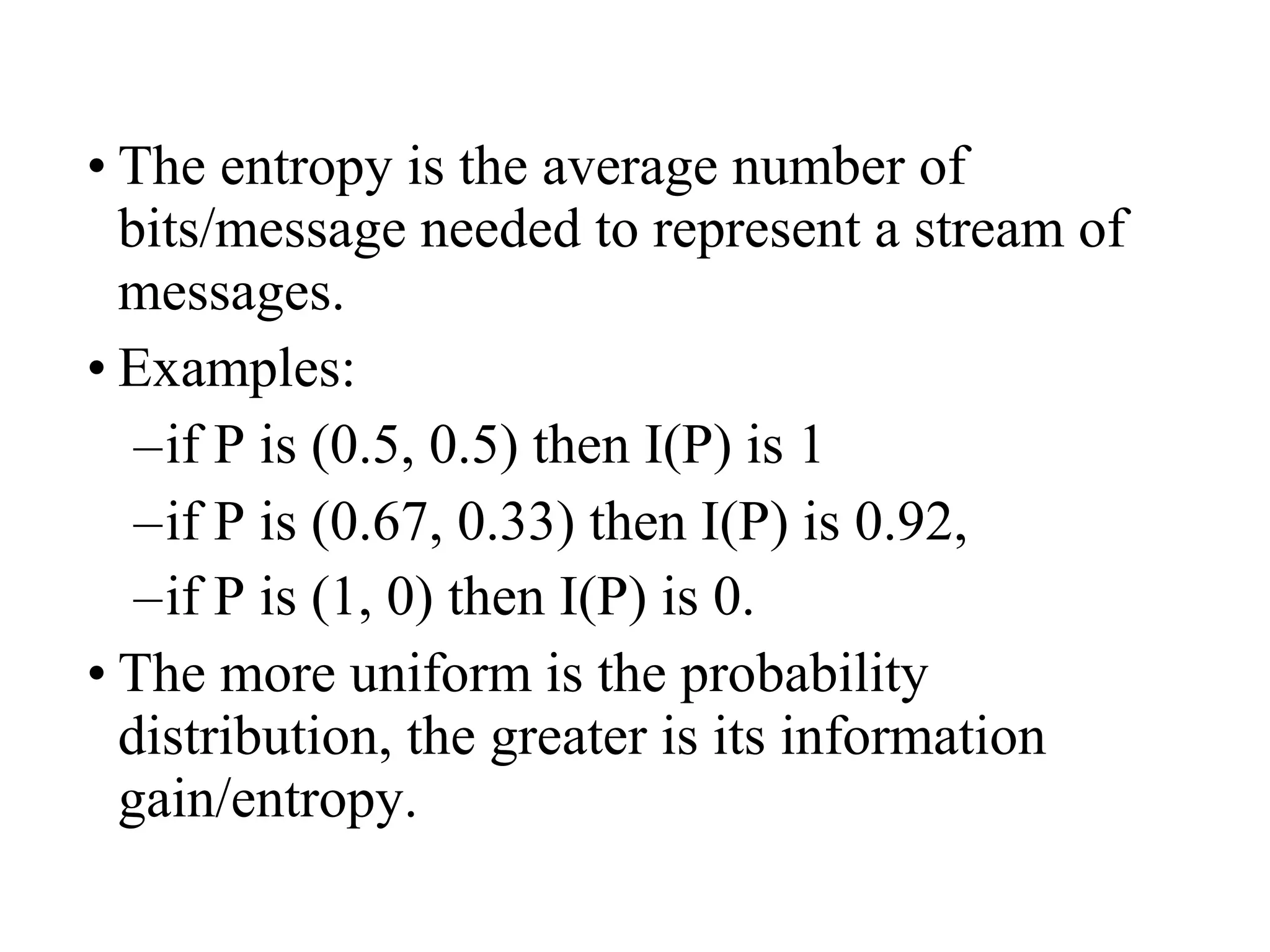
• The entropy is the average number of 
bits/message needed to represent a stream of 
messages. 
• Examples: 
–if P is (0.5, 0.5) then I(P) is 1 
–if P is (0.67, 0.33) then I(P) is 0.92, 
–if P is (1, 0) then I(P) is 0. 
• The more uniform is the probability 
distribution, the greater is its information 
gain/entropy.
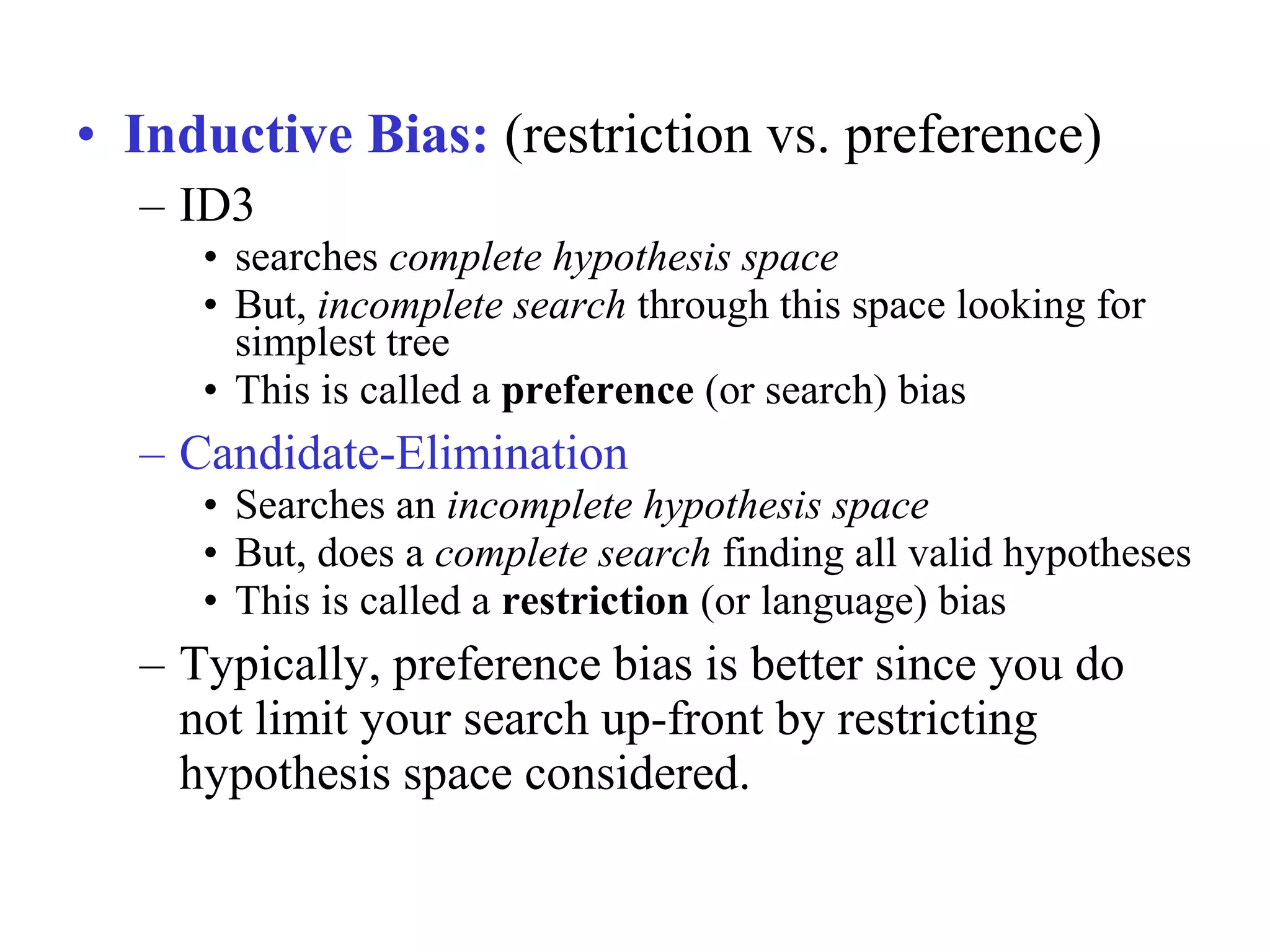
• What is the hypothesis space for decision tree 
learning? 
– Search through space of all possible decision trees 
• from simple to more complex guided by a heuristic: 
information gain 
– The space searched is complete space of finite, 
discrete-valued functions. 
• Includes disjunctive and conjunctive expressions 
– Method only maintains one current hypothesis 
• In contrast to Candidate-Elimination 
– Not necessarily global optimum 
• attributes eliminated when assigned to a node 
• No backtracking 
• Different trees are possible
• Inductive Bias: (restriction vs. preference) 
– ID3 
• searches complete hypothesis space 
• But, incomplete search through this space looking for 
simplest tree 
• This is called a preference (or search) bias 
– Candidate-Elimination 
• Searches an incomplete hypothesis space 
• But, does a complete search finding all valid hypotheses 
• This is called a restriction (or language) bias 
– Typically, preference bias is better since you do 
not limit your search up-front by restricting 
hypothesis space considered.
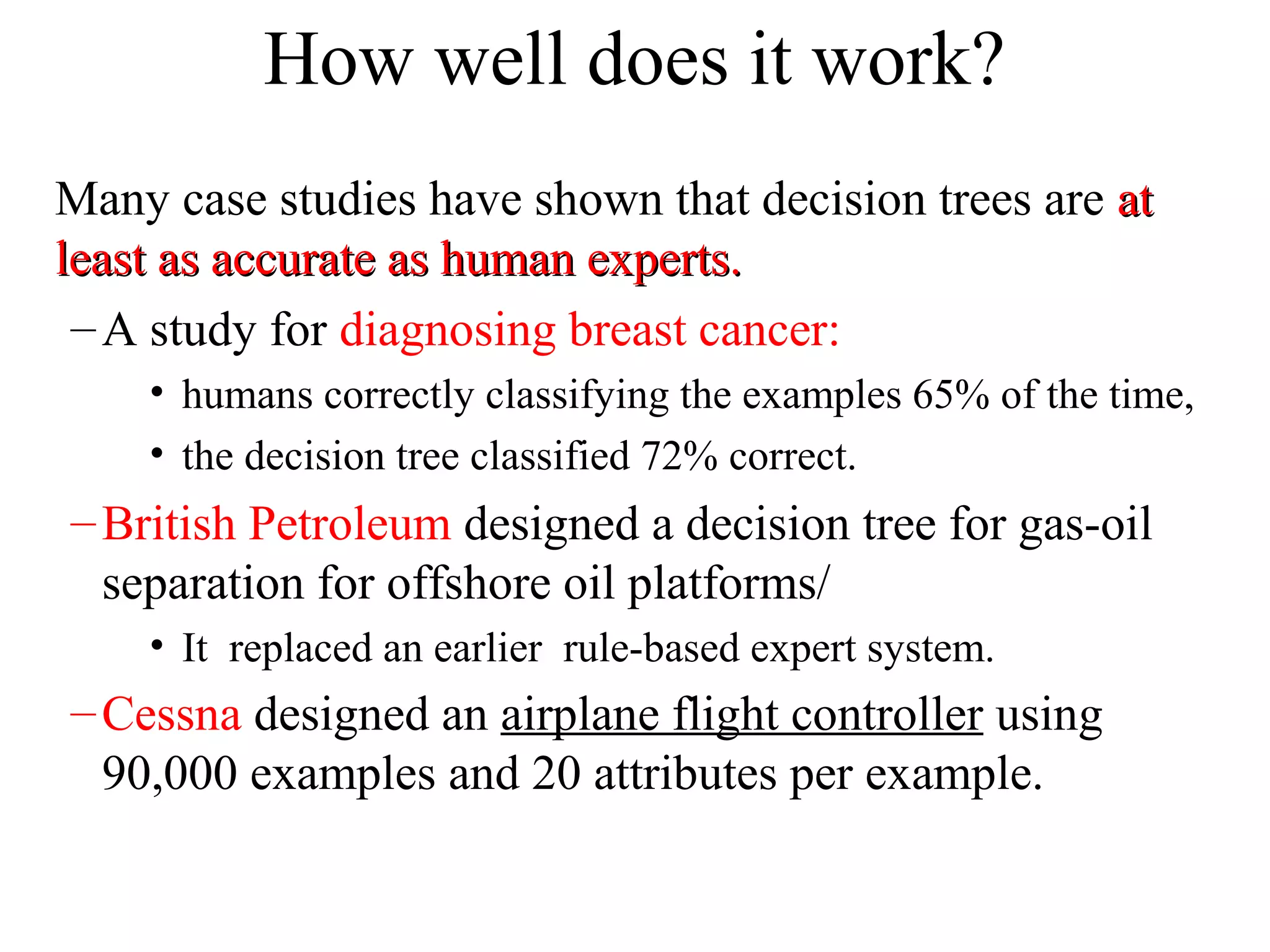
How well does it work? 
Many case studies have shown that decision trees are aatt 
lleeaasstt aass aaccccuurraattee aass hhuummaann eexxppeerrttss.. 
–A study for diagnosing breast cancer: 
• humans correctly classifying the examples 65% of the time, 
• the decision tree classified 72% correct. 
–British Petroleum designed a decision tree for gas-oil 
separation for offshore oil platforms/ 
• It replaced an earlier rule-based expert system. 
–Cessna designed an airplane flight controller using 
90,000 examples and 20 attributes per example.
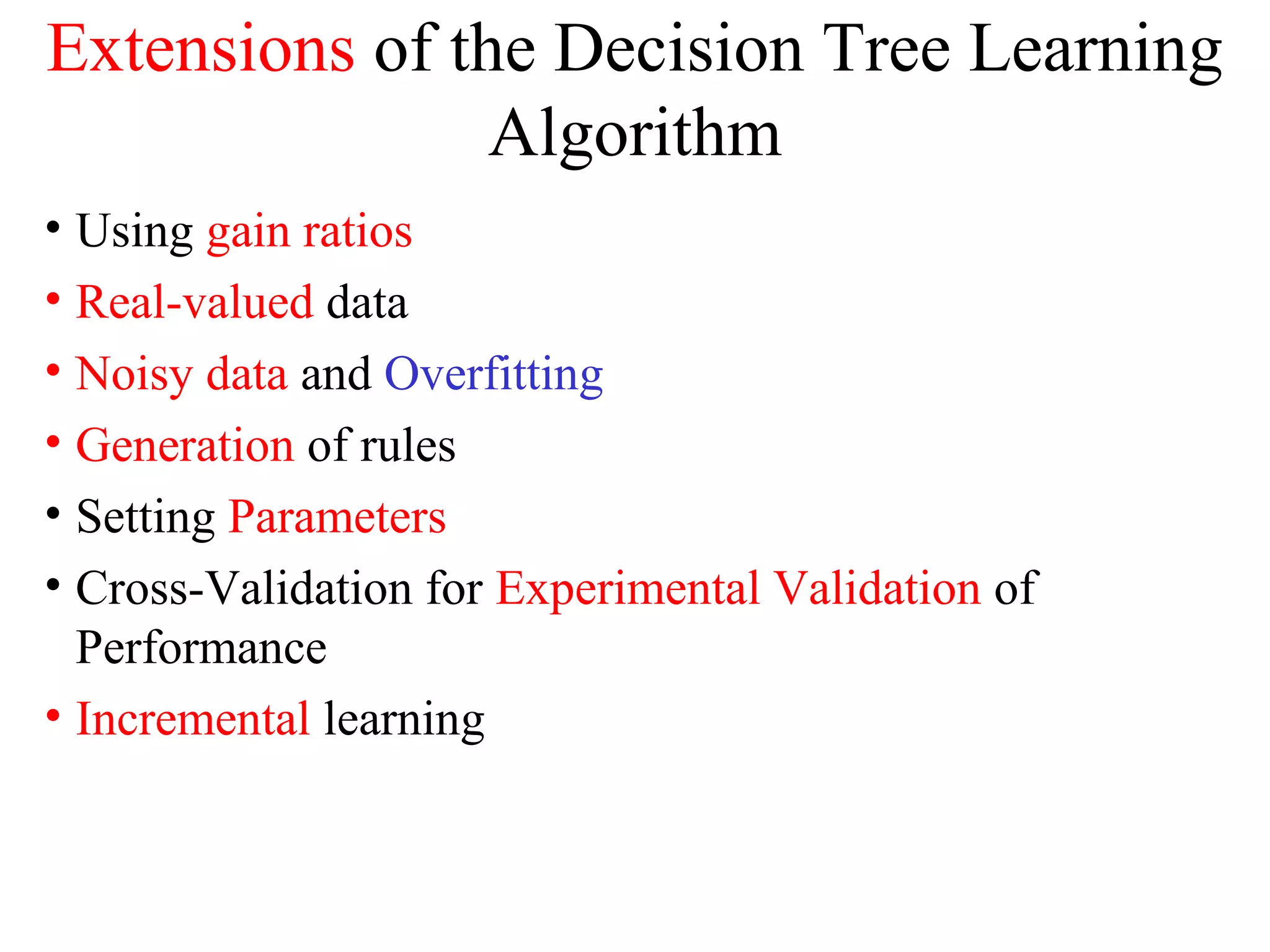
Extensions of the Decision Tree Learning 
Algorithm 
• Using gain ratios 
• Real-valued data 
• Noisy data and Overfitting 
• Generation of rules 
• Setting Parameters 
• Cross-Validation for Experimental Validation of 
Performance 
• Incremental learning
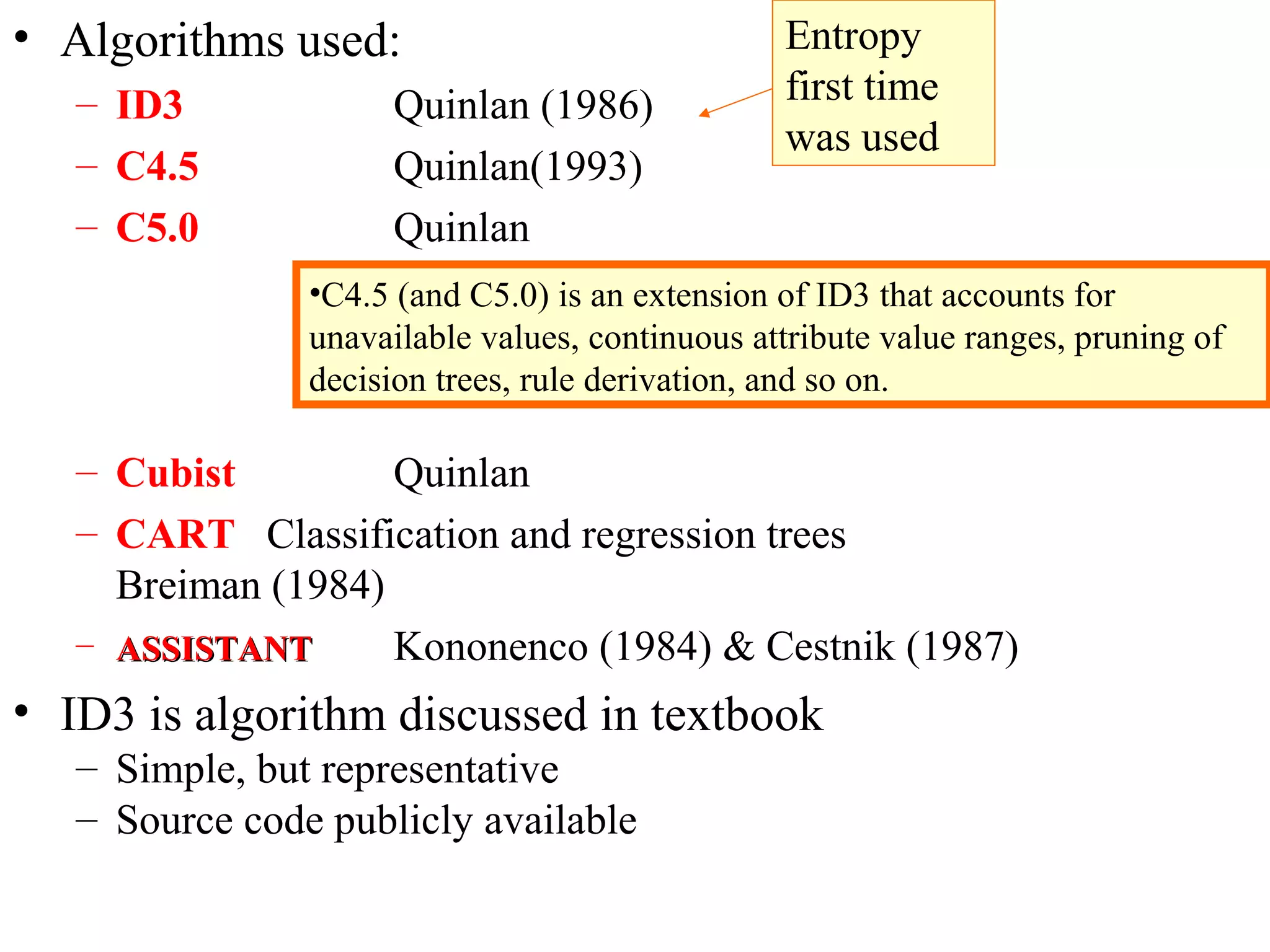
• Algorithms used: 
– ID3 Quinlan (1986) 
– C4.5 Quinlan(1993) 
– C5.0 Quinlan 
– Cubist Quinlan 
– CART Classification and regression trees 
Breiman (1984) 
– AASSSSIISSTTAANNTT Kononenco (1984) & Cestnik (1987) 
• ID3 is algorithm discussed in textbook 
– Simple, but representative 
– Source code publicly available 
Entropy 
first time 
was used 
•C4.5 (and C5.0) is an extension of ID3 that accounts for 
unavailable values, continuous attribute value ranges, pruning of 
decision trees, rule derivation, and so on.
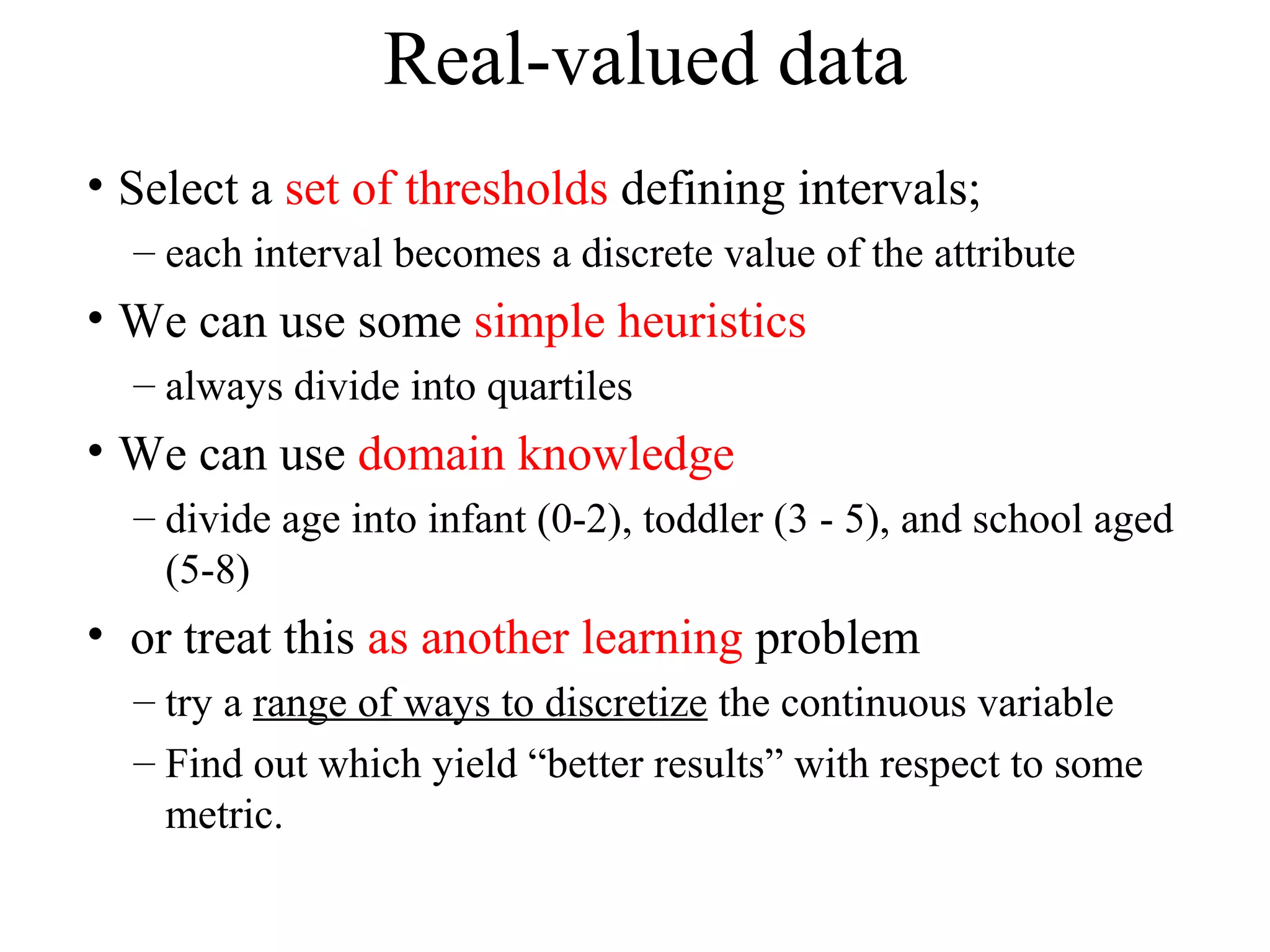
Real-valued data 
• Select a set of thresholds defining intervals; 
– each interval becomes a discrete value of the attribute 
• We can use some simple heuristics 
– always divide into quartiles 
• We can use domain knowledge 
– divide age into infant (0-2), toddler (3 - 5), and school aged 
(5-8) 
• or treat this as another learning problem 
– try a range of ways to discretize the continuous variable 
– Find out which yield “better results” with respect to some 
metric.
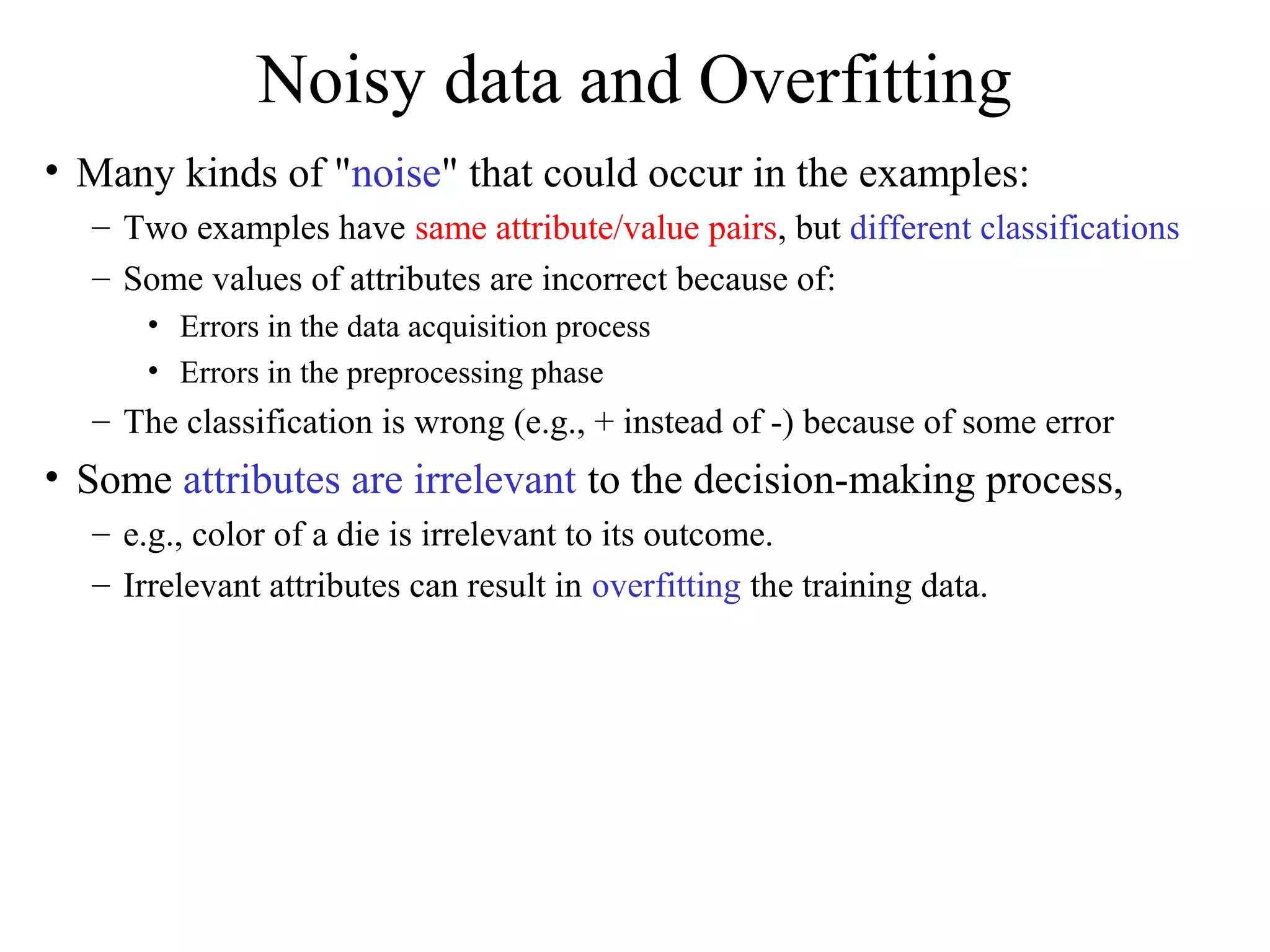
Noisy data and Overfitting 
• Many kinds of "noise" that could occur in the examples: 
– Two examples have same attribute/value pairs, but different classifications 
– Some values of attributes are incorrect because of: 
• Errors in the data acquisition process 
• Errors in the preprocessing phase 
– The classification is wrong (e.g., + instead of -) because of some error 
• Some attributes are irrelevant to the decision-making process, 
– e.g., color of a die is irrelevant to its outcome. 
– Irrelevant attributes can result in overfitting the training data.
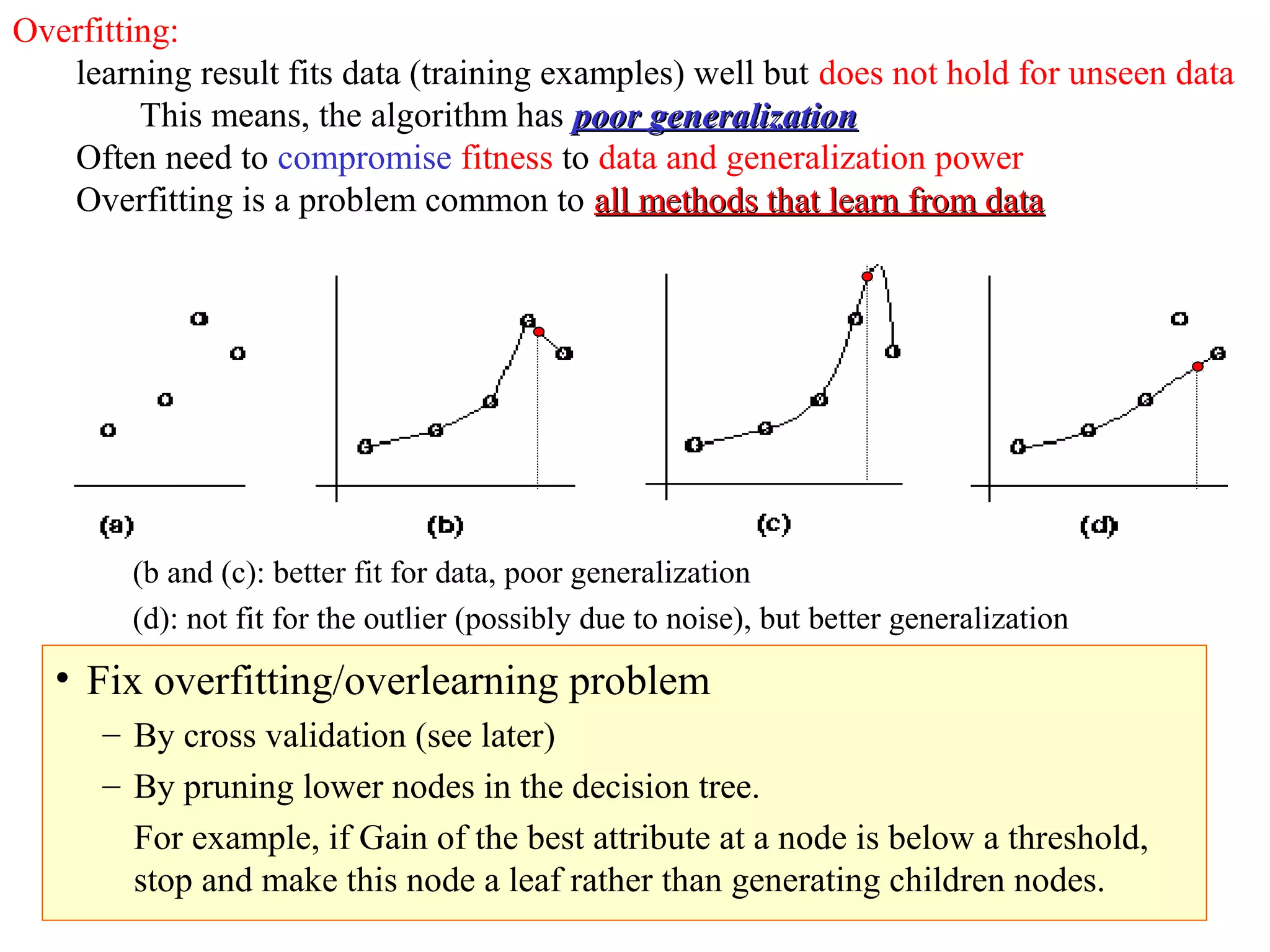
Overfitting: 
learning result fits data (training examples) well but does not hold for unseen data 
This means, the algorithm has ppoooorr ggeenneerraalliizzaattiioonn 
Often need to compromise fitness to data and generalization power 
Overfitting is a problem common to aallll mmeetthhooddss tthhaatt lleeaarrnn ffrroomm ddaattaa 
(b and (c): better fit for data, poor generalization 
(d): not fit for the outlier (possibly due to noise), but better generalization 
• Fix overfitting/overlearning problem 
– By cross validation (see later) 
– By pruning lower nodes in the decision tree. 
For example, if Gain of the best attribute at a node is below a threshold, 
stop and make this node a leaf rather than generating children nodes.
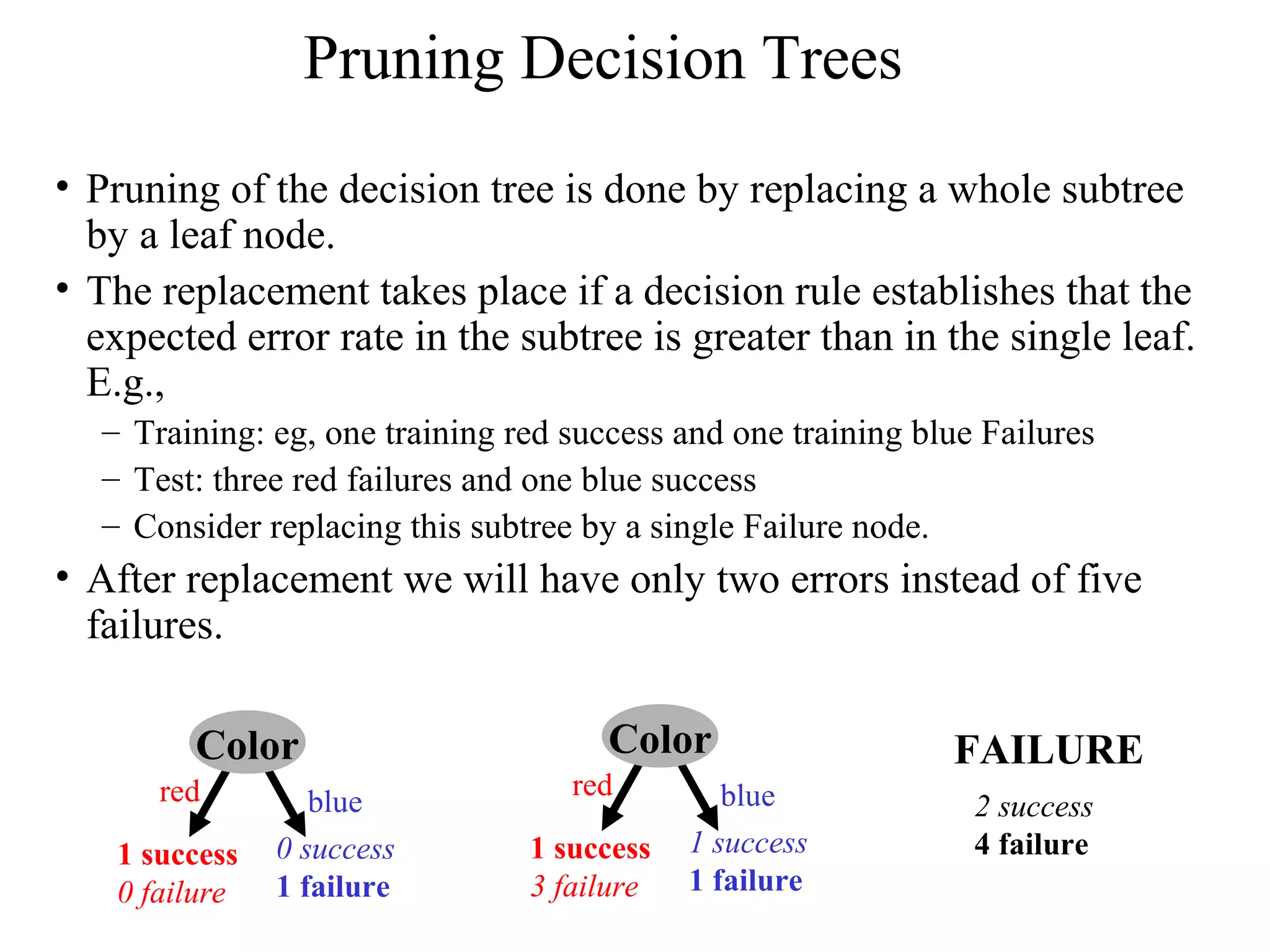
Pruning Decision Trees 
• Pruning of the decision tree is done by replacing a whole subtree 
by a leaf node. 
• The replacement takes place if a decision rule establishes that the 
expected error rate in the subtree is greater than in the single leaf. 
E.g., 
– Training: eg, one training red success and one training blue Failures 
– Test: three red failures and one blue success 
– Consider replacing this subtree by a single Failure node. 
• After replacement we will have only two errors instead of five 
failures. 
Color 
red blue 
1 success 
0 failure 
0 success 
1 failure 
Color 
FAILURE 
red blue 2 success 
1 success 
3 failure 
1 success 
1 failure 
4 failure
Incremental Learning 
• Incremental learning 
– Change can be made with each training example 
– Non-incremental learning is also called batch learning 
– Good for 
• adaptive system (learning while experiencing) 
• when environment undergoes changes 
– Often with 
• Higher computational cost 
• Lower quality of learning results 
– ITI (by U. Mass): incremental DT learning package
Evaluation Methodology 
• Standard methodology: cross validation 
1. Collect a large set of examples (all with correct classifications!). 
2. Randomly divide collection into two disjoint sets: training and 
test. 
3. Apply learning algorithm to training set giving hypothesis H 
4. Measure performance of H w.r.t. test set 
• Important: keep the training and test sets disjoint! 
• Learning is not to minimize training error (wrt data) but 
the error for test/cross-validation: a way to fix overfitting 
• To study the efficiency and robustness of an algorithm, 
repeat steps 2-4 for different training sets and sizes of 
training sets. 
• If you improve your algorithm, start again with step 1 to 
avoid evolving the algorithm to work well on just this 
collection.
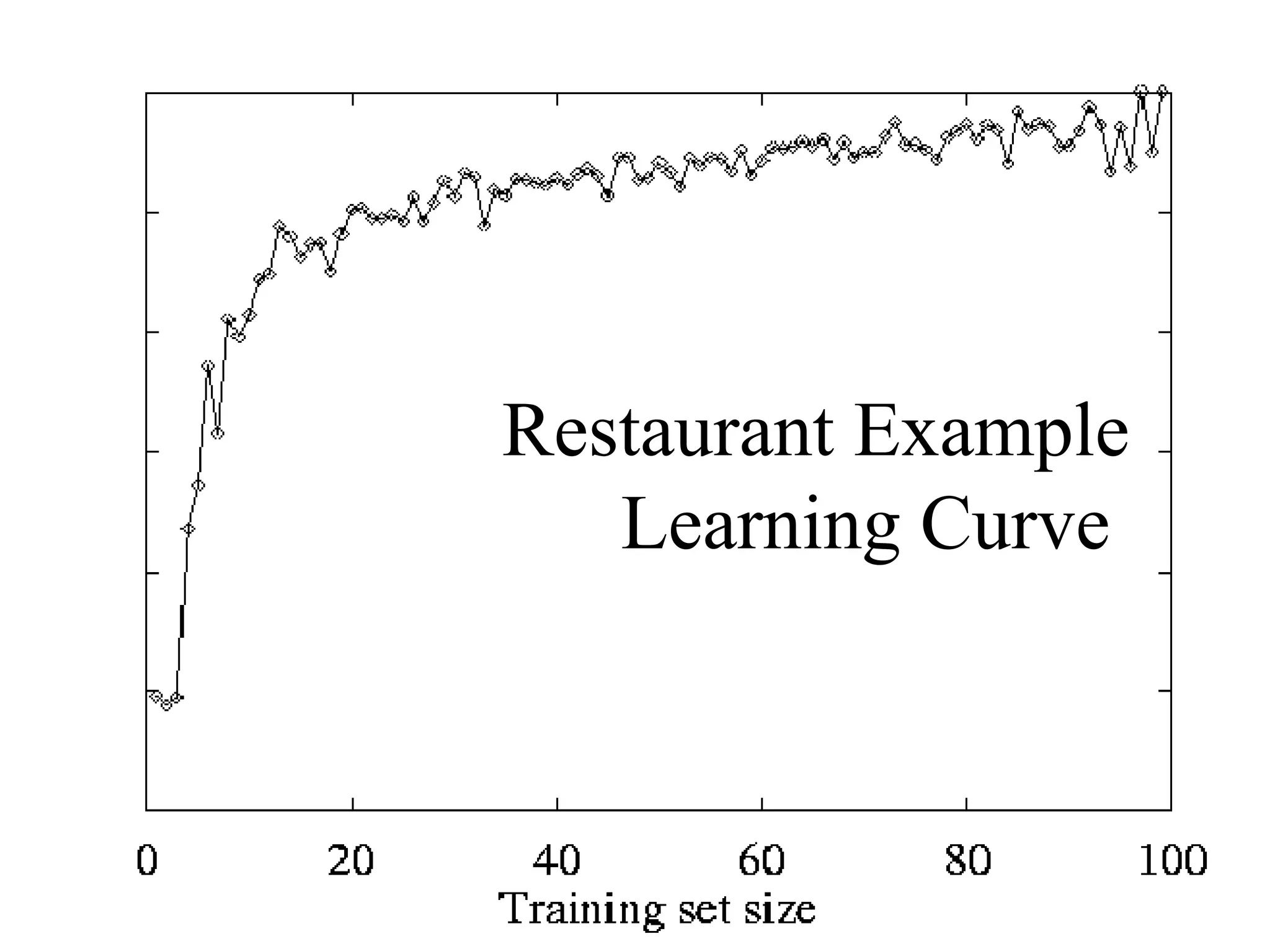
Restaurant Example 
Learning Curve
Decision Trees to Rules 
• It is easy to derive a rule set from a decision tree: write a rule for 
each path in the decision tree from the root to a leaf. 
• In that rule the left-hand side is easily built from the label of the 
nodes and the labels of the arcs. 
• The resulting rules set can be simplified: 
– Let LHS be the left hand side of a rule. 
– Let LHS' be obtained from LHS by eliminating some conditions. 
– We can certainly replace LHS by LHS' in this rule if the subsets of the 
training set that satisfy respectively LHS and LHS' are equal. 
– A rule may be eliminated by using metaconditions such as "if no other rule 
applies".
C4.5 
• C4.5 is an extension of ID3 that accounts for 
unavailable values, continuous attribute value 
ranges, pruning of decision trees, rule derivation, 
and so on. 
C4.5: Programs for Machine Learning 
J. Ross Quinlan, The Morgan Kaufmann Series 
in Machine Learning, Pat Langley, 
Series Editor. 1993. 302 pages. 
paperback book & 3.5" Sun 
disk. $77.95. ISBN 1-55860-240-2
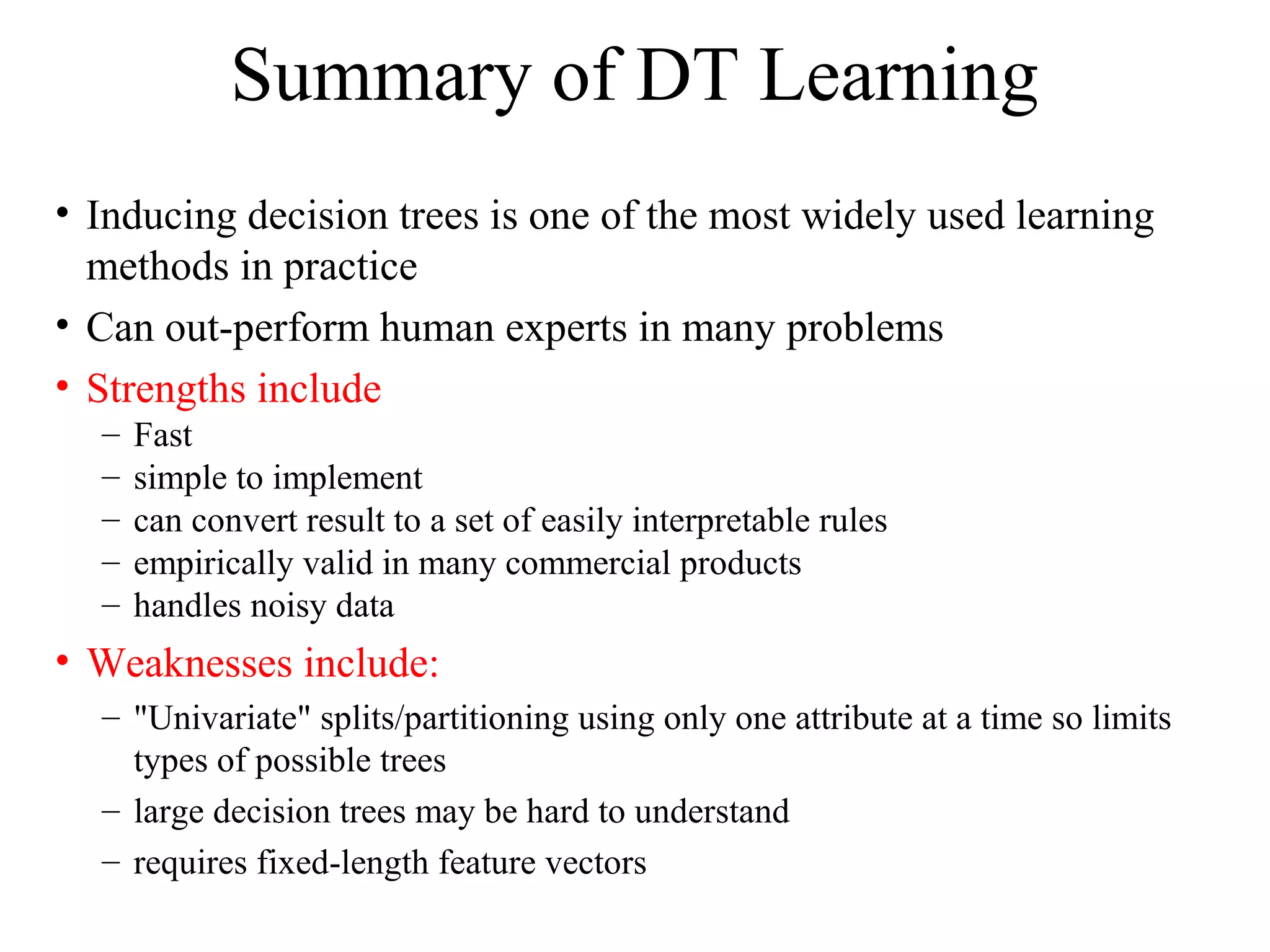
Summary of DT Learning 
• Inducing decision trees is one of the most widely used learning 
methods in practice 
• Can out-perform human experts in many problems 
• Strengths include 
– Fast 
– simple to implement 
– can convert result to a set of easily interpretable rules 
– empirically valid in many commercial products 
– handles noisy data 
• Weaknesses include: 
– "Univariate" splits/partitioning using only one attribute at a time so limits 
types of possible trees 
– large decision trees may be hard to understand 
– requires fixed-length feature vectors
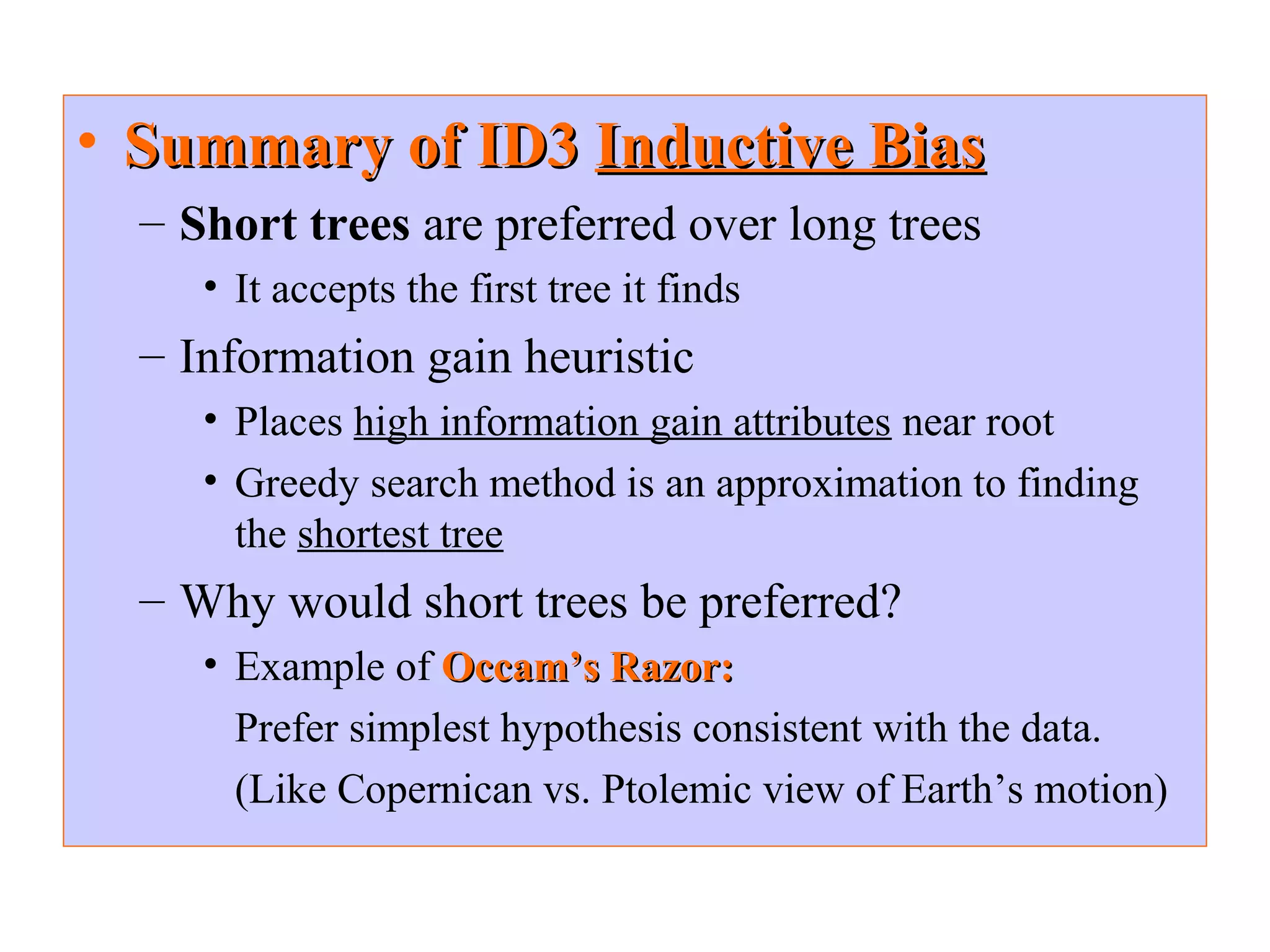
• SSuummmmaarryy ooff IIDD33 IInndduuccttiivvee BBiiaass 
– Short trees are preferred over long trees 
• It accepts the first tree it finds 
– Information gain heuristic 
• Places high information gain attributes near root 
• Greedy search method is an approximation to finding 
the shortest tree 
– Why would short trees be preferred? 
• Example of OOccccaamm’’ss RRaazzoorr:: 
Prefer simplest hypothesis consistent with the data. 
(Like Copernican vs. Ptolemic view of Earth’s motion)
– Homework Assignment 
• Tom Mitchell’s software 
See: 
• http://www.cs.cmu.edu/afs/cs.cmu.edu/project/theo-3/www/ml.html 
• Assignment #2 (on decision trees) 
• Software is at: http://www.cs.cmu.edu/afs/cs/project/theo-3/mlc/hw2/ 
– Compiles with gcc compiler 
– Unfortunately, README is not there, but it’s easy to figure out: 
» After compiling, to run: 
dt [-s <random seed> ] <train %> <prune %> <test %> <SSV-format data file> 
» %train, %prune, & %test are percent of data to be used for training, pruning & 
testing. These are given as decimal fractions. To train on all data, use 1.0 0.0 0.0 
– Data sets for PlayTennis and Vote are include with code. 
– Also try the Restaurant example from Russell & Norvig 
– Also look at www.kdnuggets.com/ (Data Sets) 
Machine Learning Database Repository at UC Irvine - (try “zoo” for fun)
QQuueessttiioonnss aanndd PPrroobblleemmss 
• 1. Think how the method of finding best variable 
order for decision trees that we discussed here be 
adopted for: 
• ordering variables in binary and multi-valued decision 
diagrams 
• finding the bound set of variables for Ashenhurst and other 
functional decompositions 
• 2. Find a more precise method for variable ordering in 
trees, that takes into account special function patterns 
recognized in data 
• 3. Write a Lisp program for creating decision trees with 
entropy based variable selection.
– Sources 
• Tom Mitchell 
– Machine Learning, Mc Graw Hill 1997 
• Allan Moser 
• Tim Finin, 
• Marie desJardins 
• Chuck Dyer

002.decision trees

  • 1.
    Machine Learning Approachbbaasseedd oonn DDeecciissiioonn TTrreeeess
  • 2.
    • DDeecciissiioonn TTrreeeeLLeeaarrnniinngg – Practical inductive inference method – Same goal as Candidate-Elimination algorithm • Find Boolean function of attributes • Decision trees can be extended to functions with more than two output values. –Widely used – Robust to noise – Can handle disjunctive (OR’s) expressions – Completely expressive hypothesis space – Easily interpretable (tree structure, if-then rules)
  • 3.
    TTrraaiinniinngg EExxaammpplleess Attribute,variable, Object, sample, property example SShhaallll wwee ppllaayy tteennnniiss ttooddaayy?? ((TTeennnniiss 11)) decision
  • 4.
    Shall we playtennis today? • DDeecciissiioonn ttrreeeess ddoo ccllaassssiiffiiccaattiioonn – Classifies instances into one of a discrete set of possible categories – Learned function represented by tree – Each node in tree is test on some attribute of an instance – Branches represent values of attributes – Follow the tree from root to leaves to find the output value.
  • 5.
    • The treeitself forms hypothesis – Disjunction (OR’s) of conjunctions (AND’s) – Each path from root to leaf forms conjunction of constraints on attributes – Separate branches are disjunctions • Example from PlayTennis decision tree: (Outlook=Sunny ÙHumidity=Normal) Ú (Outlook=Overcast) Ú (Outlook=Rain Ù Wind=Weak)
  • 6.
    • TTyyppeess ooffpprroobblleemmss ddeecciissiioonn ttrreeee lleeaarrnniinngg iiss ggoooodd ffoorr:: – Instances represented by attribute-value pairs • For algorithm in book, attributes take on a small number of discrete values • Can be extended to real-valued attributes – (numerical data) • Target function has discrete output values • Algorithm in book assumes Boolean functions • Can be extended to multiple output values
  • 7.
    – Hypothesis spacecan include disjunctive expressions. • In fact, hypothesis space is complete space of finite discrete-valued functions – Robust to imperfect training data • classification errors • errors in attribute values • missing attribute values • Examples: – Equipment diagnosis – Medical diagnosis – Credit card risk analysis – Robot movement – Pattern Recognition • face recognition • hexapod walking gates
  • 8.
    • ID3 Algorithm – Top-down, greedy search through space of possible decision trees • Remember, decision trees represent hypotheses, so this is a search through hypothesis space. –What is top-down? • How to start tree? – What attribute should represent the root? • As you proceed down tree, choose attribute for each successive node. • No backtracking: – So, algorithm proceeds from top to bottom
  • 9.
    The ID3 algorithmis used to build a decision tree, given a set of non-categorical attributes C1, C2, .., Cn, the categorical attribute C, and a training set T of records. function ID3 (R: a set of non-categorical attributes, C: the categorical attribute, S: a training set) returns a decision tree; begin If S is empty, return a single node with value Failure; If every example in S has the same value for categorical attribute, return single node with that value; If R is empty, then return a single node with most frequent of the values of the categorical attribute found in examples S; [note: there will be errors, i.e., improperly classified records]; Let D be attribute with largest Gain(D,S) among R’s attributes; Let {dj| j=1,2, .., m} be the values of attribute D; Let {Sj| j=1,2, .., m} be the subsets of S consisting respectively of records with value dj for attribute D; Return a tree with root labeled D and arcs labeled d1, d2, .., dm going respectively to the trees ID3(R-{D},C,S1), ID3(R-{D},C,S2) ,.., ID3(R-{D},C,Sm); end ID3;
  • 10.
    –What is agreedy search? • At each step, make decision which makes greatest improvement in whatever you are trying optimize. • Do not backtrack (unless you hit a dead end) • This type of search is likely not to be a globally optimum solution, but generally works well. –What are we really doing here? • At each node of tree, make decision on which attribute best classifies training data at that point. • Never backtrack (in ID3) • Do this for each branch of tree. • End result will be tree structure representing a hypothesis which works best for the training data.
  • 11.
    Information Theory Background • If there are n equally probable possible messages, then the probability p of each is 1/n • Information conveyed by a message is -log(p) = log(n) • Eg, if there are 16 messages, then log(16) = 4 and we need 4 bits to identify/send each message. • In general, if we are given a probability distribution P = (p1, p2, .., pn) • the information conveyed by distribution (aka Entropy of P) is: I(P) = -(p1*log(p1) + p2*log(p2) + .. + pn*log(pn))
  • 12.
    Question? How doyou determine which attribute best classifies data? Answer: Entropy! • Information gain: – Statistical quantity measuring how well an attribute classifies the data. • Calculate the information gain for each attribute. • Choose attribute with greatest information gain.
  • 13.
    • But howdo you measure information? – Claude Shannon in 1948 at Bell Labs established the field of information theory. – Mathematical function, Entropy, measures information content of random process: • Takes on largest value when events are equiprobable. • Takes on smallest value when only one event has non-zero probability. – For two states: • Positive examples and Negative examples from set S: H(S) = -p+log2(p+) - p-log2(p-) Entropy of set S denoted by HH((SS))
  • 14.
    Entropy Largest entropy Boolean functions with the same number of ones and zeros have largest entropy
  • 15.
    • But howdo you measure information? – Claude Shannon in 1948 at Bell Labs established the field of information theory. – Mathematical function, Entropy, measures information content of random process: • Takes on largest value when events are equiprobable. • Takes on smallest value when only one event has non-zero probability. – For two states: • Positive examples and Negative examples from set S: H(S) = - p+log2(p+) - p- log2(p-) Entropy = Measure of order in set S
  • 16.
    • In general: – For an ensemble of random events: {A1,A2,...,An}, occurring with probabilities: z ={P(A1),P(A2),...,P(An)} H P A P A i i = å i n =- ( ) log ( ( )) 2 1 n i å £ £ (Note: = 1 and 0 1 ) 1 P(A ) P(A ) i i= If you consider the self-information of event, i, to be: -log2(P(Ai)) Entropy is wweeiigghhtteedd aavveerraaggee of information carried by each event. DDooeess tthhiiss mmaakkee sseennssee??
  • 17.
    – If anevent conveys information, that means it’s a surprise. – If an event always occurs, P(Ai)=1, then it carries no information. -log2(1) = 0 – If an event rarely occurs (e.g. P(Ai)=0.001), it carries a lot of info. -log2(0.001) = 9.97 – The less likely the event, the more the information it carries since, for 0 £ P(Ai) £ 1, -log2(P(Ai)) increases as P(Ai) goes from 1 to 0. • (Note: ignore events with P(Ai)=0 since they never occur.) –DDooeess tthhiiss mmaakkee sseennssee??
  • 18.
    • What aboutentropy? – Is it a good measure of the information carried by an ensemble of events? – If the events are equally probable, the entropy is maximum. 11)) For N events, each occurring with probability 1/N. H = -å(1/N)log2(1/N) = -log2(1/N) This is the maximum value. (e.g. For N=256 (ascii characters) -log2(1/256) = 8 number of bits needed for characters. Base 2 logs measure information in bits.) This is a good thing since an ensemble of equally probable events is as uncertain as it gets. (Remember, information corresponds to surprise - uncertainty.)
  • 19.
    –2) H isa continuous function of the probabilities. • That is always a good thing. –33)) If you sub-group events into compound events, the entropy calculated for these compound groups is the same. • That is good since the uncertainty is the same. • IItt iiss aa rreemmaarrkkaabbllee ffaacctt tthhaatt tthhee eeqquuaattiioonn ffoorr eennttrrooppyy sshhoowwnn aabboovvee ((uupp ttoo aa mmuullttiipplliiccaattiivvee ccoonnssttaanntt)) iiss tthhee oonnllyy ffuunnccttiioonn wwhhiicchh ssaattiissffiieess tthheessee tthhrreeee ccoonnddiittiioonnss..
  • 20.
    • Choice ofbase 2 log corresponds to choosing units of information.(BIT’s) • AAnnootthheerr rreemmaarrkkaabbllee tthhiinngg:: –This is the same definition of entropy used in statistical mechanics for the measure of disorder. – Corresponds to macroscopic thermodynamic quantity of Second Law of Thermodynamics.
  • 21.
    • The conceptof a quantitative measure for information content plays an important role in many areas: • For example, – Data communications (channel capacity) – Data compression (limits on error-free encoding) • Entropy in a message corresponds to minimum number of bits needed to encode that message. • In our case, for a set of training data, the entropy measures the number of bits needed to encode classification for an instance. – Use probabilities found from entire set of training data. – Prob(Class=Pos) = Num. of positive cases / Total case – Prob(Class=Neg) = Num. of negative cases / Total cases
  • 22.
    (Back to thestory of ID3) • Information gain is our metric for how well one attribute A i classifies the training data. • Information gain for a particular attribute = Information about target function, given the value of that attribute. (conditional entropy) • Mathematical expression for information gain: Gain S A = H S) - P A = v H S i i v ( , ) ( ( ) ( ) v Values Ai ( ) Î å entropy Entropy for value v
  • 23.
    • ID3 algorithm(for boolean-valued function) – Calculate the entropy for all training examples • positive and negative cases • p+ = #pos/Tot p- = #neg/Tot • H(S) = -p+log2(p+) - p-log2(p-) – Determine which single attribute best classifies the training examples using information gain. • For each attribute find: å Gain S A = H S) - P A = v H S i i v ( , ) ( ( ) ( ) v Values Ai ( ) Î • Use attribute with greatest information gain aass aa rroooott
  • 24.
    Using Gain Ratios • The notion of Gain introduced earlier favors attributes that have a large number of values. – If we have an attribute D that has a distinct value for each record, then Info(D,T) is 0, thus Gain(D,T) is maximal. • To compensate for this Quinlan suggests using the following ratio instead of Gain: GainRatio(D,T) = Gain(D,T) / SplitInfo(D,T) • SplitInfo(D,T) is the information due to the split of T on the basis of value of categorical attribute D. SplitInfo(D,T) = I(|T1|/|T|, |T2|/|T|, .., |Tm|/|T|) where {T1, T2, .. Tm} is the partition of T induced by value of D.
  • 25.
    • Example: PlayTennis – Four attributes used for classification: • Outlook = {Sunny,Overcast,Rain} • Temperature = {Hot, Mild, Cool} • Humidity = {High, Normal} • Wind = {Weak, Strong} – One predicted (target) attribute (binary) • PlayTennis = {Yes,No} – Given 14 Training examples • 9 positive • 5 negative
  • 26.
    TTrraaiinniinngg EExxaammpplleess Examples, minterms, cases, objects, test cases,
  • 27.
    14 cases 9positive cases • Step 1: Calculate entropy for all cases: NPos = 9 NNeg = 5 NTot = 14 H(S) = -(9/14)*log2(9/14) - (5/14)*log2(5/14) = 0.940 entropy
  • 28.
    • Step 2:Loop over all attributes, calculate gain: – Attribute = Outlook • Loop over values of Outlook Outlook = Sunny NPos = 2 NNeg = 3 NTot = 5 H(Sunny) = -(2/5)*log2(2/5) - (3/5)*log2(3/5) = 0.971 Outlook = Overcast NPos = 4 NNeg = 0 NTot = 4 H(Sunny) = -(4/4)*log24/4) - (0/4)*log2(0/4) = 0.00
  • 29.
    Outlook = Rain NPos = 3 NNeg = 2 NTot = 5 H(Sunny) = -(3/5)*log2(3/5) - (2/5)*log2(2/5) = 0.971 • Calculate Information Gain for attribute Outlook Gain(S,Outlook) = H(S) - NSunny/NTot*H(Sunny) - NOver/NTot*H(Overcast) - NRain/NTot*H(Rainy) Gain(S,Outlook) = 9.40 - (5/14)*0.971 - (4/14)*0 - (5/14)*0.971 Gain(S,Outlook) = 0.246 – Attribute = Temperature • (Repeat process looping over {Hot, Mild, Cool}) Gain(S,Temperature) = 0.029
  • 30.
    – Attribute =Humidity • (Repeat process looping over {High, Normal}) Gain(S,Humidity) = 0.029 – Attribute = Wind • (Repeat process looping over {Weak, Strong}) Gain(S,Wind) = 0.048 Find attribute wwiitthh ggrreeaatteesstt iinnffoorrmmaattiioonn ggaaiinn:: Gain(S,Outlook) = 0.246, Gain(S,Temperature) = 0.029 Gain(S,Humidity) = 0.029, Gain(S,Wind) = 0.048 Outlook is root node of tree
  • 31.
    – Iterate algorithmto find attributes which best classify training examples under the values of the root node – Example continued • Take three subsets: – Outlook = Sunny (NTot = 5) – Outlook = Overcast (NTot = 4) –Outlook = Rainy (NTot = 5) • For each subset, repeat the above calculation looping over all attributes other than Outlook
  • 32.
    – For example: • Outlook = Sunny (NPos = 2, NNeg=3, NTot = 5) H=0.971 – Temp = Hot (NPos = 0, NNeg=2, NTot = 2) H = 0.0 – Temp = Mild (NPos = 1, NNeg=1, NTot = 2) H = 1.0 – Temp = Cool (NPos = 1, NNeg=0, NTot = 1) H = 0.0 Gain(SSunny,Temperature) = 0.971 - (2/5)*0 - (2/5)*1 - (1/5)*0 Gain(SSunny,Temperature) = 0.571 Similarly: Gain(SSunny,Humidity) = 0.971 Gain(SSunny,Wind) = 0.020 Humidity classifies Outlook=Sunny instances best and is placed as the node under Sunny outcome. – Repeat this process for Outlook = Overcast &Rainy
  • 33.
    –Important: • Attributesare excluded from consideration if they appear higher in the tree – Process continues for each new leaf node until: • Every attribute has already been included along path through the tree or • Training examples associated with this leaf all have same target attribute value.
  • 34.
    – End upwith tree:
  • 35.
    – Note: Inthis example data were perfect. • No contradictions • Branches led to unambiguous Yes, No decisions • If there are contradictions take the majority vote – This handles noisy data. – Another note: • Attributes are eliminated when they are assigned to a node and never reconsidered. – e.g. You would not go back and reconsider Outlook under Humidity – ID3 uses all of the training data at once • Contrast to Candidate-Elimination • Can hhaannddllee nnooiissyy ddaattaa..
  • 36.
    Another Example: Russell’sand Norvig’s Restaurant Domain • Develop a decision tree to model the decision a patron makes when deciding whether or not to wait for a table at a restaurant. • Two classes: wait, leave • Ten attributes: alternative restaurant available?, bar in restaurant?, is it Friday?, are we hungry?, how full is the restaurant?, how expensive?, is it raining?,do we have a reservation?, what type of restaurant is it?, what's the purported waiting time? • Training set of 12 examples • ~ 7000 possible cases
  • 37.
  • 38.
    A decision Tree from Introspection
  • 39.
  • 40.
    ID3 • Agreedy algorithm for Decision Tree Construction developed by Ross Quinlan, 1987 • Consider a smaller tree a better tree • Top-down construction of the decision tree by recursively selecting the "best attribute" to use at the current node in the tree, based on the examples belonging to this node. – Once the attribute is selected for the current node, generate children nodes, one for each possible value of the selected attribute. – Partition the examples of this node using the possible values of this attribute, and assign these subsets of the examples to the appropriate child node. – Repeat for each child node until all examples associated with a node are either all positive or all negative.
  • 41.
    Choosing the BestAttribute • The key problem is choosing which attribute to split a given set of examples. • Some possibilities are: – Random: Select any attribute at random – Least-Values: Choose the attribute with the smallest number of possible values (fewer branches) – Most-Values: Choose the attribute with the largest number of possible values (smaller subsets) – Max-Gain: Choose the attribute that has the largest expected information gain, i.e. select attribute that will result in the smallest expected size of the subtrees rooted at its children. • The ID3 algorithm uses the Max-Gain method of selecting the best attribute.
  • 42.
    Splitting Examples byTesting Attributes
  • 43.
    Another example: Tennis2 (simplified former example)
  • 44.
  • 45.
  • 46.
    • The entropyis the average number of bits/message needed to represent a stream of messages. • Examples: –if P is (0.5, 0.5) then I(P) is 1 –if P is (0.67, 0.33) then I(P) is 0.92, –if P is (1, 0) then I(P) is 0. • The more uniform is the probability distribution, the greater is its information gain/entropy.
  • 47.
    • What isthe hypothesis space for decision tree learning? – Search through space of all possible decision trees • from simple to more complex guided by a heuristic: information gain – The space searched is complete space of finite, discrete-valued functions. • Includes disjunctive and conjunctive expressions – Method only maintains one current hypothesis • In contrast to Candidate-Elimination – Not necessarily global optimum • attributes eliminated when assigned to a node • No backtracking • Different trees are possible
  • 48.
    • Inductive Bias:(restriction vs. preference) – ID3 • searches complete hypothesis space • But, incomplete search through this space looking for simplest tree • This is called a preference (or search) bias – Candidate-Elimination • Searches an incomplete hypothesis space • But, does a complete search finding all valid hypotheses • This is called a restriction (or language) bias – Typically, preference bias is better since you do not limit your search up-front by restricting hypothesis space considered.
  • 49.
    How well doesit work? Many case studies have shown that decision trees are aatt lleeaasstt aass aaccccuurraattee aass hhuummaann eexxppeerrttss.. –A study for diagnosing breast cancer: • humans correctly classifying the examples 65% of the time, • the decision tree classified 72% correct. –British Petroleum designed a decision tree for gas-oil separation for offshore oil platforms/ • It replaced an earlier rule-based expert system. –Cessna designed an airplane flight controller using 90,000 examples and 20 attributes per example.
  • 50.
    Extensions of theDecision Tree Learning Algorithm • Using gain ratios • Real-valued data • Noisy data and Overfitting • Generation of rules • Setting Parameters • Cross-Validation for Experimental Validation of Performance • Incremental learning
  • 51.
    • Algorithms used: – ID3 Quinlan (1986) – C4.5 Quinlan(1993) – C5.0 Quinlan – Cubist Quinlan – CART Classification and regression trees Breiman (1984) – AASSSSIISSTTAANNTT Kononenco (1984) & Cestnik (1987) • ID3 is algorithm discussed in textbook – Simple, but representative – Source code publicly available Entropy first time was used •C4.5 (and C5.0) is an extension of ID3 that accounts for unavailable values, continuous attribute value ranges, pruning of decision trees, rule derivation, and so on.
  • 52.
    Real-valued data •Select a set of thresholds defining intervals; – each interval becomes a discrete value of the attribute • We can use some simple heuristics – always divide into quartiles • We can use domain knowledge – divide age into infant (0-2), toddler (3 - 5), and school aged (5-8) • or treat this as another learning problem – try a range of ways to discretize the continuous variable – Find out which yield “better results” with respect to some metric.
  • 53.
    Noisy data andOverfitting • Many kinds of "noise" that could occur in the examples: – Two examples have same attribute/value pairs, but different classifications – Some values of attributes are incorrect because of: • Errors in the data acquisition process • Errors in the preprocessing phase – The classification is wrong (e.g., + instead of -) because of some error • Some attributes are irrelevant to the decision-making process, – e.g., color of a die is irrelevant to its outcome. – Irrelevant attributes can result in overfitting the training data.
  • 54.
    Overfitting: learning resultfits data (training examples) well but does not hold for unseen data This means, the algorithm has ppoooorr ggeenneerraalliizzaattiioonn Often need to compromise fitness to data and generalization power Overfitting is a problem common to aallll mmeetthhooddss tthhaatt lleeaarrnn ffrroomm ddaattaa (b and (c): better fit for data, poor generalization (d): not fit for the outlier (possibly due to noise), but better generalization • Fix overfitting/overlearning problem – By cross validation (see later) – By pruning lower nodes in the decision tree. For example, if Gain of the best attribute at a node is below a threshold, stop and make this node a leaf rather than generating children nodes.
  • 55.
    Pruning Decision Trees • Pruning of the decision tree is done by replacing a whole subtree by a leaf node. • The replacement takes place if a decision rule establishes that the expected error rate in the subtree is greater than in the single leaf. E.g., – Training: eg, one training red success and one training blue Failures – Test: three red failures and one blue success – Consider replacing this subtree by a single Failure node. • After replacement we will have only two errors instead of five failures. Color red blue 1 success 0 failure 0 success 1 failure Color FAILURE red blue 2 success 1 success 3 failure 1 success 1 failure 4 failure
  • 56.
    Incremental Learning •Incremental learning – Change can be made with each training example – Non-incremental learning is also called batch learning – Good for • adaptive system (learning while experiencing) • when environment undergoes changes – Often with • Higher computational cost • Lower quality of learning results – ITI (by U. Mass): incremental DT learning package
  • 57.
    Evaluation Methodology •Standard methodology: cross validation 1. Collect a large set of examples (all with correct classifications!). 2. Randomly divide collection into two disjoint sets: training and test. 3. Apply learning algorithm to training set giving hypothesis H 4. Measure performance of H w.r.t. test set • Important: keep the training and test sets disjoint! • Learning is not to minimize training error (wrt data) but the error for test/cross-validation: a way to fix overfitting • To study the efficiency and robustness of an algorithm, repeat steps 2-4 for different training sets and sizes of training sets. • If you improve your algorithm, start again with step 1 to avoid evolving the algorithm to work well on just this collection.
  • 58.
  • 59.
    Decision Trees toRules • It is easy to derive a rule set from a decision tree: write a rule for each path in the decision tree from the root to a leaf. • In that rule the left-hand side is easily built from the label of the nodes and the labels of the arcs. • The resulting rules set can be simplified: – Let LHS be the left hand side of a rule. – Let LHS' be obtained from LHS by eliminating some conditions. – We can certainly replace LHS by LHS' in this rule if the subsets of the training set that satisfy respectively LHS and LHS' are equal. – A rule may be eliminated by using metaconditions such as "if no other rule applies".
  • 60.
    C4.5 • C4.5is an extension of ID3 that accounts for unavailable values, continuous attribute value ranges, pruning of decision trees, rule derivation, and so on. C4.5: Programs for Machine Learning J. Ross Quinlan, The Morgan Kaufmann Series in Machine Learning, Pat Langley, Series Editor. 1993. 302 pages. paperback book & 3.5" Sun disk. $77.95. ISBN 1-55860-240-2
  • 61.
    Summary of DTLearning • Inducing decision trees is one of the most widely used learning methods in practice • Can out-perform human experts in many problems • Strengths include – Fast – simple to implement – can convert result to a set of easily interpretable rules – empirically valid in many commercial products – handles noisy data • Weaknesses include: – "Univariate" splits/partitioning using only one attribute at a time so limits types of possible trees – large decision trees may be hard to understand – requires fixed-length feature vectors
  • 62.
    • SSuummmmaarryy ooffIIDD33 IInndduuccttiivvee BBiiaass – Short trees are preferred over long trees • It accepts the first tree it finds – Information gain heuristic • Places high information gain attributes near root • Greedy search method is an approximation to finding the shortest tree – Why would short trees be preferred? • Example of OOccccaamm’’ss RRaazzoorr:: Prefer simplest hypothesis consistent with the data. (Like Copernican vs. Ptolemic view of Earth’s motion)
  • 63.
    – Homework Assignment • Tom Mitchell’s software See: • http://www.cs.cmu.edu/afs/cs.cmu.edu/project/theo-3/www/ml.html • Assignment #2 (on decision trees) • Software is at: http://www.cs.cmu.edu/afs/cs/project/theo-3/mlc/hw2/ – Compiles with gcc compiler – Unfortunately, README is not there, but it’s easy to figure out: » After compiling, to run: dt [-s <random seed> ] <train %> <prune %> <test %> <SSV-format data file> » %train, %prune, & %test are percent of data to be used for training, pruning & testing. These are given as decimal fractions. To train on all data, use 1.0 0.0 0.0 – Data sets for PlayTennis and Vote are include with code. – Also try the Restaurant example from Russell & Norvig – Also look at www.kdnuggets.com/ (Data Sets) Machine Learning Database Repository at UC Irvine - (try “zoo” for fun)
  • 64.
    QQuueessttiioonnss aanndd PPrroobblleemmss • 1. Think how the method of finding best variable order for decision trees that we discussed here be adopted for: • ordering variables in binary and multi-valued decision diagrams • finding the bound set of variables for Ashenhurst and other functional decompositions • 2. Find a more precise method for variable ordering in trees, that takes into account special function patterns recognized in data • 3. Write a Lisp program for creating decision trees with entropy based variable selection.
  • 65.
    – Sources •Tom Mitchell – Machine Learning, Mc Graw Hill 1997 • Allan Moser • Tim Finin, • Marie desJardins • Chuck Dyer