1
Information Gain
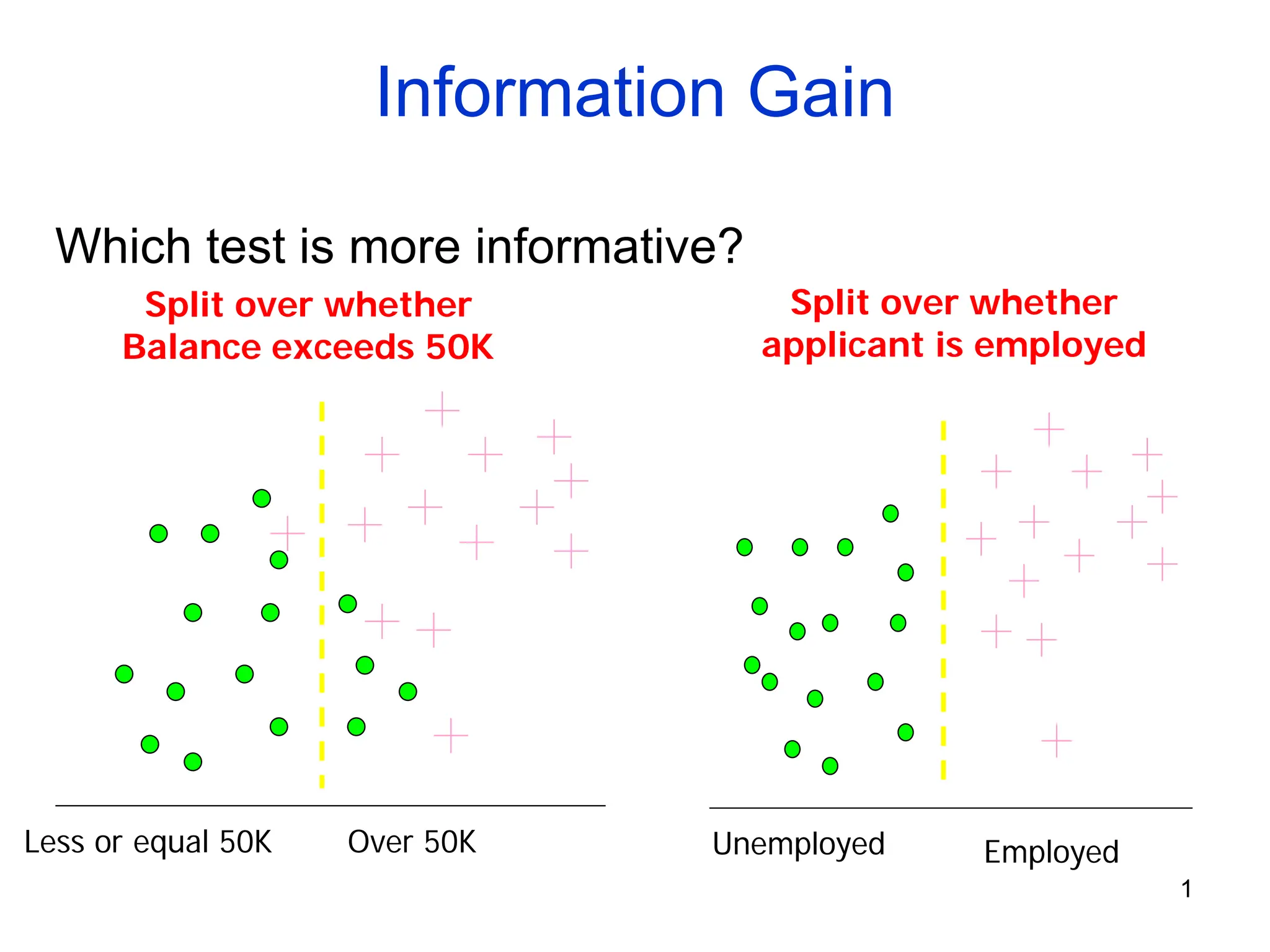
Which test is more informative?
Split over whether
Balance exceeds 50K
Over 50K
Less or equal 50K Employed
Unemployed
Split over whether
applicant is employed
2
Information Gain
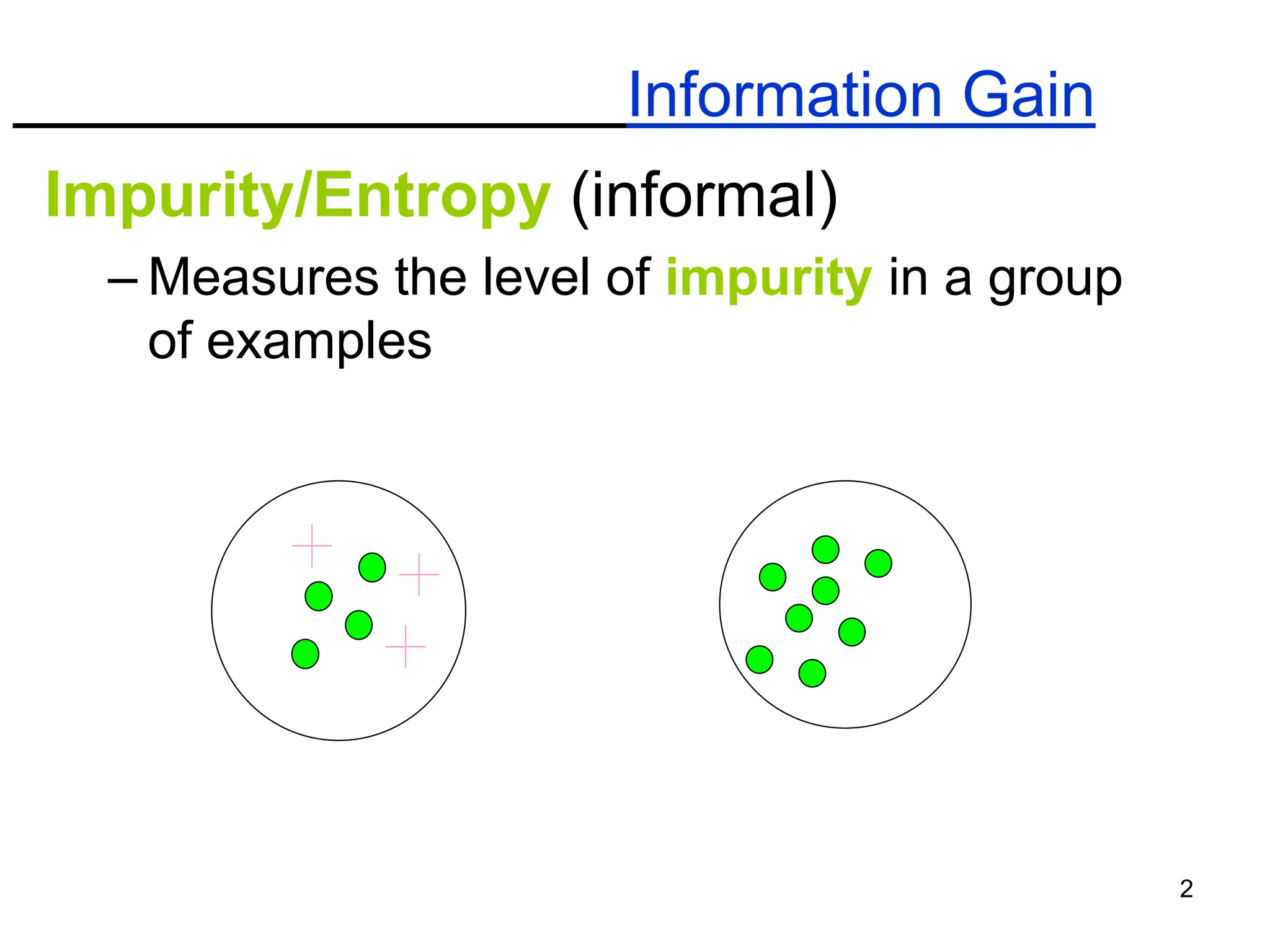
Impurity/Entropy (informal)
– Measures the level of impurity in a group
of examples
3
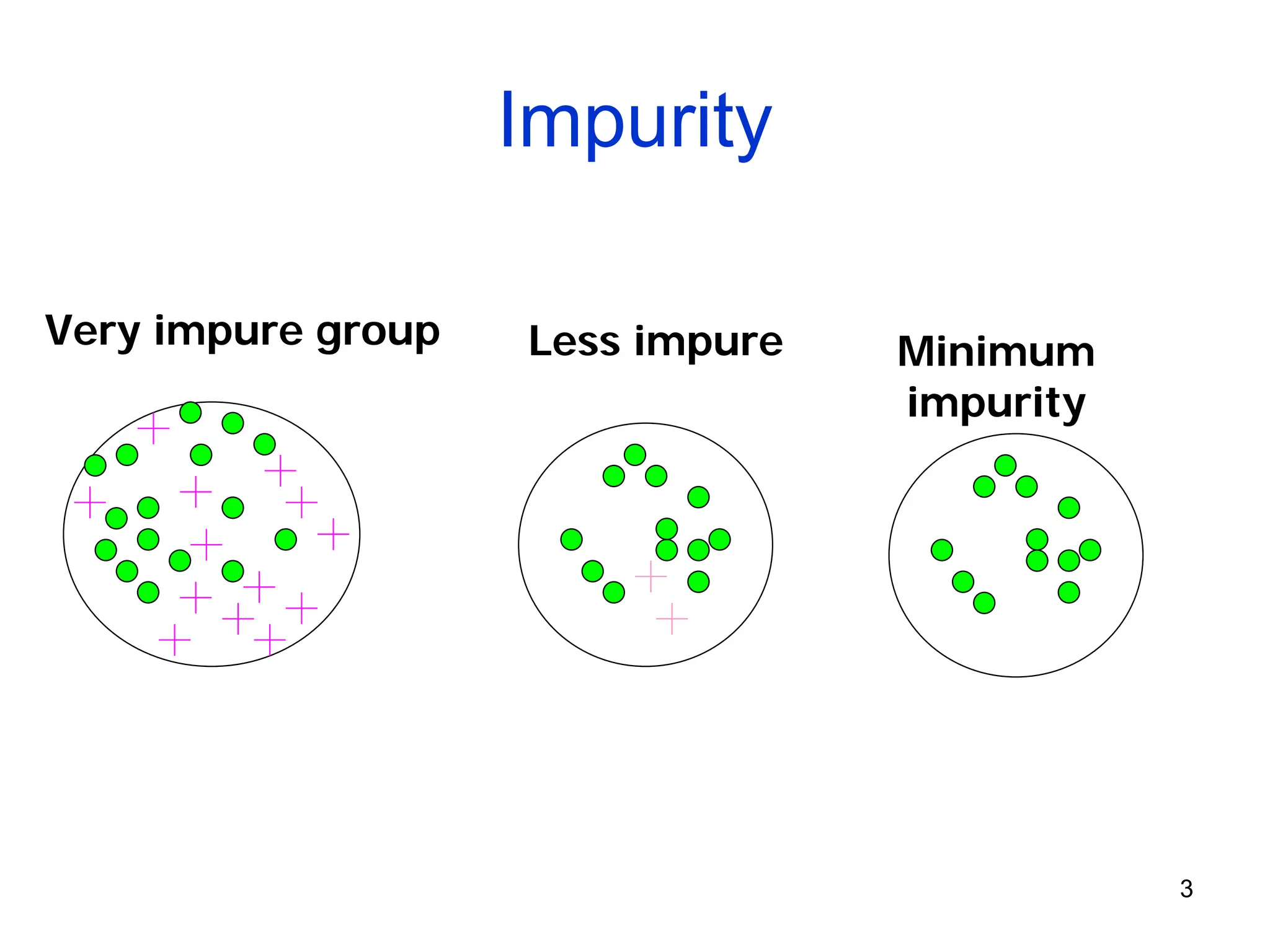
Impurity
Very impure group Less impure Minimum
impurity
4
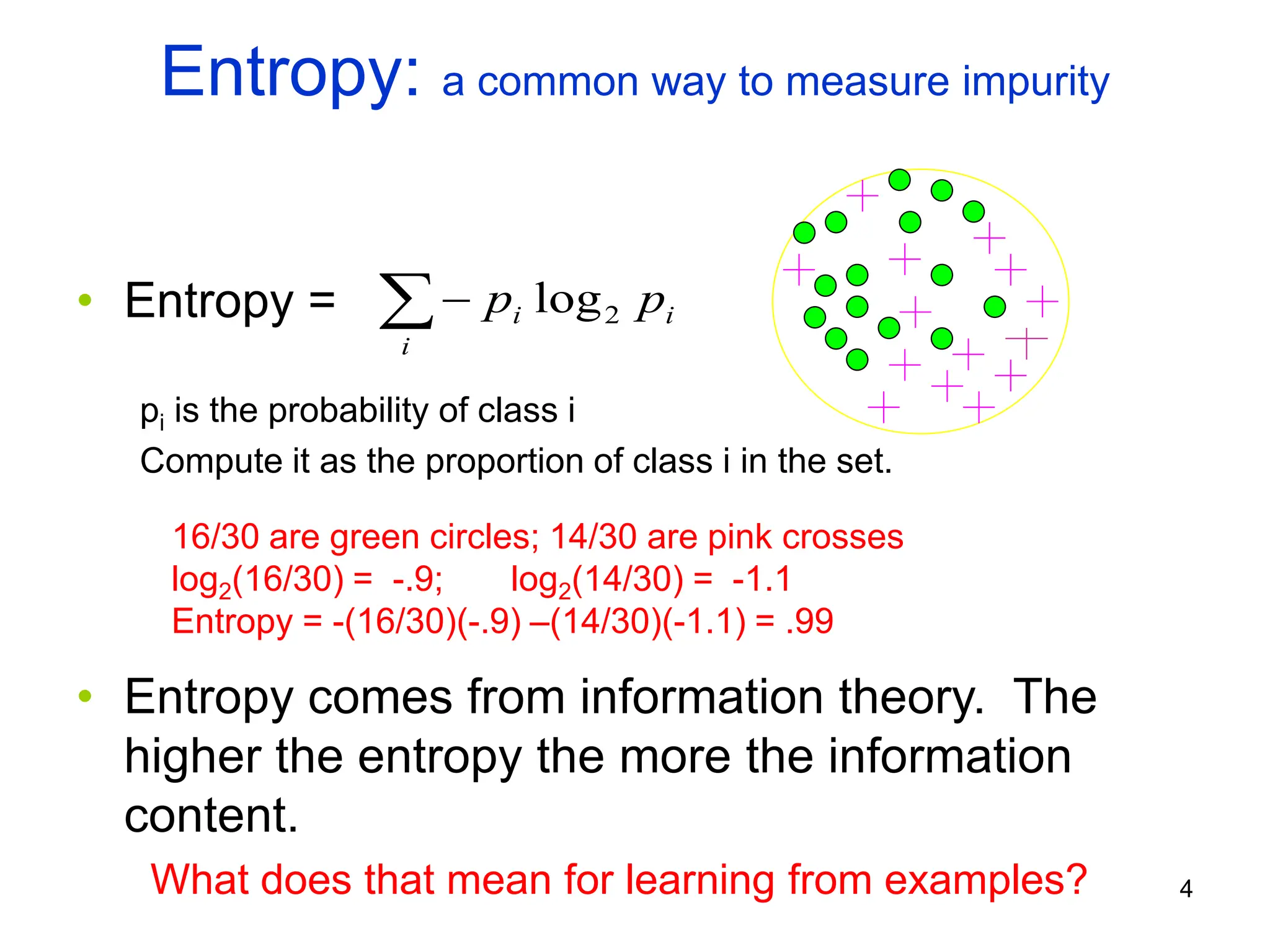
Entropy: a common way to measure impurity
• Entropy =
pi is the probability of class i
Compute it as the proportion of class i in the set.
• Entropy comes from information theory. The
higher the entropy the more the information
content.
∑−
i
i
i p
p 2
log
What does that mean for learning from examples?
16/30 are green circles; 14/30 are pink crosses
log2(16/30) = -.9; log2(14/30) = -1.1
Entropy = -(16/30)(-.9) –(14/30)(-1.1) = .99
5
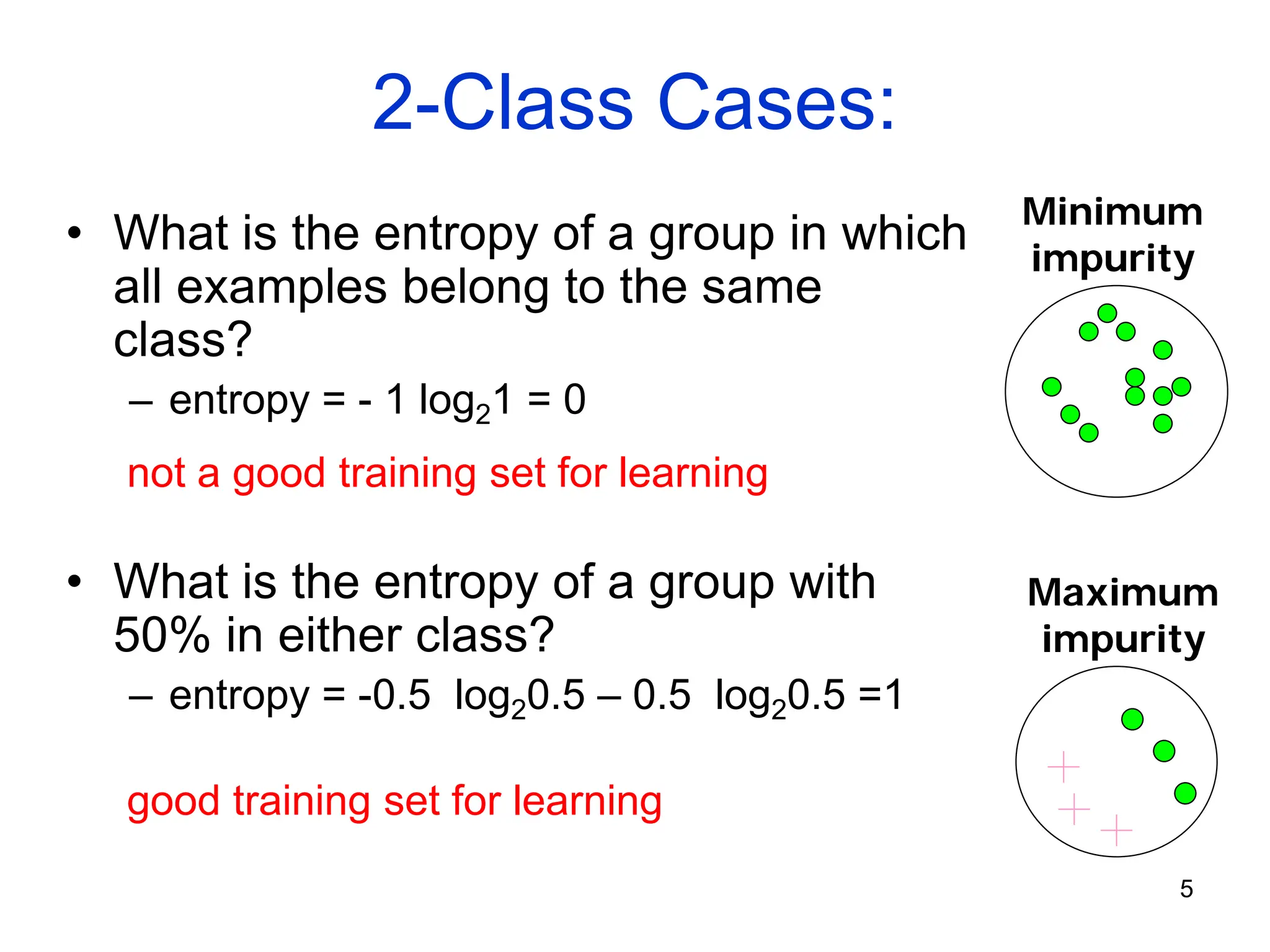
2-Class Cases:
• What is the entropy of a group in which
all examples belong to the same
class?
– entropy = - 1 log21 = 0
• What is the entropy of a group with
50% in either class?
– entropy = -0.5 log20.5 – 0.5 log20.5 =1
Minimum
impurity
Maximum
impurity
not a good training set for learning
good training set for learning
6
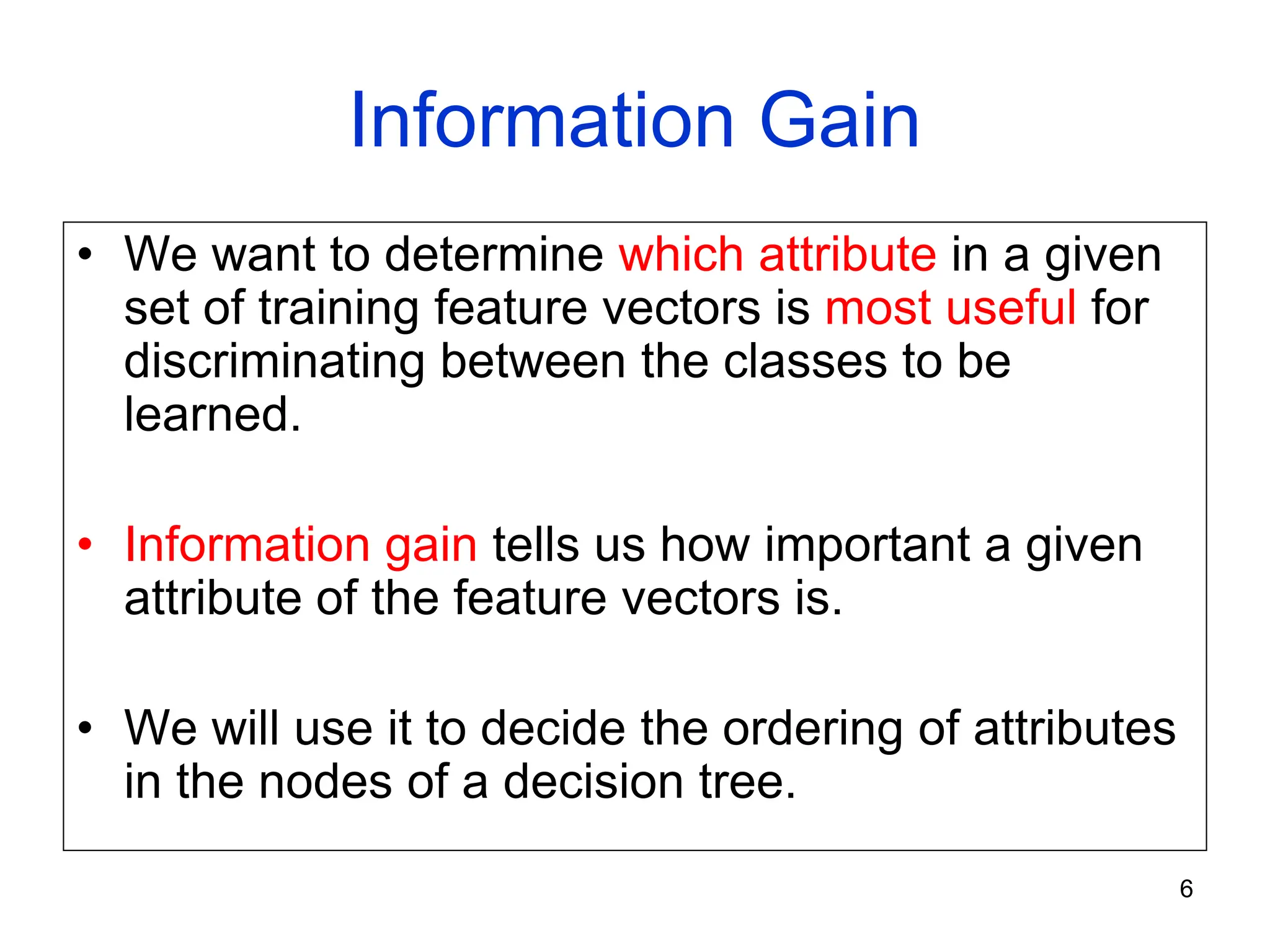
Information Gain
• We want to determine which attribute in a given
set of training feature vectors is most useful for
discriminating between the classes to be
learned.
• Information gain tells us how important a given
attribute of the feature vectors is.
• We will use it to decide the ordering of attributes
in the nodes of a decision tree.
7
Calculating Information Gain
996
.
0
30
16
log
30
16
30
14
log
30
14
2
2 =






⋅
−






⋅
−
787
.
0
17
4
log
17
4
17
13
log
17
13
2
2 =






⋅
−






⋅
−
Entire population (30 instances)
17 instances
13 instances
(Weighted) Average Entropy of Children = 615
.
0
391
.
0
30
13
787
.
0
30
17
=






⋅
+






⋅
Information Gain= 0.996 - 0.615 = 0.38 for this split
391
.
0
13
12
log
13
12
13
1
log
13
1
2
2 =






⋅
−






⋅
−
Information Gain = entropy(parent) – [average entropy(children)]
parent
entropy
child
entropy
child
entropy
8
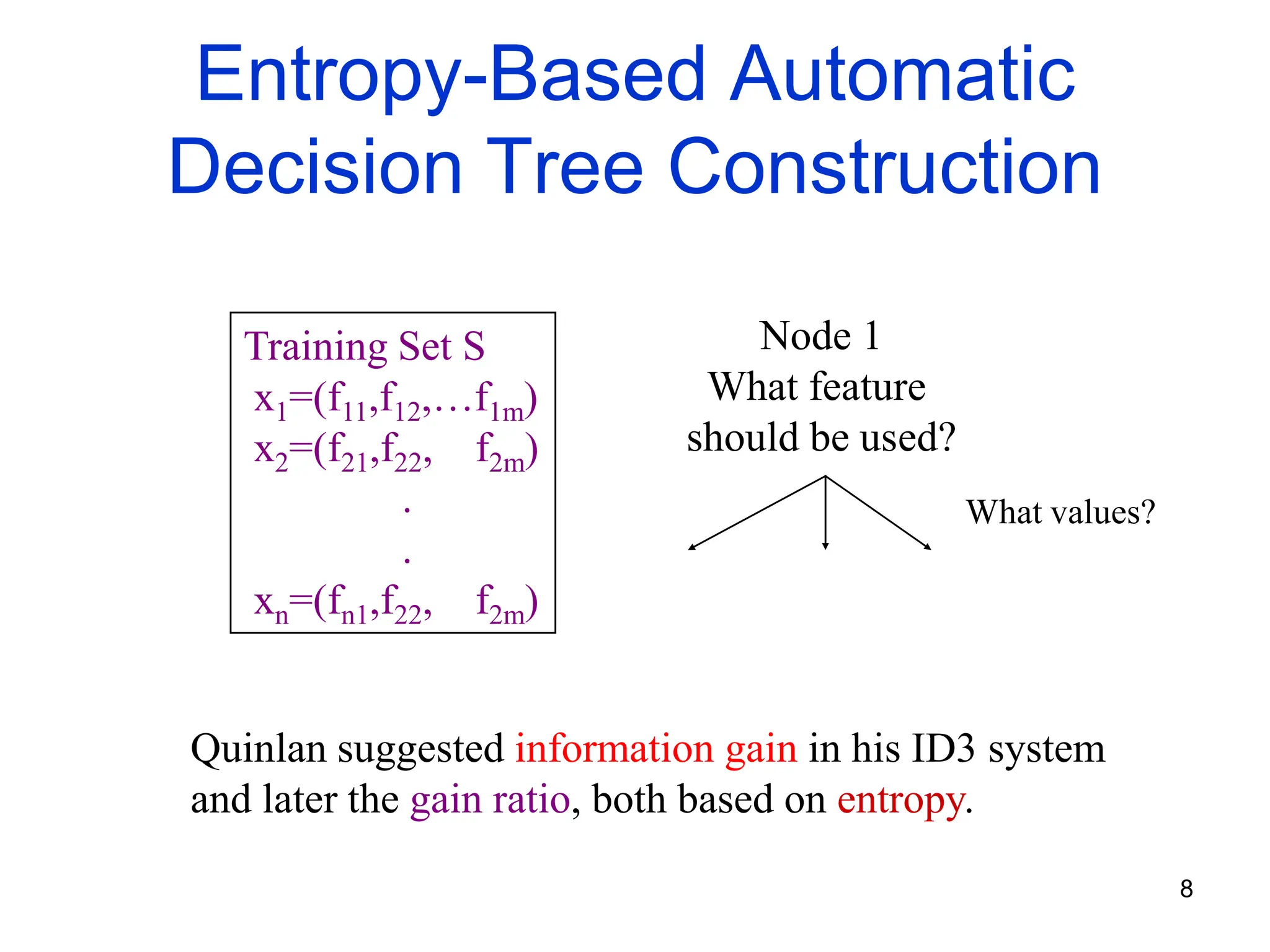
Entropy-Based Automatic
Decision Tree Construction
Node 1
What feature
should be used?
What values?
Training Set S
x1=(f11,f12,…f1m)
x2=(f21,f22, f2m)
.
.
xn=(fn1,f22, f2m)
Quinlan suggested information gain in his ID3 system
and later the gain ratio, both based on entropy.
9
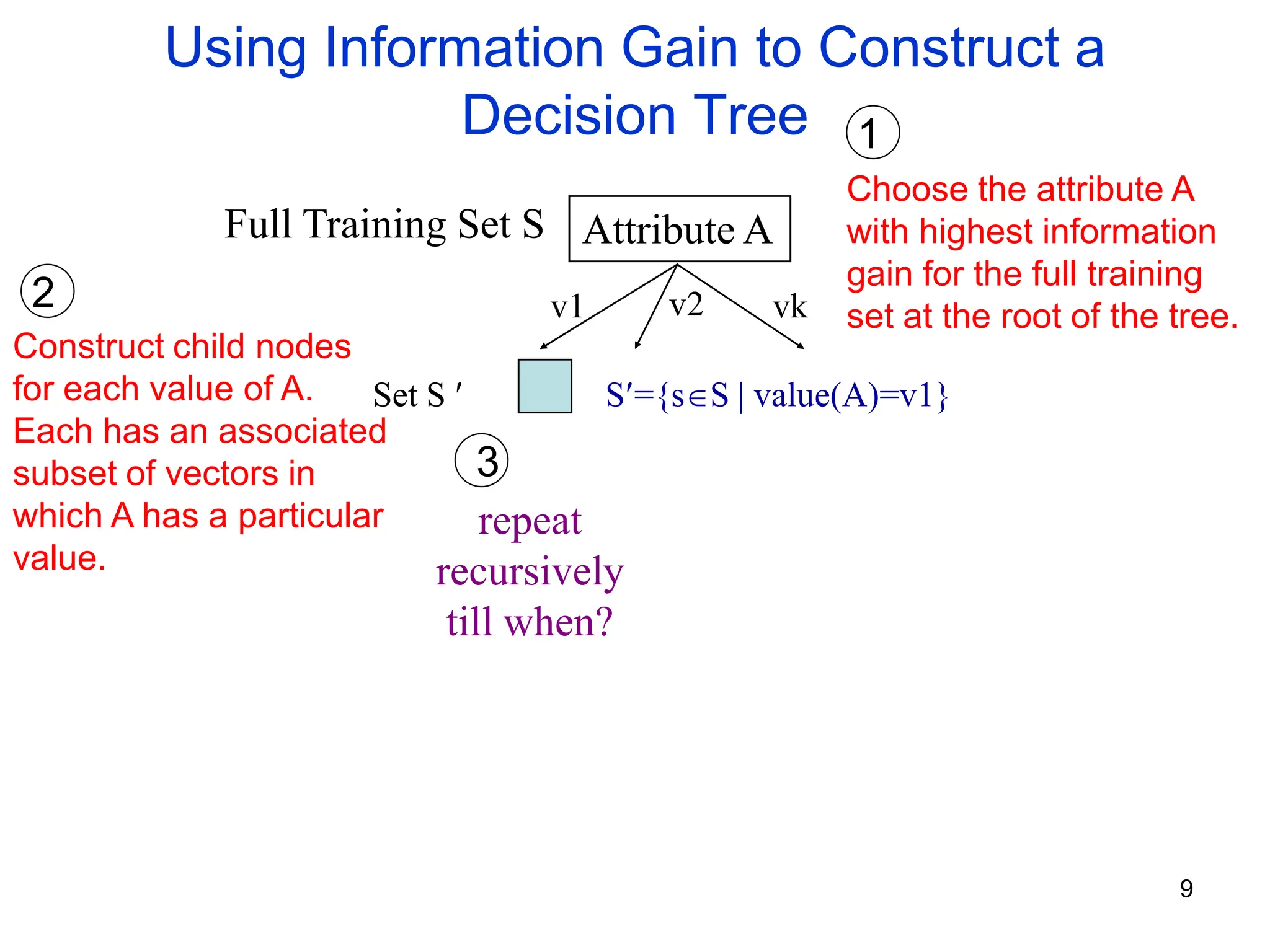
Using Information Gain to Construct a
Decision Tree
Attribute A
v1 vk
v2
Full Training Set S
Set S ′
repeat
recursively
till when?
S′={s∈S | value(A)=v1}
Choose the attribute A
with highest information
gain for the full training
set at the root of the tree.
Construct child nodes
for each value of A.
Each has an associated
subset of vectors in
which A has a particular
value.
1
2
3
10
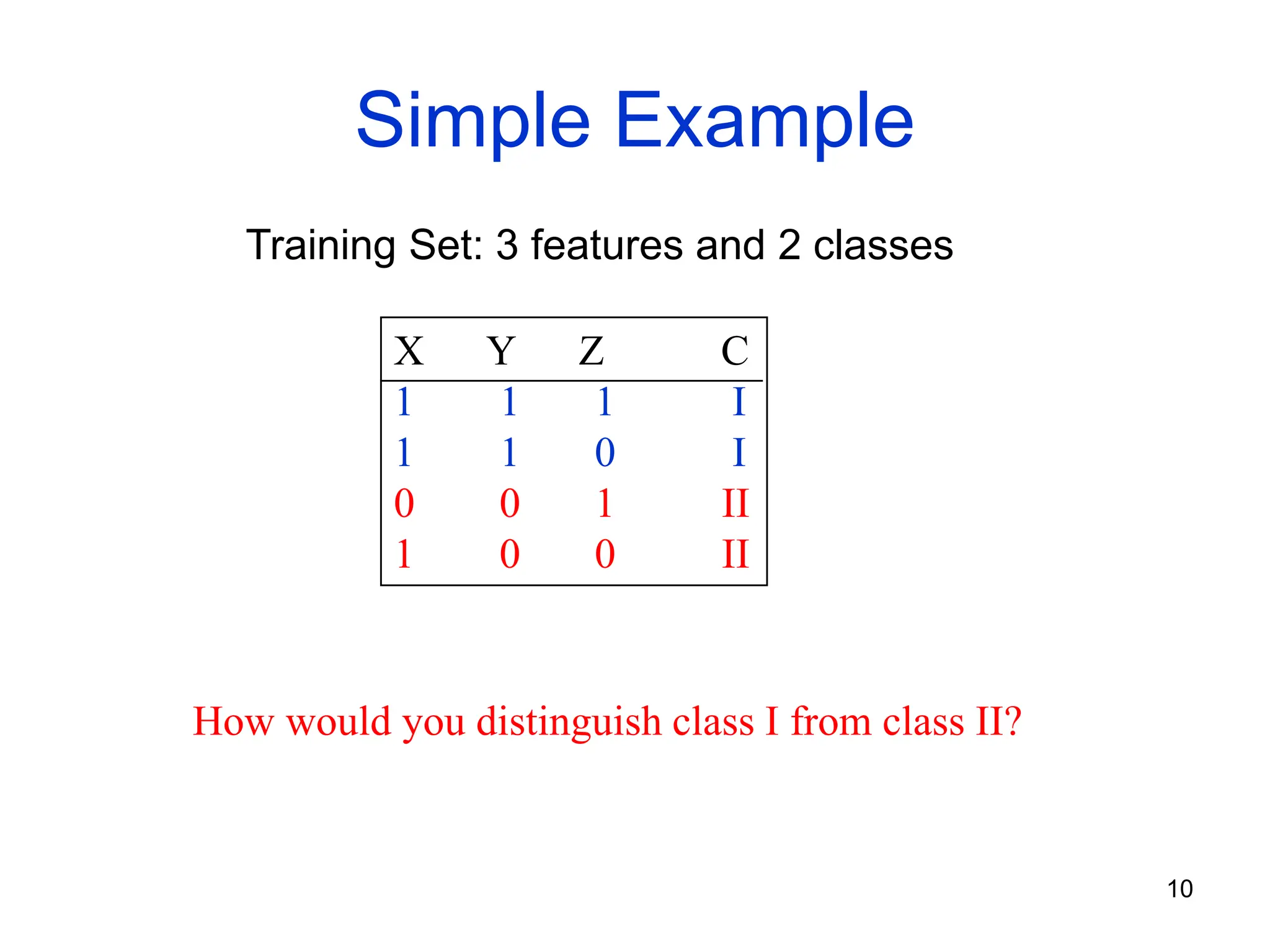
Simple Example
X Y Z C
1 1 1 I
1 1 0 I
0 0 1 II
1 0 0 II
How would you distinguish class I from class II?
Training Set: 3 features and 2 classes
11
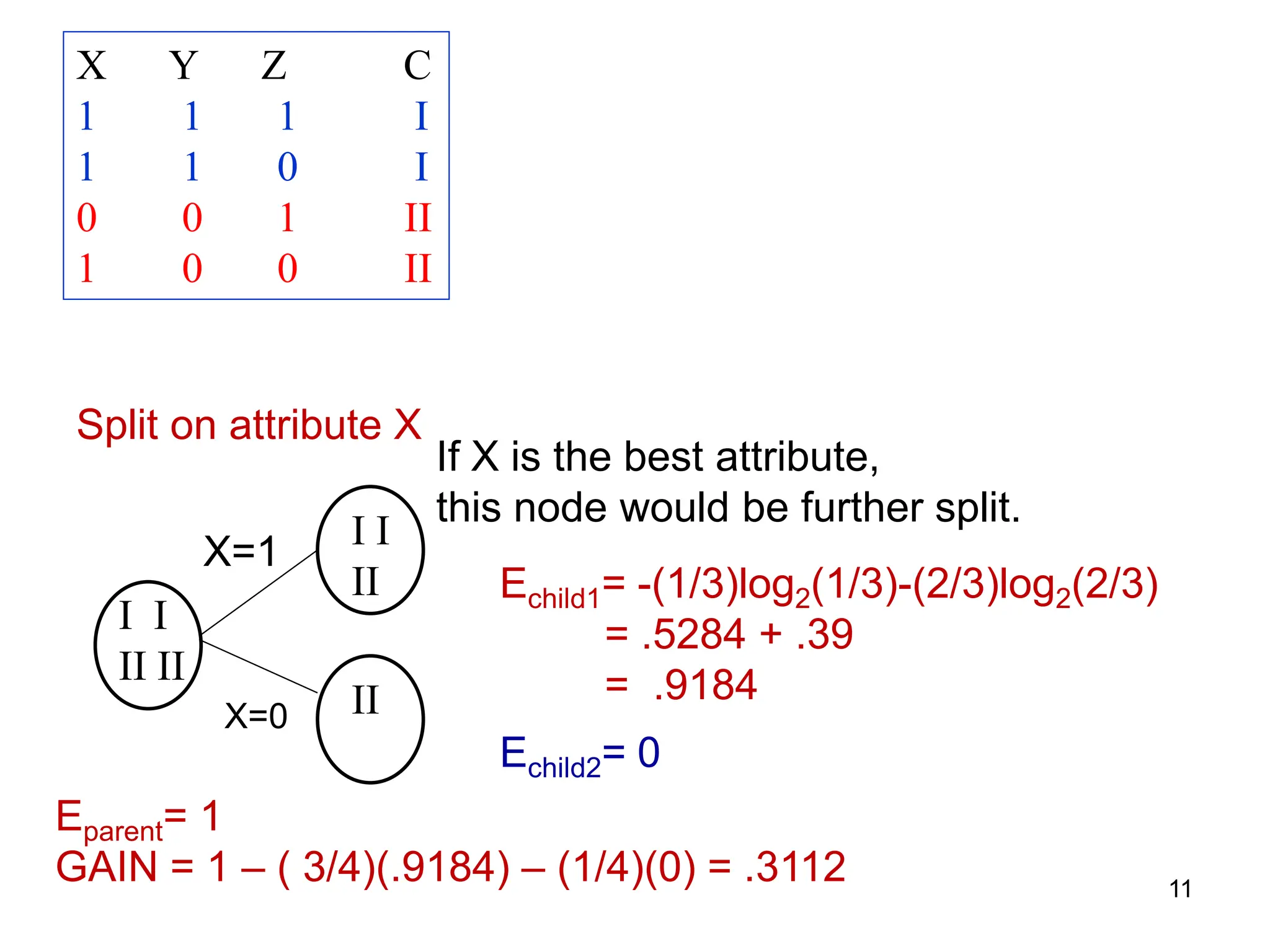
X Y Z C
1 1 1 I
1 1 0 I
0 0 1 II
1 0 0 II
Split on attribute X
I I
II II
I I
II
II
Eparent= 1
GAIN = 1 – ( 3/4)(.9184) – (1/4)(0) = .3112
X=1
X=0
Echild2= 0
Echild1= -(1/3)log2(1/3)-(2/3)log2(2/3)
= .5284 + .39
= .9184
If X is the best attribute,
this node would be further split.
12
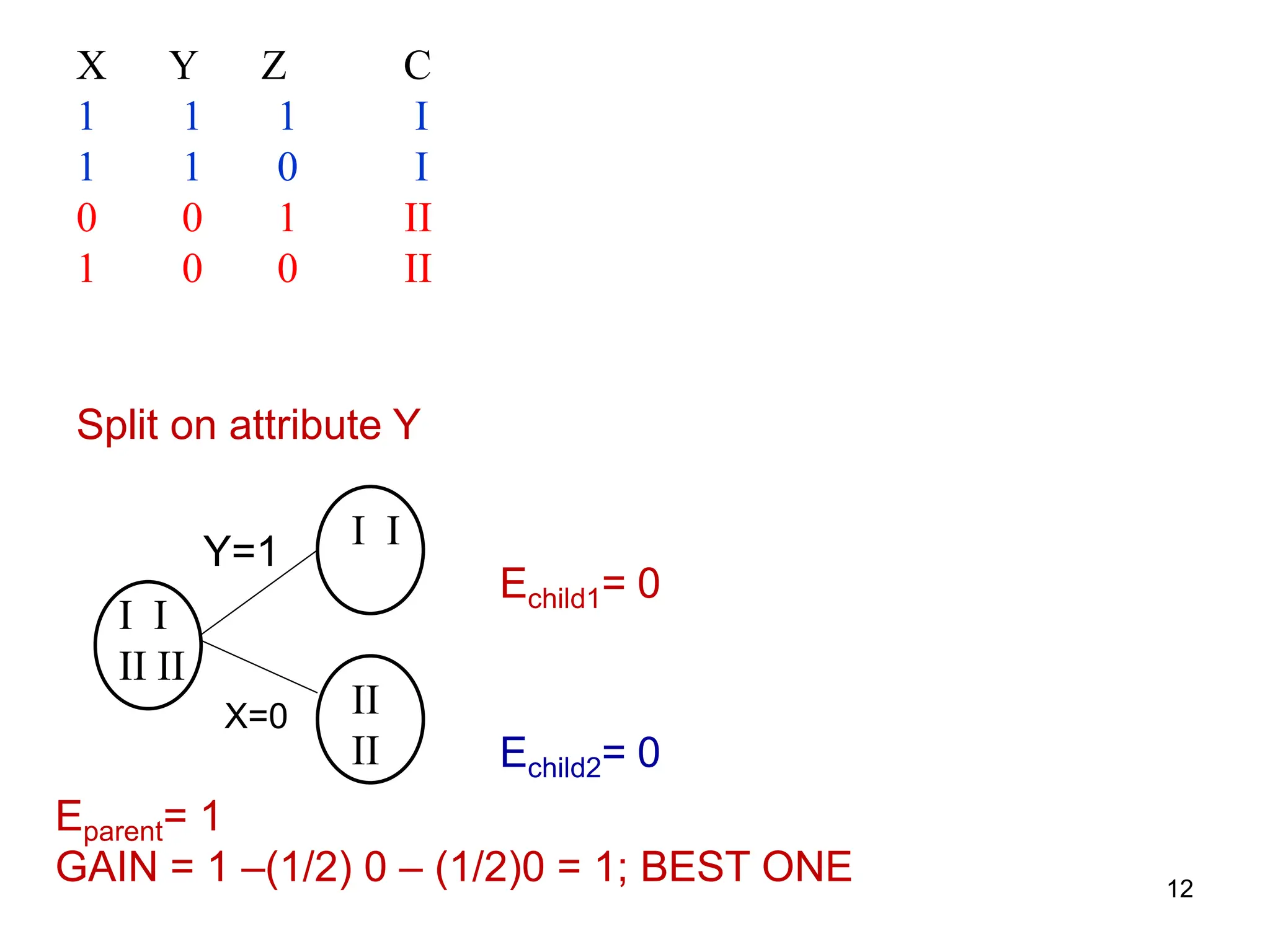
X Y Z C
1 1 1 I
1 1 0 I
0 0 1 II
1 0 0 II
Split on attribute Y
I I
II II
I I
II
II
Eparent= 1
GAIN = 1 –(1/2) 0 – (1/2)0 = 1; BEST ONE
Y=1
X=0
Echild2= 0
Echild1= 0
13
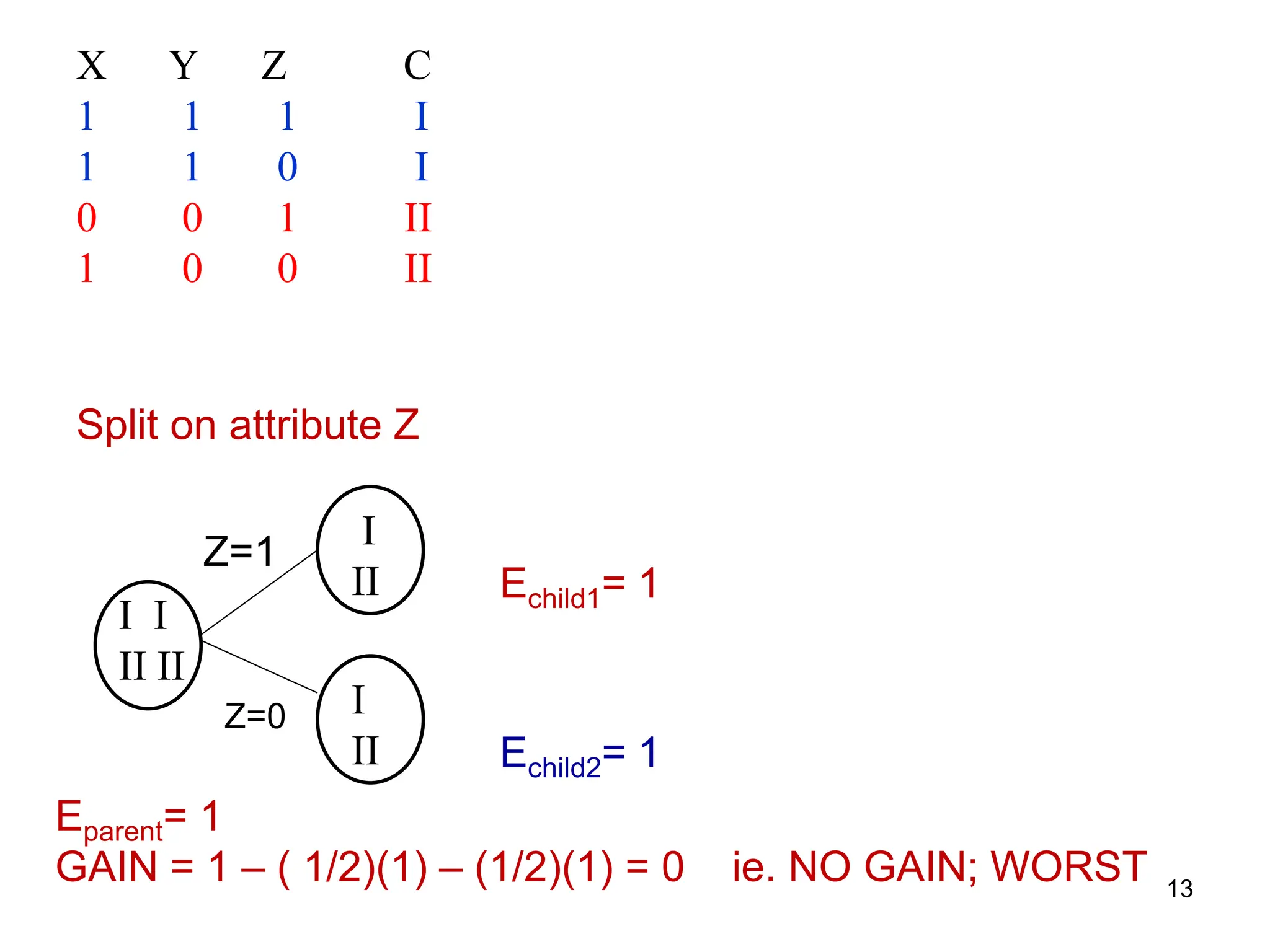
X Y Z C
1 1 1 I
1 1 0 I
0 0 1 II
1 0 0 II
Split on attribute Z
I I
II II
I
II
I
II
Eparent= 1
GAIN = 1 – ( 1/2)(1) – (1/2)(1) = 0 ie. NO GAIN; WORST
Z=1
Z=0
Echild2= 1
Echild1= 1

Machine Learning course Lecture number 5, InfoGain.pdf

  • 1.
    1 Information Gain Which testis more informative? Split over whether Balance exceeds 50K Over 50K Less or equal 50K Employed Unemployed Split over whether applicant is employed
  • 2.
    2 Information Gain Impurity/Entropy (informal) –Measures the level of impurity in a group of examples
  • 3.
    3 Impurity Very impure groupLess impure Minimum impurity
  • 4.
    4 Entropy: a commonway to measure impurity • Entropy = pi is the probability of class i Compute it as the proportion of class i in the set. • Entropy comes from information theory. The higher the entropy the more the information content. ∑− i i i p p 2 log What does that mean for learning from examples? 16/30 are green circles; 14/30 are pink crosses log2(16/30) = -.9; log2(14/30) = -1.1 Entropy = -(16/30)(-.9) –(14/30)(-1.1) = .99
  • 5.
    5 2-Class Cases: • Whatis the entropy of a group in which all examples belong to the same class? – entropy = - 1 log21 = 0 • What is the entropy of a group with 50% in either class? – entropy = -0.5 log20.5 – 0.5 log20.5 =1 Minimum impurity Maximum impurity not a good training set for learning good training set for learning
  • 6.
    6 Information Gain • Wewant to determine which attribute in a given set of training feature vectors is most useful for discriminating between the classes to be learned. • Information gain tells us how important a given attribute of the feature vectors is. • We will use it to decide the ordering of attributes in the nodes of a decision tree.
  • 7.
    7 Calculating Information Gain 996 . 0 30 16 log 30 16 30 14 log 30 14 2 2=       ⋅ −       ⋅ − 787 . 0 17 4 log 17 4 17 13 log 17 13 2 2 =       ⋅ −       ⋅ − Entire population (30 instances) 17 instances 13 instances (Weighted) Average Entropy of Children = 615 . 0 391 . 0 30 13 787 . 0 30 17 =       ⋅ +       ⋅ Information Gain= 0.996 - 0.615 = 0.38 for this split 391 . 0 13 12 log 13 12 13 1 log 13 1 2 2 =       ⋅ −       ⋅ − Information Gain = entropy(parent) – [average entropy(children)] parent entropy child entropy child entropy
  • 8.
    8 Entropy-Based Automatic Decision TreeConstruction Node 1 What feature should be used? What values? Training Set S x1=(f11,f12,…f1m) x2=(f21,f22, f2m) . . xn=(fn1,f22, f2m) Quinlan suggested information gain in his ID3 system and later the gain ratio, both based on entropy.
  • 9.
    9 Using Information Gainto Construct a Decision Tree Attribute A v1 vk v2 Full Training Set S Set S ′ repeat recursively till when? S′={s∈S | value(A)=v1} Choose the attribute A with highest information gain for the full training set at the root of the tree. Construct child nodes for each value of A. Each has an associated subset of vectors in which A has a particular value. 1 2 3
  • 10.
    10 Simple Example X YZ C 1 1 1 I 1 1 0 I 0 0 1 II 1 0 0 II How would you distinguish class I from class II? Training Set: 3 features and 2 classes
  • 11.
    11 X Y ZC 1 1 1 I 1 1 0 I 0 0 1 II 1 0 0 II Split on attribute X I I II II I I II II Eparent= 1 GAIN = 1 – ( 3/4)(.9184) – (1/4)(0) = .3112 X=1 X=0 Echild2= 0 Echild1= -(1/3)log2(1/3)-(2/3)log2(2/3) = .5284 + .39 = .9184 If X is the best attribute, this node would be further split.
  • 12.
    12 X Y ZC 1 1 1 I 1 1 0 I 0 0 1 II 1 0 0 II Split on attribute Y I I II II I I II II Eparent= 1 GAIN = 1 –(1/2) 0 – (1/2)0 = 1; BEST ONE Y=1 X=0 Echild2= 0 Echild1= 0
  • 13.
    13 X Y ZC 1 1 1 I 1 1 0 I 0 0 1 II 1 0 0 II Split on attribute Z I I II II I II I II Eparent= 1 GAIN = 1 – ( 1/2)(1) – (1/2)(1) = 0 ie. NO GAIN; WORST Z=1 Z=0 Echild2= 1 Echild1= 1