Swedish College of Engineering & Technology
Lab Incharge : Engr.Shah Nawaz
Department : Mechanical
Semester : 3rd
Topic : 2 Stroke Petrol Engine
Subject Name : Thermodynamics-2
Active Learning assignment
Prepared by:
Name
 Shahzaib Akhtar
 Hassan Abbas Niazi
 Abdullah Saddiq
Enrollment no.
 14F-UET-ME-013
 14F-UET-ME-014
 14F-UET-ME-012
Presentation Topic-
Two Stroke Engine
Stroke
 Reciprocating motion used in reciprocating engines and other mechanisms is back
and fourth motion .Each cycle of reciprocation consists of two opposite motions ,
there is a motion in one direction and then a motion back in the opposite direction .
Each of this motion is called stroke.
2 stroke
A two-stroke petrol engine is an internal combustion engine that completes the
process cycle in one revolution of the crankshaft . Thus one power stroke is obtained
in each revolution of the crank shaft.
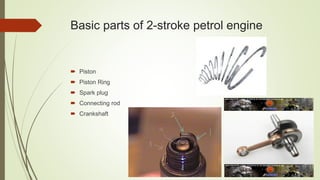
Basic parts of 2-stroke petrol engine
 Piston
 Piston Ring
 Spark plug
 Connecting rod
 Crankshaft
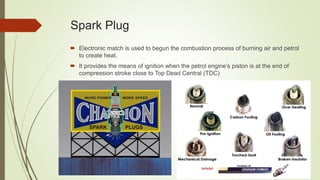
Spark Plug
 Electronic match is used to begun the combustion process of burning air and petrol
to create heat.
 It provides the means of ignition when the petrol engine’s piston is at the end of
compression stroke close to Top Dead Central (TDC)
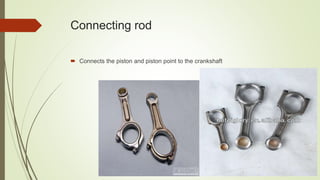
Connecting rod
 Connects the piston and piston point to the crankshaft
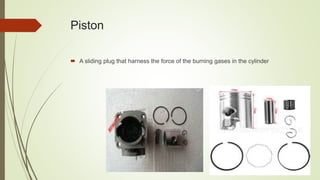
Piston
 A sliding plug that harness the force of the burning gases in the cylinder
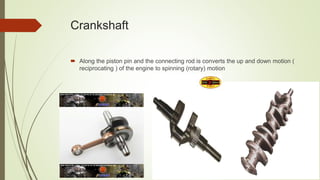
Crankshaft
 Along the piston pin and the connecting rod is converts the up and down motion (
reciprocating ) of the engine to spinning (rotary) motion
Working & parts of 2-Stroke
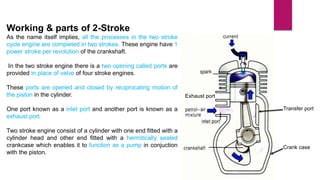
As the name itself implies, all the processes in the two stroke
cycle engine are completed in two strokes. These engine have 1
power stroke per revolution of the crankshaft.
In the two stroke engine there is a two opening called ports are
provided in place of valve of four stroke engines.
These ports are opened and closed by reciprocating motion of
the piston in the cylinder.
One port known as a inlet port and another port is known as a
exhaust port.
Two stroke engine consist of a cylinder with one end fitted with a
cylinder head and other end fitted with a hermitically sealed
crankcase which enables it to function as a pump in conjuction
with the piston.
Transfer port
Crank case
Exhaust port
Working Principle of 2 stroke
 Here suction and exhaust strokes are eliminated . Instead of valves , ports are used.
 The exhaust gases are driven out of the cylinder by the fresh fuel entering the cylinder.
 The intake & exhaust are controlled by movement of piston.
 The fresh fuel enter to cylinder due to difference of pressure.
 The fuel is compressed by the pumping action of the piston due to the design of
crankcase.
 As the piston continues to move upward , exhaust and transfer port get closed and the
compression is continued.
 In the end of the compression the spark is created which ignites the fuel & in result of
combustion thrust the piston moves from TDC to BDC.
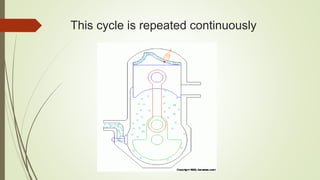
This cycle is repeated continuously
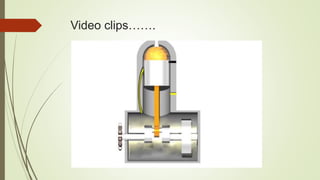
Video clips…….
Advantages
 The power developed will be nearly twice that of four stroke engine of same
dimension and operating at the same speed
 The work required to overcome the friction of the exhaust and suction strokes is
saved
 Low weight
 Construction is simple
 Low thermal efficiency.
 Can run at higher speeds (5000 rpm)
 Low maintenance cost
Disadvantages
 As working on otto-cycle , a part of the fresh mixture is lost through exhaust port
 Part of the piston stroke is lost
 Heavy consumption of lubricating oil
 Two-stroke engines are not fuel efficient, so we would get fewer miles per gallon.
Use of 2-stroke engine
 Dirt Bike
 Lawn mowers
 Outboard engines
 Chain saws
 Line Trimmers
 Jet Skis
 Snowmobiles
 Model Air Planes
 Light Motorcycles
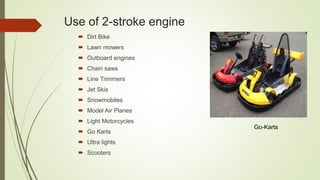
 Go Karts
 Ultra lights
 Scooters
Go-Karts
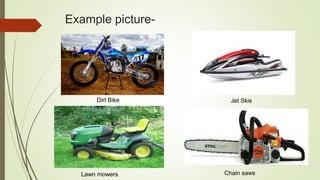
Example picture-
Dirt Bike Jet Skis
Chain sawsLawn mowers
2 stroke petrol engine!

2 stroke petrol engine!

  • 2.
    Swedish College ofEngineering & Technology Lab Incharge : Engr.Shah Nawaz Department : Mechanical Semester : 3rd Topic : 2 Stroke Petrol Engine Subject Name : Thermodynamics-2 Active Learning assignment
  • 3.
    Prepared by: Name  ShahzaibAkhtar  Hassan Abbas Niazi  Abdullah Saddiq Enrollment no.  14F-UET-ME-013  14F-UET-ME-014  14F-UET-ME-012
  • 5.
  • 6.
    Stroke  Reciprocating motionused in reciprocating engines and other mechanisms is back and fourth motion .Each cycle of reciprocation consists of two opposite motions , there is a motion in one direction and then a motion back in the opposite direction . Each of this motion is called stroke.
  • 7.
    2 stroke A two-strokepetrol engine is an internal combustion engine that completes the process cycle in one revolution of the crankshaft . Thus one power stroke is obtained in each revolution of the crank shaft.
  • 8.
    Basic parts of2-stroke petrol engine  Piston  Piston Ring  Spark plug  Connecting rod  Crankshaft
  • 9.
    Spark Plug  Electronicmatch is used to begun the combustion process of burning air and petrol to create heat.  It provides the means of ignition when the petrol engine’s piston is at the end of compression stroke close to Top Dead Central (TDC)
  • 10.
    Connecting rod  Connectsthe piston and piston point to the crankshaft
  • 11.
    Piston  A slidingplug that harness the force of the burning gases in the cylinder
  • 12.
    Crankshaft  Along thepiston pin and the connecting rod is converts the up and down motion ( reciprocating ) of the engine to spinning (rotary) motion
  • 13.
    Working & partsof 2-Stroke As the name itself implies, all the processes in the two stroke cycle engine are completed in two strokes. These engine have 1 power stroke per revolution of the crankshaft. In the two stroke engine there is a two opening called ports are provided in place of valve of four stroke engines. These ports are opened and closed by reciprocating motion of the piston in the cylinder. One port known as a inlet port and another port is known as a exhaust port. Two stroke engine consist of a cylinder with one end fitted with a cylinder head and other end fitted with a hermitically sealed crankcase which enables it to function as a pump in conjuction with the piston. Transfer port Crank case Exhaust port
  • 14.
    Working Principle of2 stroke  Here suction and exhaust strokes are eliminated . Instead of valves , ports are used.  The exhaust gases are driven out of the cylinder by the fresh fuel entering the cylinder.  The intake & exhaust are controlled by movement of piston.  The fresh fuel enter to cylinder due to difference of pressure.  The fuel is compressed by the pumping action of the piston due to the design of crankcase.  As the piston continues to move upward , exhaust and transfer port get closed and the compression is continued.  In the end of the compression the spark is created which ignites the fuel & in result of combustion thrust the piston moves from TDC to BDC.
  • 15.
    This cycle isrepeated continuously
  • 16.
  • 17.
    Advantages  The powerdeveloped will be nearly twice that of four stroke engine of same dimension and operating at the same speed  The work required to overcome the friction of the exhaust and suction strokes is saved  Low weight  Construction is simple  Low thermal efficiency.  Can run at higher speeds (5000 rpm)  Low maintenance cost
  • 18.
    Disadvantages  As workingon otto-cycle , a part of the fresh mixture is lost through exhaust port  Part of the piston stroke is lost  Heavy consumption of lubricating oil  Two-stroke engines are not fuel efficient, so we would get fewer miles per gallon.
  • 19.
    Use of 2-strokeengine  Dirt Bike  Lawn mowers  Outboard engines  Chain saws  Line Trimmers  Jet Skis  Snowmobiles  Model Air Planes  Light Motorcycles  Go Karts  Ultra lights  Scooters Go-Karts
  • 20.
    Example picture- Dirt BikeJet Skis Chain sawsLawn mowers